brake NISSAN PULSAR 1987 Repair Manual
[x] Cancel search | Manufacturer: NISSAN, Model Year: 1987, Model line: PULSAR, Model: NISSAN PULSAR 1987Pages: 238, PDF Size: 28.91 MB
Page 188 of 238
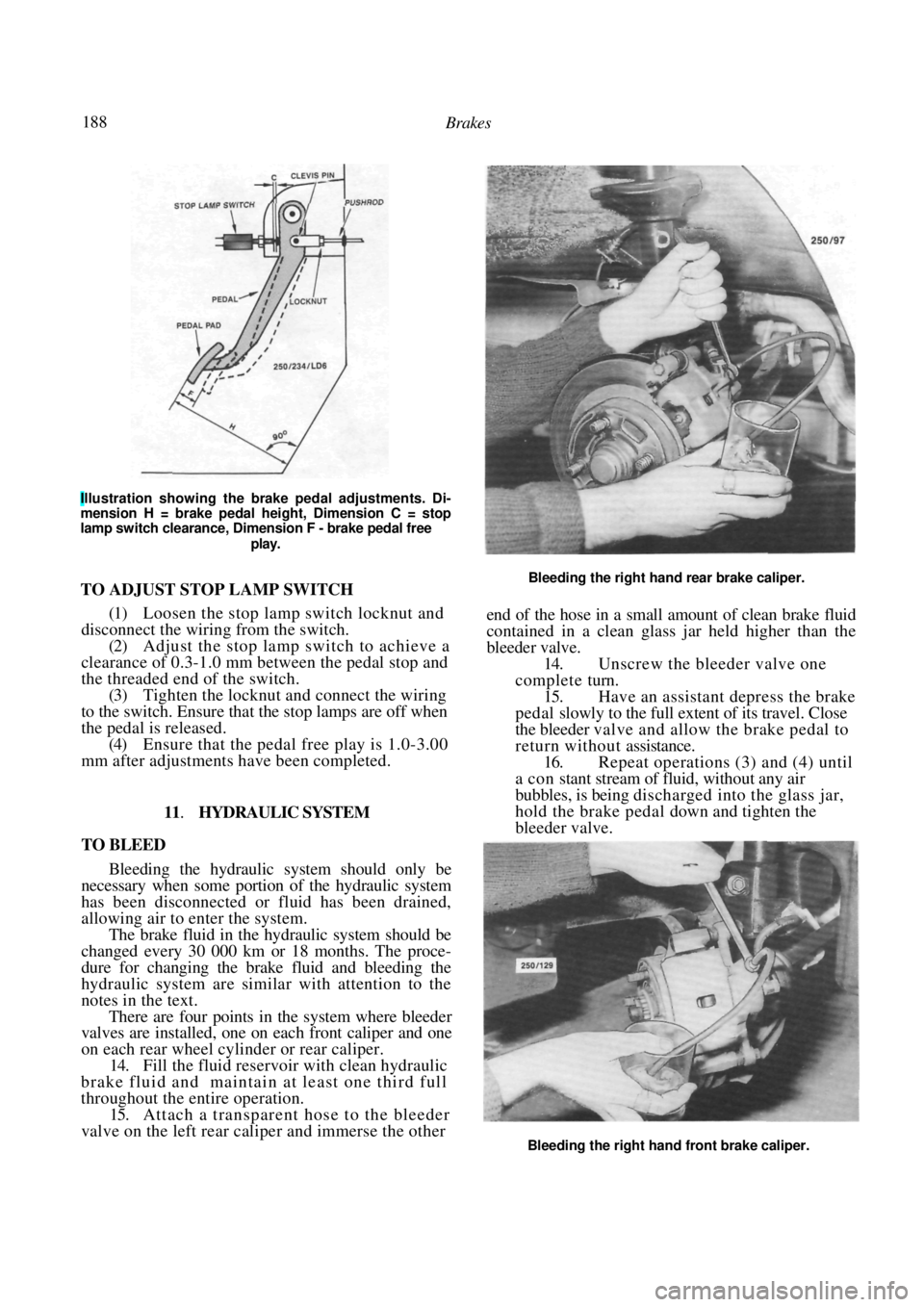
188 Brakes
Illustration showing the brake pedal adjustments. Di-
mension H = brake pedal height, Dimension C = stop
lamp switch clearance, Dimension F - brake pedal free
play.
TO ADJUST STOP LAMP SWITCH
(1) Loosen the stop lamp switch locknut and
disconnect the wiring from the switch.
(2) Adjust the stop lamp switch to achieve a
clearance of 0.3-1.0 mm between the pedal stop and
the threaded end of the switch. (3) Tighten the locknut and connect the wiring
to the switch. Ensure that the stop lamps are off when
the pedal is released.
(4) Ensure that the pedal free play is 1.0-3.00
mm after adjustments have been completed.
11. HYDRAULIC SYSTEM
TO BLEED
Bleeding the hydraulic system should only be
necessary when some portion of the hydraulic system
has been disconnected or fluid has been drained,
allowing air to enter the system.
The brake fluid in the hydraulic system should be
changed every 30 000 km or 18 months. The proce-
dure for changing the brake fluid and bleeding the
hydraulic system are simila r with attention to the
notes in the text.
There are four points in the system where bleeder
valves are installed, one on each front caliper and one
on each rear wheel cylinder or rear caliper.
14. Fill the fluid reservoir with clean hydraulic
brake fluid and maintain at least one third full
throughout the entire operation. 15. Attach a transparent hose to the bleeder
valve on the left rear cali per and immerse the other
Bleeding the right hand rear brake caliper.
end of the hose in a small amount of clean brake fluid
contained in a clean glass jar held higher than the
bleeder valve.
14. Unscrew the bleeder valve one
complete turn.
15. Have an assistant depress the brake
pedal slowly to the full extent of its travel. Close
the bleeder valve and allow the brake pedal to
r e t u r n w i t h o u t assistance. 16. Repeat operations (3) and (4) until
a con stant stream of fluid, without any air
bubbles, is being discharged into the gl ass jar,
hold the brake pedal down and tighten the
bleeder valve.
Bleeding the right hand front brake caliper.
Page 189 of 238

Brakes 189
NOTE: If changing the brake fluid, continue to be made. Always use new brake fluid for
bleeding the system until clean new fluid t opping up the reservoir.
flows from the bleeder hose. (6) Carry out the operation on the right front,
Do not allow the fluid level in the reser- right rear, right rear and left front brake in that order.
voir to fall below the one third full level at (7) Replenish the reservoir with the specified
any time during the operation or air will brake fluid to the indicated level and install the
enter the system and a fresh start will have reservoir cap.
Page 208 of 238
208 Electrical System
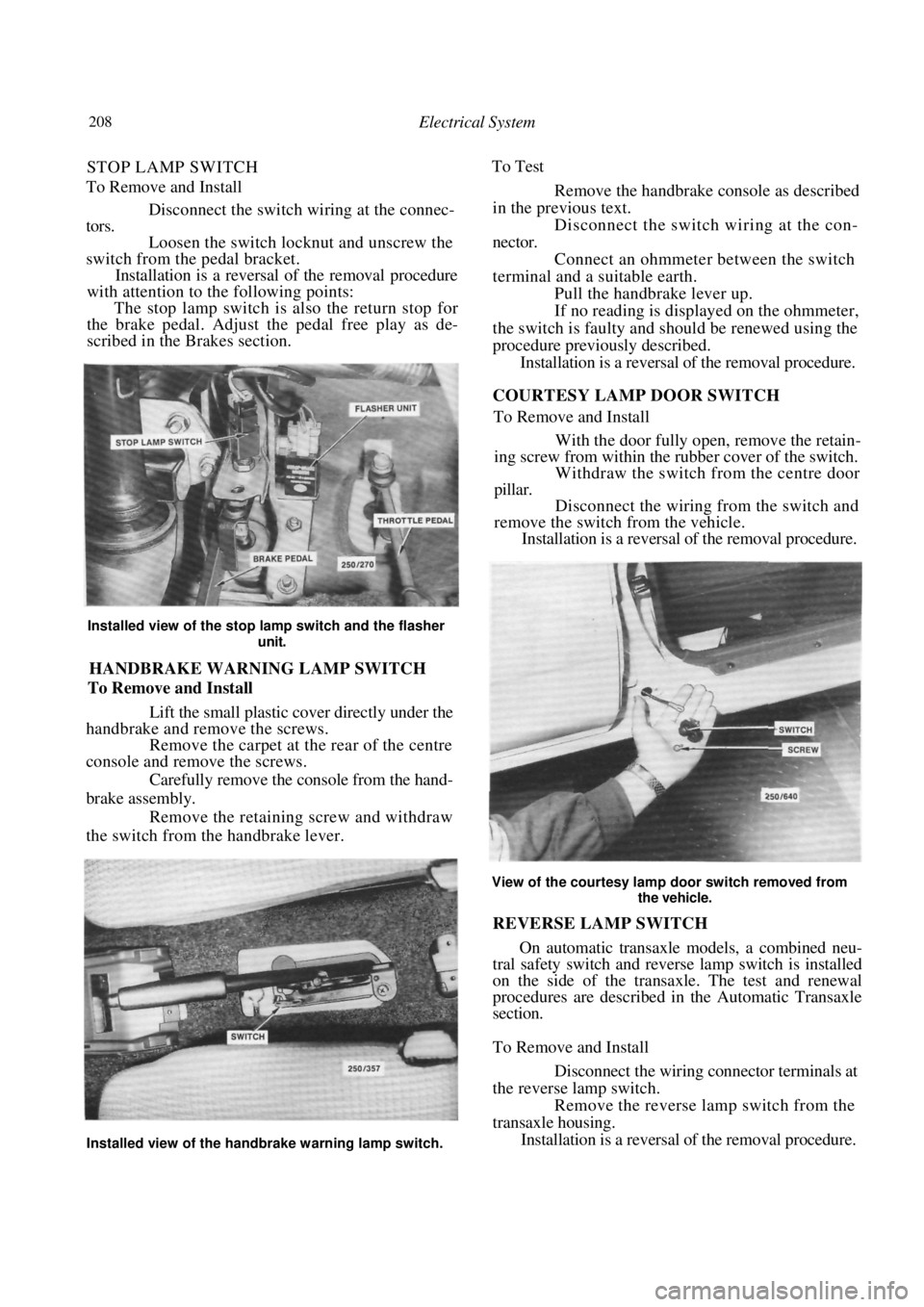
STOP LAMP SWITCH
To Remove and Install
Disconnect the switch wi ring at the connec-
tors.
Loosen the switch locknut and unscrew the
switch from the pedal bracket.
Installation is a reversal of the removal procedure
with attention to the following points:
The stop lamp switch is also the return stop for
the brake pedal. Adjust the pedal free play as de-
scribed in the Brakes section.
Installed view of the stop lamp switch and the flasher
unit.
HANDBRAKE WARNING LAMP SWITCH
To Remove and Install
Lift the small plastic cover directly under the
handbrake and remove the screws.
Remove the carpet at the rear of the centre
console and remove the screws.
Carefully remove the console from the hand-
brake assembly. Remove the retaining screw and withdraw
the switch from the handbrake lever. To Test
Remove the handbrake console as described
in the previous text.
Disconnect the switch wiring at the con-
nector. Connect an ohmmeter between the switch
terminal and a suitable earth. Pull the handbrake lever up.
If no reading is displayed on the ohmmeter,
the switch is faulty and should be renewed using the
procedure previously described. Installation is a reversal of the removal procedure.
COURTESY LAMP DOOR SWITCH
To Remove and Install
With the door fully open, remove the retain-
ing screw from within the rubber cover of the switch. Withdraw the switch from the centre door
pillar.
Disconnect the wiring from the switch and
remove the switch from the vehicle. Installation is a reversal of the removal procedure.
View of the courtesy lamp door switch removed from
the vehicle.
REVERSE LAMP SWITCH
On automatic transaxle models, a combined neu-
tral safety switch and reverse lamp switch is installed
on the side of the transaxle. The test and renewal
procedures are described in the Automatic Transaxle
section.
To Remove and Install
Disconnect the wiring connector terminals at
the reverse lamp switch. Remove the reverse lamp switch from the
transaxle housing. Installation is a reversal of the removal procedure.
Installed view of the handbrake warning lamp switch.
Page 216 of 238
216 Electrical System
NOTE: While checking the operation of the
fusible link, loosely connect the battery-
terminal only, to safeguard against damage
to the wiring harness.
(5) If the circuit is still inoperative or the fusible
link burns out again, refer the problem to an auto-
motive electrician.
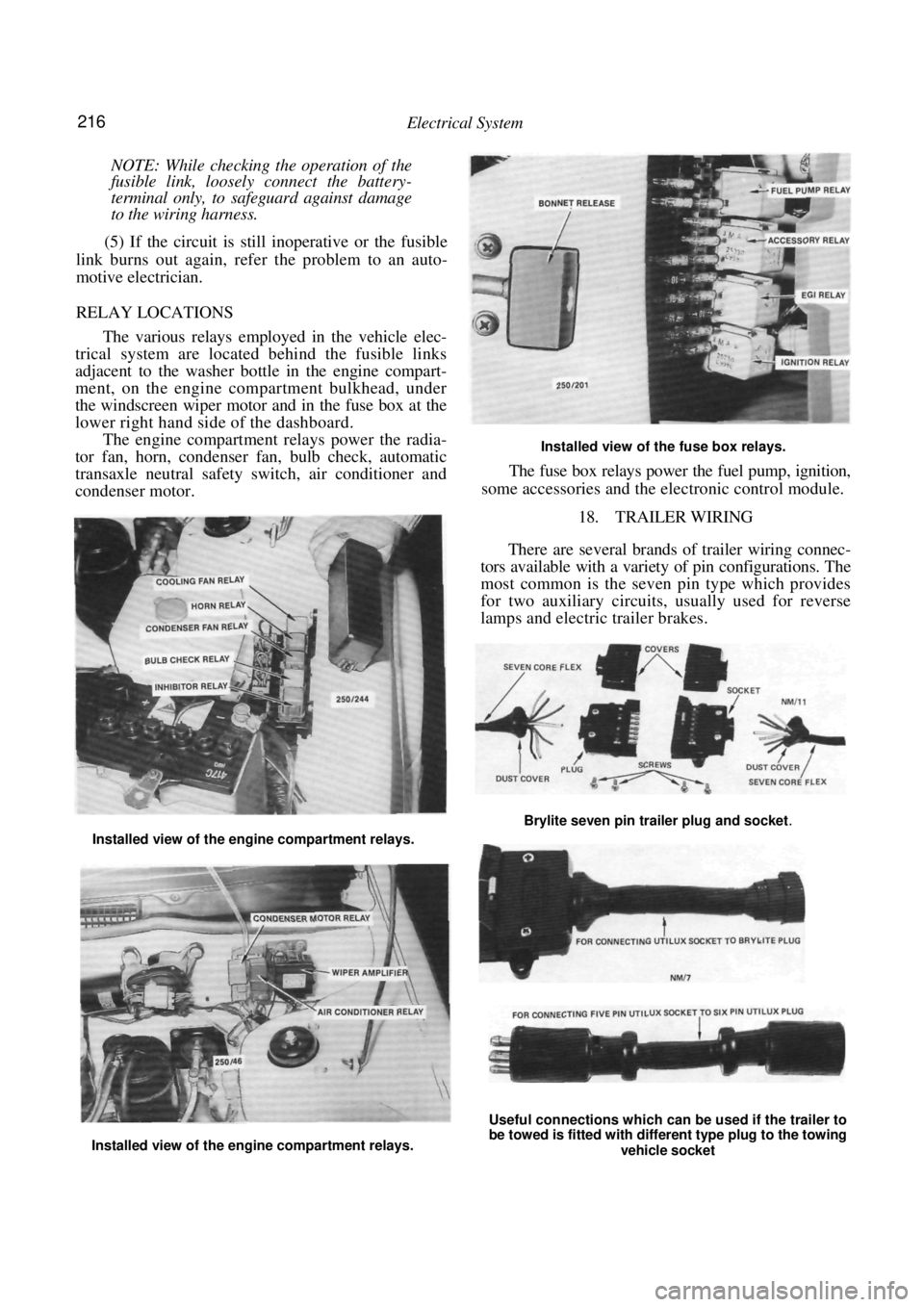
RELAY LOCATIONS
The various relays employed in the vehicle elec-
trical system are located behind the fusible links
adjacent to the washer bottle in the engine compart-
ment, on the engine compartment bulkhead, under
the windscreen wiper motor and in the fuse box at the
lower right hand side of the dashboard.
The engine compartment relays power the radia-
tor fan, horn, condenser fan, bulb check, automatic
transaxle neutral safety switch, air conditioner and
condenser motor.
Installed view of the fuse box relays.
The fuse box relays power the fuel pump, ignition,
some accessories and the el ectronic control module.
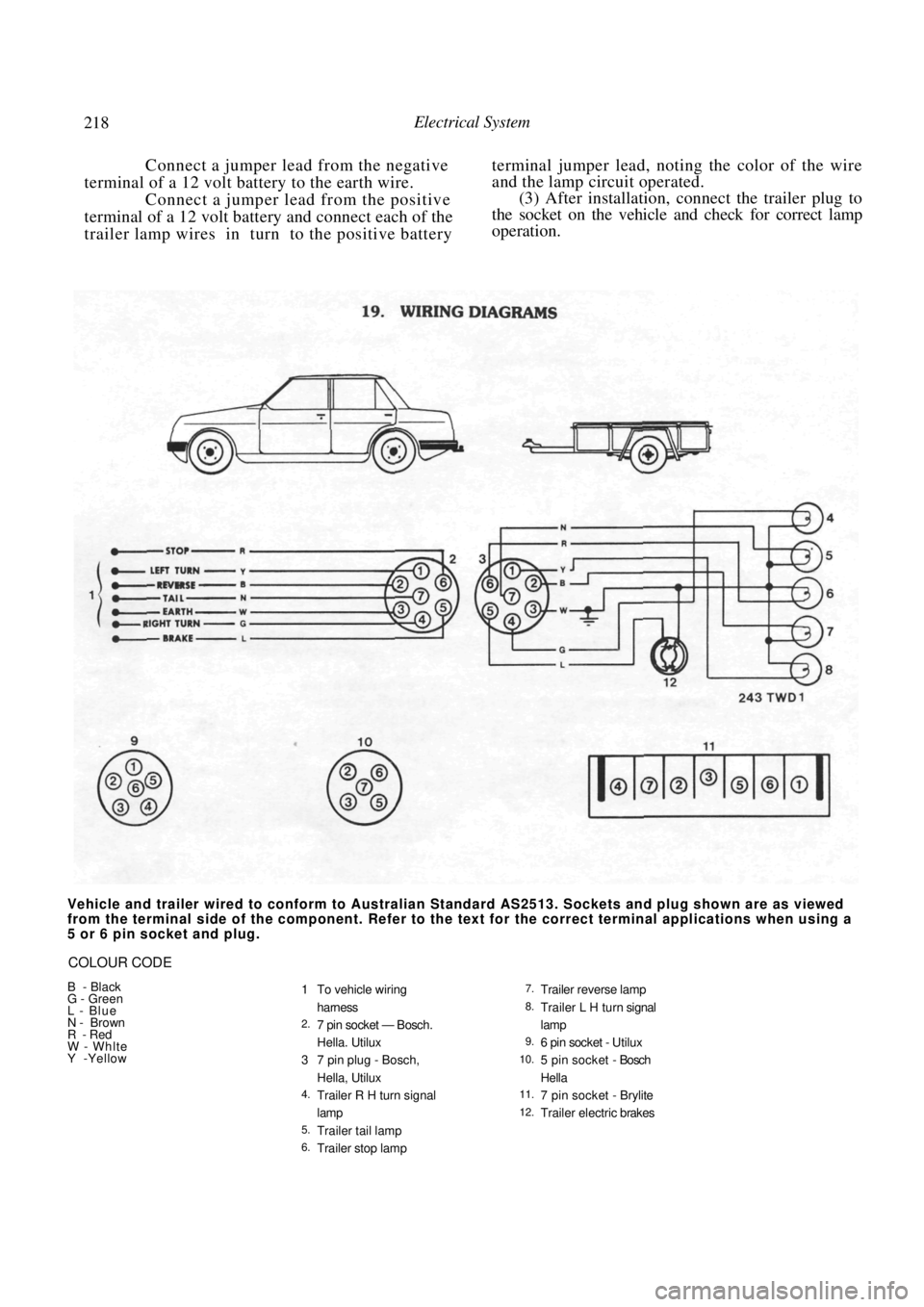
18. TRAILER WIRING
There are several brands of trailer wiring connec-
tors available with a variet y of pin configurations. The
most common is the seven pin type which provides
for two auxiliary circuits, usually used for reverse
lamps and electric trailer brakes.
Installed view of the engine compartment relays.
Installed view of the engine compartment relays.
Useful connections which can be used if the trailer to
be towed is fitted with different type plug to the towing
vehicle socket
Brylite seven pin trailer plug and socket.
Page 217 of 238
Electrical System 217
When installing a trailer socket, it may be neces-
sary to replace the original vehicle flasher unit with a
heavy duty unit to maintain the flash rate in accor-
dance with local regulations. Local regulations may
also require the installation of a dashboard mounted
repeater lamp.
Should the trailer socket and plug not be matched,
adaptors can be made or obtained to facilitate con-
nection.
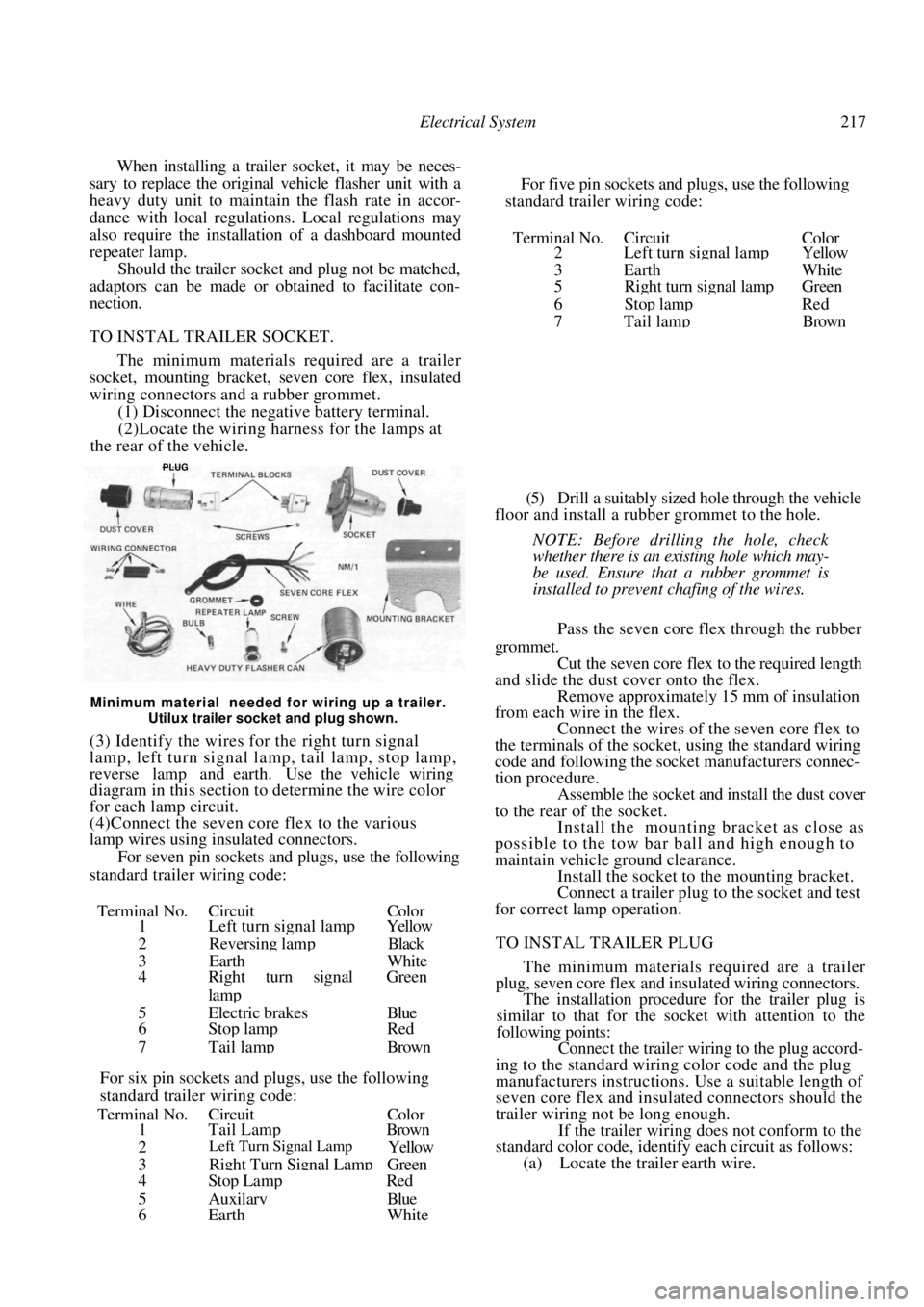
TO INSTAL TRAILER SOCKET.
The minimum materials required are a trailer
socket, mounting bracket, seven core flex, insulated
wiring connectors and a rubber grommet.
(1) Disconnect the negative battery terminal.
(2)Locate the wiring harness for the lamps at
the rear of the vehicle.
For five pin sockets and plugs, use the following
standard trailer wiring code:
Terminal No.CircuitColor2 Left turn signal lampYellow
3Earth White
5 Ri
ght turn signal lampGreen
6Stop lamp Red
7 Tail lam
p Brown
Minimum material needed for wiring up a trailer.
Utilux trailer socket and plug shown.
(3) Identify the wires for the right turn signal
lamp, left turn signal lamp, tail lamp, stop lamp,
reverse lamp and earth. Use the vehicle wiring
diagram in this section to determine the wire color
for each lamp circuit.
(4)Connect the seven core flex to the various
lamp wires using insulated connectors.
For seven pin sockets and plugs, use the following
standard trailer wiring code:
Terminal No.CircuitColor1 Left turn signal lamp Yellow
2 Reversing lamp Black
3EarthWhite
4 Right turn signal Green
lamp
5Electric brakesBlue
6 Stop lampRed
7
Tail lampBrown
For six pin sockets and pl ugs, use the following
standard trailer wiring code:
Terminal No.CircuitColor1 Tail LampBrown
2 Left Turn Signal Lamp Yellow
3Right Turn Signal LampGreen
4 Stop LampRed
5AuxilaryBlue
6 Earth White
(5) Drill a suitably si
zed hole through the vehicle
floor and install a rubber grommet to the hole.
NOTE: Before drilling the hole, check
whether there is an existing hole which may-
be used. Ensure that a rubber grommet is
installed to prevent chafing of the wires.
Pass the seven core flex through the rubber
grommet. Cut the seven core flex to the required length
and slide the dust cover onto the flex. Remove approximately 15 mm of insulation
from each wire in the flex.
Connect the wires of the seven core flex to
the terminals of the socket, using the standard wiring
code and following the socket manufacturers connec-
tion procedure. Assemble the socket and install the dust cover
to the rear of the socket. Install the mounting bracket as close as
possible to the tow bar ball and high enough to
maintain vehicle ground clearance. Install the socket to the mounting bracket.
Connect a trailer plug to the socket and test
for correct lamp operation.
TO INSTAL TRAILER PLUG
The minimum materials required are a trailer
plug, seven core flex and insulated wiring connectors.
The installation procedure for the trailer plug is
similar to that for the socket with attention to the
following points:
Connect the trailer wiring to the plug accord-
ing to the standard wiring color code and the plug
manufacturers instructions. Use a suitable length of
seven core flex and insulated connectors should the
trailer wiring not be long enough.
If the trailer wiring does not conform to the
standard color code, identify each circuit as follows: (a) Locate the trailer earth wire.
PLUG
Page 218 of 238
218 Electrical System
Connect a jumper lead from the negative
terminal of a 12 volt battery to the earth wire. Connect a jumper lead from the positive
terminal of a 12 volt battery and connect each of the
trailer lamp wires in turn to the positive battery terminal jumper lead, noting the color of the wire
and the lamp circuit operated.
(3) After installation, connect the trailer plug to
the socket on the vehicle and check for correct lamp
operation.
Vehicle and trailer wired to conform to Australian Standard AS2513. Sockets and plug shown are as viewed
from the terminal side of the component. Refer to the text for the correct terminal applications when using a
5 or 6 pin socket and plug.
COLOUR CODE
B - Black
G - Green
L - Blue
N - Brown
R - Red
W - Whlte
Y -Yellow
1 To vehicle wiring 7.Trailer reverse lamp
harness 8.Trailer L H turn signal
2. 7 pin socket — Bosch. lamp
Hella. Utilux 9.6 pin socket - Utilux
3 7 pin plug - Bosch, 10.5 pin socket - Bosch
Hella, Utilux Hella
4. Trailer R H turn signal 11.7 pin socket - Brylite
lamp 12.Trailer electric brakes
5. Trailer tail lamp
6. Trailer stop lamp
Page 220 of 238
220 Electrical System
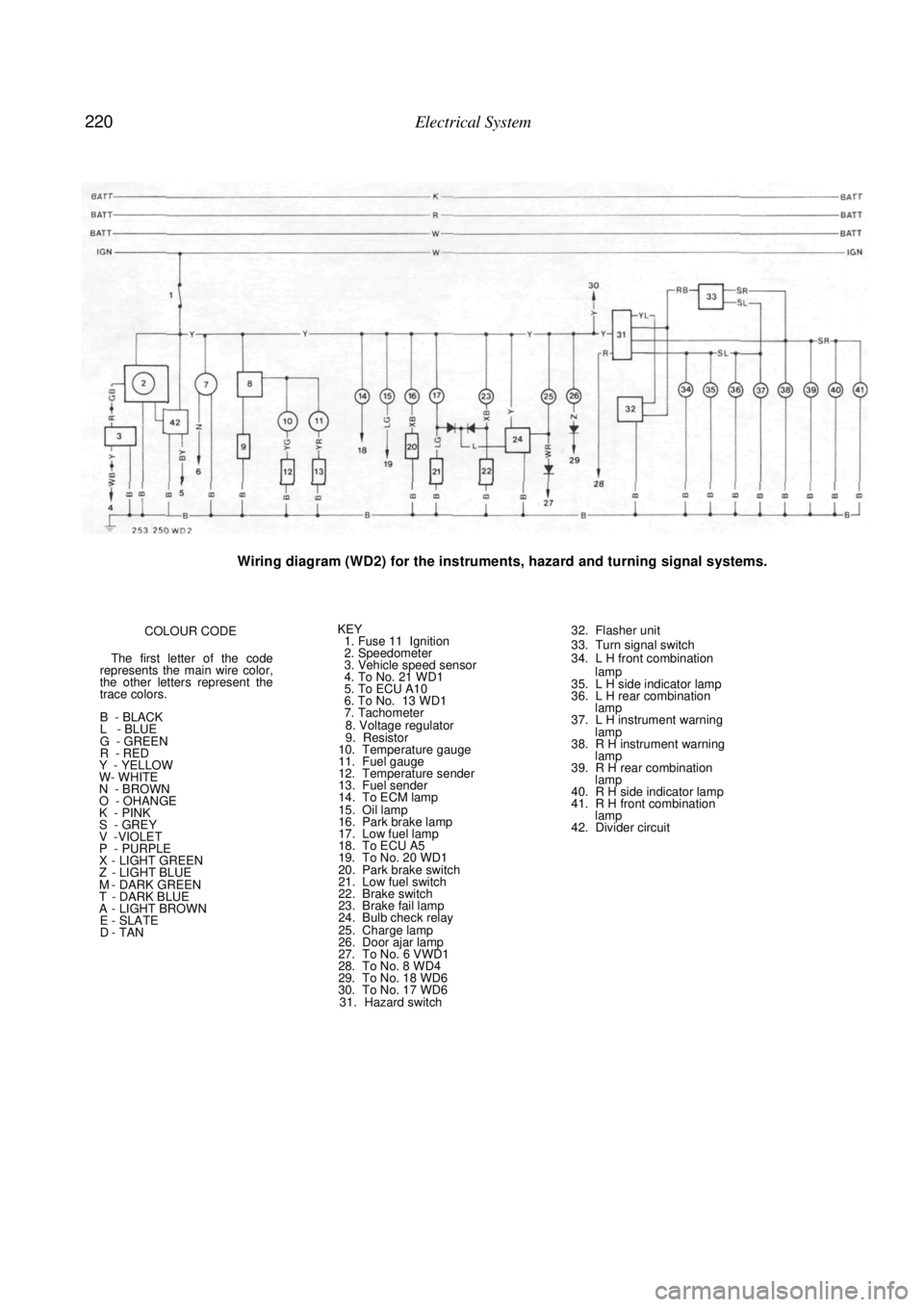
Wiring diagram (WD2) for the instruments, hazard and turning signal systems.
COLOUR CODE
The first letter of the code
represents the main wire color,
the other letters represent the
trace colors.
B - BLACK
L - BLUE
G - GREEN
R - RED
Y - YELLOW
W- WHITE
N - BROWN
O - OHANGE
K - PINK
S - GREY V -VIOLET
P - PURPLE X - LIGHT GREEN Z - LIGHT BLUE M - DARK GREEN T - DARK BLUE A - LIGHT BROWN E - SLATE D - TAN
KEY 1. Fuse 11 Ignition
2. Speedometer
3. Vehicle speed sensor
4. To No. 21 WD1
5. To ECU A10
6. To No. 13 WD1
7. Tachometer
8. Voltage regulator
9. Resistor
10. Temperature gauge
11. Fuel gauge
12. Temperature sender
13. Fuel sender
14. To ECM lamp
15. Oil lamp
16. Park brake lamp
17. Low fuel lamp
18. To ECU A5
19. To No. 20 WD1
20. Park brake switch
21. Low fuel switch
22. Brake switch
23. Brake fail lamp
24. Bulb check relay
25. Charge lamp
26. Door ajar lamp
27. To No. 6 VWD1
28. To No. 8 WD4
29. To No. 18 WD6
30. To No. 17 WD6 31. Hazard switch
32. Flasher unit
33. Turn signal switch
34. L H front combination
lamp
35. L H side indicator lamp
36. L H rear combination lamp
37. L H instrument warning
lamp
38. R H instrument warning lamp
39. R H rear combination lamp
40. R H side indicator lamp
41. R H front combination lamp
42. Divider circuit
Page 234 of 238
234 Body
LOCK ASSEMBLY
To Remove and Install
( 1 ) Remove the retaining bolts and withdraw the
lock assembly from the luggage compartment lid.
Installation is a reversal of the removal procedure
ensuring that the actuating arm on the lock is under
the lock cylinder pivot.
LOCK CYLINDER
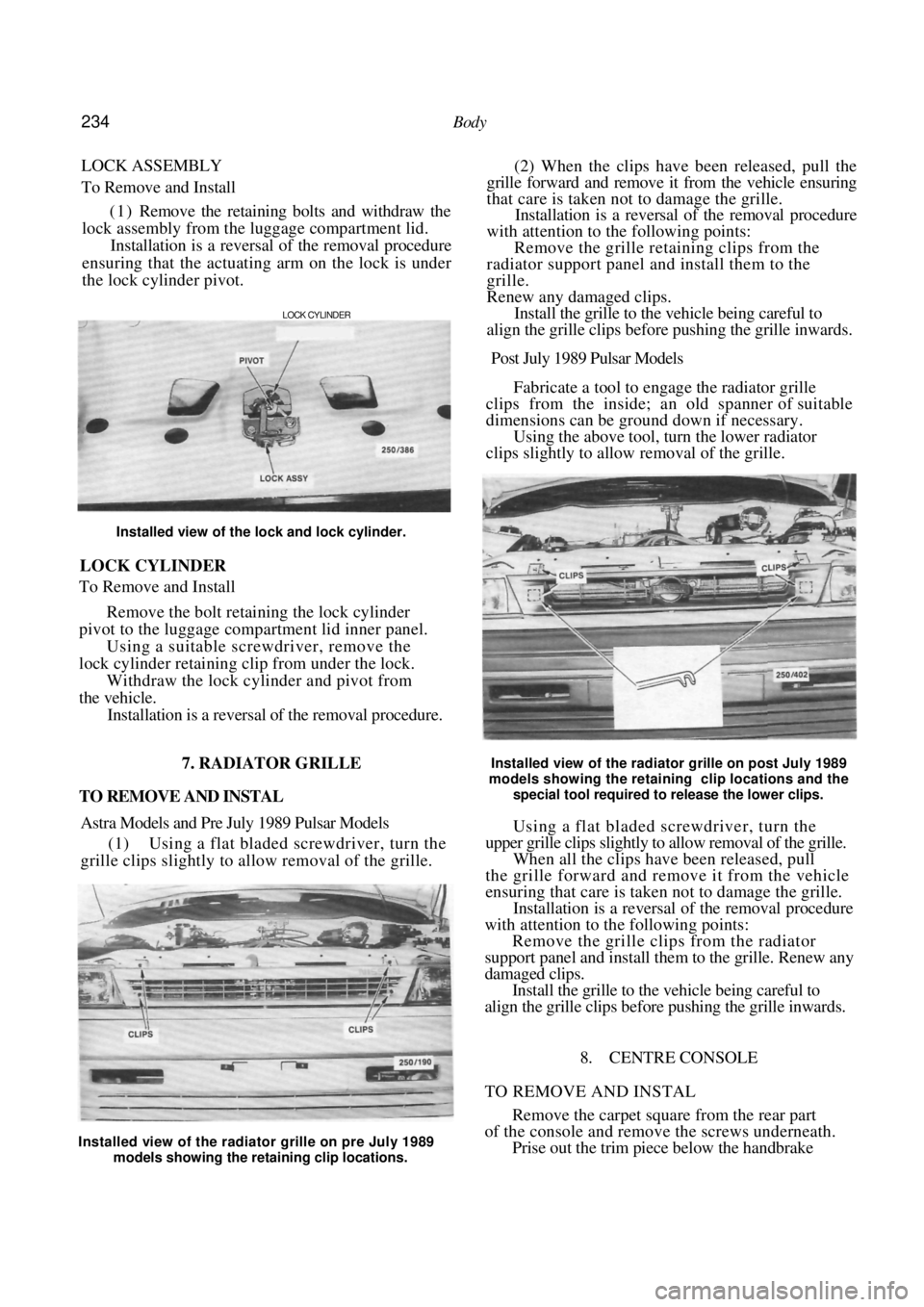
Installed view of the lock and lock cylinder.
LOCK CYLINDER
To Remove and Install
Remove the bolt retaining the lock cylinder
pivot to the luggage compartment lid inner panel. Using a suitable screwdriver, remove the
lock cylinder retaining clip from under the lock. Withdraw the lock cylinder and pivot from
the vehicle. Installation is a reversal of the removal procedure.
(2) When the clips have been released, pull the
grille forward and remove it from the vehicle ensuring
that care is taken not to damage the grille.
Installation is a reversal of the removal procedure
with attention to the following points:
Remove the grille retaining clips from the
radiator support panel and install them to the
grille.
Renew any damaged clips. Install the grille to the vehicle being careful to
align the grille clips before pushing the grille inwards.
Post July 1989 Pulsar Models
Fabricate a tool to engage the radiator grille
clips from the inside; an old spanner of suitable
dimensions can be ground down if necessary.
Using the above tool, turn the lower radiator
clips slightly to allow removal of the grille.
7. RADIATOR GRILLE
TO REMOVE AND INSTAL
Astra Models and Pre July 1989 Pulsar Models
(1) Using a flat bladed screwdriver, turn the
grille clips slightly to allow removal of the grille.
Installed view of the radiator grille on pre July 1989
models showing the retaining clip locations. Installed view of the radiator grille on post July 1989
models showing the retaining clip locations and the
special tool required to release the lower clips.
Using a flat bladed screwdriver, turn the
upper grille clips slightly to allow removal of the grille. When all the clips have been released, pull
the grille forward and remove it from the vehicle
ensuring that care is taken not to damage the grille.
Installation is a reversal of the removal procedure
with attention to the following points:
Remove the grille clips from the radiator
support panel and install them to the grille. Renew any
damaged clips.
Install the grille to the vehicle being careful to
align the grille clips before pushing the grille inwards.
8. CENTRE CONSOLE
TO REMOVE AND INSTAL
Remove the carpet square from the rear part
of the console and remove the screws underneath. Prise out the trim piece below the handbrake