wheel torque NISSAN PULSAR 1987 User Guide
[x] Cancel search | Manufacturer: NISSAN, Model Year: 1987, Model line: PULSAR, Model: NISSAN PULSAR 1987Pages: 238, PDF Size: 28.91 MB
Page 64 of 238
64 Engine
automatic transaxle models the complete drive plate
must be renewed.
(3) Inspect the drive plate bolt holes for elonga-
tion which is caused by loose retaining bolts.
(4) Inspect the drive plate for cracks.
(5) Repair or renew the flywheel if necessary.
TO INSTAL
Installation is a reversal of the removal procedure
with attention to the following points:
(1) The flywheel and drive plate retaining bolts
are special micro-encapsulated fasteners.
Install new micro-encapsulated bolts of the
correct
strength classification on assembly.
(2) Thoroughly clean the crankshaft threads with
a thread tap. Clean the threads with solvent and dry
before installing the flywh eel or drive plate retaining
bolts.
(3) Tighten the flywheel or drive plate retaining
bolts to the specified torque and on manual transaxle
models, align the clutch plate as described in the
Clutch section.
TO RENEW FLYWHEEL RING GEAR
(1) With the flywheel removed from the vehicle,
drill a 6 mm diameter hole between two teeth of the
ring gear.
NOTE: Do not drill right through the ring
gear as this will damage the flange on the
flywheel.
(2) Secure the flywheel, with the drilled hole
uppermost in a soft jawed vice.
(3) Place a cold chisel above the hole in the ring
gear and hit it sharply to split the ring gear.
(4) Check the direction of the chamfered face of
the old ring gear. The new ring gear must be installed
to the flywheel with the chamfer in the same direction. (5) Remove the ring gear, clean the mounting
face on the flywheel and remove any burrs. (6) Polish a few spots of the ring gear with emery
cloth and heat the ring gear evenly until the polished
spots turn dark blue.
NOTE; Do not heat the ring gear past the
point required to achieve a dark blue color
or the tempering of the ring gear teeth will
be impaired.
(7) With the flywheel suitably supported, pick
the ring gear up using plie rs, and place it evenly onto
the flywheel. Use a hammer and a brass drift to ensure
that the ring gear seats ag ainst the flywheel flange.
NOTE: Allow the ring gear to cool slowly.
Do not quench it in water.
13. ENGINE MOUNTINGS
TO RENEW LEFT HAND SIDE MOUNTING
(1) Disconnect the positive and negative battery
terminals, loosen the battery clamp nuts and withdraw
the battery from the engine compartment.
(2) Remove the bolts retaining the battery car-
rier to the inner mudguard and remove the battery
carrier and associ ated components from the engine
compartment. (3) Support the transaxle using a jack. Interpose
a block of wood between the head of the jack and the
transaxle to prevent damage to the transaxle.
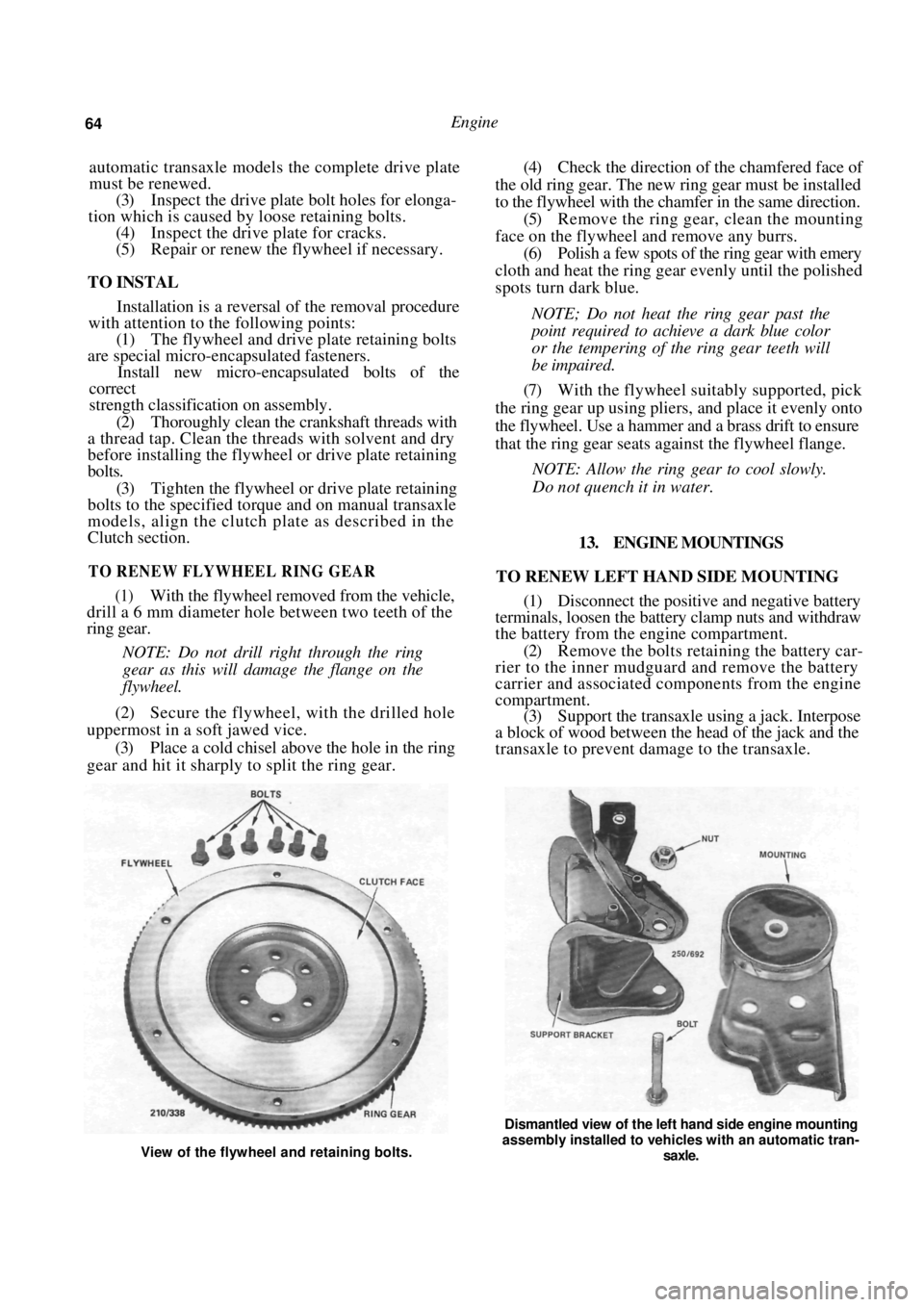
View of the flywheel and retaining bolts.
Dismantled view of the left hand side engine mounting
assembly installed to vehicles with an automatic tran-
saxle.
Page 97 of 238
Fuel and Engine Management 97
circuitry do not immerse it in cleaning
solvent as this may result in irreparable
damage.
Installation is a reversal of the removal procedure
with attention to the following points:
(1) Lubricate the new O ring seals with auto-
matic transmission fluid prior to installing them to the
injector. If removed, ensure that the lower filter screen
is installed. (2) Firmly push the injector into the throttle
body assembly until it is fully seated, ensuring that the
injector connection terminals face towards the rear of
the vehicle.
(3) Apply Loctite 262 to the injector retaining
plate screw and tighten securely.
(4) Start the engine and check for fuel leaks as
previously described.
(5) Install the air cleaner and tighten the retain-
ing nuts securely.
FUEL METER ASSEMBLY - 1.6 LITRE
ENGINE
To Remove and Install
(1) Remove the injector as previously described.
(2) Mark the fuel supp ly and return hoses,
release the clamps and disconnect the hoses from the
fuel meter assembly.
(3) Remove the air cleaner assembly base gasket
from the fuel meter assembly. (4) Remove the bolts and screws securing the
fuel meter assembly to the throttle body and remove the fuel meter assembly. Remove and discard the
gasket.
(5) If necessary, remove the fuel pressure regu-
lator as previously described.
Installation is a reversal to the removal procedure
with attention to the following points;
(1) If removed, install the fuel pressure
regulator
as previously described.
(2) Place a new gasket on the throttle body,
aligning the holes in the gasket with those in the
throttle body, ensuring that the idle air passage is not
blocked. (3) Coat the fuel meter assembly retaining
screws with Loctite 26 2 and tighten securely.
(4) Install the fuel meter assembly retaining bolts
and tighten to the specified torque.
(5) Connect the fuel supply and return hoses and
tighten the clamps securely. (6) Install the injector as previously described.
(7) Start the engine and check for fuel leaks.
Rectify as necessary. (8) Install the air cleaner assembly.
FUEL TANK
To Remove and Install
(1) Depressurize the fuel system as previously
described.
(2) Disconnect the negative battery terminal.
(3) Remove the fuel pump cover plate retaining
screws, disconnect the wi ring harness rubber grommet
from the cover plate and remove the cover plate from
the wiring harness. (4) Raise the rear of the vehicle and support it
on chassis stands. Refer to the Wheels and Tires
section if necessary. (5) Remove the fuel tank drain plug and drain
the fuel into a petroleum resistant container. (6) Mark the fuel hoses and disconnect the hoses
from the fuel pump.
(7) Disconnect the hoses from the fuel filler neck
pipe, the fuel check valve and the fuel tank breather
pipe.
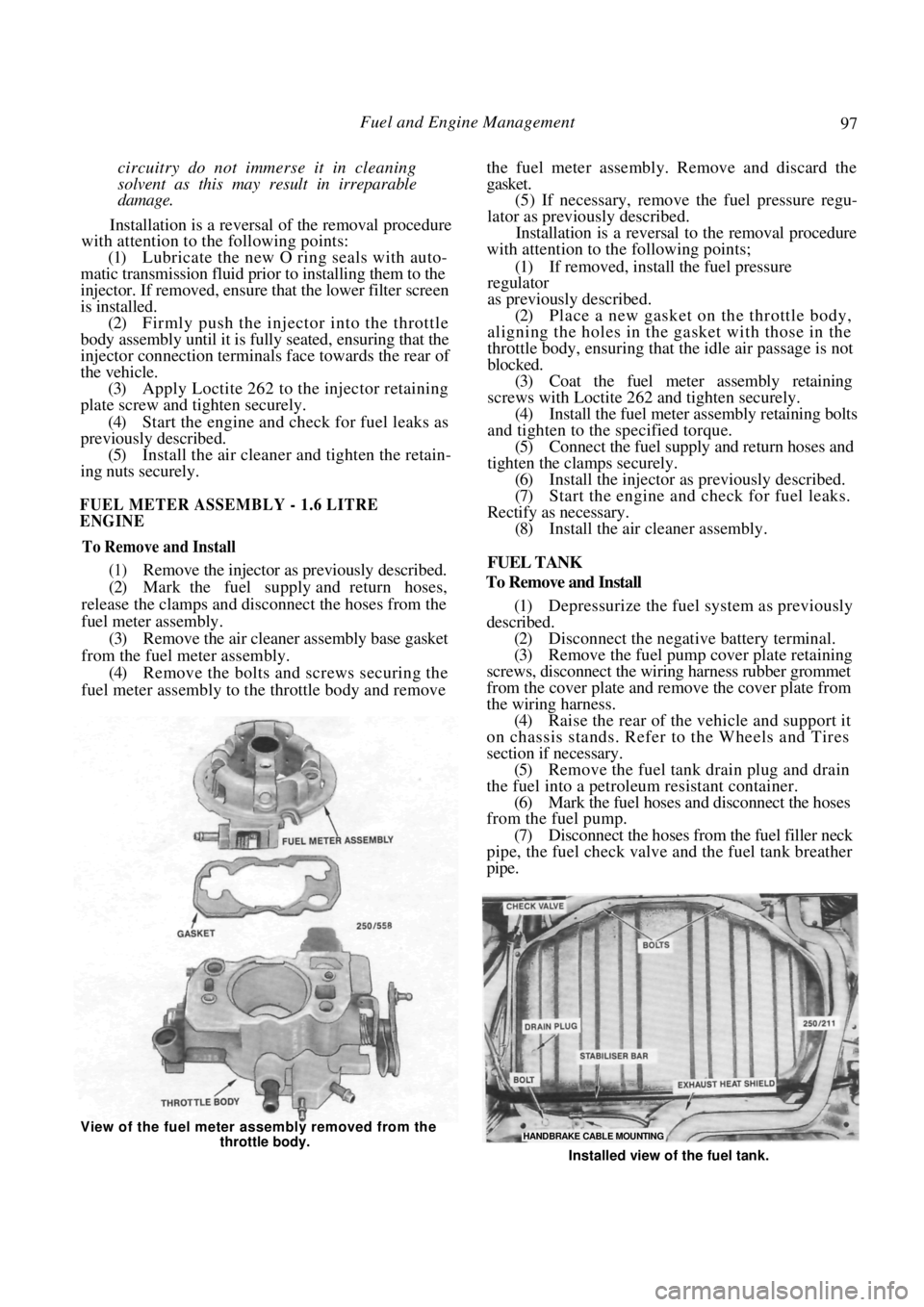
View of the fuel meter assembly removed from the
throttle body. HANDBRAKE CABLE MOUNTING
Installed view of the fuel tank.
Page 121 of 238
121
CLUTCH
SPECIFICATIONS
Type................................................... Single dry plate
Operation................................................... Mechanical
Pressure plate type .................................... Diaphragm
Release bearing type .......................Prelubri cated ball
Driven plate:
Outside diameter .................................... 215 mm
Rivet depth limit ....................................0.3 mm
Runout limit .........................................0.5 mm
Maximum spline backlash ...................0.7 mm
Pressure plate:
Diaphragm spring height
(installed) ...................................... 30.5-32.5 mm
Spring finger vari ation limit.....................0.5 mm
Clutch pedal:
Height .............................................. 175-185 mm
Free play ....................................... 12.5-17.5 mm
Release lever free play............................ 2.5-3.5 mm
Flywheel machining limit ...............................0.3 mm
TORQUE WRENCH SETTINGS
Pressure plate bolts.......................................... 29 Nm
Pedal pivot pin nut ......................................... 22 Nm
Cable loc knut.................................................... 4 Nm
Lower clutch housing to engine bolts.............. 21 Nm
Centre and upper clutch housing
to engine bolts .................................................. 49 Nm
1. CLUTCH TROUBLE SHOOTING
CLUTCH SLIPPING
(!) Worn driven plate facing: Check and renew
the clutch driven plate.
(2) Insufficient clutch pedal free play: Check and
adjust the clutch pedal free play. Ensure that the
release lever free play is correct.
(3) Weak or broken pressure plate diaphragm
spring: Check and renew the pressure plate assembly. (4) Worn or scored flywh eel: Machine or renew
the flywheel. Worn or scored pressure plate face: Renew the
pressure plate assembly.
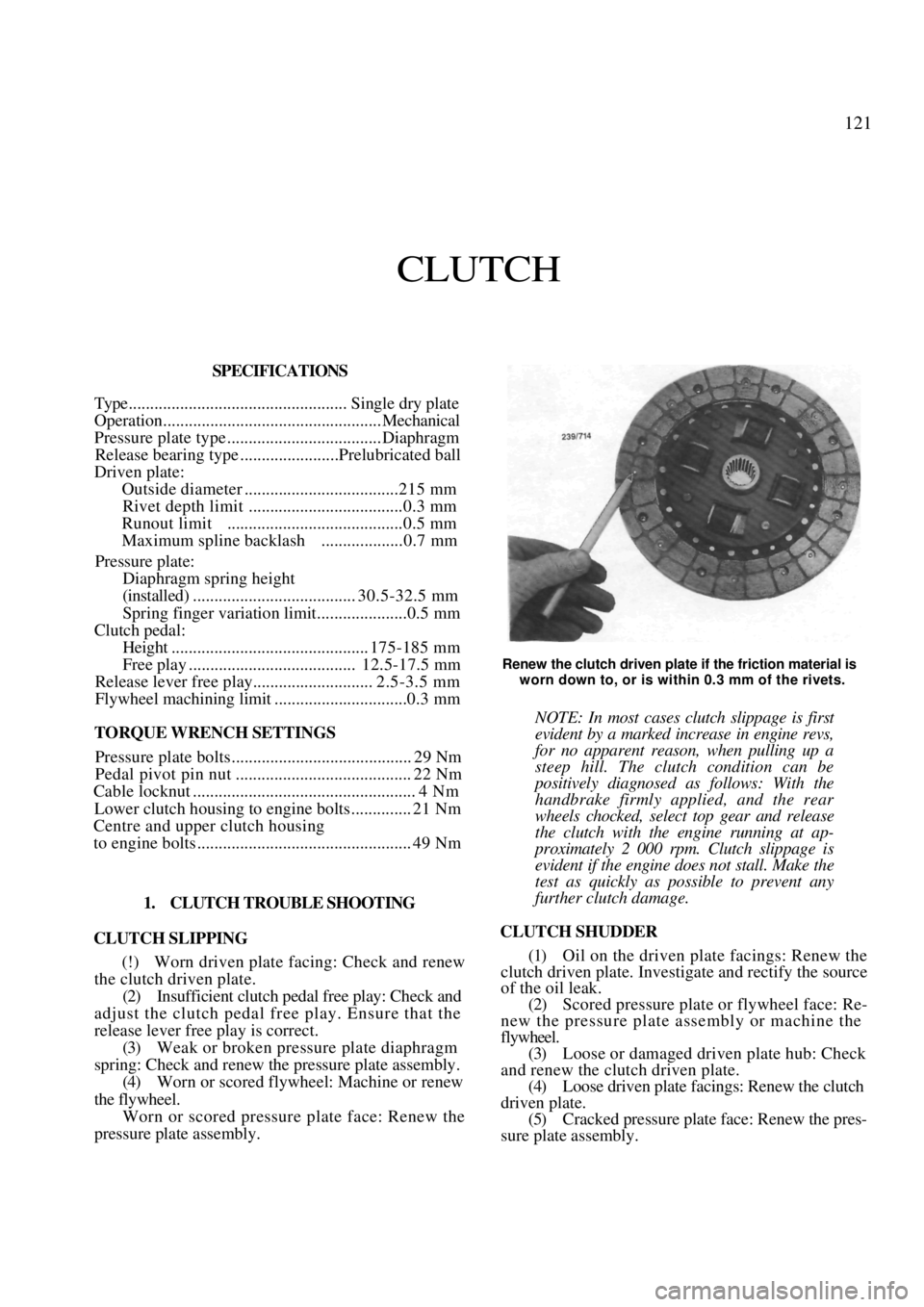
Renew the clutch driven plate if the friction material is
worn down to, or is within 0.3 mm of the rivets.
NOTE: In most cases clutch slippage is first
evident by a marked increase in engine revs,
for no apparent reason, when pulling up a
steep hill. The clutch condition can be
positively diagnosed as follows: With the
handbrake firmly applied, and the rear
wheels chocked, select top gear and release
the clutch with the engine running at ap-
proximately 2 000 rpm. Clutch slippage is
evident if the engine does not stall. Make the
test as quickly as possible to prevent any
further clutch damage.
CLUTCH SHUDDER
(1) Oil on the driven plate facings: Renew the
clutch driven plate. Invest igate and rectify the source
of the oil leak.
(2) Scored pressure plate or flywheel face: Re-
new the pressure plate assembly or machine the
flywheel. (3) Loose or damaged driven plate hub: Check
and renew the clutch driven plate. (4) Loose driven plate facings: Renew the clutch
driven plate. (5) Cracked pressure plate face: Renew the pres-
sure plate assembly.
Page 124 of 238
124 Clutch
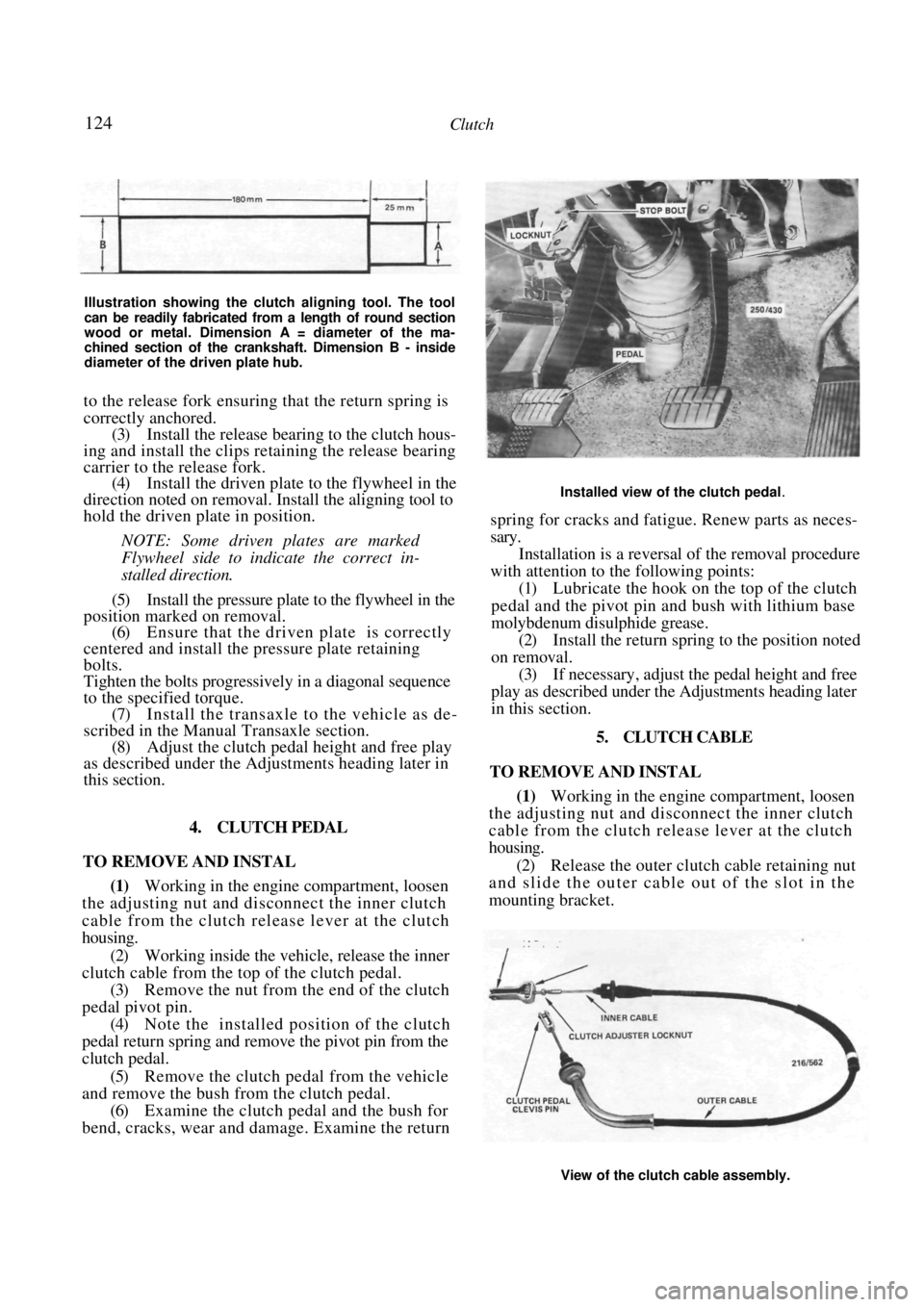
Illustration showing the clutch aligning tool. The tool
can be readily fabricated from a length of round section
wood or metal. Dimension A = diameter of the ma-
chined section of the crankshaft. Dimension B - inside
diameter of the driven plate hub.
to the release fork ensuring that the return spring is
correctly anchored.
(3) Install the release bearing to the clutch hous-
ing and install the clips re taining the release bearing
carrier to the release fork. (4) Install the driven plate to the flywheel in the
direction noted on removal. Install the aligning tool to
hold the driven plate in position.
NOTE: Some driven plates are marked
Flywheel side to indicate the correct in-
stalled direction.
(5) Install the pressure plate to the flywheel in the
position marked on removal. (6) Ensure that the driven plate is correctly
centered and install the pressure plate retaining
bolts.
Tighten the bolts progressively in a diagonal sequence
to the specified torque. (7) Install the transaxle to the vehicle as de-
scribed in the Manual Transaxle section. (8) Adjust the clutch pedal height and free play
as described under the Adjustments heading later in
this section.
4. CLUTCH PEDAL
TO REMOVE AND INSTAL
(1) Working in the engine compartment, loosen
the adjusting nut and disconnect the inner clutch
cable from the clutch release lever at the clutch
housing.
(2) Working inside the vehicle, release the inner
clutch cable from the top of the clutch pedal.
(3) Remove the nut from the end of the clutch
pedal pivot pin. (4) Note the installed position of the clutch
pedal return spring and remove the pivot pin from the
clutch pedal.
(5) Remove the clutch pedal from the vehicle
and remove the bush from the clutch pedal. (6) Examine the clutch pedal and the bush for
bend, cracks, wear and damage. Examine the return
Installed view of the clutch pedal.
spring for cracks and fatigue. Renew parts as neces-
sary.
Installation is a reversal of the removal procedure
with attention to the following points:
(1) Lubricate the hook on the top of the clutch
pedal and the pivot pin and bush with lithium base
molybdenum disulphide grease. (2) Install the return spring to the position noted
on removal. (3) If necessary, adjust the pedal height and free
play as described under the Adjustments heading later
in this section.
5. CLUTCH CABLE
TO REMOVE AND INSTAL
(1) Working in the engine compartment, loosen
the adjusting nut and disconnect the inner clutch
cable from the clutch release lever at the clutch
housing.
(2) Release the outer clutch cable retaining nut
and slide the outer cable out of the slot in the
mounting bracket.
View of the clutch cable assembly.
Page 128 of 238
128 Manual Transaxle and Drive Shafts
TRANSAXLE NOISE (FORWARD GEARS
ENGAGED, VEHICLE MOVING)
(1) Insufficient lubricant: Fill the transaxle with
the correct grade and quantity of oil. (2) Worn input shaft or mainshaft bearings:
Overhaul the transaxle and renew the faulty bearings. (3) Chipped or pitted gears: Check and overhaul
the transaxle and renew the faulty gears. (4) Damaged or worn sync hroniser assemblies:
Overhaul the transaxle and renew the synchroniser
assemblies.
FINAL DRIVE GEAR NOISE
(1) Insufficient lubricant: Fill the transaxle case
with the correct grade and quantity of oil. (2) Chipped or pitted final drive gear and/or ring
gear: Overhaul the transaxle and renew components as
necessary. (3) Worn differential carrier bearings: Overhaul
the differential assembly.
(4) Worn mainshaft or input shaft bearings:
Overhaul the transaxle.
NOTE: Check the oil level in the transaxle
case and the condition of the front hub
bearings and drive shaft joints prior to
overhauling the transaxle.
EXCESSIVE BACKLASH IN FINAL DRIVE
(1) Excessive end float in the differential carrier
bearings due to worn or incorrect bearing preload
adjustment: Check and adjust the bearing preload or
renew the bearings.
(2) Ring gear to differential case bolts loose:
Overhaul the transaxle and tighten the bolts to the
specified torque.
(3) Excessive wear in the final drive gear: Check
and overhaul the transaxle. (4) Excessive wear in the differential pinions,
side gears or pinion shaft: Overhaul the differential
assembly.
NOTE: Prior to overhauling the differential,
check the serviceability of the C.V joints on
the drive shafts.
NO DRIVE IN ANY GEAR
(1) Sheared ring gear to differential case bolts:
Overhaul the differential assembly.
(2) Broken drive shaft: Check and renew com-
ponents as necessary.
(3) Inner C.V. joint shaft out of mesh with
differential side gear: Weak or broken inner C.V. joint
shaft snap ring. Renew as necessary.
NOISE OR VIBRATION IN DRIVE SHAFTS
( 1 ) Bent or twisted drive shafts: Check and
renew the drive shafts as necessary.
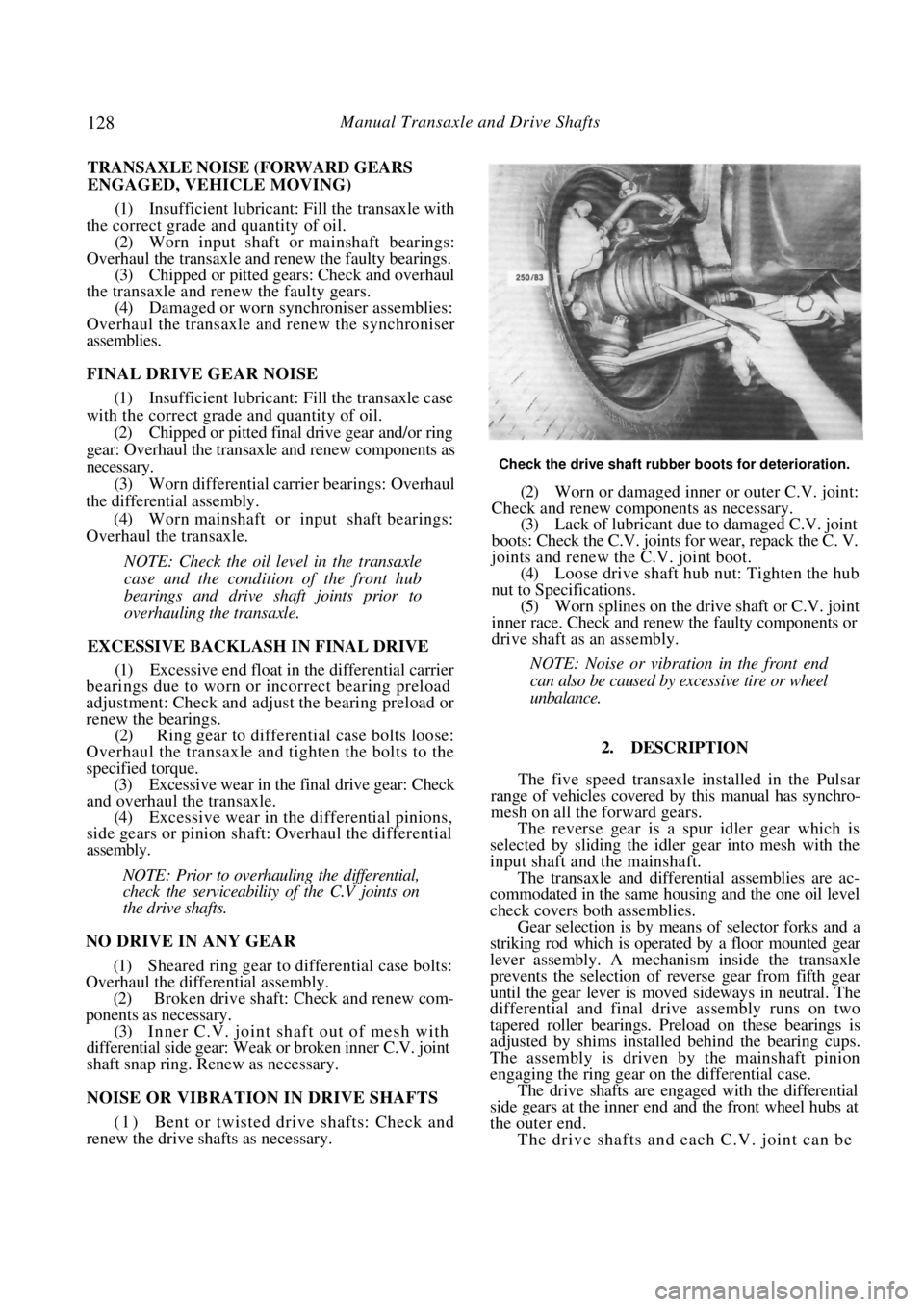
Check the drive shaft rubber boots for deterioration.
(2) Worn or damaged inner or outer C.V. joint:
Check and renew components as necessary. (3) Lack of lubricant due to damaged C.V. joint
boots: Check the C.V. joints for wear, repack the C. V.
joints and renew th e C.V. joint boot.
(4) Loose drive shaft hub nut: Tighten the hub
nut to Specifications. (5) Worn splines on the drive shaft or C.V. joint
inner race. Check and renew the faulty components or
drive shaft as an assembly.
NOTE: Noise or vibration in the front end
can also be caused by excessive tire or wheel
unbalance.
2. DESCRIPTION
The five speed transaxle installed in the Pulsar
range of vehicles covered by this manual has synchro-
mesh on all the forward gears.
The reverse gear is a spur idler gear which is
selected by sliding the idler gear into mesh with the
input shaft and the mainshaft.
The transaxle and differential assemblies are ac-
commodated in the same housing and the one oil level
check covers both assemblies.
Gear selection is by mean s of selector forks and a
striking rod which is operated by a floor mounted gear
lever assembly. A mechanism inside the transaxle
prevents the selection of re verse gear from fifth gear
until the gear lever is moved sideways in neutral. The
differential and final dr ive assembly runs on two
tapered roller bearings. Pr eload on these bearings is
adjusted by shims installed behind the bearing cups.
The assembly is driven by the mainshaft pinion
engaging the ring gear on the differential case.
The drive shafts are engaged with the differential
side gears at the inner end and the front wheel hubs at
the outer end.
The drive shafts and each C.V. joint can be
Page 129 of 238
Manual Transaxle and Drive Shafts 129
renewed as individual units. The C.V. joints are
lubricated in manufacture and need no attention in
service unless one of the r ubber boots is damaged. In
this case the joint can be cl eaned and repacked with
the recommended grease and a new boot installed.
From July 1989, Pulsar Q and Vector SSS manual
transaxle models are equipped with a limited slip
differential incorporating a viscous coupling. The
coupling is not repairable and must be renewed as an
assembly if unserviceable. A test procedure for the
viscous coupling is included in the text in this section.
3. TRANSAXLE ASSEMBLY
Special Equipment Required:
To Dismantle and Assemble — Puller set, press
and press plates, dial gauge
To Measure Mainshaft Turning Torque —
Suitable slotted adaptor and torque gauge
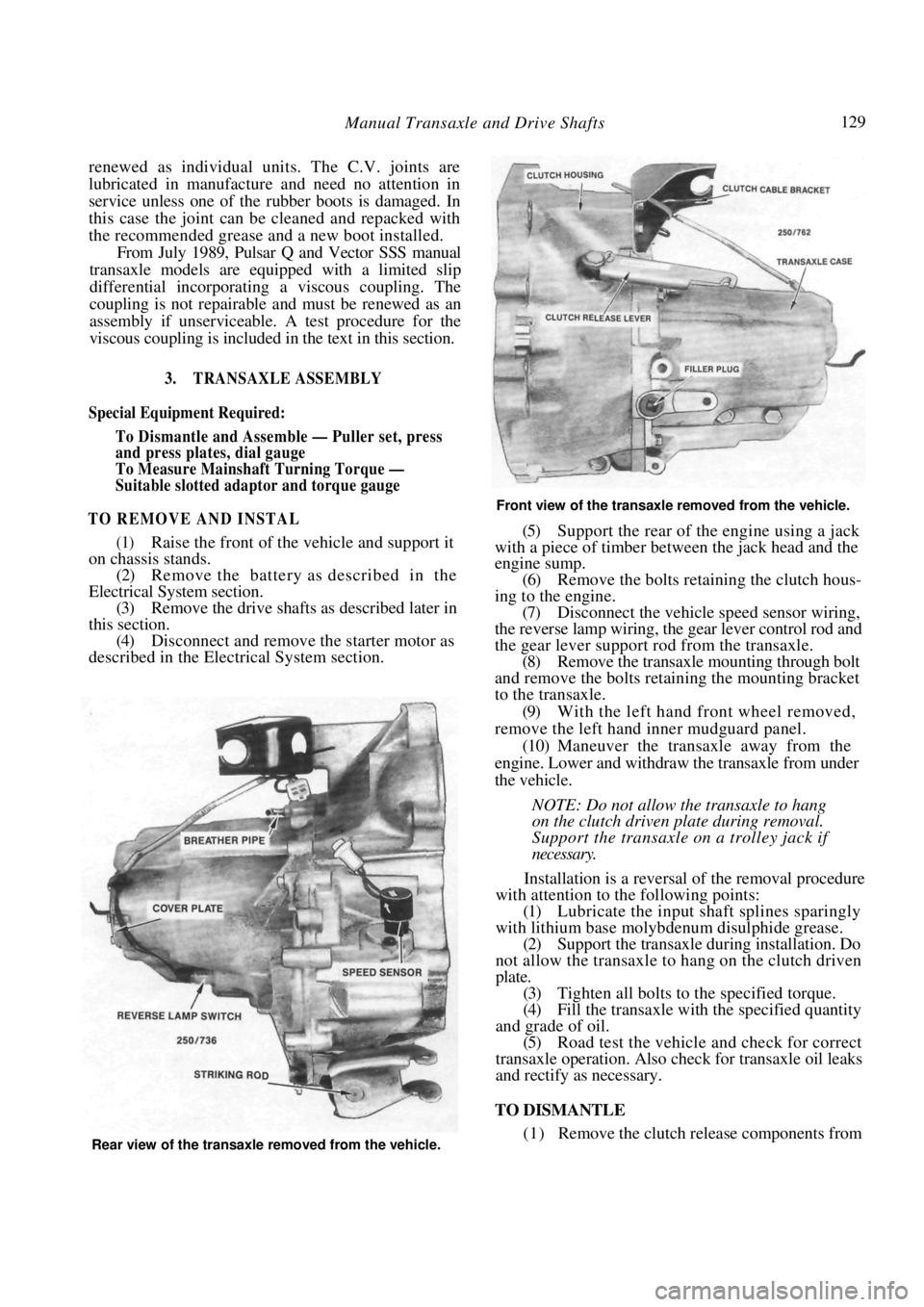
TO REMOVE AND INSTAL
(1) Raise the front of the vehicle and support it
on chassis stands.
(2) Remove the battery as described in the
Electrical System section. (3) Remove the drive shafts as described later in
this section. (4) Disconnect and remove the starter motor as
described in the Elect rical System section.
Front view of the transaxle removed from the vehicle.
(5) Support the rear of the engine using a jack
with a piece of timber between the jack head and the
engine sump.
(6) Remove the bolts retaining the clutch hous-
ing to the engine. (7) Disconnect the vehicle speed sensor wiring,
the reverse lamp wiring, the gear lever control rod and
the gear lever support rod from the transaxle. (8) Remove the transaxle mounting through bolt
and remove the bolts retaining the mounting bracket
to the transaxle.
(9) With the left hand front wheel removed,
remove the left hand inner mudguard panel. (10) Maneuver the transaxle away from the
engine. Lower and withdraw the transaxle from under
the vehicle.
NOTE: Do not allow the transaxle to hang
on the clutch driven plate during removal.
Support the transaxle on a trolley jack if
necessary.
Installation is a reversal of the removal procedure
with attention to the following points:
(1) Lubricate the input shaft splines sparingly
with lithium base molybdenum disulphide grease. (2) Support the transaxle during installation. Do
not allow the transaxle to hang on the clutch driven
plate. (3) Tighten all bolts to the specified torque.
(4) Fill the transaxle with the specified quantity
and grade of oil. (5) Road test the vehicle and check for correct
transaxle operation. Also ch eck for transaxle oil leaks
and rectify as necessary.
TO DISMANTLE
(1) Remove the clutch release components from Rear view of the transaxle removed from the vehicle.
Page 135 of 238
Manual Transaxle and Drive Shafts 135
possible to move the striking rod from fifth gear to
reverse without first moving sideways in the neutral
gate.
4. DIFFERENTIAL AND FINAL DRIVE ASSEMBLY
Special Equipment Required:
To Measure Differential Turning Torque —
Suitable slotted adaptor and torque gauge
TO CHECK VISCOUS COUPLING
From July 1989, Manual transaxle Pulsar Q and
Vector SSS models are equipped with a limited slip
differential incorporating a viscous coupling.
(1) Raise the front of the vehicle and support it
on chassis stands. (2) Rotate one front wheel and check the rota-
tional direction of the opposite wheel. (3) If both front wheels rotate in the same
direction, the viscous coupling is functioning nor-
mally. (4) If the front wheels rota te in opposite direc-
tions, the viscous coupling is unserviceable and must
be renewed as an assembly.
TO DISMANTLE AND ASSEMBLE
It is necessary to remove and dismantle the
transaxle assembly to gain access to the differential
and final drive assembly.
Refer to the Transaxle Assembly heading for the
removal of the transaxle from the vehicle. Operations
1-9 of the dismantling procedure under the same
heading describe the removal of the differential and
final drive assembly from the transaxle.
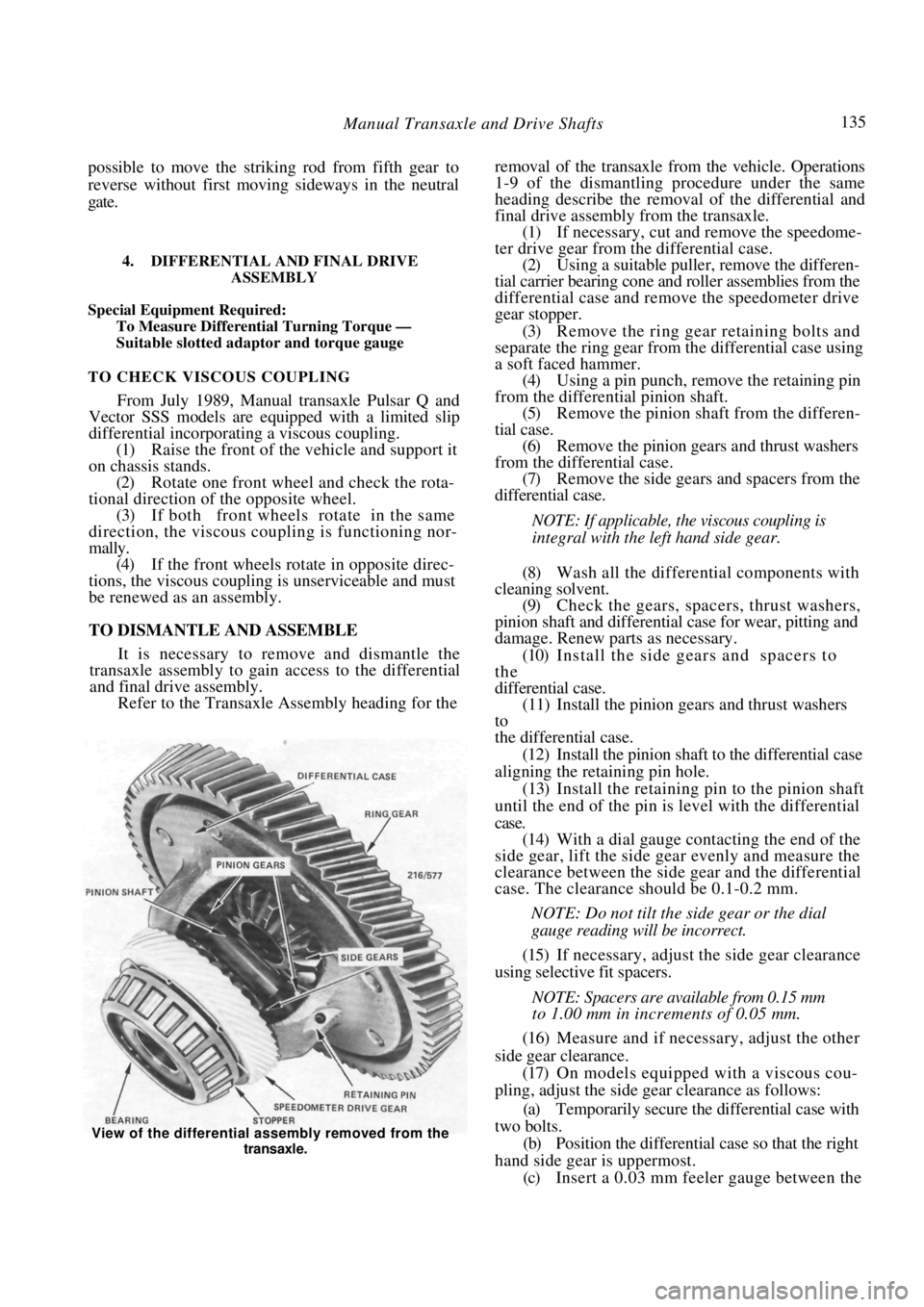
(1) If necessary, cut and remove the speedome-
ter drive gear from the differential case. (2) Using a suitable puller, remove the differen-
tial carrier bearing cone and roller assemblies from the
differential case and remove the speedometer drive
gear stopper.
(3) Remove the ring gear retaining bolts and
separate the ring gear from the differential case using
a soft faced hammer.
(4) Using a pin punch, remove the retaining pin
from the differential pinion shaft.
(5) Remove the pinion shaft from the differen-
tial case. (6) Remove the pinion gears and thrust washers
from the differential case. (7) Remove the side gears and spacers from the
differential case.
NOTE: If applicable, the viscous coupling is
integral with the left hand side gear.
(8) Wash all the differential components with
cleaning solvent. (9) Check the gears, spacer s, thrust washers,
pinion shaft and differential case for wear, pitting and
damage. Renew parts as necessary.
(10) Install the side gears and spacers to
the
differential case.
(11) Install the pinion gear s and thrust washers
to
the differential case.
(12) Install the pinion shaft to the differential case
aligning the retaining pin hole. (13) Install the retaining pin to the pinion shaft
until the end of the pin is level with the differential
case. (14) With a dial gauge contacting the end of the
side gear, lift the side gear evenly and measure the
clearance between the side gear and the differential
case. The clearance should be 0.1-0.2 mm.
NOTE: Do not tilt the side gear or the dial
gauge reading will be incorrect.
(15) If necessary, adjust the side gear clearance
using selective fit spacers.
NOTE: Spacers are available from 0.15 mm
to 1.00 mm in increments of 0.05 mm.
(16) Measure and if necessary, adjust the other
side gear clearance. (17) On models equipped with a viscous cou-
pling, adjust the side gear clearance as follows:
(a) Temporarily secure the differential case with
two bolts. (b) Position the differential case so that the right
hand side gear is uppermost. (c) Insert a 0.03 mm feeler gauge between the
View of the differential ass embly removed from the
transaxle.
Page 147 of 238
147
PART 2. MANUAL STEERING
SPECIFICATIONS
Steering gear type ............................ Rack and pinion
Steering column type ...................... Energy absorbing
collapsible and tilt adjustable
Steering wheel free play
(maximum ) ...................................................... 35 mm
Linkage........................... Direct from rack ends to t i e
rods and steering knuckles
Turns lock to lock ................................................. 3.6
Steering column length .................. 534.7-537.3 mm
Steering gear lubricant.............. Castrol EPL 1 grease
TORQUE WRENCH SETTINGS
Steering wheel retaining nut ............................ 39 Nm
Steering gear to bulkhead
mounting bolts .............................................. 108 Nm
Tie rod to steering knuckle nut...................... 98 Nm
Tie rod to tie rod end locknut ....................... 98 Nm
Tie rod ball housing to rack............................ 88 Nm
Steering column to mounting
bracket bolt ...................................................... 14 Nm
Steering column universal
coupling joint pinch bolts ............................... 29 Nm
2. STEERING WHEEL
Special Equipment Required:
To Remove Steering Wheel - Steering wheel
puller
TO REMOVE AND INSTAL
(1) Disconnect the negative battery terminal.
(2) Using a small screwdriver, carefully prise the
centre ornament from the steering wheel.
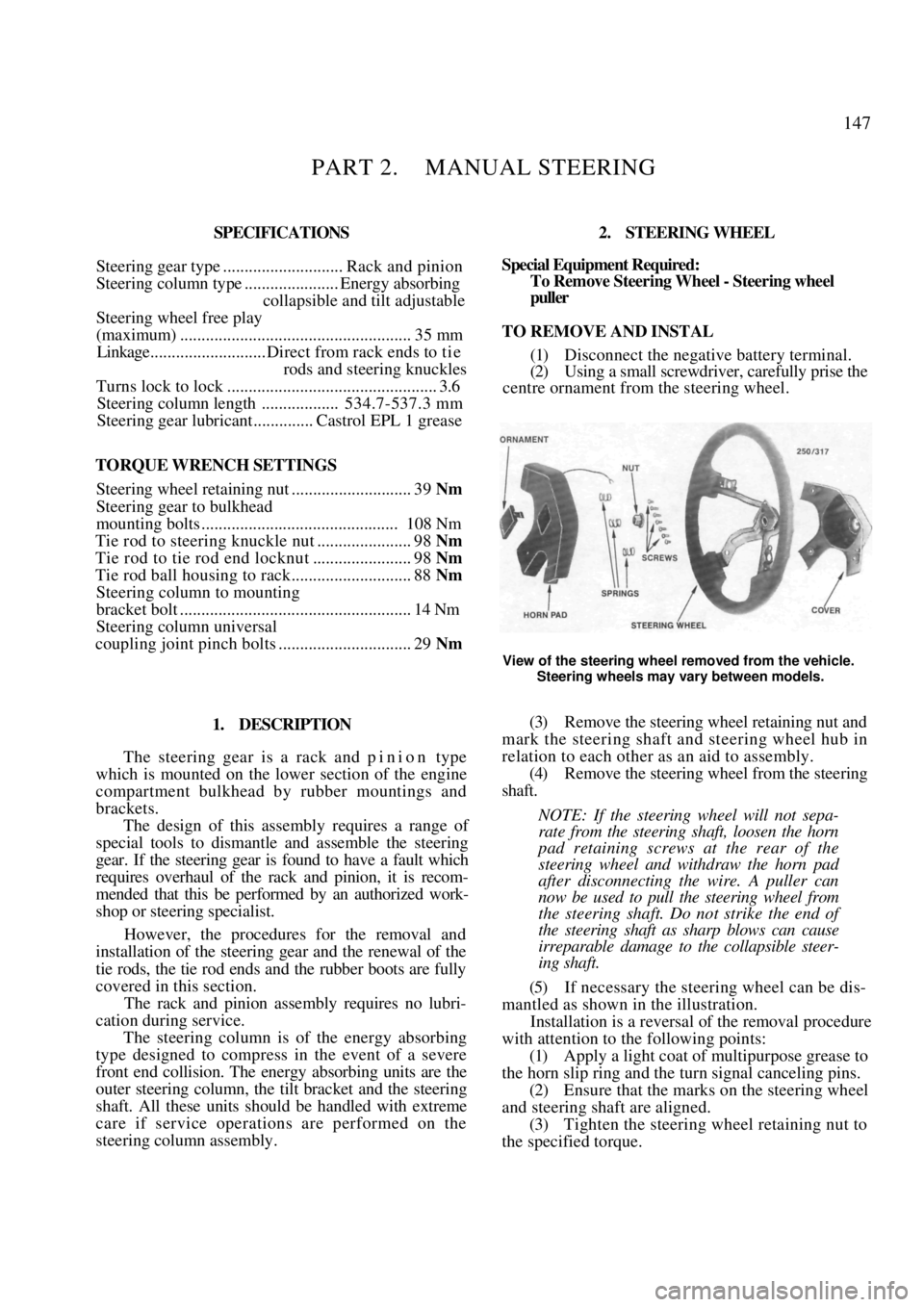
View of the steering wheel removed from the vehicle.
Steering wheels may vary between models.
1. DESCRIPTION
The steering gear is a rack and p i n i o n type
which is mounted on the lower section of the engine
compartment bulkhead by rubber mountings and
brackets.
The design of this assembly requires a range of
special tools to dismantle and assemble the steering
gear. If the steering gear is found to have a fault which
requires overhaul of the rack and pinion, it is recom-
mended that this be performed by an authorized work-
shop or steering specialist.
However, the procedures for the removal and
installation of the steering gear and the renewal of the
tie rods, the tie rod ends and the rubber boots are fully
covered in this section.
The rack and pinion assembly requires no lubri-
cation during service.
The steering column is of the energy absorbing
type designed to compress in the event of a severe
front end collision. The energy absorbing units are the
outer steering column, the tilt bracket and the steering
shaft. All these units shoul d be handled with extreme
care if service operations are performed on the
steering column assembly.
(3) Remove the steering wh eel retaining nut and
mark the steering shaft and steering wheel hub in
relation to each other as an aid to assembly.
(4) Remove the steering wheel from the steering
shaft.
NOTE: If the steering wheel will not sepa-
rate from the steering shaft, loosen the horn
pad retaining screws at the rear of the
steering wheel and withdraw the horn pad
after disconnecting the wire. A puller can
now be used to pull the steering wheel from
the steering shaft. Do not strike the end of
the steering shaft as sharp blows can cause
irreparable damage to the collapsible steer-
ing shaft.
(5) If necessary the steering wheel can be dis-
mantled as shown in the illustration.
Installation is a reversal of the removal procedure
with attention to the following points:
(1) Apply a light coat of multipurpose grease to
the horn slip ring and the turn signal canceling pins.
(2) Ensure that the marks on the steering wheel
and steering shaf t are aligned.
(3) Tighten the steering wheel retaining nut to
the specified torque.
Page 151 of 238

Steering — Part 2 151
(8) Slide the rack out of the housing slightly so
that an adjustable spanner can be used to hold the
rack. (9) Using a Stillsons wrench, unscrew the ball
housings in turn using care not to allow the rack to
rotate. Keep all the tie rod parts in order. (10) Inspect the rack boots for cracks and deteri-
oration and renew as necessary. (11) Inspect the tie rod ends for wear and damage
and renew as necessary.
Dismantled view of the tie rod ball housing and the tie
rod end assemblies removed from the steering gear.
Assembly is a reversal of the dismantling proce-
dure with attention to the following points:
(1) Using large Stillsons and a large adjustable
spanner, install the tie rod and ball housing
assemblies
to the rack. Tighten the ball housings to the specified
torque.
NOTE: To avoid damage to the rack or
pinion the adjustable spanner must be
firmly tightened over the rack teeth and the
rack must not be allowed to rotate when
installing the ball housings.
(2) Measure a point 9 mm in from the rear face
of the ball housing of the rack and at 90 deg to the
rack teeth. Centre punch this point.
(3) At this point drill a 4 mm hole, 10 mm deep
through the rack and into the ball housing thread.
(4) Place a locking pin above the hole and drive
it into position.
(5) Lubricate the rack, rack teeth and t i e rod
boot groove with suitable EPL 1 grease. (6) Install the rack boots and secure with the
clamps. Renew the clamps if necessary. (7) Install the tie rod end locknuts and then the
tie rod ends, ensuring that they are screwed on the
same number of turns as was necessary to remove
them.
(8) Tighten the locknuts to the specified torque.
(9) Install the mounting rubbers and brackets
to
the steering gear as noted on removal. (10) Install the steering gear assembly to
the
vehicle as previously described. (11) Check and if necessary adjust the front wheel toe in as described in the Front Suspension section
under the appropriate heading.
TO RENEW TIE ROD END
(1)
Raise the front of the vehicle and support it
on chassis stands. (2) Remove the relevant front wheel.
(3) Loosen the tie rod end locknut and remove
the tie rod end castellated nut. Disconnect the tie rod
from the steering arm by plac ing a suitable dolly or
hammer against one side of the steering arm eye and
striking the opposite side with a hammer. (4) Unscrew the tie rod end from the tie rod,
noting the number of turns necessary to remove it.
(5) Screw the new tie rod end onto the t i e rod
the same number of turn s noted during removal.
(6) Connect the t i e rod to the steering arm and
install the castellated nut. Tighten the nut to the
specified torque and secure it with a new split pin.
(7) Install the front wheel and lower the vehicle
to the ground. (8) Check and if necessary, adjust the front
wheel toe in as described in the Front Suspension
section. Ensure that the rubber boots are not distorted
or twisted on the tie rod when the adjustment is
completed.
TO RENEW RUBBER BOOT
(1) Raise the front of the vehicle and support it
on chassis stands. (2) Remove the relevant t i e rod end as previ-
ously described. (3) Release the clamps securi ng the boot to the
tie rod and steering gear housing. (4) Unscrew and remove the locknut from the
tie rod. (5) Remove the rubber boot together with the
outer retaining clamp from the t i e rod. (6) Sparingly lubricate th e tie rod boot groove
with EPL 1 grease, install the new boot to the t i e
rod
and push it onto the steering gear rack housing. Install
and secure the inner and outer retaining clamps.
(7) Install the tie rod end locknut and screw
the
tie rod end onto the tie ro d the same number of turns
noted during removal. (8) Connect the tie rod to the steering arm and
install the castellated nut. Tighten the nut to the
specified torque and secure it with a new split pin. (9) Install the wheel and lower the vehicle to the
ground. (10) Check and if necessary, adjust the front
wheel toe in as described in the Front Suspension
section. Ensure that the rubber boots are not distorted
or twisted when the adjustment is completed.
Page 152 of 238

152
PART 3. POWER STEERING
SPECIFICATIONS
Steering gear type ................Rack and pinion with
integral power cylinder
Steering column type .................... Energy absorbing
collapsible and lilt adjustable
Steering wheel free play ................................. 35 mm
Number of turns lock to lock:
TRW ...............................................................2.82
PR24SA ........................................................... 2.7
Linkage.....................................Direct from rack ends
to ti e rods and steering knuckles
Power steering pump
maximum pr essure.................................... 6 865 kPa
Lubricant ...................................................... Dexron II
TORQUE WRENCH SETTINGS
Steering gear to bulkhead mounting bolts... 108 Nm
Tie rod to steering knuckle nut ...................... 98 Nm
Tie rod to tie rod end locknut....................... 98 Nm
Tie rod ball housing to rack............................ 88 Nm
Power steering pump pulley nut ..................... 68 Nm
1. DESCRIPTION
The vehicles covered by this manual are equipped
with either a TRW power steering system or a
Japanese PR24SA power steering system.
Both types are similar in construction and appear-
ance.
The power steering is a rack and pinion type
which is mounted on the lower section of the engine
compartment bulkhead by rubber mountings and
brackets.
Hydraulic pressure is supplied to the power
steering gear by a pump driven by a drive belt from
the engine.
The power steering pump has a separate fluid
reservoir located on the righ t side of the bulkhead.
No lubrication of the steering gear or steering
pump is required in service and in the event of the
loss of power assistance, the steering will continue to
operate but will require a greatly increased effort.
However, as the steering gear and pump are lubricated
by the power steering fluid, the cause of the loss of
power steering or fluid loss must be determined and
repaired promptly to prevent damage to the steering
pump and to a lesser extent, the steering gear.
The t i e rod ends and rubb er boots can be renewed
without removing the steering gear from the vehicle.
To renew the integral t i e rod and tie rod ball housings,
the steering gear must be removed.
As specialist knowledge and equipment are re-
quired to overhaul the power steering gear and the
hydraulic pump, it is recommended that these op-
erations be carried out by an authorized dealer.
However, procedures for the removal and installa-
tion of the steering gear and pump are fully de-
scribed in this section.
The steering column is of the energy absorbing
type and is designed to collapse in the event of a
severe front end collision. The energy absorbing com-
ponents are the column tu bes, steering shaft and tilt
bracket breakaway capsules. All these components
should be handled with extr eme care if service opera-
tions are to be carried out on the steering column
assembly.
2. IN CAR ADJUSTMENTS, CHECKS AND
MINOR REPAIRS
If the power steering system becomes partially or
fully inoperative it is most important that the follow-
ing preliminary inspection and testing procedure be
performed prior to undertaking any trouble shooting
or repair operations.
PUMP DRIVE BELT
Inspect the pump drive belt for breakage, glazing
or wear. If any of these characteristics are evident,
renew the belt using only a genuine replacement.
If the belt is loose but still serviceable, adjust it
using the procedure outlined in the Engine Tune-up
section.
NOTE: In most cases a loose drive belt can
be heard squealing when a load is placed on
the pump as the steering wheel is turned or
as the engine speed is increased.
Checking the power steering pump drive belt for
deterioration.