engine oil NISSAN PULSAR 1987 Repair Manual
[x] Cancel search | Manufacturer: NISSAN, Model Year: 1987, Model line: PULSAR, Model: NISSAN PULSAR 1987Pages: 238, PDF Size: 28.91 MB
Page 104 of 238
104 Fuel and Engine Management
(3) Gently pull the outer throttle cable until the
inner cable remains taut without moving the throttle
linkage. (4) Install the snap ring into the groove
posi-
tioned second from the insulator.
(5) Depress the throttle pedal and check that the
throttle valve opens fully and returns to the idle
position when the pedal is released. (6) On 1.6 liter engines, install the air
cleaner
assembly.
7. ELECTRONIC COMPONENTS
NOTE: Before proceeding with any of the
operations in this section, refer to the Ser-
vice Precautions and Procedures heading.
TO CHECK IGNITION SYSTEM
(1) Perform the test procedure described in the
Roadside Trouble Shooting section. Repair or renew
components as necessary. (2) Perform the self diagnosis test procedure as
previously described and rectify any faults. If there is
no spark, proceed as follows. (3) Disconnect the 4 pin wiring connector from
the distributor and check for spark at a spark plug
high tension lead using the test spark plug. If there is a spark, renew the pickup coil in the
distributor.
If there is no spark, proceed as follows.
(4) Connect the coil high tension lead to the test
spark plug and check for spark.
If there is a spark, check the distributor cap and
rotor for cracks and moisture. Repair or renew as
necessary.
If there is no spark, proceed as follows.
(5) Disconnect the 2 pin wiring connector from
the distributor. (6) With the ignition switched On. measure the
voltage at terminals A and B on the distributor 2 pin
wiring connector. If the voltage at terminal B only is under 10 volts,
check the wiring harness for continuity between
terminal B on the distributor 2 pin wiring connector
and terminal 2 on the black ignition coil wiring
connector. Repair or renew the wiring harness as
necessary. If no fault is found, renew the ignition coll.
If the voltages at both terminals is under 10 volts,
check the wiring harness between terminal A on the
distributor 2 pin wiring connector and terminal 1 on
the black ignition coil wiring connector for continuity.
Also check the fuel pump fuse and the wiring harness
between the ignition switch and the ignition coil.
Repair or renew the wiring harness as necessary.
If the voltage at both terminals is 10 volts or
more, proceed as follows.
(7) Connect the 2 pin wiring connector to the
distributor. (8) With the ignition switched On, measure the
voltage at the tachometer signal wire.
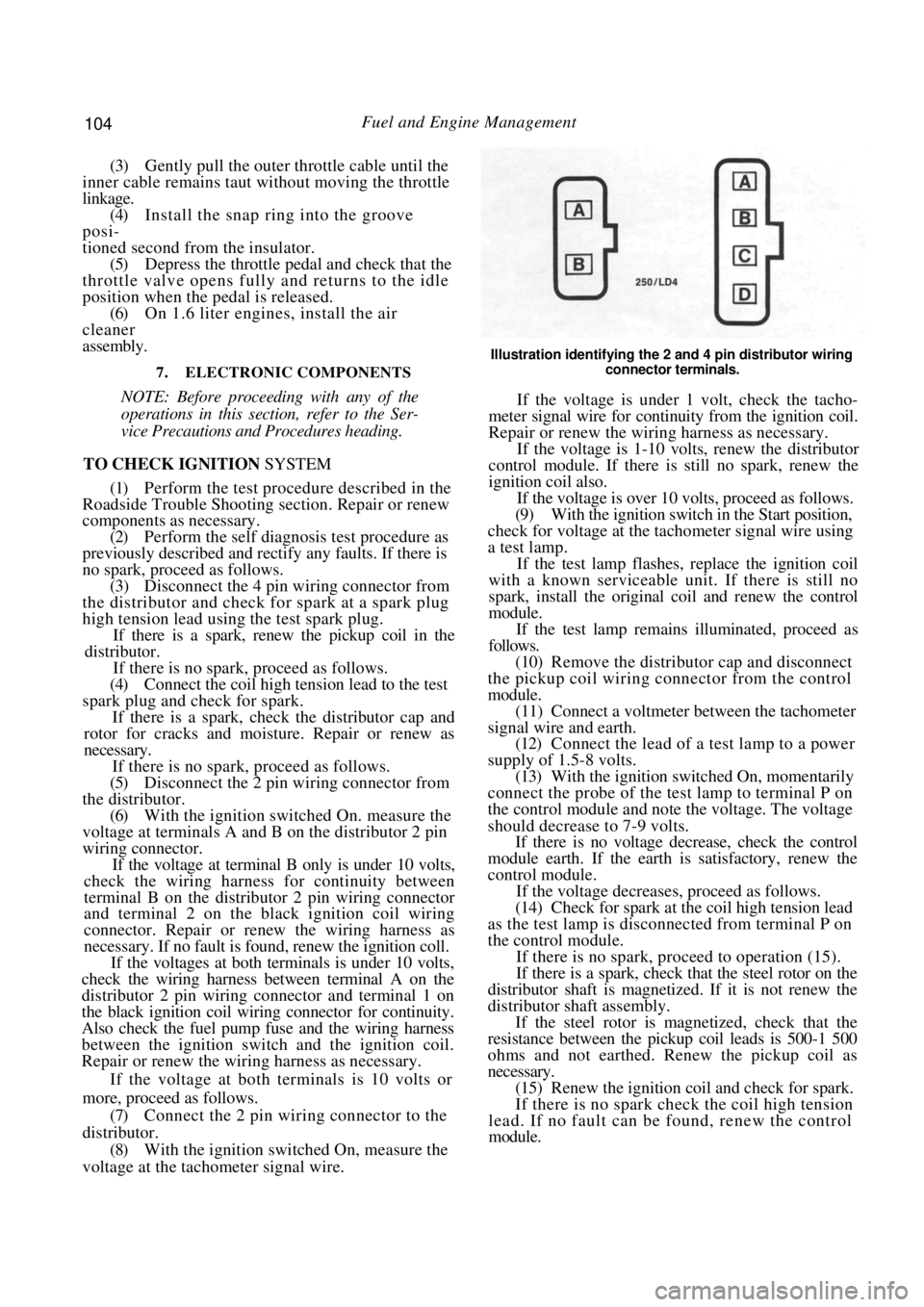
Illustration identifying the 2 and 4 pin distributor wiring
connector terminals.
If the voltage is under 1 volt, check the tacho-
meter signal wire for continuity from the ignition coil.
Repair or renew the wiring harness as necessary.
If the voltage is 1-10 volts, renew the distributor
control module. If there is still no spark, renew the
ignition coil also.
If the voltage is over 10 volts, proceed as follows.
(9) With the ignition switch in the Start position,
check for voltage at the tachometer signal wire using
a test lamp.
If the test lamp flashes, replace the ignition coil
with a known serviceable un it. If there is still no
spark, install the original coil and renew the control
module.
If the test lamp remains illuminated, proceed as
follows.
(10) Remove the distributor cap and disconnect
the pickup coil wiring co nnector from the control
module. (11) Connect a voltmeter between the tachometer
signal wire and earth. (12) Connect the lead of a test lamp to a power
supply of 1.5-8 volts. (13) With the ignition switched On, momentarily
connect the probe of the test lamp to terminal P on
the control module and note the voltage. The voltage
should decrease to 7-9 volts. If there is no voltage decrease, check the control
module earth. If the earth is satisfactory, renew the
control module.
If the voltage decreases , proceed as follows.
(14) Check for spark at the coil high tension lead
as the test lamp is disconnected from terminal P on
the control module.
If there is no spark, proceed to operation (15).
If there is a spark, check that the steel rotor on the
distributor shaft is magnetized. If it is not renew the
distributor shaft assembly.
If the steel rotor is magnetized, check that the
resistance between the pickup coil leads is 500-1 500
ohms and not earthed. Renew the pickup coil as
necessary.
(15) Renew the ignition coil and check for spark.
If there is no spark check the coil high tension
lead. If no fault can be found, renew the control
module.
Page 105 of 238
Fuel and Engine Management 105
DISTRIBUTOR
To Remove and Install
(1) Disconnect the negative battery terminal.
(2) Disconnect the distribu tor wiring connec-
tors.
(3) Disconnect the high tension leads from the
spark plugs. (4) Remove the distributor cap retaining screws
and remove the cap and high tension leads from the
vehicle. (5) Turn the engine in the normal direction of
rotation until the mark on the crankshaft pulley aligns
with the timing pointer and the rotor is pointing
towards the No. 1 spark pl ug lead terminal on the
distributor cap. (6) Mark the distributor body to camshaft hous-
ing relationship to aid in setting the ignition timing on
installation.
(7) Remove the distributor retaining nuts and
withdraw the distributor from the camshaft housing.
Installation is a reversal of the removal procedure
with attention to the following points:
(1) Ensure that the engine has not been rotated
while the distributor has been removed. If the engine
has been rotated, align the timing marks and ensure
that No. 1 piston is on the compression stroke.
(2) Check and renew the distributor base O ring
if the sealing quality is suspect. (3) Install the distributor to the camshaft
hous-
ing, aligning the coupling with the slot in the camshaft
and ensuring that the rotor does not move in relation
to the distributor body. Align the marks made on
removal. (4) Install and securely tighten the distributor
retaining nuts. (5) Install the distributor cap and tighten
the
retaining screws.
(6) Connect the distributor wiring connector.
(7) Connect the negative battery terminal and
check the ignition timing as previously described in
this section.
To Dismantle and Assemble
With the distributor removed from the engine and
the distributor cap removed, dismantle the distributor
as follows:
(1) Disconnect the pickup coil wiring connector
from the control module. (2) Measure the resistance between the terminals
on the pickup coil wiring connector and the distribu-
tor body. The r esistance should be infinity.
(3) Measure the resistance between the terminals
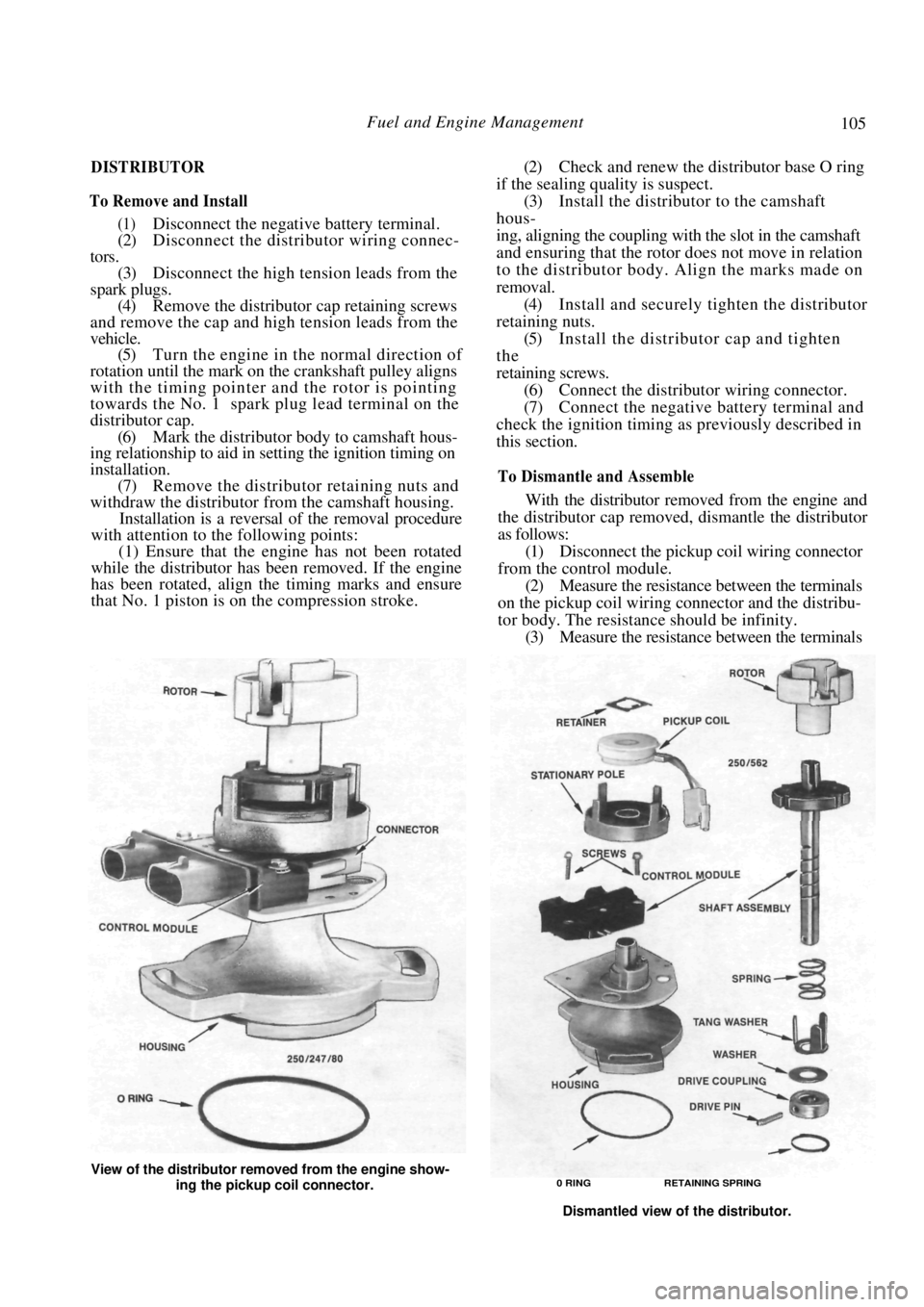
View of the distributor removed from the engine show-
ing the pickup coil connector. 0 RING RETAINING SPRING
Dismantled view of the distributor.
Page 106 of 238
106 Fuel and Engine Management
on the pickup coil wiring connector. The resistance
should be 500-1 500 ohms.
If the resistance is not as specified in either of the
above tests, renew the pickup coil.
(4) Remove the retaining spring from the dis-
tributor drive coupling.
(5) Using a pin punch, remove the drive pin
from the shaft. (6) Remove the drive coupling, washer, tang
washer and thrust spring from the shaft. (7) Remove the rotor and sh aft from the distrib-
utor housing. (8) Remove the retainer from the distributor
housing and withdraw the pickup coil. (9) Remove the retaining sc rews and remove the
control module from the distributor body. (10) Carefully lever the stationary pole from the
housing using a suitable screwdriver. Assembly is a reversal of the dismantling proce-
dure with attention to the following points:
(1) Ensure that the mating surfaces of the dis-
tributor housing and the control module are clean.
(2) Apply a silicone heat sink compound to the
surfaces between the control module and the distrib-
utor housing.
IGNITION COIL
To Test
(1) Disconnect the grey wiring connector and the
black wiring connector from the ignition coil in that
order. (2) Measure the resistance between coil terminal
I and the coil body. There should be a high resistance. (3) Measure the resistance between coil termi-
nals 2 and 4. There should be a low resistance. (4) Measure the resistance between coil terminal
3 and the high tension termin al. The resistance should
be other than infinity.
If any of the tests indicate a fault, renew the
ignition coil.
To Remove and Install
(1) Disconnect the negative battery terminal.
(2) Disconnect the grey wiring connector and the
black wiring connector from the ignition coil in that
order. Disconnect the high tension lead. (3) Remove the coil mounting bracket retaining
bolts and remove the coil and bracket from the
engine. Installation is a reversal of the removal procedure.
ELECTRONIC SPARK TIMING
To Test - Code 42
(1) Erase the self diagnosis code memory as
previously described. (2) Start and run the engine at idle speed for 60
seconds or until the ECM warning lamp lights.
(3) Stop the engine, switch the ignition On and
connect a jumper lead between terminals A and B on
the diagnostic link connector . Note any fault codes
displayed. If code 42 is displayed, proceed to operation (4).
If code 42 is not displayed, but was displayed
when the self diagnosis test procedure was originally
performed, an intermittent fault is indicated. Proceed
as follows:
(a) Check for faulty wiri ng connections. Check
that all wiring connectors are clean and secure.
(b) Check that all earth wires are secure.
(4) With the ignition switched Off, disconnect
the control unit wiring connectors. (5) With the ignition switched On, measure the
resistance between the contro l unit wiring connector
terminal D4 and a good earthing point. The resistance
should be less than 500 ohms.
If the ohmmeter reading is as specified, check the
wiring harness between the distributor 4 pin wiring
connector terminal D and the control unit wiring
connector terminal D4 for continuity. Repair or
renew the wiring harness as necessary. Also ensure
that the distributor 4 pin wiring connector is making
good contact when connected to the distributor.
If no fault can be found, renew the ignition
control module.
If the resistance is as specified proceed as follows.
(6) With the lead of a test lamp connected to the
positive battery terminal, backprobe the control unit
wiring connector terminal D5.
If the test lamp does not light, proceed to
operation (7).
If the test lamp lights, disconnect the 4 pin wiring
connector from the distributor. If the test lamp
remains illuminated check the wiring harness between
the distributor 4 pin wiring connector terminal B and
the control unit wiring connector terminal D5 for
shorts to earth. Repair or renew the wiring harness as
necessary. If the test lamp extinguishes, renew the
ignition system control module.
(7) Connect an ohmmeter between the control
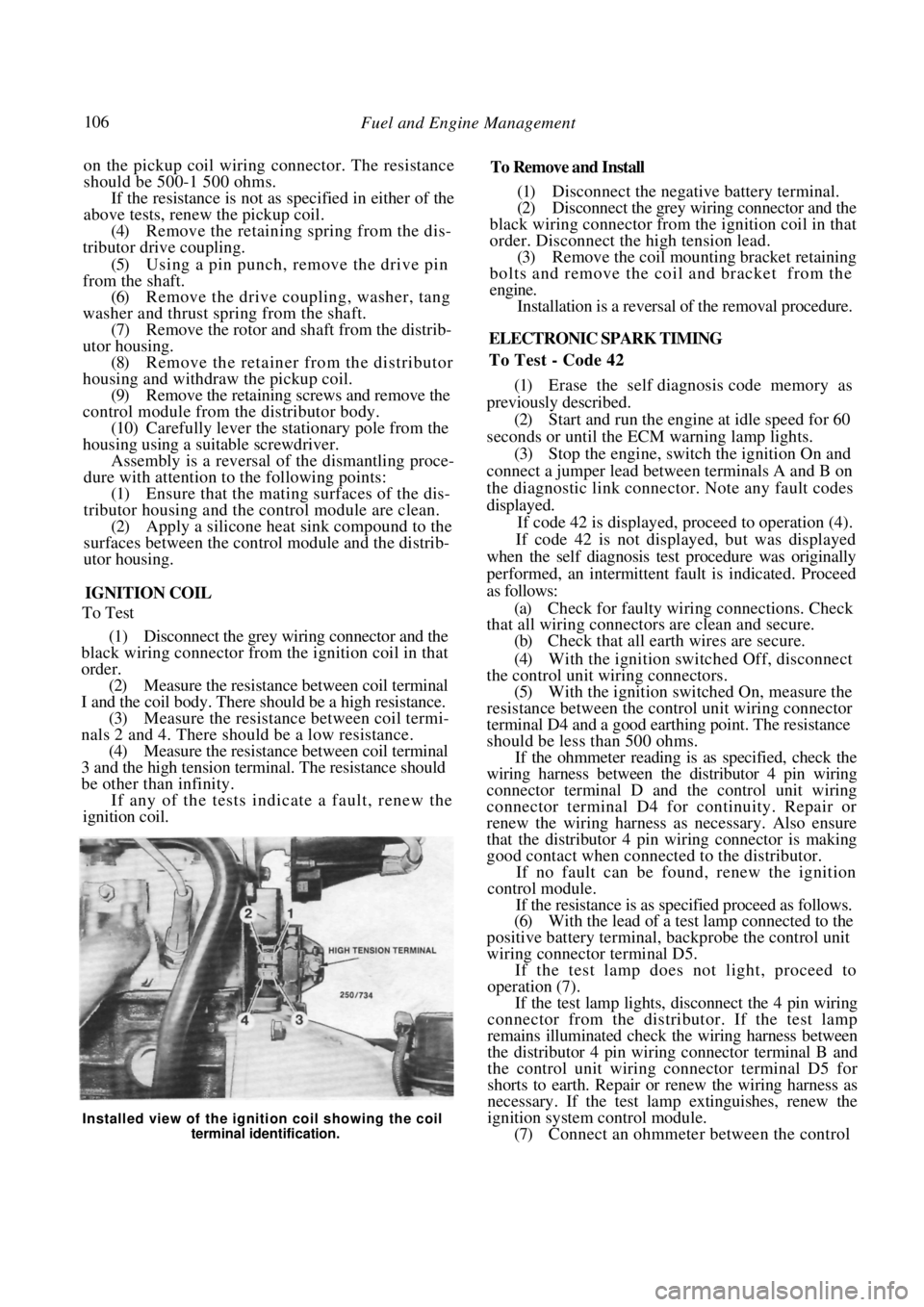
Installed view of the ignition coil showing the coil
terminal identification.
Page 117 of 238
117
EMISSION CONTROL
INTRODUCTION
To reduce the output level of the three primary
automotive emissions, carbon monoxide (CO), hydro-
carbons (HC) and oxides of nitrogen (NOx), and thus
comply with legislation on the maintenance of clean
air, several different emissi on control systems are used
in the Pulsar range of vehicles covered by this manual.
The systems will be discussed under the headings
( 1 ) Crankcase Ventilation System, (2) Evaporative
Control System, (3) Air Preheat System — 1.6 Liter
Engine and (4) Exhaust Control System.
1. CRANKCASE VENTILATION SYSTEM
DESCRIPTION
The crankcase ventilation system is of the closed
type and is designed to prevent crankcase vapors
being emitted into the atmosphere. Crankcase
vapors are caused by gases escaping past the piston
rings into the crankcase during the combustion pro-
cess.
The crankcase vapors are collected in the cam-
shaft housing from the cra nkcase via the various oil
drain passages and the pipe from the side of the
crankcase.
The crankcase vapors are then drawn into the
engine via a branched hose connected to the camshaft
housing oil baffle and the throttle body (1.8 liter
engines) or inlet manifold (1.6 liter engines).
At idle speed, vapors are drawn through the
small branch of the hose and into the engine.
As the engine speed increases, vapors are also
drawn into the engine via the main hose.
TO SERVICE THE SYSTEM
(1) At intervals of 40 000 km, disconnect the
small engine ventilation hose from the throttle body
or inlet manifold and check that the metering orifice
is not blocked.
If necessary, clean the orifice using compressed air
and solvent.
(2) Disconnect all the engine ventilation hoses
and check for blocking, collapsing and deterioration.
Renew the hoses as necessary.
2. EVAPORATIVE CONTROL SYSTEM
Special Equipment Required:
To Test Purge Valve — Hand vacuum pump
DESCRIPTION
The evaporative control system reduces the
amount of hydrocarbons emitted to the atmosphere
through fuel evaporation.
The vehicles covered by this manual use an
absorption regeneration system to reduce vapor loss.
The system utilizes a canister of activated charcoal to
trap and hold the fuel vapors until they can be fed
into the induction system for burning in the combus-
tion chambers.
The basic components of the evaporative control
system are a fuel tank with a sealed filler cap, a
charcoal canister with a pur ge control valve, a fuel
check valve and pipes a nd hoses to connect the
various components.
NOTE: The fuel tank filler cap is not vented
to the atmosphere but is equipped with a one
way relief valve to prevent a vacuum form-
ing in the fuel tank.
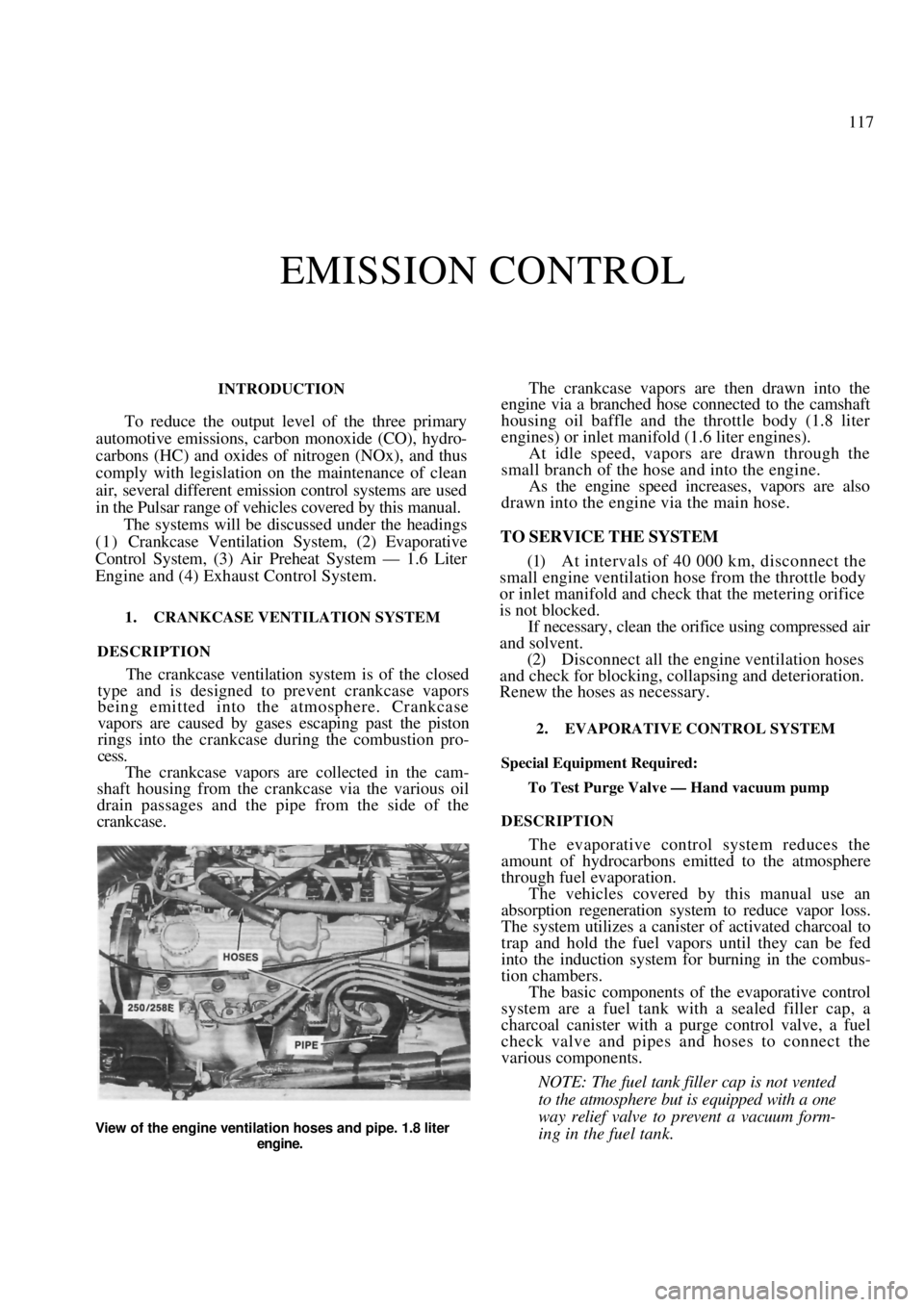
View of the engine ventilation hoses and pipe. 1.8 liter
engine.
Page 120 of 238

120 Emission Control
If the flap does not operate as described, renew
the air cleaner housing.
(2) Disconnect the vacuum hose from the servo
unit and connect it to a vacuum gauge.
(3) Start and run the engine at approximately
1 200 rpm. If the engine is cold there should be
vacuum. (4) As the engine temperature increases the
vacuum should decrease to zero. If the vacuum gauge does not read as described,
check that the vacuum supply hose is connected to the
thermal vacuum valve and the throttle body.
If no fault is found, renew the thermal vacuum
valve.
4. EXHAUST CONTROL SYSTEM
DESCRIPTION
The exhaust system is the greatest source of
pollutant emission from the internal combustion
engine.
On the Pulsar range of vehicles covered by this
manual, the exhaust control system consists of a
catalytic converter and the engine management sys-
tem. The engine management system constantly mon-
itors the exhaust gases via an oxygen sensor located in
the exhaust system. Fuel injection is then adjusted
accordingly to give the minimum amount of exhaust
emissions. Refer to the Fuel and Engine Management
section for further information.
CATALYTIC CONVERTER
The catalytic converter, which is located in the
exhaust system, converts hydrocarbons, oxides of
nitrogen and carbon monoxide present in the exhaust
gases into carbon dioxide, nitrogen, water and heat.
The catalytic converter does not require periodic
maintenance or replacement under normal circum-
stances. However, it can be damaged or poisoned by
excessively high exhaust gas temperatures, raw fuel
and the use of leaded fuel.
Installed view of the catalytic converter.
To prevent the use of leaded fuel, a small diam-
eter fuel filler neck with a spring loaded trap door is
used.
To prevent damage to the catalytic converter, the
following precautions sh ould be observed.
(1) Do not operate the vehicle on leaded fuel.
(2) Do not push or tow start the vehicle.
(3) Do not allow the engine to idle for prolonged
periods. (4) Do not operate the vehicle if the engine is
misfiring.
(5) Avoid running the vehicle out of fuel.
(6) Ensure that the engine oil is formulated to
contain low phosphorous levels.
To Inspect Catalytic Converter
(1) Inspect the converter for dents and damage.
If the converter is damaged, it should be renewed. (2) Inspect the converter heat shield for damage
and ensure that it is positioned correctly. Renew the
converter heat shield if necessary.
To Remove and Install
To remove and install the catalytic converter,
refer
to the Exhaust System heading in the Engine section.
Page 121 of 238
121
CLUTCH
SPECIFICATIONS
Type................................................... Single dry plate
Operation................................................... Mechanical
Pressure plate type .................................... Diaphragm
Release bearing type .......................Prelubri cated ball
Driven plate:
Outside diameter .................................... 215 mm
Rivet depth limit ....................................0.3 mm
Runout limit .........................................0.5 mm
Maximum spline backlash ...................0.7 mm
Pressure plate:
Diaphragm spring height
(installed) ...................................... 30.5-32.5 mm
Spring finger vari ation limit.....................0.5 mm
Clutch pedal:
Height .............................................. 175-185 mm
Free play ....................................... 12.5-17.5 mm
Release lever free play............................ 2.5-3.5 mm
Flywheel machining limit ...............................0.3 mm
TORQUE WRENCH SETTINGS
Pressure plate bolts.......................................... 29 Nm
Pedal pivot pin nut ......................................... 22 Nm
Cable loc knut.................................................... 4 Nm
Lower clutch housing to engine bolts.............. 21 Nm
Centre and upper clutch housing
to engine bolts .................................................. 49 Nm
1. CLUTCH TROUBLE SHOOTING
CLUTCH SLIPPING
(!) Worn driven plate facing: Check and renew
the clutch driven plate.
(2) Insufficient clutch pedal free play: Check and
adjust the clutch pedal free play. Ensure that the
release lever free play is correct.
(3) Weak or broken pressure plate diaphragm
spring: Check and renew the pressure plate assembly. (4) Worn or scored flywh eel: Machine or renew
the flywheel. Worn or scored pressure plate face: Renew the
pressure plate assembly.
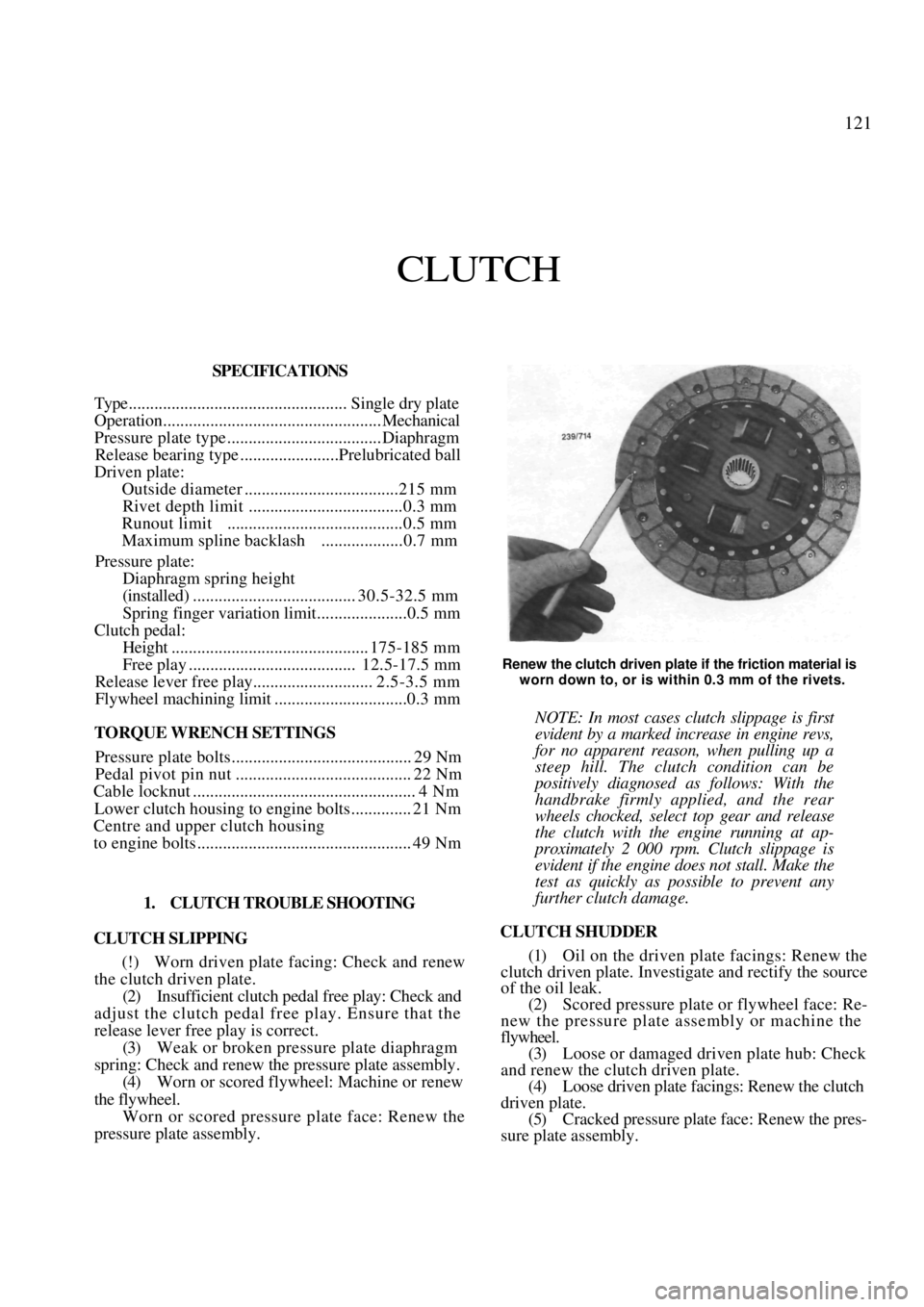
Renew the clutch driven plate if the friction material is
worn down to, or is within 0.3 mm of the rivets.
NOTE: In most cases clutch slippage is first
evident by a marked increase in engine revs,
for no apparent reason, when pulling up a
steep hill. The clutch condition can be
positively diagnosed as follows: With the
handbrake firmly applied, and the rear
wheels chocked, select top gear and release
the clutch with the engine running at ap-
proximately 2 000 rpm. Clutch slippage is
evident if the engine does not stall. Make the
test as quickly as possible to prevent any
further clutch damage.
CLUTCH SHUDDER
(1) Oil on the driven plate facings: Renew the
clutch driven plate. Invest igate and rectify the source
of the oil leak.
(2) Scored pressure plate or flywheel face: Re-
new the pressure plate assembly or machine the
flywheel. (3) Loose or damaged driven plate hub: Check
and renew the clutch driven plate. (4) Loose driven plate facings: Renew the clutch
driven plate. (5) Cracked pressure plate face: Renew the pres-
sure plate assembly.
Page 122 of 238
122 Clutch
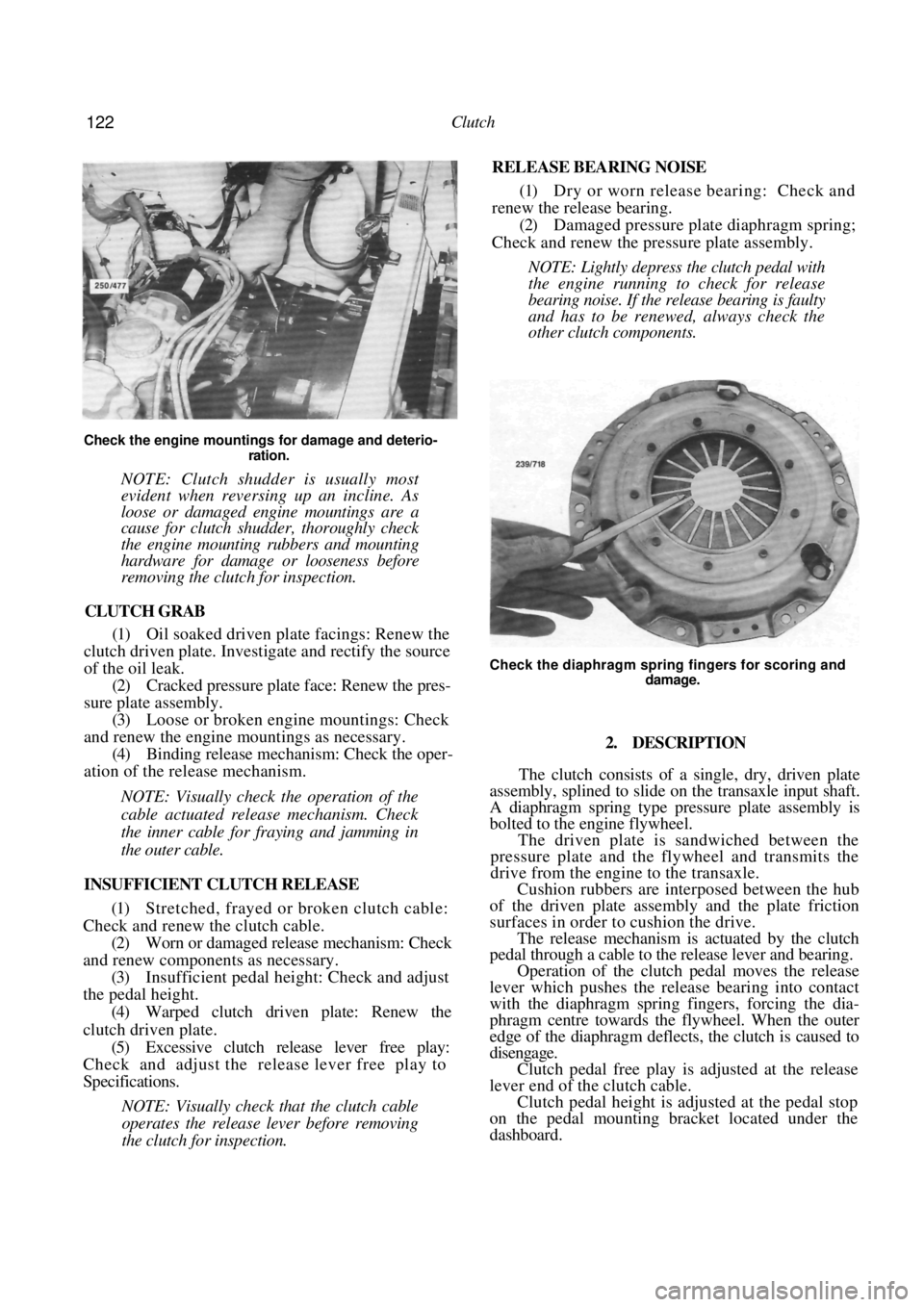
Check the engine mountings for damage and deterio- ration.
NOTE: Clutch shudder is usually most
evident when reversing up an incline. As
loose or damaged engine mountings are a
cause for clutch shudder, thoroughly check
the engine mounting rubbers and mounting
hardware for damage or looseness before
removing the clutch for inspection.
CLUTCH GRAB
(1) Oil soaked driven plate facings: Renew the
clutch driven plate. Invest igate and rectify the source
of the oil leak.
(2) Cracked pressure plate face: Renew the pres-
sure plate assembly. (3) Loose or broken engine mountings: Check
and renew the engine mountings as necessary.
(4) Binding release mechanism: Check the oper-
ation of the release mechanism.
NOTE: Visually check the operation of the
cable actuated release mechanism. Check
the inner cable for fraying and jamming in
the outer cable.
INSUFFICIENT CLUTCH RELEASE
(1) Stretched, frayed or broken clutch cable:
Check and renew the clutch cable. (2) Worn or damaged release mechanism: Check
and renew components as necessary. (3) Insufficient pedal height: Check and adjust
the pedal height.
(4) Warped clutch driven plate: Renew the
clutch driven plate. (5) Excessive clutch release lever free play:
Check and adjust the release lever free play to
Specifications.
NOTE: Visually check that the clutch cable
operates the release lever before removing
the clutch for inspection.
RELEASE BEARING NOISE
(1) Dry or worn release bearing: Check and
renew the release bearing.
(2) Damaged pressure plate diaphragm spring;
Check and renew the pressure plate assembly.
NOTE: Lightly depress the clutch pedal with
the engine running to check for release
bearing noise. If the release bearing is faulty
and has to be renewed, always check the
other clutch components.
Check the diaphragm spring fingers for scoring and damage.
2. DESCRIPTION
The clutch consists of a single, dry, driven plate
assembly, splined to slide on the transaxle input shaft.
A diaphragm spring type pr essure plate assembly is
bolted to the engine flywheel.
The driven plate is sandwiched between the
pressure plate and the flywheel and transmits the
drive from the engine to the transaxle.
Cushion rubbers are interposed between the hub
of the driven plate assembly and the plate friction
surfaces in order to cushion the drive.
The release mechanism is actuated by the clutch
pedal through a cable to the release lever and bearing.
Operation of the clutch pedal moves the release
lever which pushes the release bearing into contact
with the diaphragm spring fingers, forcing the dia-
phragm centre towards the flywheel. When the outer
edge of the diaphragm deflects, the clutch is caused to
disengage.
Clutch pedal free play is adjusted at the release
lever end of the clutch cable.
Clutch pedal height is adjusted at the pedal stop
on the pedal mounting bracket located under the
dashboard.
Page 127 of 238
Manual Transaxle and Drive Shafts 127
(6) Lubricating oil too thick: Drain the transaxle
and refill with the corre ct amount and grade of
lubricating oil. (7) Excessive end float in the mainshaft or input
shaft gears: Overhaul the transaxle.
NOTE: Check the clutch for correct opera-
tion. If reverse gear can be selected without
any gear clash this is a good indication that
the clutch is operating normally. Also check
that the correct type and grade of lubricating
oil is being used.
SLIPPING OUT OF GEAR
(1) Worn gear control rod assembly bushes:
Check and renew the worn components as necessary. (2) Faulty gear lever assembly: Check and renew
the faulty components. (3) Faulty synchroniser mechanism: Overhaul
the transaxle.
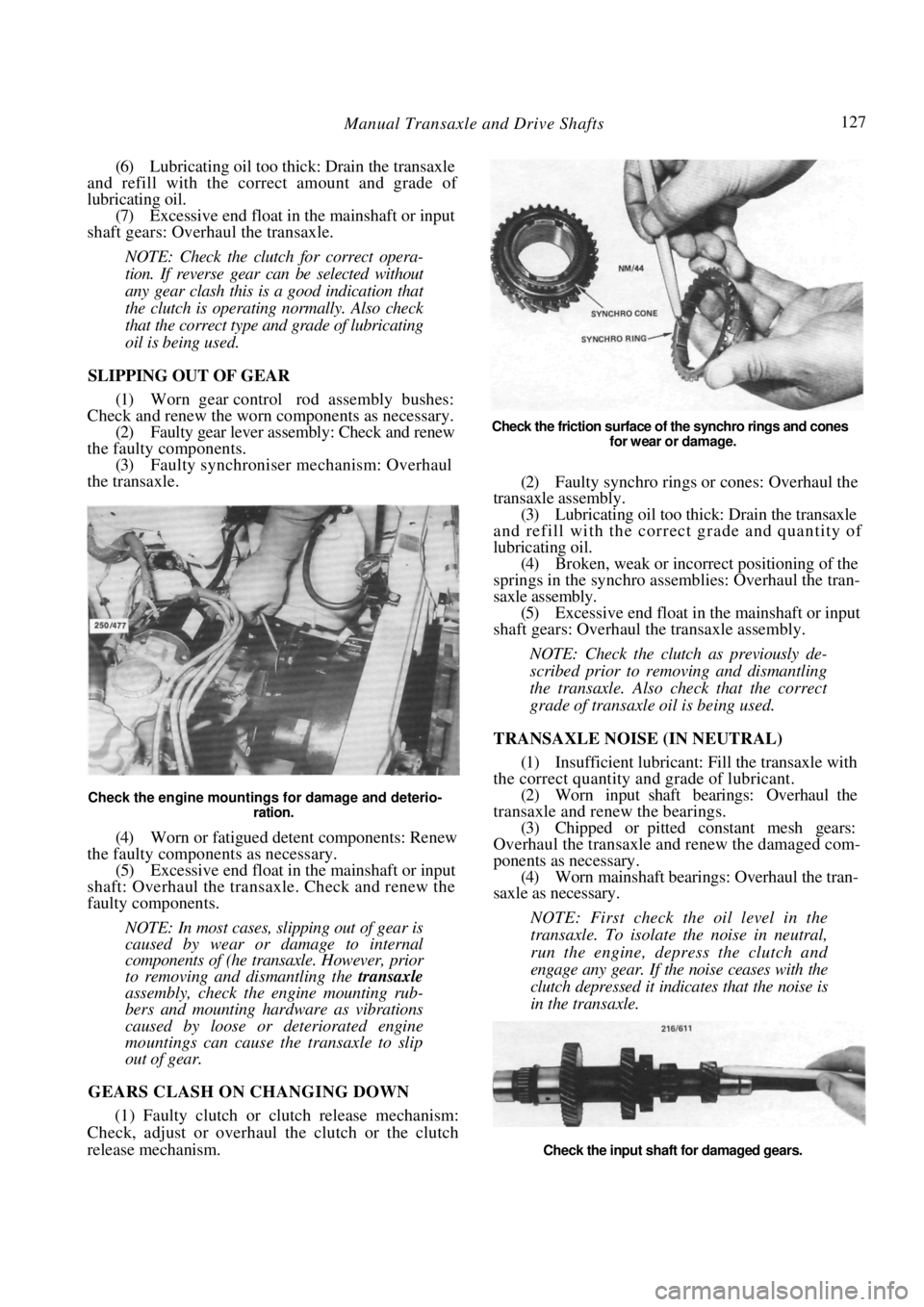
Check the engine mountings for damage and deterio-
ration.
(4) Worn or fatigued detent components: Renew
the faulty components as necessary.
(5) Excessive end float in the mainshaft or input
shaft: Overhaul the transaxle. Check and renew the
faulty components.
NOTE: In most cases, slipping out of gear is
caused by wear or damage to internal
components of (he tran saxle. However, prior
to removing and dismantling the transaxle
assembly, check the engine mounting rub-
bers and mounting hardware as vibrations
caused by loose or deteriorated engine
mountings can cause the transaxle to slip
out of gear.
GEARS CLASH ON CHANGING DOWN
(1) Faulty clutch or clutch release mechanism:
Check, adjust or overhaul the clutch or the clutch
release mechanism.
Check the friction surface of the synchro rings and cones
for wear or damage.
(2) Faulty synchro rings or cones: Overhaul the
transaxle assembly.
(3) Lubricating oil too thick: Drain the transaxle
and refill with the correct grade and quantity of
lubricating oil. (4) Broken, weak or incorrect positioning of the
springs in the synchro asse mblies: Overhaul the tran-
saxle assembly.
(5) Excessive end float in the mainshaft or input
shaft gears: Overhaul the transaxle assembly.
NOTE: Check the clutch as previously de-
scribed prior to removing and dismantling
the transaxle. Also check that the correct
grade of transaxle oil is being used.
TRANSAXLE NOISE (IN NEUTRAL)
(1) Insufficient lubricant: Fill the transaxle with
the correct quantity and grade of lubricant. (2) Worn input shaft bearings: Overhaul the
transaxle and renew the bearings. (3) Chipped or pitted constant mesh gears:
Overhaul the transaxle and renew the damaged com-
ponents as necessary. (4) Worn mainshaft bearings: Overhaul the tran-
saxle as necessary.
NOTE: First check the oil level in the
transaxle. To isolate the noise in neutral,
run the engine, depress the clutch and
engage any gear. If the noise ceases with the
clutch depressed it indicates that the noise is
in the transaxle.
Check the input shaft for damaged gears.
Page 129 of 238
Manual Transaxle and Drive Shafts 129
renewed as individual units. The C.V. joints are
lubricated in manufacture and need no attention in
service unless one of the r ubber boots is damaged. In
this case the joint can be cl eaned and repacked with
the recommended grease and a new boot installed.
From July 1989, Pulsar Q and Vector SSS manual
transaxle models are equipped with a limited slip
differential incorporating a viscous coupling. The
coupling is not repairable and must be renewed as an
assembly if unserviceable. A test procedure for the
viscous coupling is included in the text in this section.
3. TRANSAXLE ASSEMBLY
Special Equipment Required:
To Dismantle and Assemble — Puller set, press
and press plates, dial gauge
To Measure Mainshaft Turning Torque —
Suitable slotted adaptor and torque gauge
TO REMOVE AND INSTAL
(1) Raise the front of the vehicle and support it
on chassis stands.
(2) Remove the battery as described in the
Electrical System section. (3) Remove the drive shafts as described later in
this section. (4) Disconnect and remove the starter motor as
described in the Elect rical System section.
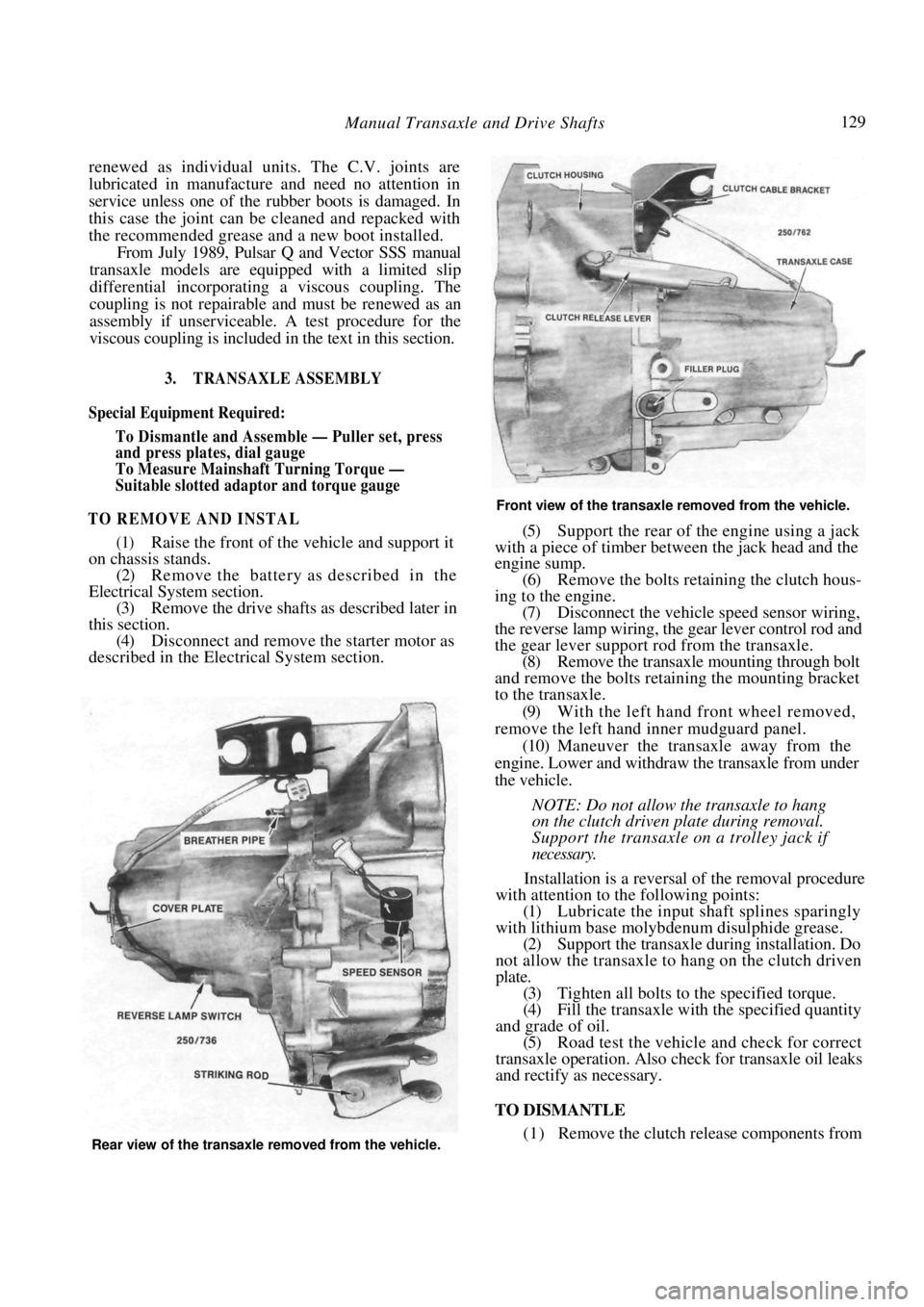
Front view of the transaxle removed from the vehicle.
(5) Support the rear of the engine using a jack
with a piece of timber between the jack head and the
engine sump.
(6) Remove the bolts retaining the clutch hous-
ing to the engine. (7) Disconnect the vehicle speed sensor wiring,
the reverse lamp wiring, the gear lever control rod and
the gear lever support rod from the transaxle. (8) Remove the transaxle mounting through bolt
and remove the bolts retaining the mounting bracket
to the transaxle.
(9) With the left hand front wheel removed,
remove the left hand inner mudguard panel. (10) Maneuver the transaxle away from the
engine. Lower and withdraw the transaxle from under
the vehicle.
NOTE: Do not allow the transaxle to hang
on the clutch driven plate during removal.
Support the transaxle on a trolley jack if
necessary.
Installation is a reversal of the removal procedure
with attention to the following points:
(1) Lubricate the input shaft splines sparingly
with lithium base molybdenum disulphide grease. (2) Support the transaxle during installation. Do
not allow the transaxle to hang on the clutch driven
plate. (3) Tighten all bolts to the specified torque.
(4) Fill the transaxle with the specified quantity
and grade of oil. (5) Road test the vehicle and check for correct
transaxle operation. Also ch eck for transaxle oil leaks
and rectify as necessary.
TO DISMANTLE
(1) Remove the clutch release components from Rear view of the transaxle removed from the vehicle.
Page 136 of 238

136 Manual Transaxle and Drive Shafts
right hand side gear and the adjacent spacer in an area
where there is no oil groove in the differential case.
(d) Insert another 0.03 mm feeler gauge diago-
nally opposite the first feeler gauge to avoid tilting the
side gear.
(e) Insert a splined adaptor into the right hand
side gear and attempt to rotate the gear by hand.
(f) If the gear cannot be rotated, change the
thickness of the left hand side gear spacer, repeating
the test until the gear can be rotated.
NOTE: Spacers are available in thicknesses
from 0.8 mm to 1.5 mm in increments of
0.1 mm.
(g) Remove the 0.03 mm feel er gauges and insert
0.09 mm feeler gauges to the same position. The gear
should lock.
(h) The spacer selection is correct when the right
hand side gear can be rotated with 0.03 mm feeler
gauges inserted but locks when 0.09 mm feeler gauges
are inserted.
(18) Install the ring gear to the differential case
with the chamfered edge of the ring gear inwards. (19) Install and tighten the retaining bolts in
a
diagonal sequence to the specified torque.
(20) Install a new speedometer drive gear to
the
differential case. Install the stopper adjacent to the
drive gear.
(21) Install the differentia] carrier bearing
cones
and roller assemblies to the differential case.
(22) Remove the adjusting shim from behind the
carrier bearing outer race in the transaxle case and
replace the outer race in the transaxle case.
(23) Install the differential assembly to the clutch
housing. (24) Install the transaxle case to the clutch housing
and tighten the retaining bolts to the specified torque.
(25) Mount a dial gauge to the clutch housing so
that the contact point is resting on the differential
case. (26) Insert a bar through the opposite side gear
and, contacting the pinion shaft, raise and lower the
differential case and measure the end float in the
carrier bearings. (27) Using the following table, select a shim to
correspond to the relevant end float.
END FLOAT SHIM THICKNESS
0.30-0.34 mm....................................................0.64 mm
0.34-0.38 mm................................................... 0.68 mm
0.38-0.42 mm................................................... 0.72 mm
0.42-0.46 mm................................................... 0.76 mm
0.46-0.50 mm................................................... 0.80 mm
0.50-0.54 mm................................................... 0.84 mm
0.54-0.58 mm................................................... 0.88 mm
0.58-0.62 mm................................................... 0.92 mm
0.62-0.66 mm................................................... 0.96 mm
0.66-0.70 mm................................................... 1.00 mm
0.70-0.74 mm................................................... 1.04 mm
0.74-0.78 mm ................................................... 1.08 mm
0.78-0.82 mm ................................................... 1.12 mm
0.82-0.86 mm ................................................... 1.16 mm
0.86-0.90 mm ................................................... 1.20 mm
0.90-0.94 mm ................................................... 1.24 mm
0.94-0.98 mm ................................................... 1.28 mm
0.98-1.02 mm ................................................... 1.32 mm
1.02-1.06 mm ................................................... 1.36 mm
1.06-1.10 mm ................................................... 1.40 mm
1.10-1.14 mm ................................................... 1.44 mm
1.14-1.18 mm ................................................... 1.48 mm
1.18-1.22 mm ................................................... 1.52 mm
1.22-1.26 mm ................................................... 1.56 mm
1.26-1.30 mm ................................................... 1.60 mm
1.30-1.34 mm ................................................... 1.64 mm
1.34-1.38 mm ................................................... 1.68 mm
1.38-1.42 mm ................................................... 1.72 mm
1.42-1.46 mm ................................................... 1.76 mm
The thickest shim available is 0.88 mm. Multiple
shims are required above this thickness.
(28) Install the shim behind the carrier
bearing
outer race in the transaxle case and assemble the unit
once more. (29) Using a suitable slotted adaptor engage the
pinion shaft and using a to rque gauge, measure the
differential turning torque. The turning torque when new carrier bearings
have been installed should be 3.9-7.8 Nm or slightly
lower if the original carrier bearings have been
replaced.
(30) Assemble the transaxle and measure the total
turning torque of the diff erential assembly and the
mainshaft. The total turning torque should be 5.9 to
13.7 Nm with new bearings or slightly lower if the
original bearings have been replaced.
5. GEAR LEVER ASSEMBLY
TO DISMANTLE AND ASSEMBLE
(1) Remove the gear lever knob and remove the
centre console as described in the Body section. If not
previously removed, remove the rubber boot sur-
rounding the gear lever. (2) Raise the front of the vehicle and support it
on chassis stands. Remove the catalytic converter and
heat shield as described in the Engine section.
(3) Remove the bolt and disconnect the control
rod from the bottom of the gear lever, noting the
position of the return spring and bracket.
(4) Remove the nuts retaining the gear lever
socket to the support rod. (5) Working inside the vehicle, lift the gear lever
out of the floor bracket. (6) Separate the lower rubber boot, socket,
spring seat, spring, upper ball seat and lower ball seat
from the gear lever, noting the location of each
component to aid assembly.