power NISSAN QASHQAI 2014 Owner´s Manual
[x] Cancel search | Manufacturer: NISSAN, Model Year: 2014, Model line: QASHQAI, Model: NISSAN QASHQAI 2014Pages: 338, PDF Size: 4.87 MB
Page 257 of 338
CAUTION
•Three-way catalyst equipped models (where
fitted) should not be started by pushing the
vehicle as the three-way catalyst may be dam-
aged.
•XTRONIC transmission (CVT) models cannot
be started by pushing the vehicle. This may
cause transmission damage.
•Never try to start the vehicle by towing it; when
the engine starts, the forward surge could
cause the vehicle to collide with the tow ve-
hicle.
WARNING
•Never continue driving if the engine of your
vehicle overheats. Doing so could cause a ve-
hicle fire.
•Never open the bonnet if steam is coming
out.
•Never remove engine coolant reservoir cap
when the engine is hot. If the engine coolant
reservoir cap is removed while the engine is
hot, pressurised hot water will spurt out and
possibly cause burning, scalding or serious
injury.
•If steam or coolant is coming out of the en-
gine, stand clear of the vehicle to prevent get-
ting injured.
•The engine cooling fan will start whenever the
coolant temperature exceeds preset degrees.
•Be careful not to allow your hands, hair, jewel-
lery or clothing to come into contact with, or
get caught in, the cooling fan or drive belts.
If the engine of your vehicle is overheating (indi-
cated by the engine coolant temperature gauge) or
if you feel a lack of engine power, detect unusual
noise, etc., proceed as follows:
1. Move and park the vehicle safely off the road and
away from traffic.
2. Turn on the hazard warning flasher lights.
3. Apply the parking brake.4. Shift the shift lever (MT models) into the N (Neu-
tral) position, XTRONIC transmission (CVT)
models: move the shift lever to the P (Park) posi-
tion.
DO NOT STOP THE ENGINE.
5. Open all windows.
6. Switch off the air conditioner system (where fit-
ted).
7. Set the heater or air conditioner temperature
control to maximum “HOT” and fan speed con-
trol to maximum speed.
8. Exit the vehicle.
9. Visually inspect and listen for steam or coolant
escaping from the radiator before opening the
bonnet. Wait until no steam or coolant can be
seen before proceeding.
10. Open the bonnet. For details, see “Bonnet
release” in the “3. Pre-driving checks and
adjustments” section.
11. Visually check if the cooling fan is running.
12. Visually check the radiator and radiator hoses
for leakage.
WARNING
If coolant is leaking, the cooling fan belt is
missing or loose or the cooling fan is not run-
ning, stop the engine.
PUSH-STARTING ENGINE OVERHEAT
In case of emergency6-13
Page 258 of 338
13. After the engine cools down, check the coolant
level in the engine coolant reservoir with the
engine running.
14. If the level is low, remove the engine coolant
reservoir cap and add coolant slowly into the
reservoir. After refilling the reservoir to the MAX
level, install the reservoir cap.
WARNING
Before removing the engine coolant reservoir
cap and to avoid the danger of being scalded,
cover the reservoir cap with a rag and loosen
the reservoir cap to the first notch to allow the
steam to escape.
15. Close the bonnet.
Have your vehicle inspected or repaired by a
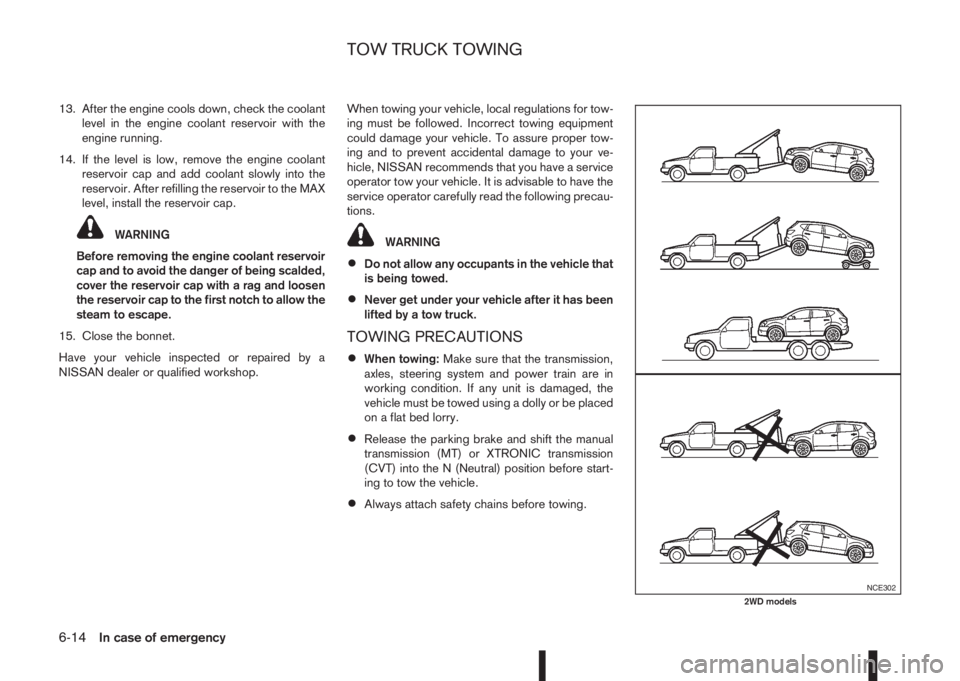
NISSAN dealer or qualified workshop.When towing your vehicle, local regulations for tow-
ing must be followed. Incorrect towing equipment
could damage your vehicle. To assure proper tow-
ing and to prevent accidental damage to your ve-
hicle, NISSAN recommends that you have a service
operator tow your vehicle. It is advisable to have the
service operator carefully read the following precau-
tions.WARNING
•Do not allow any occupants in the vehicle that
is being towed.
•Never get under your vehicle after it has been
lifted by a tow truck.
TOWING PRECAUTIONS
•When towing:Make sure that the transmission,
axles, steering system and power train are in
working condition. If any unit is damaged, the
vehicle must be towed using a dolly or be placed
on a flat bed lorry.
•Release the parking brake and shift the manual
transmission (MT) or XTRONIC transmission
(CVT) into the N (Neutral) position before start-
ing to tow the vehicle.
•Always attach safety chains before towing.
NCE3022WD models
TOW TRUCK TOWING
6-14In case of emergency
Page 310 of 338
Unit: mm (in)
Model mm (in.)
Overall length 2WD/ 4WD 4379 (172.3)
Overall width 2WD/ 4WD 1806 (71.1)
Overall height 2WD 1590 (62.6)
4WD 1595 (62.8)
2WD 1624 (63.9)*1
4WD 1630 (64.2)*1
Front tread 2WD/ 4WD 1560 (61.4)
Rear tread 2WD 1560 (61.4)
2WD*2/4WD 1550 (61)
Wheelbase 2WD/ 4WD 2646 (104.2)
*1 : with roof rail
*2: models with Independent Multi-link type suspen-
sion (where fitted)When planning to travel in another country,you
should first find out if the fuel available is suitable for
your vehicle’s engine.
Using fuel with too low octane/cetane rating may
cause engine damage. Therefore, avoid taking your
vehicle to areas where appropriate fuel is not avail-
able.
When transferring your vehicle registration to an-
other country,check with the appropriate authori-
ties that the vehicle complies with the requirements
as it may not be possible to adapt it. In some cases,
a vehicle cannot meet the legal requirements and in
other cases, it may be necessary to modify the ve-
hicle to meet specific laws and regulations.
The laws and regulations for motor vehicle emission
control and safety standards vary according to the
country; therefore, vehicle specifications may differ.
NISSAN is not responsible for any inconvenience
when the vehicle is taken and registered into an-
other country. The necessary modifications,
transportation and registration are the owner’s
responsibility.
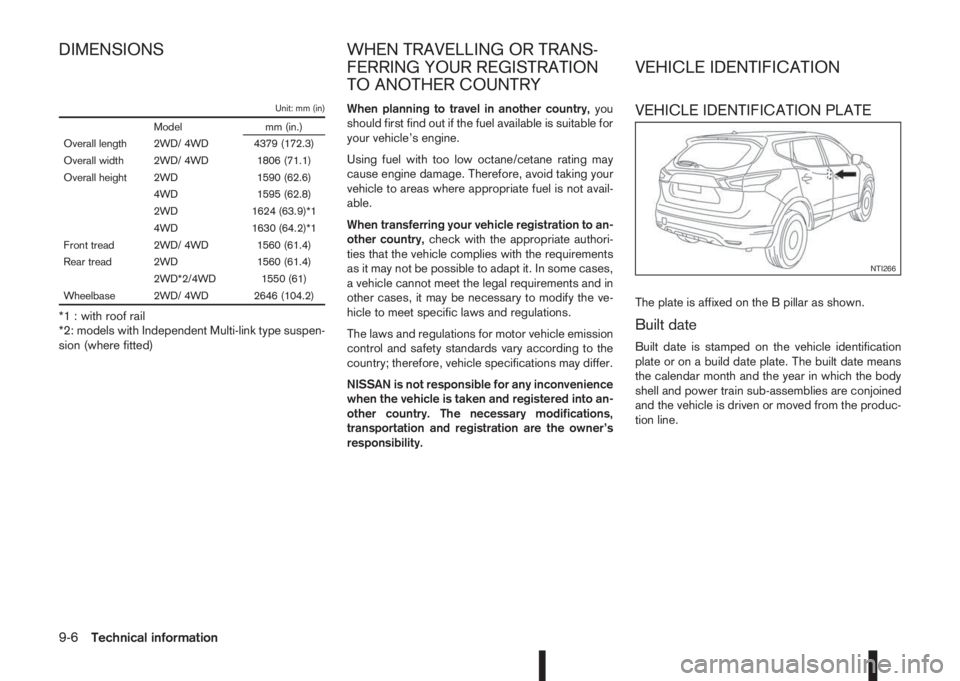
VEHICLE IDENTIFICATION PLATE
The plate is affixed on the B pillar as shown.
Built date
Built date is stamped on the vehicle identification
plate or on a build date plate. The built date means
the calendar month and the year in which the body
shell and power train sub-assemblies are conjoined
and the vehicle is driven or moved from the produc-
tion line.
NTI266
DIMENSIONS WHEN TRAVELLING OR TRANS-
FERRING YOUR REGISTRATION
TO ANOTHER COUNTRYVEHICLE IDENTIFICATION
9-6Technical information
Page 323 of 338
Difference between predictive and actual distances ............... 4-9
Dimensions ........................................................................... 9-6
Door locks ............................................................................ 3-8
– Back door ..................................................................... 3-11
– Child safety rear door locks ........................................... 3-11
– Locking/unlocking with the key — vehicle dead battery .... 3-9
– Power door lock switch ................................................. 3-10
– Remote keyless entry system ........................................... 3-4
– Super Lock system .......................................................... 3-8
– When leaving the vehicle ............................................... 3-10
Drive belts ........................................................................... 8-20
Driving
– Care when driving ......................................................... 5-10
– Cold weather driving ..................................................... 5-66
– Driving four-wheel drive (4WD) safely ............................ 5-28
– Driving on wet road ....................................................... 5-10
– Driving the vehicle ......................................................... 5-17
– Driving under winter conditions ...................................... 5-10
– Driving with manual transmission ................................... 5-17
– On-pavement and off-road driving precautions ................. 5-9
– Precautions when starting and driving .............................. 5-3
– Stop/Start System ......................................................... 5-22
E
ECO mode system .............................................................. 5-65
Electric power steering system ............................................ 5-57
Electronic Stability Programme (ESP) system ...................... 5-60
– ESP OFF switch ........................................................... 5-61
Emergency tyre puncture repair kit ............................... 6-8, 8-36
Emergency/mechanical key ................................................... 3-3
Engine
– Before starting the engine ................................................ 5-2
– Changing engine coolant ................................................. 8-6
– Changing engine oil ......................................................... 8-9
– Changing engine oil filter ............................................... 8-10– Checking engine coolant level ......................................... 8-6
– Checking engine oil level ................................................. 8-8
– Data ................................................................................ 9-5
– Engine cold start period ................................................. 5-10
– Engine compartment .............................................. 0-11, 8-5
– Engine coolant ............................................................... 5-66
– Engine coolant temperature gauge ................................... 2-3
– Engine cooling system ..................................................... 8-6
– Engine oil ........................................................................ 8-8
– Engine overheat ............................................................. 6-13
– Engine serial number ....................................................... 9-7
– Fuel filter (Diesel engine models) ................................... 8-13
– Starting engine .............................................................. 5-15
Exhaust gas (Carbon Monoxide) ............................................ 5-3
Exterior lights ...................................................................... 8-29
F
Filter
– Air cleaner filter ............................................................. 8-23
– Air conditioner filter .............................................. 4-19, 4-22
– Fuel filter (Diesel engine models) ................................... 8-13
Floor mats ............................................................................. 7-4
Fluid
– Brake and clutch fluid .................................................... 8-14
– Continuously variable transmission fluid ......................... 8-13
– Window washer/headlight cleaner fluid .......................... 8-15
Fog light
– Front fog light ................................................................ 2-38
– Rear fog light ................................................................. 2-39
Forward emergency braking system .................................... 5-40
Four-wheel drive (4WD) ...................................................... 5-26
– Driving four-wheel drive (4WD) safely ............................ 5-28
– Four-wheel drive (4WD) model (Tyres) .......................... 8-35
– Four-wheel drive mode indicator light ............................. 5-28
Index10-3
Page 325 of 338
– Starting the engine .......................................................... 3-8
Intelligent Parking Assist (IPA) ............................................. 5-46
Interior lights .............................................................. 2-50, 8-29
iPod® player operation ........................................................ 4-31
ISOFIX ................................................................................ 1-19
ISOFIX child restraint system .............................................. 1-21
J
Jump-starting .............................................................. 6-11, 8-18
K
Key ....................................................................................... 3-2
– Immobilizer ...................................................................... 3-2
– Integrated keyfob (remote control system) ....................... 3-4
– Intelligent Key battery discharge .................................... 5-14
– Intelligent Key operating range ......................................... 3-6
– Intelligent Key system ............................................. 3-6, 5-12
– Key positions (Ignition switch) ........................................ 5-11
– NISSAN Anti-Theft System (NATS) ................................. 3-2
– NISSAN Anti-Theft System (NATS) key ........................... 3-2
– Radio approval number and information ........................... 9-8
– Remote keyless entry system ........................................... 3-4
– Using Intelligent Key system ............................................ 3-6
L
Lane Departure Warning (LDW) .......................................... 5-33
– LDW system operation .................................................. 5-34
Legal requirements .............................................................. 1-15
Light
– Exterior lights ................................................................. 8-29
– Fog light switch ............................................................. 2-38– Hazard warning flasher switch ......................................... 6-2
– Headlight aiming control switch ..................................... 2-39
– Headlight and turn signal switch .................................... 2-36
– Headlight cleaner .......................................................... 2-40
– Headlight switch ............................................................ 2-36
– Headlights ..................................................................... 8-28
– Interior lights ........................................................ 2-50, 8-29
– LED headlight ................................................................ 8-28
– Light locations ............................................................... 8-30
– Luggage compartment ................................................... 2-51
– Map lights ..................................................................... 2-50
– Rear room/reading light ................................................. 2-51
– Trailer direction indicator light ........................................ 5-56
– Turn signal switch .......................................................... 2-38
– Warning/indicator lights and audible reminders ................ 2-4
Lock
– Anti-Lock Braking System (ABS) ................................... 5-59
– Back door lock .............................................................. 3-11
– Child safety rear door locks ........................................... 3-11
– Door locks ....................................................................... 3-8
– Power door lock switch ................................................. 3-10
– Steering lock ........................................................ 5-11, 5-14
– Super Lock system .......................................................... 3-8
– Unlocking with inside door handle .................................. 3-10
Luggage compartment
– Luggage floor ................................................................ 2-47
M
Maintenance
– Camera unit maintenance .............................................. 5-33
– General maintenance ....................................................... 8-2
– Maintenance precautions ................................................. 8-4
– Maintenance requirements ............................................... 8-2
– Multi-sensing camera unit .............................................. 5-35
Manual transmission
– Driving with manual transmission ................................... 5-17
Index10-5
Page 326 of 338
Map lights ........................................................................... 2-50
Maximum load limits (for Australia) ....................................... 5-55
Mechanical/emergency key ................................................... 3-3
Meter and gauges
– Engine coolant temperature gauge ................................... 2-3
– Fuel gauge ...................................................................... 2-2
– Speedometer .................................................................. 2-2
– Tachometer ..................................................................... 2-2
Meters and gauges ............................................................... 2-2
Mirror .................................................................................. 3-18
– Automatic anti-dazzling inside mirror ....................... 3-19, 7-5
– Inside rear-view mirror ................................................... 3-18
– Outside rear-view mirrors .............................................. 3-19
– Vanity mirror .................................................................. 3-20
Mobile phone integration for FM AM radio with CD player ... 4-39
Monitor display
– Monitor display’s maintenance ......................................... 7-4
– Rear-view monitor ............................................................ 4-2
Moving object detection (MOD) ........................................... 4-12
N
NISSAN Anti-Theft System (NATS) .............................. 3-2, 5-12
– NATS key ........................................................................ 3-2
– NATS security indicator light .......................................... 3-13
– Radio approval number and information ........................... 9-8
O
Odometer/twin trip odometer ................................................ 2-2
Oil
– Changing engine oil ......................................................... 8-9
– Changing engine oil filter ............................................... 8-10
– Checking engine oil level ................................................. 8-8
– Engine oil ........................................................................ 8-8– Recommended lubricants ................................................ 9-2
– Recommended SAE viscosity number .............................. 9-4
On-pavement and off-road driving precautions ....................... 5-9
Overheat
– Engine overheat ............................................................. 6-13
P
Parcel shelf
– Installation ..................................................................... 2-45
– Removal ........................................................................ 2-45
Parking ............................................................................... 5-43
– Ultrasonic parking sensors ............................................. 5-45
Parking brake switch ........................................................... 3-16
Phone
– Bluetooth® .................................................................... 4-39
– Mobile phone integration for FM AM radio with CD
player ............................................................................ 4-39
Power
– Electric power steering system ...................................... 5-57
– Power door lock switch ................................................. 3-10
– Power outlet .................................................................. 2-42
Pre-tensioner seat belt system ............................................. 1-13
Precautions
– Audio operation precautions .......................................... 4-23
– Brake precautions ......................................................... 5-58
– Cruise control precautions ............................................. 5-36
– Maintenance precautions ................................................. 8-4
– On-pavement and off-road driving precautions ................. 5-9
– Operating precautions (trailer) ....................................... 5-54
– Precautions on push-button ignition switch operation ..... 5-12
– Precautions on Supplemental Restraint System ............. 1-29
– Safety precautions ........................................................... 4-2
– Towing precautions ....................................................... 6-14
– When starting and driving ................................................ 5-3
Precautions on child restraints ............................................. 1-15
10-6Index
Page 328 of 338
Spare tyre ............................................................................. 6-2
Spark plugs (Petrol engine models) ..................................... 8-21
Speed limiter ....................................................................... 5-38
Speed limiter operations ...................................................... 5-39
Speedometer ........................................................................ 2-2
Starting
– Before starting the engine ................................................ 5-2
– Jump-starting ........................................................ 6-11, 8-18
– Precautions when starting and driving .............................. 5-3
– Push-starting ................................................................. 6-13
– Starting engine .............................................................. 5-15
Steering
– Electric power steering system ...................................... 5-57
– Phone operating buttons ................................................ 4-44
– Steering lock ........................................................ 5-11, 5-14
– Steering wheel adjustment ............................................. 3-18
– Steering wheel switches for hands-free telephone
control ........................................................................... 4-44
– Steering-wheel switch for audio control ......................... 4-38
– Telephone button ........................................................... 4-39
Stop/Start System ............................................................... 5-22
Storage ............................................................................... 2-42
– Bottle holder .................................................................. 2-44
– Coat hooks ................................................................... 2-44
– Console box .................................................................. 2-43
– Cup holder .................................................................... 2-44
– Glove box ...................................................................... 2-42
– Luggage hooks ............................................................. 2-47
– Luggage/boot compartment ........................................... 2-47
– Map pockets ................................................................. 2-44
– Roof rail ........................................................................ 2-45
– Seat pockets ................................................................. 2-44
– Storage trays ................................................................. 2-42
– Sunglasses holder ......................................................... 2-43
Sun visors ........................................................................... 3-18
Sunshade
– Sunshade operation ...................................................... 2-50Super Lock system ............................................................... 3-8
– Emergency situations ....................................................... 3-9
– Power door lock switch ................................................. 3-11
Supplemental Restraint System ........................................... 1-29
Supplemental Restraint System (air bag system)
– Air bag system .............................................................. 1-29
Switch
– Defogger switch ............................................................ 2-35
– Fog light switch ............................................................. 2-38
– Front passenger air bag switch ...................................... 1-34
– Headlight and turn signal switch .................................... 2-36
– Headlight cleaner switch ................................................ 2-40
– Ignition switch positions ................................................. 5-13
– Ignition switch push button ............................................ 5-12
– Power door lock switch ................................................. 3-10
– Precautions on push-button ignition switch operation ..... 5-12
– Push-button ignition switch ............................................ 5-12
– Room light control switch .............................................. 2-50
– Wiper and washer switch .............................................. 2-32
Switch - Defogger switch
– ThermaClear ................................................................. 2-34
System operation ................................................................ 5-41
T
Tachometer ........................................................................... 2-2
Temporary-use spare tyre ...................................................... 6-2
ThermaClear Heated Windscreen
– ThermaClear Heated Windscreen button ....................... 2-34
Three-point type seat belts .................................................. 1-11
Three-way catalyst (Petrol engine models) ............................. 5-9
Tilting steering wheel ........................................................... 3-18
Towing
– Recommended towing for four-wheel drive (4WD)
models .......................................................................... 6-15
10-8Index
Page 330 of 338
– Removing the wheel ........................................................ 6-4
– Removing the wheel cover ............................................... 6-4
– Stowing the wheel and tools ............................................ 6-6
– Wheel balance .............................................................. 8-36
– Wheel lock bolts ....................................................... 6-4, 6-6
– Wheel lock key code ....................................................... 6-6
– Wheels and tyres ................................................... 8-33, 9-5
Wheel lock bolts ................................................................... 6-6
Windows ............................................................................. 2-48
– Auto-reverse function ..................................................... 2-48
– Automatic function ......................................................... 2-48
– Locking passengers’ windows ....................................... 2-48
– Power windows ............................................................. 2-48
– Reinitialisation procedure after battery reconnection ....... 2-49
– Window reinitialisation procedure after battery
reconnection ................................................................. 2-49
Winter (Special winter equipment) ....................................... 5-67
Wiper
– Back door window wiper replacement ........................... 8-24
– Front window wiper replacement ................................... 8-24
– Rain sensor ................................................................... 2-33
– Rear window wiper and washer switch .......................... 2-33
– Washer nozzle ............................................................... 8-25
– Window washer/headlight cleaner fluid .......................... 8-15
– Windscreen wiper and washer switch ............................ 2-32
– Wiper blades replacement ............................................. 8-24
X
XTRONIC transmission
– Continuously variable transmission fluid ......................... 8-13
– Driving with XTRONIC transmission .............................. 5-18
10-10Index
Page 332 of 338
Manufacturing phase
NISSAN plants based in the UK and Spain already
achieve a recycling rate of over 90% and are look-
ing for further improvements. The UK plant installed
10 wind turbines to cut carbon dioxide emissions at
power plants by more than 3,000 tonnes per year.
NMISA (Spain) uses a solar panel water heating
system to save energy. This will generate 33% of
the energy consumed in the baths during the paint-
ing of your vehicle.
Production and distribution phase
Using resources efficiently to reduce the amount of
waste generated during the production and distribu-
tion stage. NISSAN promotes activities based on
Reducing, Reusing, and Recycling materials when-
ever possible. NISSAN’s goal is to achieve a 100%
recycling rate for operations in Japan and globally.
Use and service phase
NISSAN dealers are our window to you, our cus-
tomer. In order to meet your expectations they pro-
vide not only high quality services but are also envi-
ronmentally responsible. NISSAN promotes activi-
ties to recycle the waste generated as a result of
service centre activities.
Disposal phase
Recycle your end of life vehicle or its components.
When your NISSAN reaches the end of its life, and
is no longer suitable for daily use, it still has value.
You can help prevent waste affecting the environ-
ment by bringing your NISSAN to be recycled at ourcollection networks in your area. Our collection net-
works guarantee no cost for the treatment of your
ELV. For further information on how and where to
dispose of your ELV refer to your local NISSAN
dealer or consult: www.nissan-europe.com or con-
sult: www.nissan-global.com.
PROTECT THE ENVIRONMENT
WHEN DRIVING
Your driving behaviour has significant impact on fuel
economy and the environment. Follow the tips be-
low for better fuel-efficiency, better driving habits,
and to be environmentally friendly by reducing emis-
sions:
Fuel efficient driving
Anticipating traffic conditions and acting accordingly
reduces fuel consumption, helping to protect of our
natural environment. Take your foot off the accelera-
tor while approaching traffic lights and avoid last
minute braking when the light turns red.
Avoid speeding, harsh acceleration, and strong
braking. The gain in time does not offset pollution of
the environment. Try to maintain speed when driving
uphill to reduce fuel consumption and pollution.
Maintain speed or allow the vehicle to go slower
where traffic allows.
Close windows when driving
Driving with a window open at 100 km/h (62 MPH)
increases fuel consumption by up to 4%. Driving
with the windows closed allows for better fuel
economy.
Use the roof rack only when necessary
Only install the roof luggage system when you really
need it, otherwise put it inside the vehicle or store it
in your garage. Do not drive around with an empty
roof rack, kayak holder, or ski rack, this will reduce
your aerodynamic drag significantly.
Optimise the use of air conditioning
The air conditioning system has a positive effect on
driving and vehicle safety through comfort cooling
and dehumidifying, drivers are more alert and have
better visibility when window demisting/defogging
becomes necessary. However, use of the air condi-
tioning system will increase fuel consumption sub-
stantially in an urban environment. Optimise the use
of air conditioning by using the vents as much as
possible.
Use the parking brake on slopes
Use the parking brake when holding your vehicle on
a slope. Avoid using the clutch (manual transmis-
sion) or the accelerator (continuously variable trans-
mission) to hold your vehicle as this leads to unnec-
essary fuel consumption and wear.
Maintain a safe distance
Anticipate traffic conditions for a smoother drive and
to assure comfort and safety during your trip. Drive
and maintain a safe distance from other vehicles
while in traffic. This will help reduce fuel consump-
tion as you will not be constantly tapping your
brakes.