brake NISSAN QASHQAI 2017 Owner´s Manual
[x] Cancel search | Manufacturer: NISSAN, Model Year: 2017, Model line: QASHQAI, Model: NISSAN QASHQAI 2017Pages: 508, PDF Size: 2.68 MB
Page 391 of 508
5-106Starting and driving
The chassis control is an electric control module
that includes the following functions:
.Active Trace Control
.Active Engine Brake
.Active Ride Control
ACTIVE TRACE CONTROL
This system senses driving based on the driver’s
steering and acceleration/braking patterns, and
controls brake pressure at individual wheels to
aid tracing at corners and help smooth vehicle
response.
The Active Trace Control can be set to ON
(enabled) or OFF (disabled) through the Vehicle
Information Display “Settings” page. See “Ve-
hicle information display” (P.2-18) for more
information.
When the Vehicle Dynamic Control (VDC) OFF
switch is used to turn off the VDC system, the
Active Trace Control is also turned off.
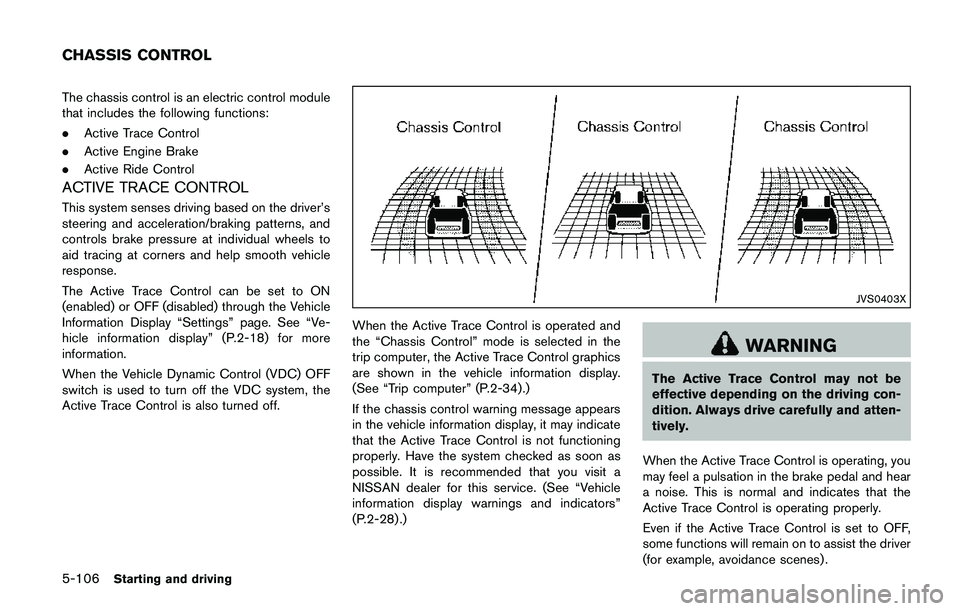
JVS0403X
When the Active Trace Control is operated and
the “Chassis Control” mode is selected in the
trip computer, the Active Trace Control graphics
are shown in the vehicle information display.
(See “Trip computer” (P.2-34).)
If the chassis control warning message appears
in the vehicle information display, it may indicate
that the Active Trace Control is not functioning
properly. Have the system checked as soon as
possible. It is recommended that you visit a
NISSAN dealer for this service. (See “Vehicle
information display warnings and indicators”
(P.2-28) .)
WARNING
The Active Trace Control may not be
effective depending on the driving con-
dition. Always drive carefully and atten-
tively.
When the Active Trace Control is operating, you
may feel a pulsation in the brake pedal and hear
a noise. This is normal and indicates that the
Active Trace Control is operating properly.
Even if the Active Trace Control is set to OFF,
some functions will remain on to assist the driver
(for example, avoidance scenes) .
CHASSIS CONTROL
Page 392 of 508
ACTIVE ENGINE BRAKE (Continuously
Variable Transmission (CVT) models)
The Active Engine Brake function adds subtle
deceleration by controlling CVT gear ratio,
depending on the cornering condition calculated
from driver’s steering input and plural sensors.
This benefit to easier traceability and less
workload of adjusting speed with braking at
corners.
The Active Engine Brake also adds subtle
deceleration with gear ratio control according
to driver’s brake pedal operation.
The Active Engine Brake can be set to ON
(enabled) or OFF (disabled) through the Vehicle
Information Display “Settings” page. See “Ve-
hicle information display” (P.2-18) for more
information.
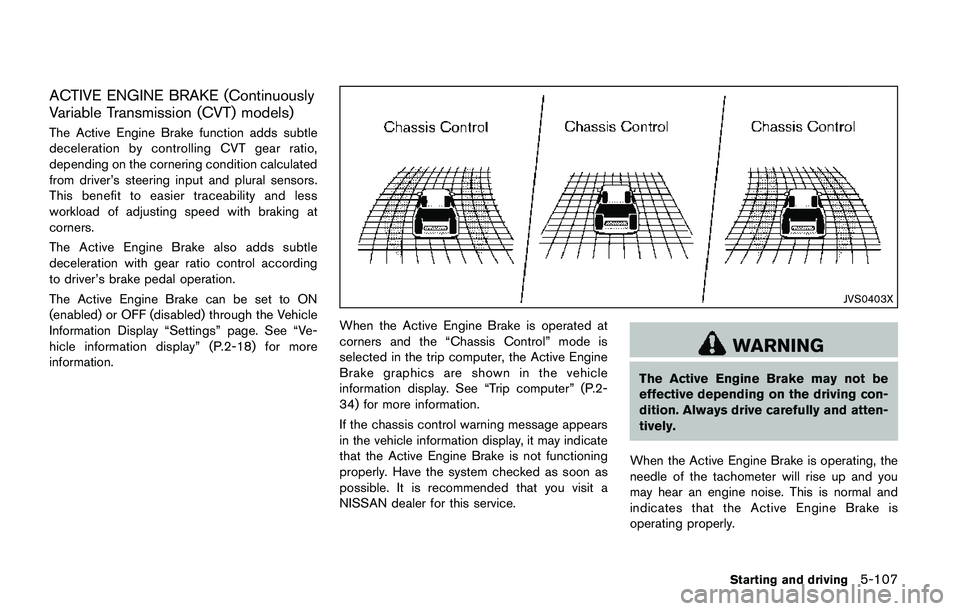
JVS0403X
When the Active Engine Brake is operated at
corners and the “Chassis Control” mode is
selected in the trip computer, the Active Engine
Brake graphics are shown in the vehicle
information display. See “Trip computer” (P.2-
34) for more information.
If the chassis control warning message appears
in the vehicle information display, it may indicate
that the Active Engine Brake is not functioning
properly. Have the system checked as soon as
possible. It is recommended that you visit a
NISSAN dealer for this service.
WARNING
The Active Engine Brake may not be
effective depending on the driving con-
dition. Always drive carefully and atten-
tively.
When the Active Engine Brake is operating, the
needle of the tachometer will rise up and you
may hear an engine noise. This is normal and
indicates that the Active Engine Brake is
operating properly.
Starting and driving5-107
Page 393 of 508
5-108Starting and driving
ACTIVE RIDE CONTROL
This system senses upper body motion based
on wheel speed information and controls engine
torque and four wheel brake pressure to
enhance ride comfort in effort to restrain
uncomfortable upper body movement. This
system come into effect above 25 MPH (40
km/h) . When the VDC OFF switch is used to
turn off the VDC system, the Active Ride Control
is also turned off.
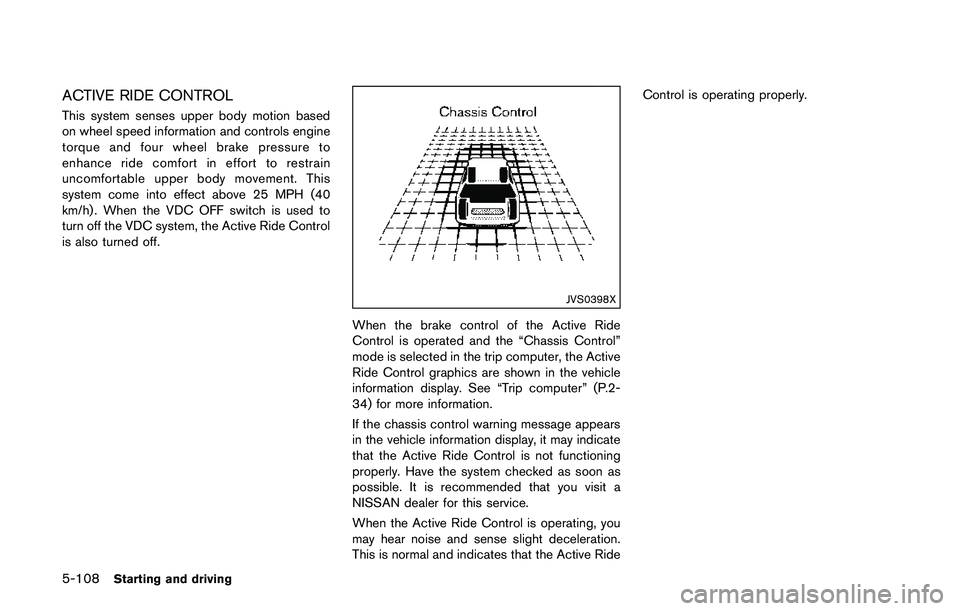
JVS0398X
When the brake control of the Active Ride
Control is operated and the “Chassis Control”
mode is selected in the trip computer, the Active
Ride Control graphics are shown in the vehicle
information display. See “Trip computer” (P.2-
34) for more information.
If the chassis control warning message appears
in the vehicle information display, it may indicate
that the Active Ride Control is not functioning
properly. Have the system checked as soon as
possible. It is recommended that you visit a
NISSAN dealer for this service.
When the Active Ride Control is operating, you
may hear noise and sense slight deceleration.
This is normal and indicates that the Active RideControl is operating properly.
Page 394 of 508
WARNING
.Never rely solely on the hill start
assist system to prevent the vehicle
from moving backward on a hill.
Always drive carefully and atten-
tively. Depress the brake pedal
when the vehicle is stopped on a
steep hill. Be especially careful
when stopped on a hill on frozen
or muddy roads. Failure to prevent
the vehicle from rolling backwards
may result in a loss of control of the
vehicle and possible serious injury
or death.
.The hill start assist system is not
designed to hold the vehicle at a
standstill on a hill. Depress the
brake pedal when the vehicle is
stopped on a steep hill. Failure to
do so may cause the vehicle to roll
backwards and may result in a
collision or serious personal injury.
.The hill start assist system may not
prevent the vehicle from rolling
backwards on a hill under all load
or road conditions. Always be pre-
pared to depress the brake pedal toprevent the vehicle from rolling
backwards. Failure to do so may
result in a collision or serious per-
sonal injury.
The hill start assist system automatically keeps
the brakes applied to help prevent the vehicle
from rolling backwards in the time it takes the
driver to release the brake pedal and apply the
accelerator when the vehicle is stopped on a hill.
The hill start assist system will operate auto-
matically under the following conditions:
.The transmission is shifted to a forward or
reverse gear.
.The vehicle is stopped completely on a hill
by applying the brake.
The maximum holding time is 2 seconds. After 2
seconds the vehicle will begin to roll back and
the hill start assist system will stop operating
completely.
The hill start assist system will not operate when
the transmission is shifted to the N (Neutral) or P
(Park) position (CVT models) or on a flat and
level road.
When the Vehicle Dynamic Control (VDC)
warning light illuminates in the meter, the hill
start assist system will not operate. (See
“Vehicle Dynamic Control (VDC) warning light”(P.2-15) .)
Starting and driving5-109
HILL START ASSIST SYSTEM
Page 396 of 508
.Allow more stopping distance under
these conditions. Braking should be
started sooner than on dry pave-
ment.
.Allow greater following distances
on slippery roads.
.Watch for slippery spots (glare ice) .
These may appear on an otherwise
clear road in shaded areas. If a
patch of ice is seen ahead, brake
before reaching it. Try not to brake
while on the ice, and avoid any
sudden steering maneuvers.
.Do not use cruise control on slip-
pery roads.
.Snow can trap dangerous exhaust
gases under your vehicle. Keep
snow clear of the exhaust pipe and
from around your vehicle.
Starting and driving5-111
Page 401 of 508
6-4In case of emergency
TPMS.
.Do not inject any tire liquid or
aerosol tire sealant into the tires,
as this may cause a malfunction of
the tire pressure sensors.
CHANGING A FLAT TIRE
If you have a flat tire, follow the instructions
below.
Stopping the vehicle
1. Safely move the vehicle off the road and
away from traffic.
2. Turn on the hazard warning flashers.
3. Park on a level surface and apply the parking
brake.
4.Continuously Variable Transmission
(CVT) models:
Move the shift lever to the P (Park) position.
Manual Transmission (MT) models:
Move the shift lever to the R (Reverse)
position.
5. Turn off the engine.
6. Raise the hood to warn other traffic, and to
signal professional road assistance person-
nel that you need assistance.7. Have all passengers get out of the vehicle
and stand in a safe place, away from traffic
and clear of the vehicle.
WARNING
.Make sure the parking brake is
securely applied and the Manual
Transmission is shifted into R (Re-
verse) , or the CVT into P (Park) .
.Never change tires when the vehicle
is on a slope, ice or slippery areas.
This is hazardous.
.Never change tires if oncoming
traffic is close to your vehicle. Wait
for professional road assistance.
MCE0001A
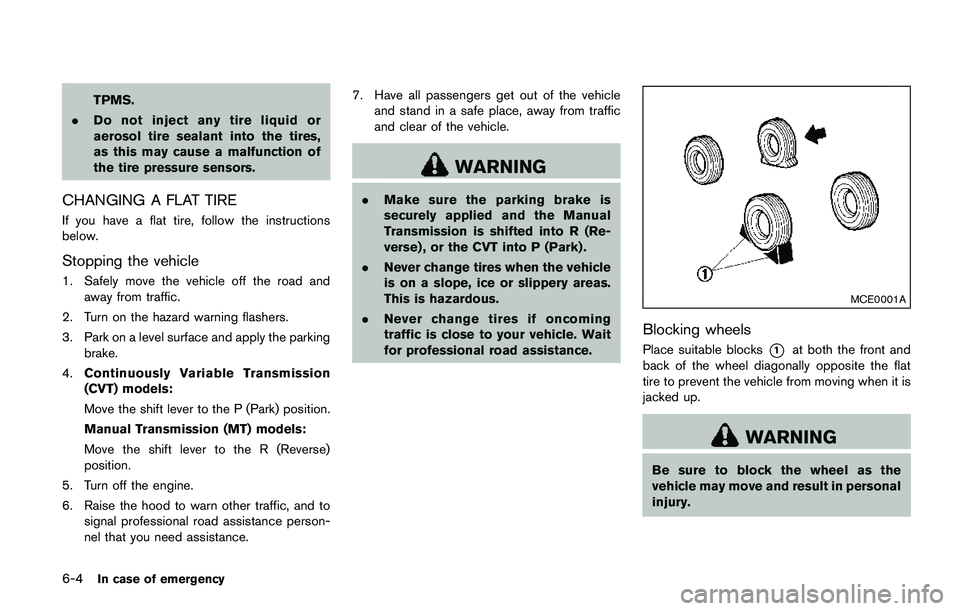
Blocking wheels
Place suitable blocks*1at both the front and
back of the wheel diagonally opposite the flat
tire to prevent the vehicle from moving when it is
jacked up.
WARNING
Be sure to block the wheel as the
vehicle may move and result in personal
injury.
Page 407 of 508
6-10In case of emergency
JVE0279X
WARNING
Always follow the instructions below.
Failure to do so could result in damage
to the charging system and cause
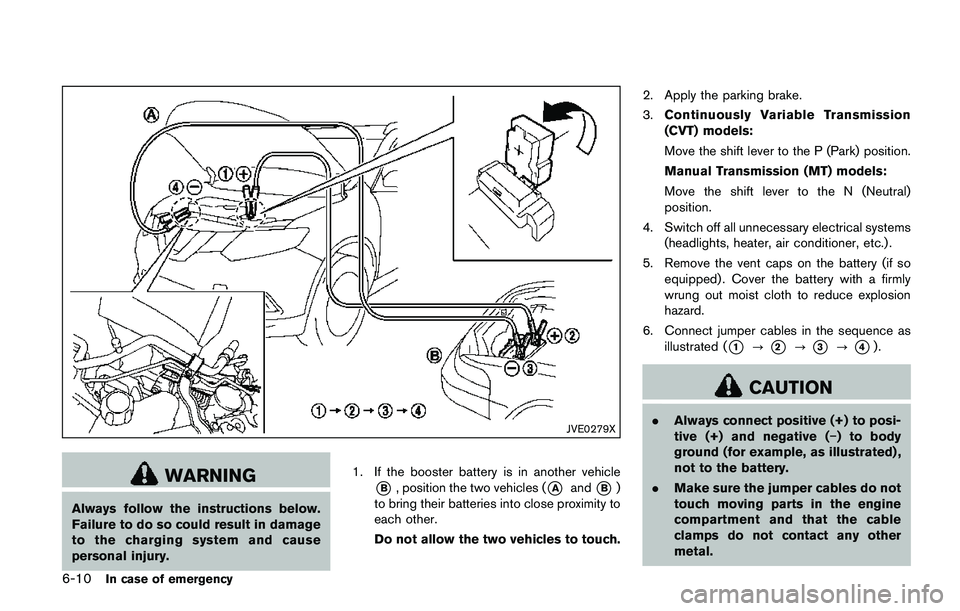
personal injury.1. If the booster battery is in another vehicle
*B, position the two vehicles (*Aand*B)
to bring their batteries into close proximity to
each other.
Do not allow the two vehicles to touch.2. Apply the parking brake.
3.Continuously Variable Transmission
(CVT) models:
Move the shift lever to the P (Park) position.
Manual Transmission (MT) models:
Move the shift lever to the N (Neutral)
position.
4. Switch off all unnecessary electrical systems
(headlights, heater, air conditioner, etc.) .
5. Remove the vent caps on the battery (if so
equipped) . Cover the battery with a firmly
wrung out moist cloth to reduce explosion
hazard.
6. Connect jumper cables in the sequence as
illustrated (
*1?*2?*3?*4).
CAUTION
.Always connect positive (+) to posi-
tive (+) and negative (í) to body
ground (for example, as illustrated) ,
not to the battery.
.Make sure the jumper cables do not
touch moving parts in the engine
compartment and that the cable
clamps do not contact any other
metal.
Page 409 of 508
6-12In case of emergency
you feel a lack of engine power, detect abnormal
noise, etc., take the following steps:
1. Move the vehicle safely off the road and
apply the parking brake.
2.Continuously Variable Transmission
(CVT) models:
Move the shift lever to the P (Park) position.
Manual Transmission (MT) models:
Move the shift lever to the N (Neutral)
position.
Do not stop the engine.
3. Turn off the air conditioner (if so equipped) .
Open all the windows, move the heater or air
conditioner temperature control to maximum
hot and fan control to high speed.
4. Get out of the vehicle. Look and listen for
steam or coolant escaping from the radiator
before opening the hood. (If steam or
coolant is escaping, turn off the engine.)
Do not open the hood further until no steam
or coolant can be seen.
5. Open the engine hood.
WARNING
If steam or water is coming from the
engine, stand clear to prevent gettingburned.
6. Visually check the drive belt for damage or
looseness. Also check if the cooling fan is
running. The radiator hoses and radiator
should not leak water. If coolant is leaking or
the cooling fan does not run, stop the
engine.
WARNING
Be careful not to allow your hands, hair,
jewelry or clothing to come into contact
with, or get caught in, engine belts or
the engine cooling fan. The engine
cooling fan can start at any time.
7. After the engine cools down, check the
coolant level in the reservoir with the engine
running. Add coolant to the reservoir if
necessary. Have your vehicle repaired. It is
recommended you visit a NISSAN dealer for
this service.
Page 412 of 508
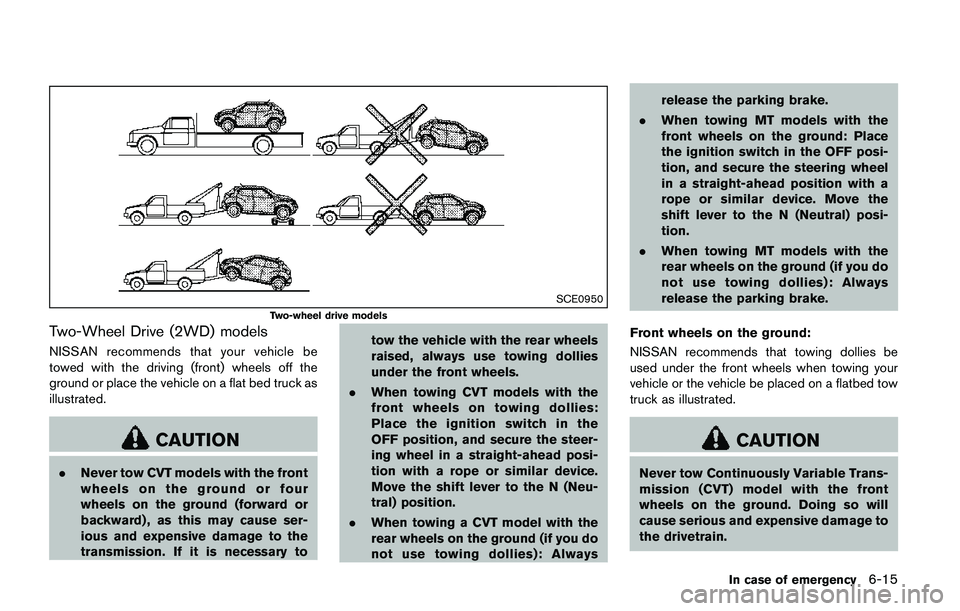
SCE0950
Two-wheel drive models
Two-Wheel Drive (2WD) models
NISSAN recommends that your vehicle be
towed with the driving (front) wheels off the
ground or place the vehicle on a flat bed truck as
illustrated.
CAUTION
.Never tow CVT models with the front
wheels on the ground or four
wheels on the ground (forward or
backward) , as this may cause ser-
ious and expensive damage to the
transmission. If it is necessary totow the vehicle with the rear wheels
raised, always use towing dollies
under the front wheels.
.When towing CVT models with the
front wheels on towing dollies:
Place the ignition switch in the
OFF position, and secure the steer-
ing wheel in a straight-ahead posi-
tion with a rope or similar device.
Move the shift lever to the N (Neu-
tral) position.
.When towing a CVT model with the
rear wheels on the ground (if you do
not use towing dollies): Alwaysrelease the parking brake.
.When towing MT models with the
front wheels on the ground: Place
the ignition switch in the OFF posi-
tion, and secure the steering wheel
in a straight-ahead position with a
rope or similar device. Move the
shift lever to the N (Neutral) posi-
tion.
.When towing MT models with the
rear wheels on the ground (if you do
not use towing dollies): Always
release the parking brake.
Front wheels on the ground:
NISSAN recommends that towing dollies be
used under the front wheels when towing your
vehicle or the vehicle be placed on a flatbed tow
truck as illustrated.
CAUTION
Never tow Continuously Variable Trans-
mission (CVT) model with the front
wheels on the ground. Doing so will
cause serious and expensive damage to
the drivetrain.
In case of emergency6-15
Page 413 of 508
6-16In case of emergency
Manual Transmission (MT) model:
1. Place the ignition switch in the OFF position.
2. Secure the steering wheel in a straight-
ahead position with rope or a similar device.
3. Move the shift lever to the N (Neutral)
position.
4. Release the parking brake.
5. Attach the safety chains whenever towing.
Rear wheels on the ground:
1. Place the ignition switch in the OFF position.
2. Move the shift lever to the N (Neutral)
position.
3. Release the parking brake.
4. Attach safety chains whenever towing.
All four wheels on the ground:
NISSAN recommends that the vehicle be placed
on a flatbed tow truck as illustrated.
CAUTION
Never tow CVT model with all four
wheels on the ground. Doing so will
cause serious and expensive damage to
the drivetrain.Manual Transmission (MT) model:
1. Place the ignition switch in the OFF position.
2. Move the shift lever to the N (Neutral)
position.
3. Release the parking brake.
VEHICLE RECOVERY (freeing a stuck
vehicle)
WARNING
To avoid vehicle damage, serious per-
sonal injury or death when recovering a
stuck vehicle:
.Contact a professional towing ser-
vice to recover the vehicle if you
have any questions regarding the
recovery procedure.
.Tow chains or cables must be at-
tached only to main structural mem-
bers of the vehicle.
.Do not use the vehicle tie-downs to
tow or free a stuck vehicle.
.Only use devices specifically de-
signed for vehicle recovery and
follow the manufacturer’s instruc-
tions..Always pull the recovery device
straight out from the front of the
vehicle. Never pull at an angle.
.Route recovery devices so they do
not touch any part of the vehicle
except the attachment point.
If your vehicle is stuck in sand, snow, mud, etc.,
use a tow strap or other device designed
specifically for vehicle recovery. Always follow
the manufacturer’s instructions for the recovery
device.
Rocking a stuck vehicle
WARNING
.Stand clear of a stuck vehicle.
.Do not spin your tires at high speed.
This could cause them to explode
and result in serious injury. Parts of
your vehicle could also overheat
and be damaged.
If your vehicle is stuck in sand, snow, mud, etc.,
use the following procedure:
1. Turn off the Vehicle Dynamic Control (VDC)
system.