maintenance NISSAN QASHQAI 2017 Owner´s Manual
[x] Cancel search | Manufacturer: NISSAN, Model Year: 2017, Model line: QASHQAI, Model: NISSAN QASHQAI 2017Pages: 508, PDF Size: 2.68 MB
Page 1 of 508

2017QASHQAI
OWNER’S MANUAL
and MAINTENANCE INFORMATION
For your safety, read carefully and keep in this vehicle.
Page 2 of 508
Welcome to the growing family of new NISSAN
owners. This vehicle is delivered to you with
confidence. It was produced using the latest
techniques and strict quality control.
This manual was prepared to help you under-
stand the operation and maintenance of your
vehicle so that you may enjoy many miles of
driving pleasure. Please read through this
manual before operating your vehicle.
A separate Warranty Information Booklet
explains details about the warranties cov-
ering your vehicle. Additionally, a separate
Customer Care/Lemon Law Booklet (U.S.
only) will explain how to resolve any
concerns you may have with your vehicle,
as well as clarify your rights under your
state’s lemon law.
In addition to factory installed options, your
vehicle may also be equipped with additional
accessories installed by NISSAN or by your
NISSAN dealer prior to delivery. It is important
that you familiarize yourself with all disclosures,
warnings, cautions and instructions concerning
proper use of such accessories prior to operat-
ing the vehicle and/or accessory. It is recom-
mended you see a NISSAN dealer for details
concerning the particular accessories with
which your vehicle is equipped.
Your NISSAN dealer knows your vehicle best.When you require any service or have any
questions, we will be glad to assist you with the
extensive resources available to us.
READ FIRST — THEN DRIVE SAFELY
Before driving your vehicle, read your Owner’s
Manual carefully. This will ensure familiarity with
controls and maintenance requirements, assist-
ing you in the safe operation of your vehicle.
WARNING
IMPORTANT SAFETY INFORMATION
REMINDERS!
Follow these important driving rules to
help ensure a safe and comfortable trip
for you and your passengers!
.NEVER drive under the influence of
alcohol or drugs.
.ALWAYS observe posted speed lim-
its and never drive too fast for
conditions.
.ALWAYS give your full attention to
driving and avoid using vehicle
features or taking other actions that
could distract you.
.ALWAYS use your seat belts and
appropriate child restraint systems.Pre-teen children should be seated
in the rear seat.
.ALWAYS provide information about
the proper use of vehicle safety
features to all occupants of the
vehicle.
.ALWAYS review this Owner’s Man-
ual for important safety information.
On-pavement and off-road driv-
ing
This vehicle will handle and maneuver
differently from an ordinary passenger
car because it has a higher center of
gravity. As with other vehicles with fea-
tures of this type, failure to operate this
vehicle correctly may result in loss of
control or an accident. Be sure to read
“Avoiding collision and rollover” and
“Driving safety precautions” in the “5.
Starting and driving” section of this
manual.
Foreword
Page 8 of 508
Illustrated table of contents0
Safety — Seats, seat belts and supplemental restraint system1
Instruments and controls
Pre-driving checks and adjustments
Heater, air conditioner, audio and phone systems
Starting and driving
In case of emergency
Appearance and care
Do-it-yourself
Maintenance and schedules
Technical and consumer information
2
3
4
5
6
7
8
9
10
Table of
Contents
Index11
Page 20 of 508
1 Safety — Seats, seat belts and supplemental
restraint system
Seats ............................................................................................ 1-2
Front seats ............................................................................ 1-3
Rear seats ............................................................................. 1-5
Armrest (if so equipped) ................................................... 1-6
Head restraints/headrests ....................................................... 1-6
Adjustable head restraint/headrest components ........ 1-7
Non-adjustable head
restraint/headrest components ........................................ 1-8
Remove .................................................................................. 1-8
Install ...................................................................................... 1-8
Adjust ..................................................................................... 1-9
Seat belts ................................................................................. 1-10
Precautions on seat belt usage .................................... 1-10
Pregnant women .............................................................. 1-13
Injured persons ................................................................. 1-13
Three-point type seat belt .............................................. 1-13
Seat belt extenders .......................................................... 1-16
Seat belt maintenance .................................................... 1-16
Child safety .............................................................................. 1-17
Infants .................................................................................. 1-17
Small children .................................................................... 1-18
Larger children .................................................................. 1-18Child restraints ....................................................................... 1-19
Precautions on child restraints ................................... 1-19
Lower Anchors and Tethers for CHildren
(LATCH) system ............................................................. 1-21
Rear-facing child restraint installation
using LATCH ................................................................... 1-24
Rear-facing child restraint installation using the
seat belts .......................................................................... 1-26
Forward-facing child restraint installation
using LATCH ................................................................... 1-29
Forward-facing child restraint installation using the
seat belts .......................................................................... 1-31
Booster seats .................................................................. 1-35
Supplemental Restraint System (SRS) ........................... 1-39
Precautions on SRS ...................................................... 1-39
NISSAN Advanced Air Bag System
(front seats) ..................................................................... 1-45
Front seat-mounted side-impact supplemental
air bag and roof-mounted curtain side-impact and
rollover supplemental air bag systems ..................... 1-53
Seat belts with pretensioners (front seats) ............. 1-54
Supplemental air bag warning labels ....................... 1-55
Supplemental air bag warning light .......................... 1-56
Repair and replacement procedure .......................... 1-57
Page 35 of 508
1-16Safety — Seats, seat belts and supplemental restraint system
belt may vary depending on the model.
WARNING
.After adjustment, release the ad-
justment button and try to move the
shoulder belt anchor up and down
to make sure it is securely fixed in
position.
.The shoulder belt anchor height
should be adjusted to the position
best for you. Failure to do so may
reduce the effectiveness of the
entire restraint system and increase
the chance or severity of injury in an
accident.
SEAT BELT EXTENDERS
If, because of body size or driving position, it is
not possible to properly fit the lap/shoulder belt
and fasten it, an extender that is compatible with
the installed seat belts is available that can be
purchased. The extender adds approximately 8
in (200 mm) of length and may be used for either
the driver or front passenger seating position. It
is recommended you visit a NISSAN dealer for
assistance with purchasing an extender if an
extender is required.
WARNING
.It is recommended that only
NISSAN seat belt extenders, made
by the same company which made
the original equipment seat belts,
be used with NISSAN seat belts.
.Adults and children who can use the
standard seat belt should not use an
extender. Such unnecessary use
could result in serious personal
injury in the event of an accident.
.Never use seat belt extenders to
install child restraints. If the child
restraint is not secured properly, the
child could be seriously injured or
killed in a collision or a sudden stop.
SEAT BELT MAINTENANCE
.To clean the seat belt webbing,apply a
mild soap solution or any solution recom-
mended for cleaning upholstery or carpets.
Then wipe with a cloth and allow the seat
belts to dry in the shade. Do not allow the
seat belts to retract until they are completely
dry.
.If dirt builds up in the shoulder belt
guideof the seat belt anchors, the seatbelts may retract slowly. Wipe the shoulder
belt guide with a clean, dry cloth.
.Periodically check to see that the seat
belt and the metal components, such as
buckles, tongues, retractors, flexible wires
and anchors, work properly. If loose parts,
deterioration, cuts or other damage on the
webbing is found, the entire seat belt
assembly should be replaced.
Page 76 of 508
REPAIR AND REPLACEMENT PRO-
CEDURE
The front air bags, side air bags, curtain air bags
and pretensioners are designed to activate on a
one-time-only basis. As a reminder, unless it is
damaged, the supplemental air bag warning light
will remain illuminated after inflation has oc-
curred. These systems should be repaired and/
or replaced as soon as possible. It is recom-
mended you visit a NISSAN dealer for this
service.
When maintenance work is required on the
vehicle, the front air bags, side air bags, curtain
air bags and pretensioners and related parts
should be pointed out to the person performing
the maintenance. The ignition switch should
always be in the LOCK position when working
under the hood or inside the vehicle.
WARNING
.Once a front air bag, side air bag or
curtain air bag has inflated, the air
bag module will not function again
and must be replaced. Additionally,
the activated pretensioners must
also be replaced. The air bag mod-
ule and pretensioner should be
replaced. It is recommended youvisit a NISSAN dealer for this ser-
vice. However, the air bag modules
and pretensioner system cannot be
repaired.
.The front air bag, side air bag and
curtain air bag systems, and preten-
sioner system should be inspected
if there is any damage to the front
end or side portion of the vehicle. It
is recommended you visit a NISSAN
dealer for this service.
.If you need to dispose of a supple-
mental air bag or pretensioner or
scrap the vehicle, it is recommended
you visit a NISSAN dealer. Correct
supplemental air bag and preten-
sioner system disposal procedures
are set forth in the appropriate
NISSAN Service Manual. Incorrect
disposal procedures could cause
personal injury.
.If there is an impact to your vehicle
from any direction, your Occupant
Classification Sensor (OCS) should
be checked to verify it is still
functioning correctly. It is recom-
mended that you visit a NISSAN
dealer for this service. The OCS
should be checked even if no airbags deploy as a result of the
impact. Failure to verify proper
OCS function may result in an
improper air bag deployment result-
ing in injury or death.
Safety — Seats, seat belts and supplemental restraint system1-57
Page 95 of 508
2-16Instruments and controls
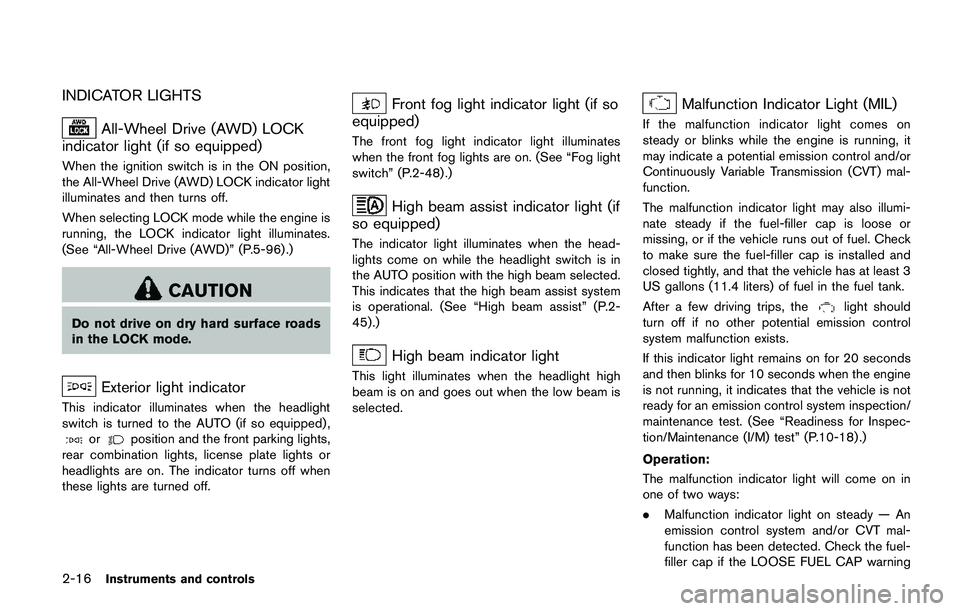
INDICATOR LIGHTS
All-Wheel Drive (AWD) LOCK
indicator light (if so equipped)
When the ignition switch is in the ON position,
the All-Wheel Drive (AWD) LOCK indicator light
illuminates and then turns off.
When selecting LOCK mode while the engine is
running, the LOCK indicator light illuminates.
(See “All-Wheel Drive (AWD)” (P.5-96) .)
CAUTION
Do not drive on dry hard surface roads
in the LOCK mode.
Exterior light indicator
This indicator illuminates when the headlight
switch is turned to the AUTO (if so equipped) ,
orposition and the front parking lights,
rear combination lights, license plate lights or
headlights are on. The indicator turns off when
these lights are turned off.
Front fog light indicator light (if so
equipped)
The front fog light indicator light illuminates
when the front fog lights are on. (See “Fog light
switch” (P.2-48) .)
High beam assist indicator light (if
so equipped)
The indicator light illuminates when the head-
lights come on while the headlight switch is in
the AUTO position with the high beam selected.
This indicates that the high beam assist system
is operational. (See “High beam assist” (P.2-
45) .)
High beam indicator light
This light illuminates when the headlight high
beam is on and goes out when the low beam is
selected.
Malfunction Indicator Light (MIL)
If the malfunction indicator light comes on
steady or blinks while the engine is running, it
may indicate a potential emission control and/or
Continuously Variable Transmission (CVT) mal-
function.
The malfunction indicator light may also illumi-
nate steady if the fuel-filler cap is loose or
missing, or if the vehicle runs out of fuel. Check
to make sure the fuel-filler cap is installed and
closed tightly, and that the vehicle has at least 3
US gallons (11.4 liters) of fuel in the fuel tank.
After a few driving trips, the
light should
turn off if no other potential emission control
system malfunction exists.
If this indicator light remains on for 20 seconds
and then blinks for 10 seconds when the engine
is not running, it indicates that the vehicle is not
ready for an emission control system inspection/
maintenance test. (See “Readiness for Inspec-
tion/Maintenance (I/M) test” (P.10-18) .)
Operation:
The malfunction indicator light will come on in
one of two ways:
.Malfunction indicator light on steady — An
emission control system and/or CVT mal-
function has been detected. Check the fuel-
filler cap if the LOOSE FUEL CAP warning
Page 98 of 508
.Indicators and warnings
.Tire pressure information
.Chassis Control
.Other information
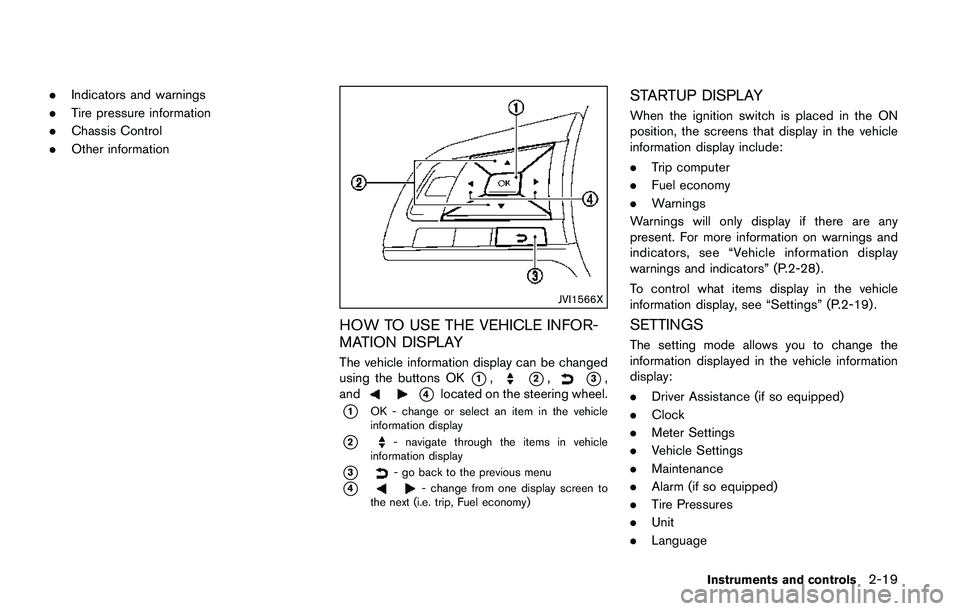
JVI1566X
HOW TO USE THE VEHICLE INFOR-
MATION DISPLAY
The vehicle information display can be changed
using the buttons OK
*1,*2,*3,
and
*4located on the steering wheel.
*1OK - change or select an item in the vehicle
information display
*2- navigate through the items in vehicle
information display
*3- go back to the previous menu
*4- change from one display screen to
the next (i.e. trip, Fuel economy)
STARTUP DISPLAY
When the ignition switch is placed in the ON
position, the screens that display in the vehicle
information display include:
.Trip computer
.Fuel economy
.Warnings
Warnings will only display if there are any
present. For more information on warnings and
indicators, see “Vehicle information display
warnings and indicators” (P.2-28) .
To control what items display in the vehicle
information display, see “Settings” (P.2-19) .
SETTINGS
The setting mode allows you to change the
information displayed in the vehicle information
display:
.Driver Assistance (if so equipped)
.Clock
.Meter Settings
.Vehicle Settings
.Maintenance
.Alarm (if so equipped)
.Tire Pressures
.Unit
.Language
Instruments and controls2-19
Page 102 of 508
.Selective Unlock
When this item is turned on, and the door
handle request switch on the driver’s or front
passenger’s side door is pushed, only the
corresponding door is unlocked. All the
doors can be unlocked if the door handle
request switch is pushed again within 1
minute. When this item is turned to off, all
the doors will be unlocked when the door
handle request switch is pushed once. From
the “Locking” menu, select “Selective Un-
lock”. Use the OK
*1to activate or
deactivate this function.
.Auto Door Unlock
The “Auto Door Unlock” feature allows the
customer to customize the auto door unlock
options.
— Ignition OFF
— Shift to Park (for Continuously Variable
Transmission (CVT) models)
— Off
.Answer Bk. Horn (if so equipped)
When the answer back horn is on, the horn
will chirp and the hazard indicators will flash
twice when locking the vehicle with the
Intelligent Key or remote keyless entry
function.Wipers:
.Speed Dependent
The “Speed Dependent” feature can be
activated or deactivated. From the “Wipers”
menu, select “Speed Dependent”. Use the
OK
*1to turn this feature ON or OFF.
.Reverse Link
The “Reverse Link” wiper feature can be set
to be ON or OFF. From the “Wipers” menu,
select “Reverse Link”. Use the OK
*1to
turn this feature ON or OFF.
.Drip wipe
The “Drip wipe” feature can be set to be ON
or OFF. From the “Wipers” menu, select
“Drip wipe”. Use the OK
*1to turn this
feature ON or OFF.
Remote start (if so equipped):
The “Remote start” feature allows user to turn
the remote engine start on or off. When turned
on, the engine can be restarted remotely. For
additional information, refer to “Remote engine
start” (P.3-22) .
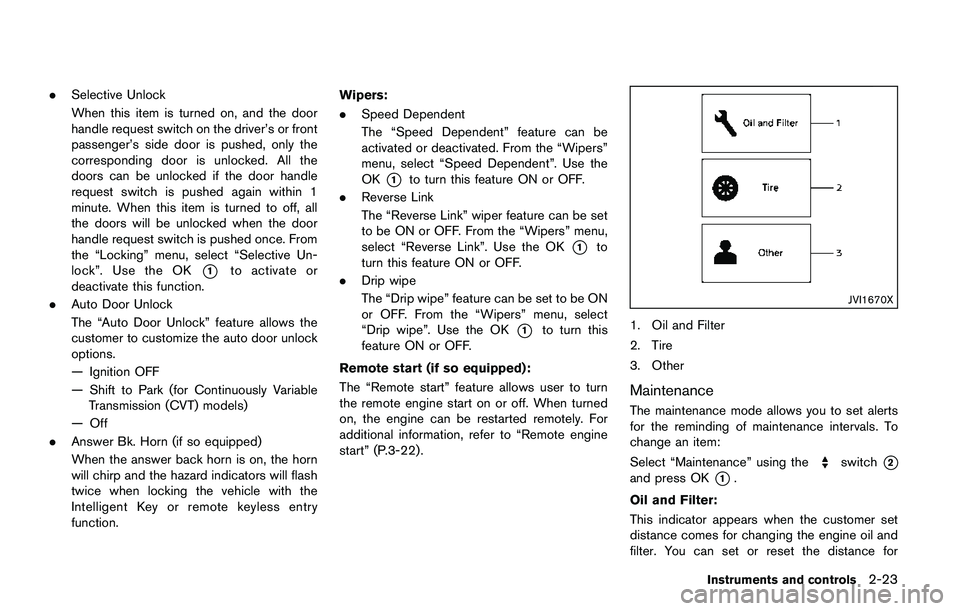
JVI1670X
1. Oil and Filter
2. Tire
3. Other
Maintenance
The maintenance mode allows you to set alerts
for the reminding of maintenance intervals. To
change an item:
Select “Maintenance” using the
switch*2
and press OK*1.
Oil and Filter:
This indicator appears when the customer set
distance comes for changing the engine oil and
filter. You can set or reset the distance for
Instruments and controls2-23
Page 103 of 508
2-24Instruments and controls
checking or replacing these items. For sched-
uled maintenance items and intervals, refer to
the “9. Maintenance and schedules” section.
Tire:
This indicator appears when the customer set
distance comes for replacing tires. You can set
or reset the distance for replacing tires.
WARNING
The tire replacement indicator is not a
substitute for regular tire checks, in-
cluding tire pressure checks. See
“Changing wheels and tires”(P.8-37) .
Many factors including tire inflation,
alignment, driving habits and road con-
ditions affect tire wear and when tires
should be replaced. Setting the tire
replacement indicator for a certain
driving distance does not mean your
tires will last that long. Use the tire
replacement indicator as a guide only
and always perform regular tire checks.
Failure to perform regular tire checks,
including tire pressure checks could
result in tire failure. Serious vehicle
damage could occur and may lead to a
collision, which could result in serious
personal injury or death.Other:
This indicator appears when the customer set
distance comes for checking or replacing
maintenance items other than the engine oil, oil
filter and tires. Other maintenance items can
include such things as air filter or tire rotation.
You can set or reset the distance for checking or
replacing the items.
Alarm (if so equipped)
This setting allows the customer to set alarms.
Select “Alarm” using the
button*2and
press OK button
*1.
Timer Alert (if so equipped):
This setting allows the customer to set an alert
to notify the driver that the set time has been
reached.
1. Use the
button*2to select “Timer
Alert”.
2. Press the OK button
*1.
3. To change the timer amount, use the
button*2and the OK button*1to save
the selected time amount.
Navigation (if so equipped):
This setting allows the customer to enable/
disable the alert for navigation in the vehicle
information display.1. Use the
button*2to select “Naviga-
tion”.
2. Press the OK button
*1to turn ON/OFF
the alert.
Phone (if so equipped):
This setting allows the customer to enable/
disable the alert for an incoming call in the
vehicle information display.
1. Use the
button*2to select “Phone”.
2. Press the OK button
*1to turn ON/OFF
the alert.
Mail (if so equipped):
This setting allows the customer to enable/
disable the alert for navigation in the vehicle
information display.
1. Use the
button*2to select “Mail”.
2. Press the OK button
*1to turn ON/OFF
the alert.