battery NISSAN ROGUE 2009 Owner´s Manual
[x] Cancel search | Manufacturer: NISSAN, Model Year: 2009, Model line: ROGUE, Model: NISSAN ROGUE 2009Pages: 316, PDF Size: 4.26 MB
Page 245 of 316
Black plate (243,1)
Model "S35-D" EDITED: 2008/ 7/ 24
When performing any inspection or mainte-
nance work on your vehicle, always take care
to prevent serious accidental injury to yourself or
damage to the vehicle. The following are general
precautions which should be closely observed.
WARNING
.Park the vehicle on a level surface,
apply the parking brake securely
and block the wheels to prevent
the vehicle from moving. Move the
selector lever to P (Park) .
.Be sure the ignition switch is in the
OFF or LOCK position when per-
forming any parts replacement or
repairs.
.If you must work with the engine
running, keep your hands, clothing,
hair and tools away from moving
fans, belts and any other moving
parts.
.It is advisable to secure or remove
any loose clothing and remove any
jewelry, such as rings, watches, etc.
before working on your vehicle.
.Always wear eye protection when-
ever you work on your vehicle.
.If you must run the engine in anenclosed space such as a garage, be
sure there is proper ventilation for
exhaust gases to escape.
.Never get under the vehicle while it
is supported only by a jack. If it is
necessary to work under the vehicle,
support it with safety stands.
.Keep smoking materials, flame and
sparks away from fuel tank and the
battery.
.The fuel filter or fuel lines should be
serviced by a NISSAN dealer be-
cause the fuel lines are under high
pressure even when the engine is
off.
CAUTION
.Do not work under the hood while
the engine is hot. Turn the engine
off and wait until it cools down.
.Avoid direct contact with used en-
gine oil and coolant. Improperly
disposed engine oil, and engine
coolant and/or other vehicle fluids
can damage the environment. Al-
ways conform to local regulations
for disposal of vehicle fluid..Never leave the engine or the CVT
related component harnesses dis-
connected while the ignition switch
is in the ON position.
.Never connect or disconnect the
battery or any transistorized com-
ponent while the ignition switch is
in the ON position.
.Your vehicle is equipped with an
automatic engine cooling fan. It may
come on at any time without warn-
ing, even if the ignition key is in the
OFF position and the engine is not
running. To avoid injury, always
disconnect the negative battery
cable before working near the fan.
This “8. Maintenance and do-it-yourself” section
gives instructions regarding only those items
which are relatively easy for an owner to perform.
A genuine NISSAN Service Manual is also
available. (See “OWNER’S MANUAL/SERVICE
MANUAL ORDER INFORMATION” in the “9.
Technical and consumer information” section.)
Youshouldbeawarethatincompleteor
improper servicing may result in operating
difficulties or excessive emissions, and could
affect warranty coverage.If in doubt about
any servicing, we recommend that it be
MAINTENANCE PRECAUTIONS
Maintenance and do-it-yourself
8-5
Page 246 of 316
Black plate (244,1)
Model "S35-D" EDITED: 2008/ 7/ 24
done by a NISSAN dealer.
SDI2127
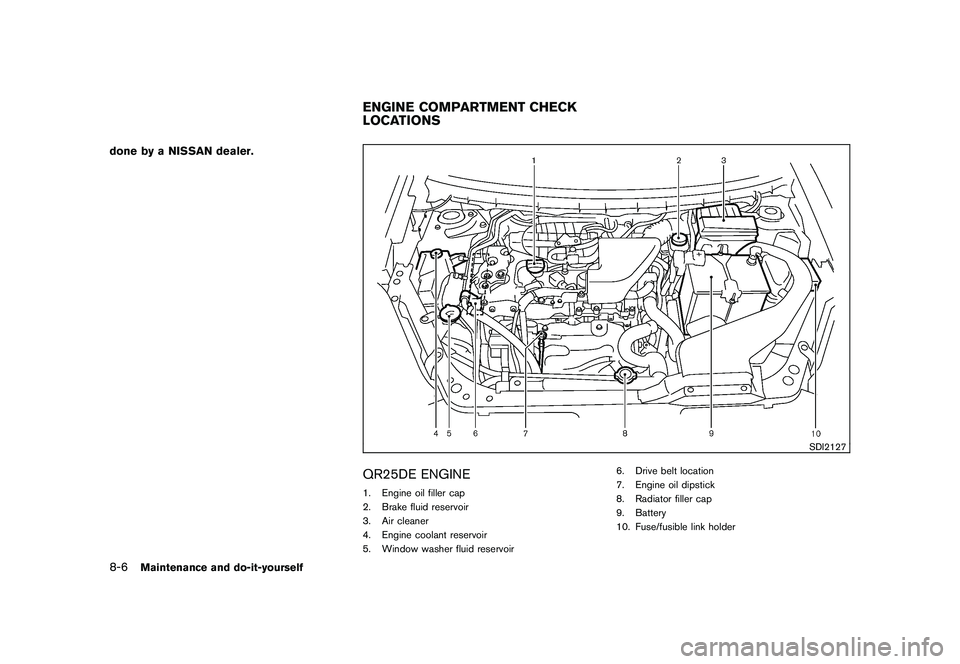
QR25DE ENGINE1. Engine oil filler cap
2. Brake fluid reservoir
3. Air cleaner
4. Engine coolant reservoir
5. Window washer fluid reservoir6. Drive belt location
7. Engine oil dipstick
8. Radiator filler cap
9. Battery
10. Fuse/fusible link holderENGINE COMPARTMENT CHECK
LOCATIONS
8-6
Maintenance and do-it-yourself
Page 253 of 316
Black plate (251,1)
Model "S35-D" EDITED: 2008/ 7/ 24
.Keep the battery surface clean and dry.
Clean the battery with a solution of baking
soda and water.
.Make certain the terminal connections are
clean and securely tightened.
.If the vehicle is not to be used for 30 days or
longer, disconnect the negative () battery
terminal cable to prevent discharging it.
WARNING
.Do not expose the battery to flames
or electrical sparks. Hydrogen gas
generated by the battery is explo-
sive. Do not allow battery fluid to
contact your skin, eyes, fabrics, or
painted surfaces. After touching a
battery or battery cap, do not touch
or rub your eyes. Thoroughly wash
your hands. If the acid contacts your
eyes, skin or clothing, immediately
flush with water for at least 15
minutes and seek medical attention.
.Do not operate the vehicle if the
fluid in the battery is low. Low
battery fluid can cause a higher load
on the battery which can generate
heat, reduce battery life, and in
some cases lead to an explosion..When working on or near a battery,
always wear suitable eye protection
and remove all jewelry.
.Battery posts, terminals and related
accessories contain lead and lead
compounds. Wash hands after
handling.
.Keep the battery out of the reach of
children.
DI0137MA
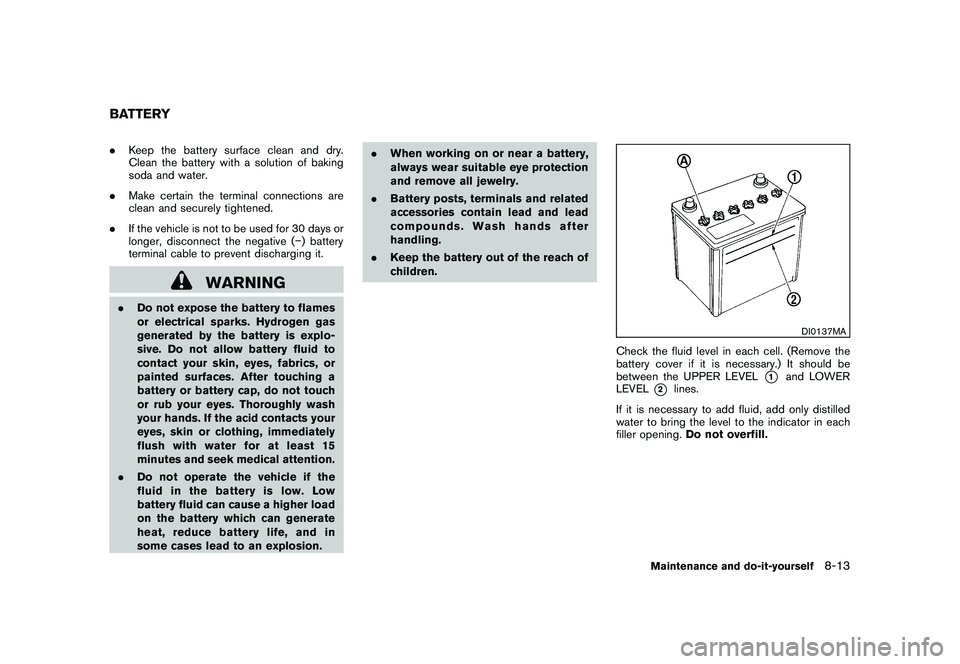
Check the fluid level in each cell. (Remove the
battery cover if it is necessary.) It should be
between the UPPER LEVEL
*1
and LOWER
LEVEL
*2
lines.
If it is necessary to add fluid, add only distilled
water to bring the level to the indicator in each
filler opening.Do not overfill.
BATTERY
Maintenance and do-it-yourself
8-13
Page 254 of 316
Black plate (252,1)
Model "S35-D" EDITED: 2008/ 7/ 24
SDI1480C
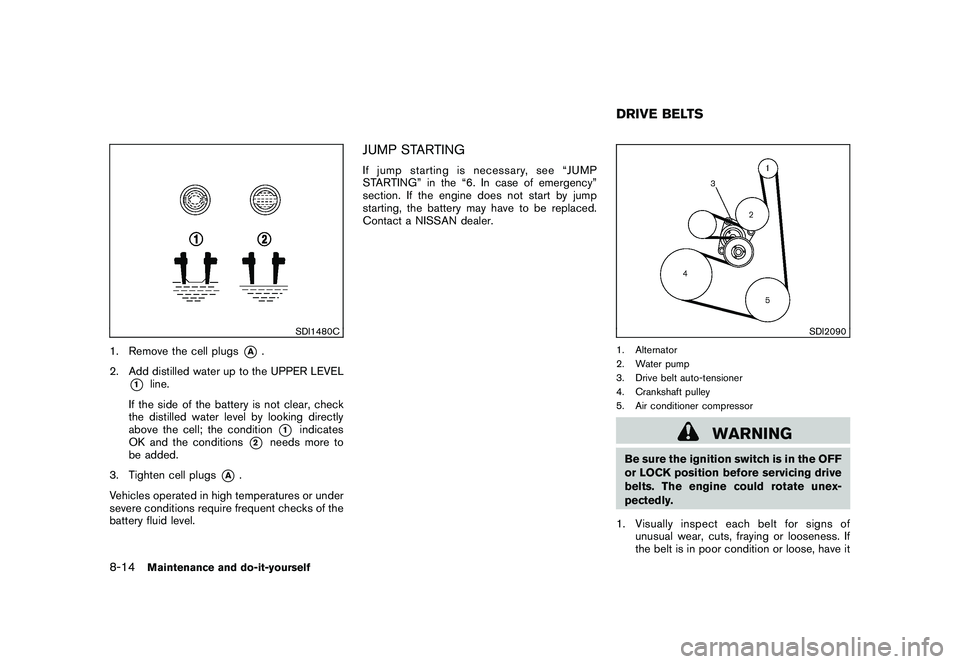
1. Remove the cell plugs
*A
.
2. Add distilled water up to the UPPER LEVEL
*1
line.
If the side of the battery is not clear, check
the distilled water level by looking directly
above the cell; the condition
*1
indicates
OK and the conditions
*2
needs more to
be added.
3. Tighten cell plugs
*A
.
Vehicles operated in high temperatures or under
severe conditions require frequent checks of the
battery fluid level.
JUMP STARTINGIf jump starting is necessary, see “JUMP
STARTING” in the “6. In case of emergency”
section. If the engine does not start by jump
starting, the battery may have to be replaced.
Contact a NISSAN dealer.
SDI2090
1. Alternator
2. Water pump
3. Drive belt auto-tensioner
4. Crankshaft pulley
5. Air conditioner compressor
WARNING
Be sure the ignition switch is in the OFF
or LOCK position before servicing drive
belts. The engine could rotate unex-
pectedly.
1. Visually inspect each belt for signs of
unusual wear, cuts, fraying or looseness. If
the belt is in poor condition or loose, have itDRIVE BELTS
8-14
Maintenance and do-it-yourself
Page 261 of 316
Black plate (259,1)
Model "S35-D" EDITED: 2008/ 7/ 24
CAUTION
Be careful not to allow children to
swallow the battery and removed parts.
SDI2134
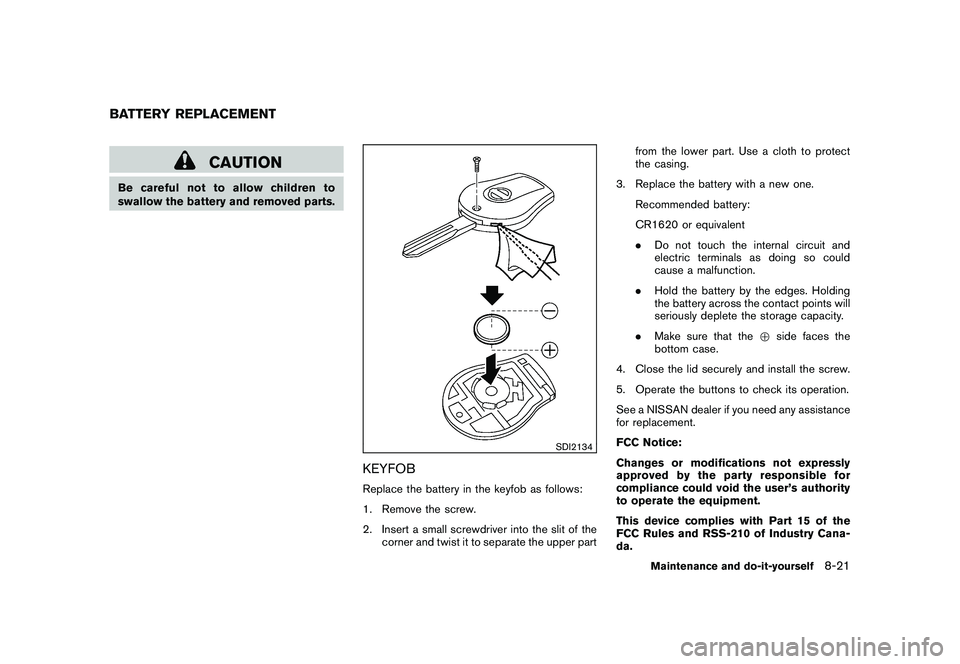
KEYFOBReplace the battery in the keyfob as follows:
1. Remove the screw.
2. Insert a small screwdriver into the slit of the
corner and twist it to separate the upper partfrom the lower part. Use a cloth to protect
the casing.
3. Replace the battery with a new one.
Recommended battery:
CR1620 or equivalent
.Do not touch the internal circuit and
electric terminals as doing so could
cause a malfunction.
.Hold the battery by the edges. Holding
the battery across the contact points will
seriously deplete the storage capacity.
.Make sure that the+side faces the
bottom case.
4. Close the lid securely and install the screw.
5. Operate the buttons to check its operation.
See a NISSAN dealer if you need any assistance
for replacement.
FCC Notice:
Changes or modifications not expressly
approved by the party responsible for
compliance could void the user’s authority
to operate the equipment.
This device complies with Part 15 of the
FCC Rules and RSS-210 of Industry Cana-
da.
BATTERY REPLACEMENT
Maintenance and do-it-yourself
8-21
Page 262 of 316
Black plate (260,1)
Model "S35-D" EDITED: 2008/ 7/ 24
Operation is subject to the following two
conditions: (1) This device may not cause
harmful interference, and (2) this device
must accept any interference received,
including interference that may cause un-
desired operation of the device.
SDI2294
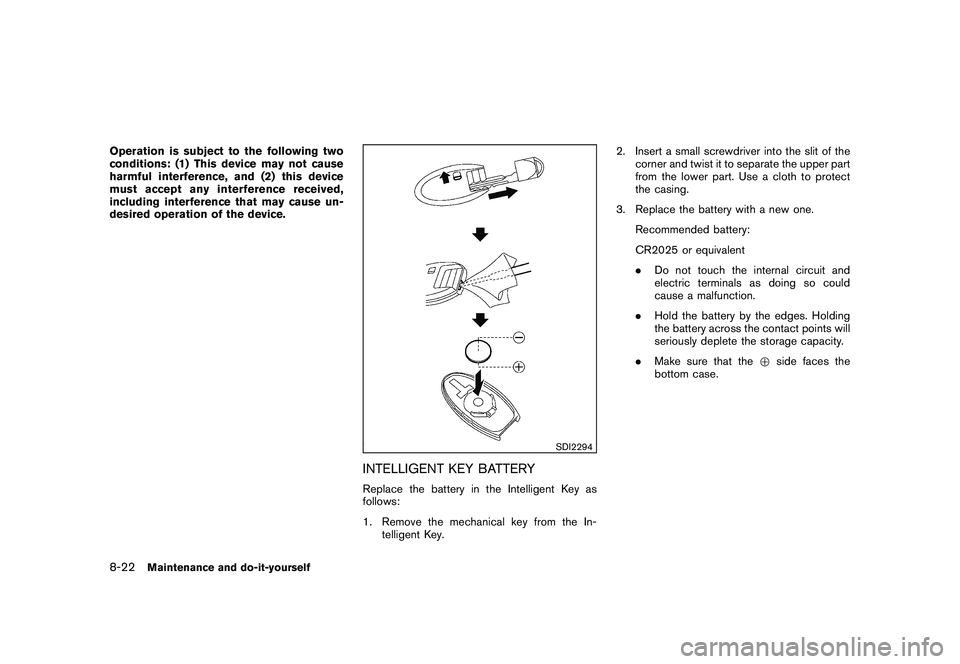
INTELLIGENT KEY BATTERYReplace the battery in the Intelligent Key as
follows:
1. Remove the mechanical key from the In-
telligent Key.2. Insert a small screwdriver into the slit of the
corner and twist it to separate the upper part
from the lower part. Use a cloth to protect
the casing.
3. Replace the battery with a new one.
Recommended battery:
CR2025 or equivalent
.Do not touch the internal circuit and
electric terminals as doing so could
cause a malfunction.
.Hold the battery by the edges. Holding
the battery across the contact points will
seriously deplete the storage capacity.
.Make sure that the+side faces the
bottom case.
8-22
Maintenance and do-it-yourself
Page 266 of 316
Black plate (264,1)
Model "S35-D" EDITED: 2008/ 7/ 24
SDI2137
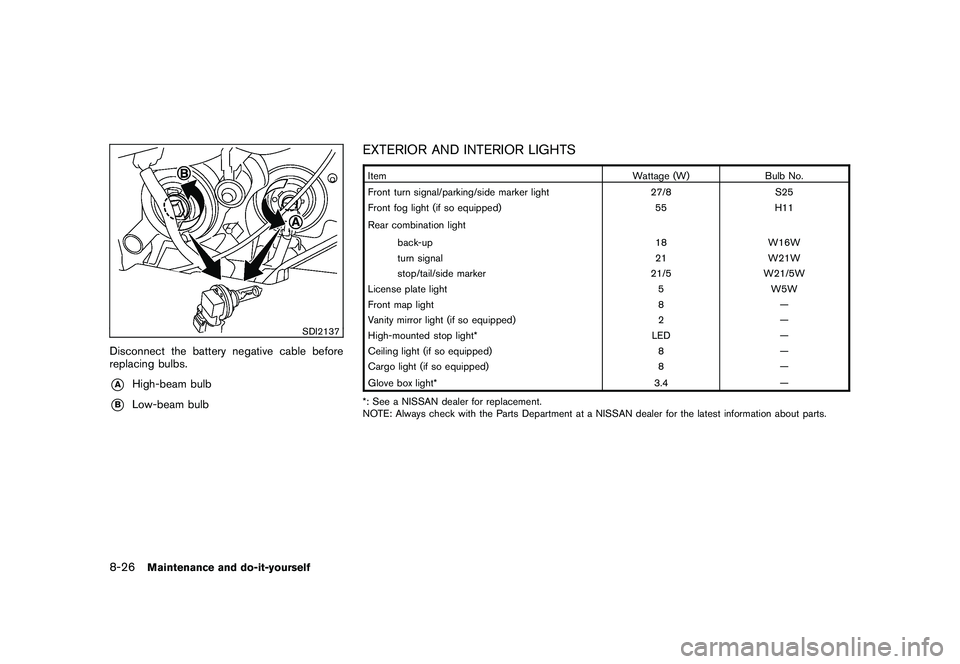
Disconnect the battery negative cable before
replacing bulbs.*A
High-beam bulb
*B
Low-beam bulb
EXTERIOR AND INTERIOR LIGHTSItem Wattage (W) Bulb No.
Front turn signal/parking/side marker light 27/8 S25
Front fog light (if so equipped) 55 H11
Rear combination light
back-up 18 W16W
turn signal 21 W21W
stop/tail/side marker 21/5 W21/5W
License plate light 5 W5W
Front map light 8 —
Vanity mirror light (if so equipped) 2 —
High-mounted stop light* LED —
Ceiling light (if so equipped) 8 —
Cargo light (if so equipped) 8 —
Glove box light* 3.4
—
*: See a NISSAN dealer for replacement.
NOTE: Always check with the Parts Department at a NISSAN dealer for the latest information about parts.
8-26
Maintenance and do-it-yourself
Page 302 of 316
Black plate (302,1)
Model "S35-D" EDITED: 2008/ 7/ 24
Trailer lights
CAUTION
When splicing into the vehicle electrical
system, a commercially available
power-type module/converter must be
used to provide power for all trailer
lighting. This unit uses the vehicle
battery as a direct power source for all
trailer lights while using the vehicle tail
light, stoplight and turn signal circuits
as a signal source. The module/con-
verter must draw no more than 15
milliamps from the stop and tail lamp
circuits. Using a module/converter that
exceeds these power requirements may
damage the vehicle’s electrical system.
See a reputable trailer dealer to obtain
the proper equipment and to have it
installed.
Trailer lights should comply with federal and/or
local regulations. For assistance in hooking up
trailer lights, contact a NISSAN dealer or
reputable trailer dealer.Trailer brakesIf your trailer is equipped with a braking system,
make sure it conforms to federal and/or local
regulations and that it is properly installed.
WARNING
Never connect a trailer brake system
directly to the vehicle brake system.Pre-towing tips.Be certain your vehicle maintains a level
position when a loaded or unloaded trailer is
hitched. Do not drive the vehicle if it has an
abnormal nose-up or nose-down condition;
check for improper tongue load, overload,
worn suspension or other possible causes
of either condition.
.Always secure items in the trailer to prevent
load shift while driving.
.Keep the cargo load as low as possible in
the trailer to keep the trailer center of gravity
low.
.Load the trailer so approximately 60% of the
trailer load is in the front half and 40% is in
the back half. Also make sure the load is
balanced side to side.
.Check your hitch, trailer tire pressure,
vehicle tire pressure, trailer light operation,
and trailer wheel lug nuts every time you
attach a trailer to the vehicle.
.Be certain your rearview mirrors conform to
all federal, state or local regulations. If not,install any mirrors required for towing before
driving the vehicle.
.Determine the overall height of the vehicle
and trailer so the required clearance is
known.
Trailer towing tipsIn order to gain skill and an understanding of the
vehicle’s behavior, you should practice turning,
stopping and backing up in an area which is free
from traffic. Steering stability, and braking
performance will be somewhat different than
under normal driving conditions.
.Always secure items in the trailer to prevent
load shift while driving.
.Lock the trailer hitch coupler with a pin or
lock to prevent the coupler from inadver-
tently becoming unlatched.
.Avoid abrupt starts, acceleration or stops.
.Avoid sharp turns or lane changes.
.Always drive your vehicle at a moderate
speed. Some states or provinces have
specific speed limits for vehicles that are
towing trailers. Obey the local speed limits.
.When backing up, hold the bottom of the
steering wheel with one hand. Move your
hand in the direction in which you want the
trailer to go. Make small corrections and
9-22
Technical and consumer information
Page 307 of 316
Black plate (307,1)
Model "S35-D" EDITED: 2008/ 7/ 24
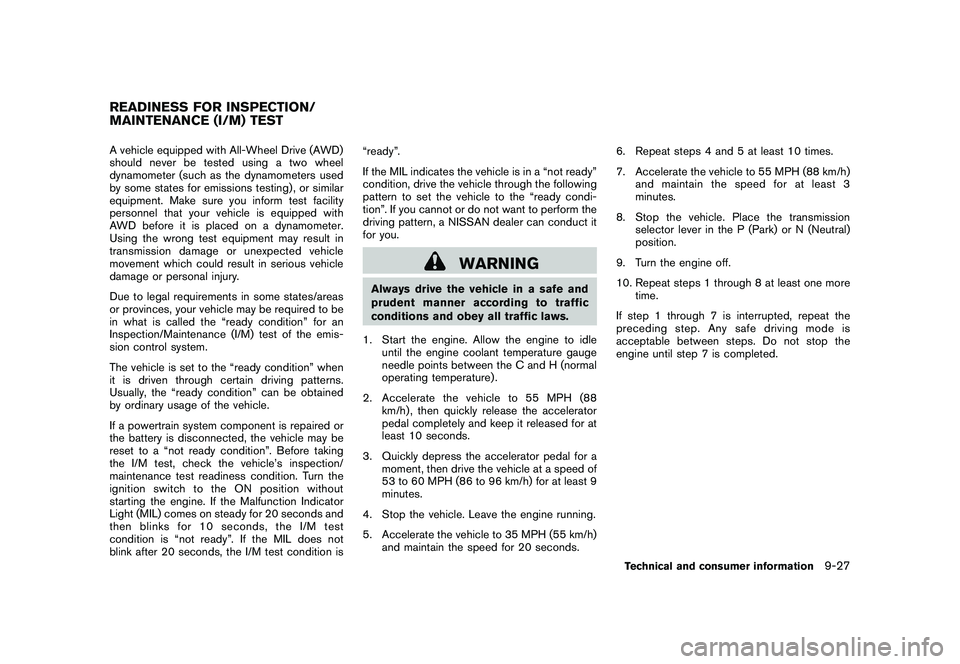
A vehicle equipped with All-Wheel Drive (AWD)
should never be tested using a two wheel
dynamometer (such as the dynamometers used
by some states for emissions testing) , or similar
equipment. Make sure you inform test facility
personnel that your vehicle is equipped with
AWD before it is placed on a dynamometer.
Using the wrong test equipment may result in
transmission damage or unexpected vehicle
movement which could result in serious vehicle
damage or personal injury.
Due to legal requirements in some states/areas
or provinces, your vehicle may be required to be
in what is called the “ready condition” for an
Inspection/Maintenance (I/M) test of the emis-
sion control system.
The vehicle is set to the “ready condition” when
it is driven through certain driving patterns.
Usually, the “ready condition” can be obtained
by ordinary usage of the vehicle.
If a powertrain system component is repaired or
the battery is disconnected, the vehicle may be
reset to a “not ready condition”. Before taking
the I/M test, check the vehicle’s inspection/
maintenance test readiness condition. Turn the
ignition switch to the ON position without
starting the engine. If the Malfunction Indicator
Light (MIL) comes on steady for 20 seconds and
then blinks for 10 seconds, the I/M test
condition is “not ready”. If the MIL does not
blink after 20 seconds, the I/M test condition is“ready”.
If the MIL indicates the vehicle is in a “not ready”
condition, drive the vehicle through the following
pattern to set the vehicle to the “ready condi-
tion”. If you cannot or do not want to perform the
driving pattern, a NISSAN dealer can conduct it
for you.
WARNING
Always drive the vehicle in a safe and
prudent manner according to traffic
conditions and obey all traffic laws.
1. Start the engine. Allow the engine to idle
until the engine coolant temperature gauge
needle points between the C and H (normal
operating temperature) .
2. Accelerate the vehicle to 55 MPH (88
km/h) , then quickly release the accelerator
pedal completely and keep it released for at
least 10 seconds.
3. Quickly depress the accelerator pedal for a
moment, then drive the vehicle at a speed of
53 to 60 MPH (86 to 96 km/h) for at least 9
minutes.
4. Stop the vehicle. Leave the engine running.
5. Accelerate the vehicle to 35 MPH (55 km/h)
and maintain the speed for 20 seconds.6. Repeat steps 4 and 5 at least 10 times.
7. Accelerate the vehicle to 55 MPH (88 km/h)
and maintain the speed for at least 3
minutes.
8. Stop the vehicle. Place the transmission
selector lever in the P (Park) or N (Neutral)
position.
9. Turn the engine off.
10. Repeat steps 1 through 8 at least one more
time.
If step 1 through 7 is interrupted, repeat the
preceding step. Any safe driving mode is
acceptable between steps. Do not stop the
engine until step 7 is completed.
READINESS FOR INSPECTION/
MAINTENANCE (I/M) TEST
Technical and consumer information
9-27
Page 310 of 316
Black plate (1,1)
10 Index
A
ABS (Anti-lock Braking System).................. 5-27
Advanced air bag system......................... 1-44
Aiming control, Headlights........................ 2-27
Air bag system
Advanced air bag system..................... 1-44
Front passenger air bag and status light.... 1-45
Front-seat mounted side-impact
supplemental air bag system.................. 1-48
Roof-mounted curtain side-impact and
rollover supplemental air bag system......... 1-48
Air bag warning labels............................. 1-51
Air bag warning light....................... 1-51, 2-16
Air cleaner housing filter.......................... 8-16
Air conditioner
Air conditioner operation........................ 4-2
Air conditioner service........................... 4-5
Air conditioner specification label............ 9-10
Air conditioning system refrigerant and
lubricant recommendations............... 4-5, 9-6
In-cabin microfilter............................... 4-5
Alarm, How to stop alarm
(see vehicle security system)..................... 2-20
Alcohol, drugs and driving.......................... 5-7
All-wheel drive (AWD)............................. 5-22
All-wheel drive (AWD) warning light............. 2-12
Antenna............................................. 4-24
Anti-lock Braking System (ABS).................. 5-27
Anti-lock braking system (ABS) warning light . . . 2-12
Appearance care
Exterior appearance care........................ 7-2
Interior appearance care........................ 7-4Audible reminders................................. 2-18
Audio operation precautions........................ 4-6
Audio system......................................... 4-6
Steering wheel audio controls................ 4-23
Autochanger, Compact Disc (CD)............... 4-20
Automatic door locks................................ 3-5
Average fuel consumption........................... 2-7
Average speed....................................... 2-8
Avoiding collision and rollover...................... 5-5
B
Back door (See lift gate).......................... 3-21
Battery.............................................. 8-13
Battery replacement, Intelligent Key.......... 8-22
Battery replacement, Keyfob.................. 8-21
Battery saver system.......................... 2-26
Keyfob battery replacement................... 8-21
Before starting the engine........................ 5-12
Belts (See drive belts)............................. 8-14
Bluetooth
®Hands-Free Phone System.......... 4-25
Booster seats...................................... 1-34
Brake
Anti-lock Braking System (ABS).............. 5-27
Brake fluid...................................... 8-11
Brake system................................... 5-26
Parking brake operation....................... 5-18
Warning light................................... 2-12
Break-in schedule.................................. 5-21
Brightness control, Instrument panel............. 2-28
Bulb check/instrument panel...................... 2-11
Bulb replacement.................................. 8-24C
Cabin air filter........................................ 4-5
Capacities and recommended fuel/lubricants..... 9-2
Car phone or CB radio............................ 4-24
Cargo cover........................................ 2-37
Cargo light......................................... 2-46
Catalytic converter, Three way catalyst............ 5-2
CD care and cleaning............................. 4-22
Ceiling light......................................... 2-45
Child restraints..................................... 1-19
Booster seats .................................. 1-34
Installation using LATCH...................... 1-24
Installation using the seat belts............... 1-28
LATCH system................................. 1-21
Precautions on child restraints................ 1-19
Top tether strap................................ 1-22
Child safety......................................... 1-11
Child safety rear door lock.......................... 3-6
Chimes, Audible reminders....................... 2-18
Circuit breaker, Fusible link ....................... 8-19
Cleaning exterior and interior................. 7-2, 7-4
Clock............................................... 2-31
Coat hooks......................................... 2-38
Cold weather driving.............................. 5-30
Command
(See Bluetooth
®Hands-Free Phone System) . . . 4-31
Compact Disc (CD) changer
(See audio system) ................................ 4-20
Compact Disc (CD) player
(See audio system) ................................ 4-15
Compass............................................. 2-8
Console box........................................ 2-35
Model "S35-D" EDITED: 2008/ 6/ 3