light NISSAN ROGUE 2018 Owner´s Manual
[x] Cancel search | Manufacturer: NISSAN, Model Year: 2018, Model line: ROGUE, Model: NISSAN ROGUE 2018Pages: 547, PDF Size: 6.42 MB
Page 490 of 547
latches lock securely in every position.
Check that the head restraints/headrests
move up and down smoothly and the locks
(if so equipped) hold securely in all latched
positions.
Seat belts:Check that all parts of the seat
belt system (for example, buckles, anchors,
adjusters and retractors) operate properly
and smoothly, and are installed securely.
Check the belt webbing for cuts, fraying,
wear or damage.
Steering wheel: Check for changes in the
steering system, such as excessive free
play, hard steering or strange noises.
Warning lights and chimes: Make sure all
warning lights and chimes are operating
properly.
Windshield defroster: Check that the air
comes out of the defroster outlets properly
and in sufficient quantity when operating
the heater or air conditioner.
Windshield wiper and washer*: Check
that the wipers and washer operate prop-
erly and that the wipers do not streak.Under the hood and vehicle
The maintenance items listed here should
be checked periodically (for example, each
time you check the engine oil or refuel).
Battery* (for serviceable batteries):
Check the fluid level in each cell. The fluid
should be at the bottom of the filler open-
ing. Vehicles operated in high tempera-
tures or under severe conditions require
frequent checks of the battery fluid level.
NOTE:
Care should be taken to avoid situations
that can lead to potential battery dis-
charge and potential no-start conditions
such as:
1. Installation or extended use of elec-
tronic accessories that consume bat-
tery power when the engine is not
running (Phone chargers, GPS, DVD
players, etc.).
2. Vehicle is not driven regularly and/or
only driven short distances.
In these cases, the battery may need to
be charged to maintain battery health. Brake fluid level*:
Make sure that the brake
fluid level is between the MAX and MIN lines
on the reservoir.
Engine coolant level*: Check the coolant
level when the engine is cold.
Engine drive belts*: Make sure the drive
belts are not frayed, worn, cracked or oily.
Engine oil level*: Check the level af ter
parking the vehicle on a level spot and
turning off the engine. Wait more than
15 minutes for the oil to drain back into the
oil pan.
Exhaust system: Make sure there are no
loose supports, cracks or holes. If the
sound of the exhaust seems unusual or
there is a smell of exhaust fumes, immedi-
ately have the exhaust system inspected. It
is recommended that you visit a NISSAN
dealer for this service. For additional infor-
mation, refer to “Exhaust gas (carbon mon-
oxide)” in the “Starting and driving” section
of this manual.
9-4Maintenance and schedules
Page 504 of 547
The following are approximate capacities. The actual refill capacities may be slightly different. When refilling, follow the procedure
described in the “Do-it-yourself ” section to determine the proper refill capacity.
Fluid typeCapacity (approximate) Recommended Fluids/Lubricants
Metric
Measure US
Measure Imperial
Measure
Fuel 55 L 14-1/2 gal 12-1/8 gal• For additional information, refer to “Fuel recommendation” in
this section.
Engine oil*1
Drain and refill
*1: For additional
information, refer to “Engine
oil” in the “Do-it-yourself ”
section of this manual. With oil filter
change 4.6 L 4-7/8 qt 4 qt
• Genuine “Nissan Motor Oil 0W-20 SN” is recommended.
• If the above motor oil is not available, use an equivalent motor
oil that matches the above grade and viscosity. For additional
information, refer to “Engine oil and oil filter recommendations”
in this section.
Without oil filter
change 4.3 L 4-1/2 qt 3-3/4 qt
Engine coolant
with reservoir 8.1 L 2-1/8 gal 1-3/4 gal• Pre-diluted Genuine NISSAN Long Life Antifreeze/Coolant (blue)
or equivalent
Continuously Variable Transmission (CVT) fluid ———• Genuine NISSAN CVT Fluid NS-3
• NISSAN recommends using Genuine NISSAN CVT Fluid NS-3 (or
equivalent) ONLY in NISSAN CVTs. Do not mix with other fluids.
Using fluids that are not equivalent to Genuine NISSAN CVT NS-3
may damage the CVT. Damage caused by the use of fluids other
than as recommended is not covered under NISSAN’s New Ve-
hicle Limited Warranty.
Differential gear oil ———
• Genuine NISSAN Differential Oil Hypoid Super GL-5 80W-90 or
equivalent conventional (non-synthetic) oil
Transfer oil ———
Brake fluid ———• Genuine NISSAN Super Heavy Duty Brake Fluid*2 or equivalent
DOT 3
*2: Available in mainland USA through a NISSAN dealer.
Multi-purpose grease ——— • NLGI No. 2 (Lithium Soap base)
Air conditioning system refrigerant ———• HFC-134a (R-134a)
• For additional information, refer to “Air conditioner system re-
frigerant and oil recommendations” in this section.
RECOMMENDED FLUIDS/
LUBRICANTS AND CAPACITIES
10-2Technical and consumer information
Page 507 of 547
Fuel containing MMT
MMT, or methylcyclopentadienyl manga-
nese tricarbonyl, is an octane boosting ad-
ditive. NISSAN does not recommend the
use of fuel containing MMT. Such fuel may
adversely affect vehicle performance, in-
cluding the emissions control system. Note
that while some fuel pumps label MMT
content, not all do, so you may have to
consult your gasoline retailer for more de-
tails.
Af termarket fuel additives
NISSAN does not recommend the use of
any af termarket fuel additives (for ex-
ample, fuel injector cleaner, octane
booster, intake valve deposit removers,
etc.) which are sold commercially. Many of
these additives intended for gum, varnish
or deposit removal may contain active sol-
vents or similar ingredients that can be
harmful to the fuel system and engine.
Octane rating tips
Using unleaded gasoline with an octane
rating lower than recommended can
cause persistent, heavy “spark knock.”
(“Spark knock” is a metallic rapping
noise.) If severe, this can lead to engine
damage. If you detect a persistent heavyspark knock even when using gasoline
of the stated octane rating, or if you hear
steady spark knock while holding a
steady speed on level roads, it is recom-
mended that you have a NISSAN dealer
correct the condition. Failure to correct
the condition is misuse of the vehicle, for
which NISSAN is not responsible.
Incorrect ignition timing may result in
spark knock, af ter-run and/or overheating,
which may cause excessive fuel consump-
tion or engine damage. If any of the above
symptoms are encountered, have your ve-
hicle checked. It is recommended that you
visit a NISSAN dealer for servicing.
However, now and then you may notice
light spark knock for a short time while
accelerating or driving up hills. This is not
a cause for concern, because you get the
greatest fuel benefit when there is light
spark knock for a short time under heavy
engine load.
Technical and consumer information10-5
Page 525 of 547
3. Attach the trailer to the vehicle and ad-just the hitch equalizers so that the
front bumper height is within 0 -
.5 inches (0 – 13 mm) of the reference
height measured in step 2. The rear
bumper should be no higher than the
reference height measured in step 2.
WARNING
Properly adjust the weight distributing
hitch so the rear of the bumper is no
higher than the measured reference
height when the trailer is attached. If
the rear bumper is higher than the mea-
sured reference height when loaded,
the vehicle may handle unpredictably
which could cause a loss of vehicle con-
trol and cause serious personal injury or
property damage.
Sway control device
Sudden maneuvers, wind gusts, and buf-
feting caused by other vehicles can affect
trailer handling. Sway control devices may
be used to help control these affects. If you
choose to use one, contact a reputable
trailer hitch supplier to make sure the sway
control device will work with the vehicle,
hitch, trailer and the trailer’s brake system. Follow the instructions provided by the
manufacturer for installing and using the
sway control device.
Class I hitch
Class I trailer hitch equipment (receiver, ball
mount and hitch ball) can be used to tow
trailers of a maximum weight of 2,000 lbs.
(907 kg).
Tire pressures
∙ When towing a trailer, inflate the
vehicle tires to the recom-
mended cold tire pressure indi-
cated on the Tire and Loading In-
formation label.
∙ Trailer tire condition, size, load rat- ing and proper inflation pressure
should be in accordance with the
trailer and tire manufacturer’s
specifications.
Safety chains
Always use suitable safety chains between
your vehicle and the trailer. The safety chains
should be crossed and should be attached
to the hitch, not to the vehicle bumper or
axle. The safety chains can be attached to
the bumper if the hitch ball is mounted to the
bumper. Be sure to leave enough slack in the
chains to permit turning corners.
Trailer lights
CAUTION
When splicing into the vehicle electrical
system, a commercially available power-
type module/converter must be used to
provide power for all trailer lighting. This
unit uses the vehicle battery as a direct
power source for all trailer lights while us-
ing the vehicle tail light, stop light and
turn signal circuits as a signal source. The
module/converter must draw no more
that 15 milliamps from the stop and tail
lamp circuits. Using a module/converter
that exceeds these power requirements
may damage the vehicle’s electrical sys-
tem. It is recommended that you visit a
reputable trailer retailer to obtain the
proper equipment and to have it installed.
Technical and consumer information10-23
Page 526 of 547
Trailer lights should comply with federal
and/or local regulations. For assistance in
hooking up trailer lights, contact a NISSAN
dealer or reputable trailer retailer. Vehicles
equipped with the optional trailer tow
package are equipped with a 7-pin trailer
harness connector. If your trailer is
equipped with a flat 4-pin connector, an
adapter will be needed to connect the
trailer lights to the vehicle. Adapters are
available at auto parts stores and hitch re-
tailers.
Pre-towing tips
∙ Be certain your vehicle maintains a levelposition when a loaded and/or un-
loaded trailer is hitched. Do not drive the
vehicle if it has an abnormal nose-up or
nose-down condition; check for im-
proper tongue load, overload, worn sus-
pension or other possible causes of ei-
ther condition.
∙ Always secure items in the trailer to pre- vent load shif t while driving.
∙ Keep the cargo load as low as possible in the trailer to keep the trailer center of
gravity low. ∙ Load the trailer so approximately 60%
of the trailer load is in the front half and
40% is in the back half. Also make sure
the load is balanced side to side.
∙ Check your hitch, trailer tire pressure, vehicle tire pressure, trailer light opera-
tion, and trailer wheel lug nuts every
time you attach a trailer to the vehicle.
∙ Be certain your rearview mirrors con- form to all federal, state or local regula-
tions. If not, install any mirrors required
for towing before driving the vehicle.
∙ Determine the overall height of the ve- hicle and trailer so the required clear-
ance is known.
Trailer towing tips
In order to gain skill and an understanding
of the vehicle’s behavior, you should prac-
tice turning, stopping and backing up in an
area which is free from traffic. Steering sta-
bility and braking performance will be
somewhat different than under normal
driving conditions.
∙ Always secure items in the trailer to pre- vent load shif t while driving. ∙ Lock the trailer hitch coupler with a pin
or lock to prevent the coupler from in-
advertently becoming unlatched.
∙ Avoid abrupt starts, acceleration or stops.
∙ Avoid sharp turns or lane changes.
∙ Always drive your vehicle at a moderate speed.
∙ When backing up, hold the bottom of the steering wheel with one hand. Move
your hand in the direction in which you
want the trailer to go. Make small cor-
rections and back up slowly. If possible,
have someone guide you when you are
backing up.
Always block the wheels on both vehicle
and trailer when parking. Parking on a
slope is not recommended; however, if you
must do so:
CAUTION
If you move the shif t lever to the P (Park)
position before blocking the wheels
and applying the parking brake, trans-
mission damage could occur.
10-24Technical and consumer information
Page 528 of 547
∙ Be careful when passing other vehicles.Passing while towing a trailer requires
considerably more distance than nor-
mal passing. Remember, the length of
the trailer must also pass the other ve-
hicle before you can safely change
lanes.
∙ Downshif t the transmission to a lower gear for engine braking when driving
down steep or long hills. This will help
slow the vehicle without applying the
brakes.
∙ Avoid holding the brake pedal down too long or too frequently. This could cause
the brakes to overheat, resulting in re-
duced braking efficiency.
∙ Increase your following distance to al- low for greater stopping distances
while towing a trailer. Anticipate stops
and brake gradually.
∙ NISSAN recommends that the cruise control not be used while towing a
trailer.
∙ Some states or provinces have specific regulations and speed limits for ve-
hicles that are towing trailers. Obey the
local speed limits. ∙ Check your hitch, trailer wiring harness
connections, and trailer wheel lug nuts
af ter 50 miles (80 km) of travel and at
every break.
∙ When launching a boat, don’t allow the water level to go over the exhaust tail
pipe or rear bumper.
∙ Make sure you disconnect the trailer lights before backing the trailer into the
water or the trailer lights may burn out.
When towing a trailer, final drive gear oil
should be replaced and transmission
oil/fluid should be changed more fre-
quently. For additional information, refer
to the “Do-it-yourself ” section of this
manual.
FLAT TOWING FOR ALL–WHEEL
DRIVE VEHICLE (if so equipped)
Towing your vehicle with all four wheels on
the ground is sometimes called flat towing.
This method is sometimes used when
towing a vehicle behind a recreational ve-
hicle, such as a motor home.
CAUTION
∙ Failure to follow these guidelines can result in severe transmission damage.
∙ Never flat tow your All-Wheel Drive (AWD) vehicle.
∙ DO NOT tow your All-Wheel Drive (AWD) vehicle with any wheels on the
ground. Doing so may cause serious
and expensive damage to the
powertrain.
∙ For emergency towing procedures re- fer to “Towing recommended by
NISSAN” in the “In case of emergency ”
section of this manual.
FLAT TOWING FOR FRONT WHEEL
DRIVE VEHICLE (if so equipped)
Towing your vehicle with all four wheels on
the ground is sometimes called flat towing.
This method is sometimes used when
towing a vehicle behind a recreational ve-
hicle, such as a motor home.
10-26Technical and consumer information
Page 532 of 547
WARNING
A vehicle equipped with All -Wheel Drive
(AWD) should never be tested using a
two wheel dynamometer (such as the
dynamometers used by some states for
emissions testing), or similar equip-
ment. Make sure you inform the test fa-
cility personnel that your vehicle is
equipped with AWD before it is placed
on a dynamometer. Using the wrong
test equipment may result in drivetrain
damage or unexpected vehicle move-
ment which could result in serious ve-
hicle damage or personal injury.
Due to legal requirements in some states
and Canadian Provinces, your vehicle may
be required to be in what is called the
“ready condition” for an
Inspection/Maintenance (I/M) test of the
emission control system.
The vehicle is set to the “ready condition”
when it is driven through certain driving
patterns. Usually, the ready condition can
be obtained by ordinary usage of the ve-
hicle.
If a powertrain system component is re-
paired or the battery is disconnected, the
vehicle may be reset to a “not ready” condi-
tion. Before taking the I/M test, check the vehicle’s inspection/maintenance test
readiness condition. Place the ignition
switch in the ON position without starting
the engine. If the Malfunction Indicator
Light (MIL) comes on steady for 20 seconds
and then blinks for 10 seconds , the I/M test
condition is “not ready”. If the MIL does not
blink af ter 20 seconds, the I/M test condi-
tion is “ready”. It is recommended that you
visit a NISSAN dealer to set the “ready con-
dition” or to prepare the vehicle for testing.
This vehicle is equipped with an Event Data
Recorder (EDR). The main purpose of an
EDR is to record, in certain crash or near
crash-like situations, such as an air bag
deployment or hitting a road obstacle, data
that will assist in understanding how a ve-
hicle’s systems performed. The EDR is de-
signed to record data related to vehicle dy-
namics and safety systems for a short
period of time, typically 30 seconds or less.
The EDR in this vehicle is designed to re-
cord such data as:
∙ How various systems in your vehicle were operating;
∙ Whether or not the driver and passen- ger safety belts were buckled/fastened;
∙ How far (if at all) the driver was depress- ing the accelerator and/or brake pedal;
and,
∙ How fast the vehicle was traveling.
∙ Sounds are not recorded.
These data can help provide a better un-
derstanding of the circumstances in which
crashes and injuries occur. NOTE: EDR data
are recorded by your vehicle only if a non-
trivial crash situation occurs; no data are
recorded by the EDR under normal driving
conditions and no personal data (e.g.
READINESS FOR INSPECTION/
MAINTENANCE (I/M) TEST EVENT DATA RECORDERS (EDR)
10-30Technical and consumer information
Page 535 of 547
11 Index
2nd row bench seat adjustment......1-6
A
ActiveRideControl(ARC) .........5-154
Air bag (See supplemental restraint
system) .................... .1-50
Air bag system Front (See supplemental front impact air
bagsystem)................1-57
Air bag warning labels ............1-67
Airbagwarninglight..........1-68, 2-17
Air bag warning light,
supplemental ..............1-68, 2-17
Air cleaner housing filter ..........8-18
Air conditioner Air conditioner operation ....4-32,4-38
Air conditioner specification label . .10-12
Air conditioner system refrigerant and oil
recommendations ............10-7
Air conditioner system refrigerant
recommendations ............10-7
Heater and air conditioner
controls...............4-29,4-38
Servicing air conditioner ........4-41
Air flow charts .................4-33
Alarm system
(See vehicle security system) .......2-39
All-Wheel Drive .............5-142,6-14
Anchor point locations ............1-33
Antenna ....................4-42 Antifreeze
...................5-156
Anti-lock brake warning light ........2-12
Anti-lock Braking System (ABS) .....5-148
Armrests.................... .1-7
Audible reminders ..............2-20
Autolightswitch ...............2-45
Automatic Automatic drive positioner . . .3-43, 3-44
Automatic power window switch. . .2-68
Automatic anti-glare inside
mirror...................3-39,3-41
Automatic door locks .............3-7
Automatic drive positioner .....3-43,3-44
Automatic Emergency Braking
(AEB) ...................2-12,5-123
Automatic Emergency Braking (AEB) with
Pedestrian Detection ............5-131
AWD...................5-142,6-14
B
Battery .................5-156,8-12 Charge warning light ...........2-13
Battery replacement ............8-24
Keyfob...................8-24
NISSAN Intelligent Key® ......8-24,8-26
Before starting the engine .........5-18
Belt(Seedrivebelt)..............8-16
Blind Spot Warning (BSW) ..........5-45
Booster seats .................1-46 Brake
Anti-lock Braking System (ABS) . . .5-148
Brakefluid.................8-10
Brakelight(Seestoplight).......8-29
Brakesystem...............5-147
Brakewarninglight............2-13
Brakewearindicators.......2-20,8-21
Parking brake operation ........5-27
Self-adjustingbrakes ..........8-21
Brakeassist .................5-149
Brakefluid...................8-10
Brakes......................8-21
Brakesystem.................5-147
Break-in schedule ..............5-140
Brightness control Instrument panel .............2-49
Bulb check/instrument panel .......2-12
Bulb replacement ..............8-29
C
Capacities and recommended fuel/
lubricants....................10-2
Cargoareastoragebin...........2-62
Cargocover................. .2-64
Cargolight...................2-73
Cargo
(See vehicle loading information) .....10-13
Car phone or CB radio ...........4-42
Chassis control ...............
5-152
Checking bulbs ................2-12
Check tire pressure .............2-34
Page 536 of 547
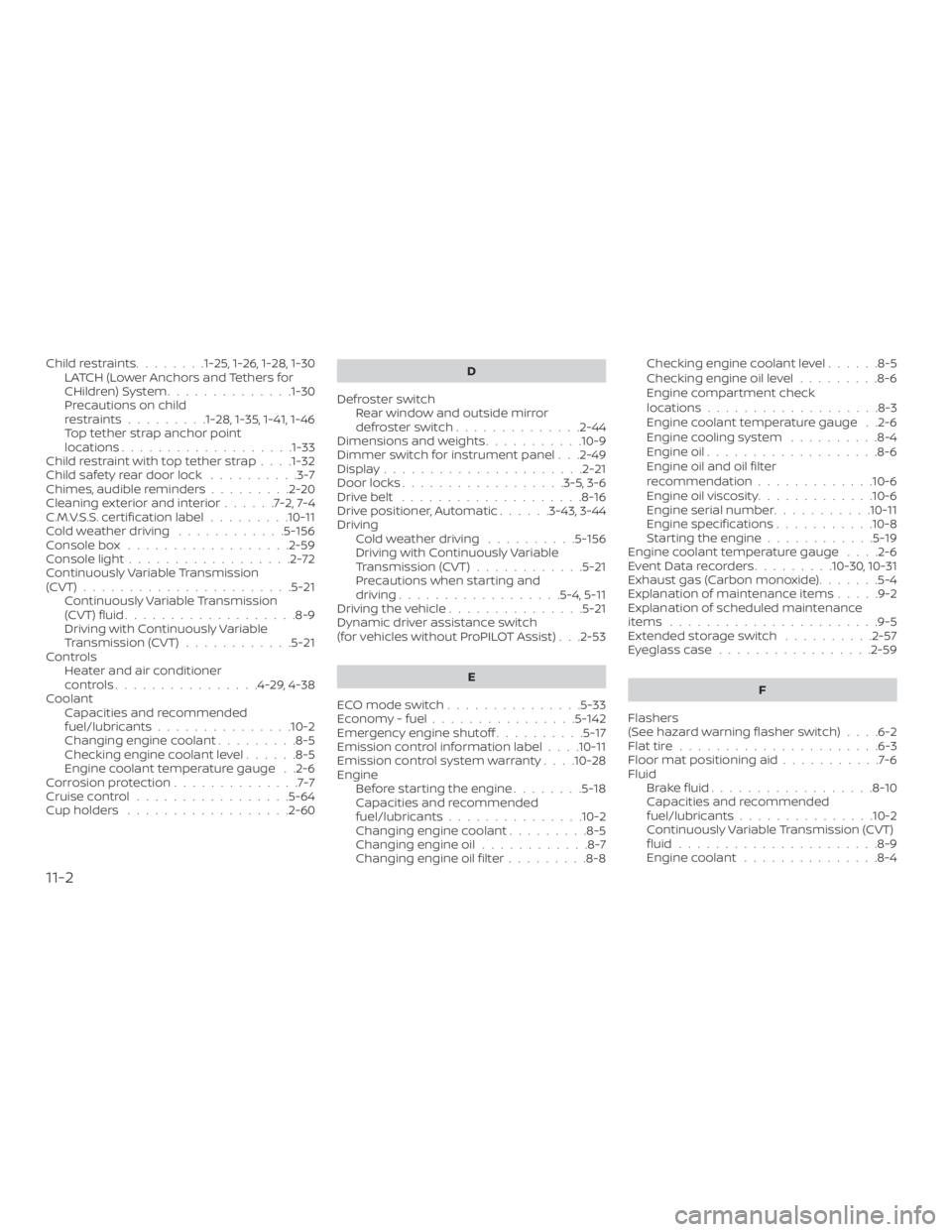
Childrestraints........1-25, 1-26, 1-28, 1-30LATCH (Lower Anchors and Tethers for
CHildren)System..............1-30
Precautions on child
restraints.........1-28, 1-35, 1-41, 1-46
Top tether strap anchor point
locations.................. .1-33
Child restraint with top tether strap . . . .1-32
Child safety rear door lock ..........3-7
Chimes, audible reminders .........2-20
Cleaningexteriorandinterior......7-2,7-4
C.M.V.S.S. certification label .........10-11
Coldweatherdriving ............5-156
Console box ..................2-59
Console light ..................2-72
Continuously Variable Transmission
(CVT) .......................5-21
Continuously Variable Transmission
(CVT) fluid ...................8-9
Driving with Continuously Variable
Transmission (CVT) ............5-21
Controls Heater and air conditioner
controls................4-29,4-38
Coolant Capacities and recommended
fuel/lubricants...............10-2
Changing engine coolant .........8-5
Checking engine coolant level ......8-5
Engine coolant temperature gauge . .2-6
Corrosionprotection..............7-7
Cruisecontrol.................5-64
Cupholders ..................2-60 D
Defroster switch Rear window and outside mirror
defrosterswitch..............2-44
Dimensions and weights ...........10-9
Dimmer switch for instrument panel . . .2-49
Display......................2-21
Door locks ..................3-5,3-6
Drivebelt ....................8-16
Drive positioner, Automatic ......3-43,3-44
Driving Cold weather driving ..........5-156
Driving with Continuously Variable
Transmission (CVT) ............5-21
Precautions when starting and
driving..................5-4,5-11
Drivingthevehicle...............5-21
Dynamic driver assistance switch
(for vehicles without ProPILOT Assist) . . .2-53
E
ECO mode switch ...............5-33
Economy - fuel ................5-142
Emergency engine shutoff ..........5-17
Emission control information label . . . .10-11
Emission control system warranty . . . .10-28
Engine Before starting the engine ........5-18
Capacities and recommended
fuel/lubricants...............10-2
Changing engine coolant .........8-5
Changing engine oil ............8-7
Changing engine oil filter .........8-8Checking engine coolant level
......8-5
Checking engine oil level .........8-6
Engine compartment check
locations...................8-3
Engine coolant temperature gauge . .2-6
Engine cooling system ..........8-4
Engine oil ...................8-6
Engine oil and oil filter
recommendation .............10-6
Engine oil viscosity .............10-6
Engine serial number ...........10-11
Engine specifications ...........10-8
Starting the engine ............5-19
Engine coolant temperature gauge ....2-6
EventDatarecorders.........10-30,10-31
Exhaust gas (Carbon monoxide) .......5-4
Explanation of maintenance items .....9-2
Explanation of scheduled maintenance
items .......................9-5
Extended storage switch ..........2-57
Eyeglasscase.................2-59
F
Flashers
(Seehazardwarningflasherswitch)....6-2
Flattire......................6-3
Floormatpositioningaid...........7-6
Fluid Brakefluid..................8-10
Capacities and recommended
fuel/lubricants...............10-2
Continuously Variable Transmission (CVT)
fluid......................8-9
Engine
coolant ...............8-4
11-2
Page 537 of 547
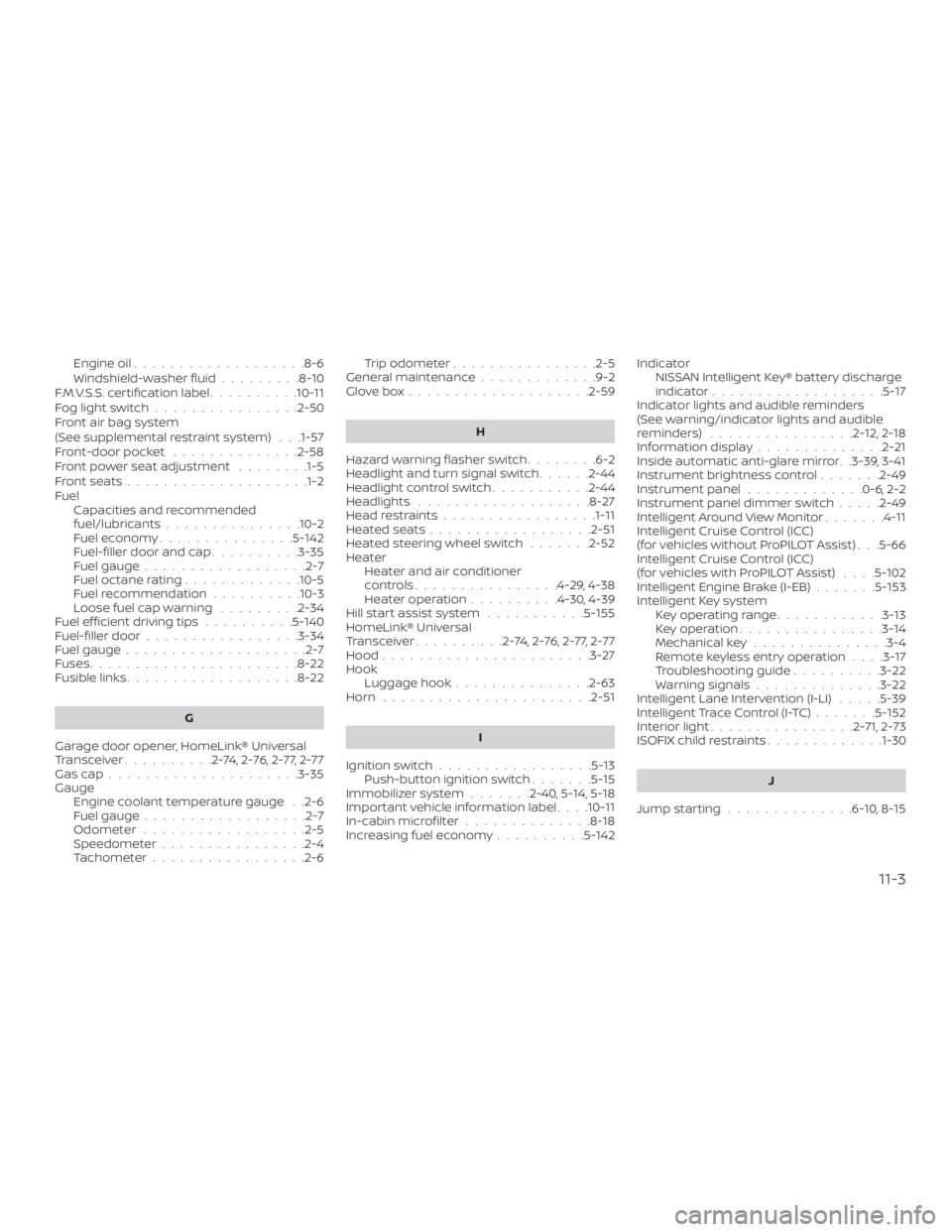
Engine oil...................8-6
Windshield-washer fluid .........8-10
F.M.V.S.S. certification label ..........10-11
Foglightswitch................2-50
Front air bag system
(See supplemental restraint system) . . .1-57
Front-door pocket ..............2-58
Front power seat adjustment ........1-5
Frontseats................... .1-2
Fuel Capacities and recommended
fuel/lubricants...............10-2
Fuel economy ...............5-142
Fuel-filler door and cap ..........3-35
Fuel gauge ..................2-7
Fueloctanerating.............10-5
Fuel recommendation ..........10-3
Loose fuel cap warning .........2-34
Fuelefficientdrivingtips..........5-140
Fuel-filler door .................3-34
Fuel gauge ....................2-7
Fuses .......................8-22
Fusiblelinks...................8-22
G
Garage door opener, HomeLink® Universal
Transceiver ..........2-74,2-76,2-77,2-77
Gascap.....................3-35
Gauge Engine coolant temperature gauge . .2-6
Fuel gauge ..................2-7
Odometer ..................2-5
Speedometer ................2-4
Tachometer .................2-6 Trip odometer
................2-5
General maintenance .............9-2
Glovebox....................2-59
H
Hazard warning flasher switch ........6-2
Headlight and turn signal switch ......2-44
Headlightcontrolswitch...........2-44
Headlights ...................8-27
Headrestraints.................1-11
Heatedseats..................2-51
Heated steering wheel switch .......2-52
Heater Heater and air conditioner
controls................4-29,4-38
Heater operation ..........4-30,4-39
Hill start assist system ...........5-155
HomeLink® Universal
Transceiver ..........2-74,2-76,2-77,2-77
Hood .......................3-27
Hook Luggage hook ...............2-63
Horn .......................2-51
I
Ignition switch .................5-13
Push-button ignition switch .......5-15
Immobilizer system .......2-40,5-14,5-18
Important vehicle information label . . . .10-11
In-cabinmicrofilter..............8-18
Increasing fuel economy ..........5-142Indicator
NISSAN Intelligent Key® battery discharge
indicator...................5-17
Indicator lights and audible reminders
(See warning/indicator lights and audible
reminders) ................2-12,2-18
Informationdisplay............. .2-21
Inside automatic anti-glare mirror. .3-39, 3-41
Instrument brightness control .......2-49
Instrument panel .............0-6,2-2
Instrument panel dimmer switch .....2-49
Intelligent Around View Monitor .......4-11
Intelligent Cruise Control (ICC)
(for vehicles without ProPILOT Assist) . . .5-66
Intelligent Cruise Control (ICC)
(for vehicles with ProPILOT Assist) . . . .5-102
Intelligent Engine Brake (I-EB) .......5-153
Intelligent Key system K
ey operating range ............3-13
Key operation ................3-14
Mechanical key ...............3-4
Remote keyless entry operation ....3-17
Troubleshooting guide ..........3-22
Warning signals ..............3-22
Intelligent Lane Intervention (I-LI) .....5-39
Intelligent Trace Control (I-TC) .......5-152
Interiorlight................2 -71, 2-73
ISOFIX child restraints .............1-30
J
Jumpstarting..............6-10,8-15
11-3