change time NISSAN ROGUE 2021 Owner´s Manual
[x] Cancel search | Manufacturer: NISSAN, Model Year: 2021, Model line: ROGUE, Model: NISSAN ROGUE 2021Pages: 556, PDF Size: 2.7 MB
Page 404 of 556
5-150Starting and driving
.Recirculating the cool air in thecabin when the A/C is on reduces
cooling load.
4. Drive at economical speeds and dis- tances.
.Observing the speed limit and notexceeding 60 MPH (97 km/h)
(where legally allowed) can improve
fuel efficiency due to reduced aero-
dynamic drag.
.Maintaining a safe following dis-tance behind other vehicles re-
duces unnecessary braking.
.Safely monitoring traffic to antici- pate changes in speed permits
reduced braking and smooth accel-
eration changes.
.Select a gear range suitable to roadconditions.
5. Use cruise control.
.Using cruise control during highway driving helps maintain a steady
speed.
.Cruise control is particularly effec-tive in providing fuel savings when
driving on flat terrains.
6. Plan for the shortest route.
.Utilize a map or navigation system to determine the best route to save
time. 7. Avoid idling.
.Shutting off your engine when safe
for stops exceeding 30-60 seconds
saves fuel and reduces emissions.
8. Buy an automated pass for toll roads.
.Automated passes permit drivers to use special lanes to maintain cruis-
ing speed through the toll and
avoid stopping and starting.
9. Winter warm up.
.Limit idling time to minimize impact to fuel economy.
.Vehicles typically need no morethan 30 seconds of idling at start-
up to effectively circulate the en-
gine oil before driving.
.Your vehicle will reach its ideal
operating temperature more
quickly while driving versus idling.
10. Keeping your vehicle cool.
.Park your vehicle in a covered parking area or in the shade when-
ever possible.
.When entering a hot vehicle, open- ing the windows will help to reduce
the inside temperature faster, re-
sulting in reduced demand on your
A/C system. .
Keep your engine tuned up.
. Follow the recommended scheduled
maintenance.
. Keep the tires inflated to the correct
pressure. Low tire pressure increases
tire wear and lowers fuel economy.
. Keep the wheels in correct alignment.
Improper alignment increases tire
wear and lowers fuel economy.
. Use the recommended viscosity en-
gine oil. (See “Engine oil and oil filter
recommendation” (P.10-6).)
INCREASING FUEL ECONOMY
Page 496 of 556
9-4Maintenance and schedules
Seats:Check seat position controls such
as seat adjusters, seatback recliners, etc.
to ensure they operate smoothly and that
all latches lock securely in every position.
Check that the head restraints/headrests
move up and down smoothly and that
the locks (if so equipped) hold securely in
all latched positions.
Steering wheel: Check for changes in the
steering conditions, such as excessive
free play, hard steering or strange noises.
Warning lights and chimes: Make sure
that all warning lights and chimes are
operating properly.
Windshield defroster: Check that the air
comes out of the defroster outlets prop-
erly and in sufficient quantity when oper-
ating the heater or air conditioner.
Windshield wiper and washer*: Check
that the wipers and washers operate
properly and that the wipers do not
streak.
Under the hood and vehicle
The maintenance items listed here should
be checked periodically (for example,
each time you check the engine oil or
refuel).
Battery*: This vehicle is equipped with a
sealed maintenance free battery. It is
recommended that you visit a NISSAN dealer for service.
NOTE:
Care should be taken to avoid situations
that can lead to potential battery dis-
charge and potential no-start condi-
tions such as:
1.
Installation or extended use of elec-
tronic accessories that consume
battery power when the engine is
not running (Phone chargers, GPS,
DVD players, etc.)
2. Vehicle is not driven regularly and/
or only driven short distances.
In these cases, the battery may need to
be charged to maintain battery health.
Brake fluid level*: Make sure that the
brake fluid level is between the MAX and
MIN lines on the reservoir.
Engine coolant level*: Check the coolant
level when the engine is cold.
Engine drive belt*: Make sure that the
drive belt is not frayed, worn, cracked or
oily.
Engine oil level*: Check the level after
parking the vehicle on a level surface and
turning off the engine. Wait more than 10
minutes for the oil to drain back into the
oil pan.
Exhaust system: Make sure there are no
loose supports, cracks or holes. If the sound of the exhaust seems unusual or
there is a smell of exhaust fumes, im-
mediately have the exhaust system in-
spected. It is recommended you visit a
NISSAN dealer for this service. (See “Pre-
cautions when starting and driving” (P.5-
5) for exhaust gas (carbon monoxide).)
Fluid leaks:
Check under the vehicle for
fuel, oil, water or other fluid leaks after the
vehicle has been parked for a while. Water
dripping from the air conditioner after use
is normal. If you should notice any leaks
or if gasoline fumes are evident, check for
the cause and have it corrected immedi-
ately.
Radiator and hoses: Check the front of
the radiator and clean off any dirt, insects,
leaves, etc., that may have accumulated.
Make sure the hoses have no cracks,
deformation, rot or loose connections.
Underbody: The underbody is frequently
exposed to corrosive substances such as
those used on icy roads or to control
dust. It is very important to remove these
substances, otherwise rust will form on
the floor pan, frame, fuel lines and around
the exhaust system. At the end of winter,
the underbody should be thoroughly
flushed with plain water, being careful to
clean those areas where mud and dirt
may accumulate. For additional informa-
tion, see “Cleaning exterior” (P.7-2).
Page 499 of 556
To help ensure smooth, safe and eco-
nomical driving, NISSAN provides two
maintenance schedules that may be
used, depending upon the conditions in
which you usually drive. These schedules
contain both distance and time intervals,
up to 120,000 miles (192,000 km)/96
months. For most people, the odometer
reading will indicate when service is
needed. However, if you drive very little,
your vehicle should be serviced at the
regular time intervals shown in the sche-
dule.
After 120,000 miles (192,000 km)/96
months, continue maintenance at the
same mileage/time intervals.
ADDITIONAL MAINTENANCE ITEMS
FOR SEVERE OPERATING CONDI-
TIONS
Additional maintenance items for se-
vere operating conditions;should be
performed on vehicles that are driven
under especially demanding conditions.
Additional maintenance items should be
performed if you primarily operate your
vehicle under the following conditions:
. Repeated short trips of less than 5
miles (8 km).
. Repeated short trips of less than 10
miles (16 km) with outside tempera-
tures remaining below freezing. .
Operating in hot weather in stop-and-
go “rush hour” traffic.
. Extensive idling and/or low speed
driving for long distances, such as
police, taxi or door-to-door delivery
use.
. Driving in dusty conditions.
. Driving on rough, muddy or salt
spread roads.
. Using a car-top carrier.
. Towing a trailer.
. Using a camper.
If your vehicle is mainly operated under
the severe conditions, follow the severe
maintenance intervals shown in the
maintenance schedule.
OIL CONTROL SYSTEM
Your vehicle is equipped with oil control
system. It calculates engine oil and filter
change intervals based on driving condi-
tions. Driving in the following severe
conditions will shorten the engine oil
and filter change interval.
Maintenance and schedules9-7
MAINTENANCE SCHEDULES
Page 500 of 556
9-8Maintenance and schedules
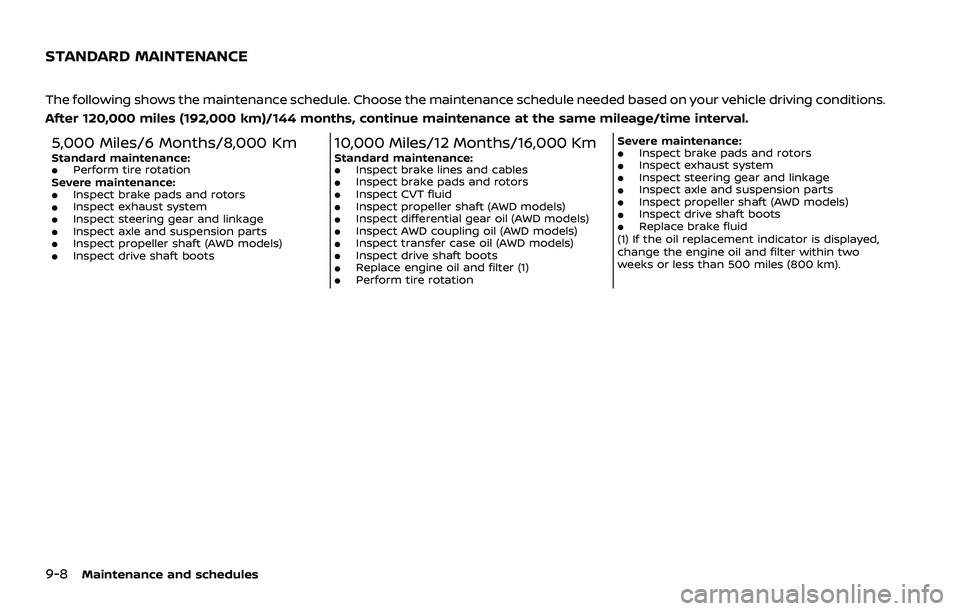
The following shows the maintenance schedule. Choose the maintenance schedule needed based on your vehicle driving conditions.
After 120,000 miles (192,000 km)/144 months, continue maintenance at the same mileage/time interval.
5,000 Miles/6 Months/8,000 KmStandard maintenance:.Perform tire rotation
Severe maintenance:
.Inspect brake pads and rotors.Inspect exhaust system.Inspect steering gear and linkage.Inspect axle and suspension parts.Inspect propeller shaft (AWD models).Inspect drive shaft boots
10,000 Miles/12 Months/16,000 KmStandard maintenance:.Inspect brake lines and cables.Inspect brake pads and rotors.Inspect CVT fluid.Inspect propeller shaft (AWD models).Inspect differential gear oil (AWD models).Inspect AWD coupling oil (AWD models).Inspect transfer case oil (AWD models).Inspect drive shaft boots.Replace engine oil and filter (1).Perform tire rotation Severe maintenance:
.Inspect brake pads and rotors.Inspect exhaust system.Inspect steering gear and linkage.Inspect axle and suspension parts.Inspect propeller shaft (AWD models).Inspect drive shaft boots.Replace brake fluid
(1) If the oil replacement indicator is displayed,
change the engine oil and filter within two
weeks or less than 500 miles (800 km).
STANDARD MAINTENANCE
Page 517 of 556
.If a methanol blend is used, it should
contain no more than 5% methanol
(methyl alcohol, wood alcohol). It
should also contain a suitable
amount of appropriate cosolvents
and corrosion inhibitors. If not prop-
erly formulated with appropriate
cosolvents and corrosion inhibitors,
such methanol blends may cause
fuel system damage and/or vehicle
performance problems. At this time,
sufficient data is not available to
ensure that all methanol blends are
suitable for use in NISSAN vehicles.
If any driveability problems such as en-
gine stalling and difficult hot-starting are
experienced after using oxygenate-blend
fuels, immediately change to a non-oxy-
genate fuel or a fuel with a low blend of
MTBE.
Take care not to spill gasoline during
refueling. Gasoline containing oxyge-
nates can cause paint damage.
E-15 fuel
E-15 fuel is a mixture of approximately
15% fuel ethanol and 85% unleaded gaso-
line. E-15 can only be used in vehicles
designed to run on E- 15 fuel. U.S. govern-
ment regulations require fuel ethanol
dispensing pumps to be identified with
small, square, orange and black label with
the common abbreviation or the appro- priate percentage for that region.
E-85 fuel
E-85 fuel is a mixture of approximately
85% fuel ethanol and 15% unleaded gaso-
line. E-85 can only be used in a Flexible
Fuel Vehicle (FFV). Do not use E-85 fuel in
your vehicle. U.S. government regulations
require fuel ethanol dispensing pumps to
be identified by a small, square, orange
and black label with the common abbre-
viation or the appropriate percentage for
that region.
Fuel containing MMT
MMT, or methylcyclopentadienyl manga-
nese tricarbonyl, is an octane boosting
additive. NISSAN does not recommend
the use of fuel containing MMT. Such fuel
may adversely affect vehicle perfor-
mance, including the emissions control
system. Note that while some fuel pumps
label MMT content, not all do, so you may
have to consult your gasoline retailer for
more details.
Aftermarket fuel additives
NISSAN does not recommend the use of
any aftermarket fuel additives (for exam-
ple, fuel injector cleaner, octane booster,
intake valve deposit removers, etc.) which
are sold commercially. Many of these
additives intended for gum, varnish or
deposit removal may contain active sol-
vent or similar ingredients that can be
harmful to the fuel system and engine.
Octane rating tips
Using unleaded gasoline with an octane
rating lower than recommended can
cause persistent, heavy “spark knock”.
(Spark knock is a metallic rapping
noise.) If severe, this can lead to engine
damage. If you detect a persistent
heavy spark knock even when using
gasoline of the stated octane rating, or
if you hear steady spark knock while
holding a steady speed on level roads, it
is recommended you have a NISSAN
dealer correct the condition. Failure to
correct the condition is misuse of the
vehicle, for which NISSAN is not respon-
sible.
Incorrect ignition timing will result in
spark knock, after-run and/or overheat-
ing, which may cause excessive fuel
consumption or engine damage. If any
of the above symptoms are encountered,
have your vehicle checked. It is recom-
mended you visit a NISSAN dealer for
servicing.
However, now and then you may notice
light spark knock for a short time while
accelerating or driving up hills. This is
not a cause for concern, because you
Technical and consumer information10-5
Page 538 of 556
10-26Technical and consumer information
the water or the trailer lights may
burn out.
When towing a trailer, the Continuously
Variable Transmission (CVT) fluid, trans-
fer fluid and differential gear oil should
be changed more frequently. For addi-
tional information, see the "9. Mainte-
nance and schedules" section.FLAT TOWING FOR ALL–WHEEL
DRIVE VEHICLE (if so equipped)
Towing your vehicle with all four wheels
on the ground is sometimes called flat
towing. This method is sometimes used
when towing a vehicle behind a recrea-
tional vehicle, such as a motor home.
CAUTION
. Failure to follow these guidelines
can result in severe transmission
damage.
. Never flat tow your All-Wheel
Drive (AWD) vehicle.
. DO NOT tow your All-Wheel Drive
(AWD) vehicle with any wheels on
the ground. Doing so may cause
serious and expensive damage to
the powertrain.
. For emergency towing proce-
dures refer to “Towing recom-
mended by NISSAN” (P.6-16).
FLAT TOWING FOR FRONT-WHEEL
DRIVE VEHICLE (if so equipped)
Towing your vehicle with all four wheels
on the ground is sometimes called flat
towing. This method is sometimes used
when towing a vehicle behind a recrea-
tional vehicle, such as a motor home.
CAUTION
.Failure to follow these guidelines
can result in severe transmission
damage.
. Whenever flat towing your vehi-
cle, always tow forward, never
backward.
. Never tow your front wheel drive
vehicle with the front tires on the
ground. Doing so may cause ser-
ious and expensive damage to
the powertrain.
. DO NOT tow your front wheel
drive Continuously Variable
Transmission (CVT) vehicle with
all four wheels on the ground (flat
towing). Doing so WILL DAMAGE
internal transmission parts due
to lack of transmission lubrica-
tion.
FLAT TOWING