Condition NISSAN TEANA 2008 Service Manual
[x] Cancel search | Manufacturer: NISSAN, Model Year: 2008, Model line: TEANA, Model: NISSAN TEANA 2008Pages: 5121, PDF Size: 69.03 MB
Page 3043 of 5121
SQUEAK AND RATTLE TROUBLE DIAGNOSES
IP-3
< SYMPTOM DIAGNOSIS >
C
D
E
F
G
H
I
K
L
MA
B
IP
N
O
P
If possible, drive the vehicle with the customer until the noise is duplicated. Note any additional information on
the Diagnostic Worksheet regarding the conditions or location of the noise. This information can be used to
duplicate the same conditions when the repair is reconfirmed.
If the noise can be duplicated easily during the test drive, to help identify the source of the noise, try to dupli-
cate the noise with the vehicle stopped by doing one or all of the following:
1) Close a door.
2) Tap or push/pull around the area where the noise appears to be coming from.
3) Rev the engine.
4) Use a floor jack to recreate vehicle “twist”.
5) At idle, apply engine load (electrical load, half-clutch on M/T model, drive position on A/T model).
6) Raise the vehicle on a hoist and hit a tire with a rubber hammer.
Drive the vehicle and attempt to duplicate the conditions the customer states exist when the noise occurs.
If it is difficult to duplicate the noise, drive the vehicle slowly on an undulating or rough road to stress the
vehicle body.
LOCATE THE NOISE AND IDENTIFY THE ROOT CAUSE
1. Narrow down the noise to a general area. To help pinpoint the source of the noise, use a listening tool
(Engine Ear or mechanics stethoscope).
2. Narrow down the noise to a more specific area and identify the cause of the noise by:
Removing the components in the area that is are suspected to be the cause of the noise.
Do not use too much force when removing clips and fasteners, otherwise clips and fastener can be broken
or lost during the repair, resulting in the creation of new noise.
Tapping or pushing/pulling the component that is are suspected to be the cause of the noise.
Do not tap or push/pull the component with excessive force, otherwise the noise will be eliminated only tem-
porarily.
Feeling for a vibration by hand by touching the component(s) that is are suspected to be the cause of the
noise.
Placing a piece of paper between components that is are suspected to be the cause of the noise.
Looking for loose components and contact marks.
Refer to IP-4, "
Inspection Procedure".
REPAIR THE CAUSE
If the cause is a loose component, tighten the component securely.
If the cause is insufficient clearance between components:
- Separate components by repositioning or loosening and retightening the component, if possible.
- Insulate components with a suitable insulator such as urethane pads, foam blocks, felt cloth tape or ure-
thane tape. These insulators are available through the authorized Nissan Parts Department.
CAUTION:
Never use excessive force as many components are constructed of plastic and may be damaged.
NOTE:
URETHANE PADS
Insulates connectors, harness, etc.
INSULATOR (Foam blocks)
Insulates components from contact. Can be used to fill space behind a panel.
INSULATOR (Light foam block)
FELT CLOTHTAPE
Used to insulate where movement does not occur. Ideal for instrument panel applications.
The following materials, not available through NISSAN Parts Department, can also be used to repair
squeaks and rattles.
UHMW(TEFLON) TAPE
Insulates where slight movement is present. Ideal for instrument panel applications.
SILICONE GREASE
Used in place of UHMW tape that is be visible or does not fit.
Note: Will only last a few months.
SILICONE SPRAY
Used when grease cannot be applied.
DUCT TAPE
Used to eliminate movement.
CONFIRM THE REPAIR
Page 3044 of 5121

IP-4
< SYMPTOM DIAGNOSIS >
SQUEAK AND RATTLE TROUBLE DIAGNOSES
Confirm that the cause of a noise is repaired by test driving the vehicle. Operate the vehicle under the same
conditions as when the noise originally occurred. Refer to the notes on the Diagnostic Worksheet.
Inspection ProcedureINFOID:0000000003939974
Refer to Table of Contents for specific component removal and installation information.
INSTRUMENT PANEL
Most incidents are caused by contact and movement between:
1. Cluster lid A and instrument panel
2. Acrylic lens and combination meter housing
3. Instrument panel to front pillar garnish
4. Instrument panel to windshield
5. Instrument panel mounting pins
6. Wiring harnesses behind the combination meter
7. A/C defroster duct and duct joint
These incidents can usually be located by tapping or moving the components to duplicate the noise or by
pressing on the components while driving to stop the noise. Most of these incidents can be repaired by apply-
ing felt cloth tape or silicon spray (in hard to reach areas). Urethane pads can be used to insulate wiring har-
ness.
CAUTION:
Never use silicone spray to isolate a squeak or rattle. If the area is saturated with silicone, the recheck
of repair becomes impossible.
CENTER CONSOLE
Components to pay attention to include:
1. Shifter assembly cover to finisher
2. A/C control unit and cluster lid C
3. Wiring harnesses behind audio and A/C control unit
The instrument panel repair and isolation procedures also apply to the center console.
DOORS
Pay attention to the following:
1. Finisher and inner panel making a slapping noise
2. Inside handle escutcheon to door finisher
3. Wiring harnesses tapping
4. Door striker out of alignment causing a popping noise on starts and stops
Tapping or moving the components or pressing on them while driving to duplicate the conditions can isolate
many of these incidents. The areas can usually be insulated with felt cloth tape or insulator foam blocks to
repair the noise.
TRUNK
Trunk noises are often caused by a loose jack or loose items put into the trunk by the customer.
In addition look for the following:
1. Trunk lid dumpers out of adjustment
2. Trunk lid striker out of adjustment
3. Trunk lid torsion bars knocking together
4. A loose license plate or bracket
Most of these incidents can be repaired by adjusting, securing or insulating the item(s) or component(s) caus-
ing the noise.
SUNROOF/HEADLINING
Noises in the sunroof/headlining area can often be traced to one of the following:
1. Sunroof lid, rail, linkage or seals making a rattle or light knocking noise
2. Sunvisor shaft shaking in the holder
3. Front or rear windshield touching headlining and squeaking
Page 3045 of 5121

SQUEAK AND RATTLE TROUBLE DIAGNOSES
IP-5
< SYMPTOM DIAGNOSIS >
C
D
E
F
G
H
I
K
L
MA
B
IP
N
O
P
Again, pressing on the components to stop the noise while duplicating the conditions can isolate most of these
incidents. Repairs usually consist of insulating with felt cloth tape.
SEATS
When isolating seat noise it is important to note the position the seat is in and the load placed on the seat
when the noise occurs. These conditions should be duplicated when verifying and isolating the cause of the
noise.
Cause of seat noise include:
1. Headrest rods and holder
2. A squeak between the seat pad cushion and frame
3. Rear seatback lock and bracket
These noises can be isolated by moving or pressing on the suspected components while duplicating the con-
ditions under which the noise occurs. Most of these incidents can be repaired by repositioning the component
or applying urethane tape to the contact area.
UNDERHOOD
Some interior noise may be caused by components under the hood or on the engine wall. The noise is then
transmitted into the passenger compartment.
Causes of transmitted underhood noise include:
1. Any component mounted to the engine wall
2. Components that pass through the engine wall
3. Engine wall mounts and connectors
4. Loose radiator mounting pins
5. Hood bumpers out of adjustment
6. Hood striker out of adjustment
These noises can be difficult to isolate since they cannot be reached from the interior of the vehicle. The best
method is to secure, move or insulate one component at a time and test drive the vehicle. Also, engine RPM
or load can be changed to isolate the noise. Repairs can usually be made by moving, adjusting, securing, or
insulating the component causing the noise.
Page 3068 of 5121

LAN
LAN-1
ELECTRICAL & POWER CONTROL
C
DE
F
G H
I
J
K L
B
SECTION LAN
A
O P
N
CONTENTS
LAN SYSTEM
CAN FUNDAMENTAL
PRECAUTION ................ ...............................
4
PRECAUTIONS .............................................. .....4
Precautions for Trouble Diagnosis ...................... ......4
Precautions for Harness Repair ................................4
FUNCTION DIAGNOSIS ...............................5
CAN COMMUNICATION SYSTEM ................ .....5
System Description ............................................. ......5
System Diagram ........................................................5
CAN Communication Control Circuit .........................6
DIAG ON CAN .....................................................7
Description .......................................................... ......7
System Diagram ........................................................7
TROUBLE DIAGNOSIS ......................................8
Condition of Error Detection ................................ ......8
Symptom When Error Occurs in CAN Communi-
cation System ...................................................... ......
8
CAN Diagnosis with CONSULT-III ..........................11
Self-Diagnosis .........................................................11
CAN Diagnostic Support Monitor ............................11
How to Use CAN Communication Signal Chart ......13
BASIC INSPECTION ...................................14
DIAGNOSIS AND REPAIR WORKFLOW ..... ....14
Trouble Diagnosis Flow Chart ............................. ....14
Trouble Diagnosis Procedure ..................................14
CAN
HOW TO USE THIS MANU AL .....................
19
HOW TO USE THIS SECTION ....................... ....19
Caution ................................................................ ....19
Abbreviation List ......................................................19
PRECAUTION ..............................................20
PRECAUTIONS .................................................20
Precaution for Supplemental Restraint System
(SRS) "AIR BAG" and "SEAT BELT PRE-TEN-
SIONER" ............................................................. ....
20
Precautions for Trouble Diagnosis ..........................20
Precautions for Harness Repair ..............................20
BASIC INSPECTION ...................................21
DIAGNOSIS AND REPAIR WORKFLOW ........21
Interview Sheet .................................................... ....21
FUNCTION DIAGNOSIS ..............................22
CAN COMMUNICATION SYSTEM ...................22
CAN System Specification Chart ......................... ....22
CAN Communication Signal Chart ..........................22
COMPONENT DIAGNOSIS .........................26
CAN COMMUNICATION SYSTEM ...................26
Component Parts Location .................................. ....26
Wiring Diagram - CAN SYSTEM - ...........................27
MALFUNCTION AREA CHART ........................31
Main Line ............................................................. ....31
Branch Line .............................................................31
Short Circuit .............................................................31
MAIN LINE BETWEEN ADP AND M&A CIR-
CUIT ..................................................................
32
Diagnosis Procedure ...............................................32
MAIN LINE BETWEEN M&A AND DLC CIR-
CUIT ..................................................................
33
Diagnosis Procedure ...............................................33
MAIN LINE BETWEEN DLC AND ABS CIR-
CUIT ..................................................................
34
Diagnosis Procedure ...............................................34
ECM BRANCH LINE CIRCUIT .........................35
Diagnosis Procedure ...............................................35
Page 3075 of 5121
![NISSAN TEANA 2008 Service Manual LAN-8
< FUNCTION DIAGNOSIS >[CAN FUNDAMENTAL]
TROUBLE DIAGNOSIS
TROUBLE DIAGNOSIS
Condition of Error DetectionINFOID:0000000003767670
“U1000” or “U1001” is indicated on SELF-DIAG RESULTS on CO](/img/5/57391/w960_57391-3074.png "NISSAN TEANA 2008 Service Manual LAN-8
< FUNCTION DIAGNOSIS >[CAN FUNDAMENTAL]
TROUBLE DIAGNOSIS
TROUBLE DIAGNOSIS
Condition of Error DetectionINFOID:0000000003767670
“U1000” or “U1001” is indicated on SELF-DIAG RESULTS on CO")
LAN-8
< FUNCTION DIAGNOSIS >[CAN FUNDAMENTAL]
TROUBLE DIAGNOSIS
TROUBLE DIAGNOSIS
Condition of Error DetectionINFOID:0000000003767670
“U1000” or “U1001” is indicated on SELF-DIAG RESULTS on CONSULT-III if CAN communication signal is
not transmitted or received between units for 2 seconds or more.
CAN COMMUNICATION SYSTEM ERROR
CAN communication line open (CAN-H, CAN-L, or both)
CAN communication line short (ground, between CAN communication lines, other harnesses)
Error of CAN communication control circuit of the unit connected to CAN communication line
WHEN “U1000” OR “U1001” IS INDICATED EVEN THOUGH CAN COMMUNICATION SYSTEM IS
NORMAL
Removal/installation of parts: Error may be detected when removing and installing CAN communication unit
and related parts while turning the ignition switch ON. (A DTC except for CAN communication may be
detected.)
Fuse blown out (removed): CAN communication of the unit may cease.
Voltage drop: Error may be detected if voltage drops due to discharged battery when turning the ignition
switch ON (Depending on the control unit which carries out CAN communication).
Error may be detected if the power supply circuit of the control unit, which carries out CAN communication,
malfunctions (Depending on the control unit which carries out CAN communication).
Error may be detected if reprogramming is not completed normally.
NOTE:
CAN communication system is normal if “U1000” or “U1001” is indicated on SELF-DIAG RESULTS of CON-
SULT-III under the above conditions. Erase the memory of the self-diagnosis of each unit.
Symptom When Error Occurs in CAN Communication SystemINFOID:0000000003767671
In CAN communication system, multiple units mutually transmit and receive signals. Each unit cannot transmit
and receive signals if any error occurs on CAN communication line. Under this condition, multiple control units
related to the root cause malfunction or go into fail-safe mode.
ERROR EXAMPLE
NOTE:
Each vehicle differs in symptom of each unit under fail-safe mode and CAN communication line wiring.
Refer to LAN-19, "
Abbreviation List" for the unit abbreviation.
Example: TCM branch line open circuit
SKIB8738E
Unit name Symptom
ECM Engine torque limiting is affected, and shift harshness increases.
BCM Reverse warning chime does not sound.
Page 3078 of 5121
![NISSAN TEANA 2008 Service Manual LAN
TROUBLE DIAGNOSIS
LAN-11
< FUNCTION DIAGNOSIS >[CAN FUNDAMENTAL]
C
D
E
F
G
H
I
J
K
L B A
O
P N
CAN Diagnosis with CONSULT-IIIINFOID:0000000003767672
CAN diagnosis on CONSULT-III extracts the root](/img/5/57391/w960_57391-3077.png "NISSAN TEANA 2008 Service Manual LAN
TROUBLE DIAGNOSIS
LAN-11
< FUNCTION DIAGNOSIS >[CAN FUNDAMENTAL]
C
D
E
F
G
H
I
J
K
L B A
O
P N
CAN Diagnosis with CONSULT-IIIINFOID:0000000003767672
CAN diagnosis on CONSULT-III extracts the root")
LAN
TROUBLE DIAGNOSIS
LAN-11
< FUNCTION DIAGNOSIS >[CAN FUNDAMENTAL]
C
D
E
F
G
H
I
J
K
L B A
O
P N
CAN Diagnosis with CONSULT-IIIINFOID:0000000003767672
CAN diagnosis on CONSULT-III extracts the root cause by receiving the following information.
Response to the system call
Control unit diagnosis information
Self-diagnosis
CAN diagnostic support monitor
Self-DiagnosisINFOID:0000000003767673
CAN Diagnostic Support MonitorINFOID:0000000003767674
MONITOR ITEM (CONSULT-III)
Unit name Symptom
ECM Engine torque limiting is affected, and shift harshness increases.
Engine speed drops.
BCM Reverse warning chime does not sound.
The front wiper moves under continuous operation mode even though the front
wiper switch being in the intermittent position.
The room lamp does not turn ON.
The engine does not start (if an error or malfunction occurs while turning the igni-
tion switch OFF.)
The steering lock does not release (if an error or malfunction occurs while turning
the ignition switch OFF.)
EPS control unit The steering effort increases.
Combination meter The tachometer and the speedometer do not move.
Warning lamps turn ON.
Indicator lamps do not turn ON.
ABS actuator and electric unit (control unit) Normal operation.
TCM No impact on operation.
IPDM E/RWhen the ignition switch is ON,
The headlamps (Lo) turn ON.
The cooling fan continues to rotate.
DTCSelf-diagnosis item
(CONSULT-III indication)DTC detection condition Inspection/Action
U1000 CAN COMM CIRCUITWhen ECM is not transmitting or receiving CAN
communication signal of OBD (emission-related
diagnosis) for 2 seconds or more.
Start the inspection. Re-
fer to the applicable sec-
tion of the indicated
control unit. When a control unit (except for ECM) is not
transmitting or receiving CAN communication
signal for 2 seconds or more.
U1001 CAN COMM CIRCUITWhen ECM is not transmitting or receiving CAN
communication signal other than OBD (emis-
sion-related diagnosis) for 2 seconds or more.
U1002 SYSTEM COMMWhen a control unit is not transmitting or receiv-
ing CAN communication signal for 2 seconds or
less.
U1010 CONTROL UNIT [CAN]
When an error is detected during the initial diag-
nosis for CAN controller of each control unit.Replace the control unit
indicating “U1010” or
“P0607”. P0607 ECM
Page 3081 of 5121
![NISSAN TEANA 2008 Service Manual LAN-14
< BASIC INSPECTION >[CAN FUNDAMENTAL]
DIAGNOSIS AND REPAIR WORKFLOW
BASIC INSPECTION
DIAGNOSIS AND REPAIR WORKFLOW
Trouble Diagnosis Flow ChartINFOID:0000000003767676
Trouble Diagnosis Procedur](/img/5/57391/w960_57391-3080.png "NISSAN TEANA 2008 Service Manual LAN-14
< BASIC INSPECTION >[CAN FUNDAMENTAL]
DIAGNOSIS AND REPAIR WORKFLOW
BASIC INSPECTION
DIAGNOSIS AND REPAIR WORKFLOW
Trouble Diagnosis Flow ChartINFOID:0000000003767676
Trouble Diagnosis Procedur")
LAN-14
< BASIC INSPECTION >[CAN FUNDAMENTAL]
DIAGNOSIS AND REPAIR WORKFLOW
BASIC INSPECTION
DIAGNOSIS AND REPAIR WORKFLOW
Trouble Diagnosis Flow ChartINFOID:0000000003767676
Trouble Diagnosis ProcedureINFOID:0000000003767677
INTERVIEW WITH CUSTOMER
Interview with the customer is important to detect the root cause of CAN communication system errors and to
understand vehicle condition and symptoms for proper trouble diagnosis.
Points in interview What: Parts name, system name
When: Date, Frequency
Where: Road condition, Place
In what condition: Driving condition/environment
Result: Symptom
NOTE:
Check normal units as well as error symptoms.
- Example: Circuit between ECM and the combination meter is judged normal if the customer indicates
tachometer functions normally.
When a CAN communication system error is present, multiple control units may malfunction or go into fail-
safe mode.
JSMIA0016GB
Page 3082 of 5121
![NISSAN TEANA 2008 Service Manual LAN
DIAGNOSIS AND REPAIR WORKFLOW
LAN-15
< BASIC INSPECTION >[CAN FUNDAMENTAL]
C
D
E
F
G
H
I
J
K
L B A
O
P N
Indication of the combination meter is important to detect the root cause because it is t](/img/5/57391/w960_57391-3081.png "NISSAN TEANA 2008 Service Manual LAN
DIAGNOSIS AND REPAIR WORKFLOW
LAN-15
< BASIC INSPECTION >[CAN FUNDAMENTAL]
C
D
E
F
G
H
I
J
K
L B A
O
P N
Indication of the combination meter is important to detect the root cause because it is t")
LAN
DIAGNOSIS AND REPAIR WORKFLOW
LAN-15
< BASIC INSPECTION >[CAN FUNDAMENTAL]
C
D
E
F
G
H
I
J
K
L B A
O
P N
Indication of the combination meter is important to detect the root cause because it is the most obvious to
the customer, and it performs CAN communication with many units.
INSPECTION OF VEHICLE CONDITION
Check whether the symptom is reproduced or not.
NOTE:
Do not turn the ignition switch OFF or disconnect the battery cable while reproducing the error. The error may
temporarily correct itself, making it difficult to determine the root cause.
CHECK OF CAN SYSTEM TYPE (HOW TO USE CAN SYSTEM TYPE SPECIFICATION CHART)
Determine CAN system type based on vehicle equipment.
NOTE:
This chart is used if CONSULT-III does not automatically recognize CAN system type.
There are two styles for CAN system type specification charts. Depending on the number of available sys-
tem types, either style A or style B may be used.
CAN System Type Specification Chart (Style A)
NOTE:
SKIB8717E
Page 3084 of 5121
![NISSAN TEANA 2008 Service Manual LAN
DIAGNOSIS AND REPAIR WORKFLOW
LAN-17
< BASIC INSPECTION >[CAN FUNDAMENTAL]
C
D
E
F
G
H
I
J
K
L B A
O
P N
CAN system type is easily checked with the vehicle equipment identification information sho](/img/5/57391/w960_57391-3083.png "NISSAN TEANA 2008 Service Manual LAN
DIAGNOSIS AND REPAIR WORKFLOW
LAN-17
< BASIC INSPECTION >[CAN FUNDAMENTAL]
C
D
E
F
G
H
I
J
K
L B A
O
P N
CAN system type is easily checked with the vehicle equipment identification information sho")
LAN
DIAGNOSIS AND REPAIR WORKFLOW
LAN-17
< BASIC INSPECTION >[CAN FUNDAMENTAL]
C
D
E
F
G
H
I
J
K
L B A
O
P N
CAN system type is easily checked with the vehicle equipment identification information shown in the chart.
CREATE INTERVIEW SHEET
Fill out the symptom described by the customer, vehicle condition, and CAN system type on the interview
sheet.
JSMIA0018GB
Page 3191 of 5121
PREPARATION
MA-3
< PREPARATION >
C
D
E
F
G
H
I
J
K
L
MB
MAN
OA
PREPARATION
PREPARATION
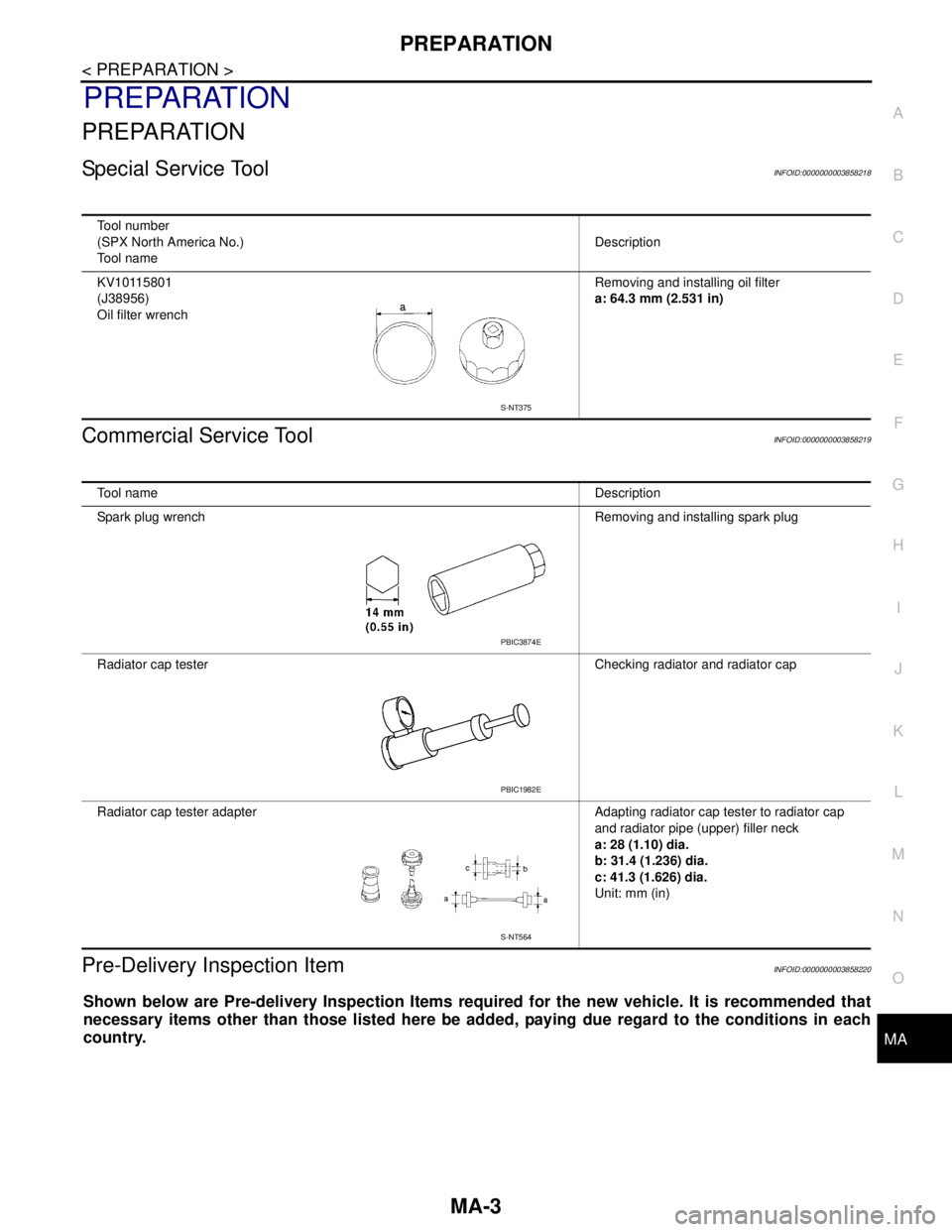
Special Service ToolINFOID:0000000003858218
Commercial Service ToolINFOID:0000000003858219
Pre-Delivery Inspection ItemINFOID:0000000003858220
Shown below are Pre-delivery Inspection Items required for the new vehicle. It is recommended that
necessary items other than those listed here be added, paying due regard to the conditions in each
country.
Tool number
(SPX North America No.)
Tool nameDescription
KV10115801
(J38956)
Oil filter wrenchRemoving and installing oil filter
a: 64.3 mm (2.531 in)
S-NT375
Tool nameDescription
Spark plug wrench Removing and installing spark plug
Radiator cap tester Checking radiator and radiator cap
Radiator cap tester adapter Adapting radiator cap tester to radiator cap
and radiator pipe (upper) filler neck
a: 28 (1.10) dia.
b: 31.4 (1.236) dia.
c: 41.3 (1.626) dia.
Unit: mm (in)
PBIC3874E
PBIC1982E
S-NT564