warning NISSAN TEANA 2008 Service Manual
[x] Cancel search | Manufacturer: NISSAN, Model Year: 2008, Model line: TEANA, Model: NISSAN TEANA 2008Pages: 5121, PDF Size: 69.03 MB
Page 1866 of 5121
![NISSAN TEANA 2008 Service Manual PRECAUTIONS
EC-405
< PRECAUTION >[VQ25DE, VQ35DE]
C
D
E
F
G
H
I
J
K
L
MA
EC
N
P O
PRECAUTION
PRECAUTIONS
Precaution for Supplemental Restraint System (SRS) "AIR BAG" and "SEAT BELT
PRE-TENSIONER"
INF](/img/5/57391/w960_57391-1865.png "NISSAN TEANA 2008 Service Manual PRECAUTIONS
EC-405
< PRECAUTION >[VQ25DE, VQ35DE]
C
D
E
F
G
H
I
J
K
L
MA
EC
N
P O
PRECAUTION
PRECAUTIONS
Precaution for Supplemental Restraint System (SRS) \"AIR BAG\" and \"SEAT BELT
PRE-TENSIONER\"
INF")
PRECAUTIONS
EC-405
< PRECAUTION >[VQ25DE, VQ35DE]
C
D
E
F
G
H
I
J
K
L
MA
EC
N
P O
PRECAUTION
PRECAUTIONS
Precaution for Supplemental Restraint System (SRS) "AIR BAG" and "SEAT BELT
PRE-TENSIONER"
INFOID:0000000003960684
The Supplemental Restraint System such as “AIR BAG” and “SEAT BELT PRE-TENSIONER”, used along
with a front seat belt, helps to reduce the risk or severity of injury to the driver and front passenger for certain
types of collision. Information necessary to service the system safely is included in the “SRS AIRBAG” and
“SEAT BELT” of this Service Manual.
WARNING:
To avoid rendering the SRS inoperative, which could increase the risk of personal injury or death in
the event of a collision which would result in air bag inflation, all maintenance must be performed by
an authorized NISSAN/INFINITI dealer.
Improper maintenance, including incorrect removal and installation of the SRS, can lead to personal
injury caused by unintentional activation of the system. For removal of Spiral Cable and Air Bag
Module, see the “SRS AIRBAG”.
Never use electrical test equipment on any circuit related to the SRS unless instructed to in this Ser-
vice Manual. SRS wiring harnesses can be identified by yellow and/or orange harnesses or harness
connectors.
Precautions For Xenon Headlamp ServiceINFOID:0000000003856878
WARNING:
Comply with the following warnings to prevent any serious accident.
Disconnect the battery cable (negative terminal) or the power supply fuse before installing, remov-
ing, or touching the xenon headlamp (bulb included). The xenon headlamp contains high-voltage
generated parts.
Never work with wet hands.
Check the xenon headlamp ON-OFF status after assembling it to the vehicle. Never turn the xenon
headlamp ON in other conditions. Connect the power supply to the vehicle-side connector.
(Turning it ON outside the lamp case may cause fire or visual impairments.)
Never touch the bulb glass immediately after turning it OFF. It is extremely hot.
CAUTION:
Comply with the following cautions to prevent any error and malfunction.
Install the xenon bulb securely. (Insufficient bulb socket installation may melt the bulb, the connec-
tor, the housing, etc. by high-voltage leakage or corona discharge.)
Never perform HID circuit inspection with a tester.
Never touch the xenon bulb glass with hands. Never put oil and grease on it.
Dispose of the used xenon bulb after packing it in thick vinyl without breaking it.
Never wipe out dirt and contamination with organic solvent (thinner, gasoline, etc.).
Precaution for Procedure without Cowl Top CoverINFOID:0000000003856879
When performing the procedure after removing cowl top cover, cover
the lower end of windshield with urethane, etc.
On Board Diagnostic (OBD) System of Engine and CVTINFOID:0000000003856880
The ECM has an on board diagnostic system. It will illuminate the malfunction indicator MI to warn the driver of
a malfunction causing emission deterioration.
PIIB3706J
Page 1880 of 5121
PRECAUTIONS
EM-5
< PRECAUTION >
C
D
E
F
G
H
I
J
K
L
MA
EM
N
P O
PRECAUTION
PRECAUTIONS
Precaution for Procedure without Cowl Top CoverINFOID:0000000003802312
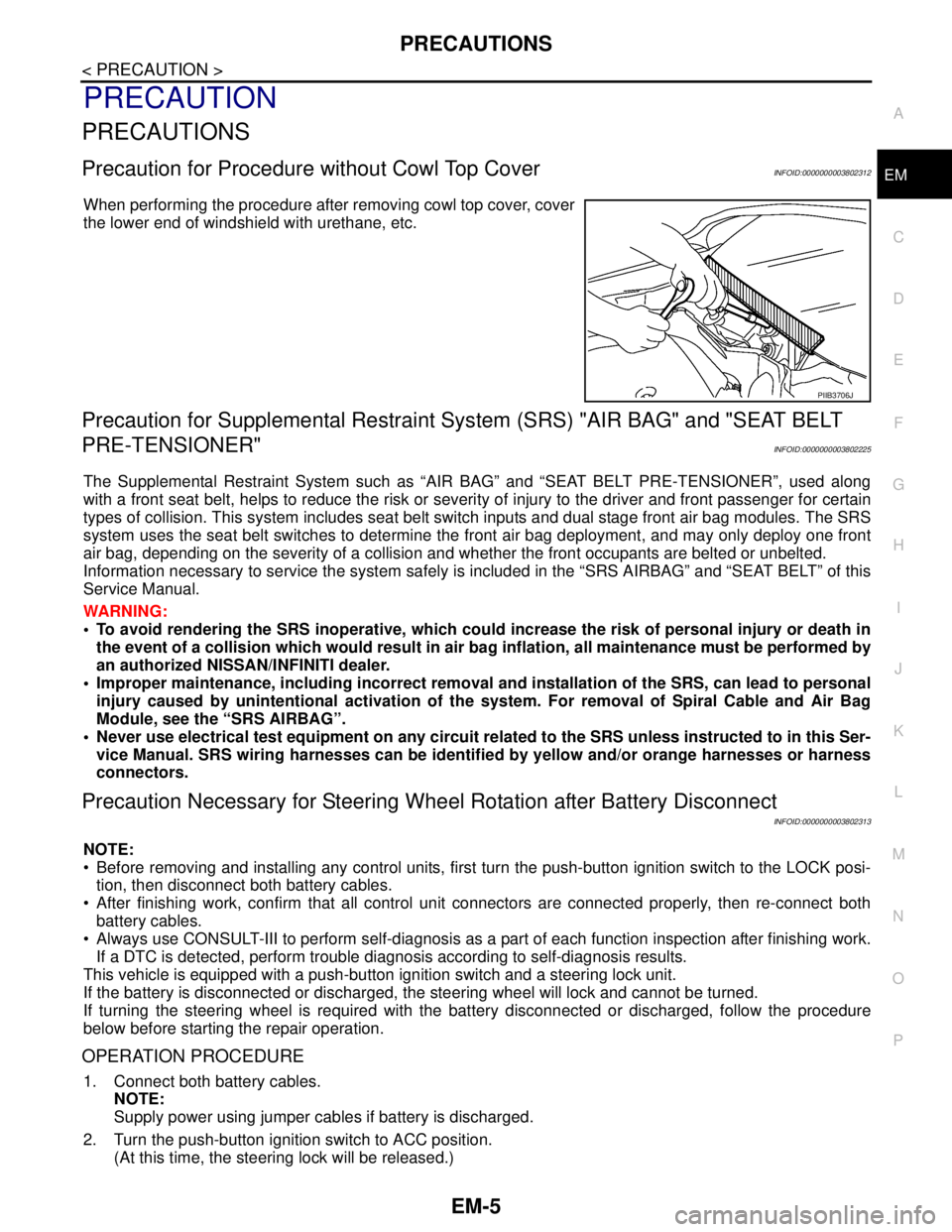
When performing the procedure after removing cowl top cover, cover
the lower end of windshield with urethane, etc.
Precaution for Supplemental Restraint System (SRS) "AIR BAG" and "SEAT BELT
PRE-TENSIONER"
INFOID:0000000003802225
The Supplemental Restraint System such as “AIR BAG” and “SEAT BELT PRE-TENSIONER”, used along
with a front seat belt, helps to reduce the risk or severity of injury to the driver and front passenger for certain
types of collision. This system includes seat belt switch inputs and dual stage front air bag modules. The SRS
system uses the seat belt switches to determine the front air bag deployment, and may only deploy one front
air bag, depending on the severity of a collision and whether the front occupants are belted or unbelted.
Information necessary to service the system safely is included in the “SRS AIRBAG” and “SEAT BELT” of this
Service Manual.
WARNING:
• To avoid rendering the SRS inoperative, which could increase the risk of personal injury or death in
the event of a collision which would result in air bag inflation, all maintenance must be performed by
an authorized NISSAN/INFINITI dealer.
Improper maintenance, including incorrect removal and installation of the SRS, can lead to personal
injury caused by unintentional activation of the system. For removal of Spiral Cable and Air Bag
Module, see the “SRS AIRBAG”.
Never use electrical test equipment on any circuit related to the SRS unless instructed to in this Ser-
vice Manual. SRS wiring harnesses can be identified by yellow and/or orange harnesses or harness
connectors.
Precaution Necessary for Steering Wheel Rotation after Battery Disconnect
INFOID:0000000003802313
NOTE:
Before removing and installing any control units, first turn the push-button ignition switch to the LOCK posi-
tion, then disconnect both battery cables.
After finishing work, confirm that all control unit connectors are connected properly, then re-connect both
battery cables.
Always use CONSULT-III to perform self-diagnosis as a part of each function inspection after finishing work.
If a DTC is detected, perform trouble diagnosis according to self-diagnosis results.
This vehicle is equipped with a push-button ignition switch and a steering lock unit.
If the battery is disconnected or discharged, the steering wheel will lock and cannot be turned.
If turning the steering wheel is required with the battery disconnected or discharged, follow the procedure
below before starting the repair operation.
OPERATION PROCEDURE
1. Connect both battery cables.
NOTE:
Supply power using jumper cables if battery is discharged.
2. Turn the push-button ignition switch to ACC position.
(At this time, the steering lock will be released.)
PIIB3706J
Page 1887 of 5121
EM-12
< ON-VEHICLE MAINTENANCE >
DRIVE BELT
ON-VEHICLE MAINTENANCE
DRIVE BELT
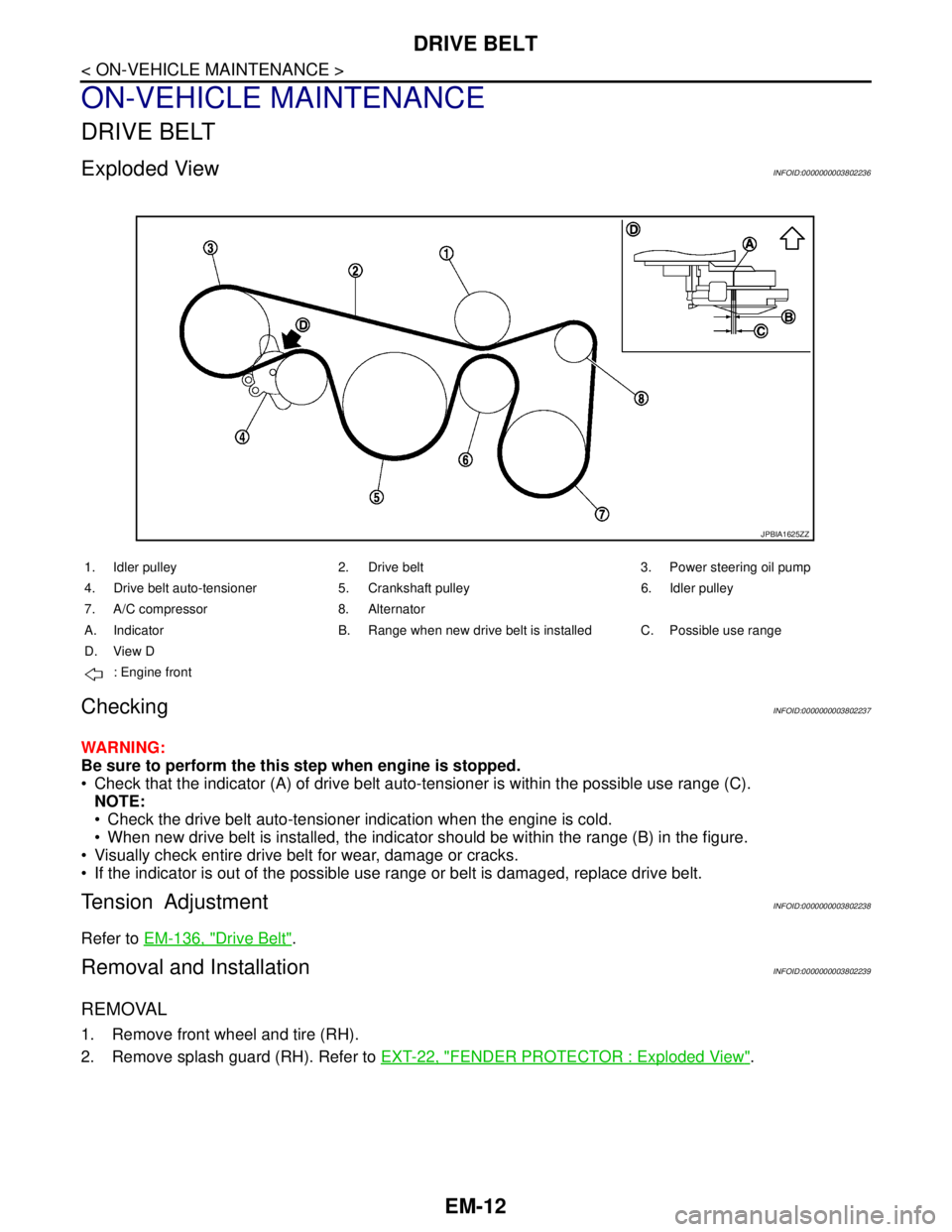
Exploded ViewINFOID:0000000003802236
CheckingINFOID:0000000003802237
WARNING:
Be sure to perform the this step when engine is stopped.
Check that the indicator (A) of drive belt auto-tensioner is within the possible use range (C).
NOTE:
Check the drive belt auto-tensioner indication when the engine is cold.
When new drive belt is installed, the indicator should be within the range (B) in the figure.
Visually check entire drive belt for wear, damage or cracks.
If the indicator is out of the possible use range or belt is damaged, replace drive belt.
Tension AdjustmentINFOID:0000000003802238
Refer to EM-136, "Drive Belt".
Removal and InstallationINFOID:0000000003802239
REMOVAL
1. Remove front wheel and tire (RH).
2. Remove splash guard (RH). Refer to EXT-22, "
FENDER PROTECTOR : Exploded View".
JPBIA1625ZZ
1. Idler pulley 2. Drive belt 3. Power steering oil pump
4. Drive belt auto-tensioner 5. Crankshaft pulley 6. Idler pulley
7. A/C compressor 8. Alternator
A. Indicator B. Range when new drive belt is installed C. Possible use range
D. View D
: Engine front
Page 1904 of 5121
INTAKE MANIFOLD COLLECTOR
EM-29
< ON-VEHICLE REPAIR >
C
D
E
F
G
H
I
J
K
L
MA
EM
N
P O
Removal and InstallationINFOID:0000000003802254
REMOVAL
WARNING:
To avoid the danger of being scalded, never drain engine coolant when the engine is hot.
1. Remove engine cover. Refer to EM-24, "
Exploded View".
CAUTION:
Be careful not to damage or scratch engine cover.
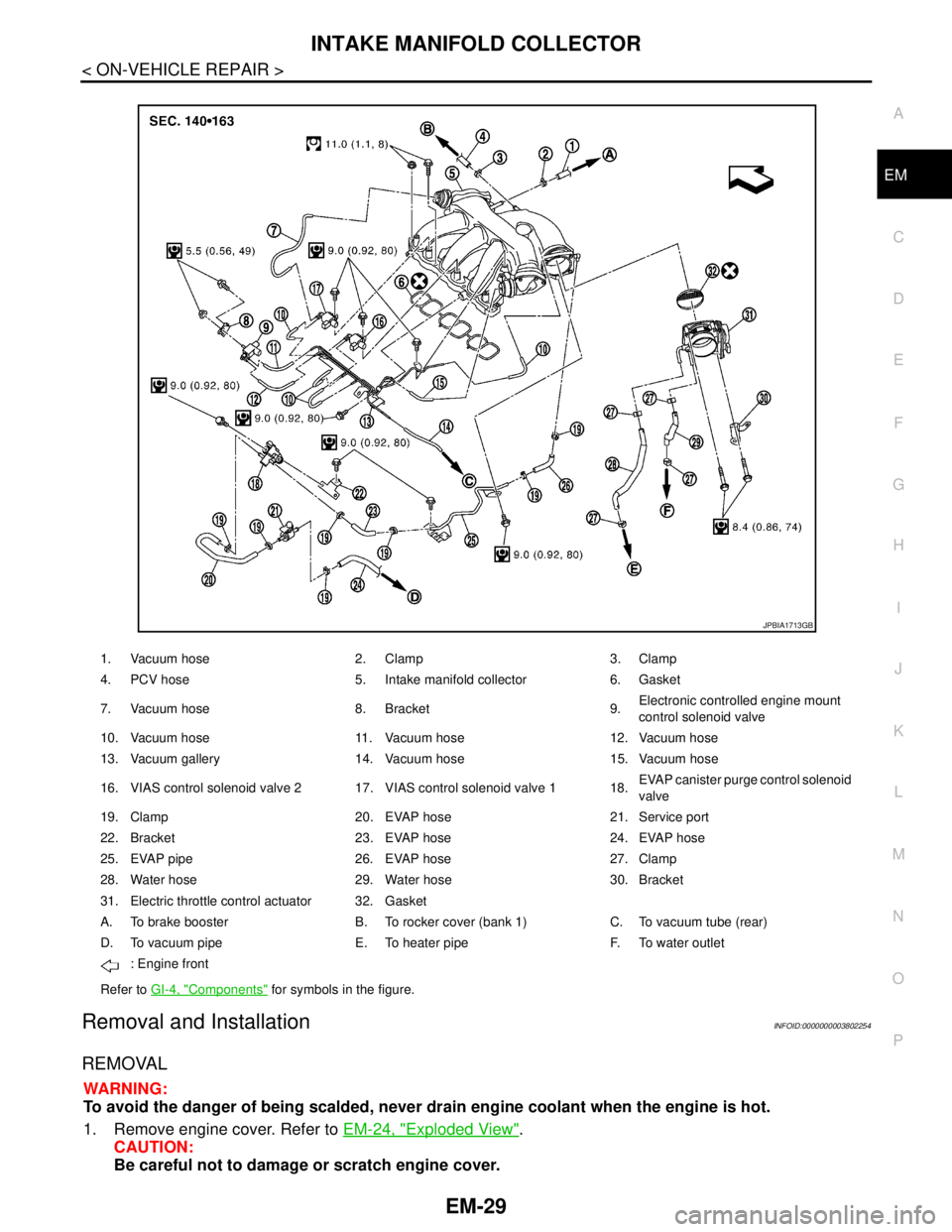
1. Vacuum hose 2. Clamp 3. Clamp
4. PCV hose 5. Intake manifold collector 6. Gasket
7. Vacuum hose 8. Bracket 9.Electronic controlled engine mount
control solenoid valve
10. Vacuum hose 11. Vacuum hose 12. Vacuum hose
13. Vacuum gallery 14. Vacuum hose 15. Vacuum hose
16. VIAS control solenoid valve 2 17. VIAS control solenoid valve 1 18.EVAP canister purge control solenoid
valve
19. Clamp 20. EVAP hose 21. Service port
22. Bracket 23. EVAP hose 24. EVAP hose
25. EVAP pipe 26. EVAP hose 27. Clamp
28. Water hose 29. Water hose 30. Bracket
31. Electric throttle control actuator 32. Gasket
A. To brake booster B. To rocker cover (bank 1) C. To vacuum tube (rear)
D. To vacuum pipe E. To heater pipe F. To water outlet
: Engine front
Refer to GI-4, "
Components" for symbols in the figure.
JPBIA1713GB
Page 1909 of 5121
EM-34
< ON-VEHICLE REPAIR >
EXHAUST MANIFOLD AND THREE WAY CATALYST
EXHAUST MANIFOLD AND THREE WAY CATALYST
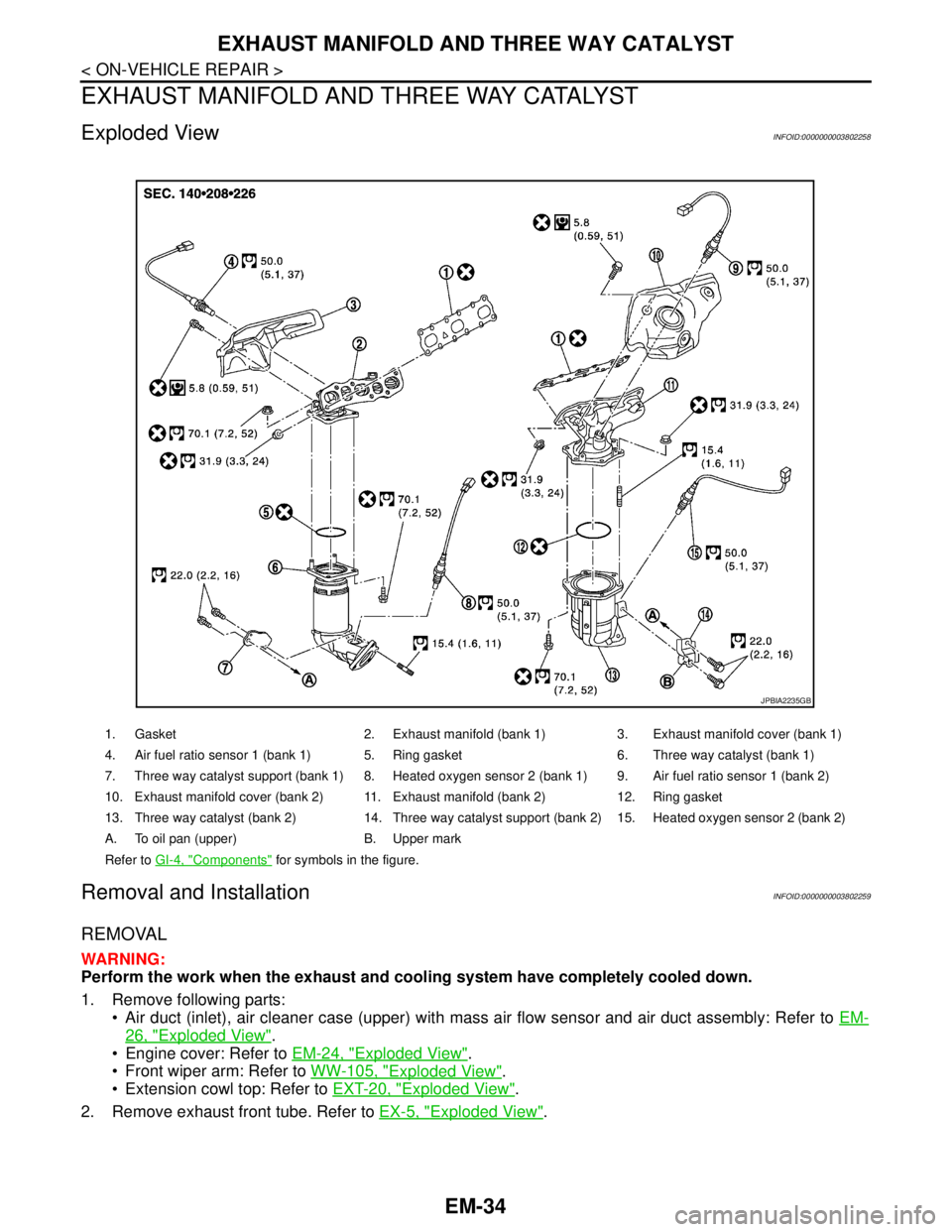
Exploded ViewINFOID:0000000003802258
Removal and InstallationINFOID:0000000003802259
REMOVAL
WARNING:
Perform the work when the exhaust and cooling system have completely cooled down.
1. Remove following parts:
Air duct (inlet), air cleaner case (upper) with mass air flow sensor and air duct assembly: Refer to EM-
26, "Exploded View".
Engine cover: Refer to EM-24, "
Exploded View".
Front wiper arm: Refer to WW-105, "
Exploded View".
Extension cowl top: Refer to EXT-20, "
Exploded View".
2. Remove exhaust front tube. Refer to EX-5, "
Exploded View".
1. Gasket 2. Exhaust manifold (bank 1) 3. Exhaust manifold cover (bank 1)
4. Air fuel ratio sensor 1 (bank 1) 5. Ring gasket 6. Three way catalyst (bank 1)
7. Three way catalyst support (bank 1) 8. Heated oxygen sensor 2 (bank 1) 9. Air fuel ratio sensor 1 (bank 2)
10. Exhaust manifold cover (bank 2) 11. Exhaust manifold (bank 2) 12. Ring gasket
13. Three way catalyst (bank 2) 14. Three way catalyst support (bank 2) 15. Heated oxygen sensor 2 (bank 2)
A. To oil pan (upper) B. Upper mark
Refer to GI-4, "
Components" for symbols in the figure.
JPBIA2235GB
Page 1919 of 5121
EM-44
< ON-VEHICLE REPAIR >
FUEL INJECTOR AND FUEL TUBE
FUEL INJECTOR AND FUEL TUBE
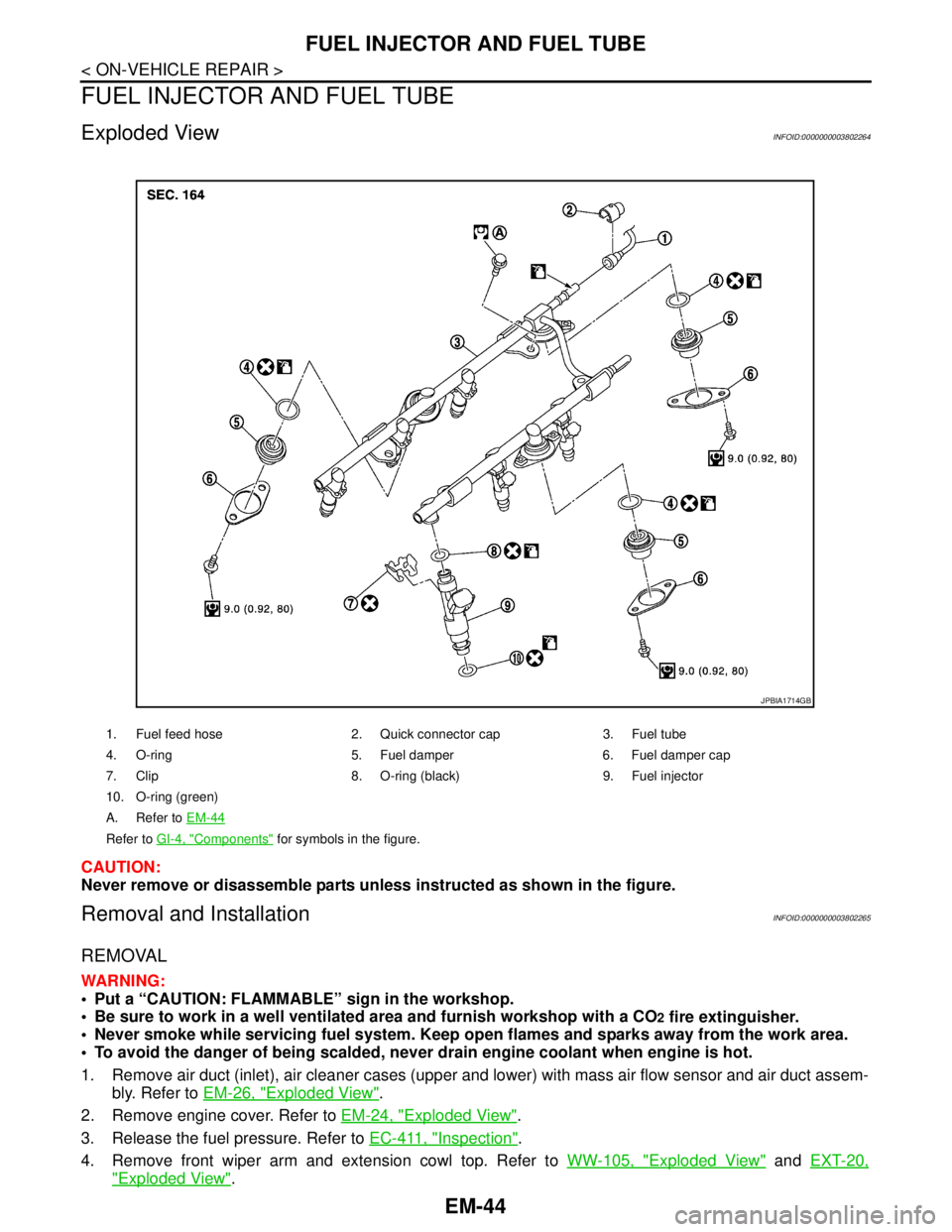
Exploded ViewINFOID:0000000003802264
CAUTION:
Never remove or disassemble parts unless instructed as shown in the figure.
Removal and InstallationINFOID:0000000003802265
REMOVAL
WARNING:
Put a “CAUTION: FLAMMABLE” sign in the workshop.
Be sure to work in a well ventilated area and furnish workshop with a CO
2 fire extinguisher.
Never smoke while servicing fuel system. Keep open flames and sparks away from the work area.
To avoid the danger of being scalded, never drain engine coolant when engine is hot.
1. Remove air duct (inlet), air cleaner cases (upper and lower) with mass air flow sensor and air duct assem-
bly. Refer to EM-26, "
Exploded View".
2. Remove engine cover. Refer to EM-24, "
Exploded View".
3. Release the fuel pressure. Refer to EC-411, "
Inspection".
4. Remove front wiper arm and extension cowl top. Refer to WW-105, "
Exploded View" and EXT-20,
"Exploded View".
1. Fuel feed hose 2. Quick connector cap 3. Fuel tube
4. O-ring 5. Fuel damper 6. Fuel damper cap
7. Clip 8. O-ring (black) 9. Fuel injector
10. O-ring (green)
A. Refer to EM-44
Refer to GI-4, "Components" for symbols in the figure.
JPBIA1714GB
Page 1942 of 5121
ENGINE ASSEMBLY
EM-67
< REMOVAL AND INSTALLATION >
C
D
E
F
G
H
I
J
K
L
MA
EM
N
P O
REMOVAL AND INSTALLATION
ENGINE ASSEMBLY
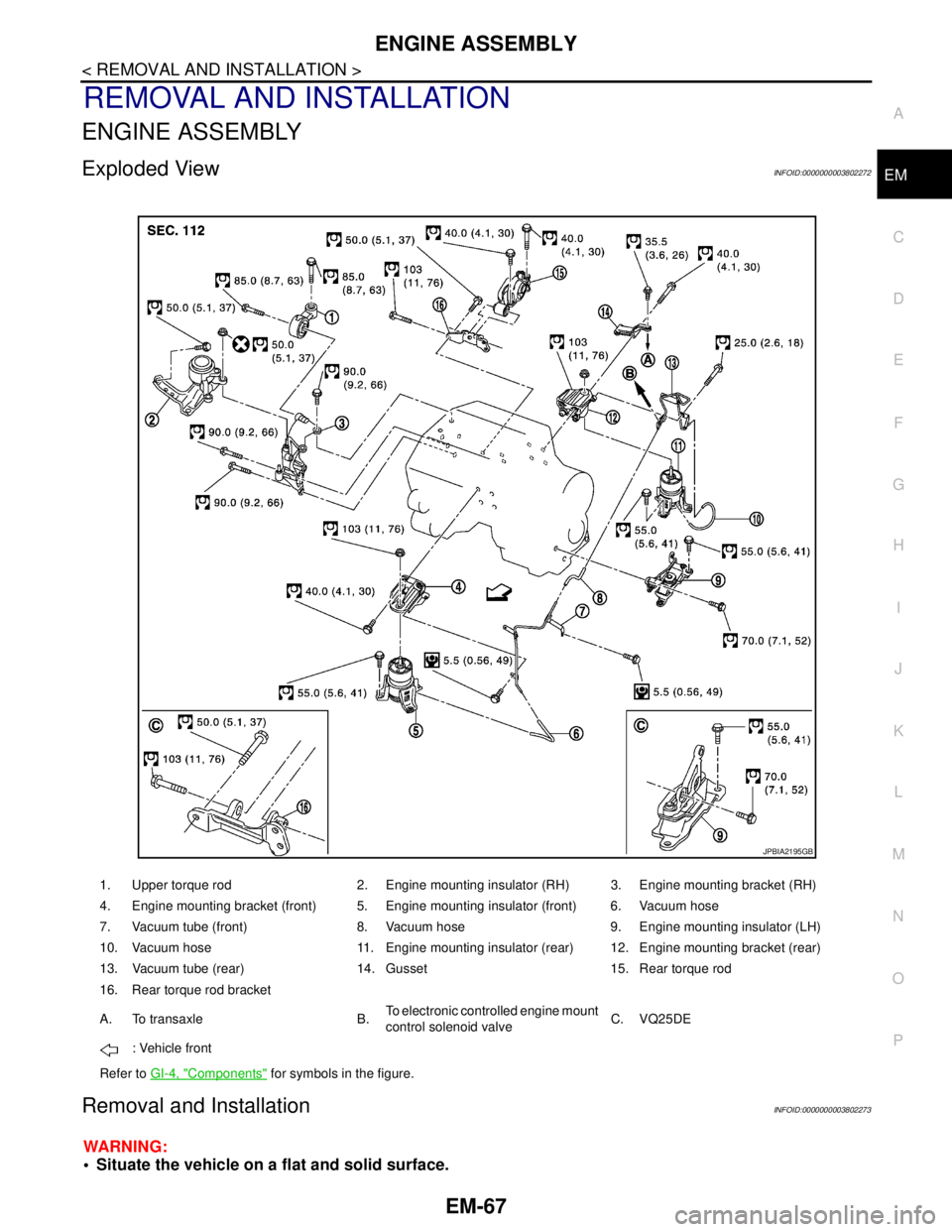
Exploded ViewINFOID:0000000003802272
Removal and InstallationINFOID:0000000003802273
WARNING:
Situate the vehicle on a flat and solid surface.
1. Upper torque rod 2. Engine mounting insulator (RH) 3. Engine mounting bracket (RH)
4. Engine mounting bracket (front) 5. Engine mounting insulator (front) 6. Vacuum hose
7. Vacuum tube (front) 8. Vacuum hose 9. Engine mounting insulator (LH)
10. Vacuum hose 11. Engine mounting insulator (rear) 12. Engine mounting bracket (rear)
13. Vacuum tube (rear) 14. Gusset 15. Rear torque rod
16. Rear torque rod bracket
A. To transaxle B.To electronic controlled engine mount
control solenoid valveC. VQ25DE
: Vehicle front
Refer to GI-4, "
Components" for symbols in the figure.
JPBIA2195GB
Page 1967 of 5121
EM-92
< DISASSEMBLY AND ASSEMBLY >
CAMSHAFT
b. Disconnect ignition coil and injector harness connectors. Refer to EM-49, "Exploded View" and EM-44,
"Exploded View".
3. Remove intake valve timing control solenoid valve. Refer to EM-79, "
Exploded View".
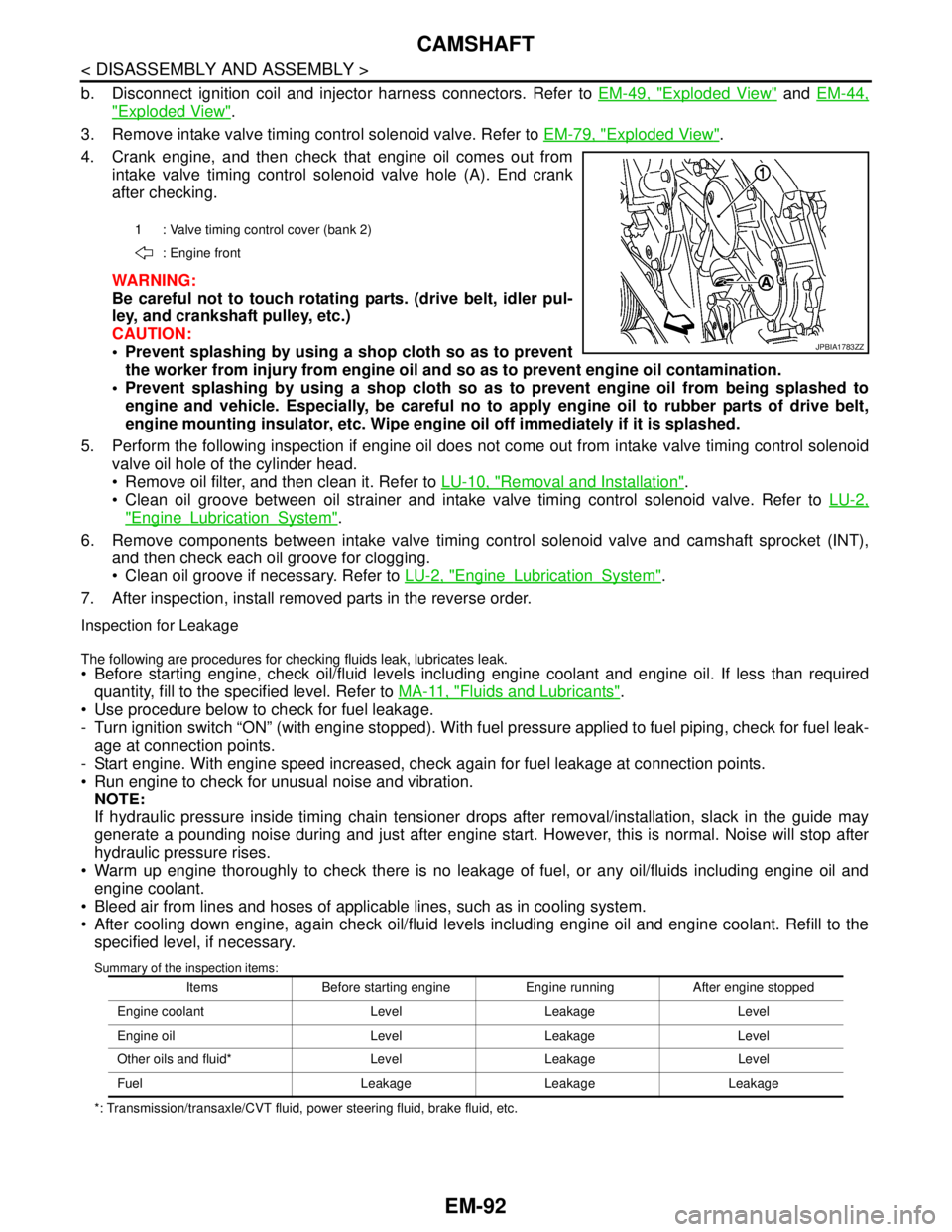
4. Crank engine, and then check that engine oil comes out from
intake valve timing control solenoid valve hole (A). End crank
after checking.
WARNING:
Be careful not to touch rotating parts. (drive belt, idler pul-
ley, and crankshaft pulley, etc.)
CAUTION:
Prevent splashing by using a shop cloth so as to prevent
the worker from injury from engine oil and so as to prevent engine oil contamination.
Prevent splashing by using a shop cloth so as to prevent engine oil from being splashed to
engine and vehicle. Especially, be careful no to apply engine oil to rubber parts of drive belt,
engine mounting insulator, etc. Wipe engine oil off immediately if it is splashed.
5. Perform the following inspection if engine oil does not come out from intake valve timing control solenoid
valve oil hole of the cylinder head.
Remove oil filter, and then clean it. Refer to LU-10, "
Removal and Installation".
Clean oil groove between oil strainer and intake valve timing control solenoid valve. Refer to LU-2,
"EngineLubricationSystem".
6. Remove components between intake valve timing control solenoid valve and camshaft sprocket (INT),
and then check each oil groove for clogging.
Clean oil groove if necessary. Refer to LU-2, "
EngineLubricationSystem".
7. After inspection, install removed parts in the reverse order.
Inspection for Leakage
The following are procedures for checking fluids leak, lubricates leak. Before starting engine, check oil/fluid levels including engine coolant and engine oil. If less than required
quantity, fill to the specified level. Refer to MA-11, "
Fluids and Lubricants".
Use procedure below to check for fuel leakage.
- Turn ignition switch “ON” (with engine stopped). With fuel pressure applied to fuel piping, check for fuel leak-
age at connection points.
- Start engine. With engine speed increased, check again for fuel leakage at connection points.
Run engine to check for unusual noise and vibration.
NOTE:
If hydraulic pressure inside timing chain tensioner drops after removal/installation, slack in the guide may
generate a pounding noise during and just after engine start. However, this is normal. Noise will stop after
hydraulic pressure rises.
Warm up engine thoroughly to check there is no leakage of fuel, or any oil/fluids including engine oil and
engine coolant.
Bleed air from lines and hoses of applicable lines, such as in cooling system.
After cooling down engine, again check oil/fluid levels including engine oil and engine coolant. Refill to the
specified level, if necessary.
Summary of the inspection items:
*: Transmission/transaxle/CVT fluid, power steering fluid, brake fluid, etc.1 : Valve timing control cover (bank 2)
: Engine front
JPBIA1783ZZ
Items Before starting engine Engine running After engine stopped
Engine coolant Level Leakage Level
Engine oil Level Leakage Level
Other oils and fluid* Level Leakage Level
Fuel Leakage Leakage Leakage
Page 1976 of 5121
![NISSAN TEANA 2008 Service Manual CYLINDER HEAD
EM-101
< DISASSEMBLY AND ASSEMBLY >
C
D
E
F
G
H
I
J
K
L
MA
EM
N
P O
b. Drive out valve guide with a press [under a 20 kN (2 ton, 2.0 lmp
ton) pressure] or a hammer and the valve guide dr](/img/5/57391/w960_57391-1975.png "NISSAN TEANA 2008 Service Manual CYLINDER HEAD
EM-101
< DISASSEMBLY AND ASSEMBLY >
C
D
E
F
G
H
I
J
K
L
MA
EM
N
P O
b. Drive out valve guide with a press [under a 20 kN (2 ton, 2.0 lmp
ton) pressure] or a hammer and the valve guide dr")
CYLINDER HEAD
EM-101
< DISASSEMBLY AND ASSEMBLY >
C
D
E
F
G
H
I
J
K
L
MA
EM
N
P O
b. Drive out valve guide with a press [under a 20 kN (2 ton, 2.0 lmp
ton) pressure] or a hammer and the valve guide drift (commer-
cial service tool).
WARNING:
Cylinder head contains heat. When working, wear protec-
tive equipment to avoid getting burned.
9. Remove spark plug tube, as necessary.
Using a pliers, pull spark plug tube out of cylinder head.
CAUTION:
Take care not to damage cylinder head.
Once removed, spark plug tube will be deformed and cannot be reused. Never remove it unless
absolutely necessary.
ASSEMBLY
1. If valve guide is removed in step 8 (DISASSEMBLY), install it.
Replace with oversized [0.2 mm (0.008 in)] valve guide.
a. Using the valve guide reamer (commercial service tool) (A),
ream cylinder head valve guide hole.
b. Heat cylinder head to 110 to 130°C (230 to 266°F) by soaking in
heated oil (A).
c. Using the valve guide drift (commercial service tool), press valve
guide from camshaft side to the dimensions as in the figure.
WARNING:
Cylinder head contains heat. When working, wear protec-
tive equipment to avoid getting burned.
SEM931C
Valve guide hole diameter (for service parts):
Intake and exhaust
: Refer to EM-139, "
CylinderHead".
JPBIA0185ZZ
JPBIA0184ZZ
Projection (A)
Intake and exhaust
: Refer to EM-139, "
CylinderHead".
JPBIA0186ZZ
Page 1977 of 5121
EM-102
< DISASSEMBLY AND ASSEMBLY >
CYLINDER HEAD
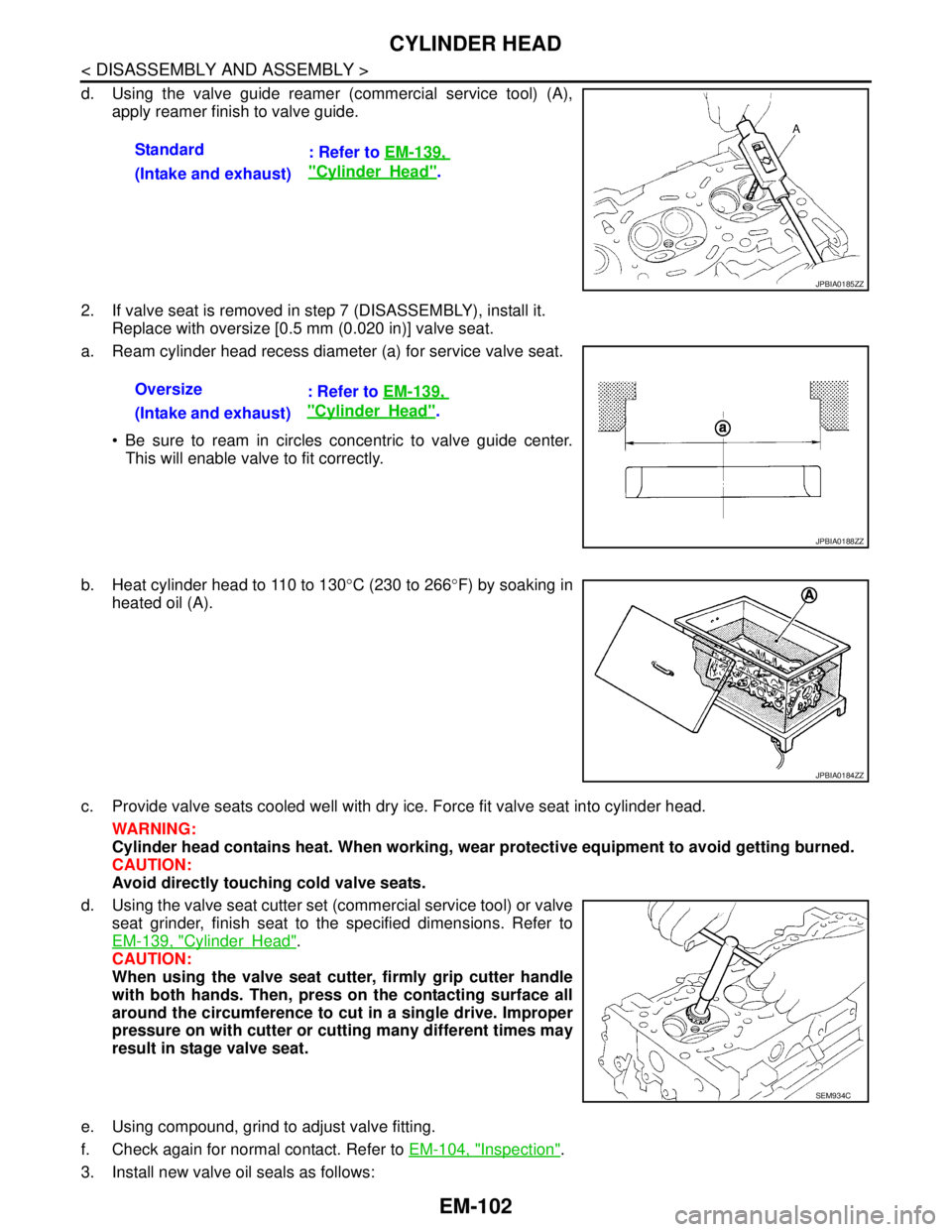
d. Using the valve guide reamer (commercial service tool) (A),
apply reamer finish to valve guide.
2. If valve seat is removed in step 7 (DISASSEMBLY), install it.
Replace with oversize [0.5 mm (0.020 in)] valve seat.
a. Ream cylinder head recess diameter (a) for service valve seat.
Be sure to ream in circles concentric to valve guide center.
This will enable valve to fit correctly.
b. Heat cylinder head to 110 to 130°C (230 to 266°F) by soaking in
heated oil (A).
c. Provide valve seats cooled well with dry ice. Force fit valve seat into cylinder head.
WARNING:
Cylinder head contains heat. When working, wear protective equipment to avoid getting burned.
CAUTION:
Avoid directly touching cold valve seats.
d. Using the valve seat cutter set (commercial service tool) or valve
seat grinder, finish seat to the specified dimensions. Refer to
EM-139, "
CylinderHead".
CAUTION:
When using the valve seat cutter, firmly grip cutter handle
with both hands. Then, press on the contacting surface all
around the circumference to cut in a single drive. Improper
pressure on with cutter or cutting many different times may
result in stage valve seat.
e. Using compound, grind to adjust valve fitting.
f. Check again for normal contact. Refer to EM-104, "
Inspection".
3. Install new valve oil seals as follows:Standard
: Refer to EM-139,
"CylinderHead".
(Intake and exhaust)
JPBIA0185ZZ
Oversize
: Refer to EM-139,
"CylinderHead".
(Intake and exhaust)
JPBIA0188ZZ
JPBIA0184ZZ
SEM934C