maintenance NISSAN TEANA 2008 Service Manual
[x] Cancel search | Manufacturer: NISSAN, Model Year: 2008, Model line: TEANA, Model: NISSAN TEANA 2008Pages: 5121, PDF Size: 69.03 MB
Page 3379 of 5121
MWI
PRECAUTIONS
MWI-125
< PRECAUTION >
C
D
E
F
G
H
I
J
K
L
MB A
O
P
PRECAUTION
PRECAUTIONS
Precaution for Supplemental Restraint System (SRS) "AIR BAG" and "SEAT BELT
PRE-TENSIONER"
INFOID:0000000003940983
The Supplemental Restraint System such as “AIR BAG” and “SEAT BELT PRE-TENSIONER”, used along
with a front seat belt, helps to reduce the risk or severity of injury to the driver and front passenger for certain
types of collision. Information necessary to service the system safely is included in the “SRS AIRBAG” and
“SEAT BELT” of this Service Manual.
WARNING:
• To avoid rendering the SRS inoperative, which could increase the risk of personal injury or death in
the event of a collision which would result in air bag inflation, all maintenance must be performed by
an authorized NISSAN/INFINITI dealer.
Improper maintenance, including incorrect removal and installation of the SRS, can lead to personal
injury caused by unintentional activation of the system. For removal of Spiral Cable and Air Bag
Module, see the “SRS AIRBAG”.
Never use electrical test equipment on any circuit related to the SRS unless instructed to in this Ser-
vice Manual. SRS wiring harnesses can be identified by yellow and/or orange harnesses or harness
connectors.
Page 3383 of 5121
PB-2
< ON-VEHICLE MAINTENANCE >
PARKING BRAKE SYSTEM
ON-VEHICLE MAINTENANCE
PARKING BRAKE SYSTEM
Inspection and AdjustmentINFOID:0000000003811312
INSPECTION
Pedal Stroke
1. Operate the parking brake pedal with a force of 196 N (20 kg, 44 lb). Check that the pedal stroke is within
the specified number of notches. (Check it by listening to the clicks of the ratchet.)
2. When brake warning lamp turns ON, check that the pedal stroke is within the specified number of
notches. (Check it by listening to the clicks of the ratchet.)
Inspect Components
• Check each component for installation condition such as looseness.
Check the device assembly for bend, damage and cracks. Replace if necessary.
Check the cables for wear, damage and cracks. Replace if necessary.
Check the parking brake switch, and replace it if necessary. Refer to BRC-41, "
Diagnosis Procedure" (with-
out VDC), BRC-124, "
Component Inspection" (with VDC).
ADJUSTMENT
1. Remove rear tires.
2. Fix the disc rotor using wheel nuts.
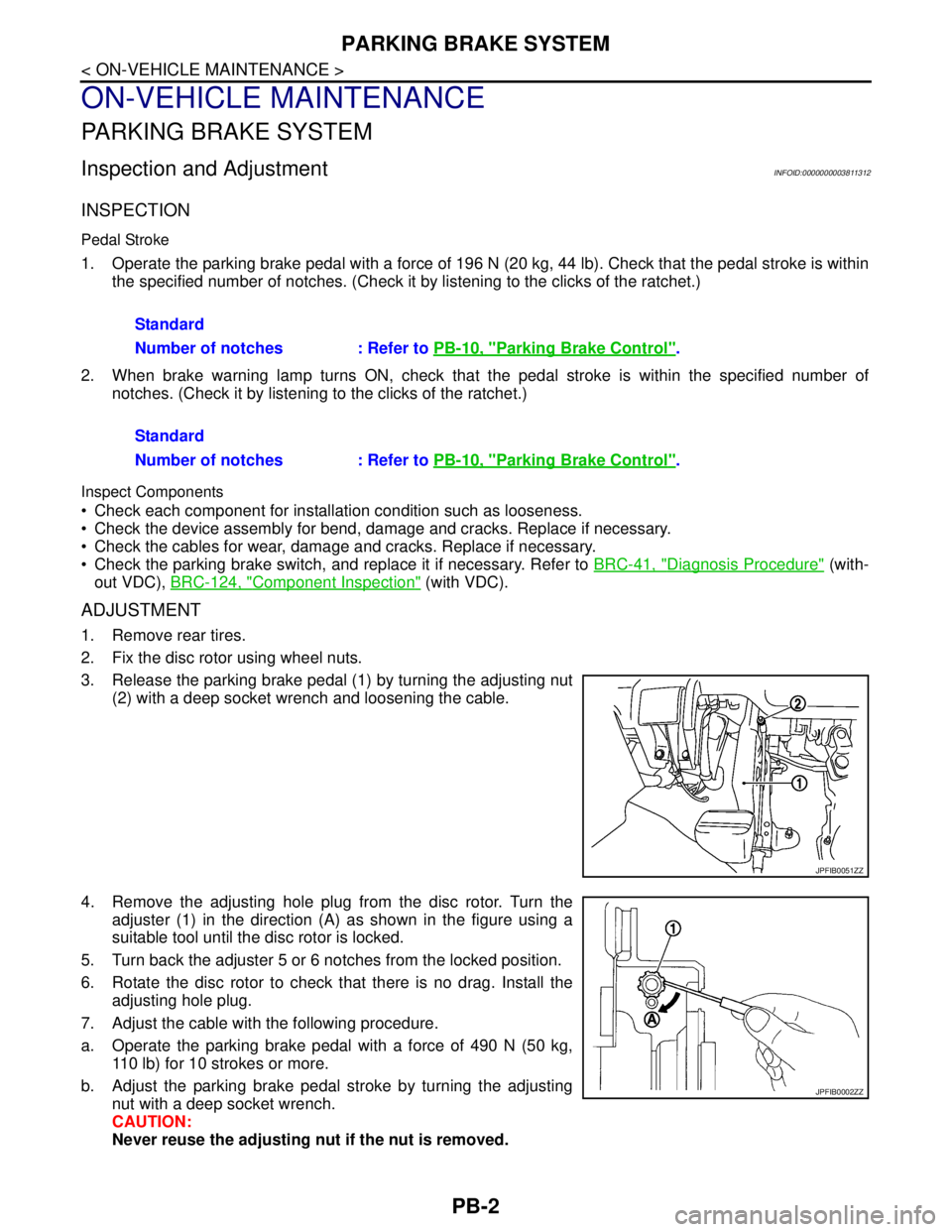
3. Release the parking brake pedal (1) by turning the adjusting nut
(2) with a deep socket wrench and loosening the cable.
4. Remove the adjusting hole plug from the disc rotor. Turn the
adjuster (1) in the direction (A) as shown in the figure using a
suitable tool until the disc rotor is locked.
5. Turn back the adjuster 5 or 6 notches from the locked position.
6. Rotate the disc rotor to check that there is no drag. Install the
adjusting hole plug.
7. Adjust the cable with the following procedure.
a. Operate the parking brake pedal with a force of 490 N (50 kg,
110 lb) for 10 strokes or more.
b. Adjust the parking brake pedal stroke by turning the adjusting
nut with a deep socket wrench.
CAUTION:
Never reuse the adjusting nut if the nut is removed.Standard
Number of notches : Refer to PB-10, "
Parking Brake Control".
Standard
Number of notches : Refer to PB-10, "
Parking Brake Control".
JPFIB0051ZZ
JPFIB0002ZZ
Page 3384 of 5121

PARKING BRAKE SYSTEM
PB-3
< ON-VEHICLE MAINTENANCE >
C
D
E
G
H
I
J
K
L
MA
B
PB
N
O
P
c. Operate the parking brake pedal with a force of 196 N (20 kg, 44 lb). Check that the pedal stroke is within
the specified number of notches. (Check it by listening to the clicks of the ratchet.)
d. Rotate the disc rotor with the parking brake pedal released and check that there is no drag. Refer to PB-8,
"Inspection and Adjustment". Standard
Number of notches : Refer to PB-10, "
Parking Brake Control".
Page 3385 of 5121

PB-4
< ON-VEHICLE MAINTENANCE >
PARKING BRAKE SHOE
PARKING BRAKE SHOE
AdjustmentINFOID:0000000003811313
1. Adjust parking brake pedal stroke. Refer to PB-2, "Inspection and Adjustment".
2. Perform parking brake break-in (drag on) operation by driving vehicle under the following conditions:
Drive forward
Vehicle speed: 40 km/h (25 MPH) set (constant and forward)
Parking brake operating force: 196 N (20 kg, 44 lb)
Distance: 100 m (328 ft)
Number of times: 1
CAUTION:
To prevent lining from getting too hot, allow a cool off period of approximately 5 minutes after
every break-in operation.
3. After the break-in procedure, check parking pedal stroke of parking brake.
CAUTION:
If it is out of the specification, adjust again. Refer to PB-2, "
Inspection and Adjustment".
Page 3512 of 5121
![NISSAN TEANA 2008 Service Manual PCS
PRECAUTIONS
PCS-121
< PRECAUTION >[POWER DISTRIBUTION SYSTEM]
C
D
E
F
G
H
I
J
K
L B A
O
P N
PRECAUTION
PRECAUTIONS
Precaution for Supplemental Restraint System (SRS) "AIR BAG" and "SEAT BELT
PRE-](/img/5/57391/w960_57391-3511.png "NISSAN TEANA 2008 Service Manual PCS
PRECAUTIONS
PCS-121
< PRECAUTION >[POWER DISTRIBUTION SYSTEM]
C
D
E
F
G
H
I
J
K
L B A
O
P N
PRECAUTION
PRECAUTIONS
Precaution for Supplemental Restraint System (SRS) \"AIR BAG\" and \"SEAT BELT
PRE-")
PCS
PRECAUTIONS
PCS-121
< PRECAUTION >[POWER DISTRIBUTION SYSTEM]
C
D
E
F
G
H
I
J
K
L B A
O
P N
PRECAUTION
PRECAUTIONS
Precaution for Supplemental Restraint System (SRS) "AIR BAG" and "SEAT BELT
PRE-TENSIONER"
INFOID:0000000003940025
The Supplemental Restraint System such as “AIR BAG” and “SEAT BELT PRE-TENSIONER”, used along
with a front seat belt, helps to reduce the risk or severity of injury to the driver and front passenger for certain
types of collision. Information necessary to service the system safely is included in the “SRS AIRBAG” and
“SEAT BELT” of this Service Manual.
WARNING:
To avoid rendering the SRS inoperative, which could increase the risk of personal injury or death in
the event of a collision which would result in air bag inflation, all maintenance must be performed by
an authorized NISSAN/INFINITI dealer.
Improper maintenance, including incorrect removal and installation of the SRS, can lead to personal
injury caused by unintentional activation of the system. For removal of Spiral Cable and Air Bag
Module, see the “SRS AIRBAG”.
Never use electrical test equipment on any circuit related to the SRS unless instructed to in this Ser-
vice Manual. SRS wiring harnesses can be identified by yellow and/or orange harnesses or harness
connectors.
Precaution Necessary for Steering Wheel Rotation after Battery Disconnect
INFOID:0000000003940024
NOTE:
Before removing and installing any control units, first turn the push-button ignition switch to the LOCK posi-
tion, then disconnect both battery cables.
After finishing work, confirm that all control unit connectors are connected properly, then re-connect both
battery cables.
Always use CONSULT-III to perform self-diagnosis as a part of each function inspection after finishing work.
If a DTC is detected, perform trouble diagnosis according to self-diagnosis results.
This vehicle is equipped with a push-button ignition switch and a steering lock unit.
If the battery is disconnected or discharged, the steering wheel will lock and cannot be turned.
If turning the steering wheel is required with the battery disconnected or discharged, follow the procedure
below before starting the repair operation.
OPERATION PROCEDURE
1. Connect both battery cables.
NOTE:
Supply power using jumper cables if battery is discharged.
2. Turn the push-button ignition switch to ACC position.
(At this time, the steering lock will be released.)
3. Disconnect both battery cables. The steering lock will remain released with both battery cables discon-
nected and the steering wheel can be turned.
4. Perform the necessary repair operation.
5. When the repair work is completed, re-connect both battery cables. With the brake pedal released, turn
the push-button ignition switch from ACC position to ON position, then to LOCK position. (The steering
wheel will lock when the push-button ignition switch is turned to LOCK position.)
6. Perform self-diagnosis check of all control units using CONSULT-III.
Page 3519 of 5121

PG
PG-1
ELECTRICAL & POWER CONTROL
C
DE
F
G H
I
J
K L
B
SECTION PG
A
O P
N
CONTENTS
POWER SUPPLY, GROUND & CIRCUIT ELEMENTS
POWER SUPPLY&GR
OUND CIRCUIT
BASIC INSPECTION ....... .............................
3
BATTERY ....................................................... .....3
How to Handle Battery ........................................ ......3
Work Flow .................................................................5
COMPONENT DIAGNOSIS .........................10
POWER SUPPLY ROUTING CIRCUIT .......... ....10
Wiring Diagram - BATTERY POWER SUPPLY - ....10
Wiring Diagram - BATTERY POWER SUPPLY
FUSE No. 6 - ....................................................... ....
25
Wiring Diagram - BATTERY POWER SUPPLY
FUSE No. 11 - .........................................................
27
Wiring Diagram - BATTERY POWER SUPPLY
FUSE No. 31 - .........................................................
29
Wiring Diagram - BATTERY POWER SUPPLY
FUSE No. 50 - .........................................................
32
Wiring Diagram - BATTERY POWER SUPPLY
FUSE No. 52 - .........................................................
36
Wiring Diagram - BATTERY POWER SUPPLY
FUSE No. 53 - .........................................................
38
Wiring Diagram - ACCESSORY POWER SUP-
PLY - .......................................................................
48
Wiring Diagram - ACCESSORY POWER SUP-
PLY FUSE No. 19 - .................................................
51
Wiring Diagram - IGNITION POWER SUPPLY - ....55
Wiring Diagram - IGNITION POWER SUPPLY
FUSE No. 3 - ...........................................................
65
Wiring Diagram - IGNITION POWER SUPPLY
FUSE No. 4 - ...........................................................
74
Wiring Diagram - IGNITION POWER SUPPLY
FUSE No. 43 - .........................................................
77
Wiring Diagram - IGNITION POWER SUPPLY
FUSE No. 44 - .........................................................
79
Fuse ........................................................................82
Fusible Link .............................................................82
Circuit Breaker ........................................................82
HARNESS LAYOUT .........................................83
How To Read Harness Layout ............................ ....83
Outline .....................................................................84
Main Harness ..........................................................85
Engine Room Harness ............................................86
Engine Control Harness ..........................................88
Body Harness ..........................................................89
Body No. 2 Harness ................................................90
Room Lamp Harness ...............................................91
Front Door Harness (LH Side) .................................92
Front Door Harness (RH Side) ................................93
Rear Door Harness (LH Side) .................................94
Rear Door Harness (RH Side) .................................95
HARNESS CONNECTOR .................................96
Description ...............................................................96
STANDARDIZED RELAY .................................99
Description ...............................................................99
FUSE BLOCK - JUNCTION BOX (J/B) ..........101
Fuse, Connector and Terminal Arrangement ........101
FUSE, FUSIBLE LINK AND RELAY BOX ......102
Fuse and Fusible Link Arrangement ......................102
IPDM E/R (INTELLIGENT POWER DISTRI-
BUTION MODULE ENGINE ROOM) ..............
103
Fuse, Connector and Terminal Arrangement ........103
PRECAUTION ............................................104
PRECAUTIONS ...............................................104
Precaution for Supplemental Restraint System
(SRS) "AIR BAG" and "SEAT BELT PRE-TEN-
SIONER" ............................................................. ..
104
ON-VEHICLE MAINTENANCE ..................105
BATTERY CHARGING CHART ......................105
Slow Charge ........................................................ ..105
Standard Charge ...................................................106
Page 3521 of 5121
![NISSAN TEANA 2008 Service Manual PG
BATTERY
PG-3
< BASIC INSPECTION >[POWER SUPPLY&GROUND CIRCUIT]
C
D
E
F
G
H
I
J
K
L B A
O
P N
BASIC INSPECTION
BATTERY
How to Handle BatteryINFOID:0000000003809460
CAUTION:
• If it becomes necessa](/img/5/57391/w960_57391-3520.png "NISSAN TEANA 2008 Service Manual PG
BATTERY
PG-3
< BASIC INSPECTION >[POWER SUPPLY&GROUND CIRCUIT]
C
D
E
F
G
H
I
J
K
L B A
O
P N
BASIC INSPECTION
BATTERY
How to Handle BatteryINFOID:0000000003809460
CAUTION:
• If it becomes necessa")
PG
BATTERY
PG-3
< BASIC INSPECTION >[POWER SUPPLY&GROUND CIRCUIT]
C
D
E
F
G
H
I
J
K
L B A
O
P N
BASIC INSPECTION
BATTERY
How to Handle BatteryINFOID:0000000003809460
CAUTION:
• If it becomes necessary to start the engine with a booster battery and jumper cables, use a 12-volt
booster battery.
After connecting battery cables, ensure that they are tightly clamped to battery terminals for good
contact.
Never add distilled water through the hole used to check specific gravity.
METHODS OF PREVENTING OVER-DISCHARGE
The following precautions must be taken to prevent over-discharging a battery.
• The battery surface (particularly its top) should always be kept
clean and dry.
The terminal connections should be clean and tight.
At every routine maintenance, check the electrolyte level.
This also applies to batteries designated as “low maintenance” and
“maintenance-free”.
When the vehicle is not going to be used over a long period of
time, disconnect the battery cable from the negative terminal. (If
the vehicle has an extended storage switch, turn it off.)
Check the charge condition of the battery.
Periodically check the specific gravity of the electrolyte. Keep a
close check on charge condition to prevent over-discharge.
CHECKING ELECTROLYTE LEVEL
WARNING:
Never allow battery fluid to come in contact with skin, eyes, fabrics, or painted surfaces. After touch-
ing a battery, never touch or rub your eyes until you have thoroughly washed your hands. If acid con-
tacts eyes, skin or clothing, immediately flush with water for 15 minutes and seek medical attention.
MEL040F
ELA0349D
MEL042F
Page 3622 of 5121
![NISSAN TEANA 2008 Service Manual PG-104
< PRECAUTION >[POWER SUPPLY&GROUND CIRCUIT]
PRECAUTIONS
PRECAUTION
PRECAUTIONS
Precaution for Supplemental Restraint System (SRS) "AIR BAG" and "SEAT BELT
PRE-TENSIONER"
INFOID:000000000384433](/img/5/57391/w960_57391-3621.png "NISSAN TEANA 2008 Service Manual PG-104
< PRECAUTION >[POWER SUPPLY&GROUND CIRCUIT]
PRECAUTIONS
PRECAUTION
PRECAUTIONS
Precaution for Supplemental Restraint System (SRS) \"AIR BAG\" and \"SEAT BELT
PRE-TENSIONER\"
INFOID:000000000384433")
PG-104
< PRECAUTION >[POWER SUPPLY&GROUND CIRCUIT]
PRECAUTIONS
PRECAUTION
PRECAUTIONS
Precaution for Supplemental Restraint System (SRS) "AIR BAG" and "SEAT BELT
PRE-TENSIONER"
INFOID:0000000003844339
The Supplemental Restraint System such as “AIR BAG” and “SEAT BELT PRE-TENSIONER”, used along
with a front seat belt, helps to reduce the risk or severity of injury to the driver and front passenger for certain
types of collision. Information necessary to service the system safely is included in the “SRS AIRBAG” and
“SEAT BELT” of this Service Manual.
WARNING:
To avoid rendering the SRS inoperative, which could increase the risk of personal injury or death in
the event of a collision which would result in air bag inflation, all maintenance must be performed by
an authorized NISSAN/INFINITI dealer.
Improper maintenance, including incorrect removal and installation of the SRS, can lead to personal
injury caused by unintentional activation of the system. For removal of Spiral Cable and Air Bag
Module, see the “SRS AIRBAG”.
Never use electrical test equipment on any circuit related to the SRS unless instructed to in this Ser-
vice Manual. SRS wiring harnesses can be identified by yellow and/or orange harnesses or harness
connectors.
Page 3623 of 5121
![NISSAN TEANA 2008 Service Manual PG
BATTERY CHARGING CHART
PG-105
< ON-VEHICLE MAINTENANCE >[POWER SUPPLY&GROUND CIRCUIT]
C
D
E
F
G
H
I
J
K
L B A
O
P N
ON-VEHICLE MAINTENANCE
BATTERY CHARGING CHART
Slow ChargeINFOID:0000000003809462](/img/5/57391/w960_57391-3622.png "NISSAN TEANA 2008 Service Manual PG
BATTERY CHARGING CHART
PG-105
< ON-VEHICLE MAINTENANCE >[POWER SUPPLY&GROUND CIRCUIT]
C
D
E
F
G
H
I
J
K
L B A
O
P N
ON-VEHICLE MAINTENANCE
BATTERY CHARGING CHART
Slow ChargeINFOID:0000000003809462")
PG
BATTERY CHARGING CHART
PG-105
< ON-VEHICLE MAINTENANCE >[POWER SUPPLY&GROUND CIRCUIT]
C
D
E
F
G
H
I
J
K
L B A
O
P N
ON-VEHICLE MAINTENANCE
BATTERY CHARGING CHART
Slow ChargeINFOID:0000000003809462
1.DETERMINE INITIAL CHARGING CURRENT
1. Determine initial charging current from specific gravity.
2. Check battery type and determine the specified current using the table.
NOTE:
After starting charging, adjustment of charging current is not necessary.
Initial Charging Current Setting (Slow Charge)
>> GO TO 2.
2.CHARGE BATTERY
1. Charge battery.
2. Check charge voltage 30 minutes after starting the battery charge.
Is the voltage between 12 V and 15 V?
YES >> GO TO 3.
NO >> Replace battery.
3.CHARGE BATTERY
Continue to charge for 12 hours.
>> GO TO 4.
4.CHECKING SPECIFIC GRAVITY
Check specific gravity. Refer to PG-3, "
How to Handle Battery".
Is the specific gravity 1.240 or more?
YES >> Complete slow charge. Perform “CAPACITY TEST”. Refer to PG-5, "Work Flow".
NO >> GO TO 5.
5.CONDUCT ADDITIONAL CHARGE
Add charging time depending on specific gravity.
Additional Charge (Slow Charge)
>> Complete slow charge. Perform “CAPACITY TEST”. Refer to PG-5, "Work Flow".
CAUTION:
CONVERTED
SPECIFIC
GRAVITYBATTERY TYPE
28B19R(L)
34B19R(L)
46B24R(L)
55B24R(L)
50D23R(L)
55D23R(L)
025 [YUASA type code]
027 [YUASA type code]
80D23R(L)
65D26R(L)
80D26R(L)
067 [YUASA type code]
096 [YUASA type code]
75D31R(L)
95D31R(L)
115D31R(L)
110D26R(L)
95E41R(L)
130E41R(L)
Below 1.100 4.0 (A) 5.0 (A) 7.0 (A) 8.0 (A)8.5
(A)9.0
(A)10.0 (A)14.0
(A)
SPECIFIC GRAVITY CHARGING TIME (h)
Below 1.150 5
1.150 - 1.200 4
1.200 - 1.240 2
Page 3624 of 5121
![NISSAN TEANA 2008 Service Manual PG-106
< ON-VEHICLE MAINTENANCE >[POWER SUPPLY&GROUND CIRCUIT]
BATTERY CHARGING CHART
Set charging current to value specified in “Initial Charging Current Setting (Slow Charge)”. If charger
is n](/img/5/57391/w960_57391-3623.png "NISSAN TEANA 2008 Service Manual PG-106
< ON-VEHICLE MAINTENANCE >[POWER SUPPLY&GROUND CIRCUIT]
BATTERY CHARGING CHART
Set charging current to value specified in “Initial Charging Current Setting (Slow Charge)”. If charger
is n")
PG-106
< ON-VEHICLE MAINTENANCE >[POWER SUPPLY&GROUND CIRCUIT]
BATTERY CHARGING CHART
Set charging current to value specified in “Initial Charging Current Setting (Slow Charge)”. If charger
is not capable of producing specified current value, set its charging current as close to that value as
possible.
Keep battery away from open flame while it is being charged.
When connecting charger, connect leads first, then turn on charger. Never turn on charger first, as
this may cause a spark.
If battery temperature rises above 55°C (131°F), stop charging. Always charge battery when its tem-
perature is below 55°C (131°F).
Standard ChargeINFOID:0000000003809463
1.DETERMINE INITIAL CHARGING CURRENT
1. Determine initial charging current from specific gravity.
2. Check battery type and determine the specified current using the table.
NOTE:
After starting charging, adjustment of charging current is not necessary.
Initial Charging Current Setting (Standard Charge)
>> GO TO 2.
2.CHARGE BATTERY
Charge battery for 8 hours.
>> GO TO 3.
3.CHECKING SPECIFIC GRAVITY
Check specific gravity. Refer to PG-3, "
How to Handle Battery".
Is the specific gravity 1.240 or more?
YES >> Complete standard charge. Perform “CAPACITY TEST”. Refer to PG-5, "Work Flow".
NO >> GO TO 4.
4.CONDUCT ADDITIONAL CHARGE
Add charging time depending on specific gravity.
Additional Charge (Standard Charge)
CONVERTED SPECIFIC
GRAVITYBATTERY TYPE
28B19R(L)
34B19R(L)
46B24R(L)
55B24R(L)
50D23R(L)
55D23R(L)
025 [YUASA type code]
027 [YUASA type code]
80D23R(L)
65D26R(L)
80D26R(L)
067 [YUASA type code]
096 [YUASA type code]
75D31R(L)
95D31R(L)
115D31R(L)
110D26R(L)
95E41R(L)
130E41R(L)
1.100 - 1.130 4.0 (A) 5.0 (A) 6.0 (A) 7.0 (A)8.0
(A)9.0 (A)13.0
(A)
1.130 - 1.160 3.0 (A) 4.0 (A) 5.0 (A) 6.0 (A)7.0
(A)8.0 (A)11 . 0
(A)
1.160 - 1.190 2.0 (A) 3.0 (A) 4.0 (A) 5.0 (A)6.0
(A)7.0 (A)9.0
(A)
1.190 - 1.220 2.0 (A) 2.0 (A) 3.0 (A) 4.0 (A)5.0
(A)5.0 (A)7.0
(A)
SPECIFIC GRAVITY CHARGING TIME (h)
Below 1.150 3.5
1.150 - 1.200 2.5
1.200 - 1.240 1.5