maintenance NISSAN TEANA 2008 Service Manual
[x] Cancel search | Manufacturer: NISSAN, Model Year: 2008, Model line: TEANA, Model: NISSAN TEANA 2008Pages: 5121, PDF Size: 69.03 MB
Page 3625 of 5121
![NISSAN TEANA 2008 Service Manual PG
BATTERY CHARGING CHART
PG-107
< ON-VEHICLE MAINTENANCE >[POWER SUPPLY&GROUND CIRCUIT]
C
D
E
F
G
H
I
J
K
L B A
O
P N
>> Complete standard charge. Perform “CAPACITY TEST”. Refer to PG-5, "Work](/img/5/57391/w960_57391-3624.png "NISSAN TEANA 2008 Service Manual PG
BATTERY CHARGING CHART
PG-107
< ON-VEHICLE MAINTENANCE >[POWER SUPPLY&GROUND CIRCUIT]
C
D
E
F
G
H
I
J
K
L B A
O
P N
>> Complete standard charge. Perform “CAPACITY TEST”. Refer to PG-5, \"Work")
PG
BATTERY CHARGING CHART
PG-107
< ON-VEHICLE MAINTENANCE >[POWER SUPPLY&GROUND CIRCUIT]
C
D
E
F
G
H
I
J
K
L B A
O
P N
>> Complete standard charge. Perform “CAPACITY TEST”. Refer to PG-5, "Work Flow".
CAUTION:
Never use standard charge method on a battery whose specific gravity is less than 1.100.
Set charging current to value specified in “Initial Charging Current Setting (Standard Charge)”. If
charger is not capable of producing specified current value, set its charging current as close to that
value as possible.
Keep battery away from open flame while it is being charged.
When connecting charger, connect leads first, then turn on charger. Never turn on charger first, as
this may cause a spark.
If battery temperature rises above 55°C (131°F), stop charging. Always charge battery when its tem-
perature is below 55°C (131°F).
Quick ChargeINFOID:0000000003809464
1.DETERMINE INITIAL CHARGING CURRENT
1. Determine initial charging current setting and charging time from specific gravity.
2. Check battery type and determine the specified current using the table.
NOTE:
After starting charging, adjustment of charging current is not necessary.
Initial Charging Current Setting and Charging Time (Quick Charge)
CAUTION:
Never use quick charge method on a battery whose specific gravity is less than 1.100.
Set initial charging current to value specified in “Initial Charging Current Setting and Charging Time
(Quick Charge)”. If charger is not capable of producing specified current value, set its charging cur-
rent as close to that value as possible.
Keep battery away from open flame while it is being charged.
When connecting charger, connect leads first, then turn on charger. Never turn on charger first, as
this may cause a spark.
Be careful of a rise in battery temperature because a large current flow is required during quick-
charge operation.
If battery temperature rises above 55°C (131°F), stop charging. Always charge battery when its tem-
perature is below 55°C (131°F).
Never exceed the charging time specified in “Initial Charging Current Setting and Charging Time
(Quick Charge)”, because charging battery over the charging time can cause deterioration of the
battery.
BATTERY TYPE
28B19R(L)
34B19R(L)
46B24R(L)
55B24R(L)
50D23R(L)
55D23R(L)
80D23R(L)
65D26R(L)
80D26R(L)
025 [YUASA type code]
027 [YUASA type code]
067 [YUASA type code]
096 [YUASA type code]
75D31R(L)
95D31R(L)
115D31R(L)
110D26R(L)
95E41R(L)
130E41R(L)
CURRENT [A] 10 15 20 25 30 40
CONVERTED SPECIFIC GRAVITY
1.100 -
1.1302.5 hours
1.130 -
1.1602.0 hours
1.160 -
1.1901.5 hours
1.190 -
1.2201.0 hour
Above
1.2200.75 hour (45 min.)
Page 3626 of 5121
![NISSAN TEANA 2008 Service Manual PG-108
< ON-VEHICLE MAINTENANCE >[POWER SUPPLY&GROUND CIRCUIT]
BATTERY CHARGING CHART
>> GO TO 2.
2.CHARGE BATTERY
Charge battery.
>> Complete quick charge. Perform “CAPACITY TEST”. Refer to PG-5,](/img/5/57391/w960_57391-3625.png "NISSAN TEANA 2008 Service Manual PG-108
< ON-VEHICLE MAINTENANCE >[POWER SUPPLY&GROUND CIRCUIT]
BATTERY CHARGING CHART
>> GO TO 2.
2.CHARGE BATTERY
Charge battery.
>> Complete quick charge. Perform “CAPACITY TEST”. Refer to PG-5,")
PG-108
< ON-VEHICLE MAINTENANCE >[POWER SUPPLY&GROUND CIRCUIT]
BATTERY CHARGING CHART
>> GO TO 2.
2.CHARGE BATTERY
Charge battery.
>> Complete quick charge. Perform “CAPACITY TEST”. Refer to PG-5, "
Work Flow".
Page 3714 of 5121

PWC-84
< PRECAUTION >
PRECAUTIONS
PRECAUTION
PRECAUTIONS
Precaution for Supplemental Restraint System (SRS) "AIR BAG" and "SEAT BELT
PRE-TENSIONER"
INFOID:0000000003826050
The Supplemental Restraint System such as “AIR BAG” and “SEAT BELT PRE-TENSIONER”, used along
with a front seat belt, helps to reduce the risk or severity of injury to the driver and front passenger for certain
types of collision. This system includes seat belt switch inputs and dual stage front air bag modules. The SRS
system uses the seat belt switches to determine the front air bag deployment, and may only deploy one front
air bag, depending on the severity of a collision and whether the front occupants are belted or unbelted.
Information necessary to service the system safely is included in the “SRS AIRBAG” and “SEAT BELT” of this
Service Manual.
WARNING:
To avoid rendering the SRS inoperative, which could increase the risk of personal injury or death in
the event of a collision which would result in air bag inflation, all maintenance must be performed by
an authorized NISSAN/INFINITI dealer.
Improper maintenance, including incorrect removal and installation of the SRS, can lead to personal
injury caused by unintentional activation of the system. For removal of Spiral Cable and Air Bag
Module, see the “SRS AIRBAG”.
Never use electrical test equipment on any circuit related to the SRS unless instructed to in this Ser-
vice Manual. SRS wiring harnesses can be identified by yellow and/or orange harnesses or harness
connectors.
Precaution Necessary for Steering Wheel Rotation after Battery Disconnect
INFOID:0000000003826051
NOTE:
Before removing and installing any control units, first turn the push-button ignition switch to the LOCK posi-
tion, then disconnect both battery cables.
After finishing work, confirm that all control unit connectors are connected properly, then re-connect both
battery cables.
Always use CONSULT-III to perform self-diagnosis as a part of each function inspection after finishing work.
If a DTC is detected, perform trouble diagnosis according to self-diagnosis results.
This vehicle is equipped with a push-button ignition switch and a steering lock unit.
If the battery is disconnected or discharged, the steering wheel will lock and cannot be turned.
If turning the steering wheel is required with the battery disconnected or discharged, follow the procedure
below before starting the repair operation.
OPERATION PROCEDURE
1. Connect both battery cables.
NOTE:
Supply power using jumper cables if battery is discharged.
2. Turn the push-button ignition switch to ACC position.
(At this time, the steering lock will be released.)
3. Disconnect both battery cables. The steering lock will remain released with both battery cables discon-
nected and the steering wheel can be turned.
4. Perform the necessary repair operation.
5. When the repair work is completed, re-connect both battery cables. With the brake pedal released, turn
the push-button ignition switch from ACC position to ON position, then to LOCK position. (The steering
wheel will lock when the push-button ignition switch is turned to LOCK position.)
6. Perform self-diagnosis check of all control units using CONSULT-III.
Page 3723 of 5121

PWO-6
< PRECAUTION >
PRECAUTIONS
PRECAUTION
PRECAUTIONS
Precaution for Supplemental Restraint System (SRS) "AIR BAG" and "SEAT BELT
PRE-TENSIONER"
INFOID:0000000003844336
The Supplemental Restraint System such as “AIR BAG” and “SEAT BELT PRE-TENSIONER”, used along
with a front seat belt, helps to reduce the risk or severity of injury to the driver and front passenger for certain
types of collision. Information necessary to service the system safely is included in the “SRS AIRBAG” and
“SEAT BELT” of this Service Manual.
WARNING:
• To avoid rendering the SRS inoperative, which could increase the risk of personal injury or death in
the event of a collision which would result in air bag inflation, all maintenance must be performed by
an authorized NISSAN/INFINITI dealer.
Improper maintenance, including incorrect removal and installation of the SRS, can lead to personal
injury caused by unintentional activation of the system. For removal of Spiral Cable and Air Bag
Module, see the “SRS AIRBAG”.
Never use electrical test equipment on any circuit related to the SRS unless instructed to in this Ser-
vice Manual. SRS wiring harnesses can be identified by yellow and/or orange harnesses or harness
connectors.
Page 3726 of 5121

RAX-1
TRANSMISSION & DRIVELINE
CEF
G H
I
J
K L
M
SECTION RAX
A
B
RAX
N
O P
CONTENTS
REAR AXLE
SYMPTOM DIAGNOSIS ..... ..........................2
NOISE, VIBRATION AND HARSHNESS
(NVH) TROUBLESHOOTING ........................ .....
2
NVH Troubleshooting Chart ................................ ......2
ON-VEHICLE MAINTENANCE .....................3
REAR WHEEL HUB AND HOUSING ............ .....3
Inspection ............................................................ ......3
ON-VEHICLE REPAIR ..................................4
REAR WHEEL HUB AND HOUSING ................4
Exploded View ..................................................... .....4
Removal and Installation ..........................................4
Inspection .................................................................5
SERVICE DATA AND SPECIFICATIONS
(SDS) ............... ..............................................
6
SERVICE DATA AND SPECIFICATIONS
(SDS) ..................................................................
6
Wheel Bearing ..................................................... .....6
Page 3728 of 5121
REAR WHEEL HUB AND HOUSING
RAX-3
< ON-VEHICLE MAINTENANCE >
C
E
F
G
H
I
J
K
L
MA
B
RAX
N
O
P
ON-VEHICLE MAINTENANCE
REAR WHEEL HUB AND HOUSING
InspectionINFOID:0000000003811098
MOUNTING INSPECTION
Make sure the mounting conditions (looseness, back lash) of each component and component conditions
(wear, damage) are normal.
WHEEL BEARING INSPECTION
Move wheel hub and bearing assembly in the axial direction by hand. Make sure there is no looseness of
wheel bearing.
Rotate wheel hub, and make sure there is no unusual noise or other irregular conditions. If there is any of
irregular conditions, replace wheel hub and bearing assembly.Standard
Axial end play : Refer to RAX-6, "
Wheel Bearing".
Page 3808 of 5121

PRECAUTIONS
RF-77
< PRECAUTION >
C
D
E
F
G
H
I
J
L
MA
B
RF
N
O
P
PRECAUTION
PRECAUTIONS
Precaution for Supplemental Restraint System (SRS) "AIR BAG" and "SEAT BELT
PRE-TENSIONER"
INFOID:0000000003940151
The Supplemental Restraint System such as “AIR BAG” and “SEAT BELT PRE-TENSIONER”, used along
with a front seat belt, helps to reduce the risk or severity of injury to the driver and front passenger for certain
types of collision. Information necessary to service the system safely is included in the “SRS AIRBAG” and
“SEAT BELT” of this Service Manual.
WARNING:
To avoid rendering the SRS inoperative, which could increase the risk of personal injury or death in
the event of a collision which would result in air bag inflation, all maintenance must be performed by
an authorized NISSAN/INFINITI dealer.
Improper maintenance, including incorrect removal and installation of the SRS, can lead to personal
injury caused by unintentional activation of the system. For removal of Spiral Cable and Air Bag
Module, see the “SRS AIRBAG”.
Never use electrical test equipment on any circuit related to the SRS unless instructed to in this Ser-
vice Manual. SRS wiring harnesses can be identified by yellow and/or orange harnesses or harness
connectors.
Service NoticeINFOID:0000000003812880
When removing or installing various parts, place a cloth or padding onto the vehicle body to prevent
scratches.
Handle trim, molding, instruments, grille, etc. carefully during removing or installing. Be careful not to oil or
damage them.
Apply sealing compound where necessary when installing parts.
When applying sealing compound, be careful that the sealing compound does not protrude from parts.
When replacing any metal parts (for example body outer panel, members, etc.), be sure to take rust preven-
tion measures.
Precaution for WorkINFOID:0000000003812881
When removing or disassembling each component, be careful not to damage or deform it. If a component
may be subject to interference, be sure to protect it with a shop cloth.
When removing (disengaging) components with a screwdriver or similar tool, be sure to wrap the component
with a shop cloth or vinyl tape to protect it.
Protect the removed parts with a shop cloth and keep them.
Replace a deformed or damaged clip.
If a part is specified as a non-reusable part, always replace it with new one.
Be sure to tighten bolts and nuts securely to the specified torque.
After re-installation is completed, be sure to check that each part works normally.
Follow the steps below to clean components.
- Water soluble foul: Dip a soft cloth into lukewarm water, and wring the water out of the cloth to wipe the
fouled area.
Then rub with a soft and dry cloth.
- Oily foul: Dip a soft cloth into lukewarm water with mild detergent (concentration: within 2 to 3%), and wipe
the fouled area.
Then dip a cloth into fresh water, and wring the water out of the cloth to wipe the detergent off. Then rub with
a soft and dry cloth.
Do not use organic solvent such as thinner, benzene, alcohol, and gasoline.
For genuine leather seats, use a genuine leather seat cleaner.
Page 3833 of 5121

RSU-1
SUSPENSION
C
DF
G H
I
J
K L
M
SECTION RSU
A
B
RSU
N
O PCONTENTS
REAR SUSPENSION
SYMPTOM DIAGNOSIS ..... ..........................2
NOISE, VIBRATION AND HARSHNESS
(NVH) TROUBLESHOOTING ........................ .....
2
NVH Troubleshooting Chart ................................ ......2
PRECAUTION ...............................................3
PRECAUTIONS .............................................. .....3
Precautions for Suspension ................................ ......3
PREPARATION ............................................4
PREPARATION .............................................. .....4
Special Service Tool ........................................... ......4
ON-VEHICLE MAINTENANCE .....................5
REAR SUSPENSION ASSEMBLY ................ .....5
Inspection ............................................................ ......5
WHEEL ALIGNMENT ..........................................6
Inspection ............................................................ ......6
Adjustment ................................................................7
ON-VEHICLE REPAIR ..................................8
REAR LOWER LINK & COIL SPRING .......... .....8
Exploded View .................................................... ......8
Removal and Installation ...........................................8
Inspection ..................................................................9
REAR SHOCK ABSORBER ..............................10
Exploded View .................................................... ....10
Removal and Installation .........................................10
Inspection ................................................................10
RADIUS ROD ................................... .................12
Exploded View ..................................................... ....12
Removal and Installation .........................................12
Inspection ................................................................12
FRONT LOWER LINK .......................................14
Exploded View .........................................................14
Removal and Installation .........................................14
Inspection ................................................................14
REAR STABILIZER ..........................................15
Exploded View .........................................................15
Removal and Installation .........................................15
Inspection ................................................................15
REMOVAL AND INSTALLATION ...............16
REAR SUSPENSION ARM ...............................16
Exploded View ..................................................... ....16
Removal and Installation .........................................16
Inspection ................................................................16
REAR SUSPENSION MEMBER .......................18
Exploded View ..................................................... ....18
Removal and Installation .........................................18
Inspection ................................................................19
SERVICE DATA AND SPECIFICATIONS
(SDS) ............... .............................................
20
SERVICE DATA AND SPECIFICATIONS
(SDS) .................................................................
20
Wheel Alignment ................................................. ....20
Ball Joint ..................................................................20
Wheel Height ...........................................................20
Page 3837 of 5121

REAR SUSPENSION ASSEMBLY
RSU-5
< ON-VEHICLE MAINTENANCE >
C
D
F
G
H
I
J
K
L
MA
B
RSU
N
O
P
ON-VEHICLE MAINTENANCE
REAR SUSPENSION ASSEMBLY
InspectionINFOID:0000000003811139
MOUNTING INSPECTION
Make sure the mounting conditions (looseness, backlash) of each component and component conditions
(wear, damage) are normal.
SHOCK ABSORBER
Check for oil leakage and damage. Replace if necessary.
Page 3838 of 5121
RSU-6
< ON-VEHICLE MAINTENANCE >
WHEEL ALIGNMENT
WHEEL ALIGNMENT
InspectionINFOID:0000000003813442
DESCRIPTION
Measure wheel alignment under unladen conditions.
NOTE:
“Unladen conditions” means that fuel, engine coolant, and lubricant are full. Spare tire, jack, hand tools and
mats are in designated positions.
PRELIMINARY CHECK
Check the following:
Tires for improper air pressure and wear
Road wheels for runout: refer to WT-2, "
Inspection".
Wheel bearing axial end play: refer to RAX-3, "
Inspection".
Shock absorber operation
Each mounting point of axle and suspension for looseness and deformation
Each of lower link, upper link, rear suspension member, suspension arm and shock absorber for cracks,
deformation, and other damage
Vehicle height (posture)
CAMBER
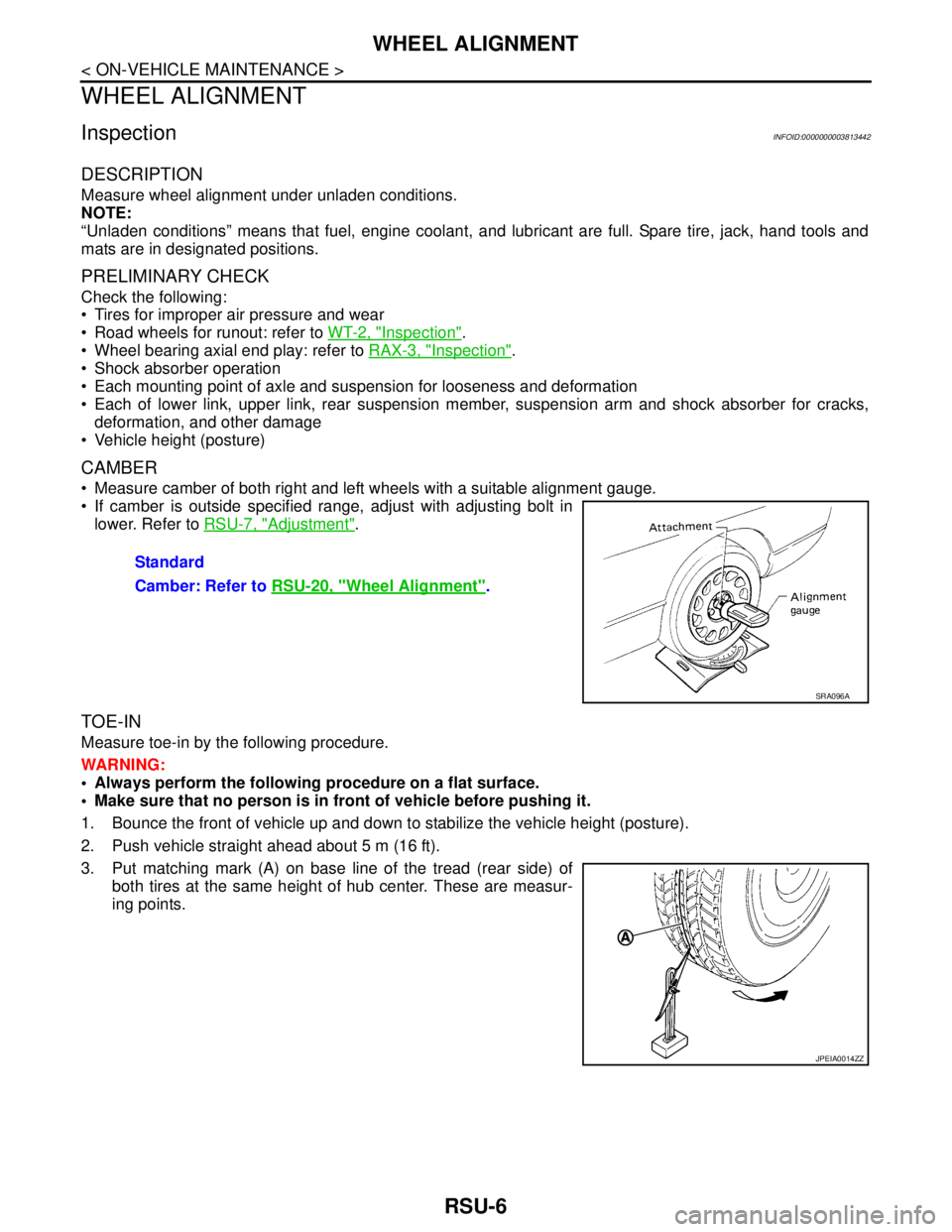
Measure camber of both right and left wheels with a suitable alignment gauge.
If camber is outside specified range, adjust with adjusting bolt in
lower. Refer to RSU-7, "
Adjustment".
TOE-IN
Measure toe-in by the following procedure.
WARNING:
Always perform the following procedure on a flat surface.
Make sure that no person is in front of vehicle before pushing it.
1. Bounce the front of vehicle up and down to stabilize the vehicle height (posture).
2. Push vehicle straight ahead about 5 m (16 ft).
3. Put matching mark (A) on base line of the tread (rear side) of
both tires at the same height of hub center. These are measur-
ing points.Standard
Camber: Refer to RSU-20, "
Wheel Alignment".
SRA096A
JPEIA0014ZZ