trunk NISSAN TEANA 2008 Service Manual
[x] Cancel search | Manufacturer: NISSAN, Model Year: 2008, Model line: TEANA, Model: NISSAN TEANA 2008Pages: 5121, PDF Size: 69.03 MB
Page 3000 of 5121
SQUEAK AND RATTLE TROUBLE DIAGNOSES
INT-23
< SYMPTOM DIAGNOSIS >
C
D
E
F
G
H
I
K
L
MA
B
INT
N
O
P
Inspection ProcedureINFOID:0000000003887244
Refer to Table of Contents for specific component removal and installation information.
INSTRUMENT PANEL
Most incidents are caused by contact and movement between:
1. Cluster lid A and instrument panel
2. Acrylic lens and combination meter housing
3. Instrument panel to front pillar garnish
4. Instrument panel to windshield
5. Instrument panel mounting pins
6. Wiring harnesses behind the combination meter
7. A/C defroster duct and duct joint
These incidents can usually be located by tapping or moving the components to duplicate the noise or by
pressing on the components while driving to stop the noise. Most of these incidents can be repaired by apply-
ing felt cloth tape or silicon spray (in hard to reach areas). Urethane pads can be used to insulate wiring har-
ness.
CAUTION:
Never use silicone spray to isolate a squeak or rattle. If the area is saturated with silicone, the recheck
of repair becomes impossible.
CENTER CONSOLE
Components to pay attention to include:
1. Shifter assembly cover to finisher
2. A/C control unit and cluster lid C
3. Wiring harnesses behind audio and A/C control unit
The instrument panel repair and isolation procedures also apply to the center console.
DOORS
Pay attention to the following:
1. Finisher and inner panel making a slapping noise
2. Inside handle escutcheon to door finisher
3. Wiring harnesses tapping
4. Door striker out of alignment causing a popping noise on starts and stops
Tapping or moving the components or pressing on them while driving to duplicate the conditions can isolate
many of these incidents. The areas can usually be insulated with felt cloth tape or insulator foam blocks to
repair the noise.
TRUNK
Trunk noises are often caused by a loose jack or loose items put into the trunk by the customer.
In addition look for the following:
1. Trunk lid dumpers out of adjustment
2. Trunk lid striker out of adjustment
3. Trunk lid torsion bars knocking together
4. A loose license plate or bracket
Most of these incidents can be repaired by adjusting, securing or insulating the item(s) or component(s) caus-
ing the noise.
SUNROOF/HEADLINING
Noises in the sunroof/headlining area can often be traced to one of the following:
1. Sunroof lid, rail, linkage or seals making a rattle or light knocking noise
2. Sunvisor shaft shaking in the holder
3. Front or rear windshield touching headlining and squeaking
Again, pressing on the components to stop the noise while duplicating the conditions can isolate most of these
incidents. Repairs usually consist of insulating with felt cloth tape.
Page 3021 of 5121
INT-44
< ON-VEHICLE REPAIR >
REAR PARCEL SHELF FINISHER
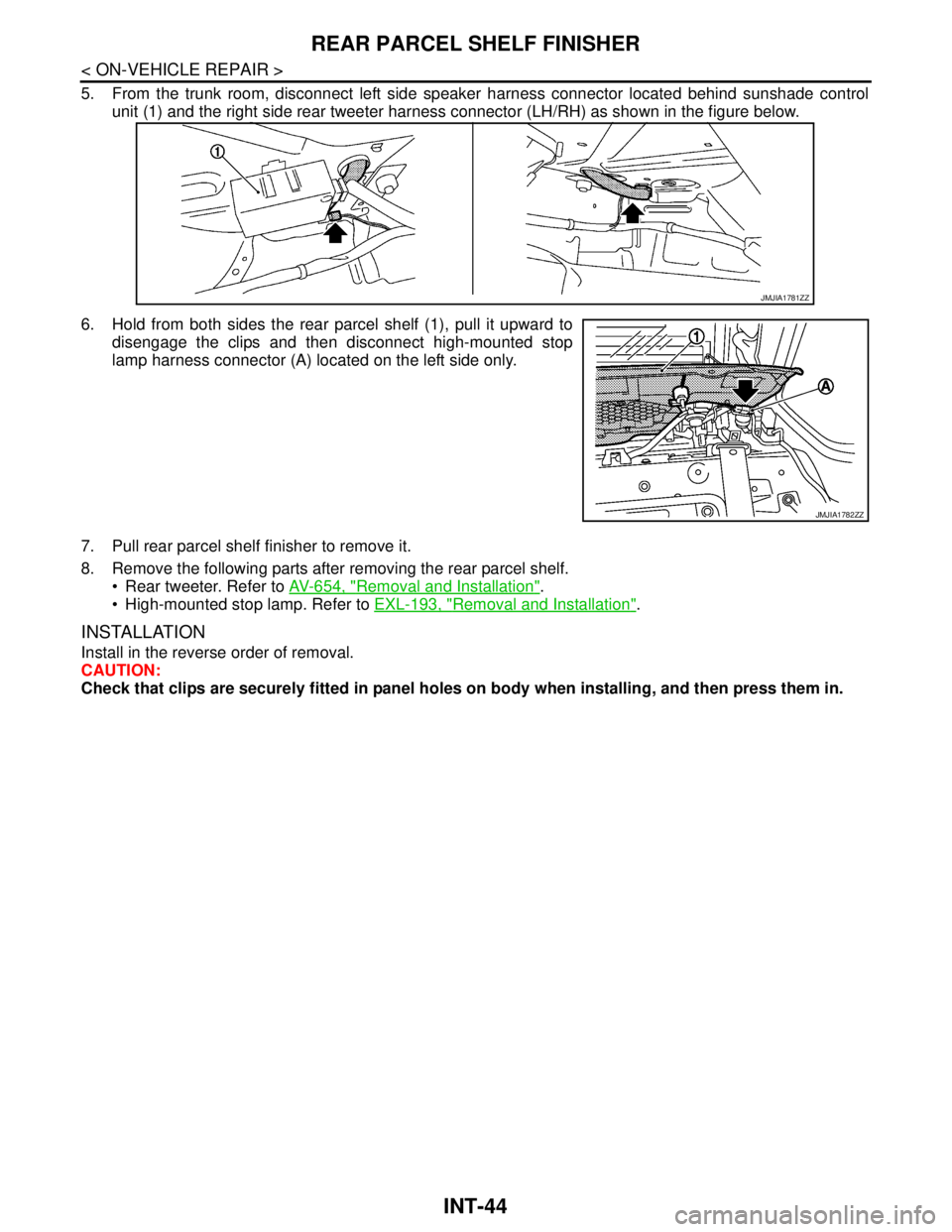
5. From the trunk room, disconnect left side speaker harness connector located behind sunshade control
unit (1) and the right side rear tweeter harness connector (LH/RH) as shown in the figure below.
6. Hold from both sides the rear parcel shelf (1), pull it upward to
disengage the clips and then disconnect high-mounted stop
lamp harness connector (A) located on the left side only.
7. Pull rear parcel shelf finisher to remove it.
8. Remove the following parts after removing the rear parcel shelf.
Rear tweeter. Refer to AV-654, "
Removal and Installation".
High-mounted stop lamp. Refer to EXL-193, "
Removal and Installation".
INSTALLATION
Install in the reverse order of removal.
CAUTION:
Check that clips are securely fitted in panel holes on body when installing, and then press them in.
JMJIA1781ZZ
JMJIA1782ZZ
Page 3023 of 5121
INT-46
< ON-VEHICLE REPAIR >
REAR SUNSHADE
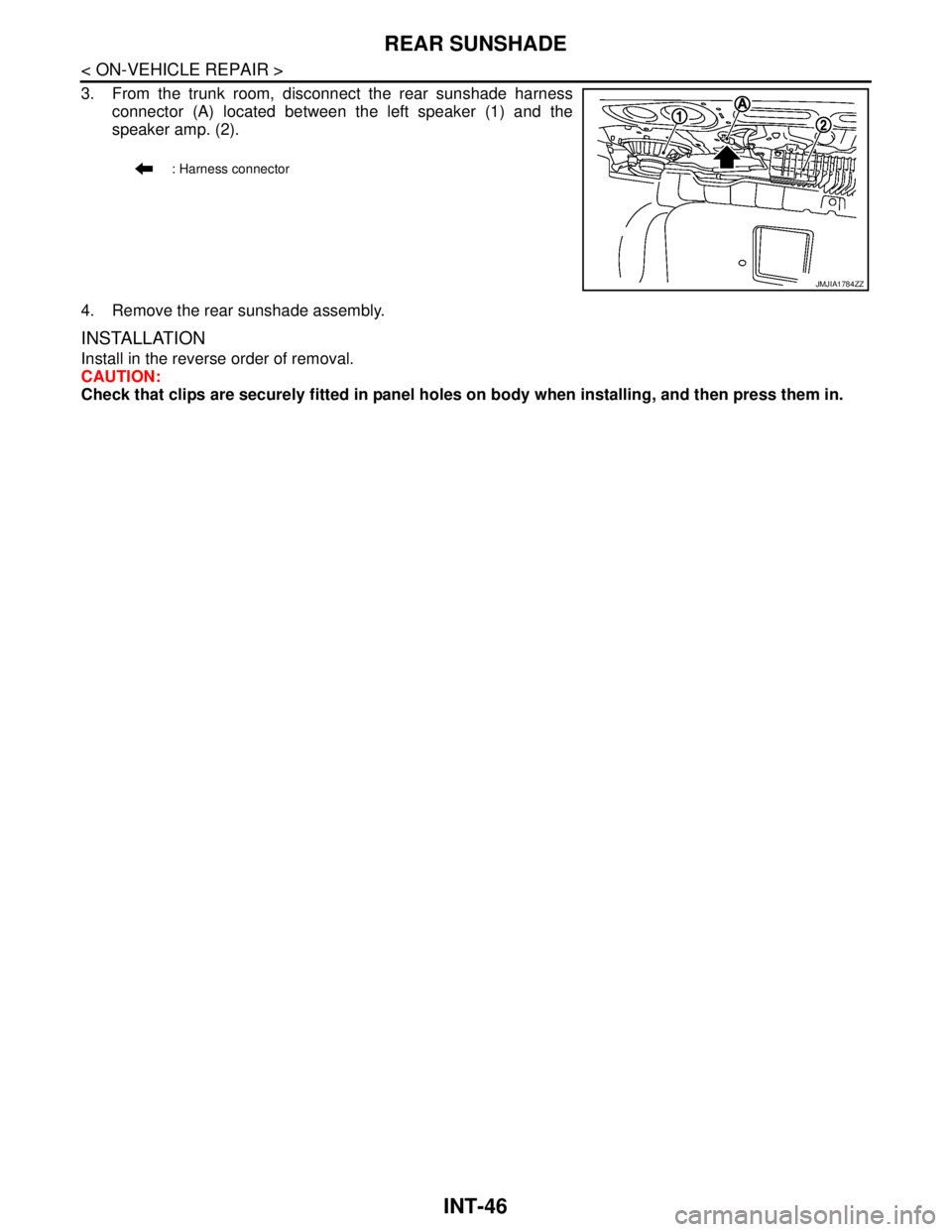
3. From the trunk room, disconnect the rear sunshade harness
connector (A) located between the left speaker (1) and the
speaker amp. (2).
4. Remove the rear sunshade assembly.
INSTALLATION
Install in the reverse order of removal.
CAUTION:
Check that clips are securely fitted in panel holes on body when installing, and then press them in.
: Harness connector
JMJIA1784ZZ
Page 3034 of 5121
TRUNK ROOM TRIM
INT-57
< ON-VEHICLE REPAIR >
C
D
E
F
G
H
I
K
L
MA
B
INT
N
O
P
TRUNK ROOM TRIM
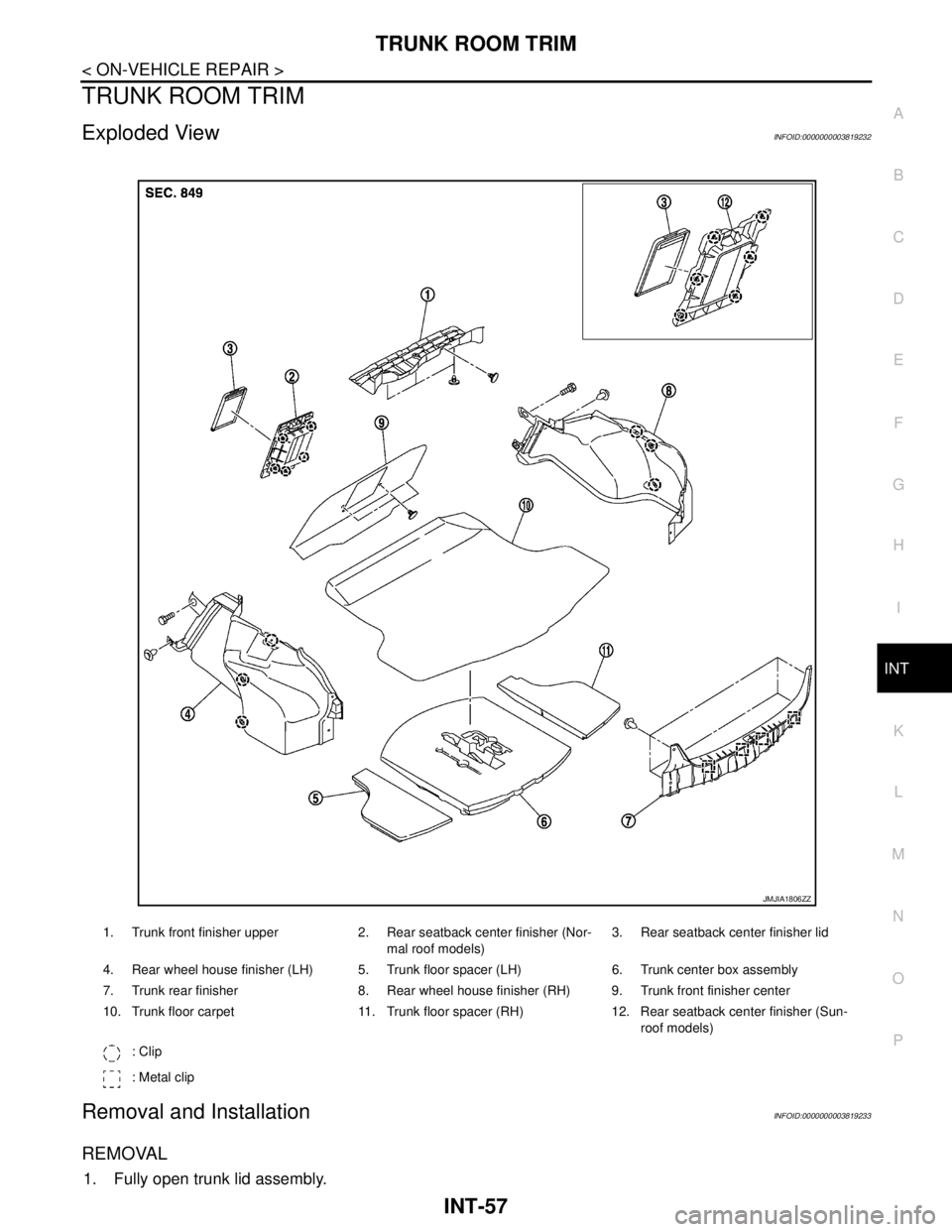
Exploded ViewINFOID:0000000003819232
Removal and InstallationINFOID:0000000003819233
REMOVAL
1. Fully open trunk lid assembly.
1. Trunk front finisher upper 2. Rear seatback center finisher (Nor-
mal roof models)3. Rear seatback center finisher lid
4. Rear wheel house finisher (LH) 5. Trunk floor spacer (LH) 6. Trunk center box assembly
7. Trunk rear finisher 8. Rear wheel house finisher (RH) 9. Trunk front finisher center
10. Trunk floor carpet 11. Trunk floor spacer (RH) 12. Rear seatback center finisher (Sun-
roof models)
: Clip
: Metal clip
JMJIA1806ZZ
Page 3035 of 5121
INT-58
< ON-VEHICLE REPAIR >
TRUNK ROOM TRIM
2. Remove trunk floor carpet.
3. Remove trunk center box.
4. Remove trunk floor spacer (LH/RH).
5. Remove trunk rear finisher mounting clips and metal clips, and then remove trunk rear finisher.
6. Remove trunk weather-strip.
7. Remove trunk front finisher center fixing clips, and then remove trunk front finisher center.
8. Remove trunk front finisher upper fixing clips, and then remove the trunk front finisher upper.
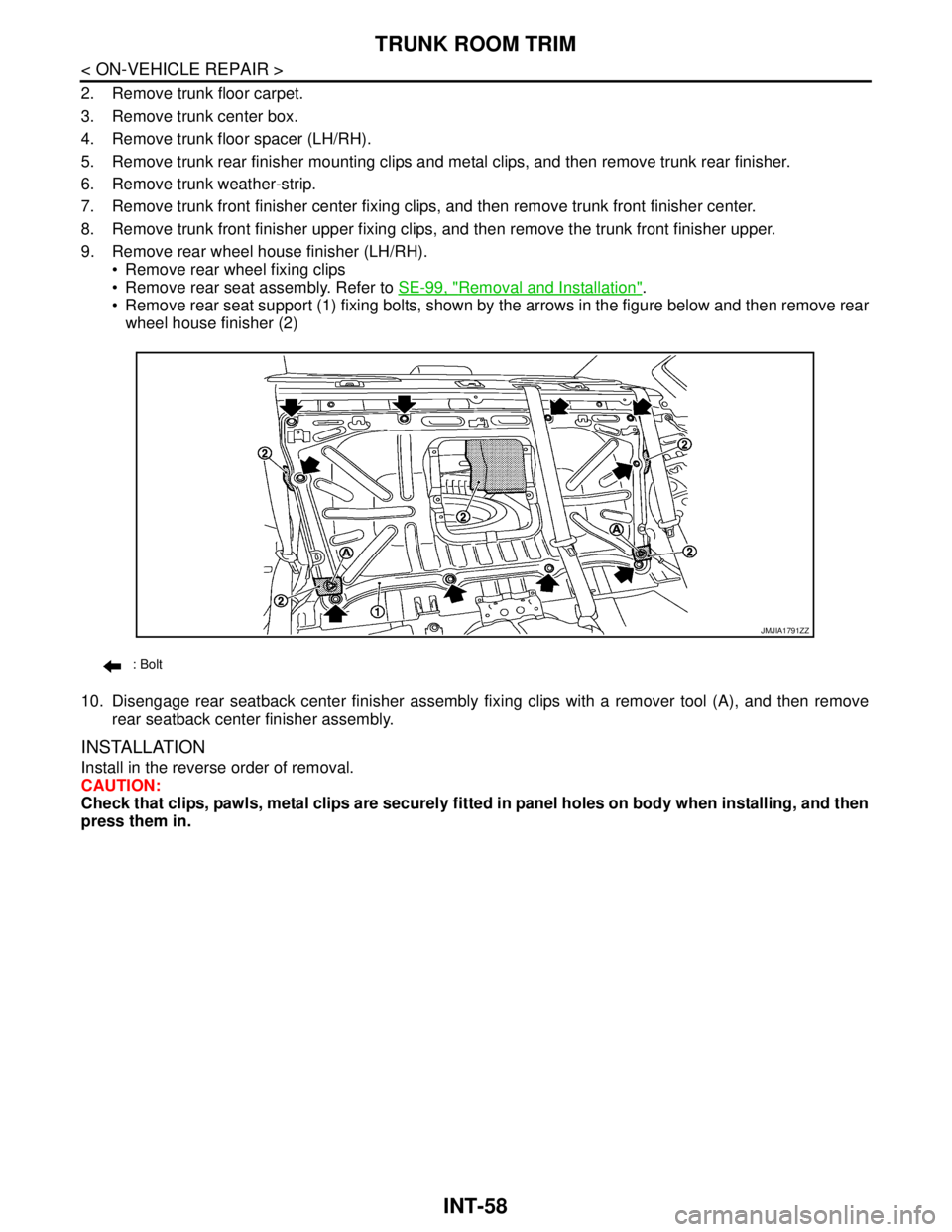
9. Remove rear wheel house finisher (LH/RH).
Remove rear wheel fixing clips
Remove rear seat assembly. Refer to SE-99, "
Removal and Installation".
Remove rear seat support (1) fixing bolts, shown by the arrows in the figure below and then remove rear
wheel house finisher (2)
10. Disengage rear seatback center finisher assembly fixing clips with a remover tool (A), and then remove
rear seatback center finisher assembly.
INSTALLATION
Install in the reverse order of removal.
CAUTION:
Check that clips, pawls, metal clips are securely fitted in panel holes on body when installing, and then
press them in.
: Bolt
JMJIA1791ZZ
Page 3036 of 5121
TRUNK LID TRIM
INT-59
< ON-VEHICLE REPAIR >
C
D
E
F
G
H
I
K
L
MA
B
INT
N
O
P
TRUNK LID TRIM
Exploded ViewINFOID:0000000003819234
Removal and InstallationINFOID:0000000003819235
REMOVAL
1. Fully open trunk lid assembly.
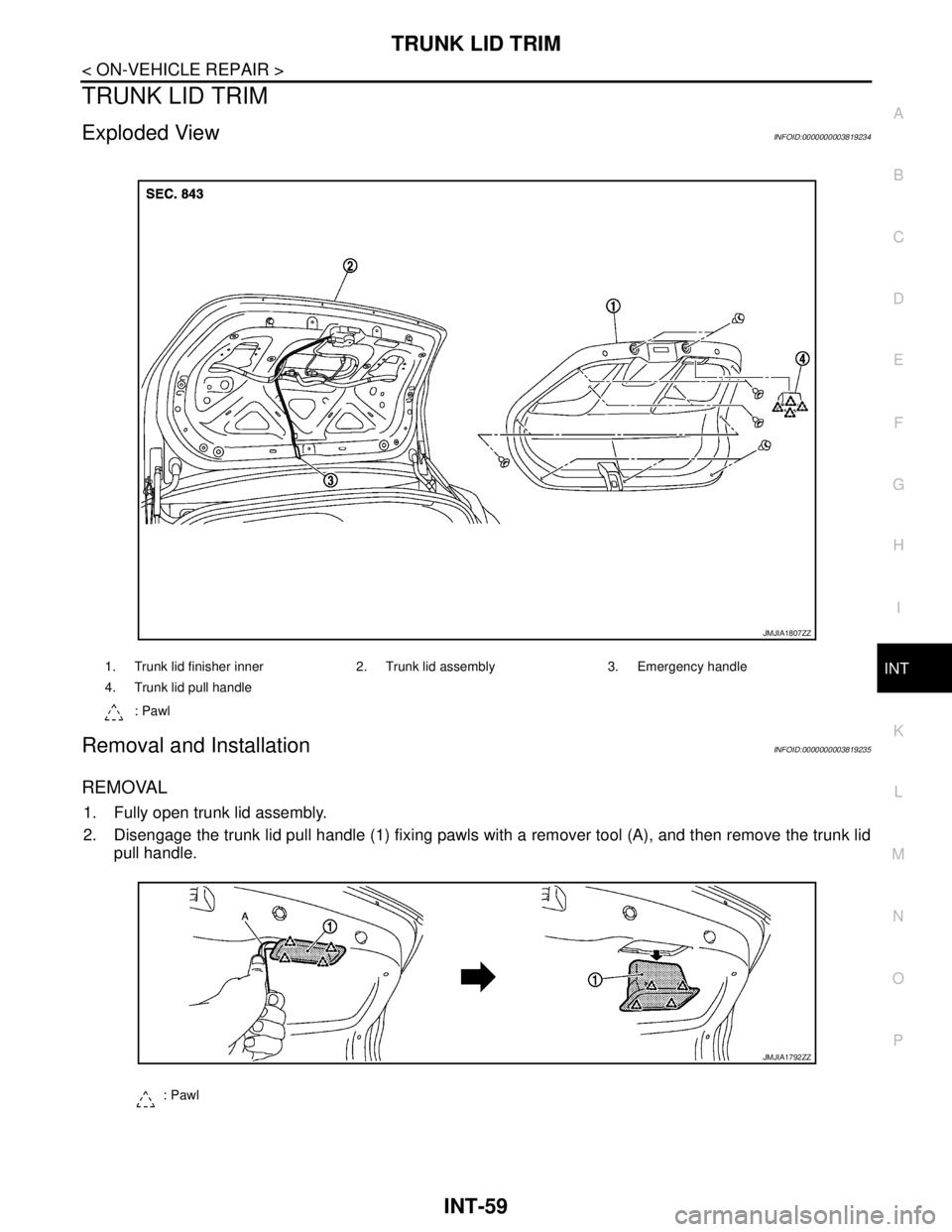
2. Disengage the trunk lid pull handle (1) fixing pawls with a remover tool (A), and then remove the trunk lid
pull handle.
1. Trunk lid finisher inner 2. Trunk lid assembly 3. Emergency handle
4. Trunk lid pull handle
: Pawl
JMJIA1807ZZ
: Pawl
JMJIA1792ZZ
Page 3037 of 5121
INT-60
< ON-VEHICLE REPAIR >
TRUNK LID TRIM
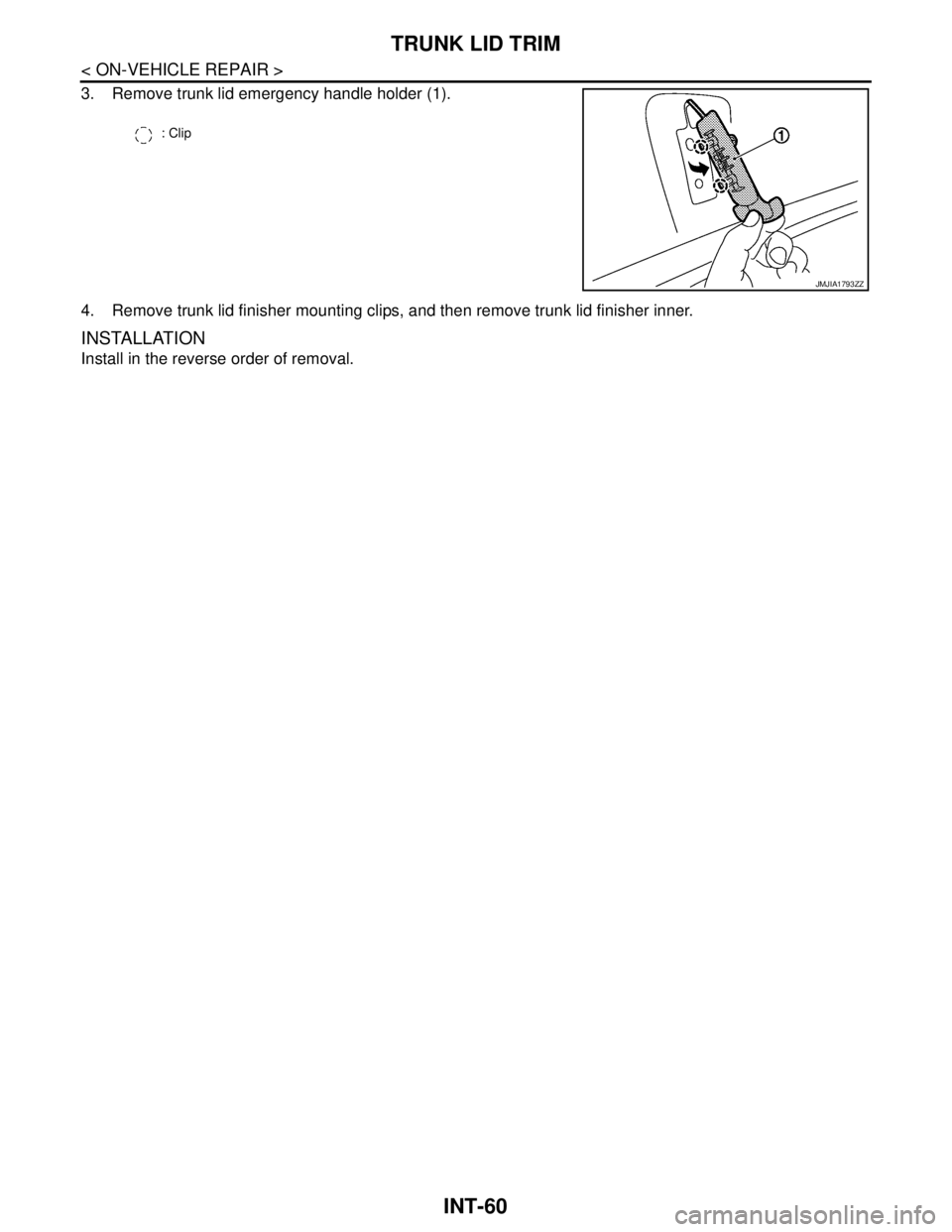
3. Remove trunk lid emergency handle holder (1).
4. Remove trunk lid finisher mounting clips, and then remove trunk lid finisher inner.
INSTALLATION
Install in the reverse order of removal.
: Clip
JMJIA1793ZZ
Page 3044 of 5121

IP-4
< SYMPTOM DIAGNOSIS >
SQUEAK AND RATTLE TROUBLE DIAGNOSES
Confirm that the cause of a noise is repaired by test driving the vehicle. Operate the vehicle under the same
conditions as when the noise originally occurred. Refer to the notes on the Diagnostic Worksheet.
Inspection ProcedureINFOID:0000000003939974
Refer to Table of Contents for specific component removal and installation information.
INSTRUMENT PANEL
Most incidents are caused by contact and movement between:
1. Cluster lid A and instrument panel
2. Acrylic lens and combination meter housing
3. Instrument panel to front pillar garnish
4. Instrument panel to windshield
5. Instrument panel mounting pins
6. Wiring harnesses behind the combination meter
7. A/C defroster duct and duct joint
These incidents can usually be located by tapping or moving the components to duplicate the noise or by
pressing on the components while driving to stop the noise. Most of these incidents can be repaired by apply-
ing felt cloth tape or silicon spray (in hard to reach areas). Urethane pads can be used to insulate wiring har-
ness.
CAUTION:
Never use silicone spray to isolate a squeak or rattle. If the area is saturated with silicone, the recheck
of repair becomes impossible.
CENTER CONSOLE
Components to pay attention to include:
1. Shifter assembly cover to finisher
2. A/C control unit and cluster lid C
3. Wiring harnesses behind audio and A/C control unit
The instrument panel repair and isolation procedures also apply to the center console.
DOORS
Pay attention to the following:
1. Finisher and inner panel making a slapping noise
2. Inside handle escutcheon to door finisher
3. Wiring harnesses tapping
4. Door striker out of alignment causing a popping noise on starts and stops
Tapping or moving the components or pressing on them while driving to duplicate the conditions can isolate
many of these incidents. The areas can usually be insulated with felt cloth tape or insulator foam blocks to
repair the noise.
TRUNK
Trunk noises are often caused by a loose jack or loose items put into the trunk by the customer.
In addition look for the following:
1. Trunk lid dumpers out of adjustment
2. Trunk lid striker out of adjustment
3. Trunk lid torsion bars knocking together
4. A loose license plate or bracket
Most of these incidents can be repaired by adjusting, securing or insulating the item(s) or component(s) caus-
ing the noise.
SUNROOF/HEADLINING
Noises in the sunroof/headlining area can often be traced to one of the following:
1. Sunroof lid, rail, linkage or seals making a rattle or light knocking noise
2. Sunvisor shaft shaking in the holder
3. Front or rear windshield touching headlining and squeaking
Page 3091 of 5121
![NISSAN TEANA 2008 Service Manual LAN-24
< FUNCTION DIAGNOSIS >[CAN]
CAN COMMUNICATION SYSTEM
Ignition switch signal R T
Interlock/PNP switch signalTR
RT
Key ID signal R T
Key switch signal R T
Key warning lamp signal R T
Low beam req](/img/5/57391/w960_57391-3090.png "NISSAN TEANA 2008 Service Manual LAN-24
< FUNCTION DIAGNOSIS >[CAN]
CAN COMMUNICATION SYSTEM
Ignition switch signal R T
Interlock/PNP switch signalTR
RT
Key ID signal R T
Key switch signal R T
Key warning lamp signal R T
Low beam req")
LAN-24
< FUNCTION DIAGNOSIS >[CAN]
CAN COMMUNICATION SYSTEM
Ignition switch signal R T
Interlock/PNP switch signalTR
RT
Key ID signal R T
Key switch signal R T
Key warning lamp signal R T
Low beam request signalTR
Meter display signal R T
Oil pressure switch signalRT
RT
Position light request signal R T R
Rear fog lamp status signal R T
Rear window defogger control signalTR
RR R T
Sleep wake up signal R R T R
Starter control relay signalTR
Starter relay status signalRT
TR
Starting mode signal R T
Steering lock relay signalTR
RT
Stop lamp switch signalTR
Theft warning horn request signal T R
Trunk switch signal R R T
ABS operation signal TR
ABS warning lamp signal R T
Brake warning lamp signal R T
SLIP indicator lamp signal R T
VDC OFF indicator lamp signal R T
CVT position indicator signal R R R T
CVT self-diagnosis signal R T
Input shaft revolution signal R T
N range signalRT
Output shaft revolution signal R T
P range signal R R R T
Shift position signal R R T
Sport mode indicator signal R T
A/C compressor feedback signal R T
Control device (detention switch) signal R R T
Front wiper stop position signal R T
High beam status signal RT
Low beam status signal RT Signal name/Connecting unit
ECM
ADP
AV
HVAC
M&A
STRG
BCM
ABS
TCM
IPDM-E
Page 3211 of 5121
CHASSIS MAINTENANCE
MA-23
< ON-VEHICLE MAINTENANCE >
C
D
E
F
G
H
I
J
K
L
MB
MAN
OA
CHASSIS MAINTENANCE
HEADLAMP AIMING ADJUSTMENT (XENON TYPE)
HEADLAMP AIMING ADJUSTMENT (XENON TYPE) : DescriptionINFOID:0000000003862420
PREPARATION BEFORE ADJUSTING
NOTE:
For details, refer to the regulations in your own country.
Perform aiming if the vehicle front body has been repaired and/or the headlamp assembly has been
replaced.
Before performing aiming adjustment, check the following. Adjust the tire pressure to the specification.
Fill with fuel, engine coolant and each oil.
Maintain the unloaded vehicle condition. (Remove luggage from the passenger compartment and the trunk
room.)
NOTE:
Do not remove the temporary tire, jack and on-vehicle tool.
Wipe out dirt on the headlamp.
CAUTION:
Never use organic solvent (thinner, gasoline etc.)
Ride alone on the driver seat.
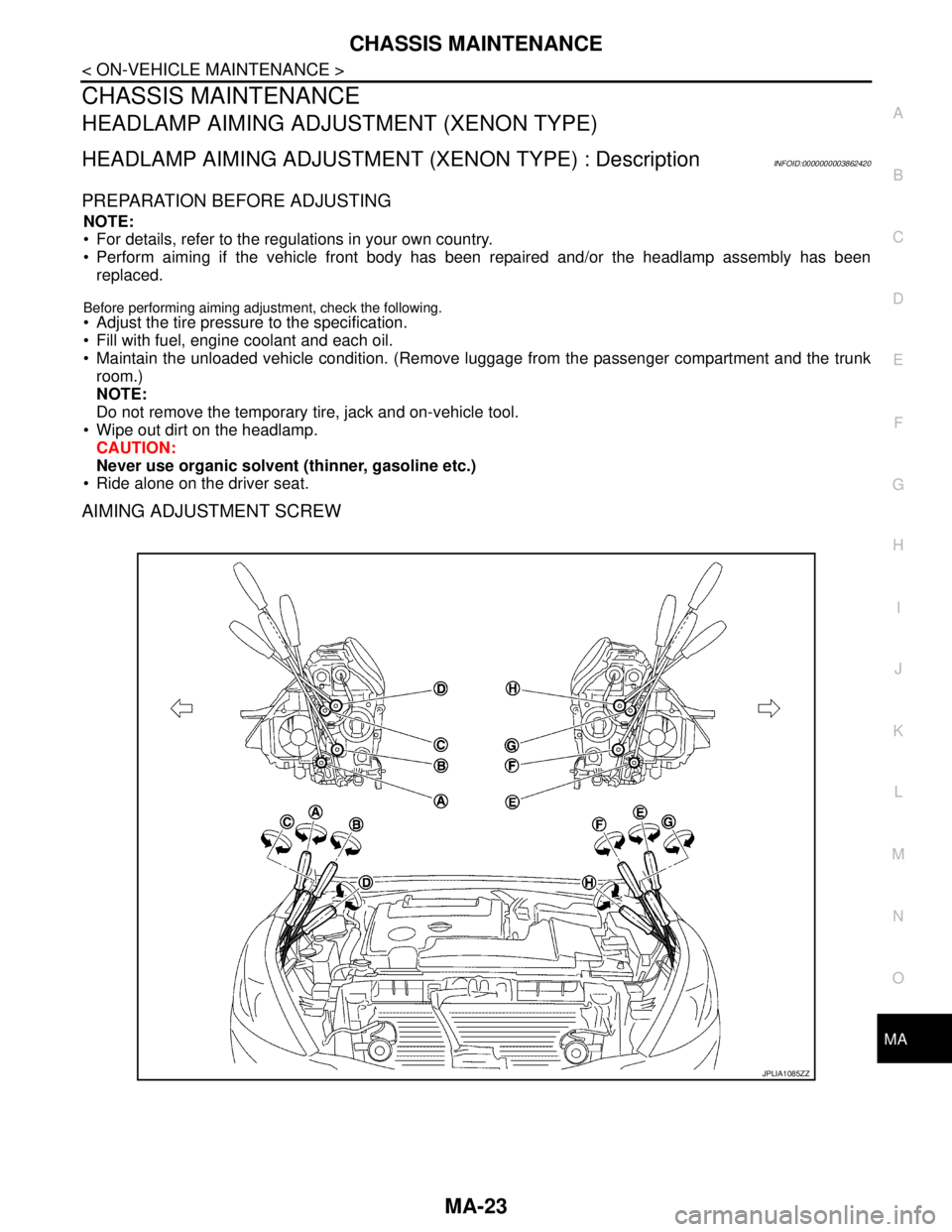
AIMING ADJUSTMENT SCREW
JPLIA1085ZZ