trunk NISSAN TEANA 2008 Service Manual
[x] Cancel search | Manufacturer: NISSAN, Model Year: 2008, Model line: TEANA, Model: NISSAN TEANA 2008Pages: 5121, PDF Size: 69.03 MB
Page 3215 of 5121

CHASSIS MAINTENANCE
MA-27
< ON-VEHICLE MAINTENANCE >
C
D
E
F
G
H
I
J
K
L
MB
MAN
OA
Unit: mm (in)
HEADLAMP AIMING ADJUSTMENT (HALOGEN TYPE)
HEADLAMP AIMING ADJUSTMENT (HALOGEN TYPE) : DescriptionINFOID:0000000003862423
PREPARATION BEFORE ADJUSTING
NOTE:
For details, refer to the regulations in your own country.
Perform aiming if the vehicle front body has been repaired and/or the headlamp assembly has been
replaced.
Before performing aiming adjustment, check the following.
Adjust the tire pressure to the specification.
Fill with fuel, engine coolant and each oil.
Maintain the unloaded vehicle condition. (Remove luggage from the passenger compartment and the trunk
room.)
NOTE:
Do not remove the temporary tire, jack and on-vehicle tool.
Wipe out dirt on the headlamp.
CAUTION:
Never use organic solvent (thinner, gasoline etc.)
Ride alone on the driver seat.
Headlamp aiming switch sets to “0”.
AIMING ADJUSTMENT SCREW
Aiming adjustment area
Vertical direction (Y)
(Lower side from headlamp center height)Lateral direction (X)
(Right and left side from headlamp centerline)
Highest light axis 106 (4.17)
0-100 (3.94) Target light axis 120 (4.72)
Lowest light axis 164 (6.46)
Page 3230 of 5121
MA-42
< ON-VEHICLE MAINTENANCE >
BODY MAINTENANCE
BODY MAINTENANCE
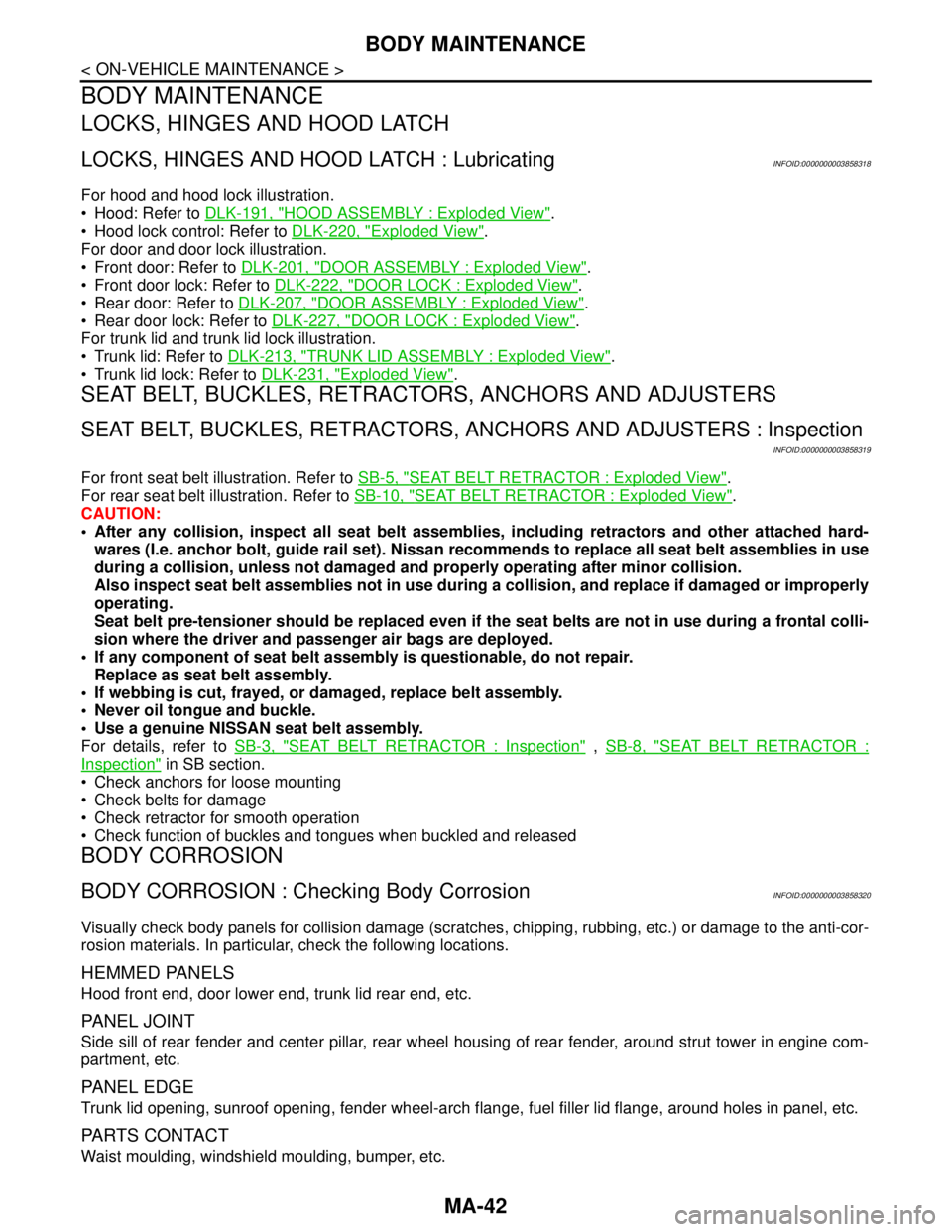
LOCKS, HINGES AND HOOD LATCH
LOCKS, HINGES AND HOOD LATCH : LubricatingINFOID:0000000003858318
For hood and hood lock illustration.
Hood: Refer to DLK-191, "
HOOD ASSEMBLY : Exploded View".
Hood lock control: Refer to DLK-220, "
Exploded View".
For door and door lock illustration.
Front door: Refer to DLK-201, "
DOOR ASSEMBLY : Exploded View".
Front door lock: Refer to DLK-222, "
DOOR LOCK : Exploded View".
Rear door: Refer to DLK-207, "
DOOR ASSEMBLY : Exploded View".
Rear door lock: Refer to DLK-227, "
DOOR LOCK : Exploded View".
For trunk lid and trunk lid lock illustration.
Trunk lid: Refer to DLK-213, "
TRUNK LID ASSEMBLY : Exploded View".
Trunk lid lock: Refer to DLK-231, "
Exploded View".
SEAT BELT, BUCKLES, RETRACTORS, ANCHORS AND ADJUSTERS
SEAT BELT, BUCKLES, RETRACTORS, ANCHORS AND ADJUSTERS : Inspection
INFOID:0000000003858319
For front seat belt illustration. Refer to SB-5, "SEAT BELT RETRACTOR : Exploded View".
For rear seat belt illustration. Refer to SB-10, "
SEAT BELT RETRACTOR : Exploded View".
CAUTION:
After any collision, inspect all seat belt assemblies, including retractors and other attached hard-
wares (I.e. anchor bolt, guide rail set). Nissan recommends to replace all seat belt assemblies in use
during a collision, unless not damaged and properly operating after minor collision.
Also inspect seat belt assemblies not in use during a collision, and replace if damaged or improperly
operating.
Seat belt pre-tensioner should be replaced even if the seat belts are not in use during a frontal colli-
sion where the driver and passenger air bags are deployed.
If any component of seat belt assembly is questionable, do not repair.
Replace as seat belt assembly.
If webbing is cut, frayed, or damaged, replace belt assembly.
Never oil tongue and buckle.
Use a genuine NISSAN seat belt assembly.
For details, refer to SB-3, "
SEAT BELT RETRACTOR : Inspection" , SB-8, "SEAT BELT RETRACTOR :
Inspection" in SB section.
Check anchors for loose mounting
Check belts for damage
Check retractor for smooth operation
Check function of buckles and tongues when buckled and released
BODY CORROSION
BODY CORROSION : Checking Body CorrosionINFOID:0000000003858320
Visually check body panels for collision damage (scratches, chipping, rubbing, etc.) or damage to the anti-cor-
rosion materials. In particular, check the following locations.
HEMMED PANELS
Hood front end, door lower end, trunk lid rear end, etc.
PA N E L J O I N T
Side sill of rear fender and center pillar, rear wheel housing of rear fender, around strut tower in engine com-
partment, etc.
PA N E L E D G E
Trunk lid opening, sunroof opening, fender wheel-arch flange, fuel filler lid flange, around holes in panel, etc.
PARTS CONTACT
Waist moulding, windshield moulding, bumper, etc.
Page 3241 of 5121

MIR-8
< SYMPTOM DIAGNOSIS >
SQUEAK AND RATTLE TROUBLE DIAGNOSES
Confirm that the cause of a noise is repaired by test driving the vehicle. Operate the vehicle under the same
conditions as when the noise originally occurred. Refer to the notes on the Diagnostic Worksheet.
Inspection ProcedureINFOID:0000000003941383
Refer to Table of Contents for specific component removal and installation information.
INSTRUMENT PANEL
Most incidents are caused by contact and movement between:
1. Cluster lid A and instrument panel
2. Acrylic lens and combination meter housing
3. Instrument panel to front pillar garnish
4. Instrument panel to windshield
5. Instrument panel mounting pins
6. Wiring harnesses behind the combination meter
7. A/C defroster duct and duct joint
These incidents can usually be located by tapping or moving the components to duplicate the noise or by
pressing on the components while driving to stop the noise. Most of these incidents can be repaired by apply-
ing felt cloth tape or silicon spray (in hard to reach areas). Urethane pads can be used to insulate wiring har-
ness.
CAUTION:
Never use silicone spray to isolate a squeak or rattle. If the area is saturated with silicone, the recheck
of repair becomes impossible.
CENTER CONSOLE
Components to pay attention to include:
1. Shifter assembly cover to finisher
2. A/C control unit and cluster lid C
3. Wiring harnesses behind audio and A/C control unit
The instrument panel repair and isolation procedures also apply to the center console.
DOORS
Pay attention to the following:
1. Finisher and inner panel making a slapping noise
2. Inside handle escutcheon to door finisher
3. Wiring harnesses tapping
4. Door striker out of alignment causing a popping noise on starts and stops
Tapping or moving the components or pressing on them while driving to duplicate the conditions can isolate
many of these incidents. The areas can usually be insulated with felt cloth tape or insulator foam blocks to
repair the noise.
TRUNK
Trunk noises are often caused by a loose jack or loose items put into the trunk by the customer.
In addition look for the following:
1. Trunk lid dumpers out of adjustment
2. Trunk lid striker out of adjustment
3. Trunk lid torsion bars knocking together
4. A loose license plate or bracket
Most of these incidents can be repaired by adjusting, securing or insulating the item(s) or component(s) caus-
ing the noise.
SUNROOF/HEADLINING
Noises in the sunroof/headlining area can often be traced to one of the following:
1. Sunroof lid, rail, linkage or seals making a rattle or light knocking noise
2. Sunvisor shaft shaking in the holder
3. Front or rear windshield touching headlining and squeaking
Page 3257 of 5121

MWI
MWI-3
C
D
E
F
G
H
I
J
K
L
MB A
O
P Diagnosis Procedure .............................................
121
THE TRUNK OPEN WARNING CONTINUES
DISPLAYING, OR DOES NOT DISPLAY ........
122
Description ............................................................122
Diagnosis Procedure .............................................122
THE AMBIENT TEMPERATURE DISPLAY IS
INCORRECT .....................................................
123
Description ............................................................123
Diagnosis Procedure .............................................123
NORMAL OPERATING CONDITION ...............124
INFORMATION DISPLAY .......................................124
INFORMATION DISPLAY : Description ................124
PRECAUTION ............................................125
PRECAUTIONS ...............................................125
Precaution for Supplemental Restraint System
(SRS) "AIR BAG" and "SEAT BELT PRE-TEN-
SIONER" ...............................................................
125
ON-VEHICLE REPAIR ...............................126
COMBINATION METER .................................126
Exploded View .......................................................126
Removal and Installation .......................................126
Disassembly and Assembly ...................................126
METER CONTROL SWITCH ..........................127
Exploded View .......................................................127
Removal and Installation .......................................127
Page 3261 of 5121

MWI
METER SYSTEM
MWI-7
< FUNCTION DIAGNOSIS >
C
D
E
F
G
H
I
J
K
L
MB A
O
P
System Description Signal source
Meter/gaugeSpeedometer Receives vehicle speed signal and indicates vehicle speed.ABS actuator and elec-
tric unit (control unit)
Tachometer Receives engine speed signal and indicates engine speed. ECM
Fuel gauge Receives fuel level sensor signal and indicates fuel level. Fuel level sensor unit
Engine coolant tem-
perature gaugeReceives engine coolant temperature signal and indicates coolant
temperature.ECM
Warning lamp/
indicator lampOil pressure warning
lampReceives oil pressure warning lamp signal and illuminates warning
lamp.IPDM E/R
Master warning Illuminates according to warning output on information display. —
Information
displayDoor open warning Receives door switch signals and displays warning. BCM
Trunk open warning Receives trunk switch signals and displays warning. BCM
Parking brake re-
lease warningReceives parking brake switch signal and vehicle speed signal and
displays warnings.Parking brake switch
ABS actuator and elec-
tric unit (control unit)
Low fuel warningReceives fuel gauge signal and displays warning if fuel level de-
creases to 11 (2-2/5 Imp gal) or less.Fuel level sensor unit
Low outside tempera-
ture warningMonitors ambient sensor signal and displays warning if ambient
temperature decreases to 3°C (37°F) or less. (If enabled)Ambient sensor
Instantaneous fuel
consumptionCalculates instantaneous fuel consumption based on received ve-
hicle speed signals and fuel consumption monitor signal and dis-
plays it.ECM
ABS actuator and elec-
tric unit (control unit)
Average fuel con-
sumptionCalculates average fuel consumption in a reset-to-reset interval
based on received vehicle speed signals and fuel consumption
monitor signal and displays it.ECM
ABS actuator and elec-
tric unit (control unit)
Average vehicle
speedCalculates average vehicle speed in a reset-to-reset interval based
on received vehicle speed signals and displays it.ABS actuator and elec-
tric unit (control unit)
Travel time Displays accumulated key switch ON time from reset to reset. —
Travel distanceCalculates accumulated travel distance in a reset-to-reset interval
based on received vehicle speed signals and displays it.ABS actuator and elec-
tric unit (control unit)
Possible driving dis-
tanceCalculates possible driving distance based on received fuel con-
sumption monitor signal, vehicle speed signals and fuel level sen-
sor signal and displays it.ABS actuator and elec-
tric unit (control unit)
ECM
Fuel level sensor unit
Ambient air tempera-
tureCorrects ambient air temperature value based on received ambient
sensor signals and displays it.Ambient sensor
Page 3282 of 5121

MWI-28
< FUNCTION DIAGNOSIS >
METER SYSTEM
LOW FUEL WARNING
The combination meter indicates the low fuel warning judged by the fuel level sensor signal received from the
fuel level sensor unit.
Warning operation condition
Fuel level: Approx. 11 (2 - 2/5 Imp gal) or less
DOOR/TRUNK OPEN WARNING
The combination meter indicates the door open warning judged by each door switch signal received from the
BCM via CAN communication line.
The combination meter indicates the trunk open warning judged by trunk switch signal received from the
BCM via CAN communication line.
INSTANTANEOUS FUEL CONSUMPTION
The combination meter receives the fuel consumption monitor signal from the ECM and the vehicle speed
signal from the ABS actuator and electric unit (control unit) via CAN communication.
The combination meter calculates instantaneous fuel consumption according to the fuel consumption moni-
tor signal and the vehicle speed signal received via CAN communication.
AVERAGE FUEL CONSUMPTION
The combination meter receives the fuel consumption monitor signal from the ECM and the vehicle speed
signal from the ABS actuator and electric unit (control unit) via CAN communication.
The combination meter calculates the average fuel consumption according to the fuel consumption monitor
signal and the vehicle speed signal received via CAN communication.
The average fuel consumption displayed on the information display is uploaded in approximately 30-second
intervals.
NOTE:
When turning ON the ignition switch after triggering a reset or removing/installing the battery, “−−−−” is indi-
cated until 30 seconds/500 m (0.31 miles) of driving.
AVERAGE VEHICLE SPEED
The combination meter receives the vehicle speed signal from the ABS actuator and electric unit (control
unit) via CAN communication.
Measures the time while the ignition switch is ON through the combination meter.
The combination meter the average vehicle speed according to the above signals.
The average vehicle speed displayed on the information display is uploaded in approximately 30-second
intervals.
NOTE:
When turning ON the ignition switch after triggering a reset or removing/installing the battery, “−−−−” is indi-
cated until 30 seconds/500 m (0.31 miles) of driving.
TRAVEL TIME
Measures the time while the ignition switch is ON through the combination meter.
TRAVEL DISTANCE
The combination meter receives the vehicle speed signal from the ABS actuator and electric unit (control
unit) via CAN communication.
The combination meter calculates the vehicle distance according to the vehicle speed signal. The vehicle
distance is displayed.
POSSIBLE DRIVING DISTANCE
The combination meter calculates possible driving distance according to the vehicle speed signal and fuel
consumption monitor signal transmitted via CAN communication and the fuel level sensor signal transmitted
from the fuel level sensor.
NOTE:
When turning ON the ignition switch after removing/installing the battery, “−−−−” is indicated until 30 sec-
onds.
The indicated values may not match each other when refueling with the ignition switch ON. Refer to MWI-
124, "INFORMATION DISPLAY : Description".
AMBIENT AIR TEMPERATURE
The combination meter receives the ambient sensor signal from the ambient sensor.
The combination meter calculates the ambient temperature according to the ambient sensor signal.
The indicated temperature does not increase if the vehicle speed is less than 20 km/h (12 MPH).
Page 3285 of 5121
MWI
METER SYSTEM
MWI-31
< FUNCTION DIAGNOSIS >
C
D
E
F
G
H
I
J
K
L
MB A
O
P
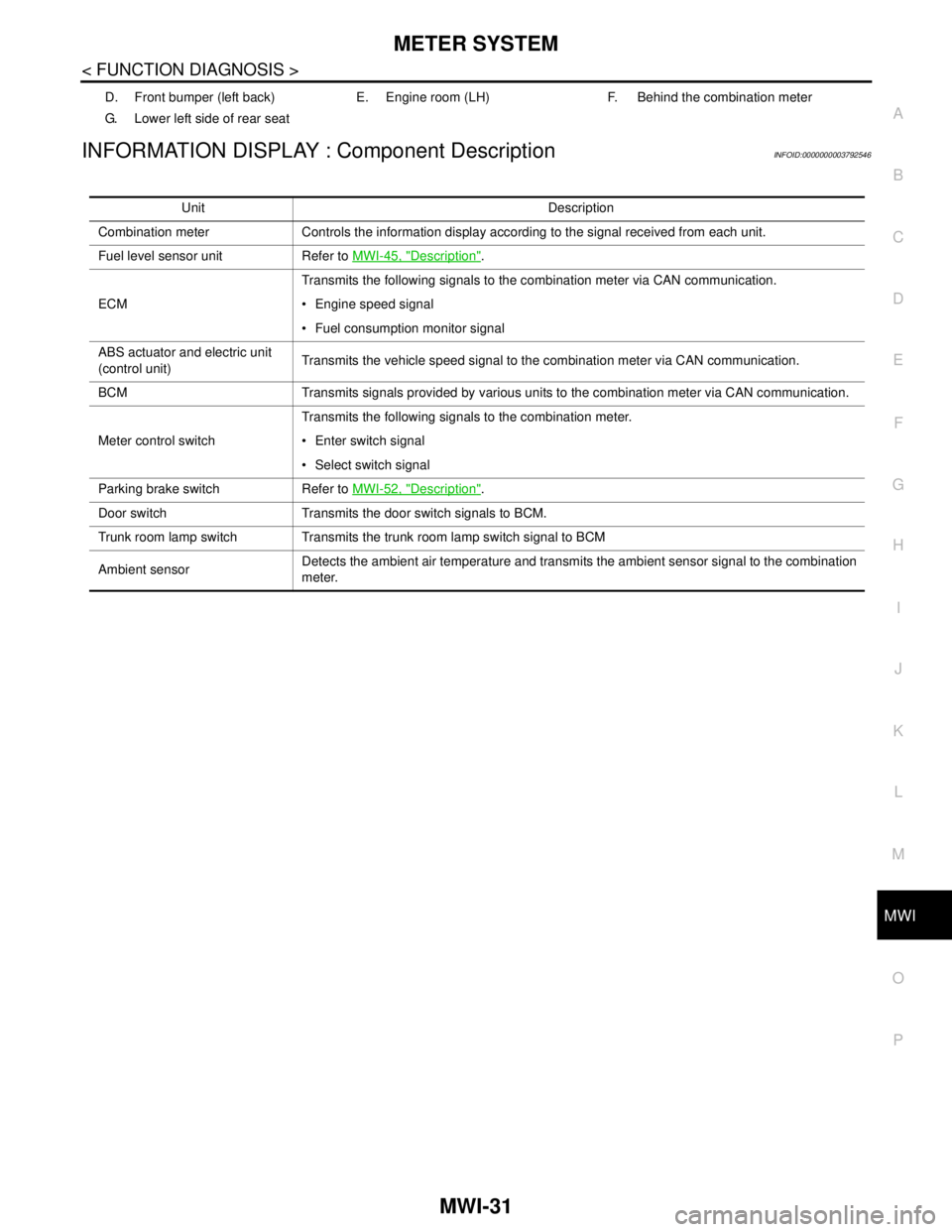
INFORMATION DISPLAY : Component DescriptionINFOID:0000000003792546
D. Front bumper (left back) E. Engine room (LH) F. Behind the combination meter
G. Lower left side of rear seat
Unit Description
Combination meter Controls the information display according to the signal received from each unit.
Fuel level sensor unit Refer to MWI-45, "
Description".
ECMTransmits the following signals to the combination meter via CAN communication.
Engine speed signal
Fuel consumption monitor signal
ABS actuator and electric unit
(control unit)Transmits the vehicle speed signal to the combination meter via CAN communication.
BCM Transmits signals provided by various units to the combination meter via CAN communication.
Meter control switchTransmits the following signals to the combination meter.
Enter switch signal
Select switch signal
Parking brake switch Refer to MWI-52, "
Description".
Door switch Transmits the door switch signals to BCM.
Trunk room lamp switch Transmits the trunk room lamp switch signal to BCM
Ambient sensorDetects the ambient air temperature and transmits the ambient sensor signal to the combination
meter.
Page 3288 of 5121
![NISSAN TEANA 2008 Service Manual MWI-34
< FUNCTION DIAGNOSIS >
DIAGNOSIS SYSTEM (METER)
W TEMP METER
[°C] XValue of engine coolant temperature signal is received from ECM via CAN com-
munication.
NOTE:
215 is displayed when the mal](/img/5/57391/w960_57391-3287.png "NISSAN TEANA 2008 Service Manual MWI-34
< FUNCTION DIAGNOSIS >
DIAGNOSIS SYSTEM (METER)
W TEMP METER
[°C] XValue of engine coolant temperature signal is received from ECM via CAN com-
munication.
NOTE:
215 is displayed when the mal")
MWI-34
< FUNCTION DIAGNOSIS >
DIAGNOSIS SYSTEM (METER)
W TEMP METER
[°C] XValue of engine coolant temperature signal is received from ECM via CAN com-
munication.
NOTE:
215 is displayed when the malfunction signal is input.
ABS W/L
[On/Off]Status of ABS warning lamp detected from ABS warning lamp signal is received
from ABS actuator and electric unit (control unit) via CAN communication.
VDC/TCS IND
[On/Off]Status of VDC OFF indicator lamp detected from VDC OFF indicator lamp signal
is received from ABS actuator and electric unit (control unit) via CAN communica-
tion.
SLIP IND
[On/Off]Status of SLIP indicator lamp detected from slip indicator lamp signal received
from ABS actuator and electric unit (control unit) via CAN communication.
BRAKE W/L
[On/Off]Status of brake warning lamp detected from brake warning lamp signal is received
from ABS actuator and electric unit (control unit) via CAN communication.
NOTE:
Displays “Off” if the brake warning lamp is illuminated when the valve check starts,
the parking brake switch is turned ON or the brake fluid level switch is turned ON.
DOOR W/L
[On/Off]Status of door warning detected from door switch signal received from BCM via
CAN communication.
TRUNK/GLAS-H
[On/Off]Status of trunk warning detected from trunk switch signal received from BCM via
CAN communication.
HI-BEAM IND
[On/Off]Status of high beam indicator lamp detected from high beam request signal is re-
ceived from BCM via CAN communication.
TURN IND
[On/Off]Status of turn indicator lamp detected from turn indicator signal is received from
BCM via CAN communication.
FR FOG IND
[On/Off]Status of front fog light indicator lamp detected from front fog light request signal
is received from BCM via CAN communication.
RR FOG IND
[On/Off]Status of rear fog light indicator lamp detected from rear fog light request signal is
received from BCM via CAN communication.
LIGHT IND
[On/Off]Status of light indicator lamp detected from position light request signal is received
from BCM via CAN communication.
OIL W/L
[On/Off]Status of oil pressure warning lamp detected from oil pressure switch signal is re-
ceived from BCM via CAN communication.
MIL
[On/Off] Status of malfunction indicator lamp detected from malfunctioning indicator lamp
signal is received from ECM via CAN communication.
CRUISE IND
[On/Off]Status of CRUISE indicator detected from ASCD status signal is received from
ECM via CAN communication.
SPORT IND
[On/Off]Status of SPORT indicator detected from sport mode switch signal is received
from control device.
4WD W/L
[On/Off]This item is displayed, but cannot be monitored.
4WD LOCK IND
[On/Off]This item is displayed, but cannot be monitored.
FUEL W/L
[On/Off]Low-fuel warning lamp status detected by the identified fuel level.
WASHER W/L
[On/Off]This item is displayed, but cannot be monitored.
KEY G/Y W/L
[On/Off]Status of key warning lamp (G/Y) detected from key warning signal is received
from BCM via CAN communication.
AFS OFF IND
[On/Off]This item is displayed, but cannot be monitored.
LCD
[B&P N, B&P I, ID NG, ROTAT, SFT
P, INSRT, BATT, NO KY,OUTKY, LK
WN]Displays status of Intelligent Key system warning detected from meter display sig-
nal is received from BCM via CAN communication. Display item [Unit]MAIN
SIGNALSDescription
Page 3290 of 5121

MWI-36
< FUNCTION DIAGNOSIS >
DIAGNOSIS SYSTEM (METER)
- 0 : The condition that the warning/indicator lamp has been turned on 1 or more times after starting the
engine and waiting for 30 seconds.
- 1 - 39 : The number of times the engine was restarted after the 0 condition.
- NO W/L ON HISTORY : Stores NO (0) turning on history of warning/indicator lamp.
NOTE:
W/L ON HISTORY is not stored for approximately 30 seconds after the engine starts.
Brake warning lamp does not store any history when the parking the brake is applied or the brake fluid level
gets low.
Display Item
Display item Description
ABS W/L Lighting history of ABS warning lamp.
VDC/TCS IND Lighting history of VDC OFF indicator lamp.
SLIP IND Lighting history of SLIP indicator lamp.
BRAKE W/L Lighting history of brake warning lamp.
DOOR W/L Lighting history of door warning.
TRUNK/GLAS-H Lighting history of trunk warning.
OIL W/L Lighting history of oil pressure warning lamp.
C-ENG W/L Lighting history of malfunction indicator lamp.
C-ENG2 W/L This item is displayed, but cannot be monitored.
CRUISE IND Lighting history of CRUISE indicator lamp.
SET IND This item is displayed, but cannot be monitored.
CRUISE W/L This item is displayed, but cannot be monitored.
BA W/L This item is displayed, but cannot be monitored.
O/D OFF IND This item is displayed, but cannot be monitored.
ATC/T-AMT W/L This item is displayed, but cannot be monitored.
ATF TEMP W/L This item is displayed, but cannot be monitored.
CVT IND This item is displayed, but cannot be monitored.
SPORT IND Lighting history of SPORT indicator lamp.
4WD W/L This item is displayed, but cannot be monitored.
FUEL W/L Lighting history of low fuel level warning.
WASHER W/L This item is displayed, but cannot be monitored.
AIR PRES W/L This item is displayed, but cannot be monitored.
KEY G/Y W/L Lighting history of key warning lamp (green/yellow).
KEY R W/L Lighting history of key warning lamp (red).
KEY KNOB W/L This item is displayed, but cannot be monitored.
SYS FAIL W/L This item is displayed, but cannot be monitored.
SFT POSI W/L This item is displayed, but cannot be monitored.
HV BAT W/L This item is displayed, but cannot be monitored.
HEV BRAKE W/L This item is displayed, but cannot be monitored.
SFT OPER W/L This item is displayed, but cannot be monitored.
CHAGE W/L Lighting history of charge warning lamp.
OIL LEV LOW This item is displayed, but cannot be monitored.
DPF W/L This item is displayed, but cannot be monitored.
Page 3307 of 5121

MWI
COMBINATION METER
MWI-53
< ECU DIAGNOSIS >
C
D
E
F
G
H
I
J
K
L
MB A
O
P
ECU DIAGNOSIS
COMBINATION METER
Reference ValueINFOID:0000000003792588
VALUES ON THE DIAGNOSIS TOOL
Monitor Item Condition Value/Status
SPEED METER
[km/h]Ignition switch
ONWhile drivingEquivalent to speedometer reading
NOTE:
655.35 is displayed when the malfunc-
tion signal is received
SPEED OUTPUT
[km/h]Ignition switch
ONWhile drivingEquivalent to speedometer reading
NOTE:
655.35 is displayed when the malfunc-
tion signal is received
ODO OUTPUT
[km/h or mph]Ignition switch
ON—Equivalent to odometer reading in
combination meter
TACHO METER
[rpm]Ignition switch
ONWhile drivingEquivalent to tachometer reading
NOTE:
8191.875 is displayed when the mal-
function signal is received
FUEL METER
[lit]Ignition switch
ON— Values according to fuel level
W TEMP METER
[°C]Ignition switch
ON—Values according to engine coolant
temperature
NOTE:
215 is displayed when the malfunction
signal is input
ABS W/LIgnition switch
ONABS warning lamp ON On
ABS warning lamp OFF Off
VDC/TCS INDIgnition switch
ONVDC OFF indicator lamp ON On
VDC OFF indicator lamp OFF Off
SLIP INDIgnition switch
ONSLIP Indicator lamp ON On
SLIP indicator lamp OFF Off
BRAKE W/LIgnition switch
ONBrake warning lamp ON On
Brake warning lamp OFF Off
DOOR W/LIgnition switch
ONDoor warning ON On
Door warning OFF Off
TRUNK/GLAS-HIgnition switch
ONTrunk warning ON On
Trunk warning OFF Off
HI-BEAM INDIgnition switch
ONHigh-beam indicator lamp ON On
High-beam indicator lamp OFF Off
TURN INDIgnition switch
ONTurn signal indicator lamp ON On
Turn signal indicator lamp OFF Off
FR FOG INDIgnition switch
ONFront fog light indicator lamp ON On
Front fog light indicator lamp OFF Off
RR FOG INDIgnition switch
ONRear fog light indicator lamp ON On
Rear fog light indicator lamp OFF Off
LIGHT IND
Ignition switch
ONTail lamp indicator lamp ON On
Tail lamp indicator lamp OFF Off