air filter NISSAN TEANA 2008 User Guide
[x] Cancel search | Manufacturer: NISSAN, Model Year: 2008, Model line: TEANA, Model: NISSAN TEANA 2008Pages: 5121, PDF Size: 69.03 MB
Page 1967 of 5121
EM-92
< DISASSEMBLY AND ASSEMBLY >
CAMSHAFT
b. Disconnect ignition coil and injector harness connectors. Refer to EM-49, "Exploded View" and EM-44,
"Exploded View".
3. Remove intake valve timing control solenoid valve. Refer to EM-79, "
Exploded View".
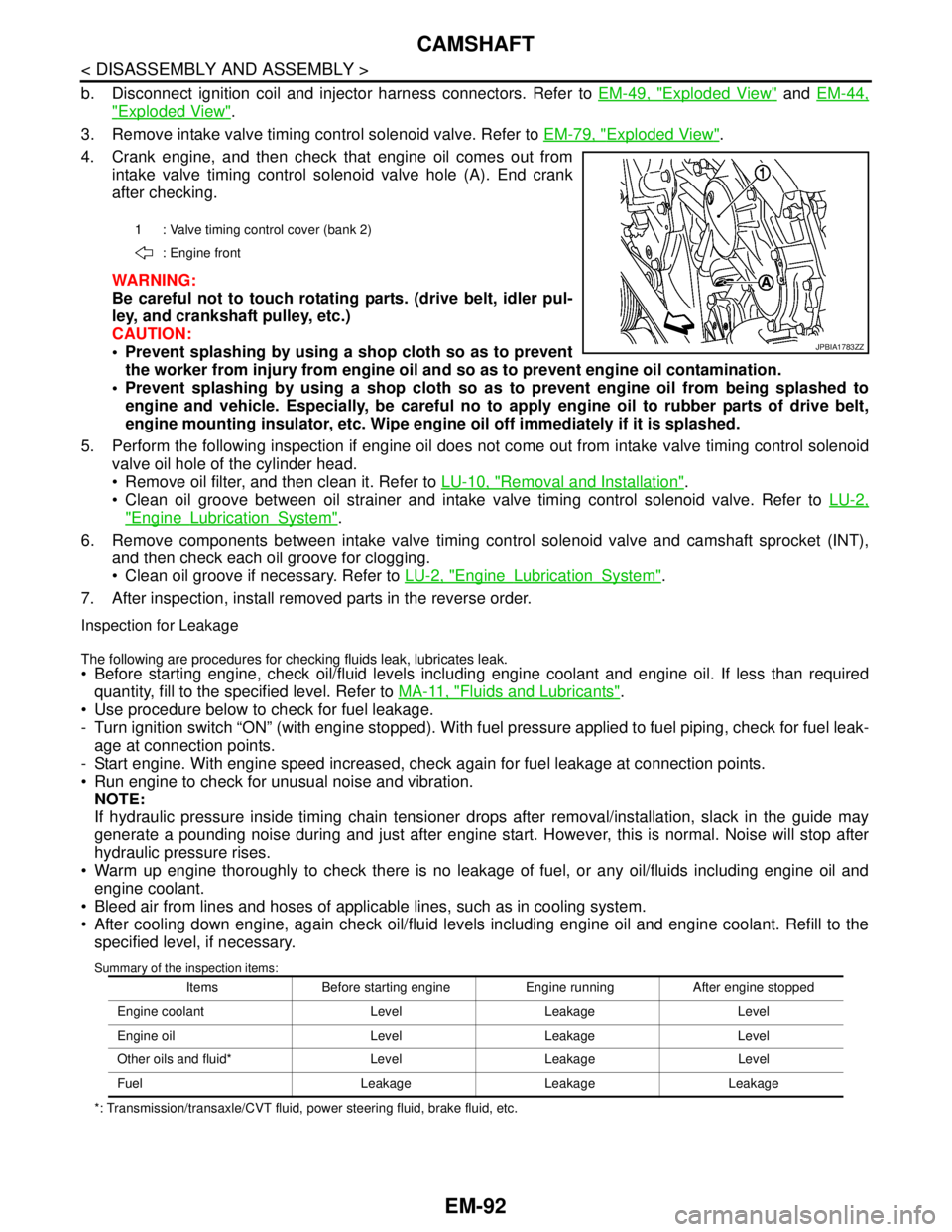
4. Crank engine, and then check that engine oil comes out from
intake valve timing control solenoid valve hole (A). End crank
after checking.
WARNING:
Be careful not to touch rotating parts. (drive belt, idler pul-
ley, and crankshaft pulley, etc.)
CAUTION:
Prevent splashing by using a shop cloth so as to prevent
the worker from injury from engine oil and so as to prevent engine oil contamination.
Prevent splashing by using a shop cloth so as to prevent engine oil from being splashed to
engine and vehicle. Especially, be careful no to apply engine oil to rubber parts of drive belt,
engine mounting insulator, etc. Wipe engine oil off immediately if it is splashed.
5. Perform the following inspection if engine oil does not come out from intake valve timing control solenoid
valve oil hole of the cylinder head.
Remove oil filter, and then clean it. Refer to LU-10, "
Removal and Installation".
Clean oil groove between oil strainer and intake valve timing control solenoid valve. Refer to LU-2,
"EngineLubricationSystem".
6. Remove components between intake valve timing control solenoid valve and camshaft sprocket (INT),
and then check each oil groove for clogging.
Clean oil groove if necessary. Refer to LU-2, "
EngineLubricationSystem".
7. After inspection, install removed parts in the reverse order.
Inspection for Leakage
The following are procedures for checking fluids leak, lubricates leak. Before starting engine, check oil/fluid levels including engine coolant and engine oil. If less than required
quantity, fill to the specified level. Refer to MA-11, "
Fluids and Lubricants".
Use procedure below to check for fuel leakage.
- Turn ignition switch “ON” (with engine stopped). With fuel pressure applied to fuel piping, check for fuel leak-
age at connection points.
- Start engine. With engine speed increased, check again for fuel leakage at connection points.
Run engine to check for unusual noise and vibration.
NOTE:
If hydraulic pressure inside timing chain tensioner drops after removal/installation, slack in the guide may
generate a pounding noise during and just after engine start. However, this is normal. Noise will stop after
hydraulic pressure rises.
Warm up engine thoroughly to check there is no leakage of fuel, or any oil/fluids including engine oil and
engine coolant.
Bleed air from lines and hoses of applicable lines, such as in cooling system.
After cooling down engine, again check oil/fluid levels including engine oil and engine coolant. Refill to the
specified level, if necessary.
Summary of the inspection items:
*: Transmission/transaxle/CVT fluid, power steering fluid, brake fluid, etc.1 : Valve timing control cover (bank 2)
: Engine front
JPBIA1783ZZ
Items Before starting engine Engine running After engine stopped
Engine coolant Level Leakage Level
Engine oil Level Leakage Level
Other oils and fluid* Level Leakage Level
Fuel Leakage Leakage Leakage
Page 2464 of 5121

FL-1
ENGINE
C
DE
F
G H
I
J
K L
M
SECTION FL
A
FL
N
O P
CONTENTS
FUEL SYSTEM
PRECAUTION ................ ...............................2
PRECAUTIONS .............................................. .....2
General Precautions ........................................... ......2
PREPARATION ............................................3
PREPARATION .............................................. .....3
Commercial Service Tool .................................... ......3
ON-VEHICLE MAINTENANCE .....................4
FUEL SYSTEM ............................................... .....4
Inspection ............................................................ ......4
Quick Connector .......................................................4
ON-VEHICLE REPAIR ..................................5
FUEL LEVEL SENSOR UNIT, FUEL FILTER
AND FUEL PUMP ASSEMBLY .........................
5
Exploded View ..................................................... .....5
Removal and Installation ..........................................5
Inspection .................................................................8
FUEL TANK ..................................... ..................9
Exploded View ..................................................... .....9
Removal and Installation ..........................................9
Inspection ................................................................10
SERVICE DATA AND SPECIFICATIONS
(SDS) ............... .............................................
11
SERVICE DATA AND SPECIFICATIONS
(SDS) .................................................................
11
Fuel Tank ............................................................. ....11
Page 2468 of 5121
FUEL LEVEL SENSOR UNIT, FUEL FILTER AND FUEL PUMP ASSEMBLY
FL-5
< ON-VEHICLE REPAIR >
C
D
E
F
G
H
I
J
K
L
MA
FL
N
P O
ON-VEHICLE REPAIR
FUEL LEVEL SENSOR UNIT, FUEL FILTER AND FUEL PUMP ASSEMBLY
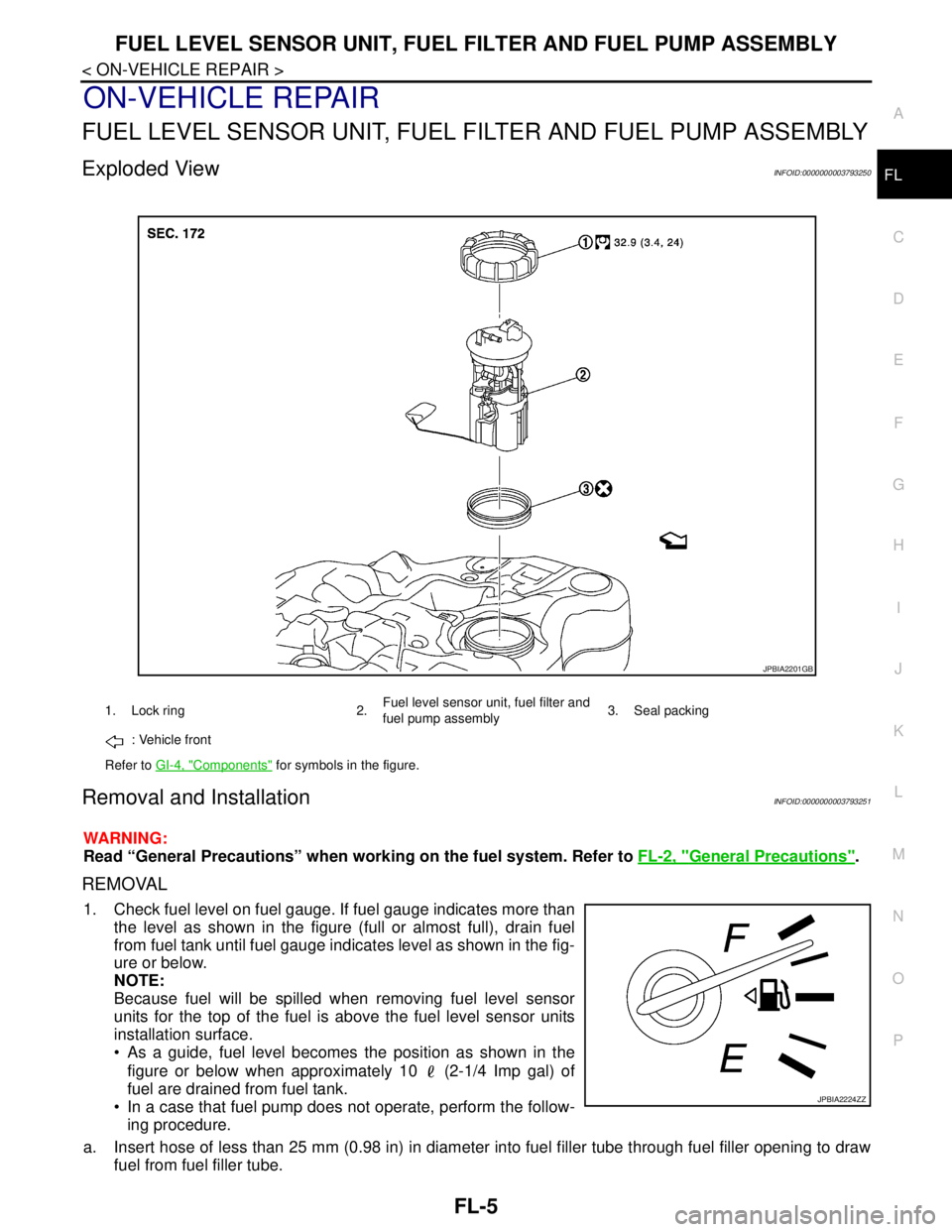
Exploded ViewINFOID:0000000003793250
Removal and InstallationINFOID:0000000003793251
WARNING:
Read “General Precautions” when working on the fuel system. Refer to FL-2, "
General Precautions".
REMOVAL
1. Check fuel level on fuel gauge. If fuel gauge indicates more than
the level as shown in the figure (full or almost full), drain fuel
from fuel tank until fuel gauge indicates level as shown in the fig-
ure or below.
NOTE:
Because fuel will be spilled when removing fuel level sensor
units for the top of the fuel is above the fuel level sensor units
installation surface.
• As a guide, fuel level becomes the position as shown in the
figure or below when approximately 10 (2-1/4 Imp gal) of
fuel are drained from fuel tank.
In a case that fuel pump does not operate, perform the follow-
ing procedure.
a. Insert hose of less than 25 mm (0.98 in) in diameter into fuel filler tube through fuel filler opening to draw
fuel from fuel filler tube.
1. Lock ring 2.Fuel level sensor unit, fuel filter and
fuel pump assembly3. Seal packing
: Vehicle front
Refer to GI-4, "
Components" for symbols in the figure.
JPBIA2201GB
JPBIA2224ZZ
Page 2469 of 5121
FL-6
< ON-VEHICLE REPAIR >
FUEL LEVEL SENSOR UNIT, FUEL FILTER AND FUEL PUMP ASSEMBLY
b. Disconnect fuel filler hose from fuel filler tube. Refer to FL-9, "Exploded View".
c. Insert hose into fuel tank through fuel filler hose to draw fuel from fuel tank.
2. Release the fuel pressure from the fuel lines. Refer to EC-411, "
Inspection".
3. Open fuel filler lid.
4. Open filler cap and release the pressure inside fuel tank.
5. Remove rear seat cushion. Refer to SE-98, "
Exploded View" (WITH VENTILATION SEAT) or SE-140,
"Exploded View" (WITHOUT VENTILATION SEAT).
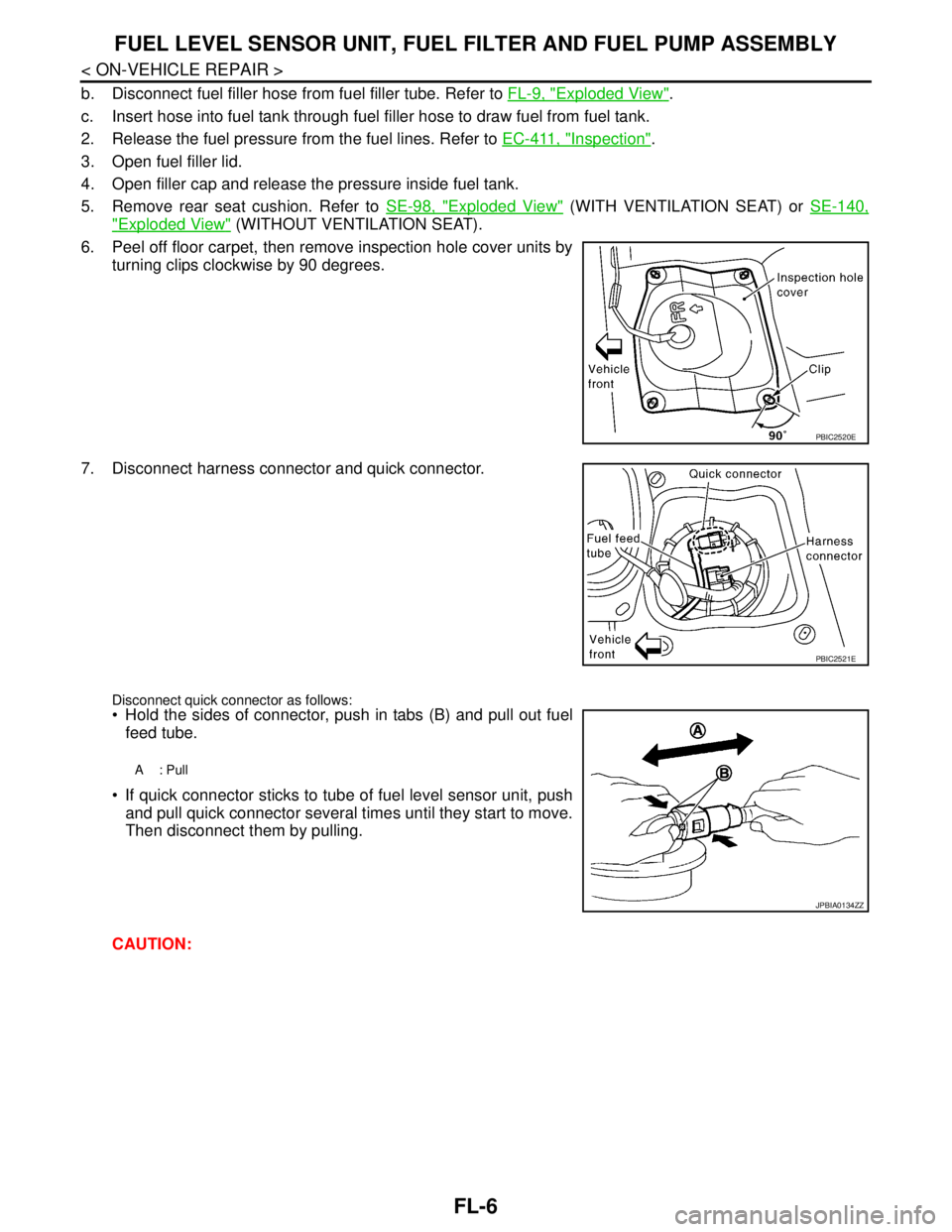
6. Peel off floor carpet, then remove inspection hole cover units by
turning clips clockwise by 90 degrees.
7. Disconnect harness connector and quick connector.
Disconnect quick connector as follows:
Hold the sides of connector, push in tabs (B) and pull out fuel
feed tube.
If quick connector sticks to tube of fuel level sensor unit, push
and pull quick connector several times until they start to move.
Then disconnect them by pulling.
CAUTION:
PBIC2520E
PBIC2521E
A: Pull
JPBIA0134ZZ
Page 2470 of 5121
FUEL LEVEL SENSOR UNIT, FUEL FILTER AND FUEL PUMP ASSEMBLY
FL-7
< ON-VEHICLE REPAIR >
C
D
E
F
G
H
I
J
K
L
MA
FL
N
P O
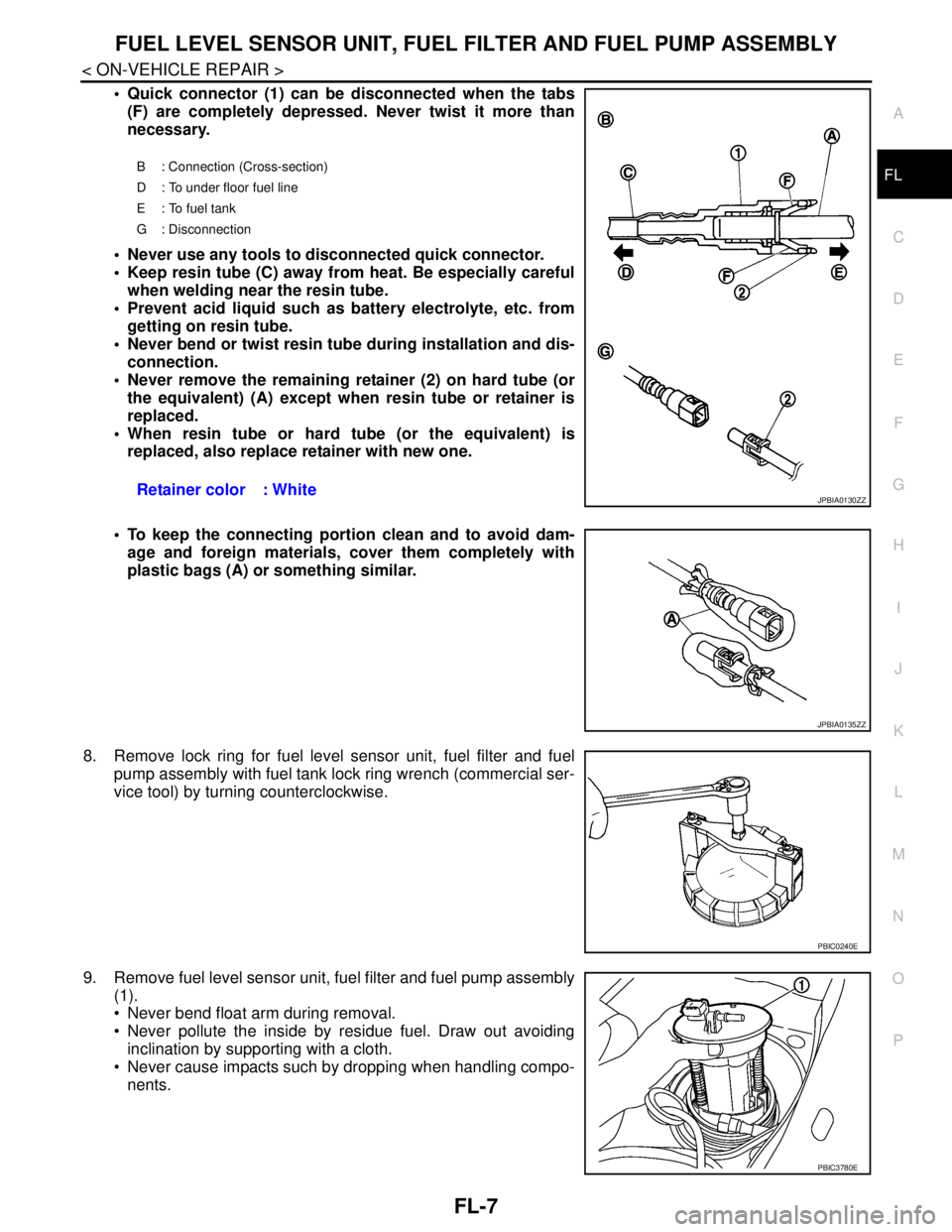
Quick connector (1) can be disconnected when the tabs
(F) are completely depressed. Never twist it more than
necessary.
Never use any tools to disconnected quick connector.
Keep resin tube (C) away from heat. Be especially careful
when welding near the resin tube.
Prevent acid liquid such as battery electrolyte, etc. from
getting on resin tube.
Never bend or twist resin tube during installation and dis-
connection.
Never remove the remaining retainer (2) on hard tube (or
the equivalent) (A) except when resin tube or retainer is
replaced.
When resin tube or hard tube (or the equivalent) is
replaced, also replace retainer with new one.
To keep the connecting portion clean and to avoid dam-
age and foreign materials, cover them completely with
plastic bags (A) or something similar.
8. Remove lock ring for fuel level sensor unit, fuel filter and fuel
pump assembly with fuel tank lock ring wrench (commercial ser-
vice tool) by turning counterclockwise.
9. Remove fuel level sensor unit, fuel filter and fuel pump assembly
(1).
Never bend float arm during removal.
Never pollute the inside by residue fuel. Draw out avoiding
inclination by supporting with a cloth.
Never cause impacts such by dropping when handling compo-
nents.
B : Connection (Cross-section)
D : To under floor fuel line
E : To fuel tank
G : Disconnection
Retainer color : WhiteJPBIA0130ZZ
JPBIA0135ZZ
PBIC0240E
PBIC3780E
Page 2471 of 5121
FL-8
< ON-VEHICLE REPAIR >
FUEL LEVEL SENSOR UNIT, FUEL FILTER AND FUEL PUMP ASSEMBLY
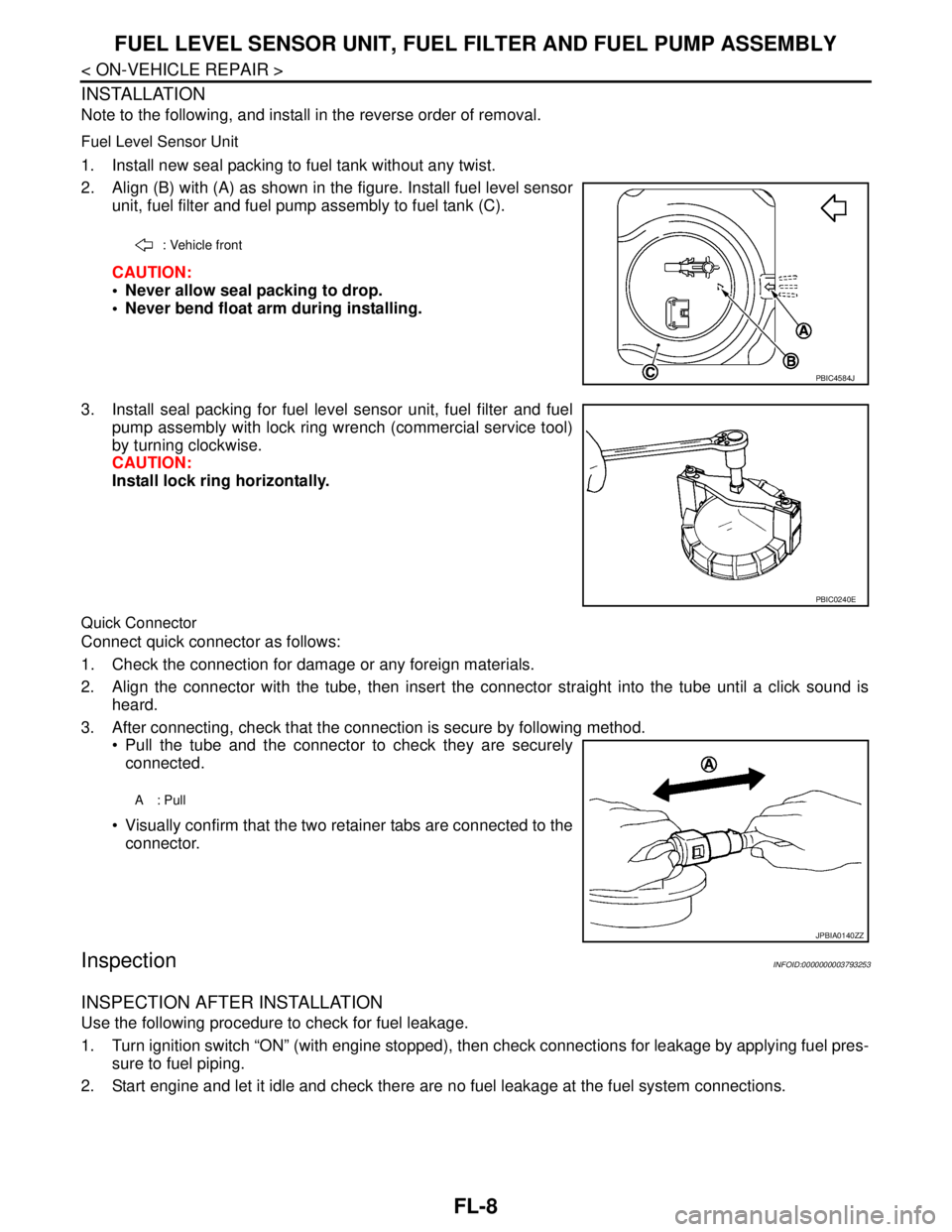
INSTALLATION
Note to the following, and install in the reverse order of removal.
Fuel Level Sensor Unit
1. Install new seal packing to fuel tank without any twist.
2. Align (B) with (A) as shown in the figure. Install fuel level sensor
unit, fuel filter and fuel pump assembly to fuel tank (C).
CAUTION:
Never allow seal packing to drop.
Never bend float arm during installing.
3. Install seal packing for fuel level sensor unit, fuel filter and fuel
pump assembly with lock ring wrench (commercial service tool)
by turning clockwise.
CAUTION:
Install lock ring horizontally.
Quick Connector
Connect quick connector as follows:
1. Check the connection for damage or any foreign materials.
2. Align the connector with the tube, then insert the connector straight into the tube until a click sound is
heard.
3. After connecting, check that the connection is secure by following method.
Pull the tube and the connector to check they are securely
connected.
Visually confirm that the two retainer tabs are connected to the
connector.
InspectionINFOID:0000000003793253
INSPECTION AFTER INSTALLATION
Use the following procedure to check for fuel leakage.
1. Turn ignition switch “ON” (with engine stopped), then check connections for leakage by applying fuel pres-
sure to fuel piping.
2. Start engine and let it idle and check there are no fuel leakage at the fuel system connections.
: Vehicle front
PBIC4584J
PBIC0240E
A: Pull
JPBIA0140ZZ
Page 2472 of 5121
FUEL TANK
FL-9
< ON-VEHICLE REPAIR >
C
D
E
F
G
H
I
J
K
L
MA
FL
N
P O
FUEL TANK
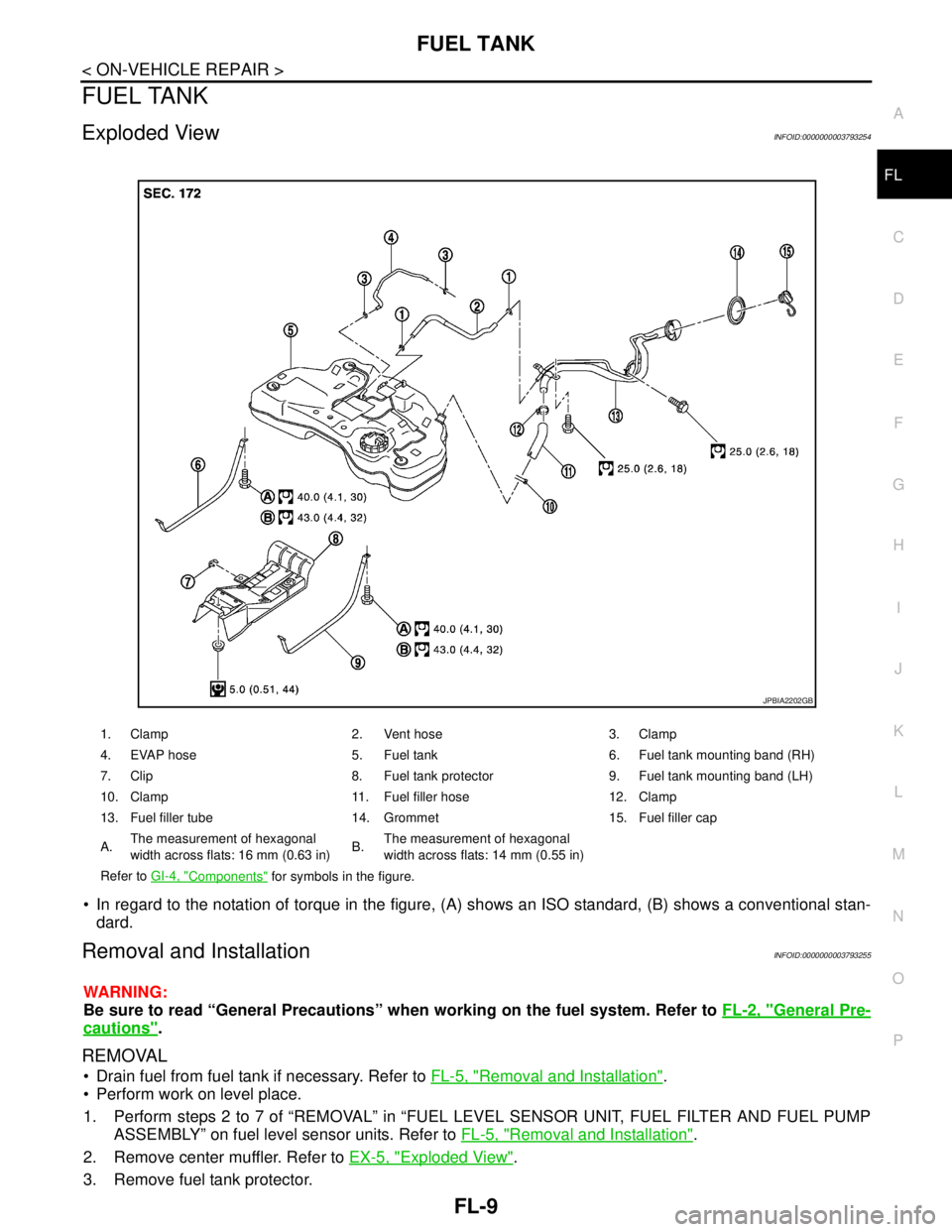
Exploded ViewINFOID:0000000003793254
In regard to the notation of torque in the figure, (A) shows an ISO standard, (B) shows a conventional stan-
dard.
Removal and InstallationINFOID:0000000003793255
WARNING:
Be sure to read “General Precautions” when working on the fuel system. Refer to FL-2, "
General Pre-
cautions".
REMOVAL
Drain fuel from fuel tank if necessary. Refer to FL-5, "Removal and Installation".
Perform work on level place.
1. Perform steps 2 to 7 of “REMOVAL” in “FUEL LEVEL SENSOR UNIT, FUEL FILTER AND FUEL PUMP
ASSEMBLY” on fuel level sensor units. Refer to FL-5, "
Removal and Installation".
2. Remove center muffler. Refer to EX-5, "
Exploded View".
3. Remove fuel tank protector.
1. Clamp 2. Vent hose 3. Clamp
4. EVAP hose 5. Fuel tank 6. Fuel tank mounting band (RH)
7. Clip 8. Fuel tank protector 9. Fuel tank mounting band (LH)
10. Clamp 11. Fuel filler hose 12. Clamp
13. Fuel filler tube 14. Grommet 15. Fuel filler cap
A.The measurement of hexagonal
width across flats: 16 mm (0.63 in)B.The measurement of hexagonal
width across flats: 14 mm (0.55 in)
Refer to GI-4, "
Components" for symbols in the figure.
JPBIA2202GB
Page 2521 of 5121
GI-28
< PRECAUTION >
PRECAUTIONS
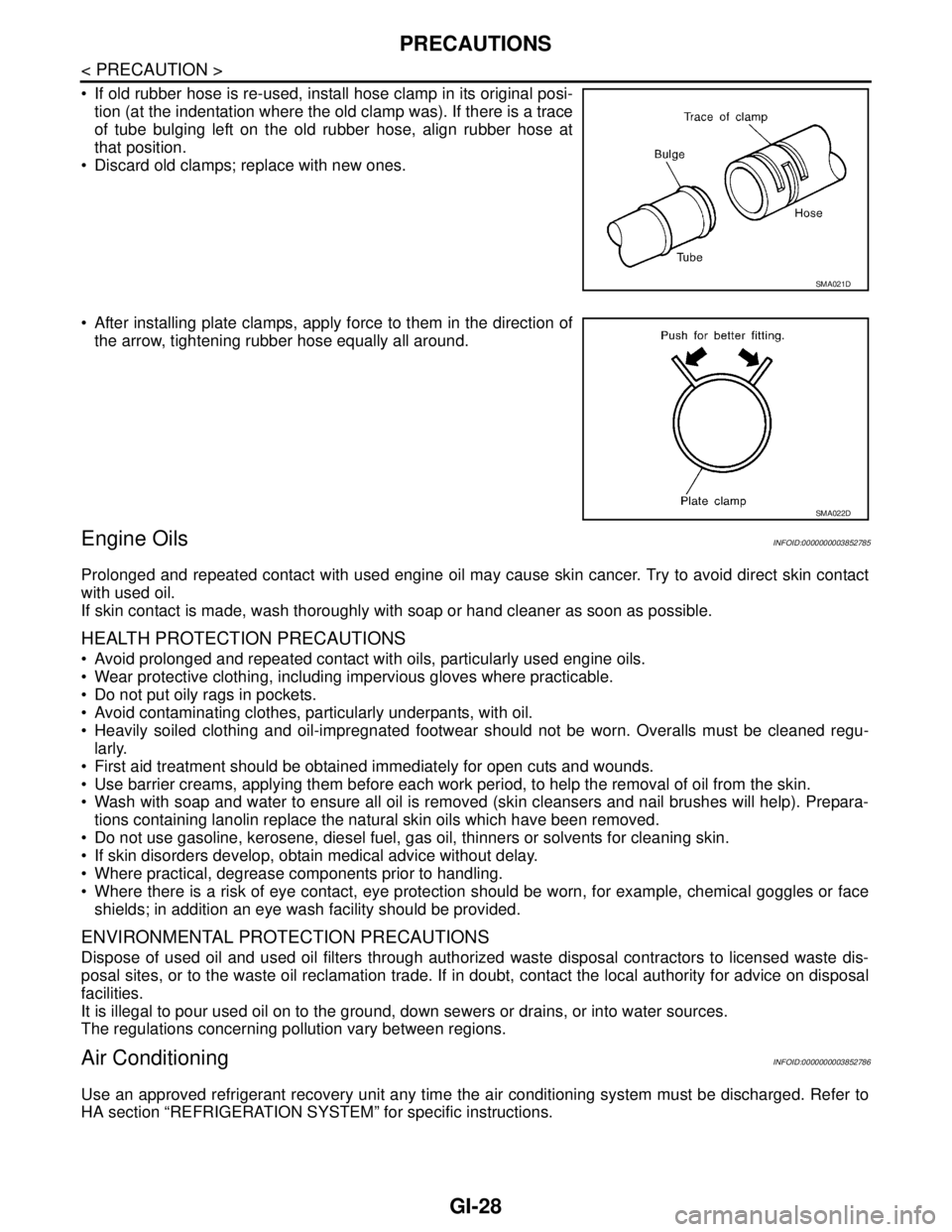
If old rubber hose is re-used, install hose clamp in its original posi-
tion (at the indentation where the old clamp was). If there is a trace
of tube bulging left on the old rubber hose, align rubber hose at
that position.
Discard old clamps; replace with new ones.
After installing plate clamps, apply force to them in the direction of
the arrow, tightening rubber hose equally all around.
Engine OilsINFOID:0000000003852785
Prolonged and repeated contact with used engine oil may cause skin cancer. Try to avoid direct skin contact
with used oil.
If skin contact is made, wash thoroughly with soap or hand cleaner as soon as possible.
HEALTH PROTECTION PRECAUTIONS
Avoid prolonged and repeated contact with oils, particularly used engine oils.
Wear protective clothing, including impervious gloves where practicable.
Do not put oily rags in pockets.
Avoid contaminating clothes, particularly underpants, with oil.
Heavily soiled clothing and oil-impregnated footwear should not be worn. Overalls must be cleaned regu-
larly.
First aid treatment should be obtained immediately for open cuts and wounds.
Use barrier creams, applying them before each work period, to help the removal of oil from the skin.
Wash with soap and water to ensure all oil is removed (skin cleansers and nail brushes will help). Prepara-
tions containing lanolin replace the natural skin oils which have been removed.
Do not use gasoline, kerosene, diesel fuel, gas oil, thinners or solvents for cleaning skin.
If skin disorders develop, obtain medical advice without delay.
Where practical, degrease components prior to handling.
Where there is a risk of eye contact, eye protection should be worn, for example, chemical goggles or face
shields; in addition an eye wash facility should be provided.
ENVIRONMENTAL PROTECTION PRECAUTIONS
Dispose of used oil and used oil filters through authorized waste disposal contractors to licensed waste dis-
posal sites, or to the waste oil reclamation trade. If in doubt, contact the local authority for advice on disposal
facilities.
It is illegal to pour used oil on to the ground, down sewers or drains, or into water sources.
The regulations concerning pollution vary between regions.
Air ConditioningINFOID:0000000003852786
Use an approved refrigerant recovery unit any time the air conditioning system must be discharged. Refer to
HA section “REFRIGERATION SYSTEM” for specific instructions.
SMA021D
SMA022D
Page 2621 of 5121
HA-52
< ON-VEHICLE REPAIR >
EVAPORATOR
EVAPORATOR
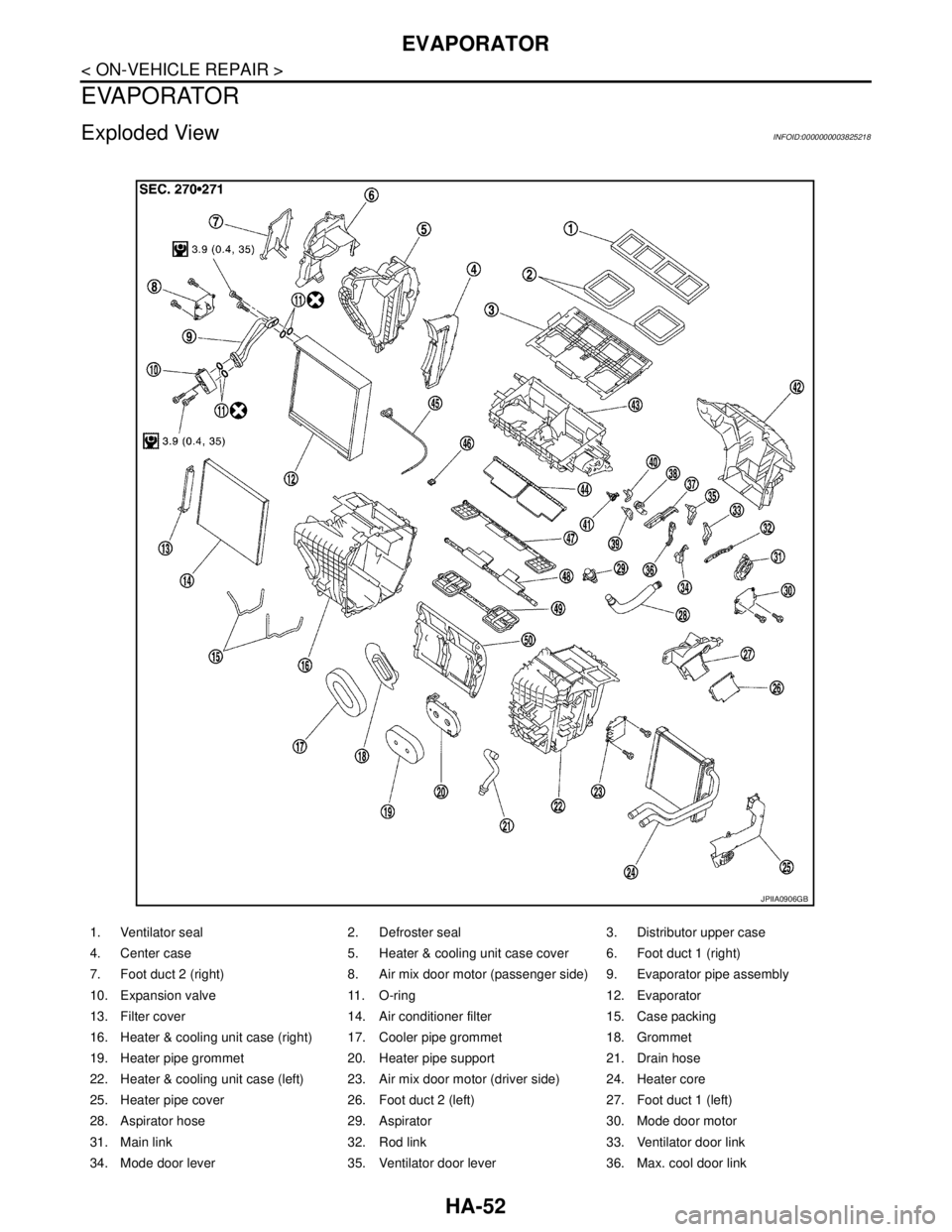
Exploded ViewINFOID:0000000003825218
1. Ventilator seal 2. Defroster seal 3. Distributor upper case
4. Center case 5. Heater & cooling unit case cover 6. Foot duct 1 (right)
7. Foot duct 2 (right) 8. Air mix door motor (passenger side) 9. Evaporator pipe assembly
10. Expansion valve 11. O-ring 12. Evaporator
13. Filter cover 14. Air conditioner filter 15. Case packing
16. Heater & cooling unit case (right) 17. Cooler pipe grommet 18. Grommet
19. Heater pipe grommet 20. Heater pipe support 21. Drain hose
22. Heater & cooling unit case (left) 23. Air mix door motor (driver side) 24. Heater core
25. Heater pipe cover 26. Foot duct 2 (left) 27. Foot duct 1 (left)
28. Aspirator hose 29. Aspirator 30. Mode door motor
31. Main link 32. Rod link 33. Ventilator door link
34. Mode door lever 35. Ventilator door lever 36. Max. cool door link
JPIIA0906GB
Page 2623 of 5121
HA-54
< ON-VEHICLE REPAIR >
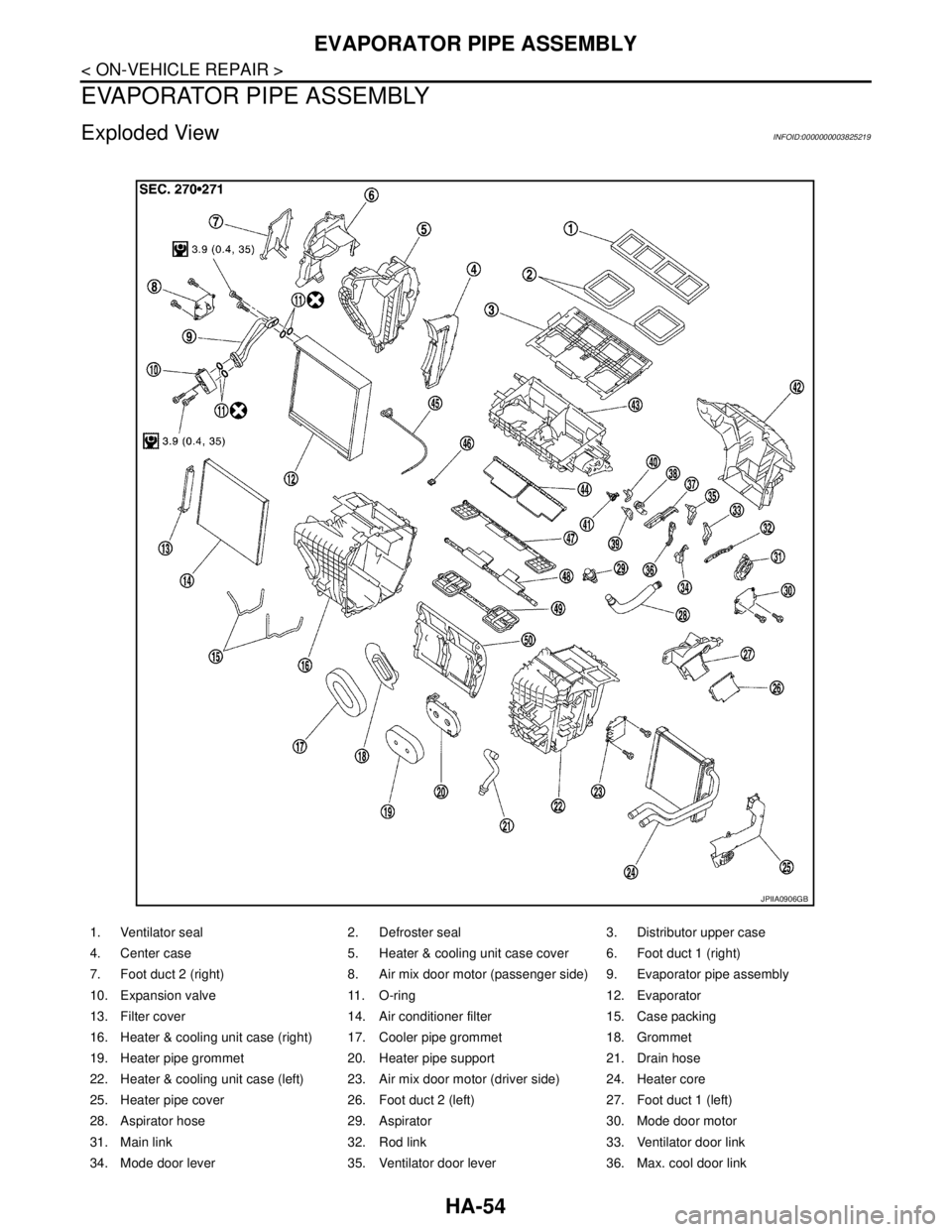
EVAPORATOR PIPE ASSEMBLY
EVAPORATOR PIPE ASSEMBLY
Exploded ViewINFOID:0000000003825219
1. Ventilator seal 2. Defroster seal 3. Distributor upper case
4. Center case 5. Heater & cooling unit case cover 6. Foot duct 1 (right)
7. Foot duct 2 (right) 8. Air mix door motor (passenger side) 9. Evaporator pipe assembly
10. Expansion valve 11. O-ring 12. Evaporator
13. Filter cover 14. Air conditioner filter 15. Case packing
16. Heater & cooling unit case (right) 17. Cooler pipe grommet 18. Grommet
19. Heater pipe grommet 20. Heater pipe support 21. Drain hose
22. Heater & cooling unit case (left) 23. Air mix door motor (driver side) 24. Heater core
25. Heater pipe cover 26. Foot duct 2 (left) 27. Foot duct 1 (left)
28. Aspirator hose 29. Aspirator 30. Mode door motor
31. Main link 32. Rod link 33. Ventilator door link
34. Mode door lever 35. Ventilator door lever 36. Max. cool door link
JPIIA0906GB