light NISSAN TEANA 2008 Service Manual
[x] Cancel search | Manufacturer: NISSAN, Model Year: 2008, Model line: TEANA, Model: NISSAN TEANA 2008Pages: 5121, PDF Size: 69.03 MB
Page 3240 of 5121
SQUEAK AND RATTLE TROUBLE DIAGNOSES
MIR-7
< SYMPTOM DIAGNOSIS >
C
D
E
F
G
H
I
J
K
MA
B
MIR
N
O
P
If possible, drive the vehicle with the customer until the noise is duplicated. Note any additional information on
the Diagnostic Worksheet regarding the conditions or location of the noise. This information can be used to
duplicate the same conditions when the repair is reconfirmed.
If the noise can be duplicated easily during the test drive, to help identify the source of the noise, try to dupli-
cate the noise with the vehicle stopped by doing one or all of the following:
1) Close a door.
2) Tap or push/pull around the area where the noise appears to be coming from.
3) Rev the engine.
4) Use a floor jack to recreate vehicle “twist”.
5) At idle, apply engine load (electrical load, half-clutch on M/T model, drive position on A/T model).
6) Raise the vehicle on a hoist and hit a tire with a rubber hammer.
Drive the vehicle and attempt to duplicate the conditions the customer states exist when the noise occurs.
If it is difficult to duplicate the noise, drive the vehicle slowly on an undulating or rough road to stress the
vehicle body.
LOCATE THE NOISE AND IDENTIFY THE ROOT CAUSE
1. Narrow down the noise to a general area. To help pinpoint the source of the noise, use a listening tool
(Engine Ear or mechanics stethoscope).
2. Narrow down the noise to a more specific area and identify the cause of the noise by:
Removing the components in the area that is are suspected to be the cause of the noise.
Do not use too much force when removing clips and fasteners, otherwise clips and fastener can be broken
or lost during the repair, resulting in the creation of new noise.
Tapping or pushing/pulling the component that is are suspected to be the cause of the noise.
Do not tap or push/pull the component with excessive force, otherwise the noise will be eliminated only tem-
porarily.
Feeling for a vibration by hand by touching the component(s) that is are suspected to be the cause of the
noise.
Placing a piece of paper between components that is are suspected to be the cause of the noise.
Looking for loose components and contact marks.
Refer to MIR-8, "
Inspection Procedure".
REPAIR THE CAUSE
If the cause is a loose component, tighten the component securely.
If the cause is insufficient clearance between components:
- Separate components by repositioning or loosening and retightening the component, if possible.
- Insulate components with a suitable insulator such as urethane pads, foam blocks, felt cloth tape or ure-
thane tape. These insulators are available through the authorized Nissan Parts Department.
CAUTION:
Never use excessive force as many components are constructed of plastic and may be damaged.
NOTE:
URETHANE PADS
Insulates connectors, harness, etc.
INSULATOR (Foam blocks)
Insulates components from contact. Can be used to fill space behind a panel.
INSULATOR (Light foam block)
FELT CLOTHTAPE
Used to insulate where movement does not occur. Ideal for instrument panel applications.
The following materials, not available through NISSAN Parts Department, can also be used to repair
squeaks and rattles.
UHMW(TEFLON) TAPE
Insulates where slight movement is present. Ideal for instrument panel applications.
SILICONE GREASE
Used in place of UHMW tape that is be visible or does not fit.
Note: Will only last a few months.
SILICONE SPRAY
Used when grease cannot be applied.
DUCT TAPE
Used to eliminate movement.
CONFIRM THE REPAIR
Page 3241 of 5121

MIR-8
< SYMPTOM DIAGNOSIS >
SQUEAK AND RATTLE TROUBLE DIAGNOSES
Confirm that the cause of a noise is repaired by test driving the vehicle. Operate the vehicle under the same
conditions as when the noise originally occurred. Refer to the notes on the Diagnostic Worksheet.
Inspection ProcedureINFOID:0000000003941383
Refer to Table of Contents for specific component removal and installation information.
INSTRUMENT PANEL
Most incidents are caused by contact and movement between:
1. Cluster lid A and instrument panel
2. Acrylic lens and combination meter housing
3. Instrument panel to front pillar garnish
4. Instrument panel to windshield
5. Instrument panel mounting pins
6. Wiring harnesses behind the combination meter
7. A/C defroster duct and duct joint
These incidents can usually be located by tapping or moving the components to duplicate the noise or by
pressing on the components while driving to stop the noise. Most of these incidents can be repaired by apply-
ing felt cloth tape or silicon spray (in hard to reach areas). Urethane pads can be used to insulate wiring har-
ness.
CAUTION:
Never use silicone spray to isolate a squeak or rattle. If the area is saturated with silicone, the recheck
of repair becomes impossible.
CENTER CONSOLE
Components to pay attention to include:
1. Shifter assembly cover to finisher
2. A/C control unit and cluster lid C
3. Wiring harnesses behind audio and A/C control unit
The instrument panel repair and isolation procedures also apply to the center console.
DOORS
Pay attention to the following:
1. Finisher and inner panel making a slapping noise
2. Inside handle escutcheon to door finisher
3. Wiring harnesses tapping
4. Door striker out of alignment causing a popping noise on starts and stops
Tapping or moving the components or pressing on them while driving to duplicate the conditions can isolate
many of these incidents. The areas can usually be insulated with felt cloth tape or insulator foam blocks to
repair the noise.
TRUNK
Trunk noises are often caused by a loose jack or loose items put into the trunk by the customer.
In addition look for the following:
1. Trunk lid dumpers out of adjustment
2. Trunk lid striker out of adjustment
3. Trunk lid torsion bars knocking together
4. A loose license plate or bracket
Most of these incidents can be repaired by adjusting, securing or insulating the item(s) or component(s) caus-
ing the noise.
SUNROOF/HEADLINING
Noises in the sunroof/headlining area can often be traced to one of the following:
1. Sunroof lid, rail, linkage or seals making a rattle or light knocking noise
2. Sunvisor shaft shaking in the holder
3. Front or rear windshield touching headlining and squeaking
Page 3251 of 5121
MIR-18
< ON-VEHICLE REPAIR >
OUTSIDE MIRROR
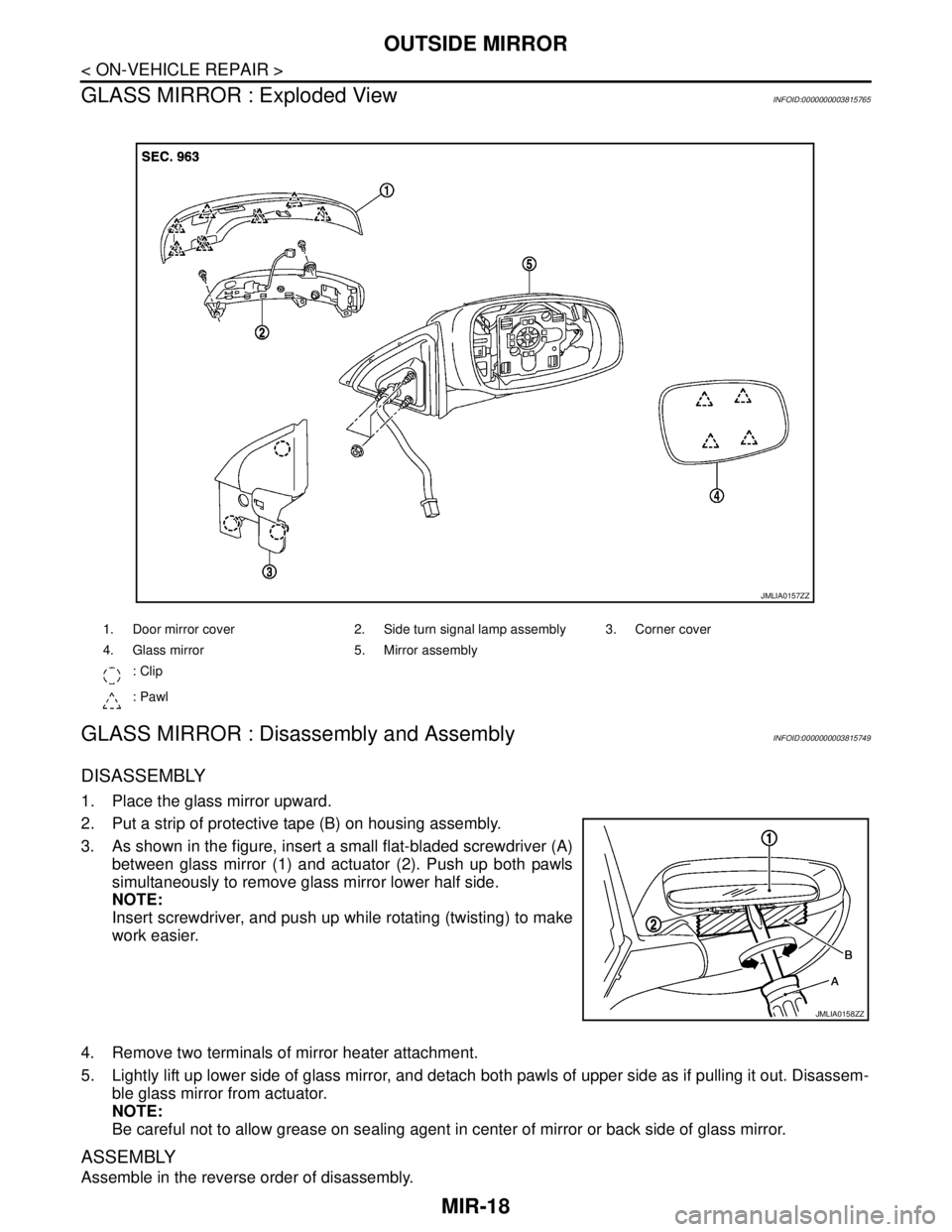
GLASS MIRROR : Exploded View
INFOID:0000000003815765
GLASS MIRROR : Disassembly and AssemblyINFOID:0000000003815749
DISASSEMBLY
1. Place the glass mirror upward.
2. Put a strip of protective tape (B) on housing assembly.
3. As shown in the figure, insert a small flat-bladed screwdriver (A)
between glass mirror (1) and actuator (2). Push up both pawls
simultaneously to remove glass mirror lower half side.
NOTE:
Insert screwdriver, and push up while rotating (twisting) to make
work easier.
4. Remove two terminals of mirror heater attachment.
5. Lightly lift up lower side of glass mirror, and detach both pawls of upper side as if pulling it out. Disassem-
ble glass mirror from actuator.
NOTE:
Be careful not to allow grease on sealing agent in center of mirror or back side of glass mirror.
ASSEMBLY
Assemble in the reverse order of disassembly.
1. Door mirror cover 2. Side turn signal lamp assembly 3. Corner cover
4. Glass mirror 5. Mirror assembly
: Clip
: Pawl
JMLIA0157ZZ
JMLIA0158ZZ
Page 3278 of 5121
MWI-24
< FUNCTION DIAGNOSIS >
METER SYSTEM
WARNING LAMPS/INDICATOR LAMPS : Component Description
INFOID:0000000003792538
METER ILLUMINATION CONTROL
METER ILLUMINATION CONTROL : System DiagramINFOID:0000000003792539
METER ILLUMINATION CONTROL : System DescriptionINFOID:0000000003796390
SYSTEM DESCRIPTION
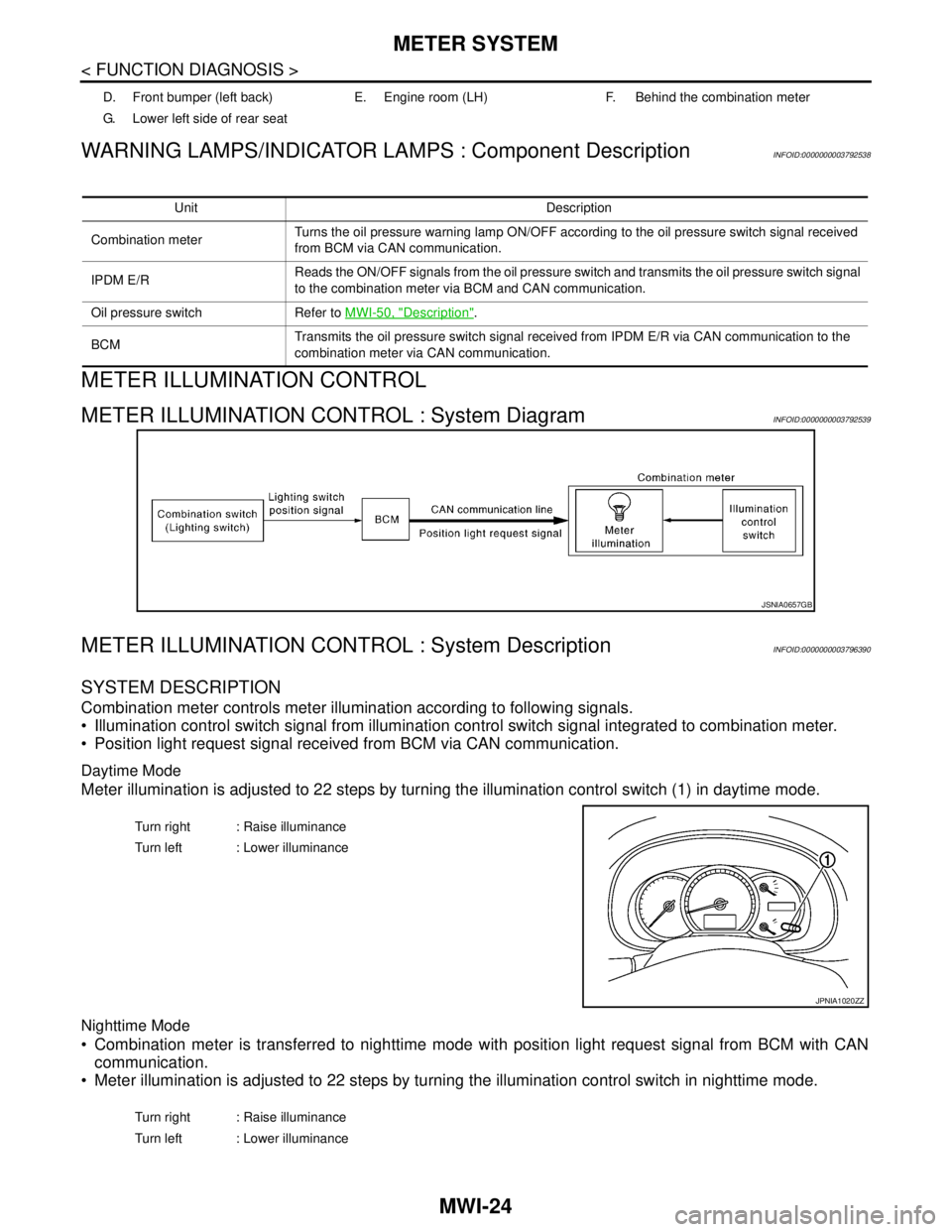
Combination meter controls meter illumination according to following signals.
Illumination control switch signal from illumination control switch signal integrated to combination meter.
Position light request signal received from BCM via CAN communication.
Daytime Mode
Meter illumination is adjusted to 22 steps by turning the illumination control switch (1) in daytime mode.
Nighttime Mode
Combination meter is transferred to nighttime mode with position light request signal from BCM with CAN
communication.
Meter illumination is adjusted to 22 steps by turning the illumination control switch in nighttime mode.
D. Front bumper (left back) E. Engine room (LH) F. Behind the combination meter
G. Lower left side of rear seat
Unit Description
Combination meterTurns the oil pressure warning lamp ON/OFF according to the oil pressure switch signal received
from BCM via CAN communication.
IPDM E/RReads the ON/OFF signals from the oil pressure switch and transmits the oil pressure switch signal
to the combination meter via BCM and CAN communication.
Oil pressure switch Refer to MWI-50, "
Description".
BCMTransmits the oil pressure switch signal received from IPDM E/R via CAN communication to the
combination meter via CAN communication.
JSNIA0657GB
Turn right : Raise illuminance
Turn left : Lower illuminance
JPNIA1020ZZ
Turn right : Raise illuminance
Turn left : Lower illuminance
Page 3281 of 5121
MWI
METER SYSTEM
MWI-27
< FUNCTION DIAGNOSIS >
C
D
E
F
G
H
I
J
K
L
MB A
O
P
METER ILLUMINATION CONTROL : Component DescriptionINFOID:0000000003796391
INFORMATION DISPLAY
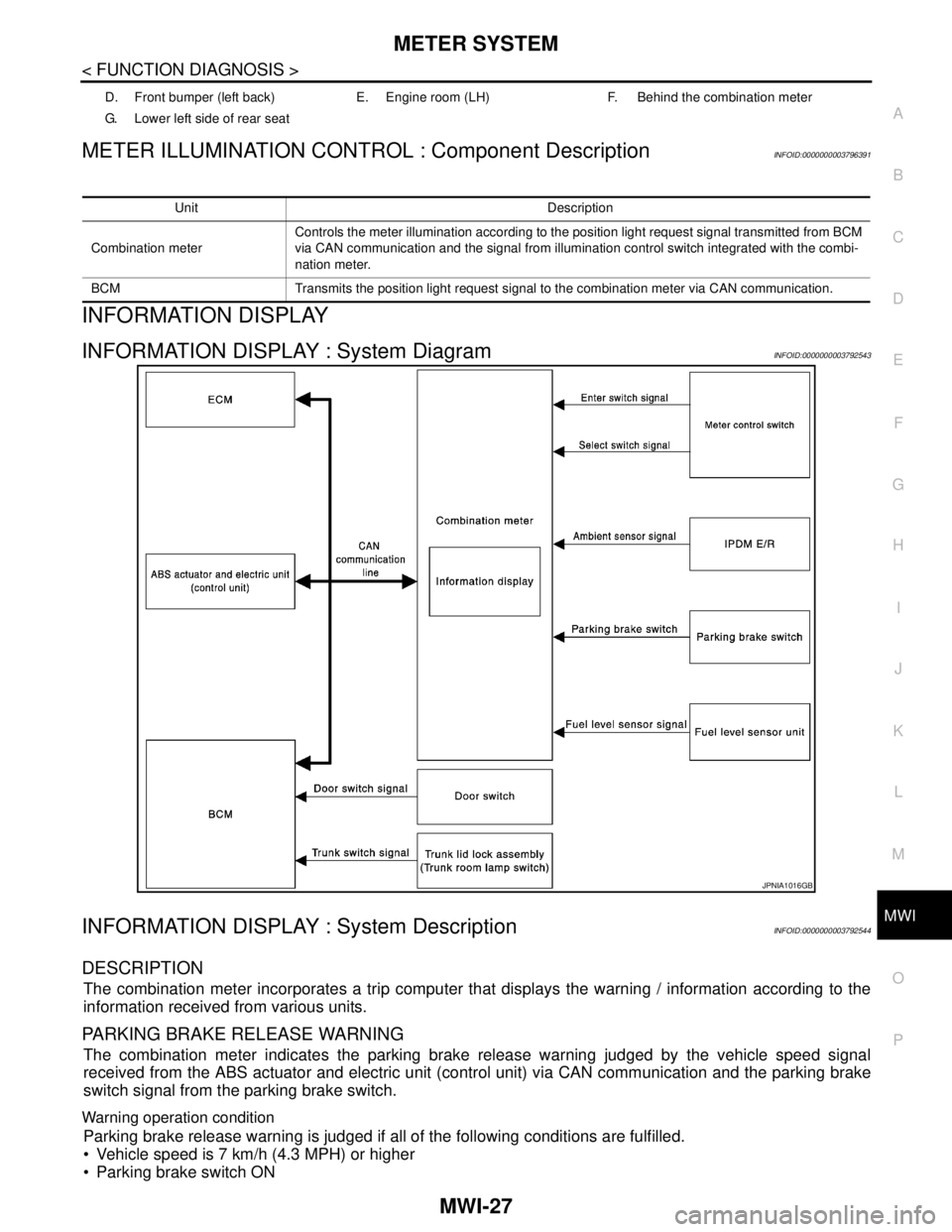
INFORMATION DISPLAY : System DiagramINFOID:0000000003792543
INFORMATION DISPLAY : System DescriptionINFOID:0000000003792544
DESCRIPTION
The combination meter incorporates a trip computer that displays the warning / information according to the
information received from various units.
PARKING BRAKE RELEASE WARNING
The combination meter indicates the parking brake release warning judged by the vehicle speed signal
received from the ABS actuator and electric unit (control unit) via CAN communication and the parking brake
switch signal from the parking brake switch.
Warning operation condition
Parking brake release warning is judged if all of the following conditions are fulfilled.
Vehicle speed is 7 km/h (4.3 MPH) or higher
Parking brake switch ON
D. Front bumper (left back) E. Engine room (LH) F. Behind the combination meter
G. Lower left side of rear seat
Unit Description
Combination meterControls the meter illumination according to the position light request signal transmitted from BCM
via CAN communication and the signal from illumination control switch integrated with the combi-
nation meter.
BCM Transmits the position light request signal to the combination meter via CAN communication.
JPNIA1016GB
Page 3287 of 5121
MWI
DIAGNOSIS SYSTEM (METER)
MWI-33
< FUNCTION DIAGNOSIS >
C
D
E
F
G
H
I
J
K
L
MB A
O
P
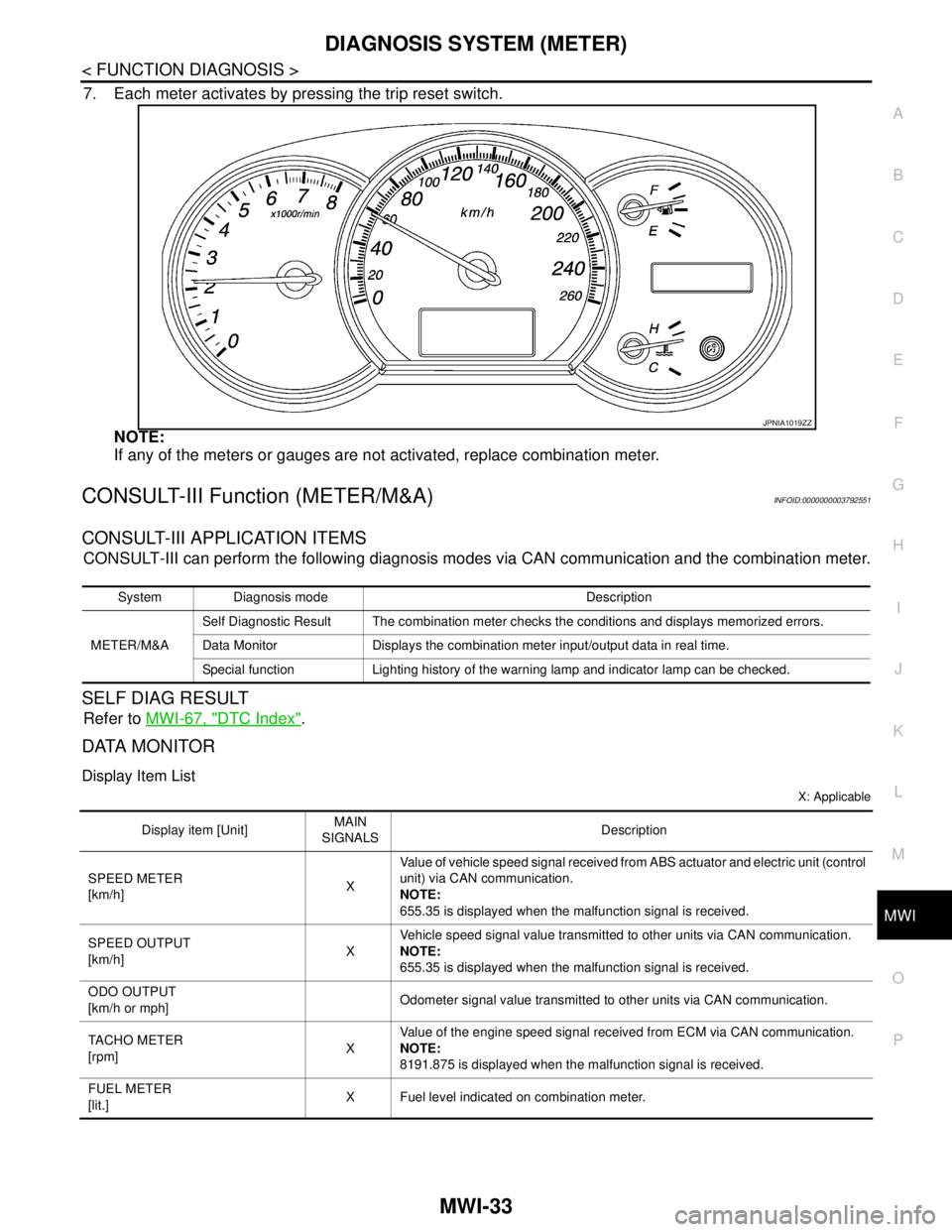
7. Each meter activates by pressing the trip reset switch.
NOTE:
If any of the meters or gauges are not activated, replace combination meter.
CONSULT-III Function (METER/M&A)INFOID:0000000003792551
CONSULT-III APPLICATION ITEMS
CONSULT-III can perform the following diagnosis modes via CAN communication and the combination meter.
SELF DIAG RESULT
Refer to MWI-67, "DTC Index".
DATA MONITOR
Display Item List
X: Applicable
JPNIA1019ZZ
System Diagnosis mode Description
METER/M&ASelf Diagnostic Result The combination meter checks the conditions and displays memorized errors.
Data Monitor Displays the combination meter input/output data in real time.
Special function Lighting history of the warning lamp and indicator lamp can be checked.
Display item [Unit]MAIN
SIGNALSDescription
SPEED METER
[km/h]XValue of vehicle speed signal received from ABS actuator and electric unit (control
unit) via CAN communication.
NOTE:
655.35 is displayed when the malfunction signal is received.
SPEED OUTPUT
[km/h]XVehicle speed signal value transmitted to other units via CAN communication.
NOTE:
655.35 is displayed when the malfunction signal is received.
ODO OUTPUT
[km/h or mph]Odometer signal value transmitted to other units via CAN communication.
TACHO METER
[rpm]XValue of the engine speed signal received from ECM via CAN communication.
NOTE:
8191.875 is displayed when the malfunction signal is received.
FUEL METER
[lit.]X Fuel level indicated on combination meter.
Page 3288 of 5121
![NISSAN TEANA 2008 Service Manual MWI-34
< FUNCTION DIAGNOSIS >
DIAGNOSIS SYSTEM (METER)
W TEMP METER
[°C] XValue of engine coolant temperature signal is received from ECM via CAN com-
munication.
NOTE:
215 is displayed when the mal](/img/5/57391/w960_57391-3287.png "NISSAN TEANA 2008 Service Manual MWI-34
< FUNCTION DIAGNOSIS >
DIAGNOSIS SYSTEM (METER)
W TEMP METER
[°C] XValue of engine coolant temperature signal is received from ECM via CAN com-
munication.
NOTE:
215 is displayed when the mal")
MWI-34
< FUNCTION DIAGNOSIS >
DIAGNOSIS SYSTEM (METER)
W TEMP METER
[°C] XValue of engine coolant temperature signal is received from ECM via CAN com-
munication.
NOTE:
215 is displayed when the malfunction signal is input.
ABS W/L
[On/Off]Status of ABS warning lamp detected from ABS warning lamp signal is received
from ABS actuator and electric unit (control unit) via CAN communication.
VDC/TCS IND
[On/Off]Status of VDC OFF indicator lamp detected from VDC OFF indicator lamp signal
is received from ABS actuator and electric unit (control unit) via CAN communica-
tion.
SLIP IND
[On/Off]Status of SLIP indicator lamp detected from slip indicator lamp signal received
from ABS actuator and electric unit (control unit) via CAN communication.
BRAKE W/L
[On/Off]Status of brake warning lamp detected from brake warning lamp signal is received
from ABS actuator and electric unit (control unit) via CAN communication.
NOTE:
Displays “Off” if the brake warning lamp is illuminated when the valve check starts,
the parking brake switch is turned ON or the brake fluid level switch is turned ON.
DOOR W/L
[On/Off]Status of door warning detected from door switch signal received from BCM via
CAN communication.
TRUNK/GLAS-H
[On/Off]Status of trunk warning detected from trunk switch signal received from BCM via
CAN communication.
HI-BEAM IND
[On/Off]Status of high beam indicator lamp detected from high beam request signal is re-
ceived from BCM via CAN communication.
TURN IND
[On/Off]Status of turn indicator lamp detected from turn indicator signal is received from
BCM via CAN communication.
FR FOG IND
[On/Off]Status of front fog light indicator lamp detected from front fog light request signal
is received from BCM via CAN communication.
RR FOG IND
[On/Off]Status of rear fog light indicator lamp detected from rear fog light request signal is
received from BCM via CAN communication.
LIGHT IND
[On/Off]Status of light indicator lamp detected from position light request signal is received
from BCM via CAN communication.
OIL W/L
[On/Off]Status of oil pressure warning lamp detected from oil pressure switch signal is re-
ceived from BCM via CAN communication.
MIL
[On/Off] Status of malfunction indicator lamp detected from malfunctioning indicator lamp
signal is received from ECM via CAN communication.
CRUISE IND
[On/Off]Status of CRUISE indicator detected from ASCD status signal is received from
ECM via CAN communication.
SPORT IND
[On/Off]Status of SPORT indicator detected from sport mode switch signal is received
from control device.
4WD W/L
[On/Off]This item is displayed, but cannot be monitored.
4WD LOCK IND
[On/Off]This item is displayed, but cannot be monitored.
FUEL W/L
[On/Off]Low-fuel warning lamp status detected by the identified fuel level.
WASHER W/L
[On/Off]This item is displayed, but cannot be monitored.
KEY G/Y W/L
[On/Off]Status of key warning lamp (G/Y) detected from key warning signal is received
from BCM via CAN communication.
AFS OFF IND
[On/Off]This item is displayed, but cannot be monitored.
LCD
[B&P N, B&P I, ID NG, ROTAT, SFT
P, INSRT, BATT, NO KY,OUTKY, LK
WN]Displays status of Intelligent Key system warning detected from meter display sig-
nal is received from BCM via CAN communication. Display item [Unit]MAIN
SIGNALSDescription
Page 3289 of 5121
MWI
DIAGNOSIS SYSTEM (METER)
MWI-35
< FUNCTION DIAGNOSIS >
C
D
E
F
G
H
I
J
K
L
MB A
O
P
NOTE:
Some items are not available according to vehicle specification.
SPECIAL FUNCTION
Special menu
W/L ON HISTORY
Stores histories when warning/indicator lamp is turned on.
“W/L ON HISTORY” indicates the “TIME” when the warning/ indicator lamp is turned on.
The “TIME” above is :
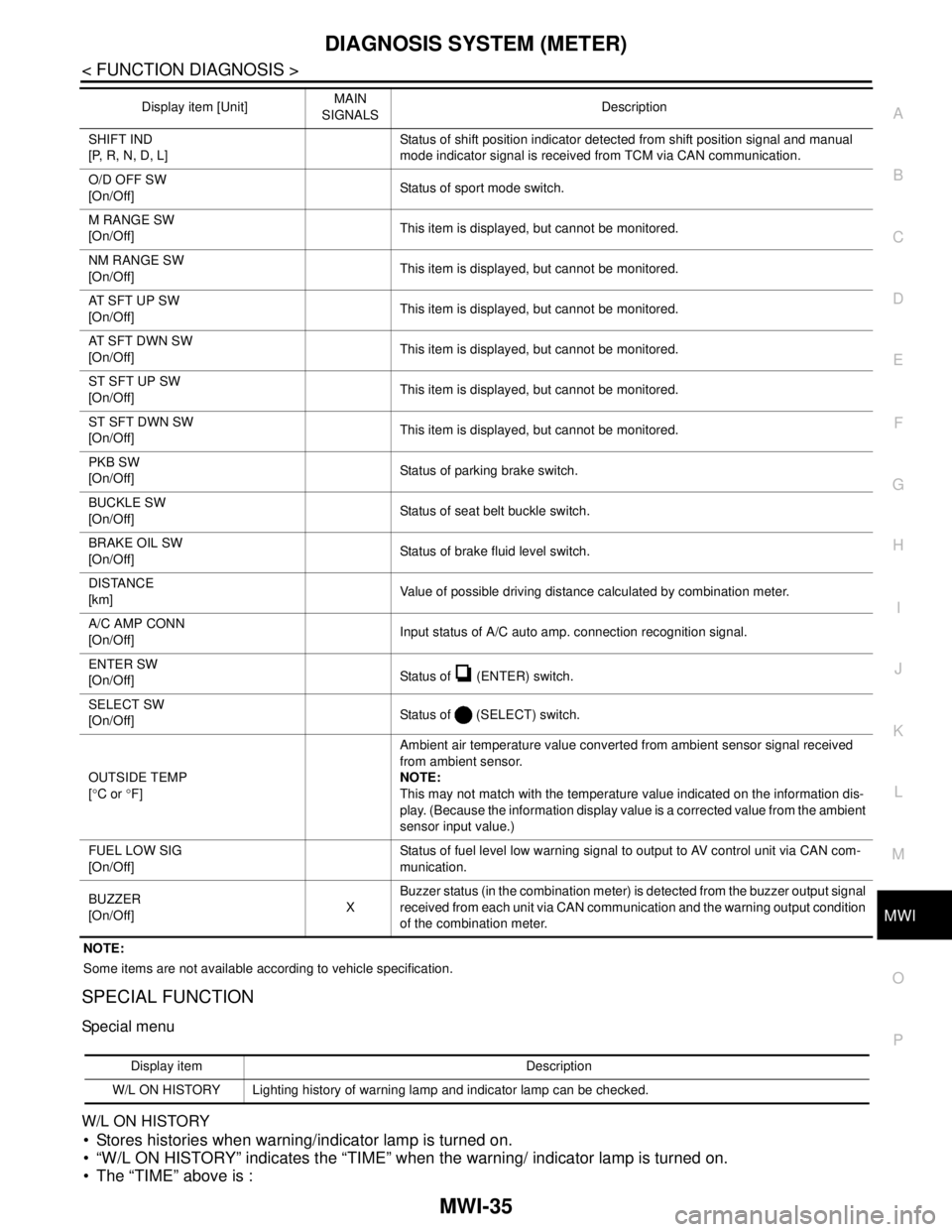
SHIFT IND
[P, R, N, D, L]Status of shift position indicator detected from shift position signal and manual
mode indicator signal is received from TCM via CAN communication.
O/D OFF SW
[On/Off] Status of sport mode switch.
M RANGE SW
[On/Off]This item is displayed, but cannot be monitored.
NM RANGE SW
[On/Off]This item is displayed, but cannot be monitored.
AT SFT UP SW
[On/Off]This item is displayed, but cannot be monitored.
AT SFT DWN SW
[On/Off]This item is displayed, but cannot be monitored.
ST SFT UP SW
[On/Off]This item is displayed, but cannot be monitored.
ST SFT DWN SW
[On/Off]This item is displayed, but cannot be monitored.
PKB SW
[On/Off]Status of parking brake switch.
BUCKLE SW
[On/Off]Status of seat belt buckle switch.
BRAKE OIL SW
[On/Off]Status of brake fluid level switch.
DISTANCE
[km]Value of possible driving distance calculated by combination meter.
A/C AMP CONN
[On/Off]Input status of A/C auto amp. connection recognition signal.
ENTER SW
[On/Off]Status of (ENTER) switch.
SELECT SW
[On/Off]Status of (SELECT) switch.
OUTSIDE TEMP
[°C or °F]Ambient air temperature value converted from ambient sensor signal received
from ambient sensor.
NOTE:
This may not match with the temperature value indicated on the information dis-
play. (Because the information display value is a corrected value from the ambient
sensor input value.)
FUEL LOW SIG
[On/Off]Status of fuel level low warning signal to output to AV control unit via CAN com-
munication.
BUZZER
[On/Off]XBuzzer status (in the combination meter) is detected from the buzzer output signal
received from each unit via CAN communication and the warning output condition
of the combination meter. Display item [Unit]MAIN
SIGNALSDescription
Display item Description
W/L ON HISTORY Lighting history of warning lamp and indicator lamp can be checked.
Page 3290 of 5121

MWI-36
< FUNCTION DIAGNOSIS >
DIAGNOSIS SYSTEM (METER)
- 0 : The condition that the warning/indicator lamp has been turned on 1 or more times after starting the
engine and waiting for 30 seconds.
- 1 - 39 : The number of times the engine was restarted after the 0 condition.
- NO W/L ON HISTORY : Stores NO (0) turning on history of warning/indicator lamp.
NOTE:
W/L ON HISTORY is not stored for approximately 30 seconds after the engine starts.
Brake warning lamp does not store any history when the parking the brake is applied or the brake fluid level
gets low.
Display Item
Display item Description
ABS W/L Lighting history of ABS warning lamp.
VDC/TCS IND Lighting history of VDC OFF indicator lamp.
SLIP IND Lighting history of SLIP indicator lamp.
BRAKE W/L Lighting history of brake warning lamp.
DOOR W/L Lighting history of door warning.
TRUNK/GLAS-H Lighting history of trunk warning.
OIL W/L Lighting history of oil pressure warning lamp.
C-ENG W/L Lighting history of malfunction indicator lamp.
C-ENG2 W/L This item is displayed, but cannot be monitored.
CRUISE IND Lighting history of CRUISE indicator lamp.
SET IND This item is displayed, but cannot be monitored.
CRUISE W/L This item is displayed, but cannot be monitored.
BA W/L This item is displayed, but cannot be monitored.
O/D OFF IND This item is displayed, but cannot be monitored.
ATC/T-AMT W/L This item is displayed, but cannot be monitored.
ATF TEMP W/L This item is displayed, but cannot be monitored.
CVT IND This item is displayed, but cannot be monitored.
SPORT IND Lighting history of SPORT indicator lamp.
4WD W/L This item is displayed, but cannot be monitored.
FUEL W/L Lighting history of low fuel level warning.
WASHER W/L This item is displayed, but cannot be monitored.
AIR PRES W/L This item is displayed, but cannot be monitored.
KEY G/Y W/L Lighting history of key warning lamp (green/yellow).
KEY R W/L Lighting history of key warning lamp (red).
KEY KNOB W/L This item is displayed, but cannot be monitored.
SYS FAIL W/L This item is displayed, but cannot be monitored.
SFT POSI W/L This item is displayed, but cannot be monitored.
HV BAT W/L This item is displayed, but cannot be monitored.
HEV BRAKE W/L This item is displayed, but cannot be monitored.
SFT OPER W/L This item is displayed, but cannot be monitored.
CHAGE W/L Lighting history of charge warning lamp.
OIL LEV LOW This item is displayed, but cannot be monitored.
DPF W/L This item is displayed, but cannot be monitored.
Page 3307 of 5121
MWI
COMBINATION METER
MWI-53
< ECU DIAGNOSIS >
C
D
E
F
G
H
I
J
K
L
MB A
O
P
ECU DIAGNOSIS
COMBINATION METER
Reference ValueINFOID:0000000003792588
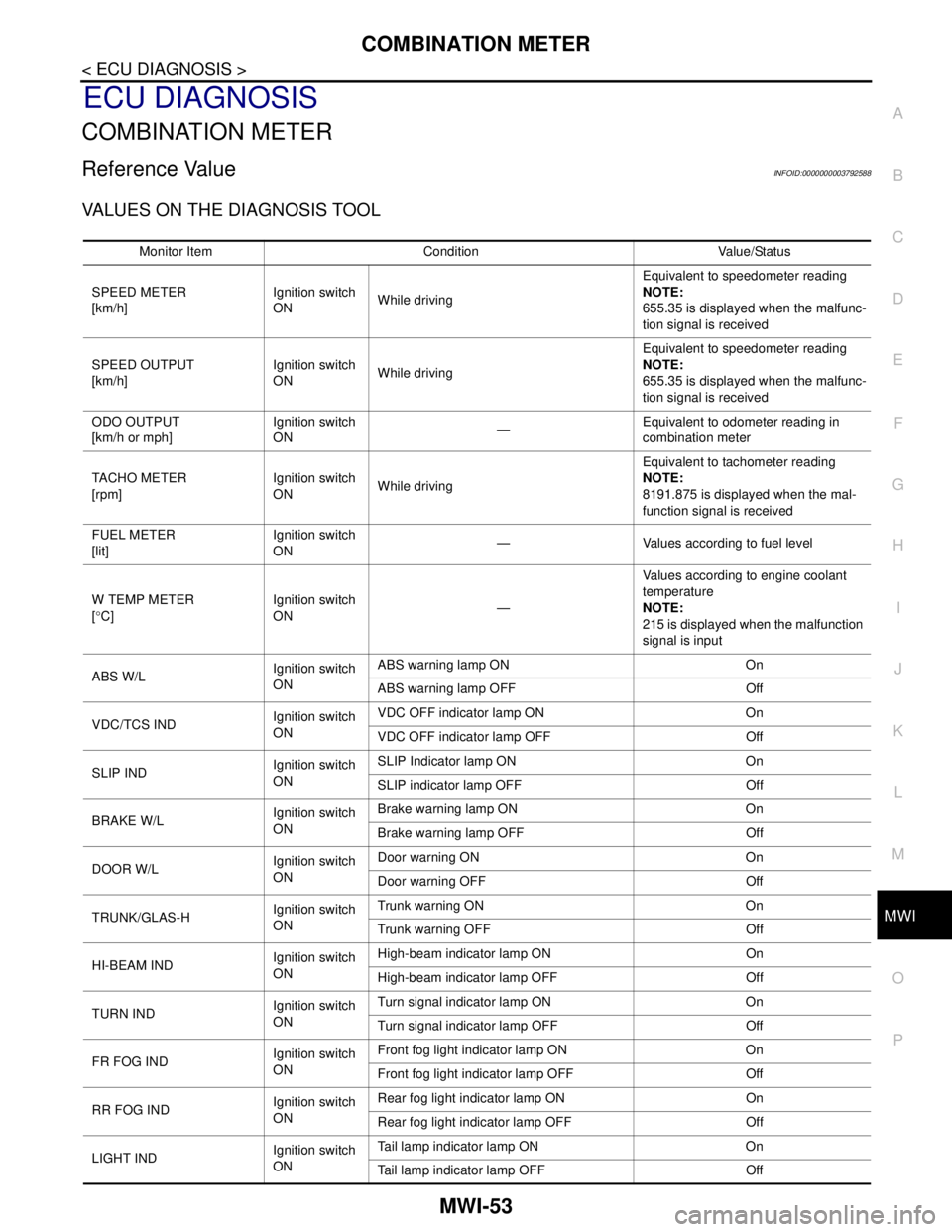
VALUES ON THE DIAGNOSIS TOOL
Monitor Item Condition Value/Status
SPEED METER
[km/h]Ignition switch
ONWhile drivingEquivalent to speedometer reading
NOTE:
655.35 is displayed when the malfunc-
tion signal is received
SPEED OUTPUT
[km/h]Ignition switch
ONWhile drivingEquivalent to speedometer reading
NOTE:
655.35 is displayed when the malfunc-
tion signal is received
ODO OUTPUT
[km/h or mph]Ignition switch
ON—Equivalent to odometer reading in
combination meter
TACHO METER
[rpm]Ignition switch
ONWhile drivingEquivalent to tachometer reading
NOTE:
8191.875 is displayed when the mal-
function signal is received
FUEL METER
[lit]Ignition switch
ON— Values according to fuel level
W TEMP METER
[°C]Ignition switch
ON—Values according to engine coolant
temperature
NOTE:
215 is displayed when the malfunction
signal is input
ABS W/LIgnition switch
ONABS warning lamp ON On
ABS warning lamp OFF Off
VDC/TCS INDIgnition switch
ONVDC OFF indicator lamp ON On
VDC OFF indicator lamp OFF Off
SLIP INDIgnition switch
ONSLIP Indicator lamp ON On
SLIP indicator lamp OFF Off
BRAKE W/LIgnition switch
ONBrake warning lamp ON On
Brake warning lamp OFF Off
DOOR W/LIgnition switch
ONDoor warning ON On
Door warning OFF Off
TRUNK/GLAS-HIgnition switch
ONTrunk warning ON On
Trunk warning OFF Off
HI-BEAM INDIgnition switch
ONHigh-beam indicator lamp ON On
High-beam indicator lamp OFF Off
TURN INDIgnition switch
ONTurn signal indicator lamp ON On
Turn signal indicator lamp OFF Off
FR FOG INDIgnition switch
ONFront fog light indicator lamp ON On
Front fog light indicator lamp OFF Off
RR FOG INDIgnition switch
ONRear fog light indicator lamp ON On
Rear fog light indicator lamp OFF Off
LIGHT IND
Ignition switch
ONTail lamp indicator lamp ON On
Tail lamp indicator lamp OFF Off