warning NISSAN TEANA 2008 Service Manual
[x] Cancel search | Manufacturer: NISSAN, Model Year: 2008, Model line: TEANA, Model: NISSAN TEANA 2008Pages: 5121, PDF Size: 69.03 MB
Page 3855 of 5121
FRONT SEAT BELT
SB-3
< ON-VEHICLE REPAIR >
C
D
E
F
G
I
J
K
L
MA
B
SB
N
O
P
ON-VEHICLE REPAIR
FRONT SEAT BELT
SEAT BELT RETRACTOR
SEAT BELT RETRACTOR : InspectionINFOID:0000000003848852
AFTER A COLLISION
WARNING:
Inspect all seat belt assemblies including retractors and attached hardware after any collision.
NISSAN/INFINITI recommends that all seat belt assemblies in use during a collision be replaced
unless the collision is minor and the belts show no damage and continue to operate properly. Not
doing so could result in serious personal injury in an accident. Seat belt assemblies not in use during
a collision must also be replaced if either damage or improper operation is noted. Seat belt pre-ten-
sioners must be replaced even if the seat belts are not in use during a frontal collision in which the air
bags are deployed.
Replace any seat belt assembly (including anchor bolts) if:
The seat belt was in use at the time of a collision (except for minor collisions and the belts, retractors and
buckles show no damage and continue to operate properly).
The seat belt was damaged in an accident (i.e. torn webbing, bent retractor or guide, etc.).
The seat belt attaching point was damaged in an accident. Inspect the seat belt attaching area for damage
or distortion and repair as necessary before installing a new seat belt assembly.
Anchor bolts are deformed or worn out.
The seat belt pre-tensioners should be replaced even if the seat belts are not in use during the collision in
which the air bags are deployed.
PRELIMINARY CHECKS
1. Check the seat belt warning lamp/chime for proper operation as follows:
a. Turn ignition switch ON. The seat belt warning lamp should illuminate. Also, the seat belt warning chime
should sound for about six seconds.
b. Fasten driver seat belt. The seat belt warning lamp should turn off and the chime (if sounding) should
stop.
2. If the air bag warning lamp is blinking, conduct self-diagnosis with CONSULT-III and air bag warning lamp.
Refer to SRC-10, "
Diagnosis Description".
3. Check that the seat belt retractor, seat belt anchor and buckle bolts are securely attached.
4. Check the shoulder seat belt guide and shoulder belt height adjuster for front seats. Ensure guide swivels
freely and that webbing lays flat and does not bind in guide. Ensure height adjuster operates properly and
holds securely.
5. Check retractor operation:
a. Fully extend the seat belt webbing and check for twists, tears or other damage.
b. Allow the seat belt to retract. Ensure that webbing returns smoothly and completely into the retractor. If
the seat belt does not return smoothly, wipe the inside of the loops with a clean paper cloth. Because dirt
build-up in the loops of the upper anchors can cause the seat belts to retract slowly.
c. Fasten the seat belt. Check that seat belt returns smoothly and completely to the retractor. If the webbing
does not return smoothly, the cause may be an accumulation of dust or dirt. Use the “SEAT BELT TAPE
SET” and perform the following steps.
Inspect the front seat belt through-anchor
1. Pull the seat belt out to a length of 500 mm (19.69 in) or more.
2. Fix the seat belt at the center pillar webbing opening with a clip or other device.
3. Pass a thin wire through the through-anchor webbing opening. Hold both ends of the wire and pull it
tauntly while moving it up and down several times along the webbing opening surface to remove dirt
stuck there.
4. Any dirt that cannot be removed with the wire can be removed by cleaning the opening with a clean
cloth.
5. Apply tape at the point where the webbing contacts the through-anchor webbing opening.
NOTE:
Apply the tape so that there is no looseness or wrinkling.
Page 3856 of 5121
SB-4
< ON-VEHICLE REPAIR >
FRONT SEAT BELT
6. Remove the clip fixing the seat belt and check that the webbing returns smoothly.
6. Repeat steps above as necessary to check the other seat belts.
SEAT BELT RETRACTOR ON-VEHICLE CHECK
Emergency Locking Retractors (ELR) and Automatic Locking Retractors (ALR)
NOTE:
All seat belt retractors are Emergency Locking Retractors (ELR) type. In an emergency (sudden stop) the
retractor will lock and prevent the webbing from extending any further. All 3-point type seat belt retractors
except the driver seat belt also have an Automatic Locking Retractors (ALR) mode. The ALR mode (also
called child restraint mode) is used when installing child seats. The ALR mode is activated when the seat belt
is fully extended. When the webbing is then retracted partially, the ALR mode automatically locks the seat belt
in a specific position so the webbing cannot be extended any further. To cancel the ALR mode, allow the seat
belt to fully wind back into the retractor.
Check the seat belt retractors with the following test(s) to determine if a retractor assembly is operating prop-
erly.
ELR Function Stationary Check
Grasp the shoulder webbing and pull forward quickly. The retractor should lock and prevent the belt from
extending further.
ALR Function Stationary Check
1. Pull out the entire length of seat belt from retractor until a click is heard.
2. Retract the webbing partially. A clicking noise should be heard as the webbing retracts indicating that the
retractor is in the Automatic Locking Retractors (ALR) mode.
3. Grasp the seat belt and try to pull out the retractor. The webbing must lock and not extend any further. If
NG, replace the retractor assembly.
4. Allow the entire length of the webbing to retract to cancel the automatic locking mode.
ELR Function Moving Check
WARNING:
Perform the following test in a safe, open area clear of other vehicles and obstructions (for example, a
large, empty parking lot). Road surface must be paved and dry. Never perform the following test on
wet or gravel roads or on public streets and highways. This could result in an accident and serious
personal injury. The driver and passenger must be prepared to brace themselves in the event that the
retractor does not lock.
1. Fasten driver seat belt. Buckle a passenger into the seat for the belt that is to be tested.
2. Proceed to the designated safe area.
3. Drive the vehicle at approximately 16 km/h (10 MPH). Notify any passengers of a pending sudden stop
and the driver and passenger must be prepared to brace themselves in the event that the retractor does
not lock, apply brakes firmly and make a very hard stop.
During stopping, seat belts should lock and not be extended. If the seat belt retractor assembly does not lock,
perform the retractor off-vehicle check.
SEAT BELT RETRACTOR OFF-VEHICLE CHECK
1. Remove the seat belt retractor.
Remove the front seat belt assembly, refer to SB-5, "
SEAT BELT RETRACTOR : Removal and Installa-
tion".
2. Slowly pull out webbing while tilting the retractor assembly forward from the mounted position without
twisting the retractor assembly as shown in the illustration.
Page 3858 of 5121
SB-6
< ON-VEHICLE REPAIR >
FRONT SEAT BELT
2. Remove the shoulder anchor.
Remove the center pillar lower and upper garnishes, refer to INT-39, "
Removal and Installation".
Remove the shoulder anchor fixing anchor nut.
3. Remove the seat belt assembly.
Disconnect the seat belt pre-tensioner connector.
CAUTION:
For installing/removing seat belt pre-tensioner connec-
tor, insert thin screwdriver wrapped in tape into notch,
lift lock and remove connector.
Install connector with lock raised, and push lock into
connector.
Remove the fixing screw and anchor bolt of the pre-tensioner seat belt retractor.
INSTALLATION
Install in the reverse order of removal.
SEAT BELT BUCKLE
SEAT BELT BUCKLE : InspectionINFOID:0000000003848855
AFTER A COLLISION
WARNING:
Inspect all seat belt assemblies including retractors and attached hardware after any collision.
NISSAN/INFINITI recommends that all seat belt assemblies in use during a collision be replaced
unless the collision was minor and the belts show no damage and continue to operate properly. Not
doing so could result in serious personal injury in an accident. Seat belt assemblies not in use during
a collision must also be replaced if either damage or improper operation is noted. Seat belt pre-ten-
sioners must be replaced even if the seat belts are not in use during a frontal collision in which the air
bags are deployed.
Replace any seat belt assembly (including anchor bolts) if:
The seat belt is in use at the time of a collision (except for minor collisions and the belts, retractors and buck-
les show no damage and continue to operate properly).
The seat belt is damaged in an accident (i.e. torn webbing, bent retractor or guide, etc.).
The seat belt attaching point is damaged in an accident. Inspect the seat belt attaching area for damage or
distortion and repair if necessary before installing a new seat belt assembly.
Anchor bolts are deformed or worn out.
The seat belt pre-tensioner must be replaced even if the seat belts are not in use during the collision in which
the air bags are deployed.
PRELIMINARY CHECKS
1. Check the seat belt warning lamp/chime for proper operation as follows:
a. Turn ignition switch ON. The seat belt warning lamp should illuminate. Also, the seat belt warning chime
should sound for about six seconds.
b. Fasten driver seat belt. The seat belt warning lamp should turn OFF and the chime (if sounding) should
stop.
2. If the air bag warning lamp is blinking, conduct self-diagnosis with CONSULT-III and air bag warning lamp.
Refer to SRC-10, "
Diagnosis Description".
3. Check that the seat belt retractor, seat belt anchor and buckle bolts are securely attached.
4. Repeat steps above if necessary to check the other seat belts.
PHIA0953J
Page 3860 of 5121
SB-8
< ON-VEHICLE REPAIR >
REAR SEAT BELT
REAR SEAT BELT
SEAT BELT RETRACTOR
SEAT BELT RETRACTOR : InspectionINFOID:0000000003848858
AFTER A COLLISION
WARNING:
Inspect all seat belt assemblies including retractors and attached hardware after any collision.
NISSAN/INFINITI recommends that all seat belt assemblies in use during a collision be replaced
unless the collision was minor and the belts show no damage and continue to operate properly. Not
doing so could result in serious personal injury in an accident. Seat belt assemblies not in use during
a collision must also be replaced if either damage or improper operation is noted. Seat belt pre-ten-
sioners must be replaced even if the seat belts are not in use during a frontal collision in which the air
bags are deployed.
Replace any seat belt assembly (including anchor bolts) if:
The seat belt is in use at the time of a collision (except for minor collisions and the belts, retractors and buck-
les show no damage and continue to operate properly).
The seat belt is damaged in an accident (i.e. torn webbing, bent retractor or guide, etc.).
The seat belt attaching point is damaged in an accident. Inspect the seat belt attaching area for damage or
distortion and repair if necessary before installing a new seat belt assembly.
Anchor bolts are deformed or worn out.
The seat belt pre-tensioners must be replaced even if the seat belts are not in use during the collision in
which the air bags are deployed.
PRELIMINARY CHECKS
1. Check the seat belt warning lamp/chime for proper operation as follows:
a. Turn ignition switch ON. The seat belt warning lamp should illuminate. Also, the seat belt warning chime
should sound for about six seconds.
b. Fasten driver seat belt. The seat belt warning lamp should turn OFF and the chime (if sounding) should
stop.
2. If the air bag warning lamp is blinking, conduct self-diagnosis with CONSULT-III and air bag warning lamp.
Refer to SRC-10, "
Diagnosis Description".
3. Check that the seat belt retractor, seat belt anchor and buckle bolts are securely attached.
4. Check retractor operation:
a. Fully extend the seat belt webbing and check for twists, tears or other damage.
b. Allow the seat belt to retract. Check that webbing returns smoothly and completely into the retractor. If the
seat belt does not return smoothly, wipe the inside of the loops with a clean paper cloth. Because dirt
build-up in the loops of that upper anchors can cause the seat belts to retract slowly.
c. Fasten the seat belt. Check the seat belt returns smoothly and completely to the retractor. If the webbing
does not return smoothly, the cause may be an accumulation of dust or dirt. Use the “SEAT BELT TAPE
SET” and perform the following steps.
5. Repeat steps above if necessary to check the other seat belts.
SEAT BELT RETRACTOR ON-VEHICLE CHECK
Emergency Locking Retractors (ELR) and Automatic Locking Retractors (ALR)
NOTE:
All seat belt retractors are Emergency Locking Retractors (ELR) type. In an emergency (sudden stop) the
retractor locks and prevent the webbing from extending any further. All 3-point type seat belt retractors except
the driver's seat belt also have an Automatic Locking Retractors (ALR) mode. The ALR mode (also called child
restraint mode) is used when installing child seats. The ALR mode is activated when the seat belt is fully
extended. When the webbing is then retracted partially, the ALR mode automatically locks the seat belt in a
specific position so the webbing cannot be extended any further. To cancel the ALR mode, allow the seat belt
to fully return into the retractor.
Check the seat belt retractors with the following test(s) to determine if a retractor assembly is operating prop-
erly.
ELR Function Stationary Check
Page 3861 of 5121
REAR SEAT BELT
SB-9
< ON-VEHICLE REPAIR >
C
D
E
F
G
I
J
K
L
MA
B
SB
N
O
P
Grasp the shoulder webbing and pull forward quickly. The retractor should lock and prevent the belt from
extending further.
ALR Function Stationary Check
1. Pull out the entire length of seat belt from retractor until a click is heard.
2. Retract the webbing partially. A clicking noise should be heard as the webbing retracts indicating that the
retractor is in the Automatic Locking Retractors (ALR) mode.
3. Grasp the seat belt and try to pull out the retractor. The webbing must lock and not extend any further. If
NG, replace the retractor assembly.
4. Allow the entire length of the webbing to retract to cancel the automatic locking mode.
ELR Function Moving Check
WARNING:
Perform the following test in a safe, open area clear of other vehicles and obstructions (for example, a
large, empty parking lot). Road surface must be paved and dry. NEVER perform the following test on
wet or gravel roads or on public streets and highways. This could result in an accident and serious
personal injury. The driver and passenger must be prepared to brace themselves in the event that the
retractor does not lock.
1. Fasten driver seat belt. Buckle a passenger into the seat for the belt that is to be tested.
2. Proceed to the designated safe area.
3. Drive the vehicle at approximately 16 km/h (10 MPH). Notify any passengers of a pending sudden stop
and the driver and passenger must be prepared to brace themselves in the event that the retractor does
not lock, apply brakes firmly and make a very hard stop.
During stopping, seat belts should lock and not be extended. If the seat belt retractor assembly does not lock,
perform the retractor off-vehicle check.
SEAT BELT RETRACTOR OFF-VEHICLE CHECK
1. Remove the seat belt retractor.
Remove the rear seat belt assembly, refer to SB-10, "
SEAT BELT RETRACTOR : Removal and Installa-
tion".
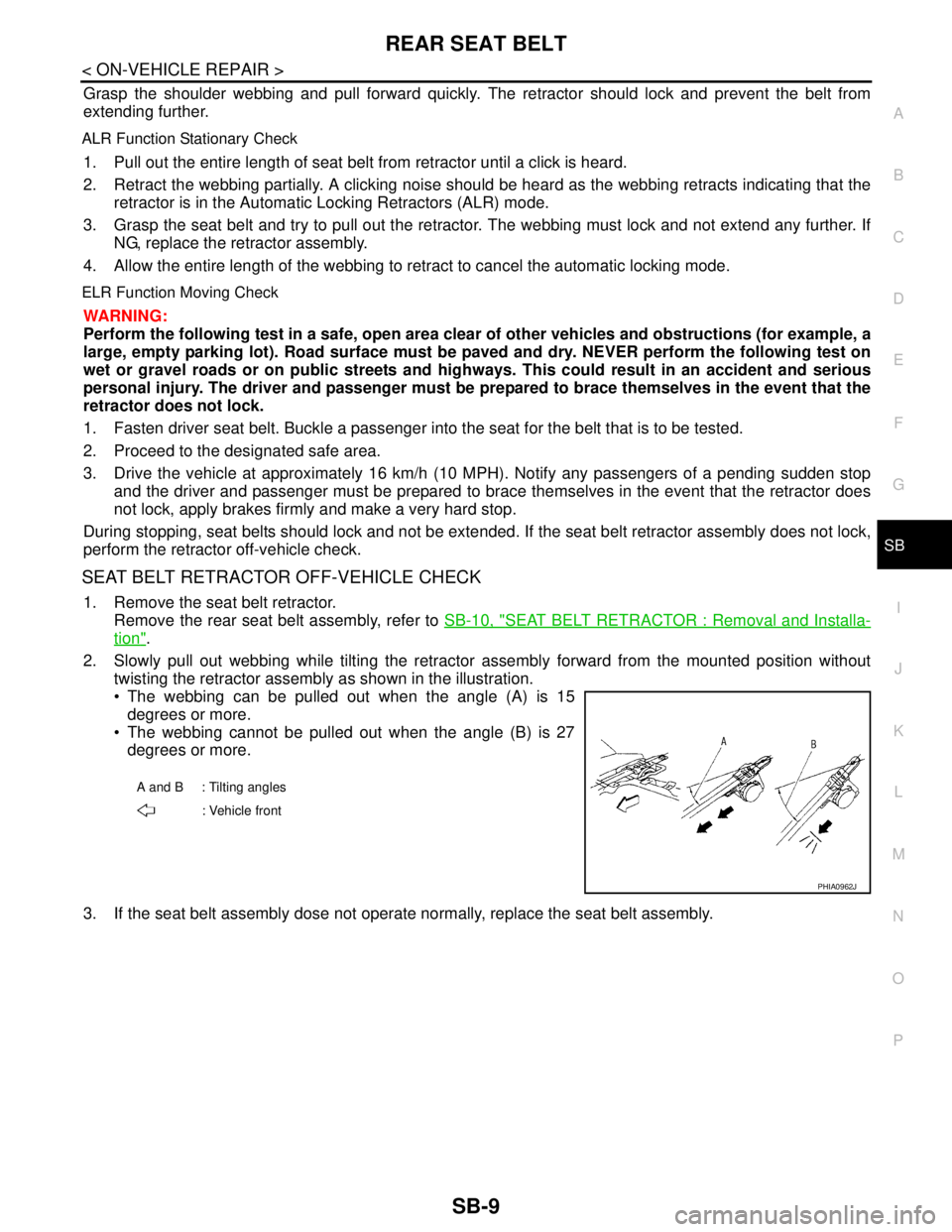
2. Slowly pull out webbing while tilting the retractor assembly forward from the mounted position without
twisting the retractor assembly as shown in the illustration.
The webbing can be pulled out when the angle (A) is 15
degrees or more.
The webbing cannot be pulled out when the angle (B) is 27
degrees or more.
3. If the seat belt assembly dose not operate normally, replace the seat belt assembly.
A and B : Tilting angles
: Vehicle front
PHIA0962J
Page 3862 of 5121
SB-10
< ON-VEHICLE REPAIR >
REAR SEAT BELT
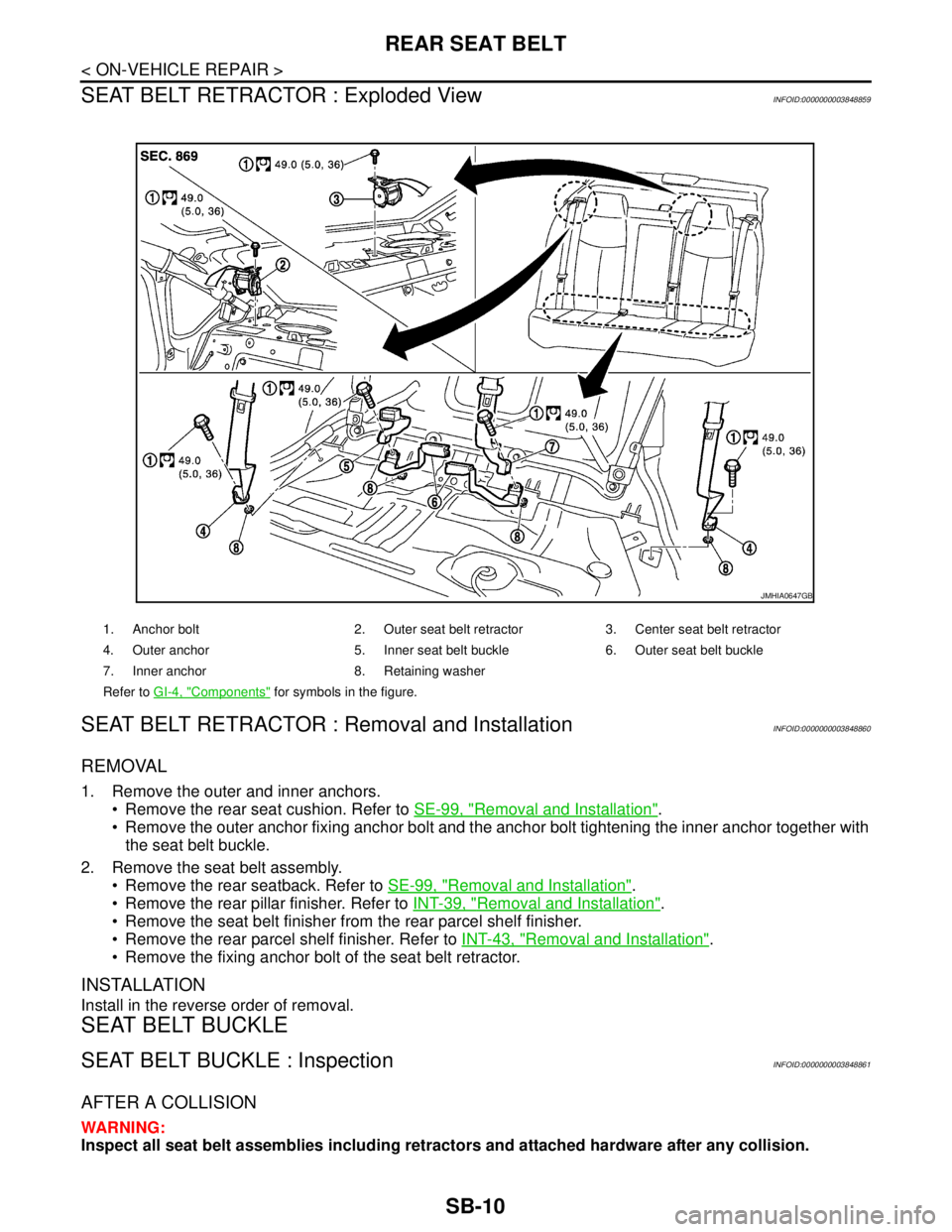
SEAT BELT RETRACTOR : Exploded View
INFOID:0000000003848859
SEAT BELT RETRACTOR : Removal and InstallationINFOID:0000000003848860
REMOVAL
1. Remove the outer and inner anchors.
Remove the rear seat cushion. Refer to SE-99, "
Removal and Installation".
Remove the outer anchor fixing anchor bolt and the anchor bolt tightening the inner anchor together with
the seat belt buckle.
2. Remove the seat belt assembly.
Remove the rear seatback. Refer to SE-99, "
Removal and Installation".
Remove the rear pillar finisher. Refer to INT-39, "
Removal and Installation".
Remove the seat belt finisher from the rear parcel shelf finisher.
Remove the rear parcel shelf finisher. Refer to INT-43, "
Removal and Installation".
Remove the fixing anchor bolt of the seat belt retractor.
INSTALLATION
Install in the reverse order of removal.
SEAT BELT BUCKLE
SEAT BELT BUCKLE : InspectionINFOID:0000000003848861
AFTER A COLLISION
WARNING:
Inspect all seat belt assemblies including retractors and attached hardware after any collision.
1. Anchor bolt 2. Outer seat belt retractor 3. Center seat belt retractor
4. Outer anchor 5. Inner seat belt buckle 6. Outer seat belt buckle
7. Inner anchor 8. Retaining washer
Refer to GI-4, "
Components" for symbols in the figure.
JMHIA0647GB
Page 3950 of 5121
![NISSAN TEANA 2008 Service Manual SE-86
< PRECAUTION >[WITH VENTILATION SEAT]
PRECAUTIONS
PRECAUTION
PRECAUTIONS
Precaution for Supplemental Restraint System (SRS) "AIR BAG" and "SEAT BELT
PRE-TENSIONER"
INFOID:0000000003940149
The S](/img/5/57391/w960_57391-3949.png "NISSAN TEANA 2008 Service Manual SE-86
< PRECAUTION >[WITH VENTILATION SEAT]
PRECAUTIONS
PRECAUTION
PRECAUTIONS
Precaution for Supplemental Restraint System (SRS) \"AIR BAG\" and \"SEAT BELT
PRE-TENSIONER\"
INFOID:0000000003940149
The S")
SE-86
< PRECAUTION >[WITH VENTILATION SEAT]
PRECAUTIONS
PRECAUTION
PRECAUTIONS
Precaution for Supplemental Restraint System (SRS) "AIR BAG" and "SEAT BELT
PRE-TENSIONER"
INFOID:0000000003940149
The Supplemental Restraint System such as “AIR BAG” and “SEAT BELT PRE-TENSIONER”, used along
with a front seat belt, helps to reduce the risk or severity of injury to the driver and front passenger for certain
types of collision. Information necessary to service the system safely is included in the “SRS AIRBAG” and
“SEAT BELT” of this Service Manual.
WARNING:
• To avoid rendering the SRS inoperative, which could increase the risk of personal injury or death in
the event of a collision which would result in air bag inflation, all maintenance must be performed by
an authorized NISSAN/INFINITI dealer.
Improper maintenance, including incorrect removal and installation of the SRS, can lead to personal
injury caused by unintentional activation of the system. For removal of Spiral Cable and Air Bag
Module, see the “SRS AIRBAG”.
Never use electrical test equipment on any circuit related to the SRS unless instructed to in this Ser-
vice Manual. SRS wiring harnesses can be identified by yellow and/or orange harnesses or harness
connectors.
Precaution Necessary for Steering Wheel Rotation after Battery Disconnect
INFOID:0000000003885169
NOTE:
Before removing and installing any control units, first turn the push-button ignition switch to the LOCK posi-
tion, then disconnect both battery cables.
After finishing work, confirm that all control unit connectors are connected properly, then re-connect both
battery cables.
Always use CONSULT-III to perform self-diagnosis as a part of each function inspection after finishing work.
If a DTC is detected, perform trouble diagnosis according to self-diagnosis results.
This vehicle is equipped with a push-button ignition switch and a steering lock unit.
If the battery is disconnected or discharged, the steering wheel will lock and cannot be turned.
If turning the steering wheel is required with the battery disconnected or discharged, follow the procedure
below before starting the repair operation.
OPERATION PROCEDURE
1. Connect both battery cables.
NOTE:
Supply power using jumper cables if battery is discharged.
2. Turn the push-button ignition switch to ACC position.
(At this time, the steering lock will be released.)
3. Disconnect both battery cables. The steering lock will remain released with both battery cables discon-
nected and the steering wheel can be turned.
4. Perform the necessary repair operation.
5. When the repair work is completed, re-connect both battery cables. With the brake pedal released, turn
the push-button ignition switch from ACC position to ON position, then to LOCK position. (The steering
wheel will lock when the push-button ignition switch is turned to LOCK position.)
6. Perform self-diagnosis check of all control units using CONSULT-III.
Service NoticeINFOID:0000000003809271
When removing or installing various parts, place a cloth or padding onto the vehicle body to prevent
scratches.
Handle trim, molding, instruments, grille, etc. carefully during removing or installing. Be careful not to oil or
damage them.
Apply sealing compound where necessary when installing parts.
When applying sealing compound, be careful that the sealing compound does not protrude from parts.
Page 3991 of 5121
![NISSAN TEANA 2008 Service Manual PRECAUTIONS
SE-127
< PRECAUTION >[WITHOUT VENTILATION SEAT]
C
D
E
F
G
H
I
K
L
MA
B
SE
N
O
P
PRECAUTION
PRECAUTIONS
Precaution for Supplemental Restraint System (SRS) "AIR BAG" and "SEAT BELT
PRE-TENS](/img/5/57391/w960_57391-3990.png "NISSAN TEANA 2008 Service Manual PRECAUTIONS
SE-127
< PRECAUTION >[WITHOUT VENTILATION SEAT]
C
D
E
F
G
H
I
K
L
MA
B
SE
N
O
P
PRECAUTION
PRECAUTIONS
Precaution for Supplemental Restraint System (SRS) \"AIR BAG\" and \"SEAT BELT
PRE-TENS")
PRECAUTIONS
SE-127
< PRECAUTION >[WITHOUT VENTILATION SEAT]
C
D
E
F
G
H
I
K
L
MA
B
SE
N
O
P
PRECAUTION
PRECAUTIONS
Precaution for Supplemental Restraint System (SRS) "AIR BAG" and "SEAT BELT
PRE-TENSIONER"
INFOID:0000000003940150
The Supplemental Restraint System such as “AIR BAG” and “SEAT BELT PRE-TENSIONER”, used along
with a front seat belt, helps to reduce the risk or severity of injury to the driver and front passenger for certain
types of collision. Information necessary to service the system safely is included in the “SRS AIRBAG” and
“SEAT BELT” of this Service Manual.
WARNING:
To avoid rendering the SRS inoperative, which could increase the risk of personal injury or death in
the event of a collision which would result in air bag inflation, all maintenance must be performed by
an authorized NISSAN/INFINITI dealer.
Improper maintenance, including incorrect removal and installation of the SRS, can lead to personal
injury caused by unintentional activation of the system. For removal of Spiral Cable and Air Bag
Module, see the “SRS AIRBAG”.
Never use electrical test equipment on any circuit related to the SRS unless instructed to in this Ser-
vice Manual. SRS wiring harnesses can be identified by yellow and/or orange harnesses or harness
connectors.
Precaution Necessary for Steering Wheel Rotation after Battery Disconnect
INFOID:0000000003885171
NOTE:
Before removing and installing any control units, first turn the push-button ignition switch to the LOCK posi-
tion, then disconnect both battery cables.
After finishing work, confirm that all control unit connectors are connected properly, then re-connect both
battery cables.
Always use CONSULT-III to perform self-diagnosis as a part of each function inspection after finishing work.
If a DTC is detected, perform trouble diagnosis according to self-diagnosis results.
This vehicle is equipped with a push-button ignition switch and a steering lock unit.
If the battery is disconnected or discharged, the steering wheel will lock and cannot be turned.
If turning the steering wheel is required with the battery disconnected or discharged, follow the procedure
below before starting the repair operation.
OPERATION PROCEDURE
1. Connect both battery cables.
NOTE:
Supply power using jumper cables if battery is discharged.
2. Turn the push-button ignition switch to ACC position.
(At this time, the steering lock will be released.)
3. Disconnect both battery cables. The steering lock will remain released with both battery cables discon-
nected and the steering wheel can be turned.
4. Perform the necessary repair operation.
5. When the repair work is completed, re-connect both battery cables. With the brake pedal released, turn
the push-button ignition switch from ACC position to ON position, then to LOCK position. (The steering
wheel will lock when the push-button ignition switch is turned to LOCK position.)
6. Perform self-diagnosis check of all control units using CONSULT-III.
Service NoticeINFOID:0000000003840019
When removing or installing various parts, place a cloth or padding onto the vehicle body to prevent
scratches.
Handle trim, molding, instruments, grille, etc. carefully during removing or installing. Be careful not to oil or
damage them.
Apply sealing compound where necessary when installing parts.
When applying sealing compound, be careful that the sealing compound does not protrude from parts.
Page 4012 of 5121

SEC-3
C
D
E
F
G
H
I
J
L
MA
B
SEC
N
O
P Diagnosis Procedure ...............................................
78
B260C STEERING LOCK UNIT .........................79
Description ..............................................................79
DTC Logic ...............................................................79
Diagnosis Procedure ...............................................79
B260D STEERING LOCK UNIT .........................80
Description ..............................................................80
DTC Logic ...............................................................80
Diagnosis Procedure ...............................................80
B260F ENGINE STATUS ...................................81
Description ..............................................................81
DTC Logic ...............................................................81
Diagnosis Procedure ...............................................81
B26E1 NO RECEPTION OF ENGINE STA-
TUS SIGNAL ......................................................
82
Description ..............................................................82
DTC Logic ...............................................................82
Diagnosis Procedure ...............................................82
B26E9 STEERING STATUS ..............................83
Description ..............................................................83
DTC Logic ...............................................................83
Diagnosis Procedure ...............................................83
B26EA KEY REGISTRATION ............................84
Description ..............................................................84
DTC Logic ...............................................................84
Diagnosis Procedure ...............................................84
B2612 STEERING STATUS ...............................85
Description ..............................................................85
DTC Logic ...............................................................85
Diagnosis Procedure ...............................................85
B2617 STARTER RELAY CIRCUIT ...................89
Description ..............................................................89
DTC Logic ...............................................................89
Diagnosis Procedure ...............................................89
B2619 BCM ........................................................91
Description ..............................................................91
DTC Logic ...............................................................91
Diagnosis Procedure ...............................................91
B261A PUSH-BUTTON IGNITION SWITCH .....92
Description ..............................................................92
DTC Logic ...............................................................92
Diagnosis Procedure ...............................................92
B261E VEHICLE TYPE ......................................95
Description ..............................................................95
DTC Logic ...............................................................95
Diagnosis Procedure ...............................................95
B2108 STEERING LOCK RELAY ......................96
Description ..............................................................96
DTC Logic ...............................................................96
Diagnosis Procedure ...............................................96
B2109 STEERING LOCK RELAY ....................97
Description ...............................................................97
DTC Logic ................................................................97
Diagnosis Procedure ...............................................97
B210A STEERING LOCK CONDITION
SWITCH .............................................................
98
Description ...............................................................98
DTC Logic ................................................................98
Diagnosis Procedure ...............................................98
B210B STARTER CONTROL RELAY ............102
Description .............................................................102
DTC Logic ..............................................................102
Diagnosis Procedure .............................................102
B210C STARTER CONTROL RELAY ............103
Description .............................................................103
DTC Logic ..............................................................103
Diagnosis Procedure .............................................103
B210D STARTER RELAY ..............................104
Description .............................................................104
DTC Logic ..............................................................104
Diagnosis Procedure .............................................104
B210E STARTER RELAY ...............................105
Description .............................................................105
DTC Logic ..............................................................105
Diagnosis Procedure .............................................105
B210F PNP/CLUTCH INTERLOCK SWITCH .107
Description .............................................................107
DTC Logic ..............................................................107
Diagnosis Procedure .............................................107
B2110 PNP/CLUTCH INTERLOCK SWITCH .109
Description .............................................................109
DTC Logic ..............................................................109
Diagnosis Procedure .............................................109
POWER SUPPLY AND GROUND CIRCUIT ..111
BCM .........................................................................111
BCM : Diagnosis Procedure ..................................111
IPDM E/R ..................................................................111
IPDM E/R : Diagnosis Procedure ..........................111
HOOD SWITCH ...............................................113
Description .............................................................113
Component Function Check ................................113
Diagnosis Procedure ............................................113
Component Inspection ...........................................114
SECURITY INDICATOR LAMP ......................115
Description .............................................................115
Component Function Check ................................115
Diagnosis Procedure .............................................115
Component Inspection ...........................................116
KEY WARNING LAMP ....................................117
Page 4019 of 5121
![NISSAN TEANA 2008 Service Manual SEC-10
< FUNCTION DIAGNOSIS >[INTELLIGENT KEY SYSTEM]
INTELLIGENT KEY SYSTEM/ENGINE START FUNCTION
4. BCM transmits the steering lock unlock signal to steering lock unit and IPDM E/R if the verificati](/img/5/57391/w960_57391-4018.png "NISSAN TEANA 2008 Service Manual SEC-10
< FUNCTION DIAGNOSIS >[INTELLIGENT KEY SYSTEM]
INTELLIGENT KEY SYSTEM/ENGINE START FUNCTION
4. BCM transmits the steering lock unlock signal to steering lock unit and IPDM E/R if the verificati")
SEC-10
< FUNCTION DIAGNOSIS >[INTELLIGENT KEY SYSTEM]
INTELLIGENT KEY SYSTEM/ENGINE START FUNCTION
4. BCM transmits the steering lock unlock signal to steering lock unit and IPDM E/R if the verification results
are OK.
5. IPDM E/R turns the steering lock relay ON and supplies power to the steering lock unit.
6. Release of the steering lock.
7. BCM transmits the power supply stop signal to IPDM E/R when it confirms that the steering lock is in the
unlock condition.
8. IPDM E/R turns the steering lock relay OFF and stops power supply to the steering lock unit.
9. BCM turns ACC relay ON and transmits the ignition power supply ON signal to IPDM E/R.
10. IPDM E/R turns the ignition relay ON and starts the ignition power supply.
11. BCM confirms that the shift position is P or N.
12. BCM transmits the starter request signal via CAN communication to IPDM E/R and turns the starter relay
in IPDM E/R ON if BCM judges that the engine start condition is satisfied.
13. IPDM E/R turns the starter control relay ON when receiving the starter request signal.
14. Battery power is supplied through the starter relay and the starter control relay to operate the starter motor
and to start the cranking.
CAUTION:
If a malfunction is detected in the Intelligent Key system, the “KEY” warning lamp in the combina-
tion meter illuminates. At that time, the engine cannot be started.
15. When BCM receives feedback signal from ECM acknowledging the engine has been initiated, the BCM
transmits a stop signal to IPDM E/R and stops the cranking by turning OFF the starter motor relay. (If the
engine initiating has failed, the cranking will stop automatically within 5 seconds.)
CAUTION:
When the Intelligent Key is carried outside of the vehicle (inside key antenna detection area) with
the power supply in the ACC or ON position, even if the engine start condition* is satisfied, the
engine cannot be started.
*: For the engine start condition, refer to “PUSH-BUTTON IGNITION SWITCH OPERATION PROCEDURE”.
OPERATION RANGE
Engine can be started when Intelligent Key is inside the vehicle. However, sometimes engine might not start
when Intelligent Key is on instrument panel or in glove box.
OPERATION WHEN KEY SLOT IS USED
When the Intelligent Key battery is discharged, it performs the NVIS (NATS) ID verification between the inte-
grated transponder and BCM by inserting the Intelligent Key into the key slot, and then the engine can be
started.
For details relating to starting the engine using key slot, refer to SEC-14, "
System Description".
BATTERY SAVER SYSTEM
When all the following conditions are met for 60 minutes, the battery saver system will cut off the power supply
to prevent battery discharge.
The ignition switch is in the ACC position
All doors are closed
Selector lever is in the P position
Reset Condition of Battery Saver System
If any of the following conditions are met the battery saver system is released and the steering will change
automatically to the lock position from the OFF position.
Opening any door
Operating with request switch on door lock
Operating with Intelligent Key on door lock
Pressing the push-button ignition switch and ignition switch will change the ignition switch to ACC position
from OFF position.
STEERING LOCK OPERATION
Steering is locked by steering lock unit when ignition switch is in the OFF position, selector lever is in the P
position and any of the following conditions are met.
Opening door
Closing door
Door is locked with request switch
Door is locked with Intelligent Key