light NISSAN TEANA 2008 Service Manual
[x] Cancel search | Manufacturer: NISSAN, Model Year: 2008, Model line: TEANA, Model: NISSAN TEANA 2008Pages: 5121, PDF Size: 69.03 MB
Page 4189 of 5121
![NISSAN TEANA 2008 Service Manual SEC-180
< ECU DIAGNOSIS >[INTELLIGENT KEY SYSTEM]
IPDM E/R (INTELLIGENT POWER DISTRIBUTION MODULE ENGINE ROOM)
TERMINAL LAYOUT
PHYSICAL VALUES
JPMIA0863ZZ
Te r m i n a l N o .
(Wire color)Description](/img/5/57391/w960_57391-4188.png "NISSAN TEANA 2008 Service Manual SEC-180
< ECU DIAGNOSIS >[INTELLIGENT KEY SYSTEM]
IPDM E/R (INTELLIGENT POWER DISTRIBUTION MODULE ENGINE ROOM)
TERMINAL LAYOUT
PHYSICAL VALUES
JPMIA0863ZZ
Te r m i n a l N o .
(Wire color)Description")
SEC-180
< ECU DIAGNOSIS >[INTELLIGENT KEY SYSTEM]
IPDM E/R (INTELLIGENT POWER DISTRIBUTION MODULE ENGINE ROOM)
TERMINAL LAYOUT
PHYSICAL VALUES
JPMIA0863ZZ
Te r m i n a l N o .
(Wire color)Description
ConditionVa l u e
(Approx.)
Signal nameInput/
Output +−
1
(R)Ground Battery power supply Input Ignition switch OFF Battery voltage
2
(L)Ground Battery power supply Input Ignition switch OFF Battery voltage
4
(LG)Ground Front wiper LO OutputIgnition
switch ONFront wiper switch OFF 0 V
Front wiper switch LO Battery voltage
5
(Y)Ground Front wiper HI OutputIgnition
switch ONFront wiper switch OFF 0 V
Front wiper switch HI Battery voltage
7
(GR)GroundTail, license plate lamps &
illuminationsOutputIgnition
switch ONLighting switch OFF 0 V
Lighting switch 1ST Battery voltage
10
(BR)Ground ECM relay power supply OutputIgnition switch OFF
(More than a few seconds after turning
ignition switch OFF)0 V
Ignition switch ON
Ignition switch OFF
(For a few seconds after turning igni-
tion switch OFF)Battery voltage
Page 4193 of 5121
![NISSAN TEANA 2008 Service Manual SEC-184
< ECU DIAGNOSIS >[INTELLIGENT KEY SYSTEM]
IPDM E/R (INTELLIGENT POWER DISTRIBUTION MODULE ENGINE ROOM)
75
(P/L)Ground Oil pressure switch InputIgnition
switch ONEngine stopped 0 V
Engine runn](/img/5/57391/w960_57391-4192.png "NISSAN TEANA 2008 Service Manual SEC-184
< ECU DIAGNOSIS >[INTELLIGENT KEY SYSTEM]
IPDM E/R (INTELLIGENT POWER DISTRIBUTION MODULE ENGINE ROOM)
75
(P/L)Ground Oil pressure switch InputIgnition
switch ONEngine stopped 0 V
Engine runn")
SEC-184
< ECU DIAGNOSIS >[INTELLIGENT KEY SYSTEM]
IPDM E/R (INTELLIGENT POWER DISTRIBUTION MODULE ENGINE ROOM)
75
(P/L)Ground Oil pressure switch InputIgnition
switch ONEngine stopped 0 V
Engine running Battery voltage
76
(SB)GroundPower generation com-
mand signalOutputIgnition switch ON
6.3 V
40% is set on “ACTIVE TEST”, “AL-
TERNATOR DUTY” of “ENGINE”
3.8 V
80% is set on “ACTIVE TEST”, “AL-
TERNATOR DUTY” of “ENGINE”
1.4 V
77
(GR)Ground Fuel pump relay control Output Approximately 1 second after turning
the ignition switch ON
Engine running0 - 1.5 V
Approximately 1 second or more after
turning the ignition switch ONBattery voltage
80
(B/W)Ground Starter motor Output At engine cranking Battery voltage
83
(Y)Ground Headlamp LO (RH) OutputIgnition
switch ONLighting switch OFF 0 V
Lighting switch 2ND Battery voltage
84
(SB)Ground Headlamp LO (LH) OutputIgnition
switch ONLighting switch OFF 0 V
Lighting switch 2ND Battery voltage
86
(L)Ground Front fog lamp (RH) OutputLighting
switch
2ND Front fog lamp switch
ON
Daytime running light
activated (Only for Can-
ada)Battery voltage
Front fog lamp switch OFF 0 V
87
(R)Ground Front fog lamp (LH) OutputLighting
switch
2ND Front fog lamp switch
ON
Daytime running light
activated (Only for Can-
ada)Battery voltage
Front fog lamp switch OFF 0 V Te r m i n a l N o .
(Wire color)Description
ConditionVa l u e
(Approx.)
Signal nameInput/
Output +−
JPMIA0001GB
JPMIA0002GB
JPMIA0003GB
Page 4194 of 5121
![NISSAN TEANA 2008 Service Manual IPDM E/R (INTELLIGENT POWER DISTRIBUTION MODULE ENGINE ROOM)
SEC-185
< ECU DIAGNOSIS >[INTELLIGENT KEY SYSTEM]
C
D
E
F
G
H
I
J
L
MA
B
SEC
N
O
P
88
(P)GroundWasher pump power sup-
plyOutput Ignition sw](/img/5/57391/w960_57391-4193.png "NISSAN TEANA 2008 Service Manual IPDM E/R (INTELLIGENT POWER DISTRIBUTION MODULE ENGINE ROOM)
SEC-185
< ECU DIAGNOSIS >[INTELLIGENT KEY SYSTEM]
C
D
E
F
G
H
I
J
L
MA
B
SEC
N
O
P
88
(P)GroundWasher pump power sup-
plyOutput Ignition sw")
IPDM E/R (INTELLIGENT POWER DISTRIBUTION MODULE ENGINE ROOM)
SEC-185
< ECU DIAGNOSIS >[INTELLIGENT KEY SYSTEM]
C
D
E
F
G
H
I
J
L
MA
B
SEC
N
O
P
88
(P)GroundWasher pump power sup-
plyOutput Ignition switch ON Battery voltage
89
(W)Ground Headlamp HI (RH) OutputIgnition
switch ON Lighting switch HI
Lighting switch PASSBattery voltage
Lighting switch OFF 0 V
90
(O)Ground Headlamp HI (LH) OutputIgnition
switch ON Lighting switch HI
Lighting switch PASSBattery voltage
Lighting switch OFF 0 V
91
(O)Ground Parking lamp (RH) OutputIgnition
switch ONLighting switch 1ST Battery voltage
Lighting switch OFF 0 V
92
(L)Ground Parking lamp (LH) OutputIgnition
switch ONLighting switch 1ST Battery voltage
Lighting switch OFF 0 V
93
(BR)GroundHeadlamp aiming motor
(RH)OutputIgnition
switch ONLighting switch 1ST Battery voltage
Lighting switch OFF 0 V
94
(Y)GroundHeadlamp aiming motor
(LH)OutputIgnition
switch ONLighting switch 1ST Battery voltage
Lighting switch OFF 0 V
99
(W)Ground Ambient sensor ground Input Ignition switch ON 0 V
100
(SB)Ground Ambient sensor OutputIgnition switch ON
NOTE:
Changes depending to ambient tem-
perature
101
(GR)GroundRefrigerant pressure sen-
sor groundInputEngine
running Warm-up condition
Idle speed0 V
102
(R)GroundRefrigerant pressure sen-
sorInputEngine
running Warm-up condition
Both A/C switch and
blower fan motor switch
ON
(Compressor operates)1.0 - 4.0 V
103
(P)GroundRefrigerant pressure sen-
sor power supplyOutputIgnition switch OFF 0 V
Ignition switch ON 5.0 V
104
(LG)
Ground Hood switch OutputClose the hood Battery voltage
Open the hood 0 V Te r m i n a l N o .
(Wire color)Description
ConditionVa l u e
(Approx.)
Signal nameInput/
Output +−
JSNIA0014GB
Page 4239 of 5121
DISPOSAL OF AIR BAG MODULE AND SEAT BELT PRE-TENSIONER
SR-25
< ON-VEHICLE REPAIR >
C
D
E
F
G
I
J
K
L
MA
B
SR
N
O
P
DISPOSAL OF AIR BAG MODULE AND SEAT BELT PRE-TENSIONER
Caution for Air Bag Module and Seat Belt Pre-tensionerINFOID:0000000003839142
Precaution for Work
Before disposing of air bag module and seat belt pre-tensioner, or vehicles equipped with such systems,
deploy the systems. If such systems have already been deployed due to an accident, dispose of them as
indicated in Disposing of Air Bag Module and Seat Belt Pre-tensioner. Refer to SR-25, "
Caution for Air Bag
Module and Seat Belt Pre-tensioner".
When deploying the air bag module and seat belt pre-tensioner, always use the Special Service Tool;
Deployment tool (SST: KV99106400).
When deploying the air bag module and seat belt pre-tensioner, stand at least 5.0 m (16.4 ft.) away from the
deployment component.
When deploying air bag module and seat belt pre-tensioner, a fairly loud noise is made, followed by smoke
being released. The smoke is not poisonous, however, be careful not to inhale smoke since it irritates the
throat and can cause choking.
Always activate one air bag module at a time.
Due to heat, leave air bag module unattended for more than 30 minutes after deployment. Also leave seat
belt pre-tensioner unattended for more than 10 minutes after deployment.
Wear gloves when handling a deployed air bag module and seat belt pre-tensioner.
Never apply water to the deployed air bag module and seat belt pre-tensioner.
Wash your hands after work is completed.
Place the vehicle outdoors with an open space of at least 6.0 m (19.7 ft) on all sides when deploying air bag
module and seat belt pre-tensioner while mounted in vehicle.
Use a volt meter to make sure the vehicle battery is fully charged.
Never dispose of the air bag module and seat belt pre-tensioner that does not deploy.
CHECKING DEPLOYMENT TOOL
Connecting to Battery
CAUTION:
The battery must show voltage of 9.6 V or more.
Remove the battery from the vehicle and place it on dry wood blocks
approximately 5.0 m (16.4 ft) away from the vehicle.
Wait 3 minutes after the vehicle battery is disconnected before pro-
ceeding.
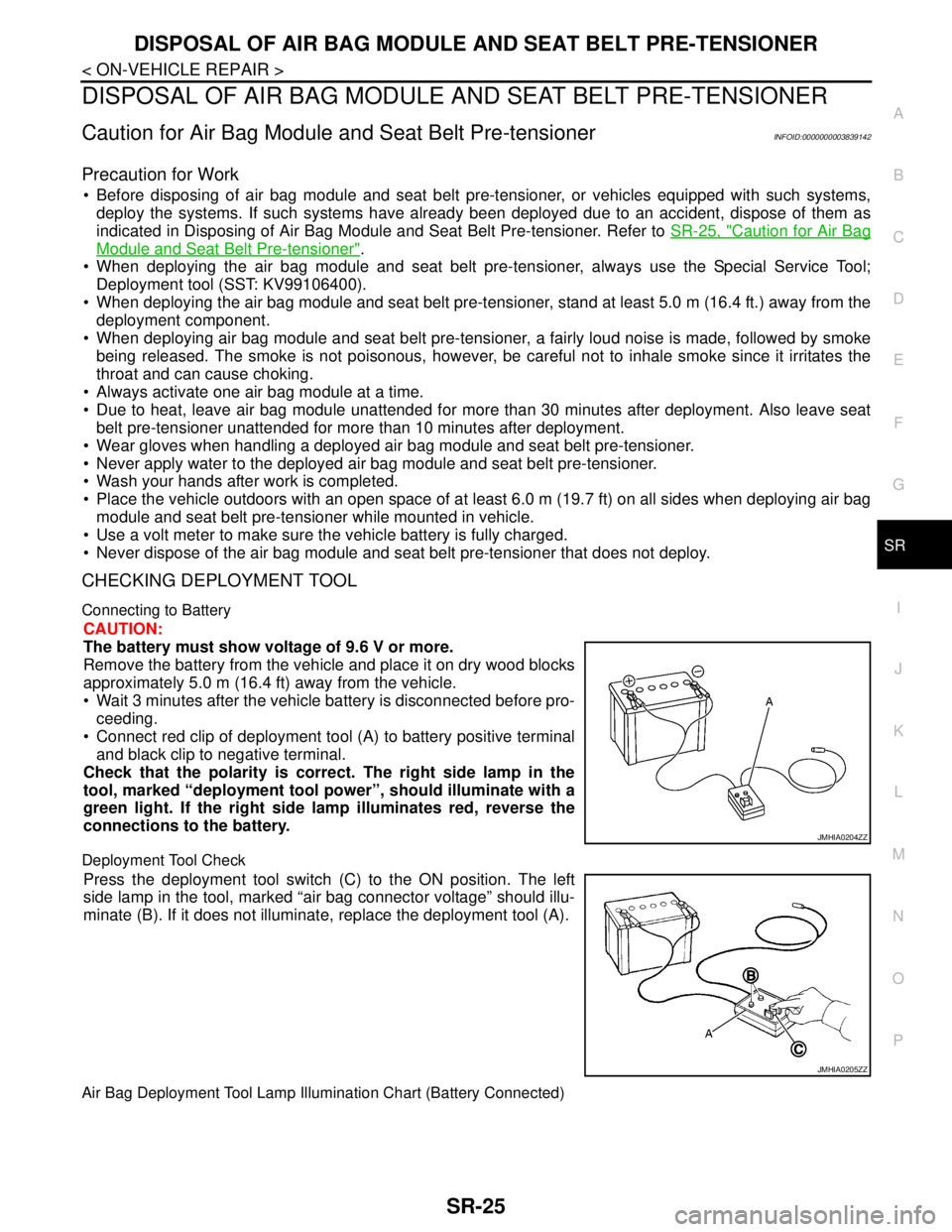
Connect red clip of deployment tool (A) to battery positive terminal
and black clip to negative terminal.
Check that the polarity is correct. The right side lamp in the
tool, marked “deployment tool power”, should illuminate with a
green light. If the right side lamp illuminates red, reverse the
connections to the battery.
Deployment Tool Check
Press the deployment tool switch (C) to the ON position. The left
side lamp in the tool, marked “air bag connector voltage” should illu-
minate (B). If it does not illuminate, replace the deployment tool (A).
Air Bag Deployment Tool Lamp Illumination Chart (Battery Connected)
JMHIA0204ZZ
JMHIA0205ZZ
Page 4399 of 5121
STEERING WHEEL
ST-9
< ON-VEHICLE MAINTENANCE >
C
D
E
F
H
I
J
K
L
MA
B
ST
N
O
P
STEERING WHEEL
InspectionINFOID:0000000003806313
STEERING WHEEL AXIAL END PLAY
1. Check installation conditions of steering gear assembly, front suspension assembly, axle and steering col-
umn assembly.
2. Check if movement exists when steering wheel is moved up and down, to the left and right and to the axial
direction.
3. Check the following items when steering wheel axial end play is out of the standard.
Check the steering column assembly mounting condition. Refer to ST-13, "
Exploded View".
Check steering gear assembly mounting condition for looseness. Refer to ST-18, "
Exploded View".
STEERING WHEEL PLAY
1. Turn steering wheel so that front wheels come to the straight-ahead position.
2. Start the engine and lightly turn steering wheel to the left and right until front wheels start to move.
3. Measure steering wheel movement on the outer circumference.
4. Check the following items when steering wheel play is out of the standard.
Check backlash for each joint of steering column assembly.
Check installation condition of steering gear assembly.
NEUTRAL POSITION STEERING WHEEL
1. Check that steering gear assembly, steering column assembly and steering wheel are installed in the cor-
rect position.
2. Perform neutral position inspection after wheel alignment. Refer to FSU-7, "
Wheel Alignment Inspection".
3. Set the vehicle to the straight-ahead position and confirm steering wheel is in the neutral position.
4. Loosen outer socket lock nut and turn inner socket to left and right equally to make fine adjustments if
steering wheel is not in the neutral position.
STEERING WHEEL TURNING FORCE
1. Park the vehicle on a level and dry surface, set parking brake.
2. Tires need to be inflated normal pressure. Refer to WT-5, "
Tire Air Pressure".
3. Start the engine.
4. Bring power steering fluid up to adequate operating temperature.Standard
Steering wheel axial end
play: Refer to ST-37, "
Steering
Wheel Axial End Play and
Play".
Standard
Steering wheel play : Refer to ST-37, "
Steering
Wheel Axial End Play and
Play".
Fluid temperature : 50 – 80°C (122 – 176°F)
Page 4420 of 5121
ST-30
< ON-VEHICLE REPAIR >
POWER STEERING OIL PUMP
1. Remove rear cover mounting bolts, and then remove rear cover from body assembly.
CAUTION:
Fix oil pump with a vise if necessary.
Use copper plates when fixing with a vise.
2. Remove O-ring from body assembly.
3. Remove rear side plate from cartridge, and then remove Teflon ring and O-ring from rear side plate.
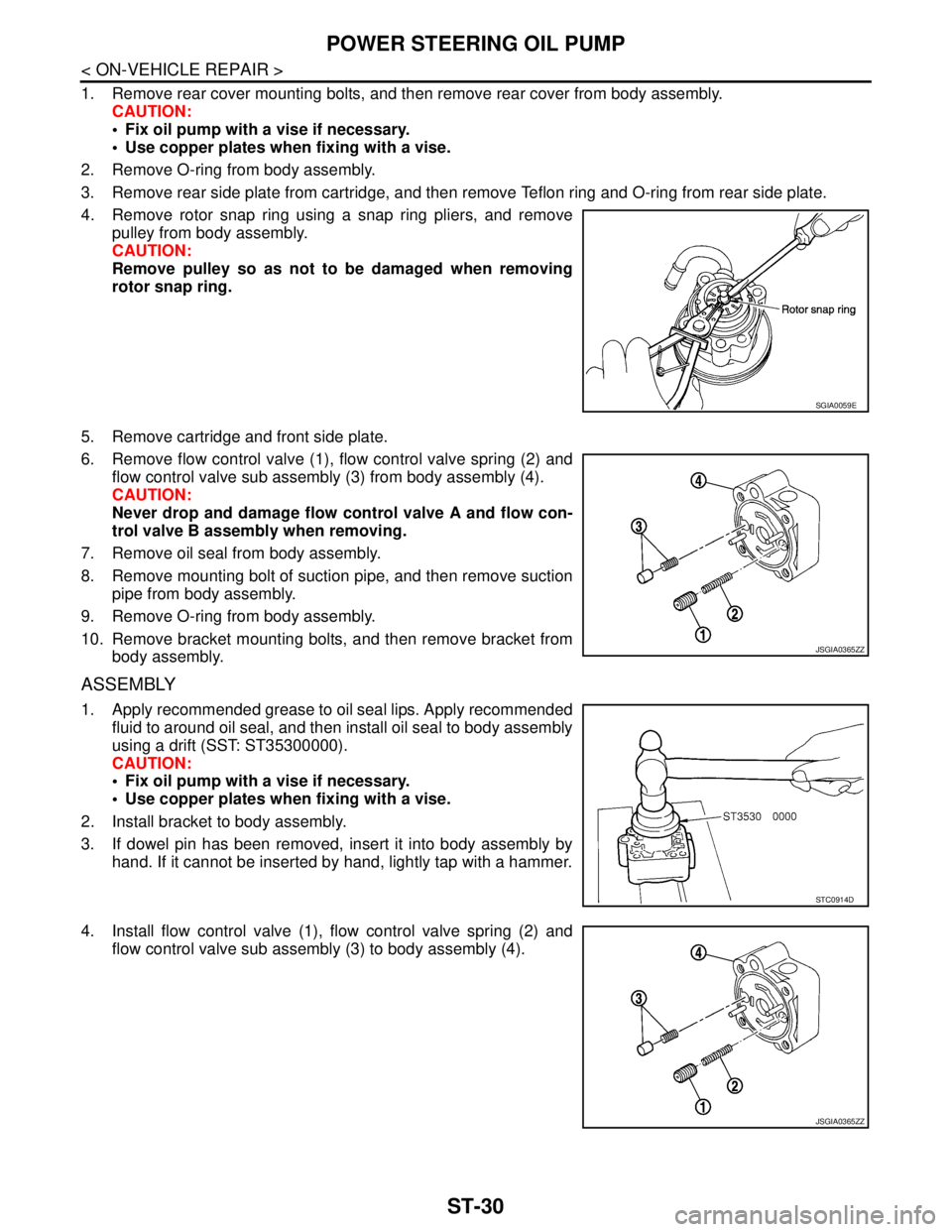
4. Remove rotor snap ring using a snap ring pliers, and remove
pulley from body assembly.
CAUTION:
Remove pulley so as not to be damaged when removing
rotor snap ring.
5. Remove cartridge and front side plate.
6. Remove flow control valve (1), flow control valve spring (2) and
flow control valve sub assembly (3) from body assembly (4).
CAUTION:
Never drop and damage flow control valve A and flow con-
trol valve B assembly when removing.
7. Remove oil seal from body assembly.
8. Remove mounting bolt of suction pipe, and then remove suction
pipe from body assembly.
9. Remove O-ring from body assembly.
10. Remove bracket mounting bolts, and then remove bracket from
body assembly.
ASSEMBLY
1. Apply recommended grease to oil seal lips. Apply recommended
fluid to around oil seal, and then install oil seal to body assembly
using a drift (SST: ST35300000).
CAUTION:
Fix oil pump with a vise if necessary.
Use copper plates when fixing with a vise.
2. Install bracket to body assembly.
3. If dowel pin has been removed, insert it into body assembly by
hand. If it cannot be inserted by hand, lightly tap with a hammer.
4. Install flow control valve (1), flow control valve spring (2) and
flow control valve sub assembly (3) to body assembly (4).
SGIA0059E
JSGIA0365ZZ
STC0914D
JSGIA0365ZZ
Page 4432 of 5121
STC-4
< FUNCTION DIAGNOSIS >
EPS SYSTEM
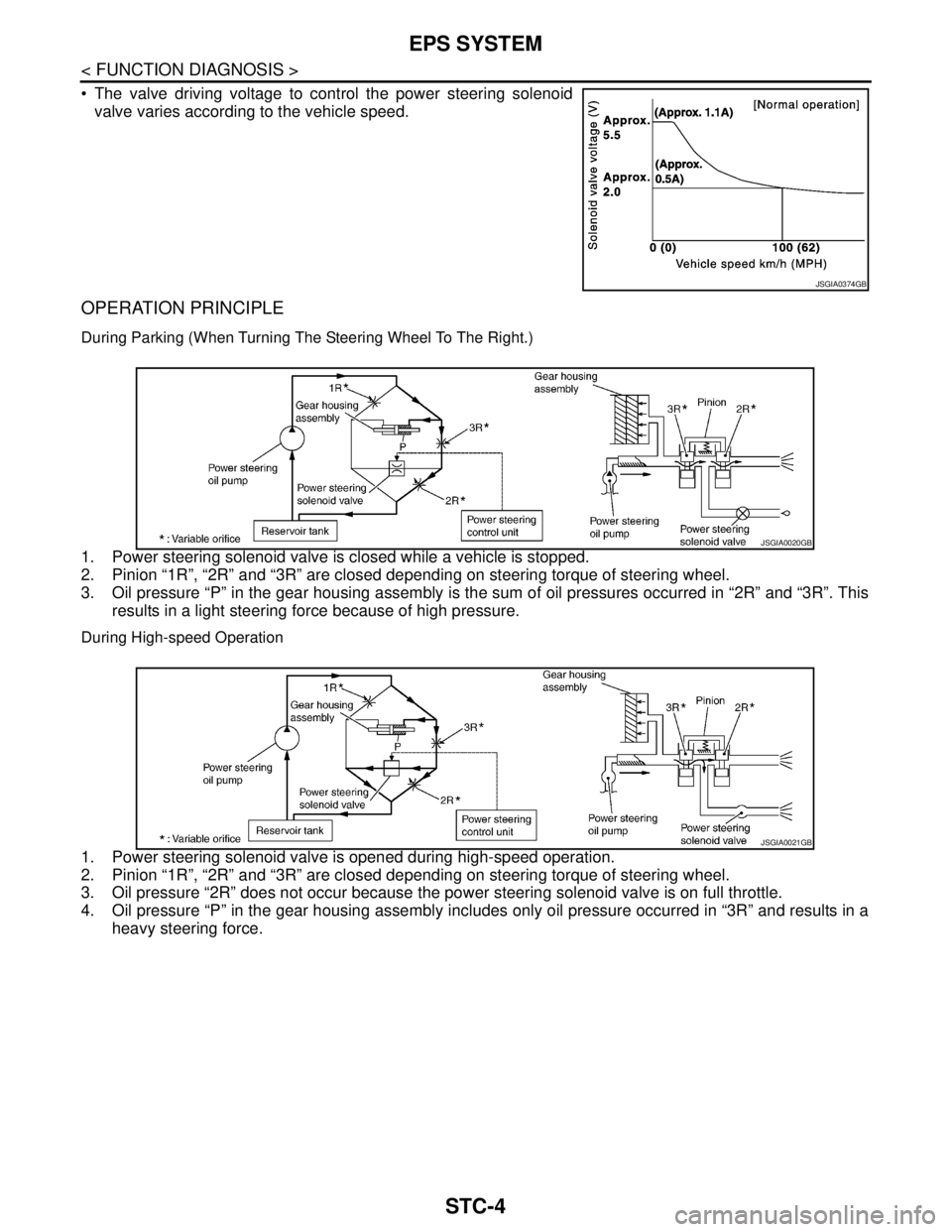
The valve driving voltage to control the power steering solenoid
valve varies according to the vehicle speed.
OPERATION PRINCIPLE
During Parking (When Turning The Steering Wheel To The Right.)
1. Power steering solenoid valve is closed while a vehicle is stopped.
2. Pinion “1R”, “2R” and “3R” are closed depending on steering torque of steering wheel.
3. Oil pressure “P” in the gear housing assembly is the sum of oil pressures occurred in “2R” and “3R”. This
results in a light steering force because of high pressure.
During High-speed Operation
1. Power steering solenoid valve is opened during high-speed operation.
2. Pinion “1R”, “2R” and “3R” are closed depending on steering torque of steering wheel.
3. Oil pressure “2R” does not occur because the power steering solenoid valve is on full throttle.
4. Oil pressure “P” in the gear housing assembly includes only oil pressure occurred in “3R” and results in a
heavy steering force.
JSGIA0374GB
JSGIA0020GB
JSGIA0021GB
Page 4445 of 5121
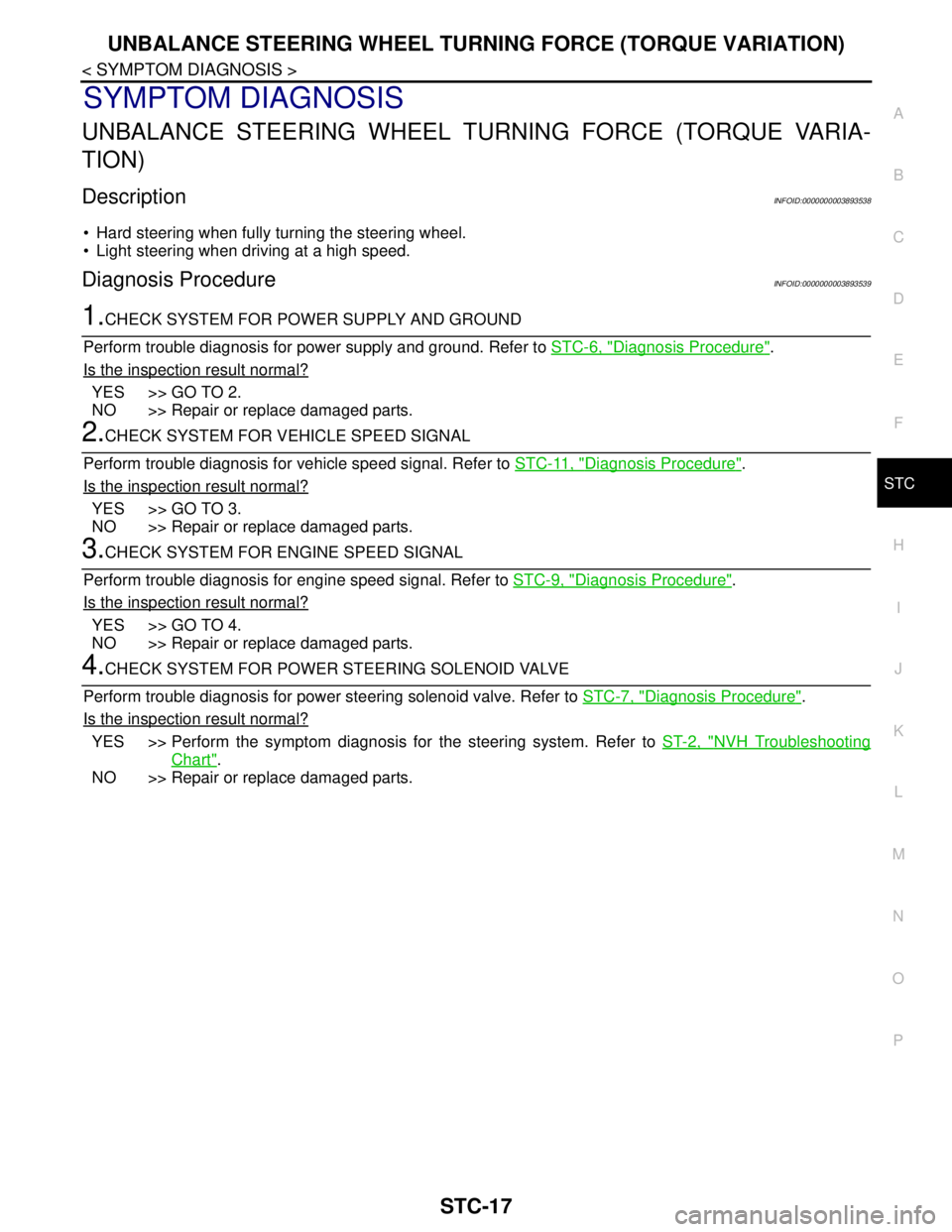
UNBALANCE STEERING WHEEL TURNING FORCE (TORQUE VARIATION)
STC-17
< SYMPTOM DIAGNOSIS >
C
D
E
F
H
I
J
K
L
MA
B
STC
N
O
P
SYMPTOM DIAGNOSIS
UNBALANCE STEERING WHEEL TURNING FORCE (TORQUE VARIA-
TION)
DescriptionINFOID:0000000003893538
Hard steering when fully turning the steering wheel.
Light steering when driving at a high speed.
Diagnosis ProcedureINFOID:0000000003893539
1.CHECK SYSTEM FOR POWER SUPPLY AND GROUND
Perform trouble diagnosis for power supply and ground. Refer to STC-6, "
Diagnosis Procedure".
Is the inspection result normal?
YES >> GO TO 2.
NO >> Repair or replace damaged parts.
2.CHECK SYSTEM FOR VEHICLE SPEED SIGNAL
Perform trouble diagnosis for vehicle speed signal. Refer to STC-11, "
Diagnosis Procedure".
Is the inspection result normal?
YES >> GO TO 3.
NO >> Repair or replace damaged parts.
3.CHECK SYSTEM FOR ENGINE SPEED SIGNAL
Perform trouble diagnosis for engine speed signal. Refer to STC-9, "
Diagnosis Procedure".
Is the inspection result normal?
YES >> GO TO 4.
NO >> Repair or replace damaged parts.
4.CHECK SYSTEM FOR POWER STEERING SOLENOID VALVE
Perform trouble diagnosis for power steering solenoid valve. Refer to STC-7, "
Diagnosis Procedure".
Is the inspection result normal?
YES >> Perform the symptom diagnosis for the steering system. Refer to ST-2, "NVH Troubleshooting
Chart".
NO >> Repair or replace damaged parts.
Page 4485 of 5121
![NISSAN TEANA 2008 Service Manual TM-12
< BASIC INSPECTION >[CVT: RE0F09B]
INSPECTION AND ADJUSTMENT
INSPECTION AND ADJUSTMENT
ADDITIONAL SERVICE WHEN REPLACING CONTROL UNIT
ADDITIONAL SERVICE WHEN REPLACING CONTROL UNIT : Precaution](/img/5/57391/w960_57391-4484.png "NISSAN TEANA 2008 Service Manual TM-12
< BASIC INSPECTION >[CVT: RE0F09B]
INSPECTION AND ADJUSTMENT
INSPECTION AND ADJUSTMENT
ADDITIONAL SERVICE WHEN REPLACING CONTROL UNIT
ADDITIONAL SERVICE WHEN REPLACING CONTROL UNIT : Precaution")
TM-12
< BASIC INSPECTION >[CVT: RE0F09B]
INSPECTION AND ADJUSTMENT
INSPECTION AND ADJUSTMENT
ADDITIONAL SERVICE WHEN REPLACING CONTROL UNIT
ADDITIONAL SERVICE WHEN REPLACING CONTROL UNIT : Precaution for TCM
and CVT Assembly Replacement
INFOID:0000000003848916
CAUTION:
• Check if new data (Unit ID) are entered correctly after replacing CVT assembly and erasing data in
TCM. (Connect CONSULT-III, and then turn ignition switch OFF.)
When replacing CVT assembly or TCM, refer to the pattern table below and erase the EEPROM in the
TCM if necessary.
EEPROM ERASING PATTERNS
METHOD FOR ERASING THE EEPROM IN THE TCM
1. Turn ignition switch ON.
2. Move selector lever to “R” position.
3. Perform “Self-Diagnostic Results” mode for “TRANSMISSION”.
4. Press the brake pedal and turn the brake switch ON.
5. Press the accelerator pedal (0.5/8 - 4/8 throttle) not to exceed the half, and hold it in the half or less open
position. (This will set the closed throttle position signal to OFF and the wide open throttle position signal
to OFF.)
6. Perform “ERASE”.
7. Wait 3 seconds and then release the accelerator pedal.
8. Turn ignition switch OFF.
METHOD FOR WRITING DATA FROM THE ROM ASSEMBLY IN THE TRANSAXLE
In the following procedure, the TCM reads data from the ROM assembly and writes it to the EEPROM in the
TCM.
1. Erase the EEPROM in the TCM.
2. Move selector lever to “P” position.
3. Turn ignition switch ON.
CHECK METHOD
Standard: About 2 seconds after the ignition switch ON, the CVT indicator lamp lights up for 2 seconds.
Non-standard: Even after the ignition switch ON, the CVT indicator lamp does not light up after 2 seconds or
illuminates immediately.
CAUTION:
Perform in the “P” or “N” position.
Action for Non-standard
Replace the CVT assembly.
Replace the TCM.
CVT assembly TCM Erasing EEPROM in TCM Remarks
Replaced Replaced Not requiredNot required because the EEPROM in the TCM is in
the default state. (CVT assembly must be replaced
first.)
Not replaced Replaced Not requiredNot required because the EEPROM in the TCM is in
the default state.
Replaced Not replaced RequiredRequired because data has been written in the EE-
PROM in the TCM and because the TCM cannot write
data from the ROM assembly in the transmission.
Page 4609 of 5121
![NISSAN TEANA 2008 Service Manual TM-136
< PRECAUTION >[CVT: RE0F09B]
PRECAUTIONS
Precaution for Procedure without Cowl Top Cover
INFOID:0000000003897196
When performing the procedure after removing cowl top cover, cover
the lower end](/img/5/57391/w960_57391-4608.png "NISSAN TEANA 2008 Service Manual TM-136
< PRECAUTION >[CVT: RE0F09B]
PRECAUTIONS
Precaution for Procedure without Cowl Top Cover
INFOID:0000000003897196
When performing the procedure after removing cowl top cover, cover
the lower end")
TM-136
< PRECAUTION >[CVT: RE0F09B]
PRECAUTIONS
Precaution for Procedure without Cowl Top Cover
INFOID:0000000003897196
When performing the procedure after removing cowl top cover, cover
the lower end of windshield with urethane, etc.
Precaution for On Board Diagnosis (OBD) System of CVT and EngineINFOID:0000000003849068
The ECM has an on board diagnostic system. It will light up the malfunction indicator (MI) to warn the driver of
a malfunction causing emission deterioration.
CAUTION:
Be sure to turn the ignition switch OFF and disconnect the battery cable from the negative terminal
before any repair or inspection work. The open/short circuit of related switches, sensors, solenoid
valves, etc. will cause the MI to light up.
Be sure to connect and lock the connectors securely after work. A loose (unlocked) connector will
cause the MI to light up due to an open circuit. (Be sure the connector is free from water, grease, dirt,
bent terminals, etc.)
Be sure to route and secure the harnesses properly after work. Interference of the harness with a
bracket, etc. may cause the MI to light up due to a short circuit.
Be sure to connect rubber tubes properly after work. A misconnected or disconnected rubber tube
may cause the MI to light up due to a malfunction of the EVAP system or fuel injection system, etc.
Be sure to erase the unnecessary malfunction information (repairs completed) from the TCM and
ECM before returning the vehicle to the customer.
Precaution for TCM and CVT Assembly ReplacementINFOID:0000000003849069
CAUTION:
Check if new data (Unit ID) are entered correctly after replacing CVT assembly and erasing data in
TCM. (Connect CONSULT-III, and then turn ignition switch OFF.)
When replacing CVT assembly or TCM, refer to the pattern table below and erase the EEPROM in the
TCM if necessary.
EEPROM ERASING PATTERNS
Removal and Installation Procedure for CVT Unit ConnectorINFOID:0000000003849070
REMOVAL
PIIB3706J
CVT assembly TCM Erasing EEPROM in TCM Remarks
Replaced Replaced Not requiredNot required because the EEPROM in the TCM is in
the default state. (CVT assembly must be replaced
first.)
Not replaced Replaced Not requiredNot required because the EEPROM in the TCM is in
the default state.
Replaced Not replaced RequiredRequired because data has been written in the EE-
PROM in the TCM and because the TCM cannot write
data from the ROM assembly in the transmission.