torque NISSAN TEANA 2008 Owner's Guide
[x] Cancel search | Manufacturer: NISSAN, Model Year: 2008, Model line: TEANA, Model: NISSAN TEANA 2008Pages: 5121, PDF Size: 69.03 MB
Page 1133 of 5121
CO-10
< ON-VEHICLE MAINTENANCE >
ENGINE COOLANT
6. Install air duct assembly and air cleaner cases (upper and lower) assembly. Refer to EM-26, "Exploded
View".
7. Install radiator cap.
8. Warm up engine until opening thermostat. Standard for warming-up time is approximately 10 minutes at
3,000 rpm.
Check thermostat opening condition by touching radiator hose (lower) to see a flow of warm water.
CAUTION:
Watch water temperature gauge so as not to overheat engine.
9. Stop the engine and cool down to less than approximately 50°C (122°F).
Cool down using fan to reduce the time.
If necessary, refill radiator up to filler neck with engine coolant.
CAUTION:
Never adhere the engine coolant to electronic equipments. (alternator etc.)
10. Refill reservoir tank to “MAX” level line with engine coolant.
11. Repeat steps 7 through 10 two or more times with radiator cap installed until engine coolant level no
longer drops.
12. Check cooling system for leakage with engine running.
13. Warm up the engine, and check for sound of engine coolant flow while running engine from idle up to
3,000 rpm with heater temperature controller set at several position between “COOL” and “WARM”.
Sound may be noticeable at heater unit.
14. Repeat step 13 three times.
15. If sound is heard, bleed air from cooling system by repeating step 5, and steps from 7 to 14 until engine
coolant level no longer drops.
FlushingINFOID:0000000003793169
1. Install reservoir tank if removed, and radiator drain plug.
CAUTION:
Be sure to clean drain plug and install with new O-ring.
If water drain plugs on cylinder block are removed, close and tighten them. Refer to EM-110, "
Dis-
assembly and Assembly".
2. Remove air duct assembly and air cleaner cases (upper and lower) assembly. Refer to EM-26, "
Exploded
View".
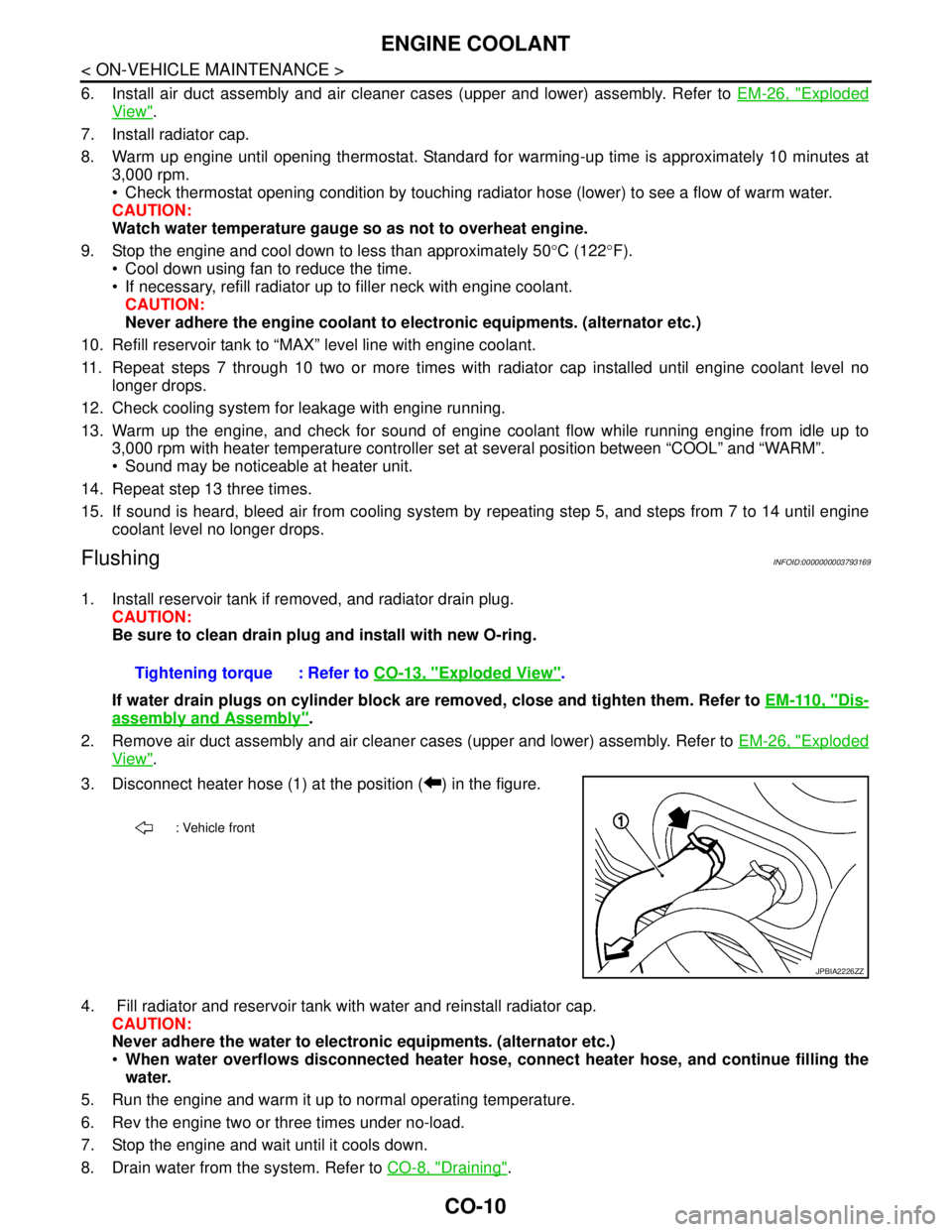
3. Disconnect heater hose (1) at the position ( ) in the figure.
4. Fill radiator and reservoir tank with water and reinstall radiator cap.
CAUTION:
Never adhere the water to electronic equipments. (alternator etc.)
When water overflows disconnected heater hose, connect heater hose, and continue filling the
water.
5. Run the engine and warm it up to normal operating temperature.
6. Rev the engine two or three times under no-load.
7. Stop the engine and wait until it cools down.
8. Drain water from the system. Refer to CO-8, "
Draining". Tightening torque : Refer to CO-13, "
Exploded View".
: Vehicle front
JPBIA2226ZZ
Page 1140 of 5121
COOLING FAN
CO-17
< ON-VEHICLE REPAIR >
C
D
E
F
G
H
I
J
K
L
MA
CO
N
P O
CAUTION:
Be careful not to damage or scratch on radiator core.
INSTALLATION
Note the following, and install in the reverse order of removal.
CAUTION:
Only use genuine parts for cooling fan mounting bolt and observe the specified torque (to prevent
radiator from being damaged).
NOTE:
Cooling fans are controlled by ECM. For details, refer to EC-60, "
System Diagram".
Disassembly and AssemblyINFOID:0000000003793177
DISASSEMBLY
1. Remove cooling fan mounting nuts, and then remove the cooling fans (RH and LH).
2. Remove fan motors (RH and LH).
ASSEMBLY
Note the following, and assemble in the reverse order of disassembly.
CAUTION:
RH and LH cooling fans are different. Be careful not to misassemble them.
Install each fan in the following position.
Secure the harness tightly to the fan shroud to prevent the fan rotation area from being loose.
Apply high thread locking sealant on for motor shaft.
InspectionINFOID:0000000003793178
INSPECTION AFTER DISASSEMBLY
Cooling Fan
Inspect cooling fan for crack or unusual bend.
If anything is found, replace cooling fan.Right side : 11 blades
Left side : 9 blades
Page 1141 of 5121
CO-18
< ON-VEHICLE REPAIR >
WATER PUMP
WATER PUMP
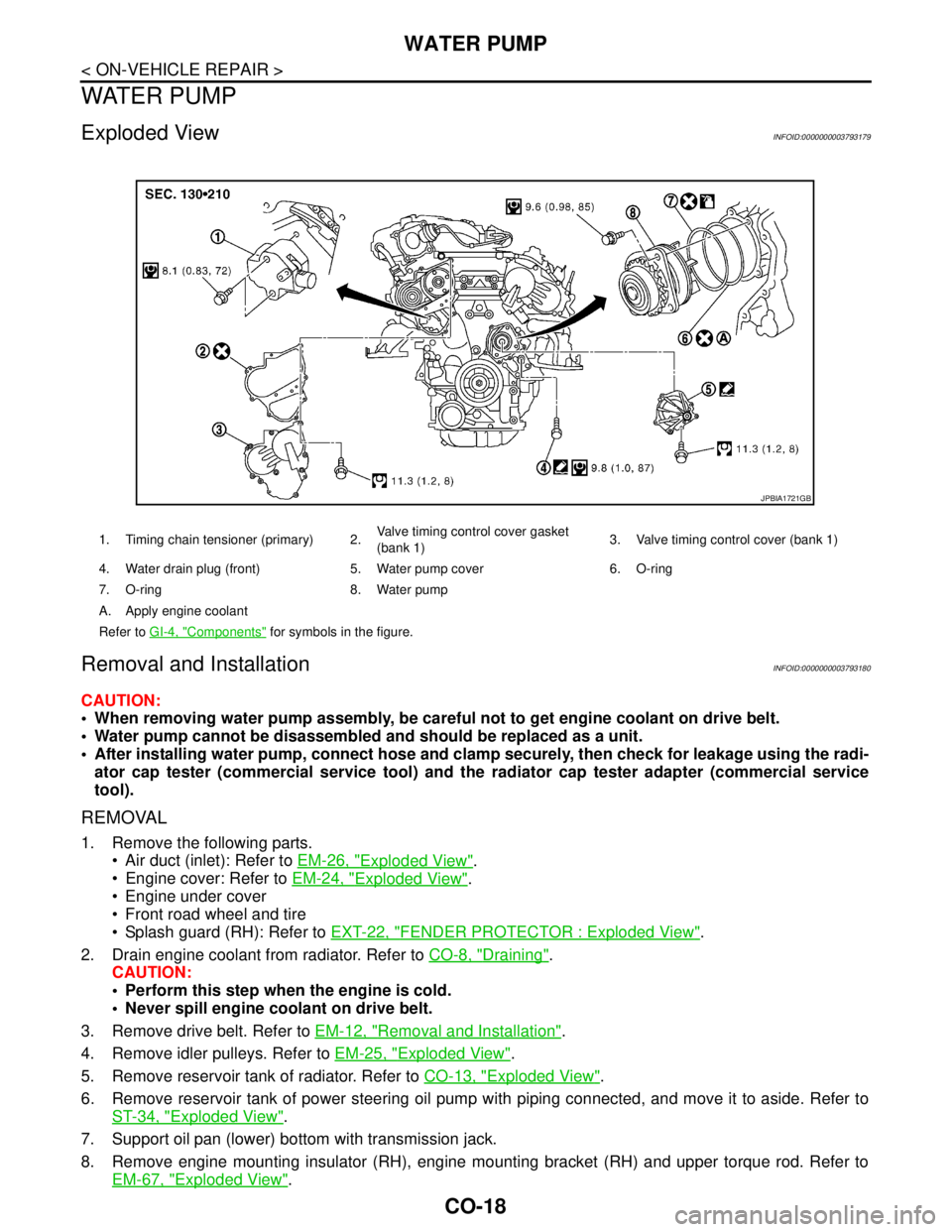
Exploded ViewINFOID:0000000003793179
Removal and InstallationINFOID:0000000003793180
CAUTION:
When removing water pump assembly, be careful not to get engine coolant on drive belt.
Water pump cannot be disassembled and should be replaced as a unit.
After installing water pump, connect hose and clamp securely, then check for leakage using the radi-
ator cap tester (commercial service tool) and the radiator cap tester adapter (commercial service
tool).
REMOVAL
1. Remove the following parts.
Air duct (inlet): Refer to EM-26, "
Exploded View".
Engine cover: Refer to EM-24, "
Exploded View".
Engine under cover
Front road wheel and tire
Splash guard (RH): Refer to EXT-22, "
FENDER PROTECTOR : Exploded View".
2. Drain engine coolant from radiator. Refer to CO-8, "
Draining".
CAUTION:
Perform this step when the engine is cold.
Never spill engine coolant on drive belt.
3. Remove drive belt. Refer to EM-12, "
Removal and Installation".
4. Remove idler pulleys. Refer to EM-25, "
Exploded View".
5. Remove reservoir tank of radiator. Refer to CO-13, "
Exploded View".
6. Remove reservoir tank of power steering oil pump with piping connected, and move it to aside. Refer to
ST-34, "
Exploded View".
7. Support oil pan (lower) bottom with transmission jack.
8. Remove engine mounting insulator (RH), engine mounting bracket (RH) and upper torque rod. Refer to
EM-67, "
Exploded View".
1. Timing chain tensioner (primary) 2.Valve timing control cover gasket
(bank 1)3. Valve timing control cover (bank 1)
4. Water drain plug (front) 5. Water pump cover 6. O-ring
7. O-ring 8. Water pump
A. Apply engine coolant
Refer to GI-4, "
Components" for symbols in the figure.
JPBIA1721GB
Page 1409 of 5121
![NISSAN TEANA 2008 Owners Guide HOOD
DLK-193
< ON-VEHICLE REPAIR >[WITH INTELLIGENT KEY SYSTEM]
C
D
E
F
G
H
I
J
L
MA
B
DLK
N
O
P
Front grille: Refer to EXT-18, "Removal and Installation".
INSTALLATION
Install in the reverse order](/img/5/57391/w960_57391-1408.png "NISSAN TEANA 2008 Owners Guide HOOD
DLK-193
< ON-VEHICLE REPAIR >[WITH INTELLIGENT KEY SYSTEM]
C
D
E
F
G
H
I
J
L
MA
B
DLK
N
O
P
Front grille: Refer to EXT-18, \"Removal and Installation\".
INSTALLATION
Install in the reverse order")
HOOD
DLK-193
< ON-VEHICLE REPAIR >[WITH INTELLIGENT KEY SYSTEM]
C
D
E
F
G
H
I
J
L
MA
B
DLK
N
O
P
Front grille: Refer to EXT-18, "Removal and Installation".
INSTALLATION
Install in the reverse order of removal.
CAUTION:
After installing, perform hood fitting adjustment. Refer to DLK-193, "
HOOD ASSEMBLY : Adjust-
ment".
After installing, perform front washer nozzle and tube inspection and adjustment. Refer to WW-102,
"Inspection and Adjustment".
HOOD ASSEMBLY : AdjustmentINFOID:0000000003813385
Check the clearance and the surface height between hood and each part visually and by touching. (Fitting
standard dimension in the table below should be satisfied.
If the clearance and the surface height are out of specification, adjust them according to the procedures
shown below.
Unit: mm (in)
1. Remove hood lock and adjust the height by rotating hood bumper rubber (side, lower) until hood becomes
1 to1.5 mm (0.039 to 0.059 in) lower than fender.
2. Temporarily tighten hood lock assembly, and position by engaging it with hood striker. Check hood lock
and striker for looseness and adjust the clearance and evenness with striker to satisfy the specification.
3. Adjust A and B shown in the figure to the following value with hood's own weight by dropping it from
approximately 200 mm (7.874 in) height or by pressing hood lightly [approximately 29 N (3.0 kg, 6.5 lb)].
4. After adjustment, tighten lock bolts to the specified torque.
HOOD HINGE
Portion StandardDifference
(RH/LH, MAX)
Hood – Front bumper
fasciaA – A D Clearance3.7 – 8.3
(0.146 – 0.315)2.0
(0.079)
Hood – Front combina-
tion lampB – B E Clearance2.4 – 6.8
(0.094 – 0.268)2.5
(0.098)
Hood – Front fender C – CF Clearance3.1 – 6.1
(0.122 – 0.240)2.0
(0.079)
G Surface height−1.5 – 1.5
(−0.059 – 0.059)—
1. Hood striker 2. Primary latch 3. Secondary striker
4. Secondary latch
A : 20.0 mm (0.787 in)
B : 6.8 mm (0.268 in)
JMKIA2399ZZ
Page 1419 of 5121
![NISSAN TEANA 2008 Owners Guide FRONT DOOR
DLK-203
< ON-VEHICLE REPAIR >[WITH INTELLIGENT KEY SYSTEM]
C
D
E
F
G
H
I
J
L
MA
B
DLK
N
O
P
Check door hinge rotating part for poor lubrication. If necessary, apply body grease.
After i](/img/5/57391/w960_57391-1418.png "NISSAN TEANA 2008 Owners Guide FRONT DOOR
DLK-203
< ON-VEHICLE REPAIR >[WITH INTELLIGENT KEY SYSTEM]
C
D
E
F
G
H
I
J
L
MA
B
DLK
N
O
P
Check door hinge rotating part for poor lubrication. If necessary, apply body grease.
After i")
FRONT DOOR
DLK-203
< ON-VEHICLE REPAIR >[WITH INTELLIGENT KEY SYSTEM]
C
D
E
F
G
H
I
J
L
MA
B
DLK
N
O
P
Check door hinge rotating part for poor lubrication. If necessary, apply body grease.
After installation, perform the fitting adjustment. Refer to DLK-203, "
DOOR ASSEMBLY : Adjust-
ment".
After installation, apply touch-up paint (the body color) onto the head of door hinge mounting nuts.
DOOR ASSEMBLY : AdjustmentINFOID:0000000003813396
Check the clearance and surface height between front door and each part by visually and touching.
If the clearance and the surface height are out of specification, adjust them according to the procedures
shown below.
Unit: mm (in)
1. Remove front fender. Refer to DLK-199, "Removal and Installation".
2. Loosen door hinge mounting nuts on door side.
3. Adjust the surface height of front door according to the fitting standard dimension.
4. Temporarily tighten door hinge mounting nuts on door side.
5. Loosen door hinge mounting bolts on body side.
6. Raise front door at rear end to adjust clearance of the front door according to the fitting standard dimen-
sion.
7. After adjustment tighten bolts and nuts to the specified torque.
8. Install front fender. Refer to DLK-199, "
Removal and Installation".
DOOR STRIKER ADJUSTMENT
Adjust door striker so that it becomes parallel with door lock insertion direction.
DOOR STRIKER
DOOR STRIKER : Exploded ViewINFOID:0000000003819380
Portion Clearance Surface height
Front fender – Front door A – A 2.6 – 4.6 (0.102 – 0.181)−1.0 – 1.0 (−0.039 – 0.039)
Front door – Rear door B – B 3.6 – 5.6 (0.142 – 0.220)−1.0 – 1.0 (−0.039 – 0.039)
JMKIA2384ZZ
Page 1425 of 5121
![NISSAN TEANA 2008 Owners Guide REAR DOOR
DLK-209
< ON-VEHICLE REPAIR >[WITH INTELLIGENT KEY SYSTEM]
C
D
E
F
G
H
I
J
L
MA
B
DLK
N
O
P
Check door hinge rotating part for poor lubrication. If necessary, apply body grease.
After in](/img/5/57391/w960_57391-1424.png "NISSAN TEANA 2008 Owners Guide REAR DOOR
DLK-209
< ON-VEHICLE REPAIR >[WITH INTELLIGENT KEY SYSTEM]
C
D
E
F
G
H
I
J
L
MA
B
DLK
N
O
P
Check door hinge rotating part for poor lubrication. If necessary, apply body grease.
After in")
REAR DOOR
DLK-209
< ON-VEHICLE REPAIR >[WITH INTELLIGENT KEY SYSTEM]
C
D
E
F
G
H
I
J
L
MA
B
DLK
N
O
P
Check door hinge rotating part for poor lubrication. If necessary, apply body grease.
After installation, perform the fitting adjustment. Refer to DLK-209, "
DOOR ASSEMBLY : Adjust-
ment".
After installation, apply touch-up paint (the body color) onto the head of door hinge mounting nuts.
DOOR ASSEMBLY : AdjustmentINFOID:0000000003813405
Check the clearance and surface height between rear door and each part by visually and touching.
If the clearance and surface height are out of specification, adjust them according to the procedures shown
below.
Unit: mm (in)
1. Remove center pillar lower garnish. Refer to INT-39, "Removal and Installation".
2. Loosen door hinge mounting nuts on door side.
3. Adjust the surface height of rear door according to the fitting standard dimension.
4. Temporarily tighten door hinge mounting nuts on door side.
5. Loosen door hinge mounting nuts and bolts on body side.
6. Raise rear door at rear end to adjust clearance of the rear door according to the fitting standard dimen-
sion.
7. After adjustment, tighten bolts and nuts to the specified torque.
8. Install center pillar lower garnish. Refer to INT-39, "
Removal and Installation".
DOOR STRIKER ADJUSTMENT
Adjust door striker so that it becomes parallel with door lock insertion direction.
DOOR STRIKER
DOOR STRIKER : Exploded ViewINFOID:0000000003819605
Portion Clearance Surface height
Front door – Rear door B – B 3.6 – 5.6 (0.142 – 0.220) -1.0 – 1.0 (-0.039 – 0.039)
Rear door – Body side outer C – C 2.6 – 4.6 (0.102 – 0.181) -1.0 – 1.0 (-0.039 – 0.039)
JMKIA2385ZZ
Page 1547 of 5121
![NISSAN TEANA 2008 Owners Guide EC-86
< FUNCTION DIAGNOSIS >[VQ25DE, VQ35DE]
INTAKE VALVE TIMING CONTROL
INTAKE VALVE TIMING CONTROL
System DiagramINFOID:0000000003856494
System DescriptionINFOID:0000000003856495
INPUT/OUTPUT SIGNAL](/img/5/57391/w960_57391-1546.png "NISSAN TEANA 2008 Owners Guide EC-86
< FUNCTION DIAGNOSIS >[VQ25DE, VQ35DE]
INTAKE VALVE TIMING CONTROL
INTAKE VALVE TIMING CONTROL
System DiagramINFOID:0000000003856494
System DescriptionINFOID:0000000003856495
INPUT/OUTPUT SIGNAL")
EC-86
< FUNCTION DIAGNOSIS >[VQ25DE, VQ35DE]
INTAKE VALVE TIMING CONTROL
INTAKE VALVE TIMING CONTROL
System DiagramINFOID:0000000003856494
System DescriptionINFOID:0000000003856495
INPUT/OUTPUT SIGNAL CHART
*: This signal is sent to the ECM through CAN communication line
SYSTEM DESCRIPTION
This mechanism hydraulically controls cam phases continuously with the fixed operating angle of the intake
valve.
The ECM receives signals such as crankshaft position, camshaft position, engine speed, and engine coolant
temperature. Then, the ECM sends ON/OFF pulse duty signals to the intake valve timing (IVT) control sole-
noid valve depending on driving status. This makes it possible to control the shut/open timing of the intake
valve to increase engine torque in low/mid speed range and output in high-speed range.
JMBIA1491GB
Sensor Input signal to ECM ECM function Actuator
Crankshaft position sensor (POS)
Engine speed and piston position
Intake valve
timing controlIntake valve timing control
solenoid valve Camshaft position sensor (PHASE)
Engine oil temperature sensor Engine oil temperature
Engine coolant temperature sensor Engine coolant temperature
ABS actuator and electric unit (control unit) Vehicle speed*
JMBIA0060GB
Page 1869 of 5121
![NISSAN TEANA 2008 Owners Guide EC-408
< PRECAUTION >[VQ25DE, VQ35DE]
PRECAUTIONS
When measuring ECM signals with a circuit tester, never allow
the two tester probes to contact.
Accidental contact of probes will cause a short circu](/img/5/57391/w960_57391-1868.png "NISSAN TEANA 2008 Owners Guide EC-408
< PRECAUTION >[VQ25DE, VQ35DE]
PRECAUTIONS
When measuring ECM signals with a circuit tester, never allow
the two tester probes to contact.
Accidental contact of probes will cause a short circu")
EC-408
< PRECAUTION >[VQ25DE, VQ35DE]
PRECAUTIONS
When measuring ECM signals with a circuit tester, never allow
the two tester probes to contact.
Accidental contact of probes will cause a short circuit and
damage the ECM power transistor.
Never use ECM ground terminals when measuring input/out-
put voltage. Doing so may result in damage to the ECM's tran-
sistor. Use a ground other than ECM terminals, such as the
ground.
B1 indicates bank 1, B2 indicates bank 2 as shown in the fig-
ure.
Never operate fuel pump when there is no fuel in lines.
Tighten fuel hose clamps to the specified torque.
Never depress accelerator pedal when starting.
Immediately after starting, never rev up engine unnecessarily.
Never rev up engine just prior to shutdown.
SEF348N
SEC893C
SEF709Y
Page 1881 of 5121

EM-6
< PRECAUTION >
PRECAUTIONS
3. Disconnect both battery cables. The steering lock will remain released with both battery cables discon-
nected and the steering wheel can be turned.
4. Perform the necessary repair operation.
5. When the repair work is completed, re-connect both battery cables. With the brake pedal released, turn
the push-button ignition switch from ACC position to ON position, then to LOCK position. (The steering
wheel will lock when the push-button ignition switch is turned to LOCK position.)
6. Perform self-diagnosis check of all control units using CONSULT-III.
Precaution for Drain Engine Coolant and Engine OilINFOID:0000000003802227
Drain engine coolant and engine oil when the engine is cooled.
Precaution for Disconnecting Fuel PipingINFOID:0000000003802228
Before starting work, check no fire or spark producing items are in the work area.
Release fuel pressure before disconnecting and disassembly.
After disconnecting pipes, plug openings to stop fuel leakage.
Precaution for Removal and DisassemblyINFOID:0000000003802229
When instructed to use SST, use the specified tools. Always be careful to work safely, avoid forceful or unin-
structed operations.
Exercise maximum care to avoid damage to mating or sliding surfaces.
Dowel pins are used for several parts alignment. When replacing and reassembling parts with dowel pins,
check that dowel pins are installed in the original position.
Cover openings of engine system with a tape or the equivalent, if necessary, to seal out foreign materials.
Mark and arrange disassembly parts in an organized way for easy troubleshooting and reassembly.
When loosening nuts and bolts, as a basic rule, start with the one furthest outside, then the one diagonally
opposite, and so on. If the order of loosening is specified, do exactly as specified. Power tools may be used
in the step.
Precaution for Inspection, Repair and ReplacementINFOID:0000000003802230
Before repairing or replacing, thoroughly inspect parts. Inspect new replacement parts in the same way, and
replace if necessary.
Precaution for Assembly and InstallationINFOID:0000000003802231
Use torque wrench to tighten bolts or nuts to specification.
When tightening nuts and bolts, as a basic rule, equally tighten in several different steps starting with the
ones in center, then ones on inside and outside diagonally in this order. If the order of tightening is specified,
do exactly as specified.
Replace with new gasket, packing, oil seal or O-ring.
Dowel pins are used for several parts alignment. When replacing and reassembling parts with dowel pins,
check that dowel pins are installed in the original position.
Thoroughly wash, clean, and air-blow each part. Carefully check engine oil or engine coolant passages for
any restriction and blockage.
Avoid damaging sliding or mating surfaces. Completely remove foreign materials such as cloth lint or dust.
Before assembly, oil sliding surfaces well.
Release air within route when refilling after draining engine coolant.
After repairing, start the engine and increase engine speed to check engine coolant, fuel, engine oil, and
exhaust gases for leakage.
Precaution for Angle TighteningINFOID:0000000003802232
Use the angle wrench [SST: KV10112100 (BT8653-A)] for the final tightening of the following engine parts:
- Cylinder head bolts
- Main bearing cap bolts
- Connecting rod cap bolts
- Crankshaft pulley bolt (No the angle wrench is required as bolt flange is provided with notches for angle
tightening)
Never use a torque value for final tightening.
The torque value for these parts are for a preliminary step.
Page 1907 of 5121
EM-32
< ON-VEHICLE REPAIR >
INTAKE MANIFOLD
INTAKE MANIFOLD
Exploded ViewINFOID:0000000003802255
Removal and InstallationINFOID:0000000003802256
REMOVAL
1. Release fuel pressure. Refer to EC-411, "Inspection".
2. Remove intake manifold collector. Refer to EM-28, "
Exploded View".
3. Remove fuel tube and fuel injector assembly. Refer to EM-44, "
Exploded View".
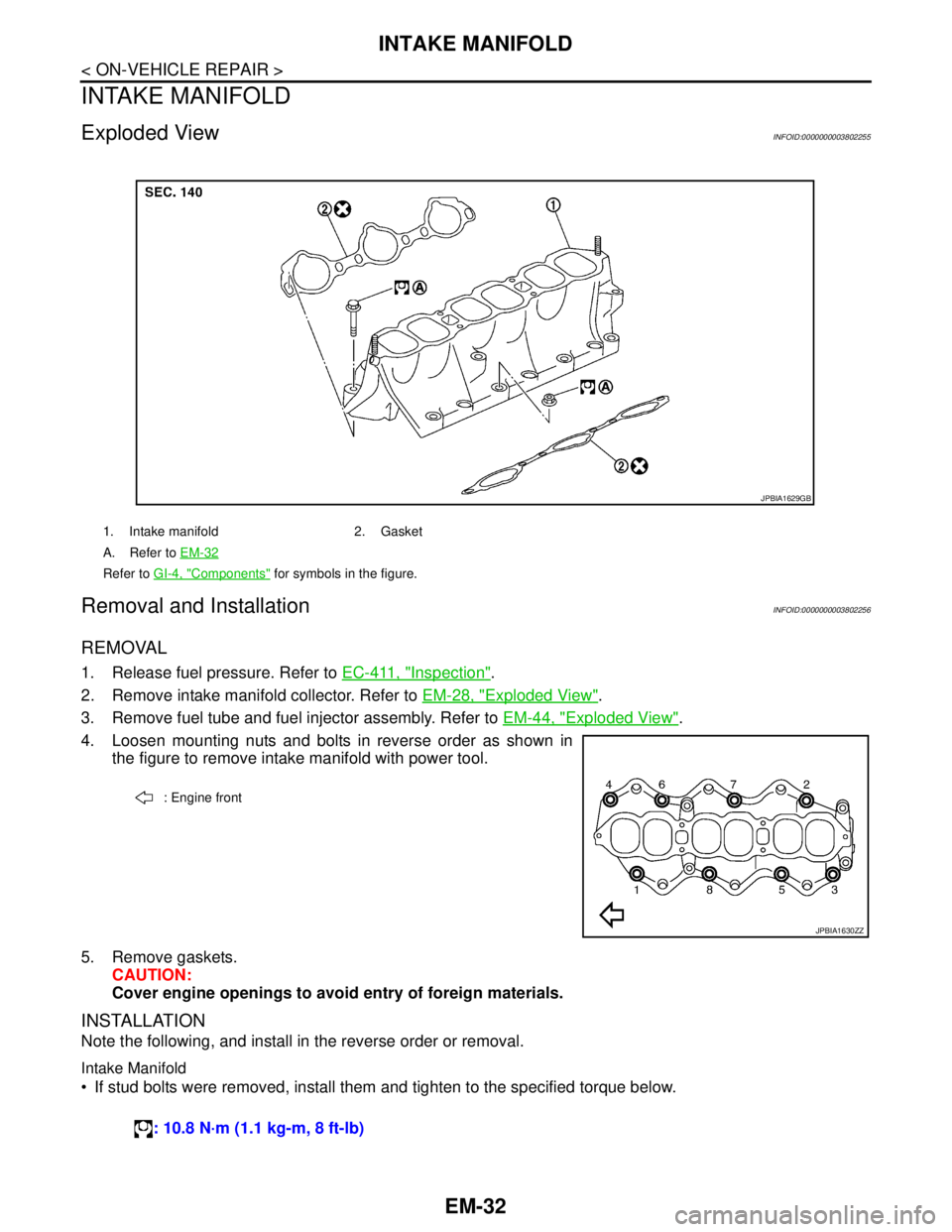
4. Loosen mounting nuts and bolts in reverse order as shown in
the figure to remove intake manifold with power tool.
5. Remove gaskets.
CAUTION:
Cover engine openings to avoid entry of foreign materials.
INSTALLATION
Note the following, and install in the reverse order or removal.
Intake Manifold
If stud bolts were removed, install them and tighten to the specified torque below.
1. Intake manifold 2. Gasket
A. Refer to EM-32
Refer to GI-4, "Components" for symbols in the figure.
JPBIA1629GB
: Engine front
JPBIA1630ZZ
: 10.8 N·m (1.1 kg-m, 8 ft-lb)