stop start NISSAN TEANA 2008 Repair Manual
[x] Cancel search | Manufacturer: NISSAN, Model Year: 2008, Model line: TEANA, Model: NISSAN TEANA 2008Pages: 5121, PDF Size: 69.03 MB
Page 1819 of 5121
![NISSAN TEANA 2008 Repair Manual EC-358
< ECU DIAGNOSIS >[VQ25DE, VQ35DE]
ECM
TP SEN 1-B1 Ignition switch: ON
(Engine stopped)
Selector lever: DAccelerator pedal: Fully released More than 0.36 V
Accelerator pedal: Fully depressed](/img/5/57391/w960_57391-1818.png "NISSAN TEANA 2008 Repair Manual EC-358
< ECU DIAGNOSIS >[VQ25DE, VQ35DE]
ECM
TP SEN 1-B1 Ignition switch: ON
(Engine stopped)
Selector lever: DAccelerator pedal: Fully released More than 0.36 V
Accelerator pedal: Fully depressed")
EC-358
< ECU DIAGNOSIS >[VQ25DE, VQ35DE]
ECM
TP SEN 1-B1 Ignition switch: ON
(Engine stopped)
Selector lever: DAccelerator pedal: Fully released More than 0.36 V
Accelerator pedal: Fully depressed Less than 4.75 V
TP SEN 2-B1*
1 Ignition switch: ON
(Engine stopped)
Selector lever: DAccelerator pedal: Fully released More than 0.36 V
Accelerator pedal: Fully depressed Less than 4.75 V
INT/A TEMP SE Ignition switch: ONIndicates intake air tempera-
ture
START SIGNAL Ignition switch: ON → START → ON OFF → ON → OFF
CLSD THL POS Ignition switch: ON
(Engine stopped)Accelerator pedal: Fully released ON
Accelerator pedal: Slightly depressed OFF
AIR COND SIG Engine: After warming up, idle the
engineAir conditioner switch: OFF OFF
Air conditioner switch: ON
(Compressor operates.)ON
P/N POSI SW Ignition switch: ONSelector lever: P or N ON
Selector lever: Except above OFF
PW/ST SIGNAL Engine: After warming up, idle the
engineSteering wheel: Not being turned OFF
Steering wheel: Being turned ON
LOAD SIGNAL Ignition switch: ONRear window defogger switch: ON
and/or
Lighting switch: 2nd positionON
Rear window defogger switch and lighting
switch: OFFOFF
IGNITION SW Ignition switch: ON → OFF → ON ON → OFF → ON
HEATER FAN SW Engine: After warming up, idle the
engineHeater fan switch: ON ON
Heater fan switch: OFF OFF
BRAKE SW Ignition switch: ONBrake pedal: Fully released OFF
Brake pedal: Slightly depressed ON
INJ PULSE-B1 Engine: After warming up
Selector lever: P or N
Air conditioner switch: OFF
No loadIdle 2.0 - 3.0 msec
2,000 rpm 1.9 - 2.9 msec
INJ PULSE-B2 Engine: After warming up
Selector lever: P or N
Air conditioner switch: OFF
No loadIdle 2.0 - 3.0 msec
2,000 rpm 1.9 - 2.9 msec
IGN TIMING Engine: After warming up
Selector lever: P or N
Air conditioner switch: OFF
No loadIdle 7° - 17° BTDC
2,000 rpm 25° - 45° BTDC
CAL/LD VALUE Engine: After warming up
Selector lever: P or N
Air conditioner switch: OFF
No loadIdle 5% - 35%
2,500 rpm 5% - 35%
MASS AIRFLOW Engine: After warming up
Selector lever: P or N
Air conditioner switch: OFF
No loadIdle 2.0 - 6.0 g·m/s
2,500 rpm 7.0 - 20.0 g·m/s
PURG VOL C/V Engine: After warming up
Selector lever: P or N
Air conditioner switch: OFF
No loadIdle
(Accelerator pedal: Not depressed even
slightly, after engine starting.)0%
2,000 rpm — Monitor Item Condition Values/Status
Page 1821 of 5121
![NISSAN TEANA 2008 Repair Manual EC-360
< ECU DIAGNOSIS >[VQ25DE, VQ35DE]
ECM
IDL A/V LEARN Engine: RunningIdle air volume learning has not been per-
formed yet.YET
Idle air volume learning has already been
performed successfully.](/img/5/57391/w960_57391-1820.png "NISSAN TEANA 2008 Repair Manual EC-360
< ECU DIAGNOSIS >[VQ25DE, VQ35DE]
ECM
IDL A/V LEARN Engine: RunningIdle air volume learning has not been per-
formed yet.YET
Idle air volume learning has already been
performed successfully.")
EC-360
< ECU DIAGNOSIS >[VQ25DE, VQ35DE]
ECM
IDL A/V LEARN Engine: RunningIdle air volume learning has not been per-
formed yet.YET
Idle air volume learning has already been
performed successfully.CMPLT
ENG OIL TEMP Engine: After warming up More than 70°C (158°F)
TRVL AFTER MIL Ignition switch: ONVehicle has traveled after MI has illumi-
nated.0 - 65,535 km
(0 - 40,723 miles)
A/F S1 HTR (B1) Engine: After warming up, idle the engine
(More than 140 seconds after starting engine)4 - 100%
A/F S1 HTR (B2) Engine: After warming up, idle the engine
(More than 140 seconds after starting engine)4 - 100%
AC PRESS SEN Engine: Idle
Both A/C switch and blower fan switch: ON (Compressor operates)1.0 - 4.0 V
VHCL SPEED SE Turn drive wheels and compare CONSULT-III value with the speedometer in-
dication.Almost the same speed as
the speedometer indication
SET VHCL SPD Engine: Running ASCD: OperatingThe preset vehicle speed is
displayed
MAIN SW Ignition switch: ONMAIN switch: Pressed ON
MAIN switch: Released OFF
CANCEL SW Ignition switch: ONCANCEL switch: Pressed ON
CANCEL switch: Released OFF
RESUME/ACC SW Ignition switch: ONRESUME/ACCELERATE switch:
PressedON
RESUME/ACCELERATE switch: Re-
leasedOFF
SET SW Ignition switch: ONSET/COAST switch: Pressed ON
SET/COAST switch: Released OFF
BRAKE SW1
(ASCD brake switch) Ignition switch: ONBrake pedal: Fully released ON
Brake pedal: Slightly depressed OFF
BRAKE SW2
(Stop lamp switch) Ignition switch: ONBrake pedal: Fully released OFF
Brake pedal: Slightly depressed ON
VHCL SPD CUT Ignition switch: ON NON
LO SPEED CUT Ignition switch: ON NON
AT OD MONITOR Ignition switch: ON OFF
AT OD CANCEL Ignition switch: ON OFF
CRUISE LAMP Ignition switch: ONMAIN switch: Pressed at the 1st time →
at the 2nd timeON → OFF
SET LAMP MAIN switch: ON
When vehicle speed is between
40 km/h (25 MPH) and 144 km/h
(89 MPH)ASCD: Operating ON
ASCD: Not operating OFF
ALT DUTY Engine: Idle 0 - 80%
A/F ADJ-B1 Engine: Running−0.330 - 0.330
A/F ADJ-B2 Engine: Running−0.330 - 0.330
BAT CUR SEN Engine speed: Idle
Battery: Fully charged*
2
Selector lever: P or N
Air conditioner switch: OFF
No loadApprox. 2,600 - 3,500 mV Monitor Item Condition Values/Status
Page 1823 of 5121
![NISSAN TEANA 2008 Repair Manual EC-362
< ECU DIAGNOSIS >[VQ25DE, VQ35DE]
ECM
5
(L)11 2
(B)Throttle control motor (Open) Output[Ignition switch: ON]
Engine stopped
Selector lever: D
Accelerator pedal: Fully de-
pressed0 - 14 V](/img/5/57391/w960_57391-1822.png "NISSAN TEANA 2008 Repair Manual EC-362
< ECU DIAGNOSIS >[VQ25DE, VQ35DE]
ECM
5
(L)11 2
(B)Throttle control motor (Open) Output[Ignition switch: ON]
Engine stopped
Selector lever: D
Accelerator pedal: Fully de-
pressed0 - 14 V")
EC-362
< ECU DIAGNOSIS >[VQ25DE, VQ35DE]
ECM
5
(L)11 2
(B)Throttle control motor (Open) Output[Ignition switch: ON]
Engine stopped
Selector lever: D
Accelerator pedal: Fully de-
pressed0 - 14 V
[Ignition switch: ON]
Engine stopped
Selector lever: D
Accelerator pedal: Fully re-
leased0 - 14 V
6
(P)11 2
(B)Throttle control motor (Close) Output[Ignition switch: ON]
Engine stopped
Selector lever: D
Accelerator pedal: Fully re-
leased0 - 14 V
8
(SB)11 2
(B)A/F sensor 1 heater (Bank 2) Output[Engine is running]
Warm-up condition
Idle speed
(More than 140 seconds after
starting engine)2.9 - 8.8 V
9
(L/B)
11 2
(B)Ignition signal No. 3
Output[Engine is running]
Warm-up condition
Idle speed
NOTE:
The pulse cycle changes de-
pending on rpm at idle0 - 0.2 V
10
(G/R)Ignition signal No. 2
11
(Y/R)Ignition signal No. 1
18
(GR/R)Ignition signal No. 6
[Engine is running]
Warm-up condition
Engine speed: 2,000 rpm0.1 - 0.4 V
19
(P)Ignition signal No. 5
21
(W)Ignition signal No. 4
12
(B)— ECM ground — — — Terminal No. Description
ConditionVa l u e
(Approx.)
+ -– Signal nameInput/
OutputJMBIA0031GB
JMBIA0032GB
JMBIA1125GB
JMBIA0030GB
JMBIA0035GB
JMBIA0036GB
Page 1848 of 5121
![NISSAN TEANA 2008 Repair Manual ECM
EC-387
< ECU DIAGNOSIS >[VQ25DE, VQ35DE]
C
D
E
F
G
H
I
J
K
L
MA
EC
N
P O
DTC RELATED ITEM
Engine operating condi-
tion in fail-safe modeDetected items RemarksReference
page
Engine speed will not](/img/5/57391/w960_57391-1847.png "NISSAN TEANA 2008 Repair Manual ECM
EC-387
< ECU DIAGNOSIS >[VQ25DE, VQ35DE]
C
D
E
F
G
H
I
J
K
L
MA
EC
N
P O
DTC RELATED ITEM
Engine operating condi-
tion in fail-safe modeDetected items RemarksReference
page
Engine speed will not")
ECM
EC-387
< ECU DIAGNOSIS >[VQ25DE, VQ35DE]
C
D
E
F
G
H
I
J
K
L
MA
EC
N
P O
DTC RELATED ITEM
Engine operating condi-
tion in fail-safe modeDetected items RemarksReference
page
Engine speed will not
rise more than 2,500 rpm
due to the fuel cutMalfunction indicator
circuitWhen there is an open circuit on MI circuit, the ECM cannot warn the
driver by illuminating MI when there is malfunction on engine control
system.
Therefore, when electrical controlled throttle and part of ECM related
diagnoses are continuously detected as NG for 5 trips, ECM warns the
driver that engine control system malfunctions and MI circuit is open by
means of operating the fail-safe function.
The fail-safe function also operates when above diagnoses except MI
circuit are detected and demands the driver to repair the malfunction.EC-346
DTC No. Detected items Engine operating condition in fail-safe mode
P0011
P0021Intake valve timing control The signal is not energized to the intake valve timing control solenoid valve and the valve
control does not function.
P0102
P0103Mass air flow sensor circuit Engine speed will not rise more than 2,400 rpm due to the fuel cut.
P0117
P0118Engine coolant tempera-
ture sensor circuitEngine coolant temperature will be determined by ECM based on the following condition.
CONSULT-III displays the engine coolant temperature decided by ECM.
ConditionEngine coolant temperature decided
(CONSULT-III display)
Just as ignition switch is turned ON
or START40°C (104°F)
Approx. 4 minutes or more after
engine starting80°C (176°F)
Except as shown above40 - 80°C (104 - 176°F)
(Depends on the time)
When the fail-safe system for engine coolant temperature sensor is activated, the cooling
fan operates while engine is running.
P0122
P0123
P0222
P0223
P2135Throttle position sensor The ECM controls the electric throttle control actuator in regulating the throttle opening in
order for the idle position to be within +10 degrees.
The ECM regulates the opening speed of the throttle valve to be slower than the normal
condition.
So, the acceleration will be poor.
P0500 Vehicle speed sensor The cooling fan operates (Highest) while engine is running.
P0605 ECM (When ECM calculation function is a malfunctioning:)
ECM stops the electric throttle control actuator control, throttle valve is maintained at a
fixed opening (approx. 5 degrees) by the return spring.
ECM deactivates ASCD operation.
P0643 Sensor power supply ECM stops the electric throttle control actuator control, throttle valve is maintained at a
fixed opening (approx. 5 degrees) by the return spring.
P1805 Brake switch ECM controls the electric throttle control actuator by regulating the throttle opening to a
small range.
Therefore, acceleration will be poor.
Vehicle condition Driving condition
When engine is idling Normal
When accelerating Poor acceleration
P2100
P2103Throttle control motor relay ECM stops the electric throttle control actuator control, throttle valve is maintained at a
fixed opening (approx. 5 degrees) by the return spring.
P2101 Electric throttle control
functionECM stops the electric throttle control actuator control, throttle valve is maintained at a
fixed opening (approx. 5 degrees) by the return spring.
P2118 Throttle control motor ECM stops the electric throttle control actuator control, throttle valve is maintained at a
fixed opening (approx. 5 degrees) by the return spring.
Page 1849 of 5121
![NISSAN TEANA 2008 Repair Manual EC-388
< ECU DIAGNOSIS >[VQ25DE, VQ35DE]
ECM
DTC Inspection Priority Chart
INFOID:0000000003856871
If some DTCs are displayed at the same time, perform inspections one by one based on the following pr](/img/5/57391/w960_57391-1848.png "NISSAN TEANA 2008 Repair Manual EC-388
< ECU DIAGNOSIS >[VQ25DE, VQ35DE]
ECM
DTC Inspection Priority Chart
INFOID:0000000003856871
If some DTCs are displayed at the same time, perform inspections one by one based on the following pr")
EC-388
< ECU DIAGNOSIS >[VQ25DE, VQ35DE]
ECM
DTC Inspection Priority Chart
INFOID:0000000003856871
If some DTCs are displayed at the same time, perform inspections one by one based on the following priority
chart.
P2119 Electric throttle control ac-
tuator(When electric throttle control actuator does not function properly due to the return spring
malfunction:)
ECM controls the electric throttle actuator by regulating the throttle opening around the
idle position. The engine speed will not rise more than 2,000 rpm.
(When throttle valve opening angle in fail-safe mode is not in specified range:)
ECM controls the electric throttle control actuator because of regulating the throttle open-
ing to 20 degrees or less.
(When ECM detects the throttle valve is stuck open:)
While the vehicle is being driver, it slows down gradually by fuel cut. After the vehicle
stops, the engine stalls.
The engine can restart in N or P position, and engine speed will not exceed 1,000 rpm or
more.
P2122
P2123
P2127
P2128
P2138Accelerator pedal position
sensorThe ECM controls the electric throttle control actuator in regulating the throttle opening in
order for the idle position to be within +10 degrees.
The ECM regulates the opening speed of the throttle valve to be slower than the normal
condition.
So, the acceleration will be poor. DTC No. Detected items Engine operating condition in fail-safe mode
Priority Detected items (DTC)
1 U1000 U1001 CAN communication line
P0102 P0103 Mass air flow sensor
P0112 P0113 Intake air temperature sensor
P0117 P0118 Engine coolant temperature sensor
P0122 P0123 P0222 P0223 P1225 P1226 P2135 Throttle position sensor
P0327 P0328 P0332 P0333 Knock sensor
P0335 Crankshaft position sensor (POS)
P0340 P0345 Camshaft position sensor (PHASE)
P0500 Vehicle speed sensor
P0605 P0607 ECM
P0643 Sensor power supply
P0705 P0850 Park/Neutral position (PNP) switch
P1550 P1551 P1552 P1553 P1554 Battery current sensor
P1610 - P1615 NATS
P1700 CVT control system
P2122 P2123 P2127 P2128 P2138 Accelerator pedal position sensor
Page 1881 of 5121

EM-6
< PRECAUTION >
PRECAUTIONS
3. Disconnect both battery cables. The steering lock will remain released with both battery cables discon-
nected and the steering wheel can be turned.
4. Perform the necessary repair operation.
5. When the repair work is completed, re-connect both battery cables. With the brake pedal released, turn
the push-button ignition switch from ACC position to ON position, then to LOCK position. (The steering
wheel will lock when the push-button ignition switch is turned to LOCK position.)
6. Perform self-diagnosis check of all control units using CONSULT-III.
Precaution for Drain Engine Coolant and Engine OilINFOID:0000000003802227
Drain engine coolant and engine oil when the engine is cooled.
Precaution for Disconnecting Fuel PipingINFOID:0000000003802228
Before starting work, check no fire or spark producing items are in the work area.
Release fuel pressure before disconnecting and disassembly.
After disconnecting pipes, plug openings to stop fuel leakage.
Precaution for Removal and DisassemblyINFOID:0000000003802229
When instructed to use SST, use the specified tools. Always be careful to work safely, avoid forceful or unin-
structed operations.
Exercise maximum care to avoid damage to mating or sliding surfaces.
Dowel pins are used for several parts alignment. When replacing and reassembling parts with dowel pins,
check that dowel pins are installed in the original position.
Cover openings of engine system with a tape or the equivalent, if necessary, to seal out foreign materials.
Mark and arrange disassembly parts in an organized way for easy troubleshooting and reassembly.
When loosening nuts and bolts, as a basic rule, start with the one furthest outside, then the one diagonally
opposite, and so on. If the order of loosening is specified, do exactly as specified. Power tools may be used
in the step.
Precaution for Inspection, Repair and ReplacementINFOID:0000000003802230
Before repairing or replacing, thoroughly inspect parts. Inspect new replacement parts in the same way, and
replace if necessary.
Precaution for Assembly and InstallationINFOID:0000000003802231
Use torque wrench to tighten bolts or nuts to specification.
When tightening nuts and bolts, as a basic rule, equally tighten in several different steps starting with the
ones in center, then ones on inside and outside diagonally in this order. If the order of tightening is specified,
do exactly as specified.
Replace with new gasket, packing, oil seal or O-ring.
Dowel pins are used for several parts alignment. When replacing and reassembling parts with dowel pins,
check that dowel pins are installed in the original position.
Thoroughly wash, clean, and air-blow each part. Carefully check engine oil or engine coolant passages for
any restriction and blockage.
Avoid damaging sliding or mating surfaces. Completely remove foreign materials such as cloth lint or dust.
Before assembly, oil sliding surfaces well.
Release air within route when refilling after draining engine coolant.
After repairing, start the engine and increase engine speed to check engine coolant, fuel, engine oil, and
exhaust gases for leakage.
Precaution for Angle TighteningINFOID:0000000003802232
Use the angle wrench [SST: KV10112100 (BT8653-A)] for the final tightening of the following engine parts:
- Cylinder head bolts
- Main bearing cap bolts
- Connecting rod cap bolts
- Crankshaft pulley bolt (No the angle wrench is required as bolt flange is provided with notches for angle
tightening)
Never use a torque value for final tightening.
The torque value for these parts are for a preliminary step.
Page 1897 of 5121
EM-22
< ON-VEHICLE MAINTENANCE >
COMPRESSION PRESSURE
COMPRESSION PRESSURE
InspectionINFOID:0000000003802245
1. Warm up engine thoroughly. Then, stop it.
2. Release fuel pressure. Refer to EC-411, "
Inspection".
3. Disconnect fuel pump fuse to avoid fuel injection during measurement. Refer to EC-20,
"ComponentPartsLocation".
4. Remove engine cover. Refer to EM-24, "
Exploded View".
5. Remove ignition coil and spark plug from each cylinder. Refer to EM-49, "
Exploded View".
6. Connect engine tachometer (not required in use of CONSULT-III).
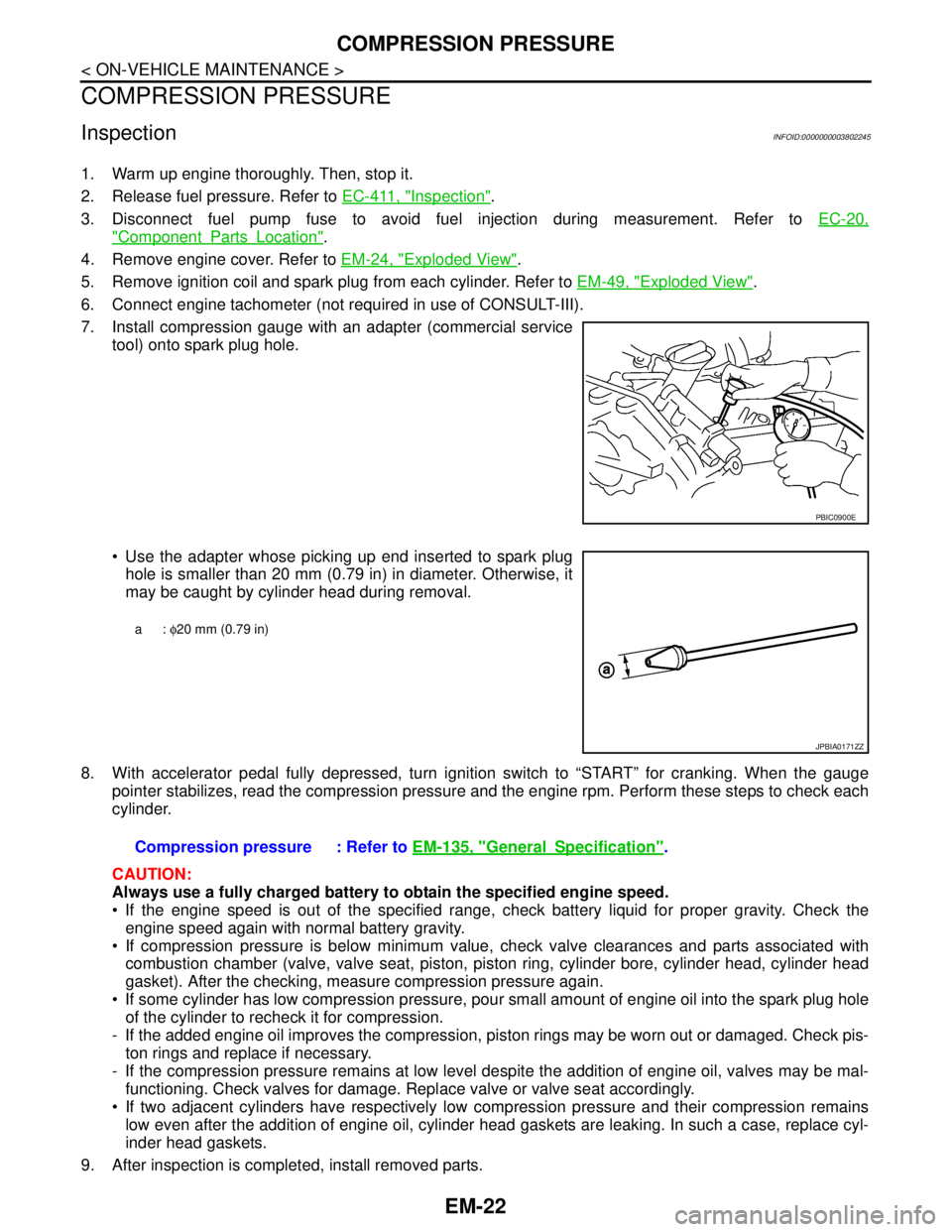
7. Install compression gauge with an adapter (commercial service
tool) onto spark plug hole.
Use the adapter whose picking up end inserted to spark plug
hole is smaller than 20 mm (0.79 in) in diameter. Otherwise, it
may be caught by cylinder head during removal.
8. With accelerator pedal fully depressed, turn ignition switch to “START” for cranking. When the gauge
pointer stabilizes, read the compression pressure and the engine rpm. Perform these steps to check each
cylinder.
CAUTION:
Always use a fully charged battery to obtain the specified engine speed.
If the engine speed is out of the specified range, check battery liquid for proper gravity. Check the
engine speed again with normal battery gravity.
If compression pressure is below minimum value, check valve clearances and parts associated with
combustion chamber (valve, valve seat, piston, piston ring, cylinder bore, cylinder head, cylinder head
gasket). After the checking, measure compression pressure again.
If some cylinder has low compression pressure, pour small amount of engine oil into the spark plug hole
of the cylinder to recheck it for compression.
- If the added engine oil improves the compression, piston rings may be worn out or damaged. Check pis-
ton rings and replace if necessary.
- If the compression pressure remains at low level despite the addition of engine oil, valves may be mal-
functioning. Check valves for damage. Replace valve or valve seat accordingly.
If two adjacent cylinders have respectively low compression pressure and their compression remains
low even after the addition of engine oil, cylinder head gaskets are leaking. In such a case, replace cyl-
inder head gaskets.
9. After inspection is completed, install removed parts.
PBIC0900E
a: φ20 mm (0.79 in)
JPBIA0171ZZ
Compression pressure : Refer to EM-135, "GeneralSpecification".
Page 1923 of 5121
EM-48
< ON-VEHICLE REPAIR >
FUEL INJECTOR AND FUEL TUBE
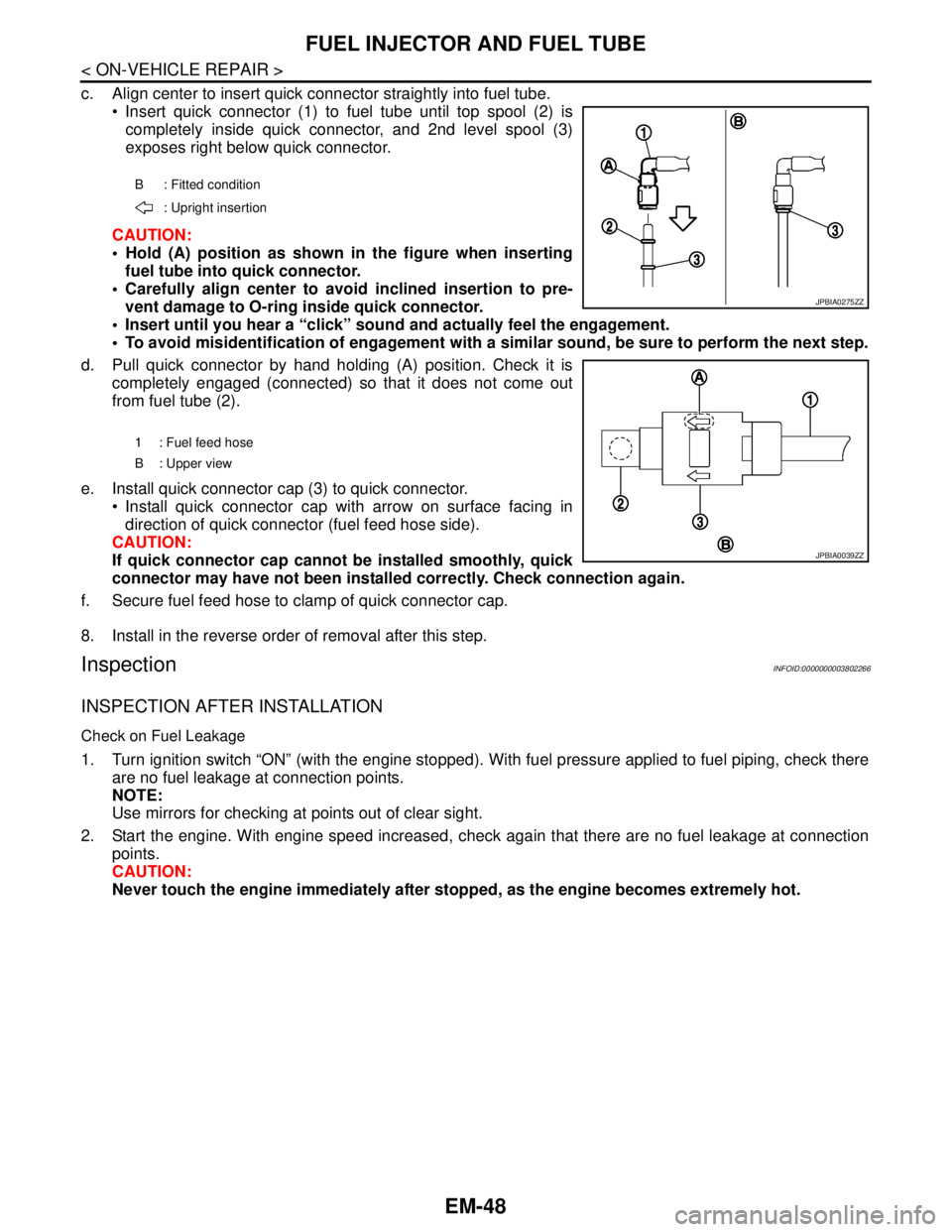
c. Align center to insert quick connector straightly into fuel tube.
Insert quick connector (1) to fuel tube until top spool (2) is
completely inside quick connector, and 2nd level spool (3)
exposes right below quick connector.
CAUTION:
Hold (A) position as shown in the figure when inserting
fuel tube into quick connector.
Carefully align center to avoid inclined insertion to pre-
vent damage to O-ring inside quick connector.
Insert until you hear a “click” sound and actually feel the engagement.
To avoid misidentification of engagement with a similar sound, be sure to perform the next step.
d. Pull quick connector by hand holding (A) position. Check it is
completely engaged (connected) so that it does not come out
from fuel tube (2).
e. Install quick connector cap (3) to quick connector.
Install quick connector cap with arrow on surface facing in
direction of quick connector (fuel feed hose side).
CAUTION:
If quick connector cap cannot be installed smoothly, quick
connector may have not been installed correctly. Check connection again.
f. Secure fuel feed hose to clamp of quick connector cap.
8. Install in the reverse order of removal after this step.
InspectionINFOID:0000000003802266
INSPECTION AFTER INSTALLATION
Check on Fuel Leakage
1. Turn ignition switch “ON” (with the engine stopped). With fuel pressure applied to fuel piping, check there
are no fuel leakage at connection points.
NOTE:
Use mirrors for checking at points out of clear sight.
2. Start the engine. With engine speed increased, check again that there are no fuel leakage at connection
points.
CAUTION:
Never touch the engine immediately after stopped, as the engine becomes extremely hot.
B : Fitted condition
: Upright insertion
1 : Fuel feed hose
B : Upper view
JPBIA0275ZZ
JPBIA0039ZZ
Page 1941 of 5121

EM-66
< ON-VEHICLE REPAIR >
TIMING CHAIN
Use procedure below to check for fuel leakage.
- Turn ignition switch “ON” (with engine stopped). With fuel pressure applied to fuel piping, check for fuel leak-
age at connection points.
- Start engine. With engine speed increased, check again for fuel leakage at connection points.
Run engine to check for unusual noise and vibration.
NOTE:
If hydraulic pressure inside chain tensioner drops after removal/installation, slack in guide may generate a
pounding noise during and just after the engine start. However, this does not indicate an unusualness. Noise
will stop after hydraulic pressure rises.
Warm up engine thoroughly to check there is no leakage of fuel, or any oil/fluids including engine oil and
engine coolant.
Bleed air from lines and hoses of applicable lines, such as in cooling system.
After cooling down engine, again check oil/fluid levels including engine oil and engine coolant. Refill to the
specified level, if necessary.
Summary of the inspection items:
*: Transmission/transaxle/CVT fluid, power steering fluid, brake fluid, etc.Items Before starting engine Engine running After engine stopped
Engine coolant Level Leakage Level
Engine oil Level Leakage Level
Other oils and fluid* Level Leakage Level
Fuel Leakage Leakage Leakage
Page 1950 of 5121
ENGINE ASSEMBLY
EM-75
< REMOVAL AND INSTALLATION >
C
D
E
F
G
H
I
J
K
L
MA
EM
N
P O
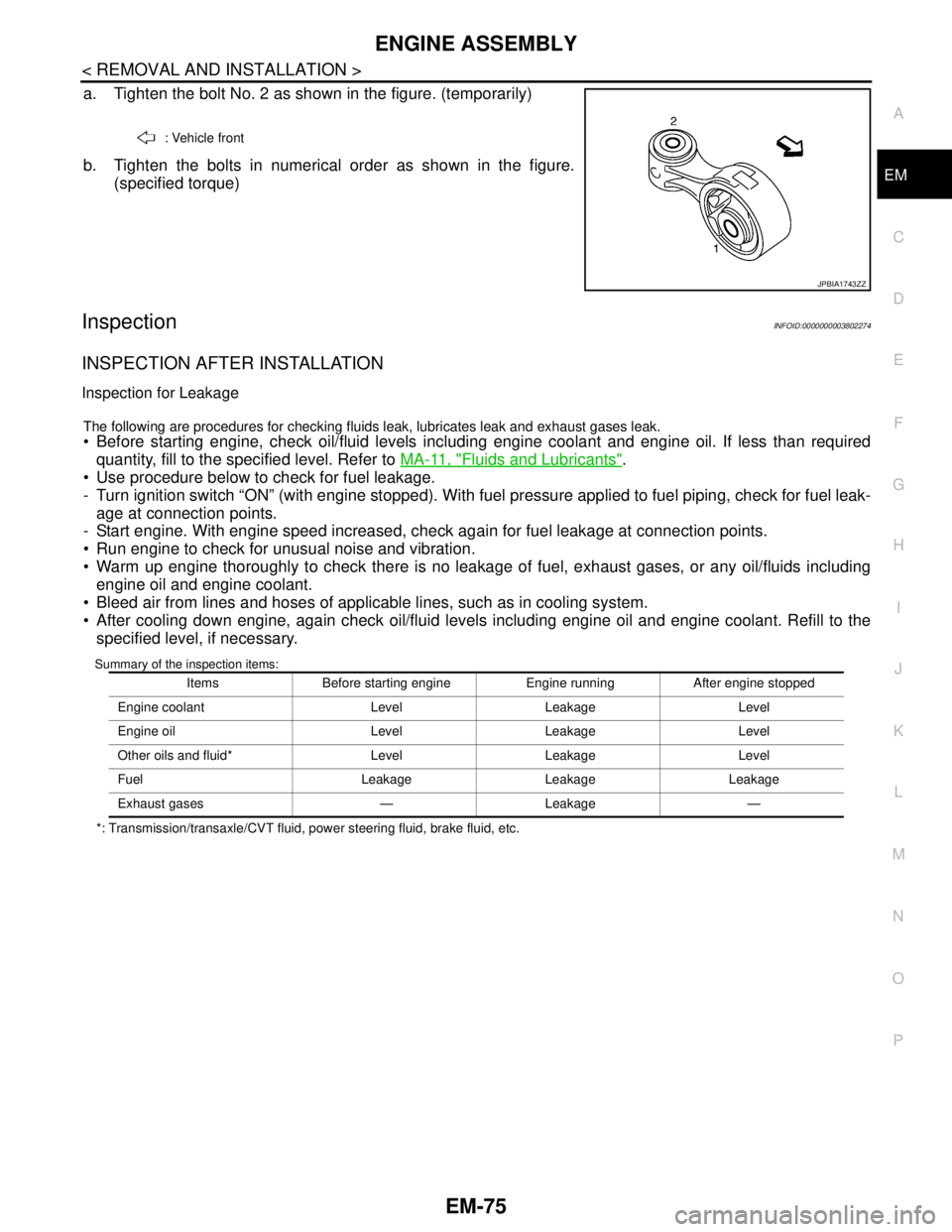
a. Tighten the bolt No. 2 as shown in the figure. (temporarily)
b. Tighten the bolts in numerical order as shown in the figure.
(specified torque)
InspectionINFOID:0000000003802274
INSPECTION AFTER INSTALLATION
Inspection for Leakage
The following are procedures for checking fluids leak, lubricates leak and exhaust gases leak.
Before starting engine, check oil/fluid levels including engine coolant and engine oil. If less than required
quantity, fill to the specified level. Refer to MA-11, "
Fluids and Lubricants".
Use procedure below to check for fuel leakage.
- Turn ignition switch “ON” (with engine stopped). With fuel pressure applied to fuel piping, check for fuel leak-
age at connection points.
- Start engine. With engine speed increased, check again for fuel leakage at connection points.
Run engine to check for unusual noise and vibration.
Warm up engine thoroughly to check there is no leakage of fuel, exhaust gases, or any oil/fluids including
engine oil and engine coolant.
Bleed air from lines and hoses of applicable lines, such as in cooling system.
After cooling down engine, again check oil/fluid levels including engine oil and engine coolant. Refill to the
specified level, if necessary.
Summary of the inspection items:
*: Transmission/transaxle/CVT fluid, power steering fluid, brake fluid, etc.: Vehicle front
JPBIA1743ZZ
Items Before starting engine Engine running After engine stopped
Engine coolant Level Leakage Level
Engine oil Level Leakage Level
Other oils and fluid* Level Leakage Level
Fuel Leakage Leakage Leakage
Exhaust gases — Leakage —