ignition NISSAN TEANA 2008 Service Manual
[x] Cancel search | Manufacturer: NISSAN, Model Year: 2008, Model line: TEANA, Model: NISSAN TEANA 2008Pages: 5121, PDF Size: 69.03 MB
Page 1829 of 5121
![NISSAN TEANA 2008 Service Manual EC-368
< ECU DIAGNOSIS >[VQ25DE, VQ35DE]
ECM
72
(BR/W)40
(G)Sensor power supply
(Refrigerant pressure sensor)— [Ignition switch: ON] 5 V
75
(Y)11 2
(B)Intake valve timing control so-
lenoid valve (B](/img/5/57391/w960_57391-1828.png "NISSAN TEANA 2008 Service Manual EC-368
< ECU DIAGNOSIS >[VQ25DE, VQ35DE]
ECM
72
(BR/W)40
(G)Sensor power supply
(Refrigerant pressure sensor)— [Ignition switch: ON] 5 V
75
(Y)11 2
(B)Intake valve timing control so-
lenoid valve (B")
EC-368
< ECU DIAGNOSIS >[VQ25DE, VQ35DE]
ECM
72
(BR/W)40
(G)Sensor power supply
(Refrigerant pressure sensor)— [Ignition switch: ON] 5 V
75
(Y)11 2
(B)Intake valve timing control so-
lenoid valve (Bank 2)Output[Engine is running]
Warm-up condition
Idle speedBATTERY VOLTAGE
(11 - 14 V)
[Engine is running]
Warm-up condition
Engine speed: 2,000rpm7 - 12 V
76
(R/G)60
(Y/B)Sensor power supply
[Crankshaft position sensor
(POS)]— [Ignition switch: ON] 5 V
77
(W/L)11 2
(B)Power supply for ECM (Back-
up)Input [Ignition switch: OFF]BATTERY VOLTAGE
(11 - 14 V)
78
(R/L)11 2
(B)Intake valve timing control so-
lenoid valve (Bank 1)Output[Engine is running]
Warm-up condition
Idle speedBATTERY VOLTAGE
(11 - 14 V)
[Engine is running]
Warm-up condition
Engine speed: 2,000rpm7 - 12 V
81
(W)84
(B)Accelerator pedal position
sensor 1Input[Ignition switch: ON]
Engine stopped
Accelerator pedal: Fully re-
leased0.5 - 1.0 V
[Ignition switch: ON]
Engine stopped
Accelerator pedal: Fully de-
pressed4.2 - 4.8 V
82
(O)100
(G)Accelerator pedal position
sensor 2Input[Ignition switch: ON]
Engine stopped
Accelerator pedal: Fully re-
leased0.25 - 0.50 V
[Ignition switch: ON]
Engine stopped
Accelerator pedal: Fully de-
pressed2.0 - 2.5 V
83
(BR)84
(B)Sensor power supply
(Accelerator pedal position
sensor 1)— [Ignition switch: ON] 5 V
84
(B)—Sensor ground
(Accelerator pedal position
sensor 1)—— — Terminal No. Description
ConditionVa l u e
(Approx.)
+ -– Signal nameInput/
Output
JMBIA0038GB
JMBIA0038GB
Page 1830 of 5121
![NISSAN TEANA 2008 Service Manual ECM
EC-369
< ECU DIAGNOSIS >[VQ25DE, VQ35DE]
C
D
E
F
G
H
I
J
K
L
MA
EC
N
P O
85
(Y)92
(BR)ASCD steering switch Input[Ignition switch: ON]
ASCD steering switch: OFF4 V
[Ignition switch: ON]
MAIN sw](/img/5/57391/w960_57391-1829.png "NISSAN TEANA 2008 Service Manual ECM
EC-369
< ECU DIAGNOSIS >[VQ25DE, VQ35DE]
C
D
E
F
G
H
I
J
K
L
MA
EC
N
P O
85
(Y)92
(BR)ASCD steering switch Input[Ignition switch: ON]
ASCD steering switch: OFF4 V
[Ignition switch: ON]
MAIN sw")
ECM
EC-369
< ECU DIAGNOSIS >[VQ25DE, VQ35DE]
C
D
E
F
G
H
I
J
K
L
MA
EC
N
P O
85
(Y)92
(BR)ASCD steering switch Input[Ignition switch: ON]
ASCD steering switch: OFF4 V
[Ignition switch: ON]
MAIN switch: Pressed0 V
[Ignition switch: ON]
CANCEL switch: Pressed1 V
[Ignition switch: ON]
RESUME/ACCELERATE
switch: Pressed3 V
[Ignition switch: ON]
SET/COAST switch: Pressed2 V
87
(GR)100
(G)Sensor power supply
(Accelerator pedal position
sensor 2)— [Ignition switch: ON] 5 V
88
(O)— Data link connectorInput/
Output——
92
(BR)—Sensor ground
(ASCD steering switch)—— —
93
(BR)11 2
(B)Ignition switch Input[Ignition switch: OFF] 0 V
[Ignition switch: ON]BATTERY VOLTAGE
(11 - 14 V)
94
(GR)11 2
(B)Engine speed output signal Output[Engine is running]
Warm-up condition
Idle speed
NOTE:
The pulse cycle changes de-
pending on rpm at idle1 V
[Engine is running]
Engine speed: 2,000 rpm1 V
97
(P)— CAN communication lineInput/
Output——
98
(L)— CAN communication lineInput/
Output——
100
(G)—Sensor ground
(Accelerator pedal position
sensor 2)—— —
102
(R)11 2
(B)PNP signal Input[Ignition switch: ON]
Selector lever: P or NBATTERY VOLTAGE
(11 - 14 V)
[Ignition switch: ON]
Selector lever: Except above0 V
105
(V)11 2
(B)Power supply for ECM Input [Ignition switch: ON]BATTERY VOLTAGE
(11 - 14 V)
Terminal No. Description
ConditionVa l u e
(Approx.)
+-– Signal nameInput/
Output
JMBIA0076GB
JMBIA0077GB
Page 1831 of 5121
![NISSAN TEANA 2008 Service Manual EC-370
< ECU DIAGNOSIS >[VQ25DE, VQ35DE]
ECM
: Average voltage for pulse signal (Actual pulse signal can be confirmed by oscilloscope.)
*1: This may vary depending on internal resistance of the tester](/img/5/57391/w960_57391-1830.png "NISSAN TEANA 2008 Service Manual EC-370
< ECU DIAGNOSIS >[VQ25DE, VQ35DE]
ECM
: Average voltage for pulse signal (Actual pulse signal can be confirmed by oscilloscope.)
*1: This may vary depending on internal resistance of the tester")
EC-370
< ECU DIAGNOSIS >[VQ25DE, VQ35DE]
ECM
: Average voltage for pulse signal (Actual pulse signal can be confirmed by oscilloscope.)
*1: This may vary depending on internal resistance of the tester.
*2: Before measuring the terminal voltage, confirm that the battery is fully charged. Refer to PG-3, "
How to Handle Battery". 106
(SB)11 2
(B)Stop lamp switch Input[Ignition switch: OFF]
Brake pedal: Fully released0 V
[Ignition switch: OFF]
Brake pedal: Slightly de-
pressedBATTERY VOLTAGE
(11 - 14 V)
107
(B)
108
(B)— ECM ground — — —
11 0
(G)11 2
(B)ASCD brake switch Input[Ignition switch: ON]
Brake pedal: Slightly de-
pressed0 V
[Ignition switch: ON]
Brake pedal: Fully releasedBATTERY VOLTAGE
(11 - 14 V)
111
(B)
11 2
(B)— ECM ground — — — Terminal No. Description
ConditionVa l u e
(Approx.)
+ -– Signal nameInput/
Output
Page 1848 of 5121
![NISSAN TEANA 2008 Service Manual ECM
EC-387
< ECU DIAGNOSIS >[VQ25DE, VQ35DE]
C
D
E
F
G
H
I
J
K
L
MA
EC
N
P O
DTC RELATED ITEM
Engine operating condi-
tion in fail-safe modeDetected items RemarksReference
page
Engine speed will not](/img/5/57391/w960_57391-1847.png "NISSAN TEANA 2008 Service Manual ECM
EC-387
< ECU DIAGNOSIS >[VQ25DE, VQ35DE]
C
D
E
F
G
H
I
J
K
L
MA
EC
N
P O
DTC RELATED ITEM
Engine operating condi-
tion in fail-safe modeDetected items RemarksReference
page
Engine speed will not")
ECM
EC-387
< ECU DIAGNOSIS >[VQ25DE, VQ35DE]
C
D
E
F
G
H
I
J
K
L
MA
EC
N
P O
DTC RELATED ITEM
Engine operating condi-
tion in fail-safe modeDetected items RemarksReference
page
Engine speed will not
rise more than 2,500 rpm
due to the fuel cutMalfunction indicator
circuitWhen there is an open circuit on MI circuit, the ECM cannot warn the
driver by illuminating MI when there is malfunction on engine control
system.
Therefore, when electrical controlled throttle and part of ECM related
diagnoses are continuously detected as NG for 5 trips, ECM warns the
driver that engine control system malfunctions and MI circuit is open by
means of operating the fail-safe function.
The fail-safe function also operates when above diagnoses except MI
circuit are detected and demands the driver to repair the malfunction.EC-346
DTC No. Detected items Engine operating condition in fail-safe mode
P0011
P0021Intake valve timing control The signal is not energized to the intake valve timing control solenoid valve and the valve
control does not function.
P0102
P0103Mass air flow sensor circuit Engine speed will not rise more than 2,400 rpm due to the fuel cut.
P0117
P0118Engine coolant tempera-
ture sensor circuitEngine coolant temperature will be determined by ECM based on the following condition.
CONSULT-III displays the engine coolant temperature decided by ECM.
ConditionEngine coolant temperature decided
(CONSULT-III display)
Just as ignition switch is turned ON
or START40°C (104°F)
Approx. 4 minutes or more after
engine starting80°C (176°F)
Except as shown above40 - 80°C (104 - 176°F)
(Depends on the time)
When the fail-safe system for engine coolant temperature sensor is activated, the cooling
fan operates while engine is running.
P0122
P0123
P0222
P0223
P2135Throttle position sensor The ECM controls the electric throttle control actuator in regulating the throttle opening in
order for the idle position to be within +10 degrees.
The ECM regulates the opening speed of the throttle valve to be slower than the normal
condition.
So, the acceleration will be poor.
P0500 Vehicle speed sensor The cooling fan operates (Highest) while engine is running.
P0605 ECM (When ECM calculation function is a malfunctioning:)
ECM stops the electric throttle control actuator control, throttle valve is maintained at a
fixed opening (approx. 5 degrees) by the return spring.
ECM deactivates ASCD operation.
P0643 Sensor power supply ECM stops the electric throttle control actuator control, throttle valve is maintained at a
fixed opening (approx. 5 degrees) by the return spring.
P1805 Brake switch ECM controls the electric throttle control actuator by regulating the throttle opening to a
small range.
Therefore, acceleration will be poor.
Vehicle condition Driving condition
When engine is idling Normal
When accelerating Poor acceleration
P2100
P2103Throttle control motor relay ECM stops the electric throttle control actuator control, throttle valve is maintained at a
fixed opening (approx. 5 degrees) by the return spring.
P2101 Electric throttle control
functionECM stops the electric throttle control actuator control, throttle valve is maintained at a
fixed opening (approx. 5 degrees) by the return spring.
P2118 Throttle control motor ECM stops the electric throttle control actuator control, throttle valve is maintained at a
fixed opening (approx. 5 degrees) by the return spring.
Page 1861 of 5121
![NISSAN TEANA 2008 Service Manual EC-400
< SYMPTOM DIAGNOSIS >[VQ25DE, VQ35DE]
ENGINE CONTROL SYSTEM SYMPTOMS
SYMPTOM DIAGNOSIS
ENGINE CONTROL SYSTEM SYMPTOMS
Symptom TableINFOID:0000000003856875
SYSTEM — BASIC ENGINE CONTROL SYSTEM](/img/5/57391/w960_57391-1860.png "NISSAN TEANA 2008 Service Manual EC-400
< SYMPTOM DIAGNOSIS >[VQ25DE, VQ35DE]
ENGINE CONTROL SYSTEM SYMPTOMS
SYMPTOM DIAGNOSIS
ENGINE CONTROL SYSTEM SYMPTOMS
Symptom TableINFOID:0000000003856875
SYSTEM — BASIC ENGINE CONTROL SYSTEM")
EC-400
< SYMPTOM DIAGNOSIS >[VQ25DE, VQ35DE]
ENGINE CONTROL SYSTEM SYMPTOMS
SYMPTOM DIAGNOSIS
ENGINE CONTROL SYSTEM SYMPTOMS
Symptom TableINFOID:0000000003856875
SYSTEM — BASIC ENGINE CONTROL SYSTEM
SYMPTOM
Reference
page
HARD/NO START/RESTART (EXCP. HA)
ENGINE STALL
HESITATION/SURGING/FLAT SPOT
SPARK KNOCK/DETONATION
LACK OF POWER/POOR ACCELERATION
HIGH IDLE/LOW IDLE
ROUGH IDLE/HUNTING
IDLING VIBRATION
SLOW/NO RETURN TO IDLE
OVERHEATS/WATER TEMPERATURE HIGH
EXCESSIVE FUEL CONSUMPTION
EXCESSIVE OIL CONSUMPTION
BATTERY DEAD (UNDER CHARGE)
Warranty symptom code AA AB AC AD AE AF AG AH AJ AK AL AM HA
Fuel Fuel pump circuit 11232 22 3 2EC-337
Fuel pressure regulator system 334444444 4EC-411
Fuel injector circuit 11232 22 2EC-334
Evaporative emission system 334444444 4EC-76
Air Positive crankcase ventilation sys-
tem
334444444 41EC-347
Incorrect idle speed adjustment 1 1 1 1 1EC-11
Electric throttle control actuator 112332222 2 2EC-296,
EC-302
IgnitionIncorrect ignition timing adjustment33111 11 1EC-11
Ignition circuit 11222 22 2EC-341
Power supply and ground circuit 22333 33 23EC-132
Mass air flow sensor circuit
1
122
222 2EC-149
Engine coolant temperature sensor circuit
333EC-157
Air fuel ratio (A/F) sensor 1 circuitEC-163
,
EC-167
,
EC-170
,
EC-173
,
EC-318
Throttle position sensor circuit
22EC-160
,
EC-206
,
EC-254
,
EC-256
,
EC-311
Accelerator pedal position sensor circuit 3 2 1EC-243
,
EC-304
,
EC-307
,
EC-314
Knock sensor circuit 2 3EC-215
Page 1867 of 5121
![NISSAN TEANA 2008 Service Manual EC-406
< PRECAUTION >[VQ25DE, VQ35DE]
PRECAUTIONS
CAUTION:
Always turn the ignition switch OFF and disconnect the negative battery cable before any repair or
inspection work. The open/short circuit](/img/5/57391/w960_57391-1866.png "NISSAN TEANA 2008 Service Manual EC-406
< PRECAUTION >[VQ25DE, VQ35DE]
PRECAUTIONS
CAUTION:
Always turn the ignition switch OFF and disconnect the negative battery cable before any repair or
inspection work. The open/short circuit")
EC-406
< PRECAUTION >[VQ25DE, VQ35DE]
PRECAUTIONS
CAUTION:
Always turn the ignition switch OFF and disconnect the negative battery cable before any repair or
inspection work. The open/short circuit of related switches, sensors, solenoid valves, etc. will cause
the MI to illuminate.
Always connect and lock the connectors securely after work. A loose (unlocked) connector will
cause the MI to illuminate due to the open circuit. (Be sure the connector is free from water, grease,
dirt, bent terminals, etc.)
Certain systems and components, especially those related to OBD, may use a new style slide-lock-
ing type harness connector. For description and how to disconnect, refer to PG-96, "
Description".
Always to route and secure the harnesses properly after work. The interference of the harness with a
bracket, etc. may cause the MI to illuminate due to the short circuit.
Always connect rubber tubes properly after work. A misconnected or disconnected rubber tube may
cause the MI to illuminate due to the malfunction of the EVAP system or fuel injection system, etc.
Always erase the unnecessary malfunction information (repairs completed) from the ECM and TCM
(Transmission control module) before returning the vehicle to the customer.
General PrecautionsINFOID:0000000003856881
Always use a 12 volt battery as power source.
Never attempt to disconnect battery cables while engine is
running.
Before connecting or disconnecting the ECM harness con-
nector, turn ignition switch OFF and disconnect negative bat-
tery cable. Failure to do so may damage the ECM because
battery voltage is applied to ECM even if ignition switch is
turned OFF.
Before removing parts, turn ignition switch OFF and then dis-
connect battery ground cable.
Never disassemble ECM.
If a battery cable is disconnected, the memory will return to the ECM value.
The ECM will now start to self-control at its initial value. Thus, engine operation can vary slightly in
this case. However, this is not an indication of a malfunction. Never replace parts because of a slight
variation.
If the battery is disconnected, the following emission-related diagnostic information will be lost
within 24 hours.
-Diagnostic trouble codes
-1st trip diagnostic trouble codes
-Freeze frame data
-1st trip freeze frame data
-System readiness test (SRT) codes
-Test values
When connecting ECM harness connector, fasten (B) it
securely with a lever (1) as far as it will go as shown in the fig-
ure.
SEF289H
2: ECM
A : Loosen
PBIB2947E
Page 1872 of 5121
![NISSAN TEANA 2008 Service Manual FUEL PRESSURE
EC-411
< ON-VEHICLE MAINTENANCE >[VQ25DE, VQ35DE]
C
D
E
F
G
H
I
J
K
L
MA
EC
N
P O
ON-VEHICLE MAINTENANCE
FUEL PRESSURE
InspectionINFOID:0000000003856884
FUEL PRESSURE RELEASE
With CONSU](/img/5/57391/w960_57391-1871.png "NISSAN TEANA 2008 Service Manual FUEL PRESSURE
EC-411
< ON-VEHICLE MAINTENANCE >[VQ25DE, VQ35DE]
C
D
E
F
G
H
I
J
K
L
MA
EC
N
P O
ON-VEHICLE MAINTENANCE
FUEL PRESSURE
InspectionINFOID:0000000003856884
FUEL PRESSURE RELEASE
With CONSU")
FUEL PRESSURE
EC-411
< ON-VEHICLE MAINTENANCE >[VQ25DE, VQ35DE]
C
D
E
F
G
H
I
J
K
L
MA
EC
N
P O
ON-VEHICLE MAINTENANCE
FUEL PRESSURE
InspectionINFOID:0000000003856884
FUEL PRESSURE RELEASE
With CONSULT-III
1. Turn ignition switch ON.
2. Perform “FUEL PRESSURE RELEASE” in “WORK SUPPORT” mode with CONSULT-III.
3. Start engine.
4. After engine stalls, crank it 2 or 3 times to release all fuel pressure.
5. Turn ignition switch OFF.
Without CONSULT-III
1. Remove fuel pump fuse located in IPDM E/R.
2. Start engine.
3. After engine stalls, crank it 2 or 3 times to release all fuel pressure.
4. Turn ignition switch OFF.
5. Reinstall fuel pump fuse after servicing fuel system.
FUEL PRESSURE CHECK
CAUTION:
Before disconnecting fuel line, release fuel pressure from fuel line to eliminate danger.
NOTE:
Prepare pans or saucers under the disconnected fuel line because the fuel may spill out. The fuel
pressure cannot be completely released because J32 models do not have fuel return system.
Be careful not to scratch or get the fuel hose connection area dirty when servicing, so that the quick
connector o-ring maintains seal ability.
1. Release fuel pressure to zero.
2. Remove fuel hose using Quick Connector Release.
Do not twist or kink fuel hose because it is plastic hose.
Keep fuel hose connections clean.
3. Install Fuel pressure adapter (B) and Fuel pressure gauge (A)
as shown in figure.
Do not distort or bend fuel rail tube when installing fuel pres-
sure gauge adapter.
When reconnecting fuel hose, check the original fuel hose for
damage and abnormality.
4. Turn ignition switch ON (reactivate fuel pump) and check for fuel
leakage.
5. Start engine and check for fuel leakage.
6. Read the indication of fuel pressure gauge kit.
During fuel pressure check, check for fuel leakage from fuel
connection every 3 minutes.
7. If result is unsatisfactory, go to next step.
8. Check the following.
Fuel hoses and fuel tubes for clogging
Fuel filter for clogging
Fuel pump
Fuel pressure regulator for clogging
9. If OK, replace fuel pressure regulator.
If NG, repair or replace malfunctioning part.
At idling
: Approximately 350 kPa (3.5 bar, 3.57 kg/cm2, 51 psi)
JMBIA1392ZZ
Page 1875 of 5121
![NISSAN TEANA 2008 Service Manual EC-414
< SERVICE DATA AND SPECIFICATIONS (SDS) [VQ25DE, VQ35DE]
SERVICE DATA AND SPECIFICATIONS (SDS)
SERVICE DATA AND SPECIFICATIONS (SDS)
SERVICE DATA AND SPECIFICATIONS (SDS)
Idle SpeedINFOID:00000](/img/5/57391/w960_57391-1874.png "NISSAN TEANA 2008 Service Manual EC-414
< SERVICE DATA AND SPECIFICATIONS (SDS) [VQ25DE, VQ35DE]
SERVICE DATA AND SPECIFICATIONS (SDS)
SERVICE DATA AND SPECIFICATIONS (SDS)
SERVICE DATA AND SPECIFICATIONS (SDS)
Idle SpeedINFOID:00000")
EC-414
< SERVICE DATA AND SPECIFICATIONS (SDS) [VQ25DE, VQ35DE]
SERVICE DATA AND SPECIFICATIONS (SDS)
SERVICE DATA AND SPECIFICATIONS (SDS)
SERVICE DATA AND SPECIFICATIONS (SDS)
Idle SpeedINFOID:0000000003856889
Ignition TimingINFOID:0000000003856890
Calculated Load ValueINFOID:0000000003856891
Mass Air Flow SensorINFOID:0000000003856892
*: Engine is warmed up to normal operating temperature and running under no load.Condition Specification
No load (in P or N position) 600 ± 50 rpm
Condition Specification
No load (in P or N position) 12 ± 5° BTDC
Condition Specification (Using CONSULT-III or GST)
At idle10 – 35 %
At 2,500 rpm10 – 35 %
Supply voltageBattery voltage (11 – 14 V)
Output voltage at idle (in N position) 0.9 – 1.2 V*
Mass air flow (Using CONSULT-III or GST)2.0 – 6.0 g·m/sec at idle*
7.0 – 20.0 g·m/sec at 2,500 rpm*
Page 1877 of 5121

EM-2
OIL PAN AND OIL STRAINER ..........................38
Exploded View ........................................................38
Removal and Installation ........................................38
Inspection ...............................................................42
FUEL INJECTOR AND FUEL TUBE .................44
Exploded View ........................................................44
Removal and Installation ........................................44
Inspection ...............................................................48
IGNITION COIL, SPARK PLUG AND ROCK-
ER COVER .........................................................
49
Exploded View ........................................................49
Removal and Installation ........................................49
TIMING CHAIN ..................................................52
Exploded View ........................................................52
Removal and Installation ........................................53
Inspection ...............................................................65
REMOVAL AND INSTALLATION ...............67
ENGINE ASSEMBLY .........................................67
Exploded View ........................................................67
Removal and Installation ........................................67
Inspection ...............................................................75
DISASSEMBLY AND ASSEMBLY .............76
ENGINE STAND SETTING ................................76
Setting ....................................................................76
ENGINE UNIT ....................................................78
Disassembly ...........................................................78
Assembly ................................................................78
REAR TIMING CHAIN CASE ............................79
Exploded View ........................................................79
Disassembly and Assembly ....................................80
CAMSHAFT .......................................................84
Exploded View ........................................................84
Removal and Installation ........................................84
Inspection ...............................................................88
OIL SEAL ...........................................................93
VALVE OIL SEAL .....................................................93
VALVE OIL SEAL : Removal and Installation .........93
FRONT OIL SEAL .....................................................93
FRONT OIL SEAL : Removal and Installation ........93
REAR OIL SEAL .......................................................94
REAR OIL SEAL : Removal and Installation ...........94
CYLINDER HEAD ..............................................96
Exploded View ........................................................96
Removal and Installation .........................................97
Disassembly and Assembly ..................................100
Inspection ..............................................................104
CYLINDER BLOCK ..........................................107
Exploded View ......................................................107
Disassembly and Assembly ..................................110
Inspection ..............................................................119
HOW TO SELECT PISTON AND BEARING ...129
Description ............................................................129
Piston ....................................................................129
Connecting Rod Bearing .....................................130
Main Bearing ........................................................132
SERVICE DATA AND SPECIFICATIONS
(SDS) .........................................................
135
SERVICE DATA AND SPECIFICATIONS
(SDS) ................................................................
135
General Specification ...........................................135
Drive Belt ..............................................................136
Spark Plug ............................................................136
Intake Manifold ......................................................136
Exhaust Manifold ..................................................136
Camshaft ...............................................................136
Cylinder Head ......................................................139
Cylinder Block ......................................................143
Main Bearing ........................................................146
Connecting Rod Bearing .....................................147
Page 1880 of 5121
PRECAUTIONS
EM-5
< PRECAUTION >
C
D
E
F
G
H
I
J
K
L
MA
EM
N
P O
PRECAUTION
PRECAUTIONS
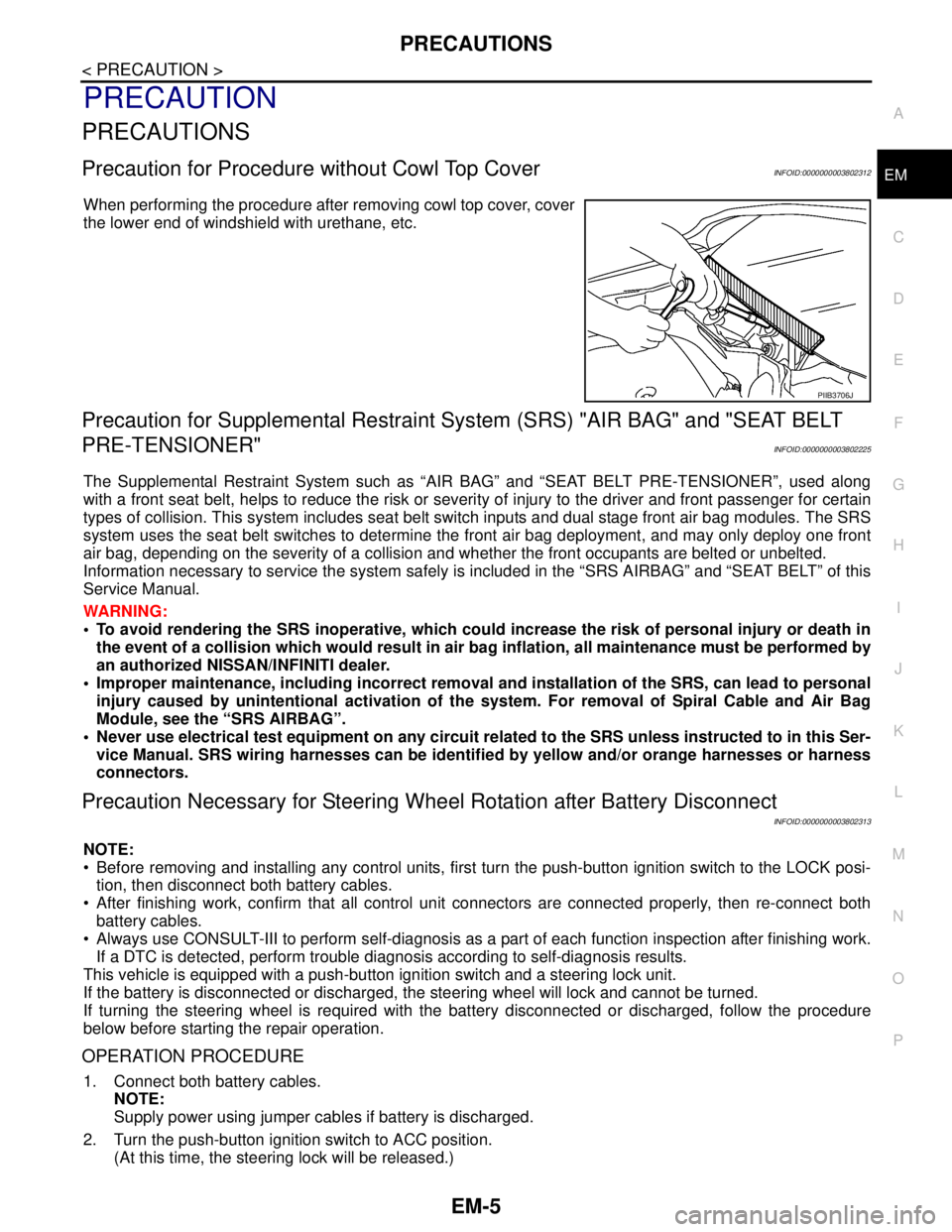
Precaution for Procedure without Cowl Top CoverINFOID:0000000003802312
When performing the procedure after removing cowl top cover, cover
the lower end of windshield with urethane, etc.
Precaution for Supplemental Restraint System (SRS) "AIR BAG" and "SEAT BELT
PRE-TENSIONER"
INFOID:0000000003802225
The Supplemental Restraint System such as “AIR BAG” and “SEAT BELT PRE-TENSIONER”, used along
with a front seat belt, helps to reduce the risk or severity of injury to the driver and front passenger for certain
types of collision. This system includes seat belt switch inputs and dual stage front air bag modules. The SRS
system uses the seat belt switches to determine the front air bag deployment, and may only deploy one front
air bag, depending on the severity of a collision and whether the front occupants are belted or unbelted.
Information necessary to service the system safely is included in the “SRS AIRBAG” and “SEAT BELT” of this
Service Manual.
WARNING:
• To avoid rendering the SRS inoperative, which could increase the risk of personal injury or death in
the event of a collision which would result in air bag inflation, all maintenance must be performed by
an authorized NISSAN/INFINITI dealer.
Improper maintenance, including incorrect removal and installation of the SRS, can lead to personal
injury caused by unintentional activation of the system. For removal of Spiral Cable and Air Bag
Module, see the “SRS AIRBAG”.
Never use electrical test equipment on any circuit related to the SRS unless instructed to in this Ser-
vice Manual. SRS wiring harnesses can be identified by yellow and/or orange harnesses or harness
connectors.
Precaution Necessary for Steering Wheel Rotation after Battery Disconnect
INFOID:0000000003802313
NOTE:
Before removing and installing any control units, first turn the push-button ignition switch to the LOCK posi-
tion, then disconnect both battery cables.
After finishing work, confirm that all control unit connectors are connected properly, then re-connect both
battery cables.
Always use CONSULT-III to perform self-diagnosis as a part of each function inspection after finishing work.
If a DTC is detected, perform trouble diagnosis according to self-diagnosis results.
This vehicle is equipped with a push-button ignition switch and a steering lock unit.
If the battery is disconnected or discharged, the steering wheel will lock and cannot be turned.
If turning the steering wheel is required with the battery disconnected or discharged, follow the procedure
below before starting the repair operation.
OPERATION PROCEDURE
1. Connect both battery cables.
NOTE:
Supply power using jumper cables if battery is discharged.
2. Turn the push-button ignition switch to ACC position.
(At this time, the steering lock will be released.)
PIIB3706J