ECU NISSAN TEANA 2008 Service Manual
[x] Cancel search | Manufacturer: NISSAN, Model Year: 2008, Model line: TEANA, Model: NISSAN TEANA 2008Pages: 5121, PDF Size: 69.03 MB
Page 3015 of 5121
INT-38
< ON-VEHICLE REPAIR >
REAR DOOR FINISHER
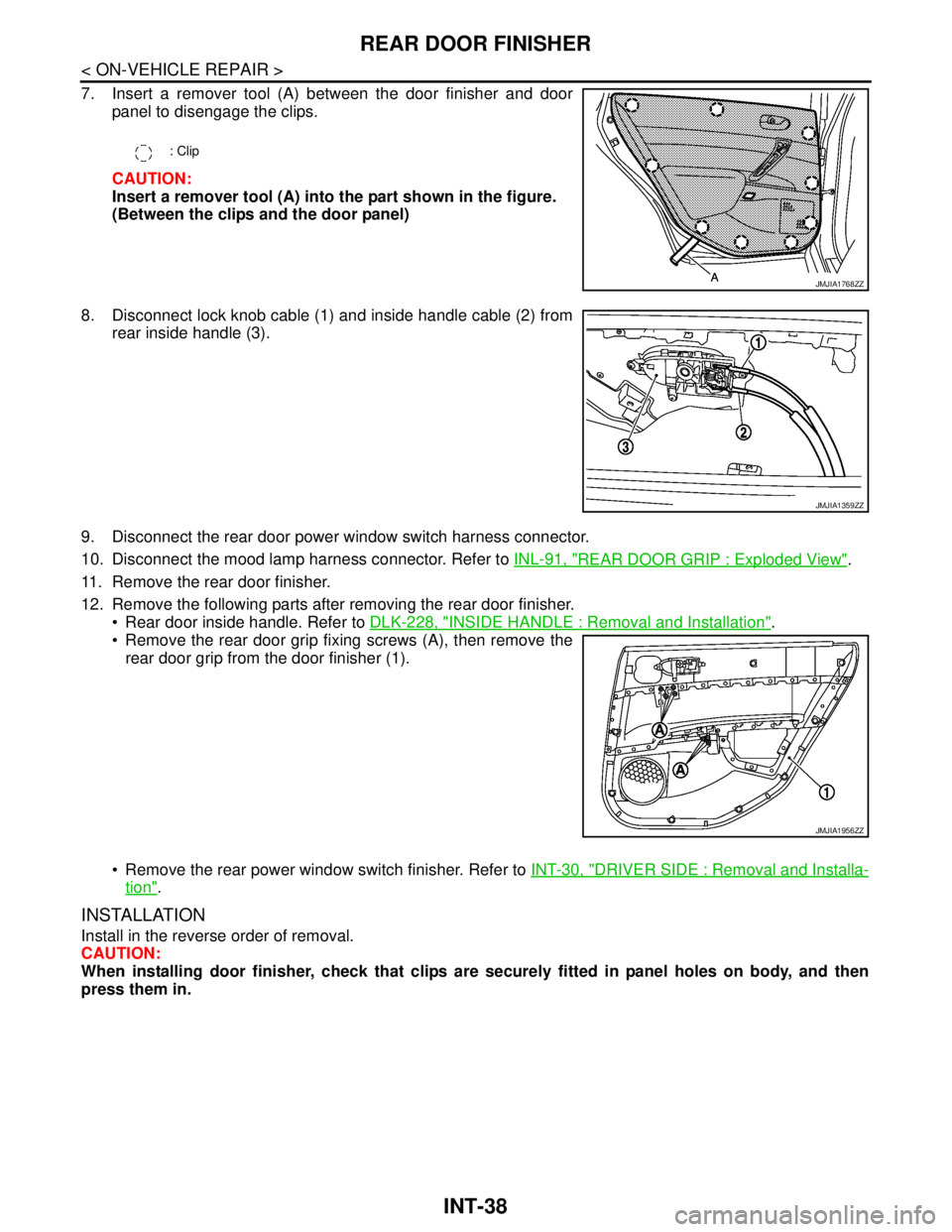
7. Insert a remover tool (A) between the door finisher and door
panel to disengage the clips.
CAUTION:
Insert a remover tool (A) into the part shown in the figure.
(Between the clips and the door panel)
8. Disconnect lock knob cable (1) and inside handle cable (2) from
rear inside handle (3).
9. Disconnect the rear door power window switch harness connector.
10. Disconnect the mood lamp harness connector. Refer to INL-91, "
REAR DOOR GRIP : Exploded View".
11. Remove the rear door finisher.
12. Remove the following parts after removing the rear door finisher.
Rear door inside handle. Refer to DLK-228, "
INSIDE HANDLE : Removal and Installation".
Remove the rear door grip fixing screws (A), then remove the
rear door grip from the door finisher (1).
Remove the rear power window switch finisher. Refer to INT-30, "
DRIVER SIDE : Removal and Installa-
tion".
INSTALLATION
Install in the reverse order of removal.
CAUTION:
When installing door finisher, check that clips are securely fitted in panel holes on body, and then
press them in.
: Clip
JMJIA1768ZZ
JMJIA1359ZZ
JMJIA1956ZZ
Page 3019 of 5121
INT-42
< ON-VEHICLE REPAIR >
BODY SIDE TRIM
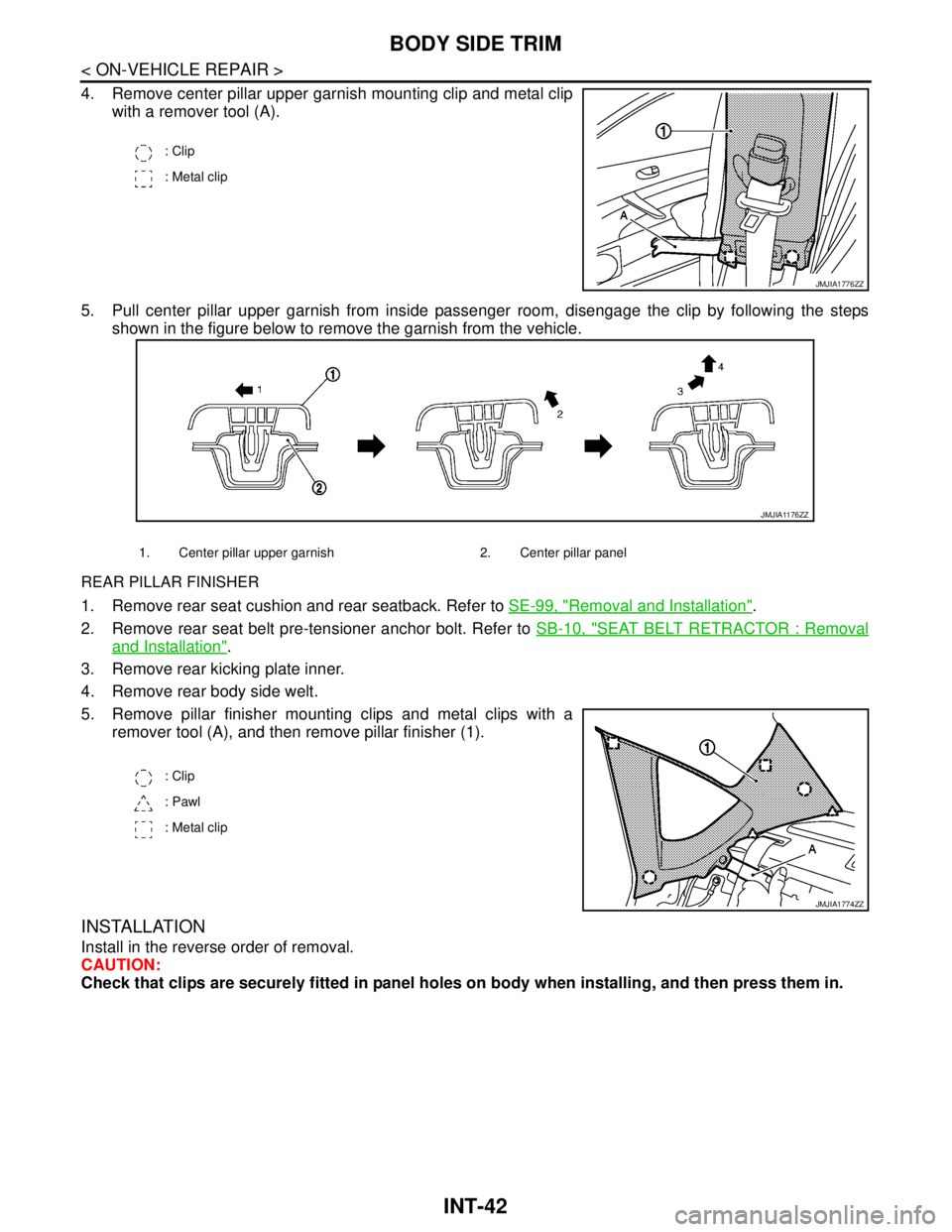
4. Remove center pillar upper garnish mounting clip and metal clip
with a remover tool (A).
5. Pull center pillar upper garnish from inside passenger room, disengage the clip by following the steps
shown in the figure below to remove the garnish from the vehicle.
REAR PILLAR FINISHER
1. Remove rear seat cushion and rear seatback. Refer to SE-99, "Removal and Installation".
2. Remove rear seat belt pre-tensioner anchor bolt. Refer to SB-10, "
SEAT BELT RETRACTOR : Removal
and Installation".
3. Remove rear kicking plate inner.
4. Remove rear body side welt.
5. Remove pillar finisher mounting clips and metal clips with a
remover tool (A), and then remove pillar finisher (1).
INSTALLATION
Install in the reverse order of removal.
CAUTION:
Check that clips are securely fitted in panel holes on body when installing, and then press them in.
: Clip
: Metal clip
JMJIA1776ZZ
1. Center pillar upper garnish 2. Center pillar panel
JMJIA1176ZZ
: Clip
: Pawl
: Metal clip
JMJIA1774ZZ
Page 3021 of 5121
INT-44
< ON-VEHICLE REPAIR >
REAR PARCEL SHELF FINISHER
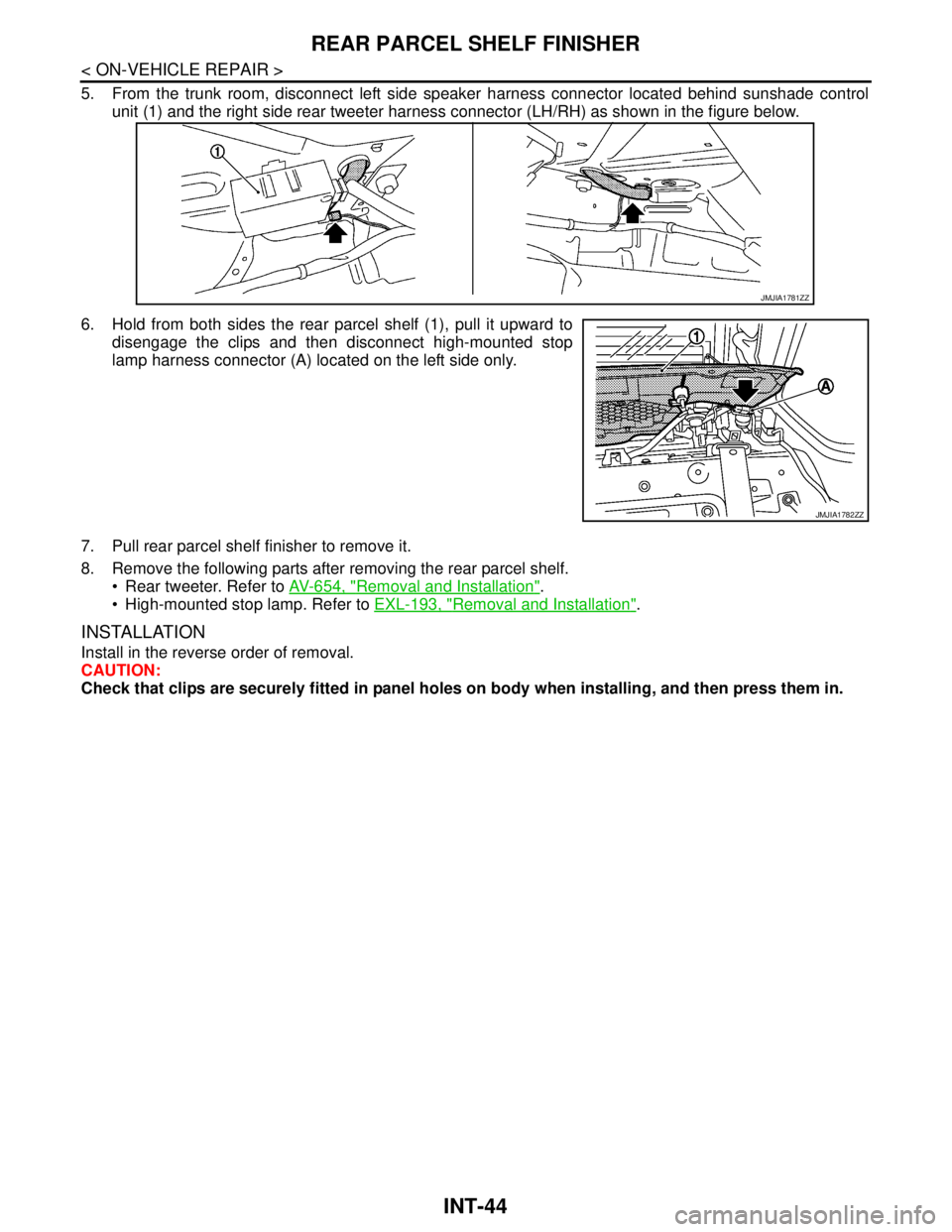
5. From the trunk room, disconnect left side speaker harness connector located behind sunshade control
unit (1) and the right side rear tweeter harness connector (LH/RH) as shown in the figure below.
6. Hold from both sides the rear parcel shelf (1), pull it upward to
disengage the clips and then disconnect high-mounted stop
lamp harness connector (A) located on the left side only.
7. Pull rear parcel shelf finisher to remove it.
8. Remove the following parts after removing the rear parcel shelf.
Rear tweeter. Refer to AV-654, "
Removal and Installation".
High-mounted stop lamp. Refer to EXL-193, "
Removal and Installation".
INSTALLATION
Install in the reverse order of removal.
CAUTION:
Check that clips are securely fitted in panel holes on body when installing, and then press them in.
JMJIA1781ZZ
JMJIA1782ZZ
Page 3023 of 5121
INT-46
< ON-VEHICLE REPAIR >
REAR SUNSHADE
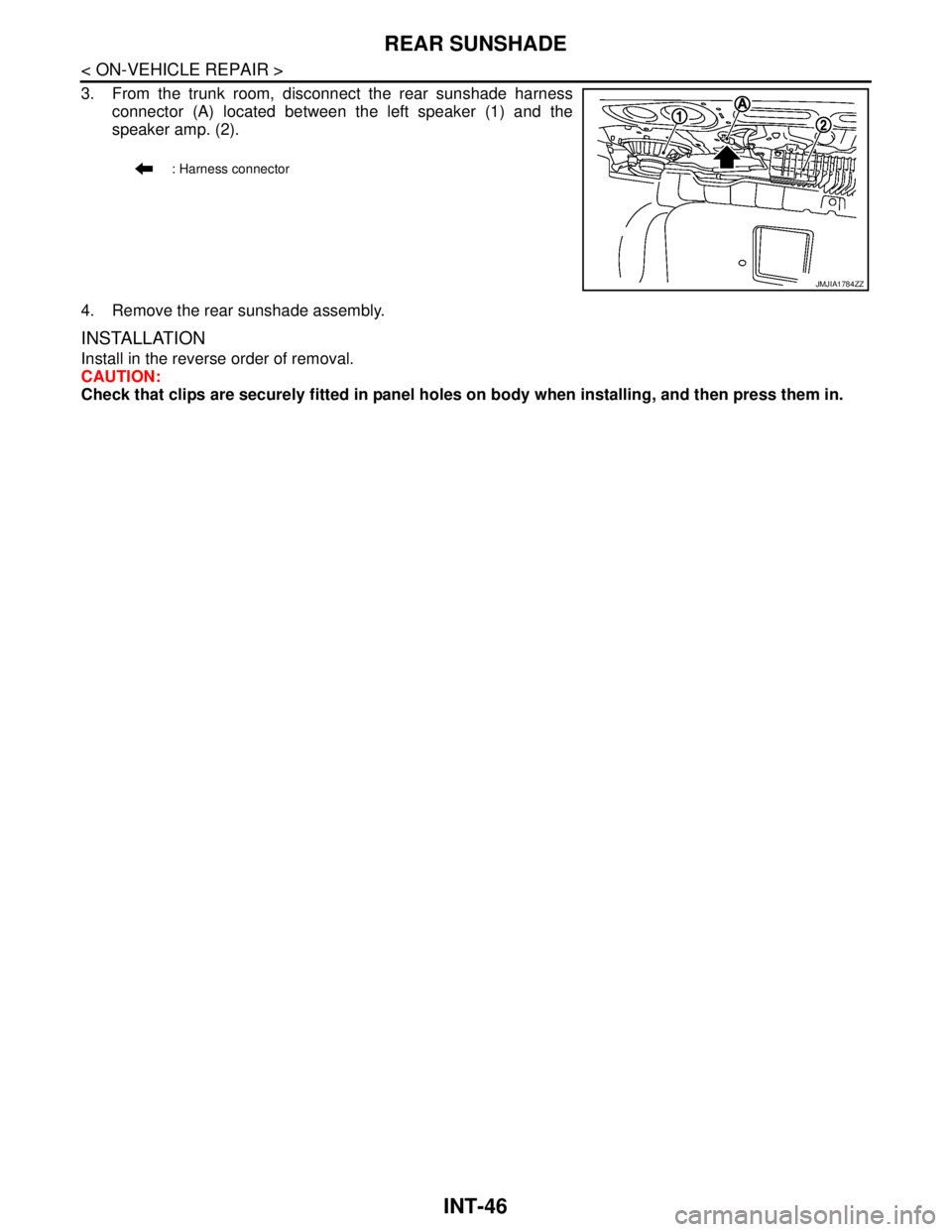
3. From the trunk room, disconnect the rear sunshade harness
connector (A) located between the left speaker (1) and the
speaker amp. (2).
4. Remove the rear sunshade assembly.
INSTALLATION
Install in the reverse order of removal.
CAUTION:
Check that clips are securely fitted in panel holes on body when installing, and then press them in.
: Harness connector
JMJIA1784ZZ
Page 3035 of 5121
INT-58
< ON-VEHICLE REPAIR >
TRUNK ROOM TRIM
2. Remove trunk floor carpet.
3. Remove trunk center box.
4. Remove trunk floor spacer (LH/RH).
5. Remove trunk rear finisher mounting clips and metal clips, and then remove trunk rear finisher.
6. Remove trunk weather-strip.
7. Remove trunk front finisher center fixing clips, and then remove trunk front finisher center.
8. Remove trunk front finisher upper fixing clips, and then remove the trunk front finisher upper.
9. Remove rear wheel house finisher (LH/RH).
Remove rear wheel fixing clips
Remove rear seat assembly. Refer to SE-99, "
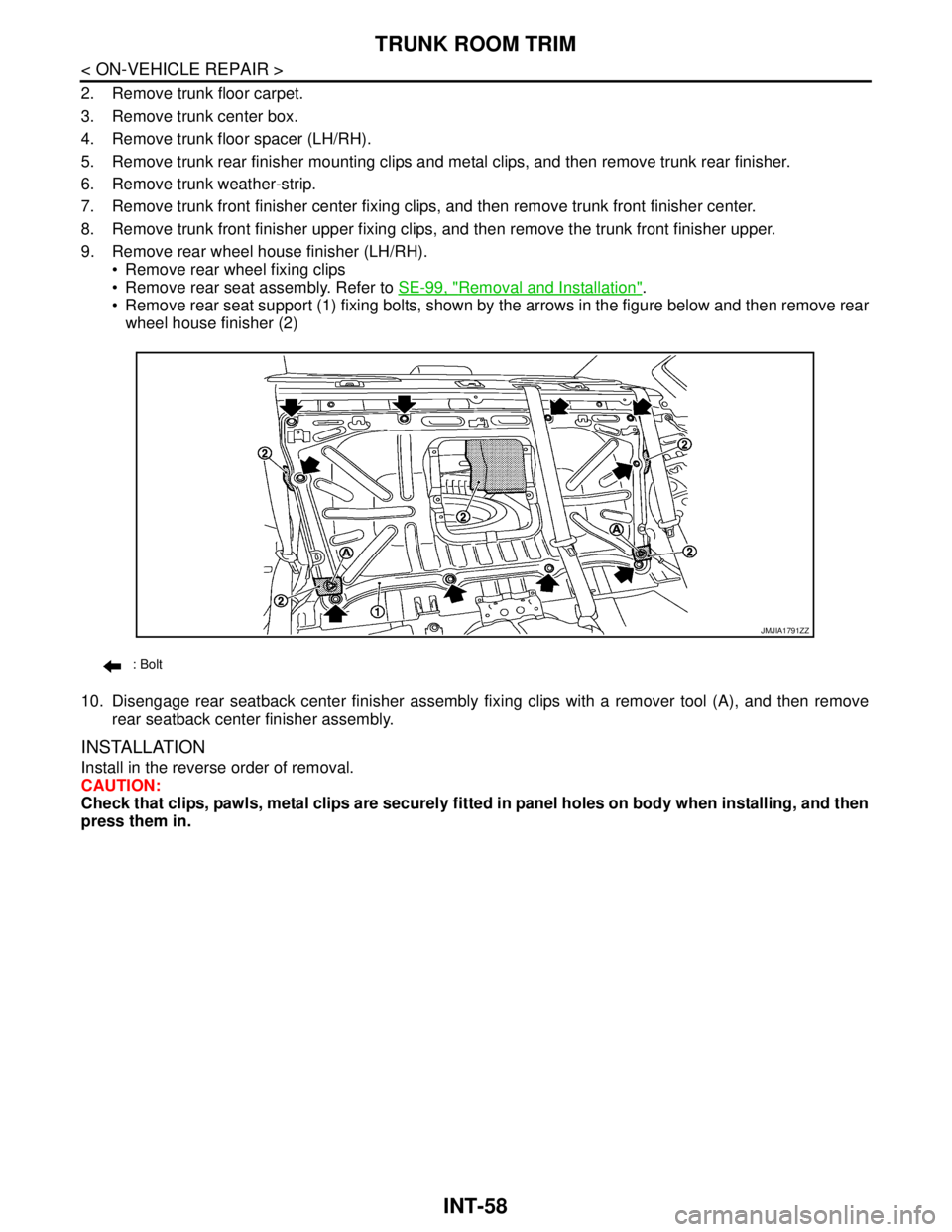
Removal and Installation".
Remove rear seat support (1) fixing bolts, shown by the arrows in the figure below and then remove rear
wheel house finisher (2)
10. Disengage rear seatback center finisher assembly fixing clips with a remover tool (A), and then remove
rear seatback center finisher assembly.
INSTALLATION
Install in the reverse order of removal.
CAUTION:
Check that clips, pawls, metal clips are securely fitted in panel holes on body when installing, and then
press them in.
: Bolt
JMJIA1791ZZ
Page 3043 of 5121
SQUEAK AND RATTLE TROUBLE DIAGNOSES
IP-3
< SYMPTOM DIAGNOSIS >
C
D
E
F
G
H
I
K
L
MA
B
IP
N
O
P
If possible, drive the vehicle with the customer until the noise is duplicated. Note any additional information on
the Diagnostic Worksheet regarding the conditions or location of the noise. This information can be used to
duplicate the same conditions when the repair is reconfirmed.
If the noise can be duplicated easily during the test drive, to help identify the source of the noise, try to dupli-
cate the noise with the vehicle stopped by doing one or all of the following:
1) Close a door.
2) Tap or push/pull around the area where the noise appears to be coming from.
3) Rev the engine.
4) Use a floor jack to recreate vehicle “twist”.
5) At idle, apply engine load (electrical load, half-clutch on M/T model, drive position on A/T model).
6) Raise the vehicle on a hoist and hit a tire with a rubber hammer.
Drive the vehicle and attempt to duplicate the conditions the customer states exist when the noise occurs.
If it is difficult to duplicate the noise, drive the vehicle slowly on an undulating or rough road to stress the
vehicle body.
LOCATE THE NOISE AND IDENTIFY THE ROOT CAUSE
1. Narrow down the noise to a general area. To help pinpoint the source of the noise, use a listening tool
(Engine Ear or mechanics stethoscope).
2. Narrow down the noise to a more specific area and identify the cause of the noise by:
Removing the components in the area that is are suspected to be the cause of the noise.
Do not use too much force when removing clips and fasteners, otherwise clips and fastener can be broken
or lost during the repair, resulting in the creation of new noise.
Tapping or pushing/pulling the component that is are suspected to be the cause of the noise.
Do not tap or push/pull the component with excessive force, otherwise the noise will be eliminated only tem-
porarily.
Feeling for a vibration by hand by touching the component(s) that is are suspected to be the cause of the
noise.
Placing a piece of paper between components that is are suspected to be the cause of the noise.
Looking for loose components and contact marks.
Refer to IP-4, "
Inspection Procedure".
REPAIR THE CAUSE
If the cause is a loose component, tighten the component securely.
If the cause is insufficient clearance between components:
- Separate components by repositioning or loosening and retightening the component, if possible.
- Insulate components with a suitable insulator such as urethane pads, foam blocks, felt cloth tape or ure-
thane tape. These insulators are available through the authorized Nissan Parts Department.
CAUTION:
Never use excessive force as many components are constructed of plastic and may be damaged.
NOTE:
URETHANE PADS
Insulates connectors, harness, etc.
INSULATOR (Foam blocks)
Insulates components from contact. Can be used to fill space behind a panel.
INSULATOR (Light foam block)
FELT CLOTHTAPE
Used to insulate where movement does not occur. Ideal for instrument panel applications.
The following materials, not available through NISSAN Parts Department, can also be used to repair
squeaks and rattles.
UHMW(TEFLON) TAPE
Insulates where slight movement is present. Ideal for instrument panel applications.
SILICONE GREASE
Used in place of UHMW tape that is be visible or does not fit.
Note: Will only last a few months.
SILICONE SPRAY
Used when grease cannot be applied.
DUCT TAPE
Used to eliminate movement.
CONFIRM THE REPAIR
Page 3044 of 5121

IP-4
< SYMPTOM DIAGNOSIS >
SQUEAK AND RATTLE TROUBLE DIAGNOSES
Confirm that the cause of a noise is repaired by test driving the vehicle. Operate the vehicle under the same
conditions as when the noise originally occurred. Refer to the notes on the Diagnostic Worksheet.
Inspection ProcedureINFOID:0000000003939974
Refer to Table of Contents for specific component removal and installation information.
INSTRUMENT PANEL
Most incidents are caused by contact and movement between:
1. Cluster lid A and instrument panel
2. Acrylic lens and combination meter housing
3. Instrument panel to front pillar garnish
4. Instrument panel to windshield
5. Instrument panel mounting pins
6. Wiring harnesses behind the combination meter
7. A/C defroster duct and duct joint
These incidents can usually be located by tapping or moving the components to duplicate the noise or by
pressing on the components while driving to stop the noise. Most of these incidents can be repaired by apply-
ing felt cloth tape or silicon spray (in hard to reach areas). Urethane pads can be used to insulate wiring har-
ness.
CAUTION:
Never use silicone spray to isolate a squeak or rattle. If the area is saturated with silicone, the recheck
of repair becomes impossible.
CENTER CONSOLE
Components to pay attention to include:
1. Shifter assembly cover to finisher
2. A/C control unit and cluster lid C
3. Wiring harnesses behind audio and A/C control unit
The instrument panel repair and isolation procedures also apply to the center console.
DOORS
Pay attention to the following:
1. Finisher and inner panel making a slapping noise
2. Inside handle escutcheon to door finisher
3. Wiring harnesses tapping
4. Door striker out of alignment causing a popping noise on starts and stops
Tapping or moving the components or pressing on them while driving to duplicate the conditions can isolate
many of these incidents. The areas can usually be insulated with felt cloth tape or insulator foam blocks to
repair the noise.
TRUNK
Trunk noises are often caused by a loose jack or loose items put into the trunk by the customer.
In addition look for the following:
1. Trunk lid dumpers out of adjustment
2. Trunk lid striker out of adjustment
3. Trunk lid torsion bars knocking together
4. A loose license plate or bracket
Most of these incidents can be repaired by adjusting, securing or insulating the item(s) or component(s) caus-
ing the noise.
SUNROOF/HEADLINING
Noises in the sunroof/headlining area can often be traced to one of the following:
1. Sunroof lid, rail, linkage or seals making a rattle or light knocking noise
2. Sunvisor shaft shaking in the holder
3. Front or rear windshield touching headlining and squeaking
Page 3045 of 5121

SQUEAK AND RATTLE TROUBLE DIAGNOSES
IP-5
< SYMPTOM DIAGNOSIS >
C
D
E
F
G
H
I
K
L
MA
B
IP
N
O
P
Again, pressing on the components to stop the noise while duplicating the conditions can isolate most of these
incidents. Repairs usually consist of insulating with felt cloth tape.
SEATS
When isolating seat noise it is important to note the position the seat is in and the load placed on the seat
when the noise occurs. These conditions should be duplicated when verifying and isolating the cause of the
noise.
Cause of seat noise include:
1. Headrest rods and holder
2. A squeak between the seat pad cushion and frame
3. Rear seatback lock and bracket
These noises can be isolated by moving or pressing on the suspected components while duplicating the con-
ditions under which the noise occurs. Most of these incidents can be repaired by repositioning the component
or applying urethane tape to the contact area.
UNDERHOOD
Some interior noise may be caused by components under the hood or on the engine wall. The noise is then
transmitted into the passenger compartment.
Causes of transmitted underhood noise include:
1. Any component mounted to the engine wall
2. Components that pass through the engine wall
3. Engine wall mounts and connectors
4. Loose radiator mounting pins
5. Hood bumpers out of adjustment
6. Hood striker out of adjustment
These noises can be difficult to isolate since they cannot be reached from the interior of the vehicle. The best
method is to secure, move or insulate one component at a time and test drive the vehicle. Also, engine RPM
or load can be changed to isolate the noise. Repairs can usually be made by moving, adjusting, securing, or
insulating the component causing the noise.
Page 3086 of 5121
![NISSAN TEANA 2008 Service Manual LAN
HOW TO USE THIS SECTION
LAN-19
< HOW TO USE THIS MANUAL >[CAN]
C
D
E
F
G
H
I
J
K
L B A
O
P N
HOW TO USE THIS MANUAL
HOW TO USE THIS SECTION
CautionINFOID:0000000003767678
This section describes](/img/5/57391/w960_57391-3085.png "NISSAN TEANA 2008 Service Manual LAN
HOW TO USE THIS SECTION
LAN-19
< HOW TO USE THIS MANUAL >[CAN]
C
D
E
F
G
H
I
J
K
L B A
O
P N
HOW TO USE THIS MANUAL
HOW TO USE THIS SECTION
CautionINFOID:0000000003767678
This section describes")
LAN
HOW TO USE THIS SECTION
LAN-19
< HOW TO USE THIS MANUAL >[CAN]
C
D
E
F
G
H
I
J
K
L B A
O
P N
HOW TO USE THIS MANUAL
HOW TO USE THIS SECTION
CautionINFOID:0000000003767678
This section describes information peculiar to a vehicle and inspection procedures.
For trouble diagnosis procedure, refer to LAN-14, "
Trouble Diagnosis Procedure".
Abbreviation ListINFOID:0000000003767679
Unit name abbreviations in CONSULT-III CAN diagnosis and in this section are as per the following list.
Abbreviation Unit name
ABS ABS actuator and electric unit (control unit)
ADP Driver seat control unit
AV AV control unit
BCM BCM
DLC Data link connector
ECM ECM
HVAC A/C auto amp.
IPDM-E IPDM E/R
M&A Combination meter
STRG Steering angle sensor
TCM TCM
Page 3193 of 5121
GENERAL MAINTENANCE
MA-5
< ON-VEHICLE MAINTENANCE >
C
D
E
F
G
H
I
J
K
L
MB
MAN
OA
ON-VEHICLE MAINTENANCE
GENERAL MAINTENANCE
General MaintenanceINFOID:0000000003858221
General maintenance includes those items which should be checked during the normal day-to-day operation
of the vehicle. They are essential if the vehicle is to continue operating properly. The owners can perform the
checks and inspections themselves or they can have their NISSAN dealers do them for a nominal charge.
OUTSIDE THE VEHICLE
The maintenance items listed here should be performed from time to time, unless otherwise specified.
INSIDE THE VEHICLE
The maintenance items listed here should be checked on a regular basis, such as when performing periodic maintenance, cleaning the vehicle,
etc.
UNDER THE HOOD AND VEHICLE
The maintenance items listed here should be checked periodically e.g. each time you check the engine oil or refuel.
Item Reference page
TiresCheck the pressure with a gauge often and always prior to long distance trips.
Adjust the pressure in all tires, including the spare, to the pressure specified.
Check carefully for damage, cuts or excessive wear.—
Windshield wiper
bladesCheck for cracks or wear if not functioning correctly. —
Doors and engine
hoodCheck that all doors and the engine hood operate properly. Also make sure that
all latches lock securely. Lubricate if necessary. Make sure that the secondary
latch keeps the hood from opening when the primary latch is released.
When driving in areas using road salt or other corrosive materials, check for lu-
brication frequently.MA-42
Tire rotationTires should be rotated every 10,000 km (6,000 miles).WT-3
Wheel alignment and
balanceIf the vehicle should pull to either side while driving on a straight and level road,
or if you detect uneven or abnormal tire wear. there may be a need for wheel
alignment. If the steering wheel or seat vibrates at normal highway speeds,
wheel balancing may be needed.
Item Reference page
LampsMake sure that the headlamps, stop lamps, tail lamps, turn signal lamps, and oth-
er lamps are all operating properly and installed securely. Also check headlamp
aim.—
Warning lamps and
chimesMake sure that all warning lamps and chimes are operating properly. —
Steering wheelCheck that it has the specified play.
Check for changes in the steering condition, such as excessive free play, hard
steering or strange noises.
Free play: Less than 35 mm (1.38 in)—
Seat beltsCheck that all parts of the seat belt system (e.g. buckles, anchors, adjusters and
retractors) operate properly and smoothly, and are installed securely. Check the
belt webbing for cuts, fraying, wear or damage.MA-42
Item Reference page
Windshield washer
fluidCheck that there is adequate fluid in the tank. —
Engine coolant levelCheck the coolant level when the engine is cold.MA-13
Engine oil levelCheck the level after parking the vehicle on a level spot and turning off the en-
gine.LU-7
Brake fluid levelMake sure that the brake fluid level is between the “MAX” and “MIN” lines on the
reservoir.MA-37
BatteryCheck the fluid level in each cell. It should be between the “MAX” and “MIN” lines. —