coolant NISSAN TEANA 2014 Service Manual
[x] Cancel search | Manufacturer: NISSAN, Model Year: 2014, Model line: TEANA, Model: NISSAN TEANA 2014Pages: 4801, PDF Size: 51.2 MB
Page 2220 of 4801
![NISSAN TEANA 2014 Service Manual
EM-222
< UNIT REMOVAL AND INSTALLATION >[VQ35DE]
ENGINE ASSEMBLY
• (B): LH cylinder head
25. Remove rear cover plate.
26. Remove the torque converter nuts.
27. Remove nuts of stabilizer connectin](/img/5/57390/w960_57390-2219.png "NISSAN TEANA 2014 Service Manual
EM-222
< UNIT REMOVAL AND INSTALLATION >[VQ35DE]
ENGINE ASSEMBLY
• (B): LH cylinder head
25. Remove rear cover plate.
26. Remove the torque converter nuts.
27. Remove nuts of stabilizer connectin")
EM-222
< UNIT REMOVAL AND INSTALLATION >[VQ35DE]
ENGINE ASSEMBLY
• (B): LH cylinder head
25. Remove rear cover plate.
26. Remove the torque converter nuts.
27. Remove nuts of stabilizer connecting rods from struts. Refer to FSU-19, "Exploded View"
.
28. Remove front wheel speed sensors and position aside. Refer to BRC-124, "Removal and Installation -
Front Wheel Sensor".
29. Remove front brake rotors. Refer to BR-36, "BRAKE CALIPER ASSEMBLY : Removal and Installation"
.
30. Remove piston rod nut. Refer to FSU-19, "Exploded View"
.
31. Remove front drive shaft (LH/RH). Refer to FAX-10, "Removal and Installation (LH)"
and FAX-12,
"Removal and Installation (RH)".
32. Remove RH drive shaft center bearing bracket.
33. Remove lower steering column pinch bolt. Refer to ST-33, "Exploded View"
.
34. Remove three way catalyst (manifold) (bank 1) heat shield.
35. Disconnect front and rear engine mounting insulator vacuum hoses.
36. Remove front and rear engine mounting insulator nut.
37. Position a suitable support table under suspension member and engine assembly. TM-206, "Removal and
Installation"
38. Disconnect the engine mounting insulator (LH), upper torque rod, and engine mounting insulator (RH).
39. For additional safety, secure the engine in position with suitable tool.
40. Remove suspension member bolts. Refer to FSU-19, "Exploded View"
.
41. Carefully lower the engine, transaxle assembly and suspension member using Tool, avoiding interference
with the vehicle body.
CAUTION:
• Before and during this procedure, alw ays check if any harnesses are left connected.
• Avoid any damage to, or any oil/grease smearin g or spilling onto the engine mounting insula-
tors.
42. Remove the starter motor. Refer to STR-23, "VQ35DE : Removal and Installation"
.
43. Remove the crankshaft position sensor (POS).
44. Remove engine and transaxle harness.
45. Separate the engine and transaxle and mount the engine on a suitable engine stand.
INSTALLATION
Installation is in the reverse order of removal.
NOTE:
Tighten transmission bolts to specification. Refer to TM-206, "Removal and Installation"
.
INSPECTION AFTER INSTALLATION
• Before starting engine, check oil/fluid levels including engine coolant and engine oil. If less than required
quantity, fill to the specified level. Refer to MA-11, "FOR USA AND CANADA : Fluids and Lubricants"
.
• Use procedure below to check for fuel leakage.
• Turn ignition switch ON (with engine stopped). With fuel pressure applied to fuel piping, check for fuel leak-
age at connection points.
ALBIA0263GB
Tool number : KV101J0010 (J-47242)
Revision: November 20132014 Altima NAM
Page 2221 of 4801
![NISSAN TEANA 2014 Service Manual
ENGINE ASSEMBLYEM-223
< UNIT REMOVAL AND INSTALLATION > [VQ35DE]
C
D E
F
G H
I
J
K L
M A
EM
NP
O
• Start engine. With engine speed increased, check again for fuel leakage at connection points.
â€](/img/5/57390/w960_57390-2220.png "NISSAN TEANA 2014 Service Manual
ENGINE ASSEMBLYEM-223
< UNIT REMOVAL AND INSTALLATION > [VQ35DE]
C
D E
F
G H
I
J
K L
M A
EM
NP
O
• Start engine. With engine speed increased, check again for fuel leakage at connection points.
â€")
ENGINE ASSEMBLYEM-223
< UNIT REMOVAL AND INSTALLATION > [VQ35DE]
C
D E
F
G H
I
J
K L
M A
EM
NP
O
• Start engine. With engine speed increased, check again for fuel leakage at connection points.
• Run engine to check for unusual noise and vibration. NOTE:
If hydraulic pressure inside timing chain tensioner dr ops after removal and installation, slack in the guide
may generate a pounding noise during and just after engine start. However, this is normal. Noise will stop
after hydraulic pressure rises.
• Warm up engine thoroughly to make sure there is no leak age of fuel, exhaust gas, or any oils/fluids including
engine oil and engine coolant.
• Bleed air from passages in lines and hoses, such as in cooling system.
• After cooling down engine, again check oil/fluid levels including engine oil and engine coolant. Refill to spec- ified level, if necessary.
• Summary of the inspection items:
*Power steering fluid, brake fluid, etc. Item Before starting engine Engine running After engine stopped
Engine coolant Level Leakage Level
Engine oil Level Leakage Level
Transmission/
transaxle fluid CVT Models Leakage Level/Leakage Leakage
Other oils and fluids* Level Leakage Level
Fuel Leakage Leakage Leakage
Exhaust gas — Leakage —
Revision: November 20132014 Altima NAM
Page 2224 of 4801
![NISSAN TEANA 2014 Service Manual
EM-226
< UNIT DISASSEMBLY AND ASSEMBLY >[VQ35DE]
CYLINDER BLOCK
6. Drain the engine of all coolant and oil.
7. Remove the oil pan. Refer to EM-157, "Removal and Installation (Upper Oil Pan)"
.
8. R](/img/5/57390/w960_57390-2223.png "NISSAN TEANA 2014 Service Manual
EM-226
< UNIT DISASSEMBLY AND ASSEMBLY >[VQ35DE]
CYLINDER BLOCK
6. Drain the engine of all coolant and oil.
7. Remove the oil pan. Refer to EM-157, \"Removal and Installation (Upper Oil Pan)\"
.
8. R")
EM-226
< UNIT DISASSEMBLY AND ASSEMBLY >[VQ35DE]
CYLINDER BLOCK
6. Drain the engine of all coolant and oil.
7. Remove the oil pan. Refer to EM-157, "Removal and Installation (Upper Oil Pan)"
.
8. Remove the timing chain primary and secondary. Refer to EM-182, "Removal and Installation"
.
9. Remove the cylinder head. Refer to EM-207, "Removal and Installation"
.
10. Cut away liquid gasket and remove rear oil seal retainer using Tool. Refer to EM-124, "Precaution for Liquid Gasket"
.
CAUTION:
• Be careful not to damage mounting surface.
• If rear oil seal retainer is removed, replace it with a new one.
NOTE:
Rear oil seal and retainer form a single part and are handled as
an assembly.
11. Remove the piston and connecting rod assemblies.
a. Position the crankshaft pin corresponding to the connecting rod to be removed onto the bottom dead center.
b. Remove the connecting rod cap.
c. Using a hammer handle or similar tool, push the piston and con- necting rod assembly out to the cylinder head side.
• Before removing the piston and connecting rod assembly, check the connecting rod side clearance. Refer to EM-234,
"Inspection".
12. Remove the connecting rod bearings. CAUTION:
• When removing the connecting rod side bearings, note the installation position. Keep them in
the correct order.
13. Remove the piston rings from the piston. • Use a piston ring expander.
CAUTION:
• When removing the piston rings, be careful not to damage the piston. Do not exp and the rings excessively.
• Be careful to mark the rings if they are to be reused so
they are installed in their original position.
• Before removing the piston rings, check the piston ring side clear- ance. Refer to EM-234, "Inspection"
.
14. Remove the piston from the connecting rod as follows.
a. Using a snap ring pliers, remove the snap ring. CAUTION:
Do not reuse snap rings. Tool number : KV10111100 (J-37228)
SEM830E
PBIC0086E
PBIC0087E
PBIC0260E
Revision: November 20132014 Altima NAM
Page 2225 of 4801
![NISSAN TEANA 2014 Service Manual
CYLINDER BLOCKEM-227
< UNIT DISASSEMBLY AND ASSEMBLY > [VQ35DE]
C
D E
F
G H
I
J
K L
M A
EM
NP
O
b. Heat the pistons to 60
° - 70 °C (140 ° - 158 °F).
WARNING:
Pistons contain heat. when wo rkin](/img/5/57390/w960_57390-2224.png "NISSAN TEANA 2014 Service Manual
CYLINDER BLOCKEM-227
< UNIT DISASSEMBLY AND ASSEMBLY > [VQ35DE]
C
D E
F
G H
I
J
K L
M A
EM
NP
O
b. Heat the pistons to 60
° - 70 °C (140 ° - 158 °F).
WARNING:
Pistons contain heat. when wo rkin")
CYLINDER BLOCKEM-227
< UNIT DISASSEMBLY AND ASSEMBLY > [VQ35DE]
C
D E
F
G H
I
J
K L
M A
EM
NP
O
b. Heat the pistons to 60
° - 70 °C (140 ° - 158 °F).
WARNING:
Pistons contain heat. when wo rking, wear protective equip-
ment to avoid getting burned.
c. Push out the piston pin with a suitable tool, with an outer diame- ter approximately 20 mm (0.8 in).
15. Remove the baffle plate from the main bearing beam.
16. Loosen the bolts in the numerical order as shown and remove the main bearing beam, bearing caps and crankshaft.
• Before loosening the main bearing cap bolts, measure the crankshaft side clearance.
Refer to EM-234, "Inspection"
.
17. Remove the oil jets and dowel pins.
18. Remove the main bearings and thrust bearings from the cylinder block and main bearing caps.
• When removing them, note the direction and position. Keep
them in the correct order for installation.
ASSEMBLY
1. Blow out the coolant and oil passages and cylinder bore to remove any foreign materials.
WARNING:
Use goggles to protect your eyes.
2. Install each plug to cylinder block as shown. CAUTION:
SEM965A
PBIC0262E
SEM842E
PBIC0898E
Revision: November 20132014 Altima NAM
Page 2232 of 4801
![NISSAN TEANA 2014 Service Manual
EM-234
< UNIT DISASSEMBLY AND ASSEMBLY >[VQ35DE]
CYLINDER BLOCK
17. Install the baffle plate to the main bearing beam.
18. Install the knock sensor. • Make sure that there is no foreign material o](/img/5/57390/w960_57390-2231.png "NISSAN TEANA 2014 Service Manual
EM-234
< UNIT DISASSEMBLY AND ASSEMBLY >[VQ35DE]
CYLINDER BLOCK
17. Install the baffle plate to the main bearing beam.
18. Install the knock sensor. • Make sure that there is no foreign material o")
EM-234
< UNIT DISASSEMBLY AND ASSEMBLY >[VQ35DE]
CYLINDER BLOCK
17. Install the baffle plate to the main bearing beam.
18. Install the knock sensor. • Make sure that there is no foreign material on the cylinder
block mating surface and the bac k surface of the knock sen-
sor.
• Install the knock sensor with the connector facing the rear of
the engine.
• Do not tighten the bolts while holding the connector.
• Make sure that the knock sensor does not interfere with other
parts.
CAUTION:
If any impact by dropping occurs to the knock sensor,
replace it with new one.
19. Install the cylinder head. Refer to EM-207, "Removal and Installation"
.
20. Install the timing chain. Refer to EM-182, "Removal and Installation"
.
21. Install the oil pan. Refer to EM-157, "Removal and Installation (Upper Oil Pan)"
.
22. Remove the engine from the stand and install the engine assembly into the vehicle. Refer to EM-220,
"Removal and Installation".
23. Install the pilot converter with its chamfer facing crankshaft as shown.
24. Install the drive plate. • Install the drive plate and reinforce plate in the direction asshown.
• Align dowel pins of crankshaft rear and drive plate with pin
holes of each part.
• Secure the crankshaft using a suitable tool.
• Tighten the drive plate bolts in one or two steps.
25. Assembly of the remaining parts is in the reverse order of disas- sembly.
26. Fill the engine with the specified oil and coolant. Refer to MA-11,
"FOR USA AND CANADA : Engine Oil Recommendation" and
MA-11, "FOR USA AND CANADA : Fluids and Lubricants"
.
CAUTION:
Wait at least 30 minutes for the sealant to set-up befo re filling the engine with fluids and running it.
InspectionINFOID:0000000009460582
PISTON AND PISTON PIN CLEARANCE
Inner Diameter of Piston Pin Hole
: Crankshaft side
PBIC0810E
JPBIA0210ZZ
PBIC0910E
Revision: November 20132014 Altima NAM
Page 2236 of 4801
![NISSAN TEANA 2014 Service Manual
EM-238
< UNIT DISASSEMBLY AND ASSEMBLY >[VQ35DE]
CYLINDER BLOCK
• : Engine front
• Piston Grade No. (A)
• Piston front mark (B)
• Oil hole (C)
• Connecting rod front mark (D)
• Cylind](/img/5/57390/w960_57390-2235.png "NISSAN TEANA 2014 Service Manual
EM-238
< UNIT DISASSEMBLY AND ASSEMBLY >[VQ35DE]
CYLINDER BLOCK
• : Engine front
• Piston Grade No. (A)
• Piston front mark (B)
• Oil hole (C)
• Connecting rod front mark (D)
• Cylind")
EM-238
< UNIT DISASSEMBLY AND ASSEMBLY >[VQ35DE]
CYLINDER BLOCK
• : Engine front
• Piston Grade No. (A)
• Piston front mark (B)
• Oil hole (C)
• Connecting rod front mark (D)
• Cylinder No. (E)
• Pin Grade No. (F)
Service parts apply only to grade 0.
Unit: mm (in)
CYLINDER BLOCK DISTORTION
• Using a scraper, remove any old gasket material on the cylinder block surface, and remove any oil, scale, carbon, or other contami-
nation.
CAUTION:
Be careful not to allow gasket fl akes to enter the oil or coolant
passages.
• Measure the distortion on the block upper face at different points in six directions.
• If out of specification, resurfac e the cylinder block. The allowable
amount of resurfacing is dependent on the amount of any cylinder
head resurfacing. The resurfacing limit is [amount of cylinder head resurfacing] + [amount of cylinder head
resurfacing] = 0.2 mm (0.008 in).
INNER DIAMETER OF MAIN BEARING HOUSING
• Install the main bearing caps with the main bearings removed, and tighten the bolts to the specified torque.
• Using a bore gauge, measure the inner diameter of the main bear-
ing housing (A).
• If out of the standard, replace the cylinder block and main bearing caps as an assembly.
NOTE:
These components cannot be replaced as a single unit, because
they were processed together.
PISTON-TO-CYLINDER BORE CLEARANCE
1. Using a bore gauge, measure cylinder bore for wear, out -of-round and taper at (A), (B) and (C). The X axis
is in the longitudinal direction of the engine.
AWBIA0027ZZ
Grade 0 1
Connecting rod bushing inner diameter
222.000 - 22.006
(0.8661 - 0.8664) 22.006 - 22.012
(0.8664 - 0.8666)
Piston pin outer diameter 21.989 - 21.995
(0.8657 - 0.8659) 21.995 - 22. 001
(0.8659 - 0.8662)
Piston pin hole diameter 21.993 - 21.999
(0.8659 - 0.8661) 21.999 - 22.005
(0.8661 - 0.8663)
Distortion limit : 0.10 mm (0.0039 in)
Cylinder block height : 214.95 - 215.05 mm (8.4626 - 8.4665 in)
SEM123C
Standard : 63.993 - 64.017 mm (2.5194 - 2.5203 in)
SEM845E
Revision: November 20132014 Altima NAM
Page 2388 of 4801
EXL-122
< PERIODIC MAINTENANCE >
HEADLAMP
PERIODIC MAINTENANCE
HEADLAMP
Aiming AdjustmentINFOID:0000000009463617
PREPARATION BEFORE ADJUSTING
Before performing aiming adjustment, check the following:
• Ensure all tires are inflated to correct pressure.
• Place vehicle and screen on level surface.
• Ensure there is no load in vehicle other than the driver (or equivalent weight placed in driver's position).
• Coolant and engine oil filled to correct level, and fuel tank full.
• Remove cargo and/or luggage to maintain an unloaded vehicle condition.
• Confirm spare tire, jack and tools are properly stowed.
• Carefully wipe off any dirt from headlamp lens. CAUTION:
Do not use organic solvent (thinner, gasoline etc.)
• Place a driver or equivalent weight of 68.5 kg (150 lb) on the driver seat.
• By hand, bounce the front and rear of the vehicle to settle the suspension and eliminate any static load.
• Place the front tires in the straight ahead position.
• Aim each headlamp individually and ensure other headlamp beam pattern is blocked from screen.
NOTE:
• For headlamp aiming details, refer to regulations in your area.
• By regulation, no means for horizontal aim adjustment is provided from the factory; only vertical aim is
adjustable.
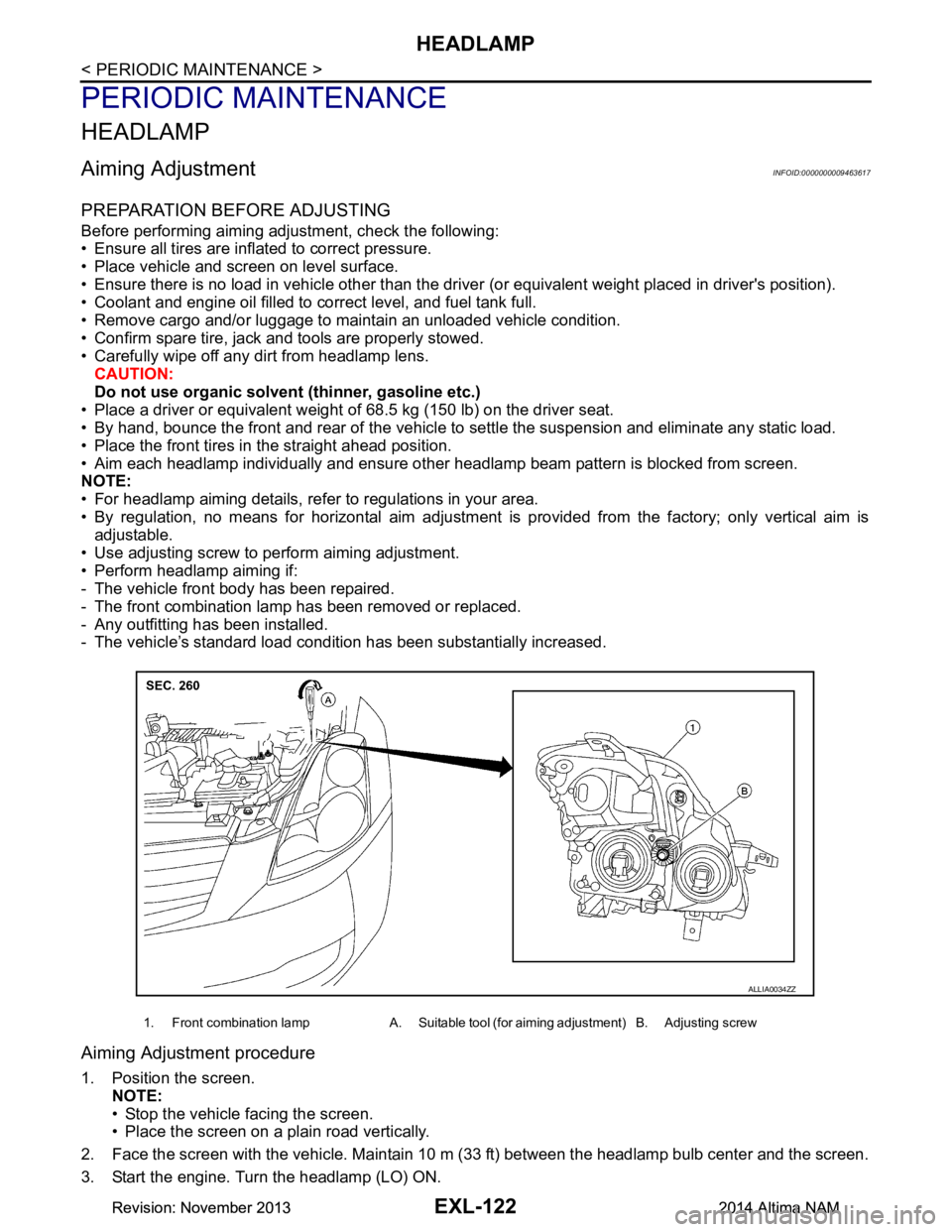
• Use adjusting screw to perform aiming adjustment.
• Perform headlamp aiming if:
- The vehicle front body has been repaired.
- The front combination lamp has been removed or replaced.
- Any outfitting has been installed.
- The vehicle’s standard load condition has been substantially increased.
Aiming Adjustment procedure
1. Position the screen.
NOTE:
• Stop the vehicle facing the screen.
• Place the screen on a plain road vertically.
2. Face the screen with the vehicle. Maintain 10 m (33 ft) between the headlamp bulb center and the screen.
3. Start the engine. Turn the headlamp (LO) ON.
1. Front combination lamp A. Suitable tool (for aiming adjustment) B. Adjusting screw
ALLIA0034ZZ
Revision: November 20132014 Altima NAMRevision: November 20132014 Altima NAM
Page 2390 of 4801
EXL-124
< PERIODIC MAINTENANCE >
FRONT FOG LAMP
FRONT FOG LAMP
Aiming AdjustmentINFOID:0000000009463618
PREPARATION BEFORE ADJUSTING
The fog lamp is a semi-sealed beam type which uses a replaceable halogen bulb. Before performing aiming
adjustment procedure, check the following:
• Ensure all tires are inflated to correct pressure.
• Place vehicle and screen on level surface.
• Ensure there is no load in vehicle other than the driver (or equivalent weight placed in driver's position).
• Coolant and engine oil filled to correct level, and fuel tank full.
• Remove cargo and/or luggage to maintain an unloaded vehicle condition.
• Confirm spare tire, jack and tools are properly stowed.
• Carefully wipe off any dirt from headlamp lens. CAUTION:
Do not use organic solvent (thinner, gasoline etc.)
• Place a driver or equivalent weight of 68.5 kg (150 lb) on the driver seat.
• By hand, bounce the front and rear of the vehicle to settle the suspension and eliminate any static load.
• Place the front tires in the straight ahead position.
• Aim each headlamp individually and ensure other headlamp beam pattern is blocked from screen.
NOTE:
• For headlamp aiming details, refer to regulations in your area.
• By regulation, no means for horizontal aim adjustment is provided from the factory; only vertical aim is
adjustable.
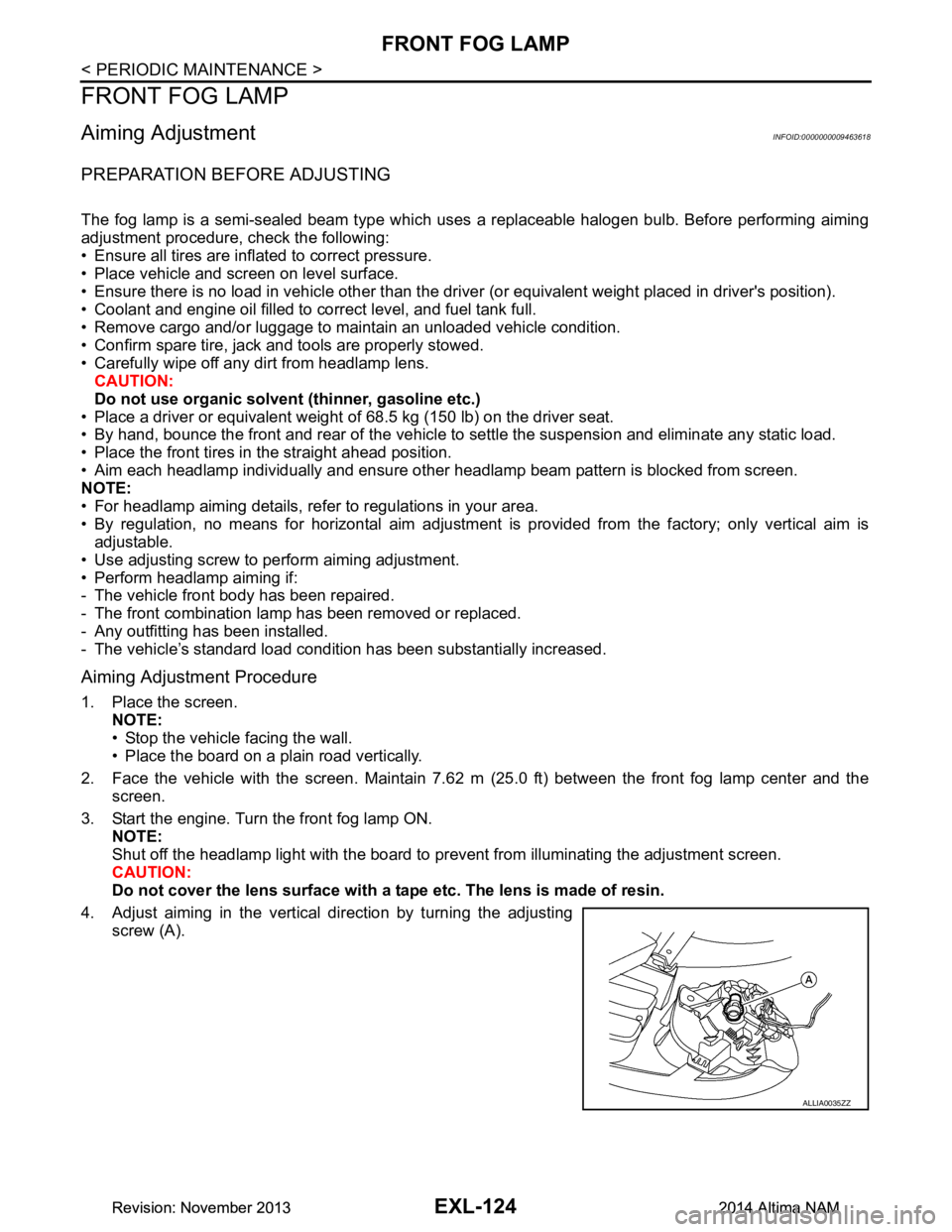
• Use adjusting screw to perform aiming adjustment.
• Perform headlamp aiming if:
- The vehicle front body has been repaired.
- The front combination lamp has been removed or replaced.
- Any outfitting has been installed.
- The vehicle’s standard load condition has been substantially increased.
Aiming Adjustment Procedure
1. Place the screen. NOTE:
• Stop the vehicle facing the wall.
• Place the board on a plain road vertically.
2. Face the vehicle with the screen. Maintain 7.62 m (25.0 ft) between the front fog lamp center and the
screen.
3. Start the engine. Turn the front fog lamp ON. NOTE:
Shut off the headlamp light with the board to prevent from illuminating the adjustment screen.
CAUTION:
Do not cover the lens surface with a tape etc. The lens is made of resin.
4. Adjust aiming in the vertical direction by turning the adjusting screw (A).
ALLIA0035ZZ
Revision: November 20132014 Altima NAMRevision: November 20132014 Altima NAM
Page 2503 of 4801
FSU-2
< PRECAUTION >
PRECAUTIONS
PRECAUTION
PRECAUTIONS
Precaution for Supplemental Restraint System (SRS) "AIR BAG" and "SEAT BELT
PRE-TENSIONER"
INFOID:0000000009951705
The Supplemental Restraint System such as “A IR BAG” and “SEAT BELT PRE-TENSIONER”, used along
with a front seat belt, helps to reduce the risk or severi ty of injury to the driver and front passenger for certain
types of collision. Information necessary to service the system safely is included in the SR and SB section of
this Service Manual.
WARNING:
• To avoid rendering the SRS inopera tive, which could increase the risk of personal injury or death in
the event of a collision which would result in air bag inflation, all maintenance must be performed by
an authorized NISS AN/INFINITI dealer.
• Improper maintenance, including in correct removal and installation of the SRS, can lead to personal
injury caused by unintent ional activation of the system. For re moval of Spiral Cable and Air Bag
Module, see the SR section.
• Do not use electrical test equipmen t on any circuit related to the SRS unless instructed to in this
Service Manual. SRS wiring harn esses can be identified by yellow and/or orange harnesses or har-
ness connectors.
PRECAUTIONS WHEN USING POWER TOOLS (AIR OR ELECTRIC) AND HAMMERS
WARNING:
• When working near the Airbag Diagnosis Sensor Unit or other Airbag System sensors with the Igni-
tion ON or engine running, DO NOT use air or electri c power tools or strike near the sensor(s) with a
hammer. Heavy vibration could activate the sensor( s) and deploy the air bag(s), possibly causing
serious injury.
• When using air or electric power tools or hammers , always switch the Ignition OFF, disconnect the
battery and wait at least three minutes before performing any service.
General PrecautionsINFOID:0000000009460620
• When installing rubber bushings, the final tightening mu st be carried out under unladen conditions with tires
on ground. Oil might shorten the life of rubber bushings. Be sure to wipe off any spilled oil.
- Unladen conditions mean that fuel, engine coolant and lubricant are full. Spare tire, jack, hand tools and mats are in designated positions.
• After servicing suspension parts, be sure to check wheel alignment.
• Self-lock nuts are not reusable. Always use new ones when installing. Since new self-lock nuts are pre-oiled,
tighten as they are.
Precaution for Procedure without Cowl Top CoverINFOID:0000000009460621
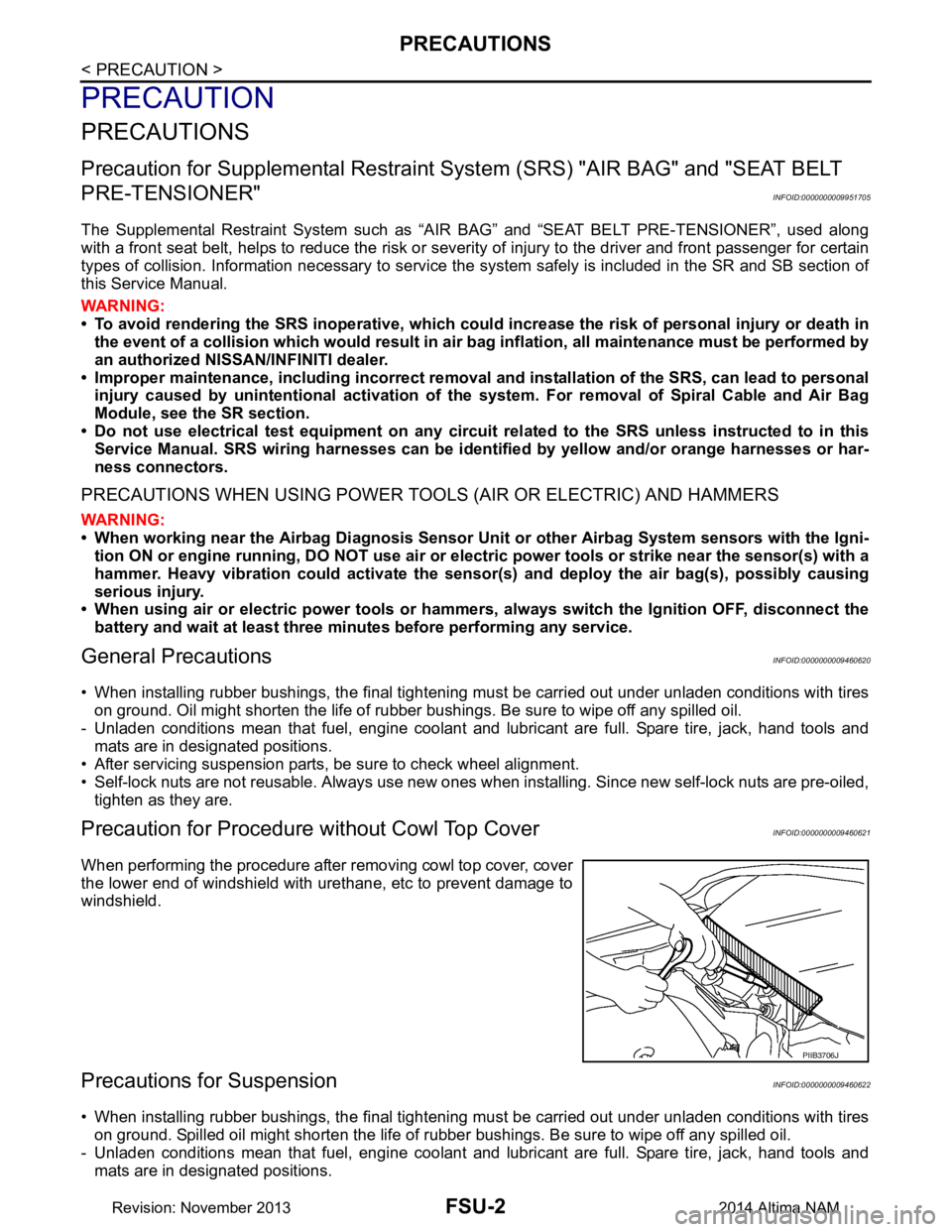
When performing the procedure after removing cowl top cover, cover
the lower end of windshield with urethane, etc to prevent damage to
windshield.
Precautions for SuspensionINFOID:0000000009460622
• When installing rubber bushings, the final tightening mu st be carried out under unladen conditions with tires
on ground. Spilled oil might shorten the life of rubber bushings. Be sure to wipe off any spilled oil.
- Unladen conditions mean that fuel, engine coolant and lubricant are full. Spare tire, jack, hand tools and mats are in designated positions.
PIIB3706J
Revision: November 20132014 Altima NAM
Page 2508 of 4801
FRONT SUSPENSION ASSEMBLYFSU-7
< PERIODIC MAINTENANCE >
C
D
F
G H
I
J
K L
M A
B
FSU
N
O P
PERIODIC MAINTENANCE
FRONT SUSPENSION ASSEMBLY
Inspection and AdjustmentINFOID:0000000009460626
INSPECTION
Make sure the mounting conditions (looseness, back lash) of each component and component conditions
(wear, damage) are normal.
LOWER BALL JOINT END PLAY
1. Set front wheels in a straight-ahead position. Do not depress brake pedal.
2. Place an iron bar or similar tool between upper link and steering knuckle.
3. Measure axial end play by prying it up and down.Refer to FSU-26, "Ball Joint"
.
CAUTION:
Be careful not to damage ball joint boot. Do not damage the installation position by applying
excessive force.
SHOCK ABSORBER
Check for oil leakage, damage and repl ace if malfunction is detected.
WHEEL ALIGNMENT
Description
Measure wheel alignment under unladen conditions.
NOTE:
"Unladen conditions" means that fuel, engine coolant, and lubricant are full. Spare tire, jack, hand tools and
mats are in designated positions.
General Information and Recommendations
• A four-wheel thrust alignment should be performed.
- This type of alignment is re commended for any NISSAN vehicle.
- The four-wheel "thrust" process helps ensure that t he vehicle is properly aligned and the steering wheel is
centered.
- The alignment rack itself should be capable of accepting any NISSAN vehicle.
- The rack should be checked to ensure that it is level.
• Make sure the machine is properly calibrated.
- Your alignment equipment should be regularly ca librated in order to give correct information.
- Check with the manufacturer of your specific equi pment for their recommended Service/Calibration Sched-
ule.
Preliminary Check
Check the following:
1. Tires for improper air pressure and wear.
2. Road wheels for runout. Refer to WT-60, "Road Wheel"
.
3. Wheel bearing axial end play. Refer to FAX-27, "Wheel Bearing"
.
4. Transverse link ball joint axial end play. Refer to FSU-11, "Removal and Installation"
.
5. Shock absorber operation.
6. Each mounting part of axle and suspension for looseness and deformation.
7. Each of suspension member, shock absorber, upper link and transverse link for cracks, deformation and other damage.
8. Vehicle height (posture).
Alignment Process
IMPORTANT:
Use only the alignment specificati ons listed in this Service Manual.
• When displaying the alignment settings, m any alignment machines use "indicators" Do not use these indi-
cators. : (Green/red, plus or minus, Go/No Go).
- The alignment specifications programmed into your machine that operate these indicators may not be cor-
rect.
Revision: November 20132014 Altima NAM