coolant level NISSAN TEANA 2014 Workshop Manual
[x] Cancel search | Manufacturer: NISSAN, Model Year: 2014, Model line: TEANA, Model: NISSAN TEANA 2014Pages: 4801, PDF Size: 51.2 MB
Page 2221 of 4801
![NISSAN TEANA 2014 Workshop Manual
ENGINE ASSEMBLYEM-223
< UNIT REMOVAL AND INSTALLATION > [VQ35DE]
C
D E
F
G H
I
J
K L
M A
EM
NP
O
• Start engine. With engine speed increased, check again for fuel leakage at connection points.
â€](/img/5/57390/w960_57390-2220.png "NISSAN TEANA 2014 Workshop Manual
ENGINE ASSEMBLYEM-223
< UNIT REMOVAL AND INSTALLATION > [VQ35DE]
C
D E
F
G H
I
J
K L
M A
EM
NP
O
• Start engine. With engine speed increased, check again for fuel leakage at connection points.
â€")
ENGINE ASSEMBLYEM-223
< UNIT REMOVAL AND INSTALLATION > [VQ35DE]
C
D E
F
G H
I
J
K L
M A
EM
NP
O
• Start engine. With engine speed increased, check again for fuel leakage at connection points.
• Run engine to check for unusual noise and vibration. NOTE:
If hydraulic pressure inside timing chain tensioner dr ops after removal and installation, slack in the guide
may generate a pounding noise during and just after engine start. However, this is normal. Noise will stop
after hydraulic pressure rises.
• Warm up engine thoroughly to make sure there is no leak age of fuel, exhaust gas, or any oils/fluids including
engine oil and engine coolant.
• Bleed air from passages in lines and hoses, such as in cooling system.
• After cooling down engine, again check oil/fluid levels including engine oil and engine coolant. Refill to spec- ified level, if necessary.
• Summary of the inspection items:
*Power steering fluid, brake fluid, etc. Item Before starting engine Engine running After engine stopped
Engine coolant Level Leakage Level
Engine oil Level Leakage Level
Transmission/
transaxle fluid CVT Models Leakage Level/Leakage Leakage
Other oils and fluids* Level Leakage Level
Fuel Leakage Leakage Leakage
Exhaust gas — Leakage —
Revision: November 20132014 Altima NAM
Page 2388 of 4801
EXL-122
< PERIODIC MAINTENANCE >
HEADLAMP
PERIODIC MAINTENANCE
HEADLAMP
Aiming AdjustmentINFOID:0000000009463617
PREPARATION BEFORE ADJUSTING
Before performing aiming adjustment, check the following:
• Ensure all tires are inflated to correct pressure.
• Place vehicle and screen on level surface.
• Ensure there is no load in vehicle other than the driver (or equivalent weight placed in driver's position).
• Coolant and engine oil filled to correct level, and fuel tank full.
• Remove cargo and/or luggage to maintain an unloaded vehicle condition.
• Confirm spare tire, jack and tools are properly stowed.
• Carefully wipe off any dirt from headlamp lens. CAUTION:
Do not use organic solvent (thinner, gasoline etc.)
• Place a driver or equivalent weight of 68.5 kg (150 lb) on the driver seat.
• By hand, bounce the front and rear of the vehicle to settle the suspension and eliminate any static load.
• Place the front tires in the straight ahead position.
• Aim each headlamp individually and ensure other headlamp beam pattern is blocked from screen.
NOTE:
• For headlamp aiming details, refer to regulations in your area.
• By regulation, no means for horizontal aim adjustment is provided from the factory; only vertical aim is
adjustable.
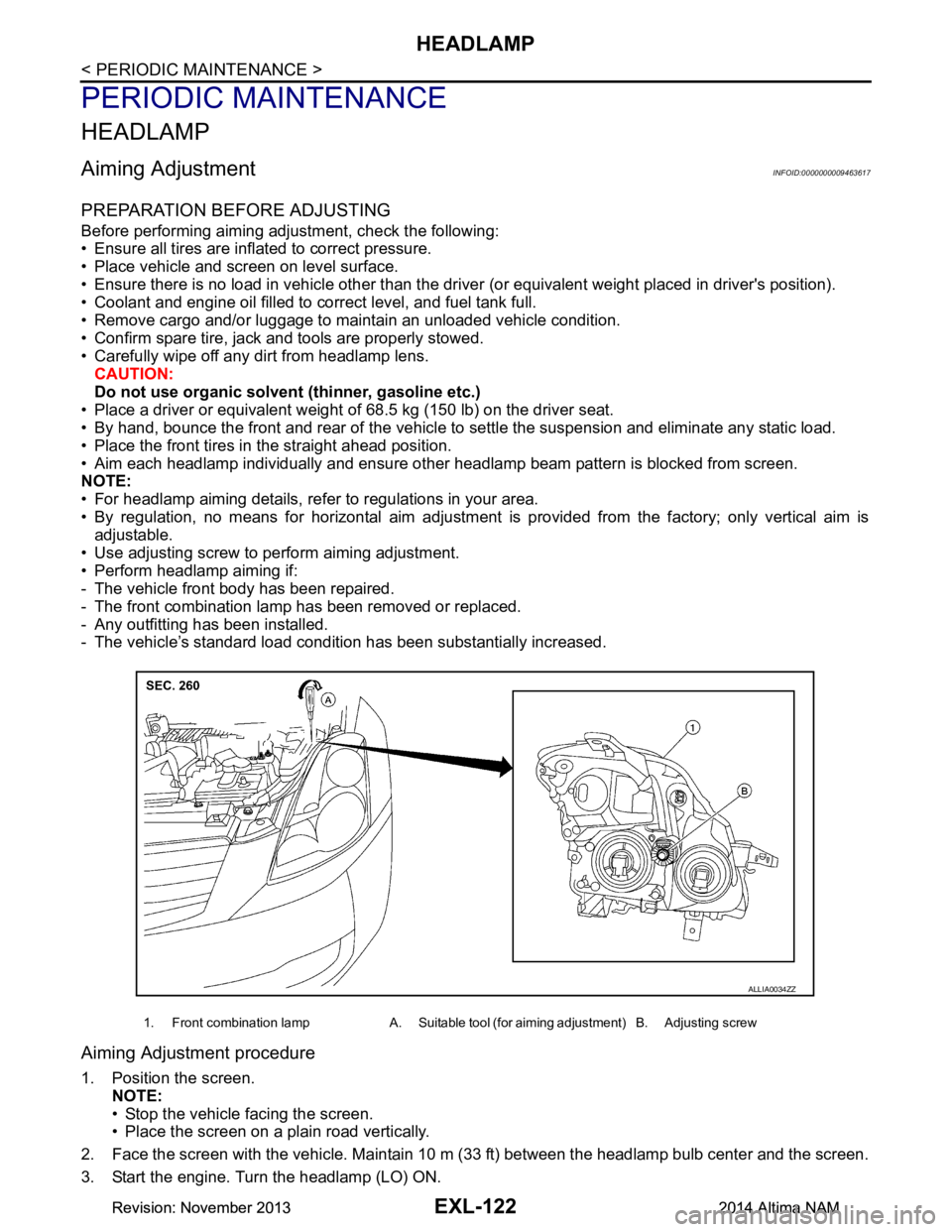
• Use adjusting screw to perform aiming adjustment.
• Perform headlamp aiming if:
- The vehicle front body has been repaired.
- The front combination lamp has been removed or replaced.
- Any outfitting has been installed.
- The vehicle’s standard load condition has been substantially increased.
Aiming Adjustment procedure
1. Position the screen.
NOTE:
• Stop the vehicle facing the screen.
• Place the screen on a plain road vertically.
2. Face the screen with the vehicle. Maintain 10 m (33 ft) between the headlamp bulb center and the screen.
3. Start the engine. Turn the headlamp (LO) ON.
1. Front combination lamp A. Suitable tool (for aiming adjustment) B. Adjusting screw
ALLIA0034ZZ
Revision: November 20132014 Altima NAMRevision: November 20132014 Altima NAM
Page 2390 of 4801
EXL-124
< PERIODIC MAINTENANCE >
FRONT FOG LAMP
FRONT FOG LAMP
Aiming AdjustmentINFOID:0000000009463618
PREPARATION BEFORE ADJUSTING
The fog lamp is a semi-sealed beam type which uses a replaceable halogen bulb. Before performing aiming
adjustment procedure, check the following:
• Ensure all tires are inflated to correct pressure.
• Place vehicle and screen on level surface.
• Ensure there is no load in vehicle other than the driver (or equivalent weight placed in driver's position).
• Coolant and engine oil filled to correct level, and fuel tank full.
• Remove cargo and/or luggage to maintain an unloaded vehicle condition.
• Confirm spare tire, jack and tools are properly stowed.
• Carefully wipe off any dirt from headlamp lens. CAUTION:
Do not use organic solvent (thinner, gasoline etc.)
• Place a driver or equivalent weight of 68.5 kg (150 lb) on the driver seat.
• By hand, bounce the front and rear of the vehicle to settle the suspension and eliminate any static load.
• Place the front tires in the straight ahead position.
• Aim each headlamp individually and ensure other headlamp beam pattern is blocked from screen.
NOTE:
• For headlamp aiming details, refer to regulations in your area.
• By regulation, no means for horizontal aim adjustment is provided from the factory; only vertical aim is
adjustable.
• Use adjusting screw to perform aiming adjustment.
• Perform headlamp aiming if:
- The vehicle front body has been repaired.
- The front combination lamp has been removed or replaced.
- Any outfitting has been installed.
- The vehicle’s standard load condition has been substantially increased.
Aiming Adjustment Procedure
1. Place the screen. NOTE:
• Stop the vehicle facing the wall.
• Place the board on a plain road vertically.
2. Face the vehicle with the screen. Maintain 7.62 m (25.0 ft) between the front fog lamp center and the
screen.
3. Start the engine. Turn the front fog lamp ON. NOTE:
Shut off the headlamp light with the board to prevent from illuminating the adjustment screen.
CAUTION:
Do not cover the lens surface with a tape etc. The lens is made of resin.
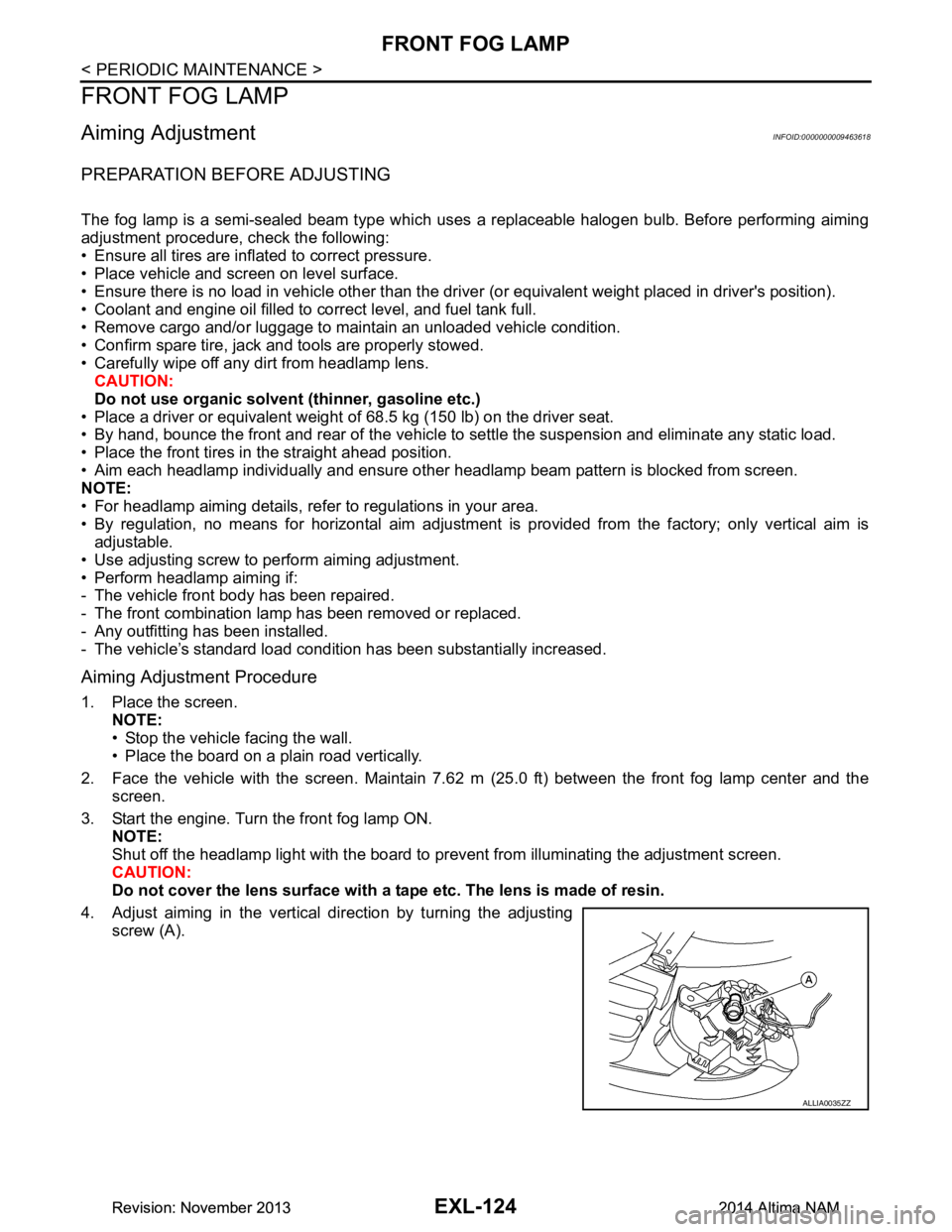
4. Adjust aiming in the vertical direction by turning the adjusting screw (A).
ALLIA0035ZZ
Revision: November 20132014 Altima NAMRevision: November 20132014 Altima NAM
Page 2508 of 4801
FRONT SUSPENSION ASSEMBLYFSU-7
< PERIODIC MAINTENANCE >
C
D
F
G H
I
J
K L
M A
B
FSU
N
O P
PERIODIC MAINTENANCE
FRONT SUSPENSION ASSEMBLY
Inspection and AdjustmentINFOID:0000000009460626
INSPECTION
Make sure the mounting conditions (looseness, back lash) of each component and component conditions
(wear, damage) are normal.
LOWER BALL JOINT END PLAY
1. Set front wheels in a straight-ahead position. Do not depress brake pedal.
2. Place an iron bar or similar tool between upper link and steering knuckle.
3. Measure axial end play by prying it up and down.Refer to FSU-26, "Ball Joint"
.
CAUTION:
Be careful not to damage ball joint boot. Do not damage the installation position by applying
excessive force.
SHOCK ABSORBER
Check for oil leakage, damage and repl ace if malfunction is detected.
WHEEL ALIGNMENT
Description
Measure wheel alignment under unladen conditions.
NOTE:
"Unladen conditions" means that fuel, engine coolant, and lubricant are full. Spare tire, jack, hand tools and
mats are in designated positions.
General Information and Recommendations
• A four-wheel thrust alignment should be performed.
- This type of alignment is re commended for any NISSAN vehicle.
- The four-wheel "thrust" process helps ensure that t he vehicle is properly aligned and the steering wheel is
centered.
- The alignment rack itself should be capable of accepting any NISSAN vehicle.
- The rack should be checked to ensure that it is level.
• Make sure the machine is properly calibrated.
- Your alignment equipment should be regularly ca librated in order to give correct information.
- Check with the manufacturer of your specific equi pment for their recommended Service/Calibration Sched-
ule.
Preliminary Check
Check the following:
1. Tires for improper air pressure and wear.
2. Road wheels for runout. Refer to WT-60, "Road Wheel"
.
3. Wheel bearing axial end play. Refer to FAX-27, "Wheel Bearing"
.
4. Transverse link ball joint axial end play. Refer to FSU-11, "Removal and Installation"
.
5. Shock absorber operation.
6. Each mounting part of axle and suspension for looseness and deformation.
7. Each of suspension member, shock absorber, upper link and transverse link for cracks, deformation and other damage.
8. Vehicle height (posture).
Alignment Process
IMPORTANT:
Use only the alignment specificati ons listed in this Service Manual.
• When displaying the alignment settings, m any alignment machines use "indicators" Do not use these indi-
cators. : (Green/red, plus or minus, Go/No Go).
- The alignment specifications programmed into your machine that operate these indicators may not be cor-
rect.
Revision: November 20132014 Altima NAM
Page 2542 of 4801

GI-14
< HOW TO USE THIS MANUAL >
ABBREVIATIONS
E
F
G
H
ABBREVIATION DESCRIPTION E/T Exhaust temperature
EBD Electric brake force distribution EC Engine control
ECL Engine coolant level
ECM Engine control module ECT Engine coolant temperature
ECV Electrical control valve
EEPROM Electrically erasable pr ogrammable read only memory
EFT Engine fuel temperature
EGR Exhaust gas recirculation
EGRT Exhaust gas recirculation temperature EGT Exhaust gas temperature
EOP Engine oil pressure EP Exhaust pressure
EPR Exhaust pressure regulator EPS Electronically cont rolled power steering
ESP Electronic stability program system
EVAP canister Evaporative emission canister EVSE Electric vehicle supply equipmentEXC Exhaust control
ABBREVIATION DESCRIPTION FC Fan control
FCW Forward collision warning FIC Fuel injector controlFP Fuel pump
FR Front
FRP Fuel rail pressure
FRT Fuel rail temperatureFTP Fuel tank pressure FTT Fuel tank temperature
ABBREVIATION DESCRIPTION GND GroundGPS Global positioning systemGST Generic scan tool
ABBREVIATION DESCRIPTION HBMC Hydraulic body-motion control systemHDD Hard disk drive
HO2S Heated oxygen sensor HOC Heated oxidation catalyst
HPCM Hybrid power train control module
Revision: November 20132014 Altima NAMRevision: November 20132014 Altima NAM
Page 2663 of 4801
![NISSAN TEANA 2014 Workshop Manual
HAC-14
< SYSTEM DESCRIPTION >[AUTOMATIC AIR CONDITIONER]
SYSTEM
-
HAC-16, "Compressor Control"
-HAC-17, "Door Control"
-HAC-20, "Temperature Control"
- Correction for input value of each sensor
Ambie](/img/5/57390/w960_57390-2662.png "NISSAN TEANA 2014 Workshop Manual
HAC-14
< SYSTEM DESCRIPTION >[AUTOMATIC AIR CONDITIONER]
SYSTEM
-
HAC-16, \"Compressor Control\"
-HAC-17, \"Door Control\"
-HAC-20, \"Temperature Control\"
- Correction for input value of each sensor
Ambie")
HAC-14
< SYSTEM DESCRIPTION >[AUTOMATIC AIR CONDITIONER]
SYSTEM
-
HAC-16, "Compressor Control"
-HAC-17, "Door Control"
-HAC-20, "Temperature Control"
- Correction for input value of each sensor
Ambient sensor (setting temperature correction)• A/C auto amp. controls passenger r oom temperature so that the optimum level always matches the temper-
ature level that the passenger may feel. Correction is appl ied to the target temperature that is set using tem-
perature control dial, according to ambient temperature detected by ambient sensor.
In-vehicle sensor [in-vehicle temperature correction]• Passenger room temperature detected by in-vehicle s ensor is corrected for each front air conditioning con-
trol (driver side and passenger side).
Intake sensor (intake temperature correction)• A/C auto amp. performs correction to change recogniti on intake temperature of A/C auto amp. quickly when
difference is large between recognition intake temperat ure and intake temperature detected by intake tem-
perature sensor. The correction is performed to change recognition intake temperature slowly when differ-
ence is small.
Sunload sensor (sunload amount correction)
• Sunload amount detected by sunload sensor is corrected for each air conditioning control.
• A/C auto amp. performs correction to change recogni tion sunload amount of A/C auto amp. slowly when
sunload amount changes quickly, for example when entering or exiting a tunnel.
Control by ECM- Cooling fan control Refer to EC-59, "COOLING FAN CONTROL : System De scription (with automatic air conditioner)"
(QR25DE) or EC-575, "COOLING FAN CONTRO L : System Description" (VQ35DE).
- Air conditioning cut control
Refer to EC-59, "COOLING FAN CONTROL : System De scription (with automatic air conditioner)"
(QR25DE) or EC-573, "AIR CONDITIONING CUT CONTROL : System Description" (VQ35DE).
Control by IPDM E/R- Relay control
Refer to PCS-6, "RELAY CONTROL SYSTEM : System Description"
.
- Cooling fan control
Refer to EC-59, "COOLING FAN CONTROL : System De scription (with automatic air conditioner)"
(QR25DE) or EC-575, "COOLING FAN CONTRO L : System Description" (VQ35DE).
Control by BCM- Relay control
Refer to BCS-7, "BODY CONTROL SYST EM : System Description"
.
Air Flow ControlINFOID:0000000009463095
DESCRIPTION
• A/C auto amp. changes duty ratio of blower motor dr ive signal and controls air flow continuously. When air
flow is increased, duty ratio of blower motor contro l signal gradually increases to prevent a sudden increase
in air flow.
• In addition to manual control and automatic control, air fl ow control consists of starting fan speed control, low
coolant temperature starting control, high in-vehicl e temperature starting control and fan speed control at
door motor operation
AUTOMATIC AIR FLOW CONTROL
• A/C auto amp. decides target air flow depending on target air mix door opening angle.
• A/C auto amp. changes duty ratio of blower motor c ontrol signal and controls the air flow continuously so
that air flow matches the target air flow.
Revision: November 20132014 Altima NAMRevision: November 20132014 Altima NAM
Page 2747 of 4801
![NISSAN TEANA 2014 Workshop Manual
HAC-98
< SYMPTOM DIAGNOSIS >[AUTOMATIC AIR CONDITIONER]
INSUFFICIENT HEATING
INSUFFICIENT HEATING
DescriptionINFOID:0000000009463169
Symptom
• Insufficient heating
• No warm air comes out. (Air](/img/5/57390/w960_57390-2746.png "NISSAN TEANA 2014 Workshop Manual
HAC-98
< SYMPTOM DIAGNOSIS >[AUTOMATIC AIR CONDITIONER]
INSUFFICIENT HEATING
INSUFFICIENT HEATING
DescriptionINFOID:0000000009463169
Symptom
• Insufficient heating
• No warm air comes out. (Air")
HAC-98
< SYMPTOM DIAGNOSIS >[AUTOMATIC AIR CONDITIONER]
INSUFFICIENT HEATING
INSUFFICIENT HEATING
DescriptionINFOID:0000000009463169
Symptom
• Insufficient heating
• No warm air comes out. (Air flow volume is normal.)
Diagnosis ProcedureINFOID:0000000009463170
NOTE:
Perform self-diagnosis with CONSULT before performing symptom diagnosis. If DTC is detected, perform the
corresponding diagnosis.
1.CHECK COOLING SYSTEM
1. Check engine coolant level and check leakage. Refer to CO-11, "System Inspection"
(QR25DE) or CO-
35, "System Inspection" (VQ35DE).
2. Check reservoir tank cap. Refer to CO-11, "System Inspection"
(QR25DE) or CO-35, "System Inspection"
(VQ35DE).
3. Check water flow sounds of the engine coolant. Refer to CO-11, "System Inspection"
(QR25DE) or CO-
35, "System Inspection" (VQ35DE).
Is the inspection result normal?
YES >> GO TO 2.
NO >> Refill engine coolant and repair or repl ace parts depending on the inspection results.
2.CHECK HEATER HOSE
Check installation of heater hose visually or by touching.
Is the inspection result normal?
YES >> GO TO 3.
NO >> Repair or replace parts depending on the inspection results.
3.CHECK HEATER CORE
1. Check temperature of inlet hose and outlet hose of front heater core.
2. Check that inlet side of heater core is hot and the outle t side is slightly lower than/almost equal to the inlet
side.
CAUTION:
Always perform the temperature in spection in a short period of time because the engine coolant
temperature is very hot.
Is the inspection result normal?
YES >> GO TO 4.
NO >> Replace heater core. Refer to HA-42, "HEATER CORE : Removal and Installation"
.
4.CHECK AIR LEAKAGE FROM EACH DUCT
Check duct and nozzle, etc. of front air conditioning system for air leakage.
Is the inspection result normal?
YES >> GO TO 5.
NO >> Repair or replace parts depending on the inspection results.
5.CHECK SETTING OF TEMPERATURE SETTING TRIMMER (FRONT)
1. Check setting value of temperature setting trimmer (front). Refer to HAC-50, "Temperature Setting Trim-
mer".
2. Check that temperature setting trimmer (front) is set to “ − direction”.
NOTE:
The control temperature can be set by t he temperature setting trimmer (front).
3. Set difference between the set temperature and control temperature to “0”.
Are the symptoms solved?
YES >> Inspection End.
NO >> Replace A/C auto amp. Refer to HAC-102, "Removal and Installation"
.
Revision: November 20132014 Altima NAMRevision: November 20132014 Altima NAM
Page 2768 of 4801
![NISSAN TEANA 2014 Workshop Manual
SYSTEM
HAC-119
< SYSTEM DESCRIPTION > [MANUAL AIR CONDITIONER]
C
D E
F
G H
J
K L
M A
B
HAC
N
O P
2. The blower speed dial is turned completely counterclockwise to the OFF position.
3. The A/C swit](/img/5/57390/w960_57390-2767.png "NISSAN TEANA 2014 Workshop Manual
SYSTEM
HAC-119
< SYSTEM DESCRIPTION > [MANUAL AIR CONDITIONER]
C
D E
F
G H
J
K L
M A
B
HAC
N
O P
2. The blower speed dial is turned completely counterclockwise to the OFF position.
3. The A/C swit")
SYSTEM
HAC-119
< SYSTEM DESCRIPTION > [MANUAL AIR CONDITIONER]
C
D E
F
G H
J
K L
M A
B
HAC
N
O P
2. The blower speed dial is turned completely counterclockwise to the OFF position.
3. The A/C switch is manually turned OFF.
In other words, the compressor ON request cannot be turned off in D/F or DEF modes.
REFRIGERANT PRESSURE PROTECTION
The refrigerant system is protected against excessively high- or low-pressures by the refrigerant pressure sen-
sor, located on the liquid tank on the condenser. The refr igerant pressure sensor detects the pressure inside
the refrigerant line and sends a voltage signal to the EC M. If the system pressure rises above or falls below
the following values, the ECM requests the IPDM E/ R to de-energize the A/C relay and disengage the com-
pressor.
• 3.12 MPa (31.82 kg/cm
2, 452.4 psi) or more (When the engine speed is less than 1,500 rpm)
• 2.74 MPa (27.95 kg/cm
2, 397.3 psi) or more (When the engine speed is 1,500 rpm or more)
• 0.14 MPa (1.43 kg/cm
2, 20.3 psi) or less
PRESSURE RELIEF VALVE
The refrigerant system is also protected by a pressure relief valve, located in the rear head of the compressor.
When the pressure of refrigerant in the system incr eases to an abnormal level [more than 2,990 kPa (30.5 kg/
cm
2, 433.6 psi)], the release port on the pressure relief valve automatically opens and releases refrigerant into
the atmosphere.
COMPRESSOR OIL CIRCULATION CONTROL
When the engine starts while the engine coolant temperature is 56 °C (133 °F) or less, ECM activates the com-
pressor for approximately 6 seconds and circulates the compressor lubricant once.
OPERATING RATE CONTROL
When the set temperature is other than fully cold or the air outlet is “VENT”, “B/L” or “FOOT”, the front air con-
trol controls the compressor activation depending on ambient temperature.
Door ControlINFOID:0000000009463200
DOOR MOTOR CONTROL
• A Local Control Unit (LCU) is built into each door motor and detects the door position by using a Position
Balanced Resistor (PBR).
• Each door motor LCU has a unique address. The front air control communicates with the door motor LCUs by using each door’s unique communication address. The front air control sends requested door position
commands to each door motor LCU via a Local Interconnect Network (LIN) communication line. Each door
motor’s LCU receives the command and sends back a door position feedback signal.
• Each LCU controls each door to the appropriate posit ion depending on the control signal from the front air
control. When the door movement is complete, the LCU transmits a signal to the front air control indicating
that the door movement is complete.
SWITCHES AND THEIR CONTROL FUNCTION
ALIIA0607GB
Revision: November 20132014 Altima NAMRevision: November 20132014 Altima NAM
Page 2806 of 4801
![NISSAN TEANA 2014 Workshop Manual
INSUFFICIENT HEATINGHAC-157
< SYMPTOM DIAGNOSIS > [MANUAL AIR CONDITIONER]
C
D E
F
G H
J
K L
M A
B
HAC
N
O P
INSUFFICIENT HEATING
Component Function CheckINFOID:0000000009463224
SYMPTOM: Insufficie](/img/5/57390/w960_57390-2805.png "NISSAN TEANA 2014 Workshop Manual
INSUFFICIENT HEATINGHAC-157
< SYMPTOM DIAGNOSIS > [MANUAL AIR CONDITIONER]
C
D E
F
G H
J
K L
M A
B
HAC
N
O P
INSUFFICIENT HEATING
Component Function CheckINFOID:0000000009463224
SYMPTOM: Insufficie")
INSUFFICIENT HEATINGHAC-157
< SYMPTOM DIAGNOSIS > [MANUAL AIR CONDITIONER]
C
D E
F
G H
J
K L
M A
B
HAC
N
O P
INSUFFICIENT HEATING
Component Function CheckINFOID:0000000009463224
SYMPTOM: Insufficient heating
INSPECTION FLOW
1. CONFIRM SYMPTOM BY PERFORMING OP ERATION CHECK - TEMPERATURE INCREASE
1. Turn temperature control dial clockwise to maximum heat.
2. Check for hot air at discharge air outlets.
Can a symptom be duplicated?
YES >> GO TO 3
NO >> GO TO 2
2. CHECK FOR ANY SYMPTOMS
Perform a complete operational check and check for any symptoms. Refer to HAC-140, "Work Procedure"
.
Does another symptom exist?
YES >> Refer to HAC-154, "Symptom Table".
NO >> System OK.
3. CHECK FOR SERVICE BULLETINS
Check for any service bulletins.
>> GO TO 4
4. CHECK ENGINE COOLING SYSTEM
1. Check for proper engine coolant level. Refer to CO-11, "System Inspection"
(QR25DE) or CO-35, "System
Inspection" (VQ35DE).
2. Check hoses for leaks or kinks.
3. Check radiator cap. Refer to CO-11, "System Inspection"
(QR25DE) or CO-35, "System Inspection"
(VQ35DE).
4. Check for air in cooling system.
>> GO TO 5
5. CHECK AIR MIX DOOR MOTOR OPERATION
Check and verify air mix door mechanism for smooth operation.
Does air mix door operate correctly?
YES >> GO TO 6
NO >> Check the air mix door motor circuit. Refer to HAC-144, "Diagnosis Procedure"
.
6. CHECK AIR DUCTS
Check for disconnected or leaking air ducts.
Is the inspection result normal?
YES >> GO TO 7
NO >> Repair all disconnected or leaking air ducts.
7. CHECK HEATER HOSE TEMPERATURES
1. Start engine and warm it up to normal operating temperature.
2. Touch both the inlet and outlet heater hoses. The inlet hose should be hot and the outlet hose should be
warm.
Is the inspection result normal?
YES >> GO TO 8
NO >> Both hoses warm: GO TO 9
8. CHECK ENGINE COOLANT SYSTEM
Revision: November 20132014 Altima NAMRevision: November 20132014 Altima NAM
Page 3159 of 4801
![NISSAN TEANA 2014 Workshop Manual
ENGINE OILLU-9
< PERIODIC MAINTENANCE > [QR25DE]
C
D E
F
G H
I
J
K L
M A
LU
NP
O
PERIODIC MAINTENANCE
ENGINE OIL
InspectionINFOID:0000000009461028
OIL LEVEL
• Before starting the engine, check the](/img/5/57390/w960_57390-3158.png "NISSAN TEANA 2014 Workshop Manual
ENGINE OILLU-9
< PERIODIC MAINTENANCE > [QR25DE]
C
D E
F
G H
I
J
K L
M A
LU
NP
O
PERIODIC MAINTENANCE
ENGINE OIL
InspectionINFOID:0000000009461028
OIL LEVEL
• Before starting the engine, check the")
ENGINE OILLU-9
< PERIODIC MAINTENANCE > [QR25DE]
C
D E
F
G H
I
J
K L
M A
LU
NP
O
PERIODIC MAINTENANCE
ENGINE OIL
InspectionINFOID:0000000009461028
OIL LEVEL
• Before starting the engine, check the oil level. If t
he engine is already started, stop it and allow 10 minutes
before checking.
• Check that the oil level is within the range (A) on the oil level
gauge.
• If it is out of range, add oil as necessary.
ENGINE OIL APPEARANCE
• Check engine oil for white milky appearance or excessive contamination.
• If engine oil becomes milky, it is highly probable t hat it is contaminated with engine coolant. Repair or
replace damaged parts.
OIL LEAKAGE
Check for oil leakage around the following areas:
•Oil pan
• Oil pan drain plug
• Oil pressure switch
• Oil filter
• Oil cooler
• Valve timing control cover and valve timing control solenoid valve
• Front cover
• Mating surface between cylinder block and cylinder head
• Mating surface between cylinder head and rocker cover
• Crankshaft oil seal (front and rear)
OIL PRESSURE CHECK
WARNING:
• Be careful not to burn yoursel f, as engine oil may be hot.
• Put the CVT shift selector in the Park "P" position.
1. Check engine oil level. Refer to OIL LEVEL.
2. Remove fender protector side cover (RH). Refer to EXT-26, "FENDER PROTECTOR : Exploded View"
.
3. Disconnect oil pressure switch harness connector at oil pressure switch. Remove oil pressure switch and install Tools.
CAUTION:
Do not drop or shock oil pressure switch.
4. Start engine and warm it up to normal operating temperature.
5. Check oil pressure with engine running under no-load, using Tool. NOTE:
JPBIA1497ZZ
Tool numbers : ST25051001 (J-25695-1)
: ST25052000 (J-25695-2)
WBIA0571E
Revision: November 20132014 Altima NAM