radiator NISSAN TEANA 2014 Repair Manual
[x] Cancel search | Manufacturer: NISSAN, Model Year: 2014, Model line: TEANA, Model: NISSAN TEANA 2014Pages: 4801, PDF Size: 51.2 MB
Page 1990 of 4801
![NISSAN TEANA 2014 Repair Manual
EC-990
< SYMPTOM DIAGNOSIS >[VQ35DE]
ENGINE CONTROL SYSTEM SYMPTOMS
1 - 6: The numbers refer to the order of inspection.Va l v e
mecha-
nism Timing chain
55555 55 5 EM-182
Camshaft
EM-194
Intake](/img/5/57390/w960_57390-1989.png "NISSAN TEANA 2014 Repair Manual
EC-990
< SYMPTOM DIAGNOSIS >[VQ35DE]
ENGINE CONTROL SYSTEM SYMPTOMS
1 - 6: The numbers refer to the order of inspection.Va l v e
mecha-
nism Timing chain
55555 55 5 EM-182
Camshaft
EM-194
Intake")
EC-990
< SYMPTOM DIAGNOSIS >[VQ35DE]
ENGINE CONTROL SYSTEM SYMPTOMS
1 - 6: The numbers refer to the order of inspection.Va l v e
mecha-
nism Timing chain
55555 55 5 EM-182
Camshaft
EM-194
Intake valve timing controlEM-172,
EM-173
Intake valve 3EM-210
Exhaust valve
Exhaust Exhaust manifold/Tube/Muffler/ Gasket 55555 55 5 EM-152
,
EM-153
,
EX-11
Three way catalyst
Lubrica-
tion Oil pan/Oil strainer/Oil pump/Oil
filter/Oil gallery/Oil cooler 55555 55 5 EM-156
,
LU-27
, LU-
29, LU-32
Oil level (Low)/Filthy oil LU-25
Cooling
Radiator/Hose/Radiator filler cap
55555 55 45 CO-40,
CO-51
Thermostat 5 CO-49
Water pumpCO-44
Water galleryCO-31
Cooling fan
5CO-42
Coolant level (Low)/Contaminat-
ed coolant CO-35
NVIS (NISSAN Vehicle Immobilizer System —
NATS) 11
SEC-11
SYMPTOM
Reference
page
HARD/NO START/RESTART (EXCP. HA)
ENGINE STALL
HESITATION/SURGING/FLAT SPOT
SPARK KNOCK/DETONATION
LACK OF POWER/POOR ACCELERATION
HIGH IDLE/LOW IDLE
ROUGH IDLE/HUNTING
IDLING VIBRATION
SLOW/NO RETURN TO IDLE
OVERHEATS/WATER TEMPERATURE HIGH
EXCESSIVE FUEL CONSUMPTION
EXCESSIVE OIL CONSUMPTION
BATTERY DEAD (UNDER CHARGE)
Warranty symptom code AA AB AC AD AE AF AG AH AJ AK AL AM HA
Revision: November 20132014 Altima NAMRevision: November 20132014 Altima NAM
Page 2029 of 4801
![NISSAN TEANA 2014 Repair Manual
INTAKE MANIFOLDEM-31
< REMOVAL AND INSTALLATION > [QR25DE]
C
D E
F
G H
I
J
K L
M A
EM
NP
O
9. Disconnect the brake booster vacuum
hose from the intake manifold.
10. Disconnect the fuel quick connec](/img/5/57390/w960_57390-2028.png "NISSAN TEANA 2014 Repair Manual
INTAKE MANIFOLDEM-31
< REMOVAL AND INSTALLATION > [QR25DE]
C
D E
F
G H
I
J
K L
M A
EM
NP
O
9. Disconnect the brake booster vacuum
hose from the intake manifold.
10. Disconnect the fuel quick connec")
INTAKE MANIFOLDEM-31
< REMOVAL AND INSTALLATION > [QR25DE]
C
D E
F
G H
I
J
K L
M A
EM
NP
O
9. Disconnect the brake booster vacuum
hose from the intake manifold.
10. Disconnect the fuel quick connector from the fuel tube assembly. Refer to EM-41, "Removal and Installa-
tion".
11. Disconnect the water hoses from the electric throttle control actuator.
NOTE:
When removing only intake manifold, position electric throttle control actuator aside without disconnecting
the water hose.
12. Loosen bolts in reverse order as shown, then remove electric throttle control actuator and electr ic throttle control actuator O-
ring.
CAUTION:
Handle carefully to avoid any damage.
13. Disconnect the radiator hose (upper) from the water outlet. Refer to CO-16, "Exploded View"
.
14. Disconnect electrical harness connectors from the tumble control valve, tumble control valve position sen-
sor, and power valve motor.
15. Remove the fuel tube assembly. Refer to EM-41, "Removal and Installation"
.
16. Remove the bolts and nuts in the reverse order shown using power tools and remove the intake manifold assembly with gas-
ket.
CAUTION:
Cover engine openings to pr event entry of foreign materi-
als.
NOTE:
Disregard No. 6 when loosening.
INSTALLATION
Installation is in the reverse order of removal. Fo llow the tightening sequences and specifications below and
perform the following:
• Perform the “Throttle Valve Closed Position Learning” when harness connector of electric throttle control
actuator is disconnected. Refer to EC-178, "Work Procedure"
.
• Perform the “Idle Air Volume Learning” and “Throttle Valve Closed Position Learning” when electric throttle
control actuator is replaced. Refer to EC-179, "Work Procedure"
or EC-178, "Work Procedure".
Intake Manifold
1. Securely install gasket to the mounting groove.
CAUTION:
Do not reuse gasket.
AWBIA1359ZZ
ALBIA1159ZZ
Revision: November 20132014 Altima NAM
Page 2082 of 4801
![NISSAN TEANA 2014 Repair Manual
EM-84
< UNIT REMOVAL AND INSTALLATION >[QR25DE]
ENGINE ASSEMBLY
Removal and Installation
INFOID:0000000009460508
WARNING:
• Place chocks at the front and back of the rear wheels.
• For engines n](/img/5/57390/w960_57390-2081.png "NISSAN TEANA 2014 Repair Manual
EM-84
< UNIT REMOVAL AND INSTALLATION >[QR25DE]
ENGINE ASSEMBLY
Removal and Installation
INFOID:0000000009460508
WARNING:
• Place chocks at the front and back of the rear wheels.
• For engines n")
EM-84
< UNIT REMOVAL AND INSTALLATION >[QR25DE]
ENGINE ASSEMBLY
Removal and Installation
INFOID:0000000009460508
WARNING:
• Place chocks at the front and back of the rear wheels.
• For engines not equipped with slin gers, attach proper slingers and bolts as described in the Parts
Catalog.
CAUTION:
• Do not start working until the exh aust system and coolant are cool.
• If items or work required are not covered by the en gine main body section, follow the applicable pro-
cedures.
• Use the correct supporting points for lifting and jacking. Refer to GI-33, "Garage Jack and Safety
Stand".
• In removing the drive shaft, be careful not to damage the grease seals on the transaxle.
NOTE:
When removing components such as hoses, tubes/lines, etc. , cap or plug openings to prevent fluid from spill-
ing.
REMOVAL
1. Remove engine cover using power tool. Refer to EM-28, "Removal and Installation".
2. Release fuel pressure. Refer to EC-182, "Work Procedure"
.
3. Disconnect the negative and positive battery terminal. Refer to PG-73, "Removal and Installation (Bat-
tery)".
4. Disconnect the fuel rail at the fuel hose quick connector (engine side). Refer to EM-41, "Removal and
Installation".
5. Drain the engine coolant. Refer to CO-12, "Changing Engine Coolant"
.
6. Remove the engine under cover. Refer to EXT-28, "Removal and Installation"
.
7. Remove hood assembly. Refer to DLK-170, "HOOD ASSEMBLY : Removal and Installation"
.
8. Remove core support cover.
9. Remove the front air duct and air cleaner case assembly. Refer to EM-29, "Removal and Installation"
.
10. Remove battery and battery tray. Refer to PG-74, "Removal and Installation (Battery Tray)"
.
11. Remove cowl top. Refer to EXT-24, "Removal and Installation"
.
12. Remove strut brace. Refer to FSU-19, "Exploded View"
.
13. Disconnect EVAP hose and vacuum hose from intake manifold.
14. Remove upper and lower radiator hoses (engine side).
15. Remove CVT cooler lines.
16. Disconnect engine room harness connecto r at the CVT and ECM connectors.
CAUTION:
Protect the harness connector with plastic bags or suitable covering to help prevent damage and
intrusion of foreign mate rials into the connectors.
17. Remove the brake booster vacuum hose.
18. Disconnect the heater hoses.
19. Remove the front wheels and tires using a power tool. Refer to WT-55, "Adjustment"
.
20. Remove the fender protector side covers (RH) and (LH). Refer to EXT-26, "FENDER PROTECTOR :
Removal and Installation".
21. Remove tie rod ends from the steering knuckles. Refer to ST-36, "Removal and Installation"
.
22. Remove the power steering gear bolts and support the power steering gear. Refer to ST-36, "Exploded
View".
23. Remove rear cover plate.
24. Remove the torque converter nuts.
25. Remove the rear engine mount torque rod.
26. Remove front exhaust tube and gaskets. Refer to EX-5, "Exploded View"
.
G. 90 N·m (9.2 kg-m, 66 ft-lb) H. 103 N·m (11 kg-m, 76 ft-lb) J. Follow installation procedure
Front
Revision: November 20132014 Altima NAM
Page 2150 of 4801
![NISSAN TEANA 2014 Repair Manual
EM-152
< REMOVAL AND INSTALLATION >[VQ35DE]
EXHAUST MANIFOLD AND THREE WAY CATALYST
Removal and Installation (LH)
INFOID:0000000009460546
REMOVAL
WARNING:
• Perform the work when the exhaust syst](/img/5/57390/w960_57390-2149.png "NISSAN TEANA 2014 Repair Manual
EM-152
< REMOVAL AND INSTALLATION >[VQ35DE]
EXHAUST MANIFOLD AND THREE WAY CATALYST
Removal and Installation (LH)
INFOID:0000000009460546
REMOVAL
WARNING:
• Perform the work when the exhaust syst")
EM-152
< REMOVAL AND INSTALLATION >[VQ35DE]
EXHAUST MANIFOLD AND THREE WAY CATALYST
Removal and Installation (LH)
INFOID:0000000009460546
REMOVAL
WARNING:
• Perform the work when the exhaust system has completely cooled down.
• When removing the front and rear engine mounting th rough bolts and nuts, lift the engine up slightly
for safety.
NOTE:
When removing components such as hoses, tubes/lines, etc. , cap or plug openings to prevent fluid from spill-
ing.
1. Remove the air cleaner assembly, and air duct hose and resonator assembly. Refer to EM-144, "Removal
and Installation".
2. Remove the battery and battery tray assembly. Refer to PG-74, "Removal and Installation (Battery Tray)"
.
3. Remove the engine under cover. Refer to EXT-28, "Removal and Installation"
.
4. Remove the radiator assembly. Refer to CO-41, "Removal and Installation"
.
5. Remove the engine cooling fan shroud and motor assembly. Refer to CO-42, "Removal and Installation"
.
6. Remove the front exhaust tube. Refer to EX-10, "Exploded View"
.
7. Remove the LH three way catalyst support brackets.
8. Remove heated oxygen sensor 2 (bank 2), air fuel ratio (A/F) sensor 1 (bank 2).
a. Remove harness connector of each sensor, and di sconnect the harness from the bracket and middle
clamp.
b. Remove both heated oxygen sensor 2 and air fuel ratio (A/F) sensor 1 using Tool.
CAUTION:
• Be careful not to damage heated oxygen sen sors 2 or air fuel ratio (A/F) sensors 1.
• Discard any heated oxygen sensor 2 which has been dropped from a height of more than 0.5 m
(19.7 in) onto a hard surface such as a co ncrete floor; replace with a new sensor.
9. Remove exhaust manifold heat shield (LH) and three way catalyst heat shields (LH) using power tool.
10. Remove the three way catalyst (bank 2) by loosening the bolts first and then removing the nuts and through bolts.
11. Loosen and remove the exhaust manifold nuts in the reverse order as shown.
NOTE:
Number 7 and 8 are not applicable to removal.
12. Remove the exhaust manifold (LH) and gasket.
INSPECTION AFTER REMOVAL
Surface Distortion Tool numbers : KV10114400 (J-38365)
: KV991J0050 (J-44626)
: Engine front
AWBIA1208GB
Revision: November 20132014 Altima NAM
Page 2173 of 4801
![NISSAN TEANA 2014 Repair Manual
FRONT TIMING CHAIN CASEEM-175
< REMOVAL AND INSTALLATION > [VQ35DE]
C
D E
F
G H
I
J
K L
M A
EM
NP
O
REMOVAL
1. Remove engine under cover. Refer to
EXT-28, "Removal and Installation".
2. Drain the](/img/5/57390/w960_57390-2172.png "NISSAN TEANA 2014 Repair Manual
FRONT TIMING CHAIN CASEEM-175
< REMOVAL AND INSTALLATION > [VQ35DE]
C
D E
F
G H
I
J
K L
M A
EM
NP
O
REMOVAL
1. Remove engine under cover. Refer to
EXT-28, \"Removal and Installation\".
2. Drain the")
FRONT TIMING CHAIN CASEEM-175
< REMOVAL AND INSTALLATION > [VQ35DE]
C
D E
F
G H
I
J
K L
M A
EM
NP
O
REMOVAL
1. Remove engine under cover. Refer to
EXT-28, "Removal and Installation".
2. Drain the engine coolant from the radiator. Refer to MA-23, "ENGINE COOLANT : Changing Engine Cool-
ant".
3. Drain the engine oil. Refer to MA-27, "ENGINE OIL : Changing Engine Oil"
.
4. Drain the power steering fluid. Refer to ST-30, "Draining and Refilling"
.
5. Remove engine room cover. Refer to EM-143, "Removal and Installation"
.
6. Remove front air duct. Refer to EM-144, "Removal and Installation"
.
7. Remove battery tray. Refer to PG-74, "Removal and Installation (Battery Tray)"
.
8. Remove the hood ledge covers (LH/RH).
9. Remove cowl top and cowl top extension. Refer to EXT-24, "Removal and Installation"
.
10. Remove upper radiator hose.
11. Disconnect engine coolant reservoir hose from t he radiator and remove engine coolant reservoir.
12. Remove cooling fan assembly. Refer to CO-42, "Removal and Installation"
.
13. Disconnect lower radiator hose from engine.
14. Remove the radiator. Refer to CO-41, "Removal and Installation"
.
15. Disconnect the power steering fluid reservoir tank hose from the power steering pump and fluid cooler and
remove the power steering fluid reservoir tank. Refer to ST-38, "Exploded View"
.
16. Remove the front RH wheel and tire. Refer to MA-39, "WHEELS : Adjustment"
.
17. Remove the fender protector side cover (RH). Refer to EXT-26, "FENDER PROTECTOR : Removal and
Installation".
18. Remove the drive belt. Refer to EM-134, "Removal and Installation"
.
19. Remove the rocker covers, if necessary. Refer to EM-168, "Removal and Installation LH"
and EM-169,
"Removal and Installation RH".
NOTE:
Necessary only when removing timing chains.
20. If removing the timing chains, obtain compression TDC of No. 1 cylinder as follows:
a. Rotate crankshaft pulley clockwise to align timing mark (grooved line without color) with timing indicator.
b. Check that intake and exhaust camshaft lobes on No. 1 cylinder (right bank of engine) are located as shown.
• If not, turn the crankshaft one revolution (360 °) and align as
shown.
21. Remove the access plate and lock the ring gear using Tool. CAUTION:
JMBIA1135GB
SEM418G
Tool number : — (J-50288)
Revision: November 20132014 Altima NAM
Page 2215 of 4801
![NISSAN TEANA 2014 Repair Manual
ENGINE MOUNTEM-217
< REMOVAL AND INSTALLATION > [VQ35DE]
C
D E
F
G H
I
J
K L
M A
EM
NP
O
ENGINE MOUNT
ENGINE MOUNT (FRONT)
ENGINE MOUNT (FRONT) : Removal and InstallationINFOID:0000000009460578
WARN](/img/5/57390/w960_57390-2214.png "NISSAN TEANA 2014 Repair Manual
ENGINE MOUNTEM-217
< REMOVAL AND INSTALLATION > [VQ35DE]
C
D E
F
G H
I
J
K L
M A
EM
NP
O
ENGINE MOUNT
ENGINE MOUNT (FRONT)
ENGINE MOUNT (FRONT) : Removal and InstallationINFOID:0000000009460578
WARN")
ENGINE MOUNTEM-217
< REMOVAL AND INSTALLATION > [VQ35DE]
C
D E
F
G H
I
J
K L
M A
EM
NP
O
ENGINE MOUNT
ENGINE MOUNT (FRONT)
ENGINE MOUNT (FRONT) : Removal and InstallationINFOID:0000000009460578
WARNING:
• Situate the vehicle on a flat and solid surface.
• Place chocks at front and back of rear wheels.
• Always work safely.
• Do not start work until the engine an d exhaust system are cooled completely.
CAUTION:
Do not damage or spill oil on the engine mount insulator (front).
NOTE:
When removing components such as hoses, tubes/lines, etc. , cap or plug openings to prevent fluid from spill-
ing.
REMOVAL
1. Remove the air cleaner assembly, front air duct, and air duct hose and resonator assembly. Refer to EM-
144, "Removal and Installation".
2. Remove the battery and battery tray assembly. Refer to PG-74, "Removal and Installation (Battery Tray)"
.
3. Remove the engine under cover. Refer to EXT-28, "Removal and Installation"
.
4. Remove the fender protector side covers (RH/LH). Refer to EXT-26, "FENDER PROTECTOR : Removal
and Installation".
5. Partially remove the fender protectors (RH/LH). Refer to EXT-26, "FENDER PROTECTOR : Removal and
Installation".
6. Remove the radiator. Refer to CO-41, "Removal and Installation"
.
7. Remove the cooling fan shroud and motor assembly. Refer to CO-42, "Removal and Installation"
.
8. Remove the exhaust manifold heat shield (LH). Refer to EM-153, "Removal and Installation (RH)"
.
9. Support the engine (1) and transaxle (2) using a suitable jack (A) as shown.
CAUTION:
• Position a suitable jack under the engine and transaxle
assembly as shown.
• Do not damage the front exhau st tube or transaxle oil pan
with the jack.
10. Disconnect the engine mounting insulator (front) vacuum hose.
11. Remove the engine mounting insulator (front) nut (A).
ALBIA0894GB
AWBIA1241GB
Revision: November 20132014 Altima NAM
Page 2219 of 4801
![NISSAN TEANA 2014 Repair Manual
ENGINE ASSEMBLYEM-221
< UNIT REMOVAL AND INSTALLATION > [VQ35DE]
C
D E
F
G H
I
J
K L
M A
EM
NP
O
• Do not damage the edge of the crankshaft
position sensor (POS) or the ring gear teeth.
REMOVAL](/img/5/57390/w960_57390-2218.png "NISSAN TEANA 2014 Repair Manual
ENGINE ASSEMBLYEM-221
< UNIT REMOVAL AND INSTALLATION > [VQ35DE]
C
D E
F
G H
I
J
K L
M A
EM
NP
O
• Do not damage the edge of the crankshaft
position sensor (POS) or the ring gear teeth.
REMOVAL")
ENGINE ASSEMBLYEM-221
< UNIT REMOVAL AND INSTALLATION > [VQ35DE]
C
D E
F
G H
I
J
K L
M A
EM
NP
O
• Do not damage the edge of the crankshaft
position sensor (POS) or the ring gear teeth.
REMOVAL
NOTE:
When removing components such as hoses, tubes/lines, etc. , cap or plug openings to prevent fluid from spill-
ing.
1. Remove hood assembly. Refer to DLK-170, "HOOD ASSEMBLY : Removal and Installation"
.
2. Release fuel pressure. Refer to FL-5, "Inspection"
.
3. Drain engine coolant. Refer to CO-36, "Changing Engine Coolant"
.
4. Drain power steering fluid. Refer to ST-30, "Draining and Refilling"
.
5. Remove front wheels and tires (RH/LH). Refer to WT-55, "Adjustment"
.
6. Remove fender protector side covers (RH/LH). Refer to EXT-26, "FENDER PROTECTOR : Removal and
Installation".
7. Remove the engine under cover. Refer to EXT-17, "Removal and Installation"
.
8. Remove the engine room cover. Refer to EM-143, "Removal and Installation"
.
9. Remove air duct hose and resonator assembly and air cleaner case assembly with mass air flow sensor.
Refer to EM-144, "Removal and Installation"
.
10. Remove battery and battery tray. Refer to PG-74, "Removal and Installation (Battery Tray)"
.
11. Remove transmission control module. Refer to TM-183, "Removal and Installation"
.
12. Remove cowl top. Refer to EXT-24, "Removal and Installation"
.
13. Remove strut brace using power tools. Refer to FSU-19, "Exploded View"
.
14. Remove IPDM E/R. Refer to PCS-32, "Removal and Installation"
.
15. Remove the following parts: • EVAP vacuum hose
• Brake booster vacuum hose
• Heater hoses (engine side)
16. Disconnect transaxle shift control cables. Refer to TM-380, "Removal and Installation"
.
17. Remove upper and lower radiator hoses.
18. Disconnect CVT fluid cooler hoses.
19. Remove power steering reservoir, suction hose and high pressure hose.
20. Disconnect fuel hose quick connection at vehicle piping side. Refer to EM-163, "Removal and Installa-
tion".
21. Remove the front exhaust tube using power tools. Refer to EX-10, "Exploded View"
.
22. Discharge and recover the R134a refrigerant. Refer to HA-23, "Recycle Refrigerant"
.
23. Remove the A/C compressor using power tools. Refer to HA-30, "COMPRESSOR : Removal and Installa-
tion".
24. Install engine slingers into front of LH cylinder head and rear of RH cylinder head.
• (A): RH cylinder head
ALBIA0262GB
Revision: November 20132014 Altima NAM
Page 2427 of 4801

SQUEAK AND RATTLE TROUBLE DIAGNOSESEXT-13
< PERIODIC MAINTENANCE >
C
D E
F
G H
I
J
L
M A
B
EXT
N
O P
1. Loose harness or harness connectors.
2. Front console map/reading lamp lens loose.
3. Loose screws at console attachment points.
SEATS
When isolating seat noise it's important to note the pos ition the seat is in and the load placed on the seat when
the noise is present. These conditions should be duplic ated when verifying and isolating the cause of the
noise.
Cause of seat noise include:
1. Headrest rods and holder
2. A squeak between the seat pad cushion and frame
3. The rear seatback lock and bracket
These noises can be isolated by moving or pressing on the suspected components while duplicating the con-
ditions under which the noise occurs. Most of thes e incidents can be repaired by repositioning the component
or applying urethane tape to the contact area.
UNDERHOOD
Some interior noise may be caused by components under the hood or on the engine wall. The noise is then
transmitted into the passenger compartment.
Causes of transmitted underhood noise include:
1. Any component installed to the engine wall
2. Components that pass through the engine wall
3. Engine wall mounts and connectors
4. Loose radiator installation pins
5. Hood bumpers out of adjustment
6. Hood striker out of adjustment
These noises can be difficult to isolate since they cannot be reached from the interior of the vehicle. The best
method is to secure, move or insulate one component at a time and test drive the vehicle. Also, engine rpm or
load can be changed to isolate the noise. Repairs can usually be made by moving, adjusting, securing, or
insulating the component causing the noise.
Revision: November 20132014 Altima NAM
Page 2556 of 4801
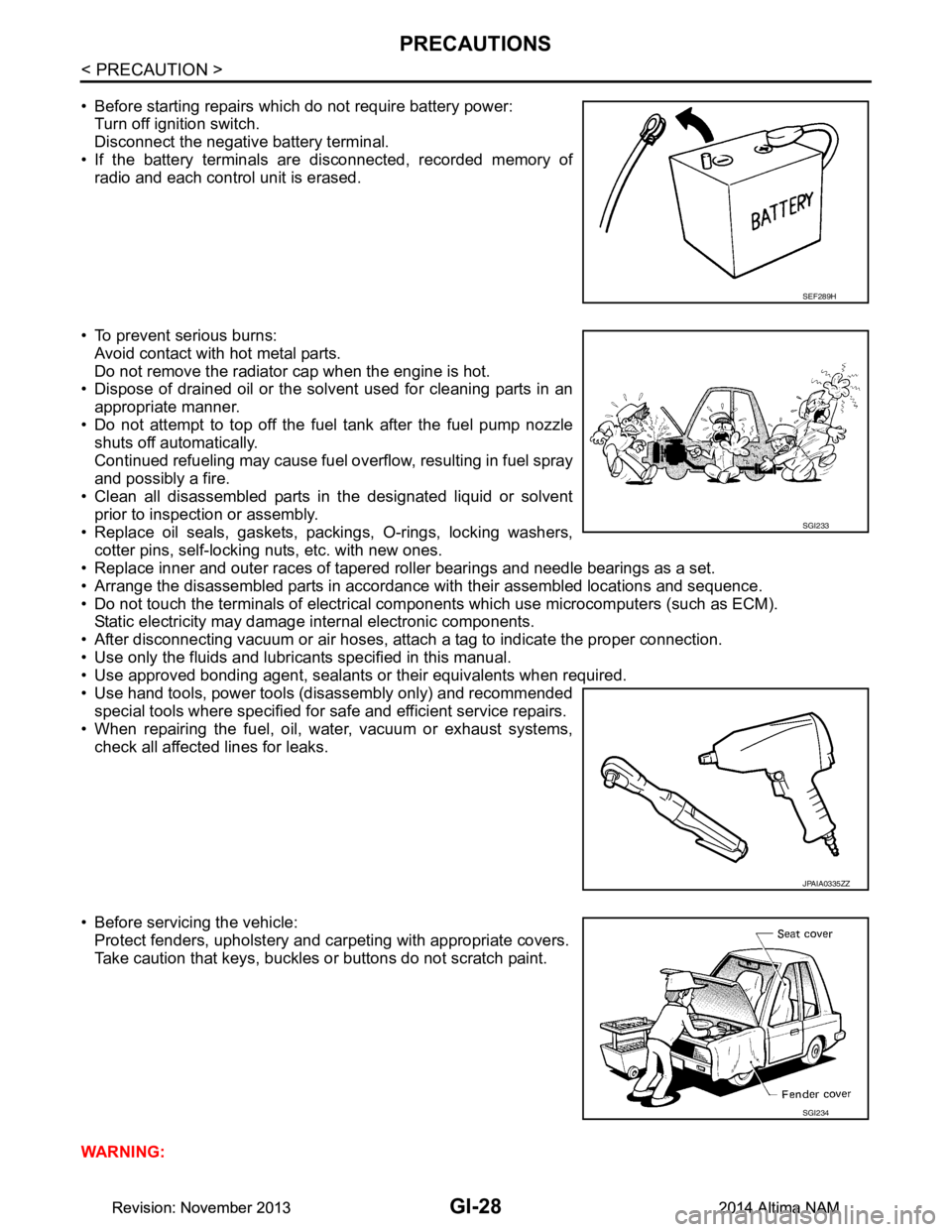
GI-28
< PRECAUTION >
PRECAUTIONS
• Before starting repairs which do not require battery power:Turn off ignition switch.
Disconnect the negative battery terminal.
• If the battery terminals are disconnected, recorded memory of
radio and each control unit is erased.
• To prevent serious burns: Avoid contact with hot metal parts.
Do not remove the radiator cap when the engine is hot.
• Dispose of drained oil or the solvent used for cleaning parts in an
appropriate manner.
• Do not attempt to top off the fuel tank after the fuel pump nozzle
shuts off automatically.
Continued refueling may cause fuel overflow, resulting in fuel spray
and possibly a fire.
• Clean all disassembled parts in the designated liquid or solvent
prior to inspection or assembly.
• Replace oil seals, gaskets, packings, O-rings, locking washers, cotter pins, self-locking nuts, etc. with new ones.
• Replace inner and outer races of tapered roller bearings and needle bearings as a set.
• Arrange the disassembled parts in accordance with their assembled locations and sequence.
• Do not touch the terminals of electrical com ponents which use microcomputers (such as ECM).
Static electricity may damage internal electronic components.
• After disconnecting vacuum or air hoses, atta ch a tag to indicate the proper connection.
• Use only the fluids and lubricants specified in this manual.
• Use approved bonding agent, sealants or their equivalents when required.
• Use hand tools, power tools (disassembly only) and recommended special tools where specified for safe and efficient service repairs.
• When repairing the fuel, oil, water, vacuum or exhaust systems,
check all affected lines for leaks.
• Before servicing the vehicle: Protect fenders, upholstery and carpeting with appropriate covers.
Take caution that keys, buckles or buttons do not scratch paint.
WARNING:
SEF289H
SGI233
JPAIA0335ZZ
SGI234
Revision: November 20132014 Altima NAMRevision: November 20132014 Altima NAM
Page 2588 of 4801

GW-8
< SYMPTOM DIAGNOSIS >
SQUEAK AND RATTLE TROUBLE DIAGNOSES
1. Loose harness or harness connectors.
2. Front console map/reading lamp lens loose.
3. Loose screws at console attachment points.
SEATS
When isolating seat noise it's important to note the pos ition the seat is in and the load placed on the seat when
the noise is present. These conditions should be dupl icated when verifying and isolating the cause of the
noise.
Cause of seat noise include:
1. Headrest rods and holder
2. A squeak between the seat pad cushion and frame
3. The rear seatback lock and bracket
These noises can be isolated by moving or pressing on the suspected components while duplicating the con-
ditions under which the noise occurs. Most of thes e incidents can be repaired by repositioning the component
or applying urethane tape to the contact area.
UNDERHOOD
Some interior noise may be caused by components under the hood or on the engine wall. The noise is then
transmitted into the passenger compartment.
Causes of transmitted underhood noise include:
1. Any component installed to the engine wall
2. Components that pass through the engine wall
3. Engine wall mounts and connectors
4. Loose radiator installation pins
5. Hood bumpers out of adjustment
6. Hood striker out of adjustment
These noises can be difficult to isolate since they cannot be reached from the interior of the vehicle. The best
method is to secure, move or insulate one component at a time and test drive the vehicle. Also, engine rpm or
load can be changed to isolate the noise. Repairs can usually be made by moving, adjusting, securing, or
insulating the component causing the noise.
Revision: November 20132014 Altima NAM