SEC NISSAN TEANA 2014 Service Manual
[x] Cancel search | Manufacturer: NISSAN, Model Year: 2014, Model line: TEANA, Model: NISSAN TEANA 2014Pages: 4801, PDF Size: 51.2 MB
Page 3662 of 4801
WHEEL HUBRAX-5
< PERIODIC MAINTENANCE >
CEF
G H
I
J
K L
M A
B
RAX
N
O P
PERIODIC MAINTENANCE
WHEEL HUB
On-vehicle ServiceINFOID:0000000009460676
Check axle and suspension parts for excessive play, wear or damage.
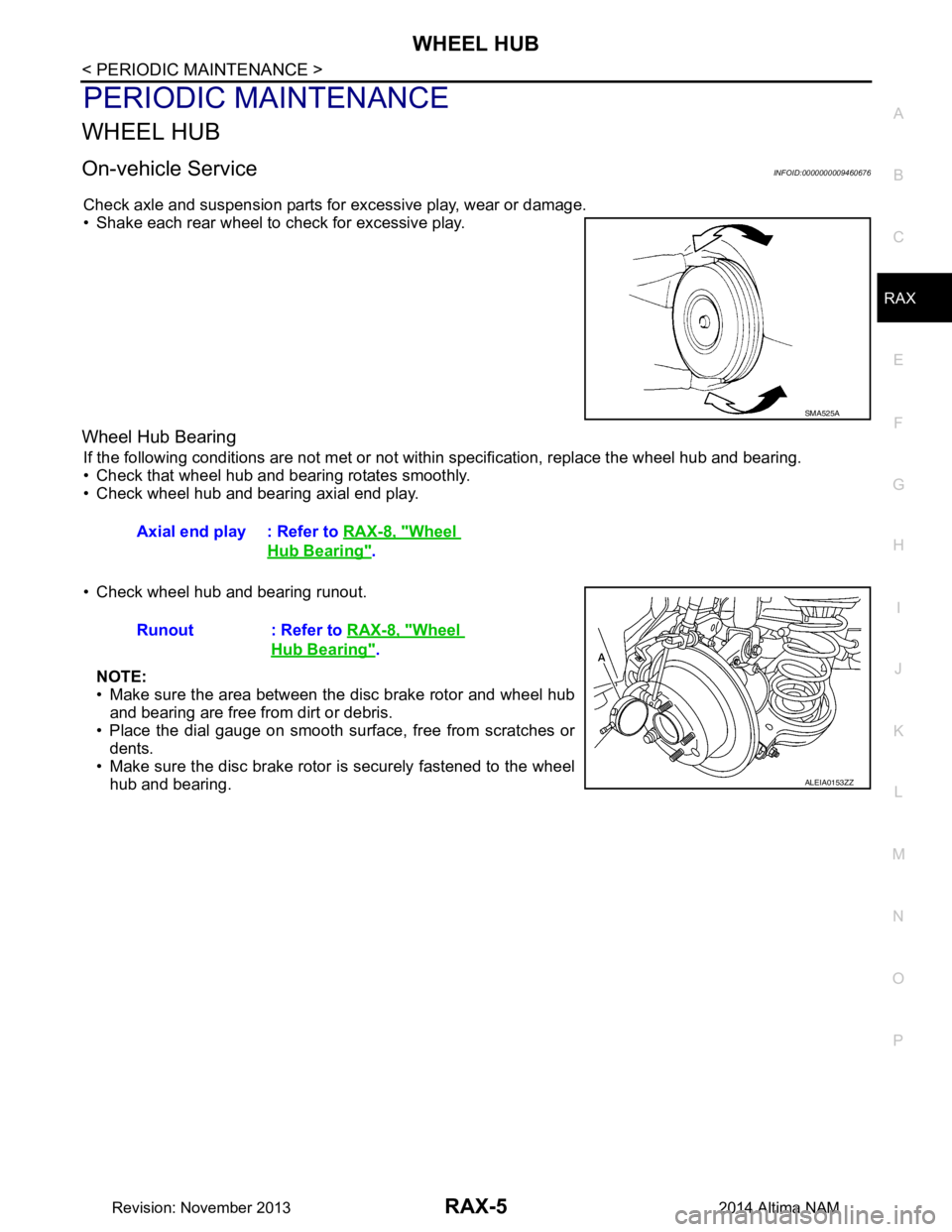
• Shake each rear wheel to check for excessive play.
Wheel Hub Bearing
If the following conditions are not met or not with in specification, replace the wheel hub and bearing.
• Check that wheel hub and bearing rotates smoothly.
• Check wheel hub and bearing axial end play.
• Check wheel hub and bearing runout. NOTE:
• Make sure the area between the disc brake rotor and wheel hub
and bearing are free from dirt or debris.
• Place the dial gauge on smooth su rface, free from scratches or
dents.
• Make sure the disc brake rotor is securely fastened to the wheel hub and bearing.
SMA525A
Axial end play : Refer to RAX-8, "Wheel
Hub Bearing".
Runout : Refer to RAX-8, "Wheel
Hub Bearing".
ALEIA0153ZZ
Revision: November 20132014 Altima NAM
Page 3666 of 4801

RF-1
BODY EXTERIOR, DOORS, ROOF & VEHICLE SECURITY
C
D E
F
G H
I
J
L
M
SECTION RF
A
B
RF
N
O P
CONTENTS
ROOF
PRECAUTION ................ ...............................3
PRECAUTIONS .............................................. .....3
Precaution for Supplemental Restraint System
(SRS) "AIR BAG" and "SEAT BELT PRE-TEN-
SIONER" ............................................................. ......
3
Precaution for Work ..................................................3
PREPARATION ............................................4
PREPARATION .............................................. .....4
Special Service Tools ........................................ ......4
Commercial Service Tools .......................................4
SYSTEM DESCRIPTION ..............................5
COMPONENT PARTS ................................... .....5
MOONROOF .......................................................... ......5
MOONROOF : Component Parts Location .............5
MOONROOF : Component Description ...................5
SYSTEM ..............................................................6
MOONROOF .......................................................... ......6
MOONROOF : System Diagram ..............................6
MOONROOF : System Description ...........................6
DIAGNOSIS SYSTEM (BCM) .............................8
COMMON ITEM ..................................................... ......8
COMMON ITEM : CONSULT Function (BCM -
COMMON ITEM) ................................................. ......
8
RETAINED PWR ................................................... ......8
RETAINED PWR : CONSULT Function (BCM -
RETAINED PWR) ............................................... ......
9
ECU DIAGNOSIS INFORMATION ..............10
BCM (BODY CONTROL MODULE) ............... ....10
List of ECU Reference ........................................ ....10
MOONROOF MOTOR ASSEMBLY ...................11
Reference Value .................................................. ....11
WIRING DIAGRAM ......................................12
MOONROOF SYSTEM .....................................12
Wiring Diagram .................................................... ....12
BASIC INSPECTION ...................................18
DIAGNOSIS AND REPAIR WORKFLOW ........18
Work Flow ............................................................ ....18
INSPECTION AND ADJUSTMENT ..................20
ADDITIONAL SERVICE WHEN REPLACING
CONTROL UNIT .................................................... ....
20
ADDITIONAL SERVICE WHEN REPLACING
CONTROL UNIT : Description ............................. ....
20
ADDITIONAL SERVICE WHEN REPLACING
CONTROL UNIT : Special Repair Requirement .. ....
20
DTC/CIRCUIT DIAGNOSIS .........................21
POWER SUPPLY AND GROUND CIRCUIT ....21
BCM ....................................................................... ....21
BCM : Diagnosis Procedure ....................................21
MOONROOF MOTOR ASSEMBLY ...........................21
MOONROOF MOTOR ASSEM BLY : Description ....21
MOONROOF MO TOR ASSEMBLY :
Component Function Check .............................. ....
22
MOONROOF MOTOR ASSEMBLY :
Diagnosis Procedure .......................................... ....
22
MOONROOF MOTOR ASSEMBLY : Component
Inspection ............................................................ ....
24
MOONROOF MOTOR ASSEMBLY : Special Re-
pair Requirement ................................................. ....
25
MOONROOF SWITCH ......................................26
Description ...............................................................26
Diagnosis Procedure ..............................................26
Component Inspection .............................................27
Revision: November 20132014 Altima NAMRevision: November 20132014 Altima NAM
Page 3668 of 4801
PRECAUTIONSRF-3
< PRECAUTION >
C
D E
F
G H
I
J
L
M A
B
RF
N
O P
PRECAUTION
PRECAUTIONS
Precaution for Supplemental Restraint System (SRS) "AIR BAG" and "SEAT BELT
PRE-TENSIONER"
INFOID:0000000009951570
The Supplemental Restraint System such as “A IR BAG” and “SEAT BELT PRE-TENSIONER”, used along
with a front seat belt, helps to reduce the risk or severi ty of injury to the driver and front passenger for certain
types of collision. Information necessary to service t he system safely is included in the SR and SB section of
this Service Manual.
WARNING:
• To avoid rendering the SRS inoper ative, which could increase the risk of personal injury or death in
the event of a collision which would result in air bag inflation, all maintenance must be performed by
an authorized NISSAN/INFINITI dealer.
• Improper maintenance, including in correct removal and installation of the SRS, can lead to personal
injury caused by unintentional act ivation of the system. For removal of Spiral Cable and Air Bag
Module, see the SR section.
• Do not use electrical test equipm ent on any circuit related to the SRS unless instructed to in this
Service Manual. SRS wiring harnesses can be identi fied by yellow and/or orange harnesses or har-
ness connectors.
PRECAUTIONS WHEN USING POWER TOOLS (AIR OR ELECTRIC) AND HAMMERS
WARNING:
• When working near the Airbag Diagnosis Sensor Un it or other Airbag System sensors with the Igni-
tion ON or engine running, DO NOT use air or el ectric power tools or strike near the sensor(s) with a
hammer. Heavy vibration could activate the sensor( s) and deploy the air bag(s), possibly causing
serious injury.
• When using air or electric power tools or hammers , always switch the Ignition OFF, disconnect the
battery and wait at least three mi nutes before performing any service.
Precaution for WorkINFOID:0000000009461288
• When removing or disassembling each component, be ca reful not to damage or deform it. If a component
may be subject to interference, be sure to protect it with a shop cloth.
• When removing (disengaging) components with a screwdriver or similar tool, be sure to wrap the component with a shop cloth or vinyl tape to protect it.
• Protect the removed parts with a shop cloth and prevent them from being dropped.
• Replace a deformed or damaged clip.
• If a part is specified as a non-reusabl e part, always replace it with a new one.
• Be sure to tighten bolts and nuts securely to the specified torque.
• After installation is complete, be sure to check that each part works properly.
• Follow the steps below to clean components:
- Water soluble dirt:
• Dip a soft cloth into lukewarm water, wring the water out of the cloth and wipe the dirty area.
• Then rub with a soft, dry cloth.
-Oily dirt:
• Dip a soft cloth into lukewarm water with mild detergent (concentration: within 2 to 3%) and wipe the dirty area.
• Then dip a cloth into fresh water, wring the water out of the cloth and wipe the detergent off.
• Then rub with a soft, dry cloth.
- Do not use organic solvent such as thinner, benzene, alcohol or gasoline.
- For genuine leather seats, use a genuine leather seat cleaner.
Revision: November 20132014 Altima NAMRevision: November 20132014 Altima NAM
Page 3671 of 4801
RF-6
< SYSTEM DESCRIPTION >
SYSTEM
SYSTEM
MOONROOF
MOONROOF : System DiagramINFOID:0000000009461293
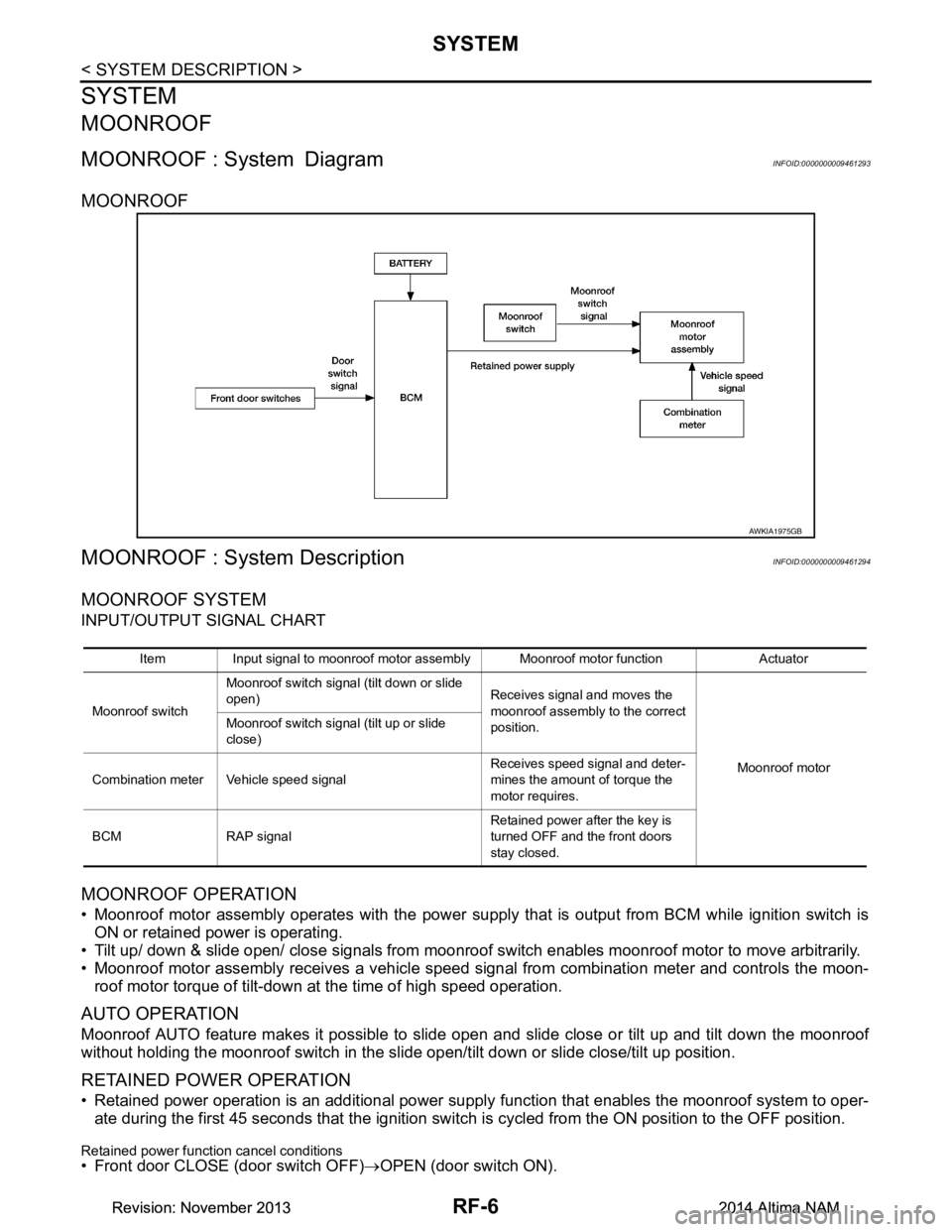
MOONROOF
MOONROOF : System DescriptionINFOID:0000000009461294
MOONROOF SYSTEM
INPUT/OUTPUT SIGNAL CHART
MOONROOF OPERATION
• Moonroof motor assembly operates with the power supply that is output from BCM while ignition switch isON or retained power is operating.
• Tilt up/ down & slide open/ close signals from moonroof switch enables moonroof motor to move arbitrarily.
• Moonroof motor assembly receives a vehicle speed signal from combination meter and controls the moon- roof motor torque of tilt-down at the time of high speed operation.
AUTO OPERATION
Moonroof AUTO feature makes it possible to slide open and slide close or tilt up and tilt down the moonroof
without holding the moonroof switch in the slide open/tilt down or slide close/tilt up position.
RETAINED POWER OPERATION
• Retained power operation is an additional power supply function that enables the moonroof system to oper-
ate during the first 45 seconds that the ignition switch is cycled from the ON position to the OFF position.
Retained power function cancel conditions• Front door CLOSE (door switch OFF)→OPEN (door switch ON).
AWKIA1975GB
Item Input signal to moonroof motor assembly Moonroof motor function Actuator
Moonroof switch Moonroof switch signal (tilt down or slide
open) Receives signal and moves the
moonroof assembly to the correct
position.
Moonroof motor
Moonroof switch signal (tilt up or slide
close)
Combination meter Vehicle speed signal Receives speed signal and deter-
mines the amount of torque the
motor requires.
BCM RAP signal Retained power after the key is
turned OFF and the front doors
stay closed.
Revision: November 20132014 Altima NAMRevision: November 20132014 Altima NAM
Page 3672 of 4801

SYSTEMRF-7
< SYSTEM DESCRIPTION >
C
D E
F
G H
I
J
L
M A
B
RF
N
O P
• When ignition switch is ON again.
• When timer time passes. (45 seconds)
ANTI-PINCH FUNCTION
The CPU of moonroof motor assembly monitors t he moonroof motor operation and the moonroof position
(fully-closed or other) by the signals from moonroof motor.
When moonroof motor detects an interruption during t he following slide close and tilt down operation, moon-
roof switch controls the motor for open and the moonroof will operate until full up position (when tilt down oper-
ates) or 100 mm (3.94 in) or more in an open direction (when slide close operates):
• Close operation and tilt down when ignition switch is in the “ON” position
Revision: November 20132014 Altima NAMRevision: November 20132014 Altima NAM
Page 3673 of 4801

RF-8
< SYSTEM DESCRIPTION >
DIAGNOSIS SYSTEM (BCM)
DIAGNOSIS SYSTEM (BCM)
COMMON ITEM
COMMON ITEM : CONSULT Function (BCM - COMMON ITEM)INFOID:0000000009941201
APPLICATION ITEM
CONSULT performs the following functions via CAN communication with BCM.
SYSTEM APPLICATION
BCM can perform the following functions.
RETAINED PWR
Direct Diagnostic Mode Description
Ecu Identification The BCM part number is displayed.
Self Diagnostic Result The BCM self diagnostic results are displayed.
Data Monitor The BCM input/output data is displayed in real time.
Active Test The BCM activates outputs to test components.
Work support The settings for BCM functions can be changed.
Configuration • The vehicle specification can be read and saved.
• The vehicle specification can be written when replacing BCM.
CAN Diag Support Mntr The result of transmit/receive diagnosis of CAN communication is displayed.
System Sub System Direct Diagnostic Mode
Ecu Identification
Self Diagnostic Result
Data Monitor
Active Test
Work support
Configuration
CAN Diag Support Mntr
Door lock DOOR LOCK ××××
Rear window defogger REAR DEFOGGER ×××
Warning chime BUZZER ××
Interior room lamp timer INT LAMP ×××
Remote keyless entry system MULTI REMOTE ENT ×××
Exterior lamp HEADLAMP ×××
Wiper and washer WIPER ×××
Turn signal and hazard warning lamps FLASHER ××
Air conditioner AIR CONDITIONER ×
Intelligent Key system INTELLIGENT KEY ××××
Combination switch COMB SW ×
BCM BCM × × ×××
Immobilizer IMMU ×××
Interior room lamp battery saver BATTERY SAVER ××
Trunk open TRUNK ×
Vehicle security system THEFT ALM ×××
RAP system RETAINED PWR ×
Signal buffer system SIGNAL BUFFER ×
Revision: November 20132014 Altima NAMRevision: November 20132014 Altima NAM
Page 3676 of 4801
MOONROOF MOTOR ASSEMBLYRF-11
< ECU DIAGNOSIS INFORMATION >
C
D E
F
G H
I
J
L
M A
B
RF
N
O P
MOONROOF MOTOR ASSEMBLY
Reference ValueINFOID:0000000009461298
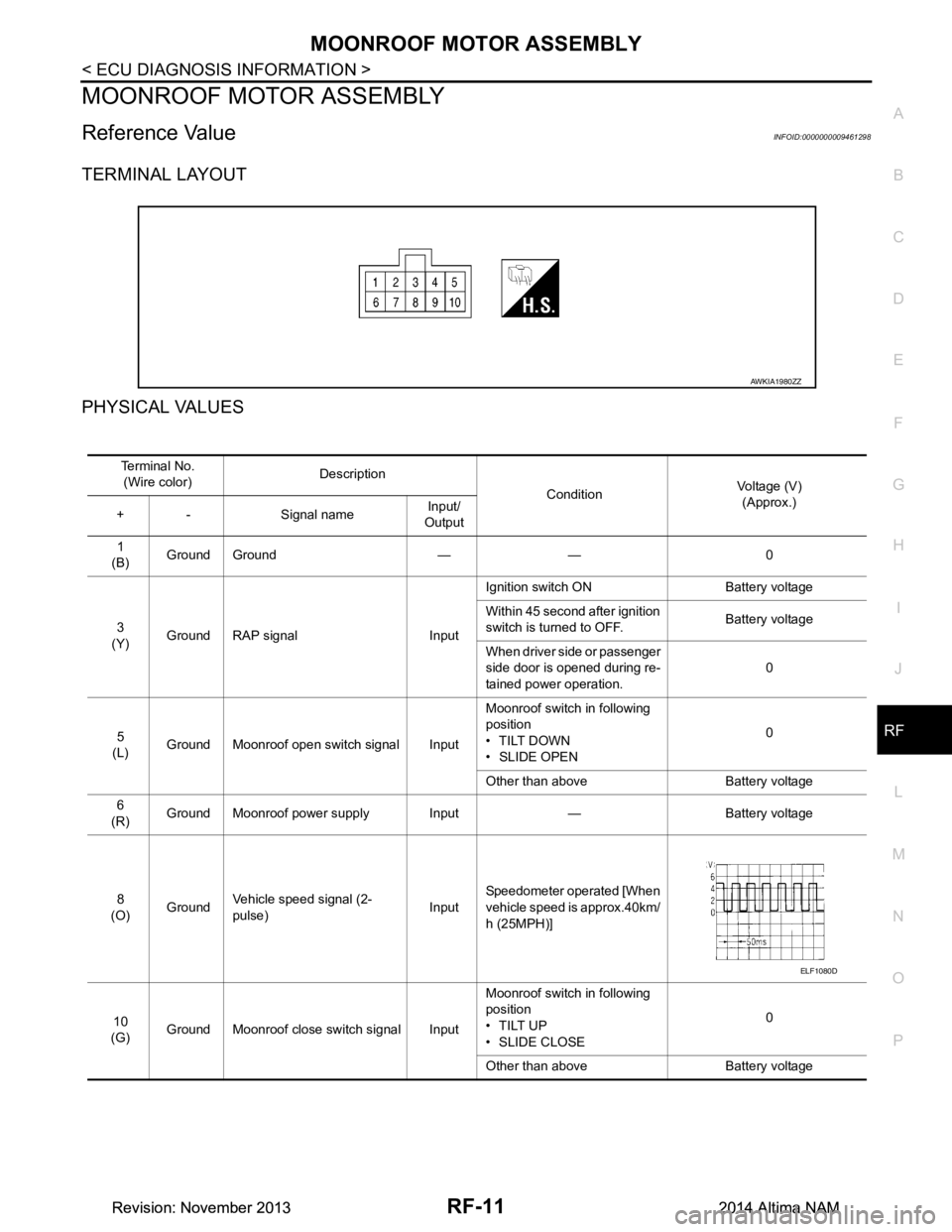
TERMINAL LAYOUT
PHYSICAL VALUES
AWKIA1980ZZ
Te r m i n a l N o . (Wire color) Description
ConditionVoltage (V)
(Approx.)
+ - Signal name Input/
Output
1
(B) Ground Ground — — 0
3
(Y) Ground RAP signal Input Ignition switch ON Battery voltage
Within 45 second after ignition
switch is turned to OFF. Battery voltage
When driver side or passenger
side door is opened during re-
tained power operation. 0
5
(L) Ground Moonroof open switch signal Input Moonroof switch in following
position
•TILT DOWN
• SLIDE OPEN 0
Other than above Battery voltage
6
(R) Ground Moonroof power supply Input — Battery voltage
8
(O) Ground
Vehicle speed signal (2-
pulse) InputSpeedometer operated [When
vehicle speed is approx.40km/
h (25MPH)]
10
(G) Ground Moonroof close switch signal Input Moonroof switch in following
position
•TILT UP
•SLIDE CLOSE 0
Other than above Battery voltage
ELF1080D
Revision: November 20132014 Altima NAMRevision: November 20132014 Altima NAM
Page 3685 of 4801

RF-20
< BASIC INSPECTION >
INSPECTION AND ADJUSTMENT
INSPECTION AND ADJUSTMENT
ADDITIONAL SERVICE WHEN REPLACING CONTROL UNIT
ADDITIONAL SERVICE WHEN REPL ACING CONTROL UNIT : Description
INFOID:0000000009461301
MEMORY RESET PROCEDURE
1. Please observe the following instructi ons at confirming the moonroof operation.
NOTE:
Do not disconnect the electronic power while the moonroof is operating or within 5 seconds after the
moonroof stops. (to wipe-out the memory of lid position and operating friction.)
2. Initialization of system should be conducted after the following conditions. • When the moonroof motor is changed.
• When the moonroof does not operate normally. (Incomplete initialization conditions)
ADDITIONAL SERVICE WHEN REPLACING CONTROL UNIT : Special Repair Re-
quirement
INFOID:0000000009461302
INITIALIZATION PROCEDURE
If the moonroof does not open or clos e automatically, use the following procedure to return moonroof opera-
tion to normal.
NOTE:
If the moonroof switch is released at any time duri ng step 4, the procedure must be started over again. Leave
the ignition switch ON for at least 2 seconds after this procedure.
1. Push the ignition switch to the ON position.
2. Hold the moonroof switch in the tilt up position. Release the switch when the moonroof has reached the
full tilt up position.
3. Hold the moonroof switch in the tilt up position agai n. After a delay, the moonroof will backup. Release the
switch.
4. Within 4 seconds of releasing the switch in step 3, hold the moonroof switch in the tilt up position again.
The moonroof will move from the full tilt-up → slide-close → slide-open → slide-close → tilt-up → slide-
close. Release the switch, initialization is complete if the moonroof operates normally.
ANTI-PINCH FUNCTION
1. Fully open the moonroof to the full open position.
2. Place a piece of wood at the fully closed position.
3. Close the moonroof completely with auto-slide close function.
4. Moonroof should make contact and then tilt up in reverse for 100mm (3.94 in.) (approx.).
CAUTION:
• Do not test the anti-pinch functi on with your hands or other part of body parts because they may be
pinched.
• Depending on environment and drivin g conditions, if a similar impact or load is applied to the moon-
roof it may lower.
• Test the auto-slide operation before inspectio n when the system initialization is performed.
• Perform the initialization proced ure when the auto-slide operation or anti-pinch function does not
operate normally.
Revision: November 20132014 Altima NAMRevision: November 20132014 Altima NAM
Page 3700 of 4801
SQUEAK AND RATTLE TROUBLE DIAGNOSESRF-35
< SYMPTOM DIAGNOSIS >
C
D E
F
G H
I
J
L
M A
B
RF
N
O P
SQUEAK AND RATTLE TROUBLE DIAGNOSES
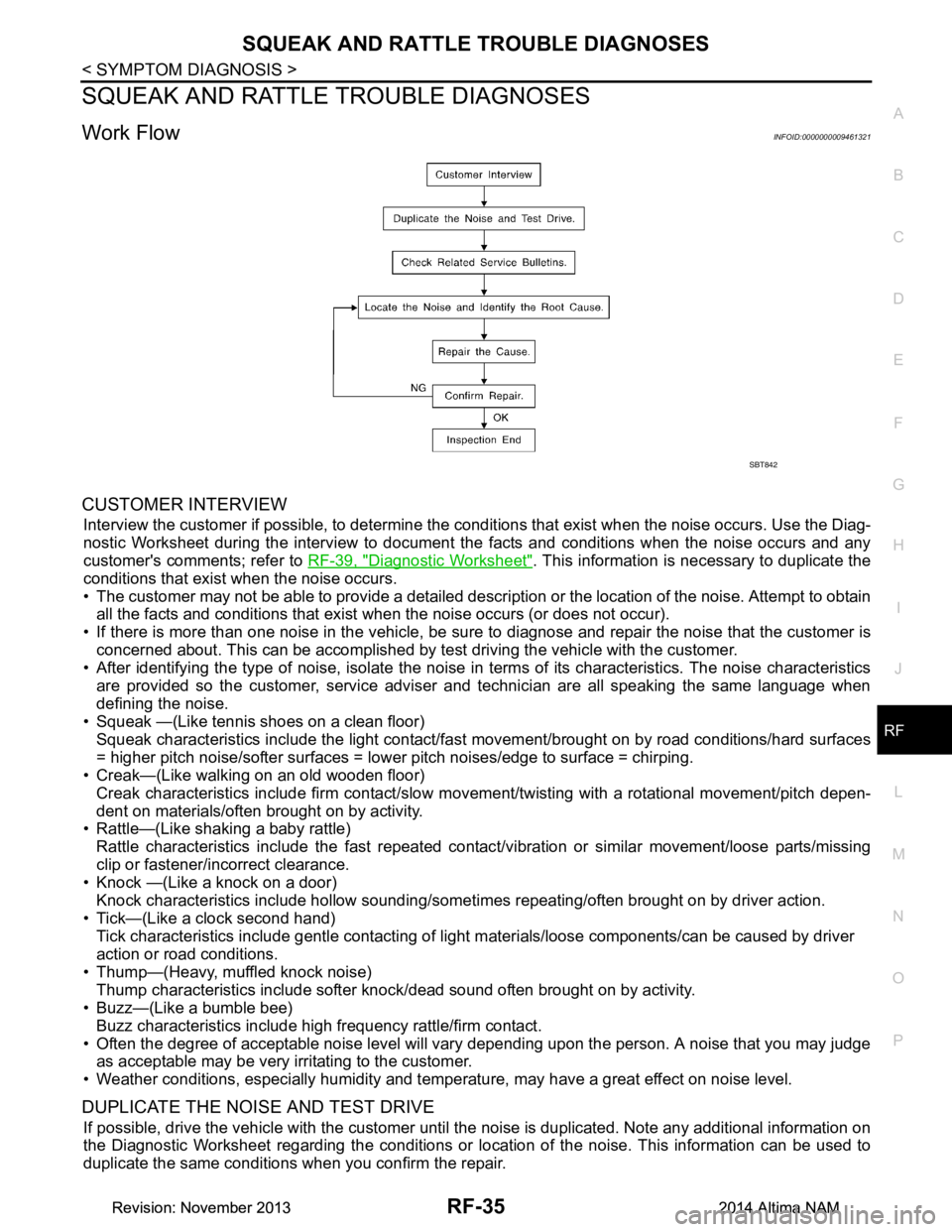
Work FlowINFOID:0000000009461321
CUSTOMER INTERVIEW
Interview the customer if possible, to determine the c onditions that exist when the noise occurs. Use the Diag-
nostic Worksheet during the interv iew to document the facts and conditions when the noise occurs and any
customer's comments; refer to RF-39, "Diagnostic Worksheet"
. This information is necessary to duplicate the
conditions that exist when the noise occurs.
• The customer may not be able to provide a detailed descr iption or the location of the noise. Attempt to obtain
all the facts and conditions that exist when the noise occurs (or does not occur).
• If there is more than one noise in the vehicle, be sure to diagnose and repair the noise that the customer is
concerned about. This can be accomplished by test driving the vehicle with the customer.
• After identifying the type of noise, isolate the noise in terms of its characteristics. The noise characteristics
are provided so the customer, service adviser and technician are all speaking the same language when
defining the noise.
• Squeak —(Like tennis shoes on a clean floor)
Squeak characteristics include the light contact/fast movement/brought on by road conditions/hard surfaces
= higher pitch noise/softer surfaces = lower pitch noises/edge to surface = chirping.
• Creak—(Like walking on an old wooden floor)
Creak characteristics include firm contact/slow mo vement/twisting with a rotational movement/pitch depen-
dent on materials/often brought on by activity.
• Rattle—(Like shaking a baby rattle)
Rattle characteristics include the fast repeated contac t/vibration or similar movement/loose parts/missing
clip or fastener/incorrect clearance.
• Knock —(Like a knock on a door)
Knock characteristics include hollow sounding/someti mes repeating/often brought on by driver action.
• Tick—(Like a clock second hand) Tick characteristics include gentle contacting of li ght materials/loose components/can be caused by driver
action or road conditions.
• Thump—(Heavy, muffled knock noise) Thump characteristics include softer k nock/dead sound often brought on by activity.
• Buzz—(Like a bumble bee)
Buzz characteristics include high frequency rattle/firm contact.
• Often the degree of acceptable noise level will vary depending upon the person. A noise that you may judge as acceptable may be very irritating to the customer.
• Weather conditions, especially humidity and temperature, may have a great effect on noise level.
DUPLICATE THE NOISE AND TEST DRIVE
If possible, drive the vehicle with the customer until the noise is duplicated. Note any additional information on
the Diagnostic Worksheet regarding the conditions or lo cation of the noise. This information can be used to
duplicate the same conditions when you confirm the repair.
SBT842
Revision: November 20132014 Altima NAMRevision: November 20132014 Altima NAM
Page 3701 of 4801
RF-36
< SYMPTOM DIAGNOSIS >
SQUEAK AND RATTLE TROUBLE DIAGNOSES
If the noise can be duplicated easily during the test drive, to help identify the source of the noise, try to dupli-
cate the noise with the vehicle stopped by doing one or all of the following:
1) Close a door.
2) Tap or push/pull around the area where the noise appears to be coming from.
3) Rev the engine.
4) Use a floor jack to recreate vehicle “twist”.
5) At idle, apply engine load (electrical load, half-clutch on M/T model, drive position on CVT and A/T models).
6) Raise the vehicle on a hoist and hit a tire with a rubber hammer.
• Drive the vehicle and attempt to duplicate the conditions the customer states exist when the noise occurs.
• If it is difficult to duplicate the noise, drive the v ehicle slowly on an undulating or rough road to stress the
vehicle body.
CHECK RELATED SERVICE BULLETINS
After verifying the customer concern or symptom, chec k ASIST for Technical Service Bulletins (TSBs) related
to that concern or symptom.
If a TSB relates to the symptom, follo w the procedure to repair the noise.
LOCATE THE NOISE AND IDENTIFY THE ROOT CAUSE
1. Narrow down the noise to a general area. To help pi npoint the source of the noise, use a listening tool
(Chassis Ear: J-39570, Engine Ear: J-39565 and mechanic's stethoscope).
2. Narrow down the noise to a more specific area and identify the cause of the noise by:
• removing the components in the area that you suspect the noise is coming from.
Do not use too much force when removing clips and fasteners, otherwise clips and fasteners can be
broken or lost during the repair, resulting in the creation of new noise.
• tapping or pushing/pulling the component that you suspect is causing the noise. Do not tap or push/pull the component with excessive force, otherwise the noise will be eliminated only
temporarily.
• feeling for a vibration with your hand by touching the component(s) that you suspect is (are) causing the
noise.
• placing a piece of paper between components that you suspect are causing the noise.
• looking for loose components and contact marks. Refer to RF-37, "Generic Squeak and Rattle Troubleshooting"
.
REPAIR THE CAUSE
• If the cause is a loose component, tighten the component securely.
• If the cause is insufficient clearance between components:
- separate components by repositioning or loos ening and retightening the component, if possible.
- insulate components with a suitable insulator such as urethane pads, foam blocks, felt cloth tape or urethane
tape. A NISSAN Squeak and Rattle Kit (J-43980) is av ailable through your authorized NISSAN Parts Depart-
ment.
CAUTION:
Do not use excessive force as many components are constructed of plastic and may be damaged.
Always check with the Parts Department for the latest parts information.
The following materials are contained in the NISS AN Squeak and Rattle Kit (J-43980). Each item can be
ordered separately as needed.
URETHANE PADS [1.5 mm (0.059 in) thick]
Insulates connectors, harness, etc.
76268-9E005: 100 ×135 mm (3.94 ×5.31 in)/76884-71L01: 60 ×85 mm (2.36 ×3.35 in)/76884-71L02: 15 ×25
mm (0.59 ×0.98 in)
INSULATOR (Foam blocks)
Insulates components from contact. Can be used to fill space behind a panel.
73982-9E000: 45 mm (1.77 in) thick, 50 ×50 mm (1.97 ×1.97 in)/73982-50Y00: 10 mm (0.39 in) thick,
50 ×50 mm (1.97 ×1.97 in)
INSULATOR (Light foam block)
80845-71L00: 30 mm (1.18 in) thick, 30 ×50 mm (1.18 ×1.97 in)
FELT CLOTH TAPE
Used to insulate where movemen t does not occur. Ideal for instrument panel applications.
68370-4B000: 15 ×25 mm (0.59 ×0.98 in) pad/68239-13E00: 5 mm (0.20 in ) wide tape roll. The following
materials not found in the kit can also be used to repair squeaks and rattles.
UHMW (TEFLON) TAPE
Insulates where slight movemen t is present. Ideal for instrument panel applications.
SILICONE GREASE
Revision: November 20132014 Altima NAMRevision: November 20132014 Altima NAM