engine control NISSAN TERRANO 2002 Service User Guide
[x] Cancel search | Manufacturer: NISSAN, Model Year: 2002, Model line: TERRANO, Model: NISSAN TERRANO 2002Pages: 1767, PDF Size: 41.51 MB
Page 22 of 1767
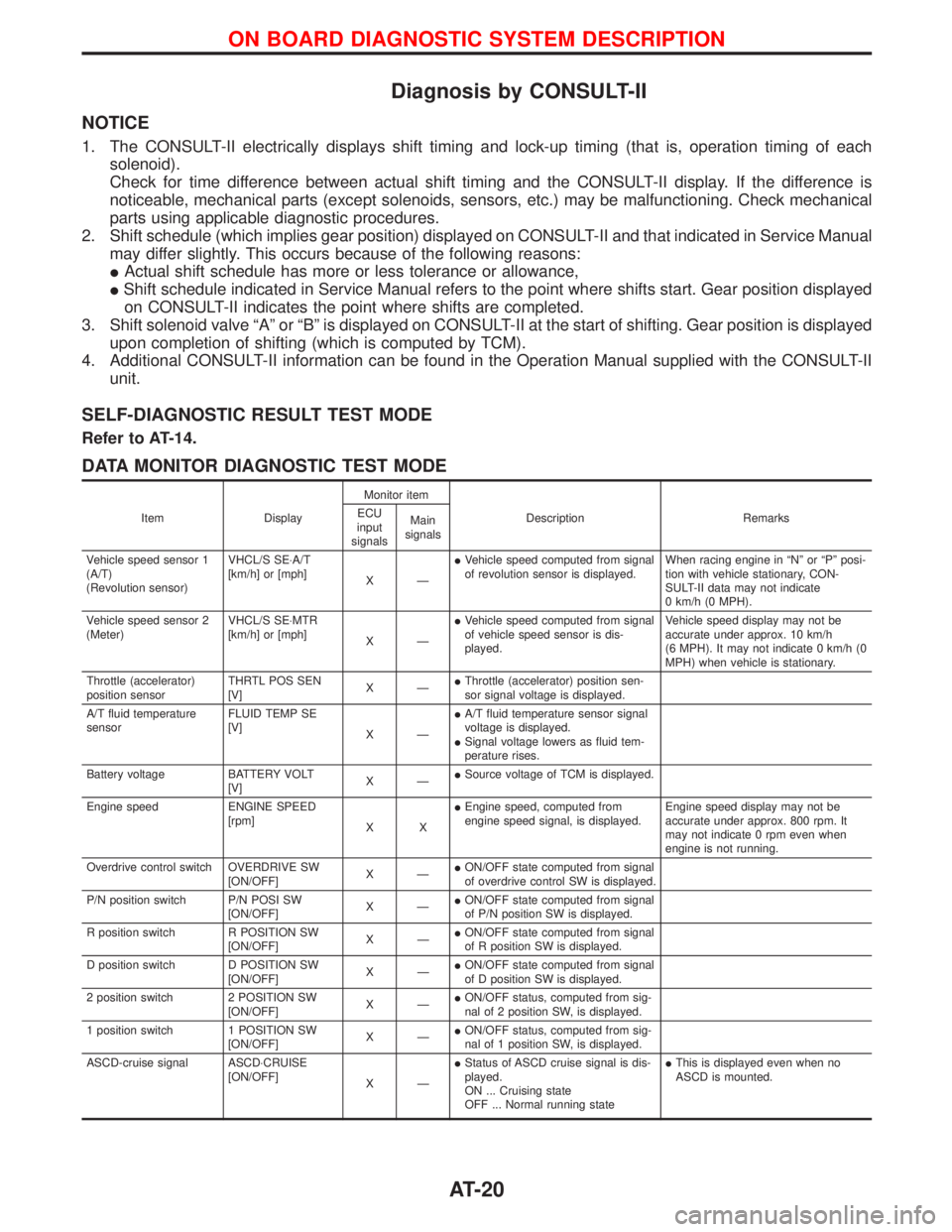
Diagnosis by CONSULT-II
NOTICE
1. The CONSULT-II electrically displays shift timing and lock-up timing (that is, operation timing of each
solenoid).
Check for time difference between actual shift timing and the CONSULT-II display. If the difference is
noticeable, mechanical parts (except solenoids, sensors, etc.) may be malfunctioning. Check mechanical
parts using applicable diagnostic procedures.
2. Shift schedule (which implies gear position) displayed on CONSULT-II and that indicated in Service Manual
may differ slightly. This occurs because of the following reasons:
IActual shift schedule has more or less tolerance or allowance,
IShift schedule indicated in Service Manual refers to the point where shifts start. Gear position displayed
on CONSULT-II indicates the point where shifts are completed.
3. Shift solenoid valve ªAº or ªBº is displayed on CONSULT-II at the start of shifting. Gear position is displayed
upon completion of shifting (which is computed by TCM).
4. Additional CONSULT-II information can be found in the Operation Manual supplied with the CONSULT-II
unit.
SELF-DIAGNOSTIC RESULT TEST MODE
Refer to AT-14.
DATA MONITOR DIAGNOSTIC TEST MODE
Item DisplayMonitor item
Description Remarks ECU
input
signalsMain
signals
Vehicle speed sensor 1
(A/T)
(Revolution sensor)VHCL/S SE×A/T
[km/h] or [mph]
XÐIVehicle speed computed from signal
of revolution sensor is displayed.When racing engine in ªNº or ªPº posi-
tion with vehicle stationary, CON-
SULT-II data may not indicate
0 km/h (0 MPH).
Vehicle speed sensor 2
(Meter)VHCL/S SE×MTR
[km/h] or [mph]
XÐIVehicle speed computed from signal
of vehicle speed sensor is dis-
played.Vehicle speed display may not be
accurate under approx. 10 km/h
(6 MPH). It may not indicate 0 km/h (0
MPH) when vehicle is stationary.
Throttle (accelerator)
position sensorTHRTL POS SEN
[V]XÐIThrottle (accelerator) position sen-
sor signal voltage is displayed.
A/T fluid temperature
sensorFLUID TEMP SE
[V]
XÐIA/T fluid temperature sensor signal
voltage is displayed.
ISignal voltage lowers as fluid tem-
perature rises.
Battery voltage BATTERY VOLT
[V]XÐISource voltage of TCM is displayed.
Engine speed ENGINE SPEED
[rpm]
XXIEngine speed, computed from
engine speed signal, is displayed.Engine speed display may not be
accurate under approx. 800 rpm. It
may not indicate 0 rpm even when
engine is not running.
Overdrive control switch OVERDRIVE SW
[ON/OFF]XÐION/OFF state computed from signal
of overdrive control SW is displayed.
P/N position switch P/N POSI SW
[ON/OFF]XÐION/OFF state computed from signal
of P/N position SW is displayed.
R position switch R POSITION SW
[ON/OFF]XÐION/OFF state computed from signal
of R position SW is displayed.
D position switch D POSITION SW
[ON/OFF]XÐION/OFF state computed from signal
of D position SW is displayed.
2 position switch 2 POSITION SW
[ON/OFF]XÐION/OFF status, computed from sig-
nal of 2 position SW, is displayed.
1 position switch 1 POSITION SW
[ON/OFF]XÐION/OFF status, computed from sig-
nal of 1 position SW, is displayed.
ASCD-cruise signal ASCD×CRUISE
[ON/OFF]
XÐIStatus of ASCD cruise signal is dis-
played.
ON ... Cruising state
OFF ... Normal running stateIThis is displayed even when no
ASCD is mounted.
ON BOARD DIAGNOSTIC SYSTEM DESCRIPTION
AT-20
Page 24 of 1767
Introduction
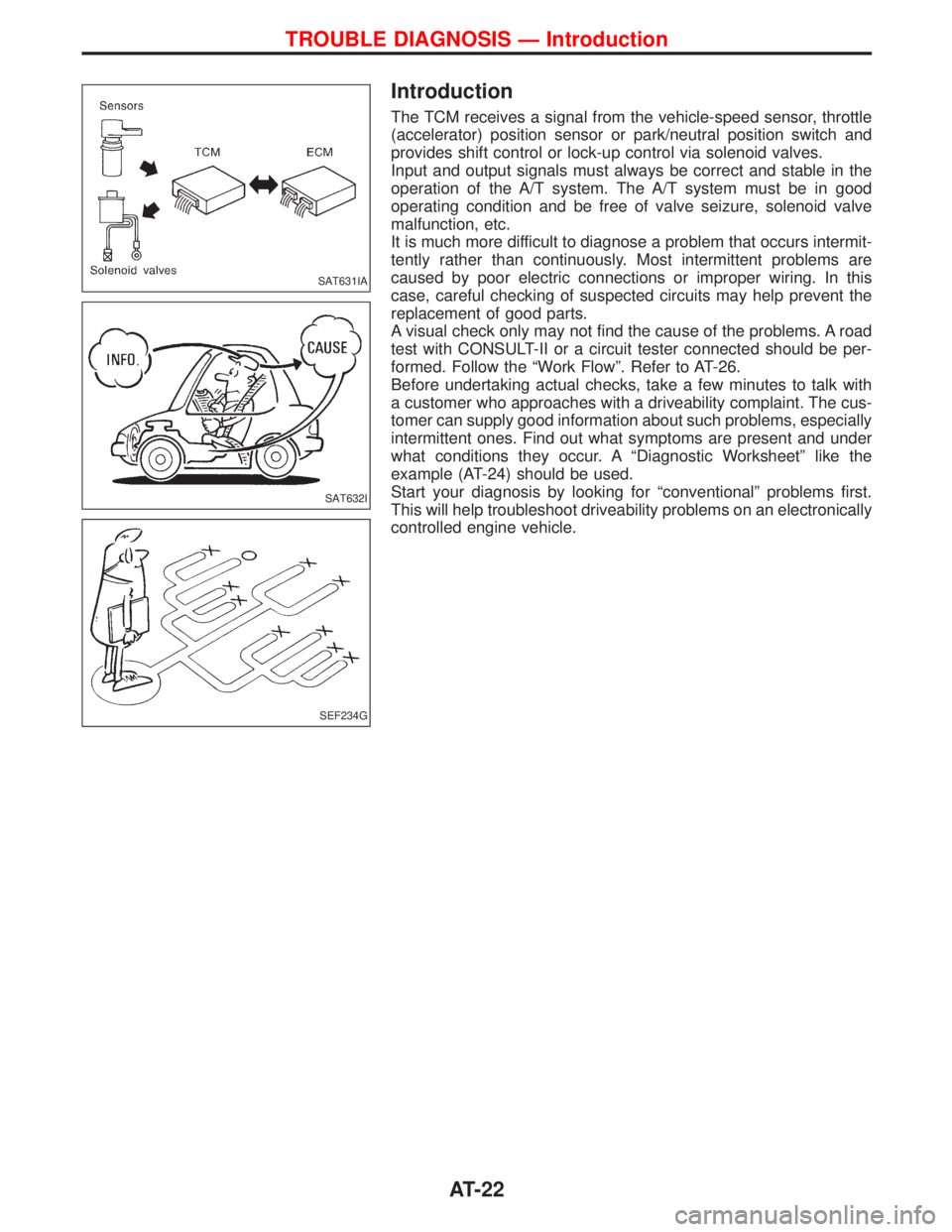
The TCM receives a signal from the vehicle-speed sensor, throttle
(accelerator) position sensor or park/neutral position switch and
provides shift control or lock-up control via solenoid valves.
Input and output signals must always be correct and stable in the
operation of the A/T system. The A/T system must be in good
operating condition and be free of valve seizure, solenoid valve
malfunction, etc.
It is much more difficult to diagnose a problem that occurs intermit-
tently rather than continuously. Most intermittent problems are
caused by poor electric connections or improper wiring. In this
case, careful checking of suspected circuits may help prevent the
replacement of good parts.
A visual check only may not find the cause of the problems. A road
test with CONSULT-II or a circuit tester connected should be per-
formed. Follow the ªWork Flowº. Refer to AT-26.
Before undertaking actual checks, take a few minutes to talk with
a customer who approaches with a driveability complaint. The cus-
tomer can supply good information about such problems, especially
intermittent ones. Find out what symptoms are present and under
what conditions they occur. A ªDiagnostic Worksheetº like the
example (AT-24) should be used.
Start your diagnosis by looking for ªconventionalº problems first.
This will help troubleshoot driveability problems on an electronically
controlled engine vehicle.
SAT631IA
SAT632I
SEF234G
TROUBLE DIAGNOSIS Ð Introduction
AT-22
Page 26 of 1767
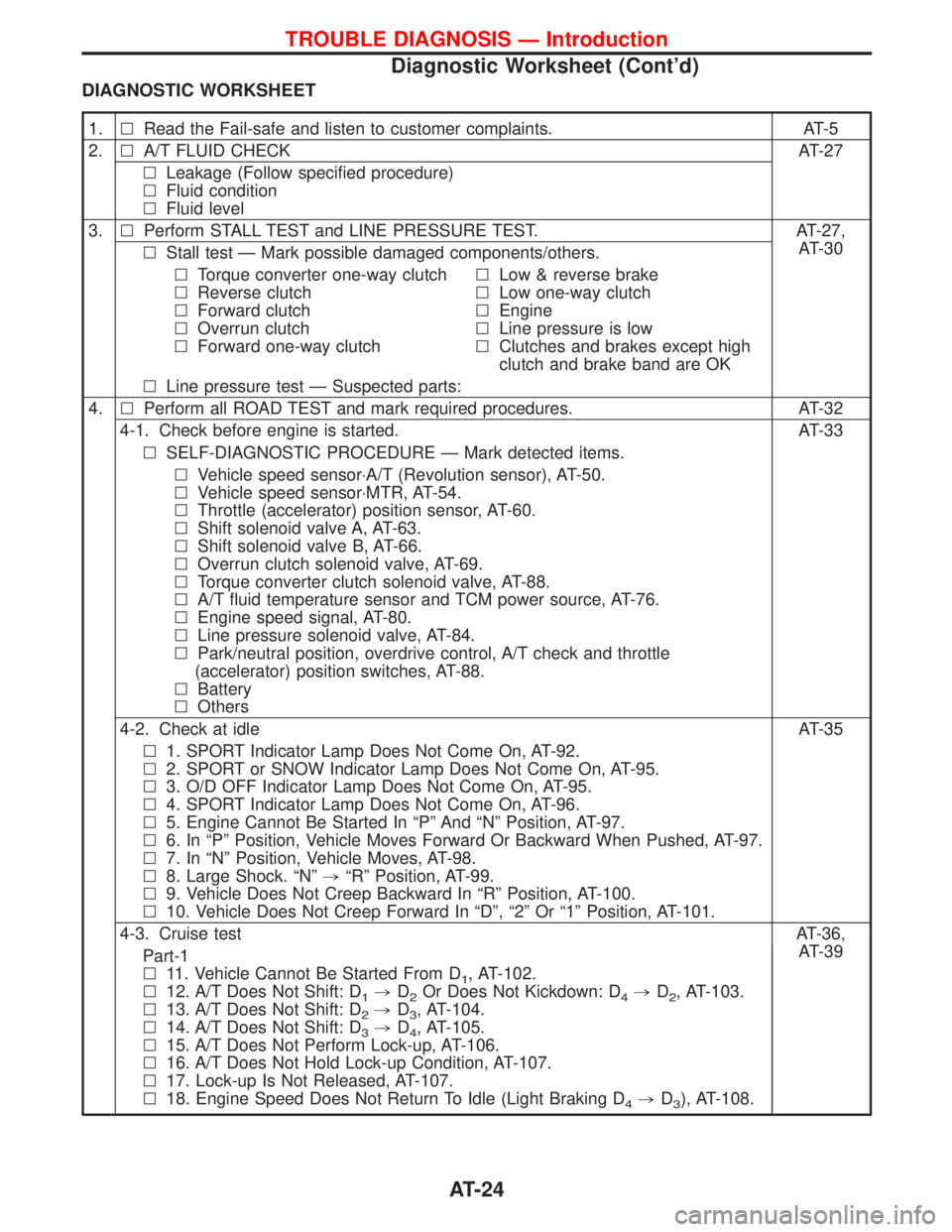
DIAGNOSTIC WORKSHEET
1.lRead the Fail-safe and listen to customer complaints. AT-5
2.lA/T FLUID CHECK AT-27
lLeakage (Follow specified procedure)
lFluid condition
lFluid level
3.lPerform STALL TEST and LINE PRESSURE TEST. AT-27,
AT-30
lStall test Ð Mark possible damaged components/others.
lTorque converter one-way clutch
lReverse clutch
lForward clutch
lOverrun clutch
lForward one-way clutchlLow & reverse brake
lLow one-way clutch
lEngine
lLine pressure is low
lClutches and brakes except high
clutch and brake band are OK
lLine pressure test Ð Suspected parts:
4.lPerform all ROAD TEST and mark required procedures. AT-32
4-1. Check before engine is started. AT-33
lSELF-DIAGNOSTIC PROCEDURE Ð Mark detected items.
lVehicle speed sensor×A/T (Revolution sensor), AT-50.
lVehicle speed sensor×MTR, AT-54.
lThrottle (accelerator) position sensor, AT-60.
lShift solenoid valve A, AT-63.
lShift solenoid valve B, AT-66.
lOverrun clutch solenoid valve, AT-69.
lTorque converter clutch solenoid valve, AT-88.
lA/T fluid temperature sensor and TCM power source, AT-76.
lEngine speed signal, AT-80.
lLine pressure solenoid valve, AT-84.
lPark/neutral position, overdrive control, A/T check and throttle
(accelerator) position switches, AT-88.
lBattery
lOthers
4-2. Check at idle AT-35
l1. SPORT Indicator Lamp Does Not Come On, AT-92.
l2. SPORT or SNOW Indicator Lamp Does Not Come On, AT-95.
l3. O/D OFF Indicator Lamp Does Not Come On, AT-95.
l4. SPORT Indicator Lamp Does Not Come On, AT-96.
l5. Engine Cannot Be Started In ªPº And ªNº Position, AT-97.
l6. In ªPº Position, Vehicle Moves Forward Or Backward When Pushed, AT-97.
l7. In ªNº Position, Vehicle Moves, AT-98.
l8. Large Shock. ªNº,ªRº Position, AT-99.
l9. Vehicle Does Not Creep Backward In ªRº Position, AT-100.
l10. Vehicle Does Not Creep Forward In ªDº, ª2º Or ª1º Position, AT-101.
4-3. Cruise testAT-36,
AT-39
Part-1
l11. Vehicle Cannot Be Started From D
1, AT-102.
l12. A/T Does Not Shift: D
1,D2Or Does Not Kickdown: D4,D2, AT-103.
l13. A/T Does Not Shift: D
2,D3, AT-104.
l14. A/T Does Not Shift: D
3,D4, AT-105.
l15. A/T Does Not Perform Lock-up, AT-106.
l16. A/T Does Not Hold Lock-up Condition, AT-107.
l17. Lock-up Is Not Released, AT-107.
l18. Engine Speed Does Not Return To Idle (Light Braking D
4,D3), AT-108.
TROUBLE DIAGNOSIS Ð Introduction
Diagnostic Worksheet (Cont'd)
AT-24
Page 27 of 1767
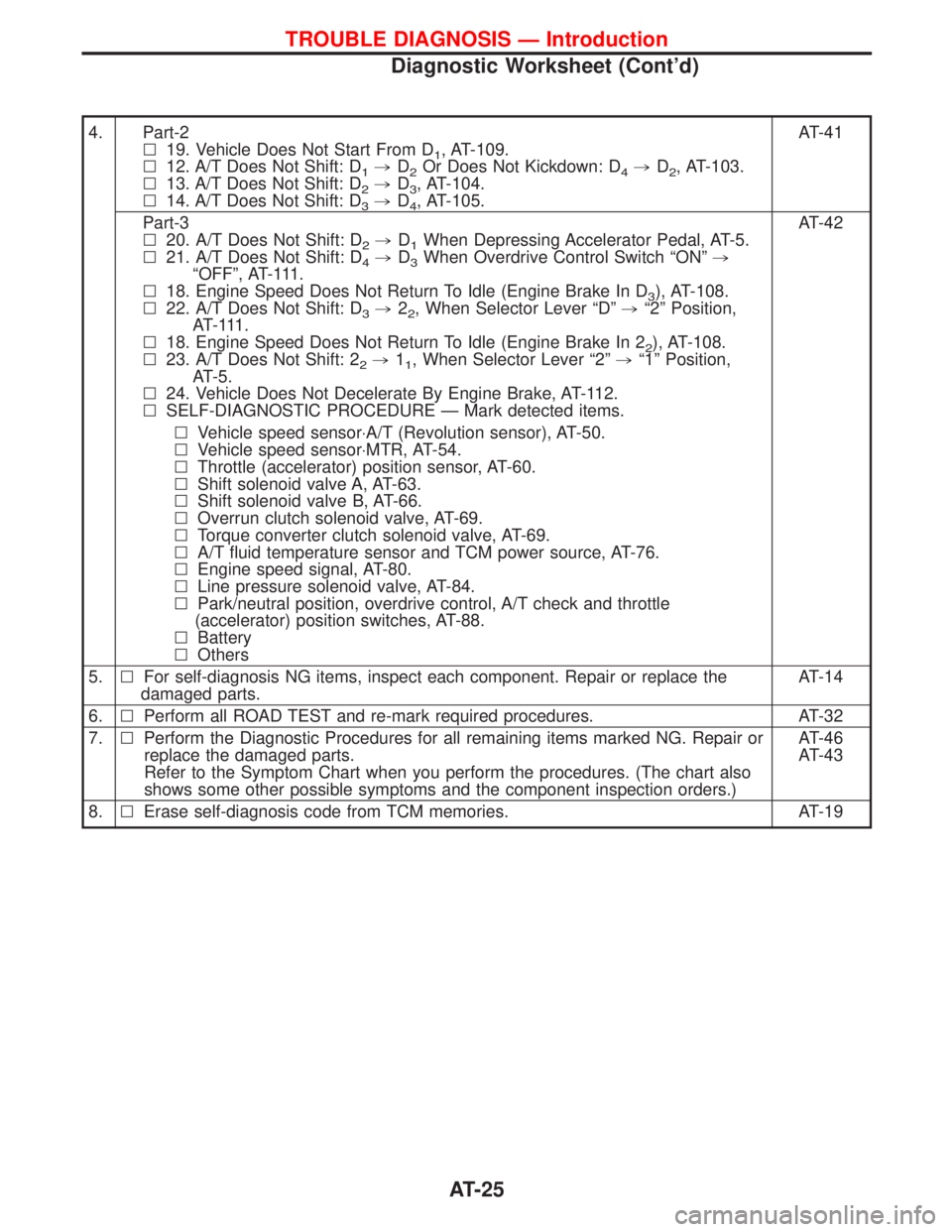
4. Part-2
l19. Vehicle Does Not Start From D
1, AT-109.
l12. A/T Does Not Shift: D
1,D2Or Does Not Kickdown: D4,D2, AT-103.
l13. A/T Does Not Shift: D
2,D3, AT-104.
l14. A/T Does Not Shift: D
3,D4, AT-105.AT-41
Part-3
l20. A/T Does Not Shift: D
2,D1When Depressing Accelerator Pedal, AT-5.
l21. A/T Does Not Shift: D
4,D3When Overdrive Control Switch ªONº,
ªOFFº, AT-111.
l18. Engine Speed Does Not Return To Idle (Engine Brake In D
3), AT-108.
l22. A/T Does Not Shift: D
3,22, When Selector Lever ªDº,ª2º Position,
AT- 111 .
l18. Engine Speed Does Not Return To Idle (Engine Brake In 2
2), AT-108.
l23. A/T Does Not Shift: 2
2,11, When Selector Lever ª2º,ª1º Position,
AT-5.
l24. Vehicle Does Not Decelerate By Engine Brake, AT-112.
lSELF-DIAGNOSTIC PROCEDURE Ð Mark detected items.AT-42
lVehicle speed sensor×A/T (Revolution sensor), AT-50.
lVehicle speed sensor×MTR, AT-54.
lThrottle (accelerator) position sensor, AT-60.
lShift solenoid valve A, AT-63.
lShift solenoid valve B, AT-66.
lOverrun clutch solenoid valve, AT-69.
lTorque converter clutch solenoid valve, AT-69.
lA/T fluid temperature sensor and TCM power source, AT-76.
lEngine speed signal, AT-80.
lLine pressure solenoid valve, AT-84.
lPark/neutral position, overdrive control, A/T check and throttle
(accelerator) position switches, AT-88.
lBattery
lOthers
5.lFor self-diagnosis NG items, inspect each component. Repair or replace the
damaged parts.AT-14
6.lPerform all ROAD TEST and re-mark required procedures. AT-32
7.lPerform the Diagnostic Procedures for all remaining items marked NG. Repair or
replace the damaged parts.
Refer to the Symptom Chart when you perform the procedures. (The chart also
shows some other possible symptoms and the component inspection orders.)AT-46
AT-43
8.lErase self-diagnosis code from TCM memories. AT-19
TROUBLE DIAGNOSIS Ð Introduction
Diagnostic Worksheet (Cont'd)
AT-25
Page 33 of 1767
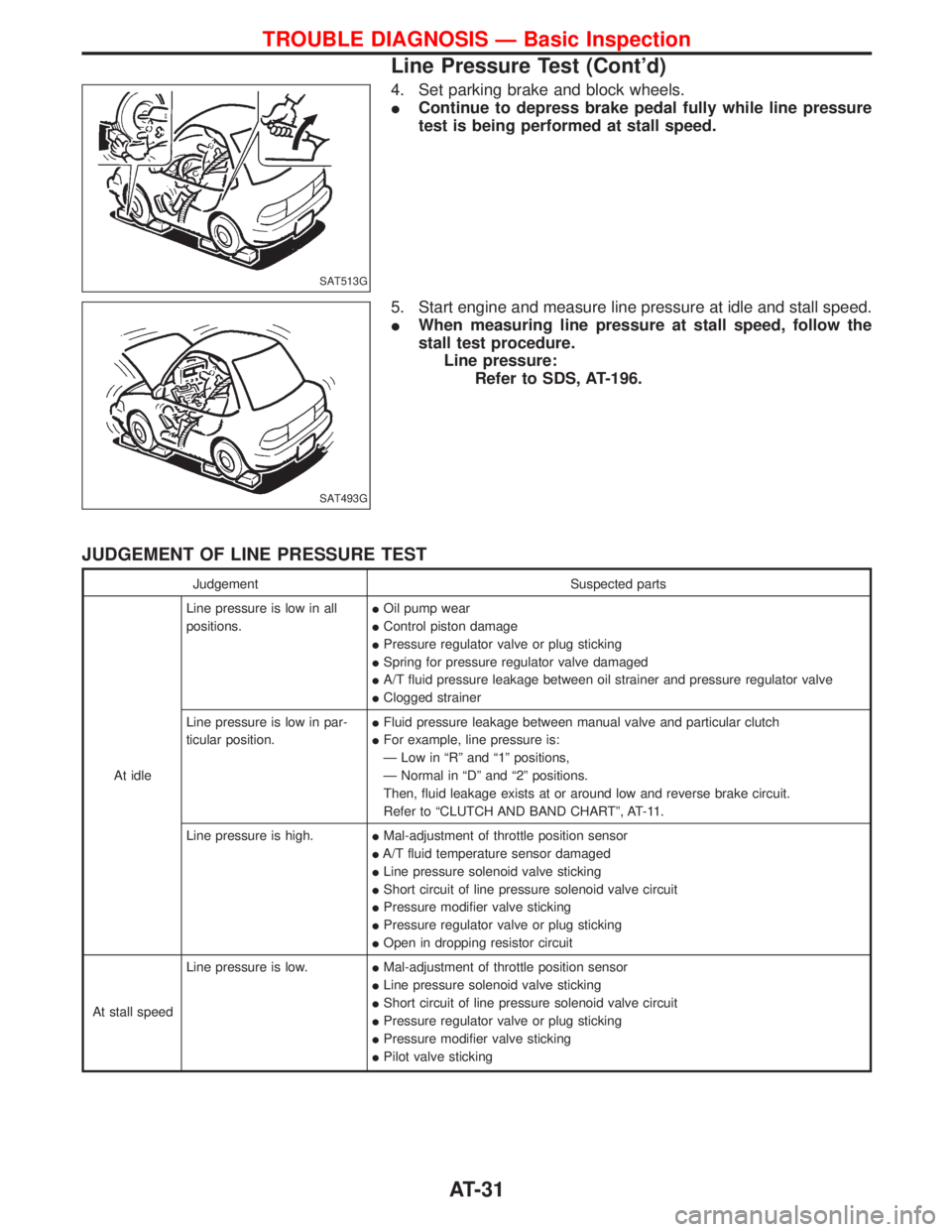
4. Set parking brake and block wheels.
IContinue to depress brake pedal fully while line pressure
test is being performed at stall speed.
5. Start engine and measure line pressure at idle and stall speed.
IWhen measuring line pressure at stall speed, follow the
stall test procedure.
Line pressure:
Refer to SDS, AT-196.
JUDGEMENT OF LINE PRESSURE TEST
Judgement Suspected parts
At idleLine pressure is low in all
positions.IOil pump wear
IControl piston damage
IPressure regulator valve or plug sticking
ISpring for pressure regulator valve damaged
IA/T fluid pressure leakage between oil strainer and pressure regulator valve
IClogged strainer
Line pressure is low in par-
ticular position.IFluid pressure leakage between manual valve and particular clutch
IFor example, line pressure is:
Ð Low in ªRº and ª1º positions,
Ð Normal in ªDº and ª2º positions.
Then, fluid leakage exists at or around low and reverse brake circuit.
Refer to ªCLUTCH AND BAND CHARTº, AT-11.
Line pressure is high.IMal-adjustment of throttle position sensor
IA/T fluid temperature sensor damaged
ILine pressure solenoid valve sticking
IShort circuit of line pressure solenoid valve circuit
IPressure modifier valve sticking
IPressure regulator valve or plug sticking
IOpen in dropping resistor circuit
At stall speedLine pressure is low.IMal-adjustment of throttle position sensor
ILine pressure solenoid valve sticking
IShort circuit of line pressure solenoid valve circuit
IPressure regulator valve or plug sticking
IPressure modifier valve sticking
IPilot valve sticking
SAT513G
SAT493G
TROUBLE DIAGNOSIS Ð Basic Inspection
Line Pressure Test (Cont'd)
AT-31
Page 35 of 1767
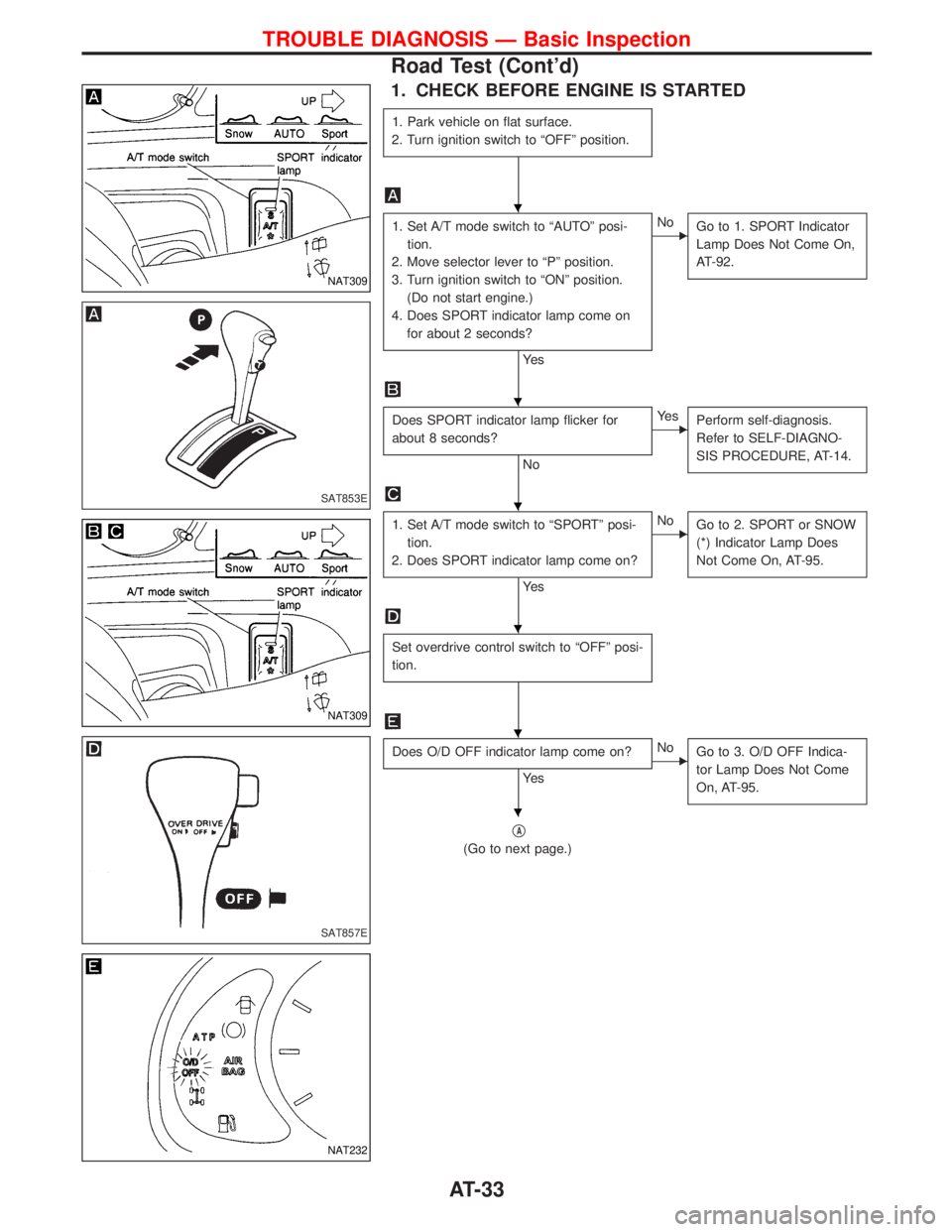
1. CHECK BEFORE ENGINE IS STARTED
1. Park vehicle on flat surface.
2. Turn ignition switch to ªOFFº position.
1. Set A/T mode switch to ªAUTOº posi-
tion.
2. Move selector lever to ªPº position.
3. Turn ignition switch to ªONº position.
(Do not start engine.)
4. Does SPORT indicator lamp come on
for about 2 seconds?
Ye s
ENo
Go to 1. SPORT Indicator
Lamp Does Not Come On,
AT-92.
Does SPORT indicator lamp flicker for
about 8 seconds?
No
EYe s
Perform self-diagnosis.
Refer to SELF-DIAGNO-
SIS PROCEDURE, AT-14.
1. Set A/T mode switch to ªSPORTº posi-
tion.
2. Does SPORT indicator lamp come on?
Ye s
ENo
Go to 2. SPORT or SNOW
(*) Indicator Lamp Does
Not Come On, AT-95.
Set overdrive control switch to ªOFFº posi-
tion.
Does O/D OFF indicator lamp come on?
Ye s
ENo
Go to 3. O/D OFF Indica-
tor Lamp Does Not Come
On, AT-95.
qA
(Go to next page.)
NAT309
SAT853E
NAT309
SAT857E
NAT232
H
H
H
H
H
H
TROUBLE DIAGNOSIS Ð Basic Inspection
Road Test (Cont'd)
AT-33
Page 41 of 1767
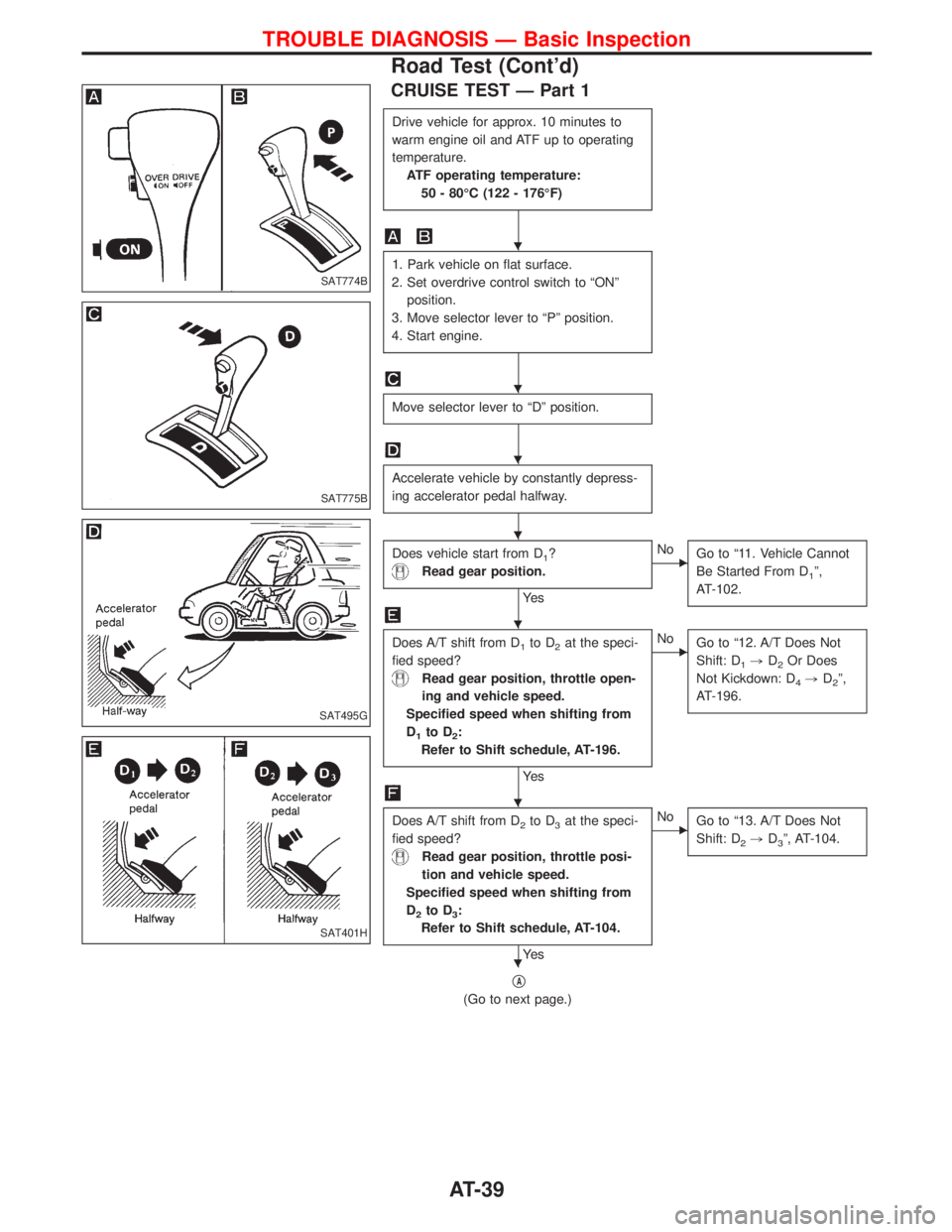
CRUISE TEST Ð Part 1
Drive vehicle for approx. 10 minutes to
warm engine oil and ATF up to operating
temperature.
ATF operating temperature:
50 - 80ÉC (122 - 176ÉF)
1. Park vehicle on flat surface.
2. Set overdrive control switch to ªONº
position.
3. Move selector lever to ªPº position.
4. Start engine.
Move selector lever to ªDº position.
Accelerate vehicle by constantly depress-
ing accelerator pedal halfway.
Does vehicle start from D1?
Read gear position.
Ye s
ENo
Go to ª11. Vehicle Cannot
Be Started From D
1º,
AT-102.
Does A/T shift from D1to D2at the speci-
fied speed?
Read gear position, throttle open-
ing and vehicle speed.
Specified speed when shifting from
D
1to D2:
Refer to Shift schedule, AT-196.
Ye s
ENo
Go to ª12. A/T Does Not
Shift: D
1,D2Or Does
Not Kickdown: D
4,D2º,
AT-196.
Does A/T shift from D2to D3at the speci-
fied speed?
Read gear position, throttle posi-
tion and vehicle speed.
Specified speed when shifting from
D
2to D3:
Refer to Shift schedule, AT-104.
Ye s
ENo
Go to ª13. A/T Does Not
Shift: D
2,D3º, AT-104.
qA
(Go to next page.)
SAT774B
SAT775B
SAT495G
SAT401H
H
H
H
H
H
H
H
TROUBLE DIAGNOSIS Ð Basic Inspection
Road Test (Cont'd)
AT-39
Page 43 of 1767
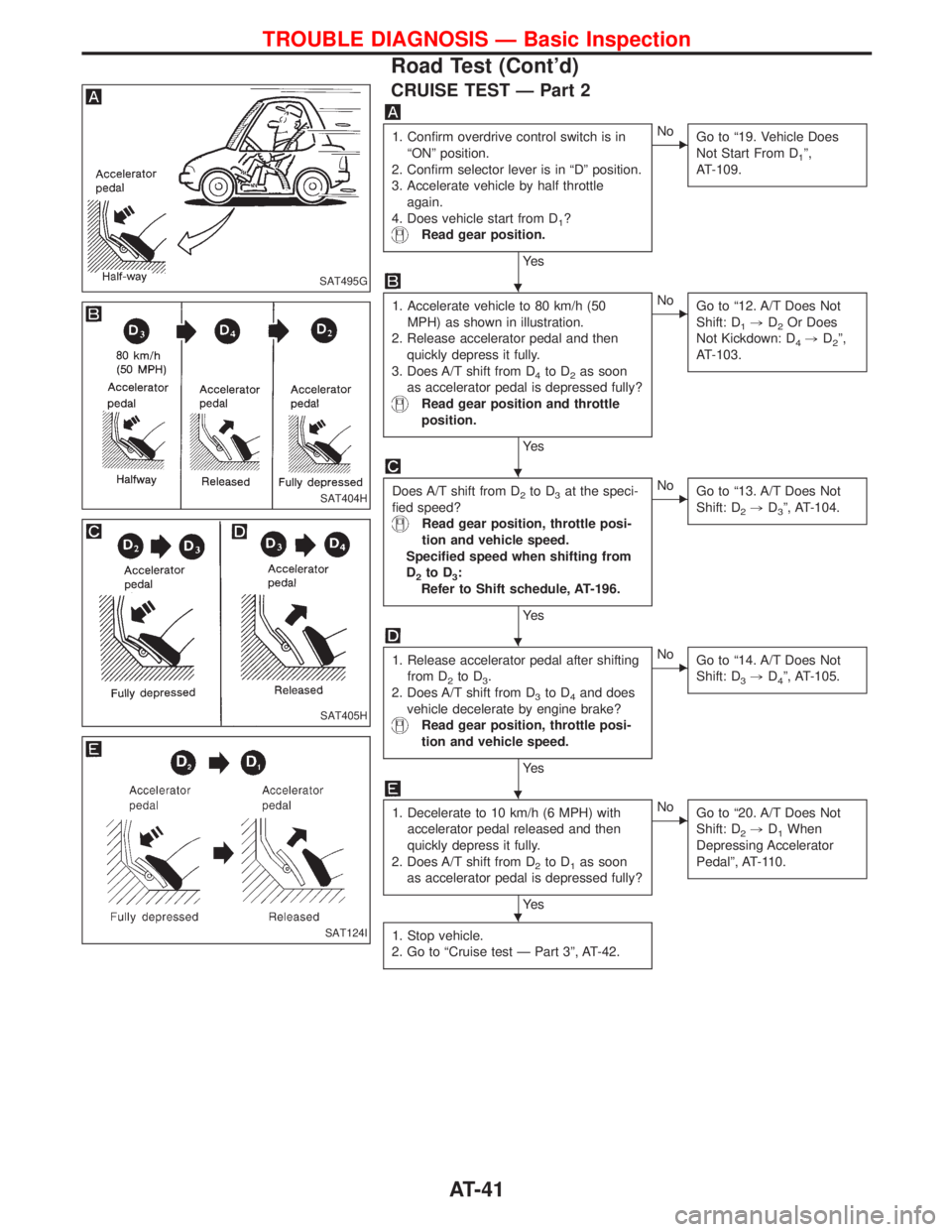
CRUISE TEST Ð Part 2
1. Confirm overdrive control switch is in
ªONº position.
2. Confirm selector lever is in ªDº position.
3. Accelerate vehicle by half throttle
again.
4. Does vehicle start from D
1?
Read gear position.
Ye s
ENo
Go to ª19. Vehicle Does
Not Start From D
1º,
AT-109.
1. Accelerate vehicle to 80 km/h (50
MPH) as shown in illustration.
2. Release accelerator pedal and then
quickly depress it fully.
3. Does A/T shift from D
4to D2as soon
as accelerator pedal is depressed fully?
Read gear position and throttle
position.
Ye s
ENo
Go to ª12. A/T Does Not
Shift: D
1,D2Or Does
Not Kickdown: D
4,D2º,
AT-103.
Does A/T shift from D2to D3at the speci-
fied speed?
Read gear position, throttle posi-
tion and vehicle speed.
Specified speed when shifting from
D
2to D3:
Refer to Shift schedule, AT-196.
Ye s
ENo
Go to ª13. A/T Does Not
Shift: D
2,D3º, AT-104.
1. Release accelerator pedal after shifting
from D
2to D3.
2. Does A/T shift from D
3to D4and does
vehicle decelerate by engine brake?
Read gear position, throttle posi-
tion and vehicle speed.
Ye s
ENo
Go to ª14. A/T Does Not
Shift: D
3,D4º, AT-105.
1. Decelerate to 10 km/h (6 MPH) with
accelerator pedal released and then
quickly depress it fully.
2. Does A/T shift from D
2to D1as soon
as accelerator pedal is depressed fully?
Ye s
ENo
Go to ª20. A/T Does Not
Shift: D
2,D1When
Depressing Accelerator
Pedalº, AT-110.
1. Stop vehicle.
2. Go to ªCruise test Ð Part 3º, AT-42.
SAT495G
SAT404H
SAT405H
SAT124I
H
H
H
H
H
TROUBLE DIAGNOSIS Ð Basic Inspection
Road Test (Cont'd)
AT-41
Page 44 of 1767
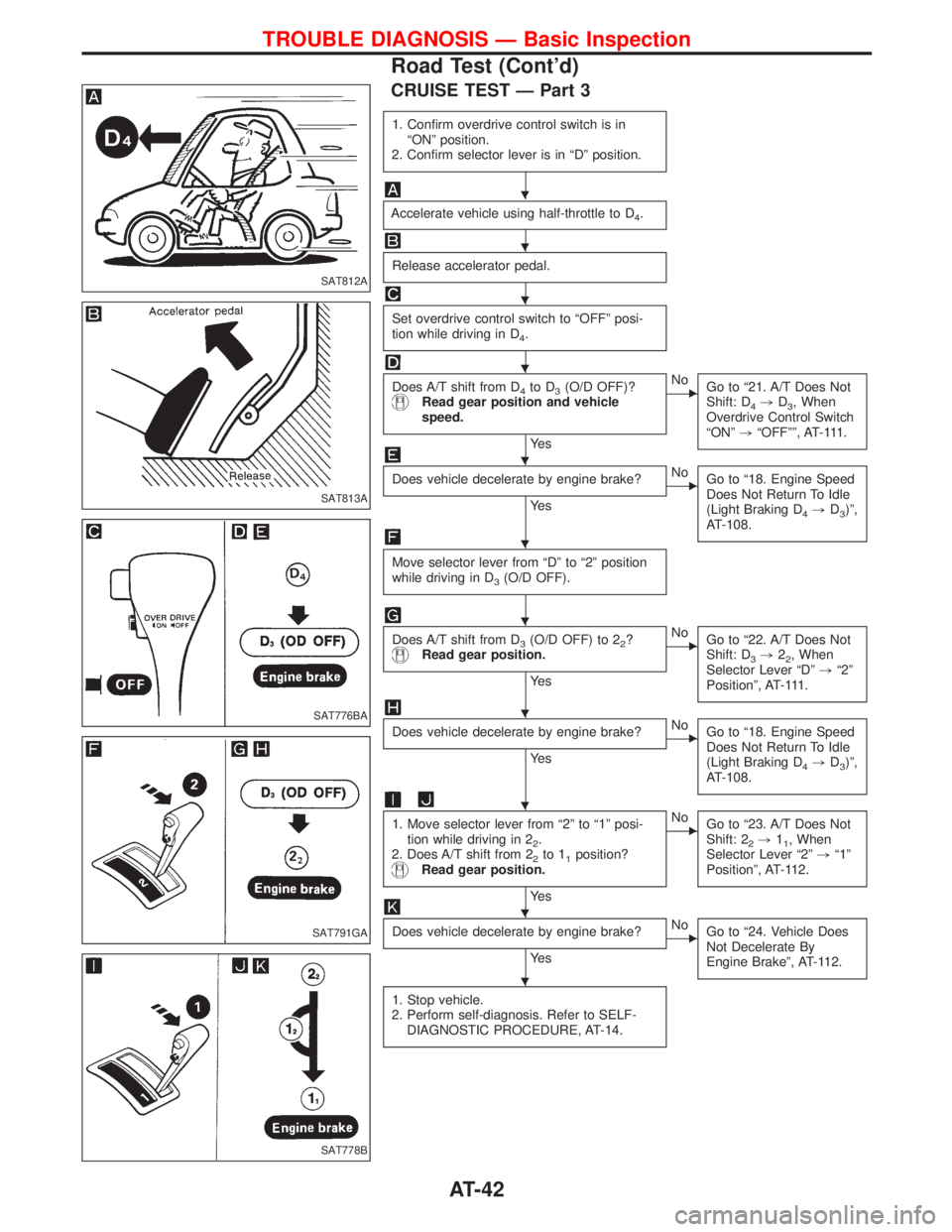
CRUISE TEST Ð Part 3
1. Confirm overdrive control switch is in
ªONº position.
2. Confirm selector lever is in ªDº position.
Accelerate vehicle using half-throttle to D4.
Release accelerator pedal.
Set overdrive control switch to ªOFFº posi-
tion while driving in D
4.
Does A/T shift from D4to D3(O/D OFF)?Read gear position and vehicle
speed.
Ye s
ENo
Go to ª21. A/T Does Not
Shift: D
4,D3, When
Overdrive Control Switch
ªONº,ªOFFºº, AT-111.
Does vehicle decelerate by engine brake?
Ye s
ENo
Go to ª18. Engine Speed
Does Not Return To Idle
(Light Braking D
4,D3)º,
AT-108.
Move selector lever from ªDº to ª2º position
while driving in D
3(O/D OFF).
Does A/T shift from D3(O/D OFF) to 22?Read gear position.
Ye s
ENo
Go to ª22. A/T Does Not
Shift: D
3,22, When
Selector Lever ªDº,ª2º
Positionº, AT-111.
Does vehicle decelerate by engine brake?
Ye s
ENo
Go to ª18. Engine Speed
Does Not Return To Idle
(Light Braking D
4,D3)º,
AT-108.
1. Move selector lever from ª2º to ª1º posi-
tion while driving in 2
2.
2. Does A/T shift from 2
2to 11position?Read gear position.
Ye s
ENo
Go to ª23. A/T Does Not
Shift: 2
2,11, When
Selector Lever ª2º,ª1º
Positionº, AT-112.
Does vehicle decelerate by engine brake?
Ye s
ENo
Go to ª24. Vehicle Does
Not Decelerate By
Engine Brakeº, AT-112.
1. Stop vehicle.
2. Perform self-diagnosis. Refer to SELF-
DIAGNOSTIC PROCEDURE, AT-14.
SAT812A
SAT813A
SAT776BA
SAT791GA
SAT778B
H
H
H
H
H
H
H
H
H
H
H
TROUBLE DIAGNOSIS Ð Basic Inspection
Road Test (Cont'd)
AT-42
Page 45 of 1767
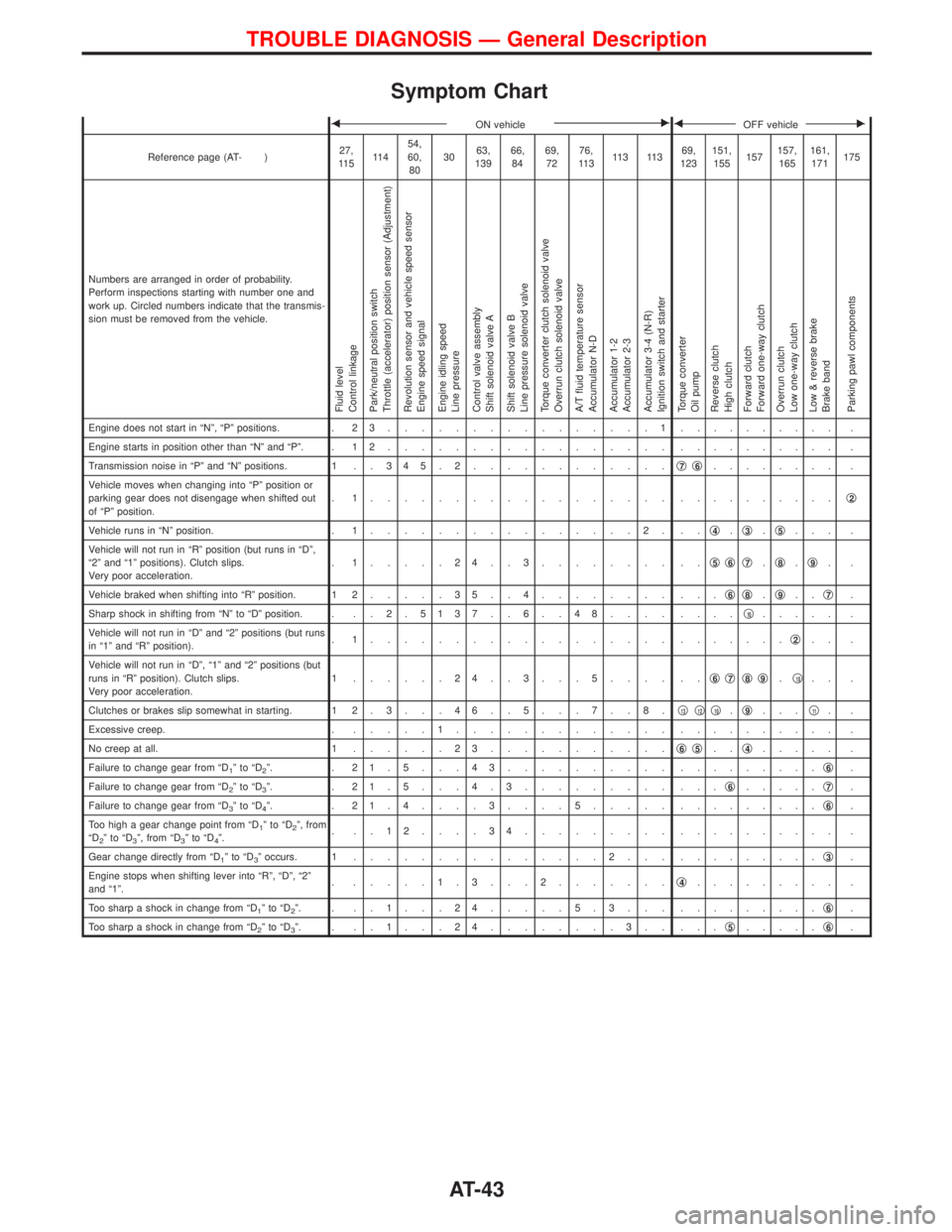
Symptom Chart
FON vehicleEFOFF vehicleE
Reference page (AT- )27,
11 511 454,
60,
803063,
13966,
8469,
7276,
11 311 3 11 369,
123151,
155157157,
165161,
171175
Numbers are arranged in order of probability.
Perform inspections starting with number one and
work up. Circled numbers indicate that the transmis-
sion must be removed from the vehicle.
Fluid level
Control linkage
Park/neutral position switch
Throttle (accelerator) position sensor (Adjustment)
Revolution sensor and vehicle speed sensor
Engine speed signal
Engine idling speed
Line pressure
Control valve assembly
Shift solenoid valve A
Shift solenoid valve B
Line pressure solenoid valve
Torque converter clutch solenoid valve
Overrun clutch solenoid valve
A/T fluid temperature sensor
Accumulator N-D
Accumulator 1-2
Accumulator 2-3
Accumulator 3-4 (N-R)
Ignition switch and starter
Torque converter
Oil pump
Reverse clutch
High clutch
Forward clutch
Forward one-way clutch
Overrun clutch
Low one-way clutch
Low & reverse brake
Brake band
Parking pawl components
Engine does not start in ªNº, ªPº positions. . 2 3................1.......... .
Engine starts in position other than ªNº and ªPº. . 1 2................. .......... .
Transmission noise in ªPº and ªNº positions. 1 . . 3 4 5 . 2............q
7q6........ .
Vehicle moves when changing into ªPº position or
parking gear does not disengage when shifted out
of ªPº position.. 1.................. ..........q
2
Vehicle runs in ªNº position. . 1................2. ..q4.q3.q5... .
Vehicle will not run in ªRº position (but runs in ªDº,
ª2º and ª1º positions). Clutch slips.
Very poor acceleration.. 1.....24..3........ ..q
5q6q7.q8.q9..
Vehicle braked when shifting into ªRº position. 1 2.....35..4........ ...q
6q8.q9..q7.
Sharp shock in shifting from ªNº to ªDº position. . . . 2 .5137 . . 6 . . 48.... ....q
10..... .
Vehicle will not run in ªDº and ª2º positions (but runs
in ª1º and ªRº position).. 1.................. .......q
2.. .
Vehicle will not run in ªDº, ª1º and ª2º positions (but
runs in ªRº position). Clutch slips.
Very poor acceleration.1 ......24..3...5.... ..q
6q7q8q9.q10.. .
Clutches or brakes slip somewhat in starting. 1 2 . 3 . . . 4 6 . . 5 . . . 7 . . 8 .q
13q12q10.q9...q11..
Excessive creep. ......1............. .......... .
No creep at all. 1......23...........q
6q5..q4..... .
Failure to change gear from ªD
1ºtoªD2º. . 21.5...43.......... .........q6.
Failure to change gear from ªD
2ºtoªD3º. . 21.5...4.3......... ...q6.....q7.
Failure to change gear from ªD
3ºtoªD4º. . 21.4....3....5..... .........q6.
Too high a gear change point from ªD
1ºtoªD2º, from
ªD2ºtoªD3º, from ªD3ºtoªD4º.. ..12....34......... .......... .
Gear change directly from ªD
1ºtoªD3º occurs. 1...............2... .........q3.
Engine stops when shifting lever into ªRº, ªDº, ª2º
and ª1º.. .....1.3...2.......q
4......... .
Too sharp a shock in change from ªD
1ºtoªD2º. . ..1...24.....5.3... .........q6.
Too sharp a shock in change from ªD
2ºtoªD3º. . ..1...24........3.. ...q5.....q6.
TROUBLE DIAGNOSIS Ð General Description
AT-43