light NISSAN TERRANO 2004 Service Owner's Manual
[x] Cancel search | Manufacturer: NISSAN, Model Year: 2004, Model line: TERRANO, Model: NISSAN TERRANO 2004Pages: 1833, PDF Size: 53.42 MB
Page 379 of 1833
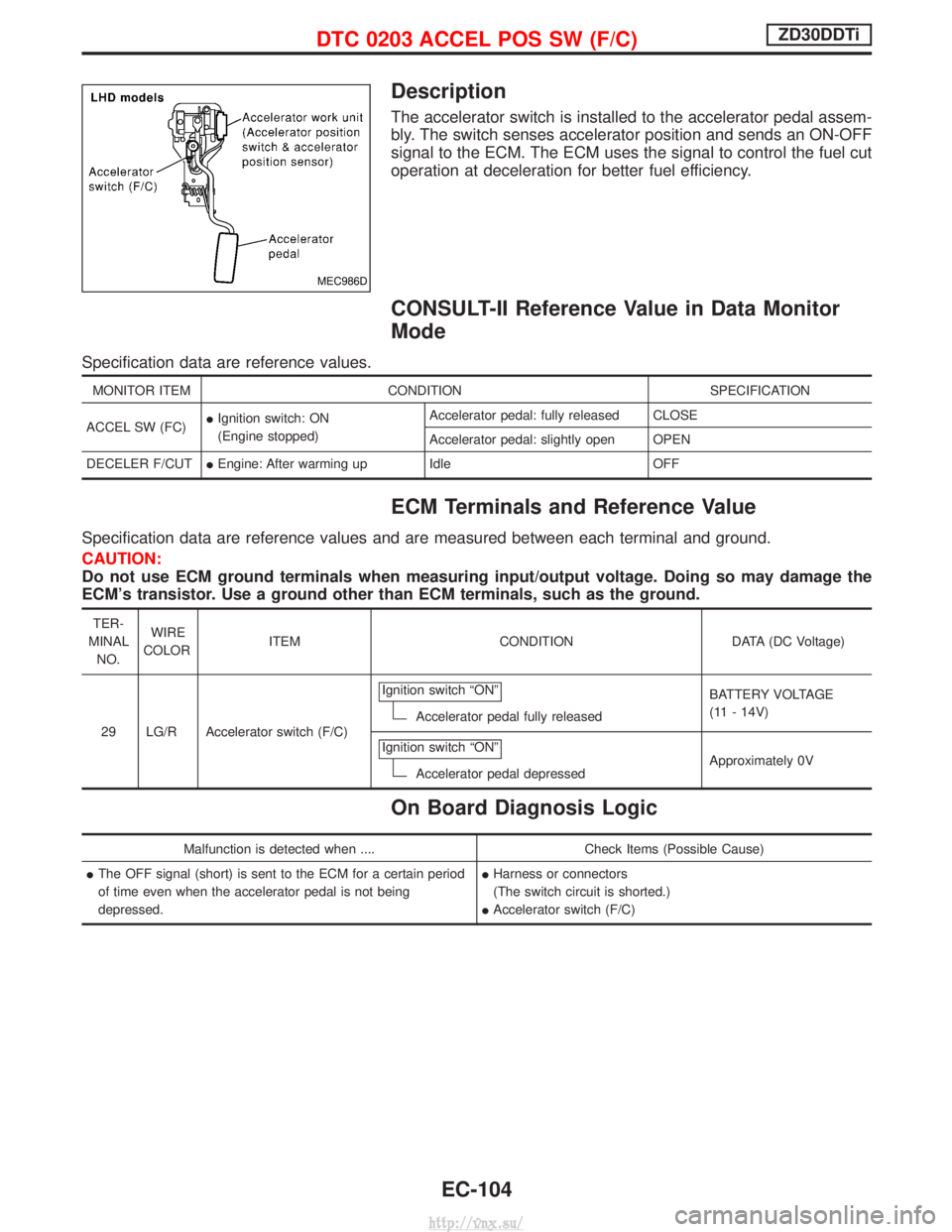
Description
The accelerator switch is installed to the accelerator pedal assem-
bly. The switch senses accelerator position and sends an ON-OFF
signal to the ECM. The ECM uses the signal to control the fuel cut
operation at deceleration for better fuel efficiency.
CONSULT-II Reference Value in Data Monitor
Mode
Specification data are reference values.
MONITOR ITEMCONDITION SPECIFICATION
ACCEL SW (FC) I
Ignition switch: ON
(Engine stopped) Accelerator pedal: fully released CLOSE
Accelerator pedal: slightly open OPEN
DECELER F/CUT IEngine: After warming up Idle OFF
ECM Terminals and Reference Value
Specification data are reference values and are measured between each terminal and ground.
CAUTION:
Do not use ECM ground terminals when measuring input/output voltage. Doing so may damage the
ECM's transistor. Use a ground other than ECM terminals, such as the ground.
TER-
MINAL NO. WIRE
COLOR ITEM CONDITION DATA (DC Voltage)
29 LG/R Accelerator switch (F/C) Ignition switch ªONº
Accelerator pedal fully released
BATTERY VOLTAGE
(11 - 14V)
Ignition switch ªONº
Accelerator pedal depressed Approximately 0V
On Board Diagnosis Logic
Malfunction is detected when ....
Check Items (Possible Cause)
I The OFF signal (short) is sent to the ECM for a certain period
of time even when the accelerator pedal is not being
depressed. I
Harness or connectors
(The switch circuit is shorted.)
I Accelerator switch (F/C)
MEC986D
DTC 0203 ACCEL POS SW (F/C)ZD30DDTi
EC-104
http://vnx.su/
Page 406 of 1833
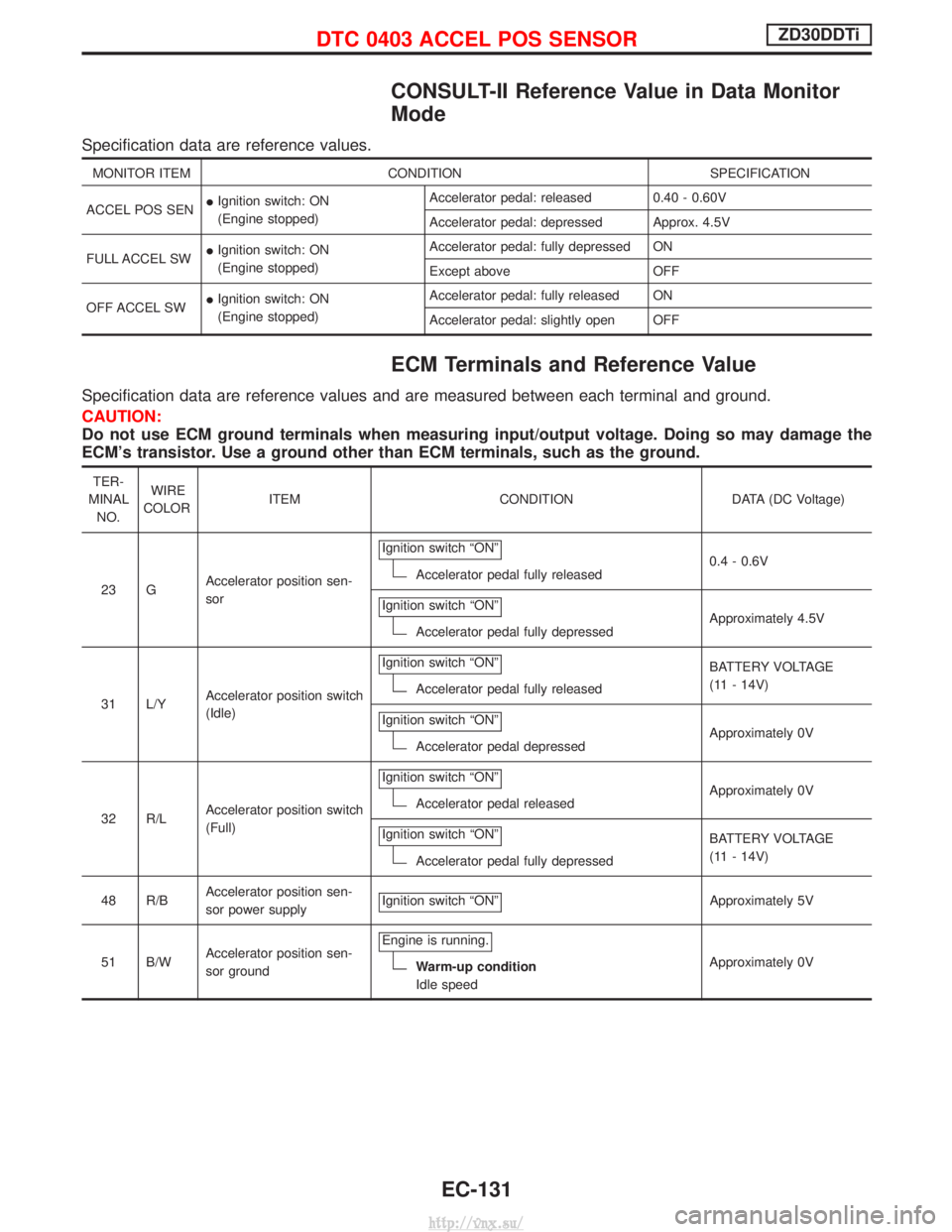
CONSULT-II Reference Value in Data Monitor
Mode
Specification data are reference values.
MONITOR ITEMCONDITION SPECIFICATION
ACCEL POS SEN I
Ignition switch: ON
(Engine stopped) Accelerator pedal: released 0.40 - 0.60V
Accelerator pedal: depressed Approx. 4.5V
FULL ACCEL SW I
Ignition switch: ON
(Engine stopped) Accelerator pedal: fully depressed ON
Except above OFF
OFF ACCEL SW I
Ignition switch: ON
(Engine stopped) Accelerator pedal: fully released ON
Accelerator pedal: slightly open OFF
ECM Terminals and Reference Value
Specification data are reference values and are measured between each terminal and ground.
CAUTION:
Do not use ECM ground terminals when measuring input/output voltage. Doing so may damage the
ECM's transistor. Use a ground other than ECM terminals, such as the ground.
TER-
MINAL NO. WIRE
COLOR ITEM CONDITION DATA (DC Voltage)
23 G Accelerator position sen-
sor Ignition switch ªONº
Accelerator pedal fully released
0.4 - 0.6V
Ignition switch ªONº
Accelerator pedal fully depressed Approximately 4.5V
31 L/Y Accelerator position switch
(Idle) Ignition switch ªONº
Accelerator pedal fully released
BATTERY VOLTAGE
(11 - 14V)
Ignition switch ªONº
Accelerator pedal depressed Approximately 0V
32 R/L Accelerator position switch
(Full) Ignition switch ªONº
Accelerator pedal released
Approximately 0V
Ignition switch ªONº
Accelerator pedal fully depressed BATTERY VOLTAGE
(11 - 14V)
48 R/B Accelerator position sen-
sor power supply Ignition switch ªONº
Approximately 5V
51 B/W Accelerator position sen-
sor ground Engine is running.
Warm-up condition
Idle speed
Approximately 0V
DTC 0403 ACCEL POS SENSORZD30DDTi
EC-131
http://vnx.su/
Page 591 of 1833
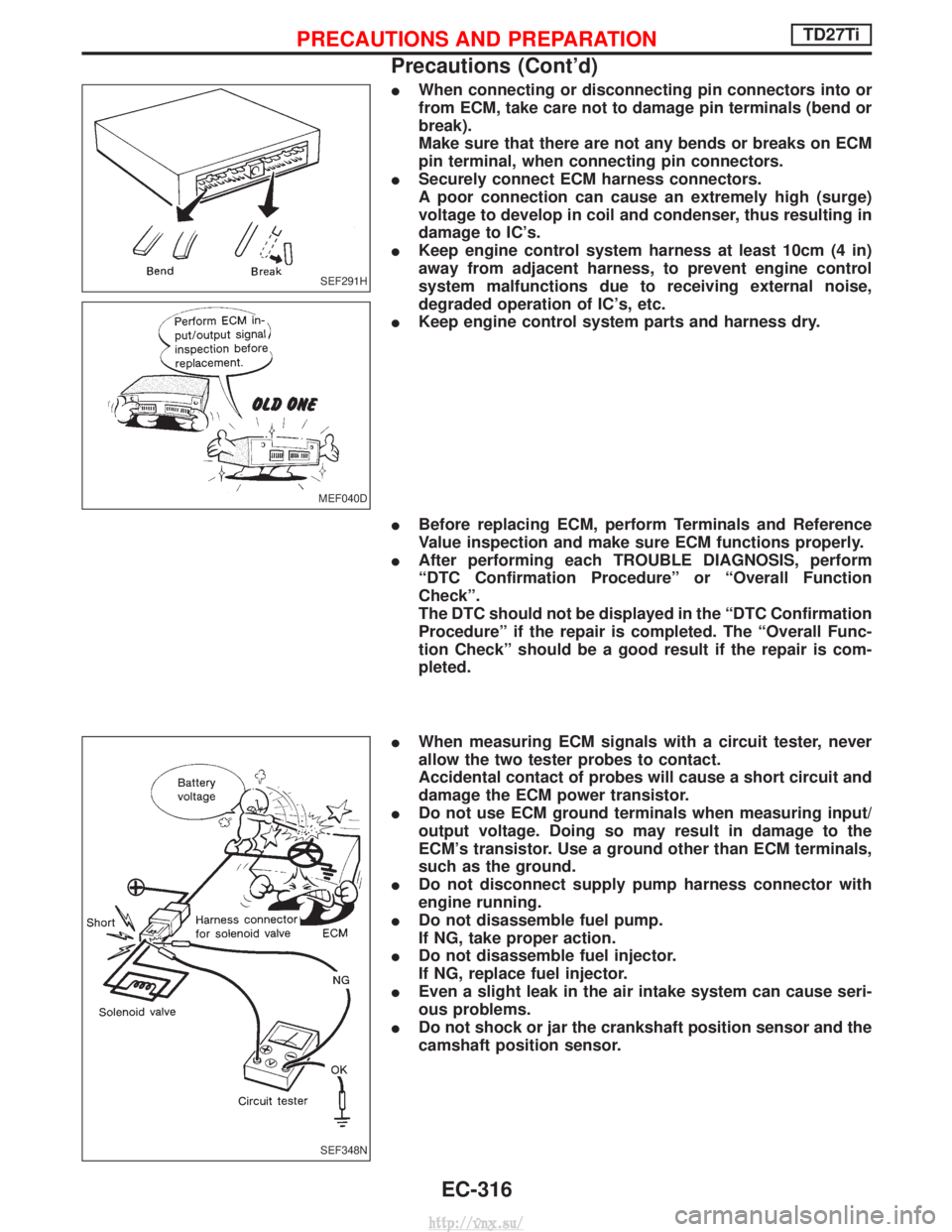
IWhen connecting or disconnecting pin connectors into or
from ECM, take care not to damage pin terminals (bend or
break).
Make sure that there are not any bends or breaks on ECM
pin terminal, when connecting pin connectors.
I Securely connect ECM harness connectors.
A poor connection can cause an extremely high (surge)
voltage to develop in coil and condenser, thus resulting in
damage to IC's.
I Keep engine control system harness at least 10cm (4 in)
away from adjacent harness, to prevent engine control
system malfunctions due to receiving external noise,
degraded operation of IC's, etc.
I Keep engine control system parts and harness dry.
I Before replacing ECM, perform Terminals and Reference
Value inspection and make sure ECM functions properly.
I After performing each TROUBLE DIAGNOSIS, perform
ªDTC Confirmation Procedureº or ªOverall Function
Checkº.
The DTC should not be displayed in the ªDTC Confirmation
Procedureº if the repair is completed. The ªOverall Func-
tion Checkº should be a good result if the repair is com-
pleted.
I When measuring ECM signals with a circuit tester, never
allow the two tester probes to contact.
Accidental contact of probes will cause a short circuit and
damage the ECM power transistor.
I Do not use ECM ground terminals when measuring input/
output voltage. Doing so may result in damage to the
ECM's transistor. Use a ground other than ECM terminals,
such as the ground.
I Do not disconnect supply pump harness connector with
engine running.
I Do not disassemble fuel pump.
If NG, take proper action.
I Do not disassemble fuel injector.
If NG, replace fuel injector.
I Even a slight leak in the air intake system can cause seri-
ous problems.
I Do not shock or jar the crankshaft position sensor and the
camshaft position sensor.
SEF291H
MEF040D
SEF348N
PRECAUTIONS AND PREPARATIONTD27Ti
Precautions (Cont'd)
EC-316
http://vnx.su/
Page 613 of 1833
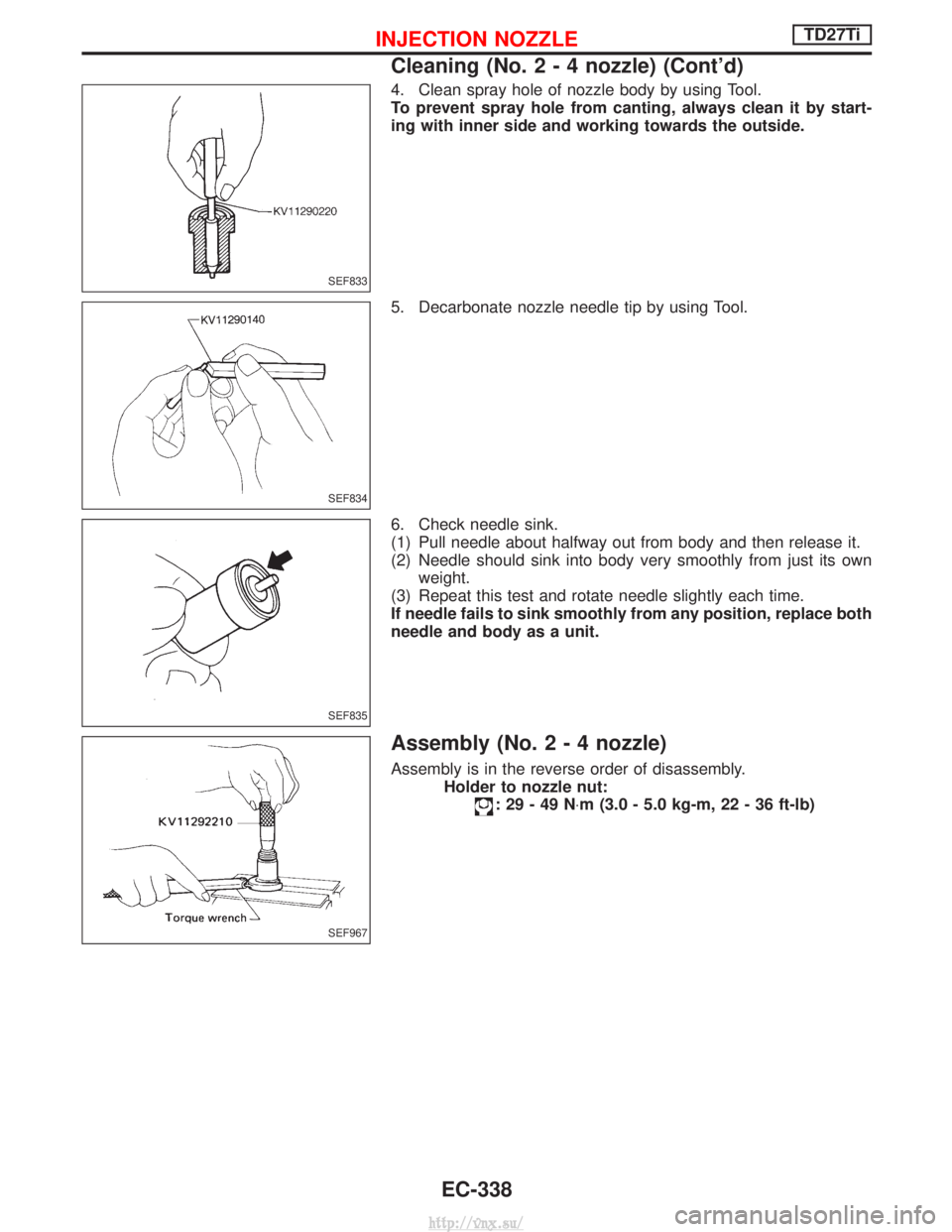
4. Clean spray hole of nozzle body by using Tool.
To prevent spray hole from canting, always clean it by start-
ing with inner side and working towards the outside.
5. Decarbonate nozzle needle tip by using Tool.
6. Check needle sink.
(1) Pull needle about halfway out from body and then release it.
(2) Needle should sink into body very smoothly from just its ownweight.
(3) Repeat this test and rotate needle slightly each time.
If needle fails to sink smoothly from any position, replace both
needle and body as a unit.
Assembly (No.2-4nozzle)
Assembly is in the reverse order of disassembly. Holder to nozzle nut:
:29-49N ×m (3.0 - 5.0 kg-m, 22 - 36 ft-lb)
SEF833
SEF834
SEF835
SEF967
INJECTION NOZZLETD27Ti
Cleaning (No.2-4nozzle) (Cont'd)
EC-338
http://vnx.su/
Page 619 of 1833
DTC and MI Detection Logic
When a malfunction is detected for the first time, the malfunction (DTC) is stored in the ECM memory.
The MI will light up each time the ECM detects a malfunction. However, if the same malfunction is experienced
in two consecutive driving patterns and the engine is still running, the MI will stay lit up. For a description of
diagnostic items causing the MI to light up, refer to ªTROUBLE DIAGNOSIS Ð INDEXº, EC-313.
Diagnostic Trouble Code (DTC)
HOW TO READ DTC
The DTC can be read by the following methods.
Without CONSULT-II
ECM displays the DTC by a set of four digit numbers with MI illumination in the diagnostic test mode II (Self-
diagnostic results). Example: 0102, 0103, 0104, etc.
With CONSULT-II
CONSULT-II displays the DTC in ªSELF-DIAG RESULTSº mode. Examples: P0100, P0115, P0500, etc.
These DTCs are prescribed by ISO15031-6.
(CONSULT-II also displays the malfunctioning component or system.)
IOutput of the trouble code means that the indicated circuit has a malfunction. However, in the Mode
II it does not indicate whether the malfunction is still occurring or occurred in the past and returned
to normal.
CONSULT-II can identify them. Therefore, using CONSULT-II (if available) is recommended.
HOW TO ERASE DTC
How to Erase DTC (
With CONSULT-II)
1. If the ignition switch stays ªONº after repair work, be sure to turn ignition switch ªOFFº once. Wait at least
5 seconds and then turn it ªONº (engine stopped) again.
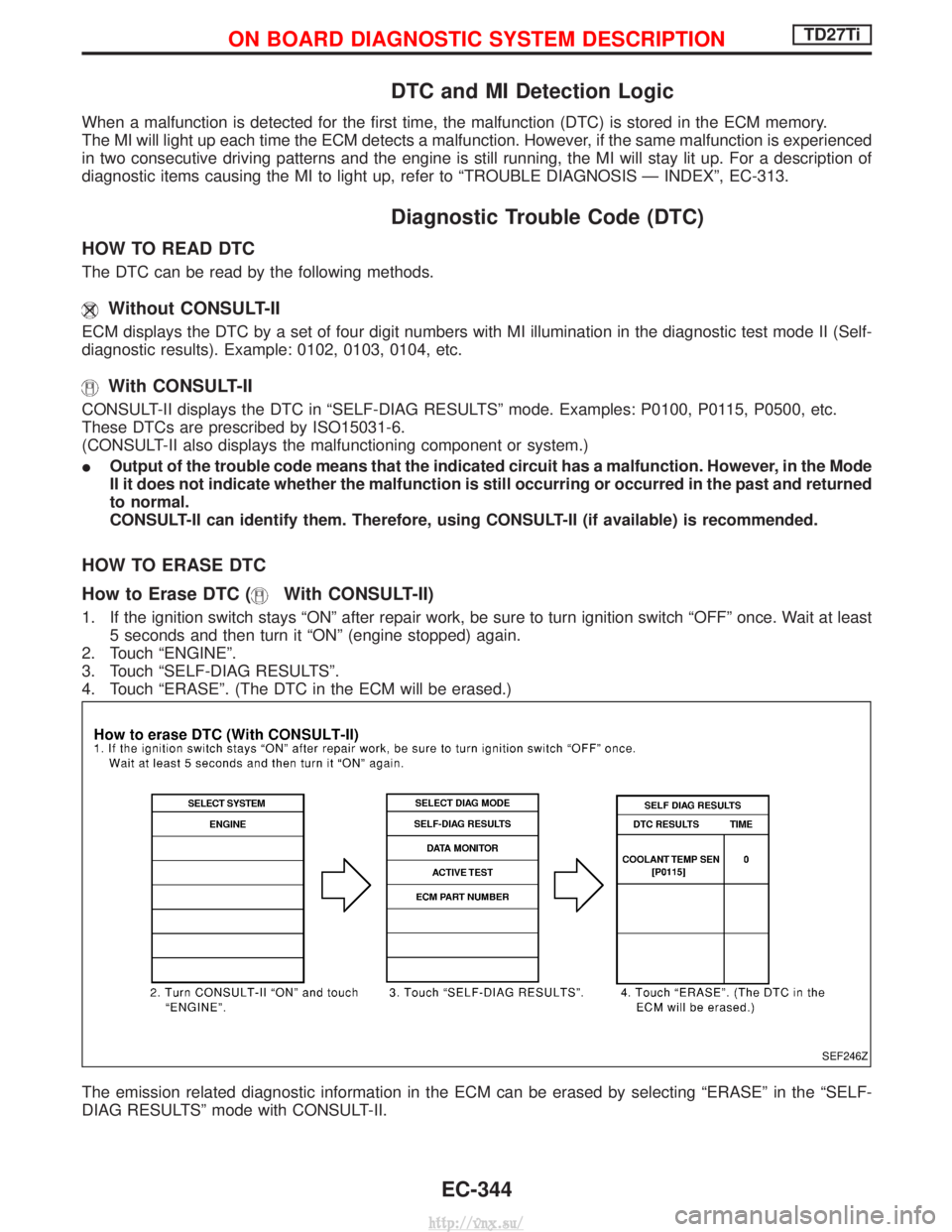
2. Touch ªENGINEº.
3. Touch ªSELF-DIAG RESULTSº.
4. Touch ªERASEº. (The DTC in the ECM will be erased.)
The emission related diagnostic information in the ECM can be erased by selecting ªERASEº in the ªSELF-
DIAG RESULTSº mode with CONSULT-II.
SEF246Z
ON BOARD DIAGNOSTIC SYSTEM DESCRIPTIONTD27Ti
EC-344
http://vnx.su/
Page 620 of 1833
How to Erase DTC (Without CONSULT-II)
1. If the ignition switch stays ªONº after repair work, be sure to turn ignition switch ªOFFº once. Wait at least5 seconds and then turn it ªONº (engine stopped) again.
2. Change the diagnostic test mode from Mode II to Mode I by using the data link connector. (See EC-346.)
The emission related diagnostic information in the ECM can be erased by changing the diagnostic test mode.
I If the battery is disconnected, the emission-related diagnostic information will be lost after approx.
24 hours.
I Erasing the emission-related diagnostic information using CONSULT-II is easier and quicker than
switching the diagnostic test mode using the data link connector.
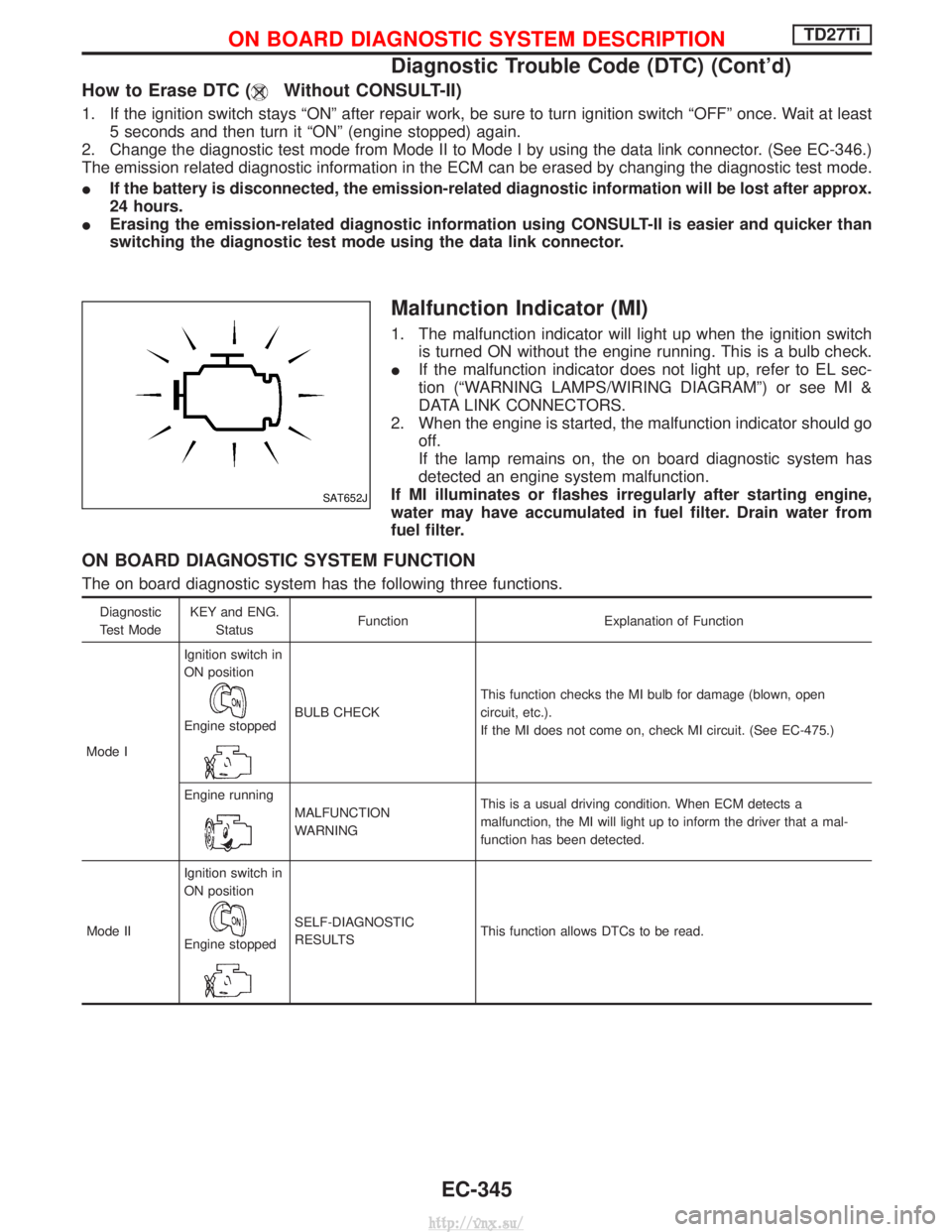
Malfunction Indicator (MI)
1. The malfunction indicator will light up when the ignition switch
is turned ON without the engine running. This is a bulb check.
I If the malfunction indicator does not light up, refer to EL sec-
tion (ªWARNING LAMPS/WIRING DIAGRAMº) or see MI &
DATA LINK CONNECTORS.
2. When the engine is started, the malfunction indicator should go off.
If the lamp remains on, the on board diagnostic system has
detected an engine system malfunction.
If MI illuminates or flashes irregularly after starting engine,
water may have accumulated in fuel filter. Drain water from
fuel filter.
ON BOARD DIAGNOSTIC SYSTEM FUNCTION
The on board diagnostic system has the following three functions.
Diagnostic
Test Mode KEY and ENG.
Status Function Explanation of Function
Mode I Ignition switch in
ON position
Engine stoppedBULB CHECK
This function checks the MI bulb for damage (blown, open
circuit, etc.).
If the MI does not come on, check MI circuit. (See EC-475.)
Engine running
MALFUNCTION
WARNING This is a usual driving condition. When ECM detects a
malfunction, the MI will light up to inform the driver that a mal-
function has been detected.
Mode II Ignition switch in
ON position
Engine stopped
SELF-DIAGNOSTIC
RESULTS
This function allows DTCs to be read.
SAT652J
ON BOARD DIAGNOSTIC SYSTEM DESCRIPTIONTD27Ti
Diagnostic Trouble Code (DTC) (Cont'd)
EC-345
http://vnx.su/
Page 624 of 1833
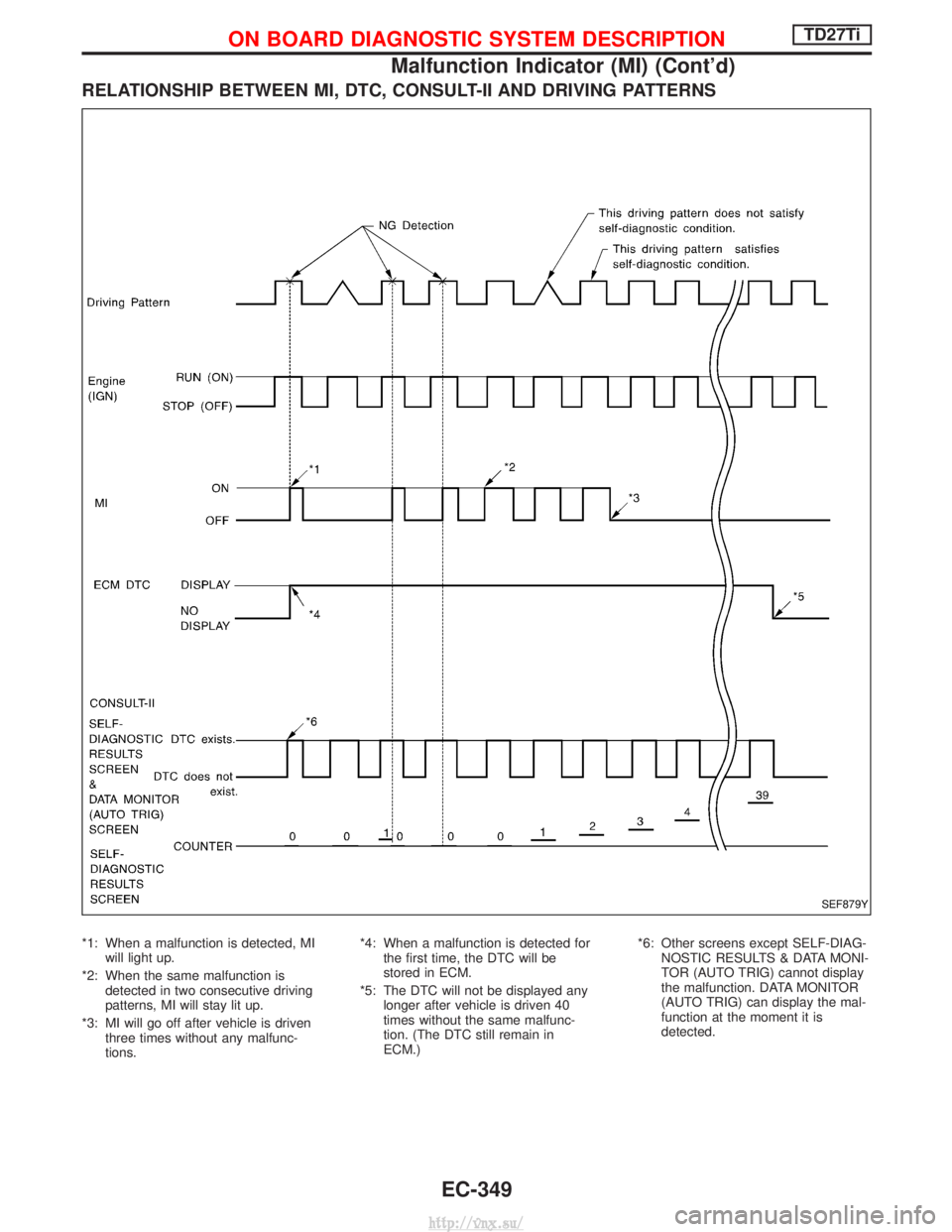
RELATIONSHIP BETWEEN MI, DTC, CONSULT-II AND DRIVING PATTERNS
*1: When a malfunction is detected, MIwill light up.
*2: When the same malfunction is detected in two consecutive driving
patterns, MI will stay lit up.
*3: MI will go off after vehicle is driven three times without any malfunc-
tions. *4: When a malfunction is detected for
the first time, the DTC will be
stored in ECM.
*5: The DTC will not be displayed any longer after vehicle is driven 40
times without the same malfunc-
tion. (The DTC still remain in
ECM.) *6: Other screens except SELF-DIAG-
NOSTIC RESULTS & DATA MONI-
TOR (AUTO TRIG) cannot display
the malfunction. DATA MONITOR
(AUTO TRIG) can display the mal-
function at the moment it is
detected.
SEF879Y
ON BOARD DIAGNOSTIC SYSTEM DESCRIPTIONTD27Ti
Malfunction Indicator (MI) (Cont'd)
EC-349
http://vnx.su/
Page 634 of 1833
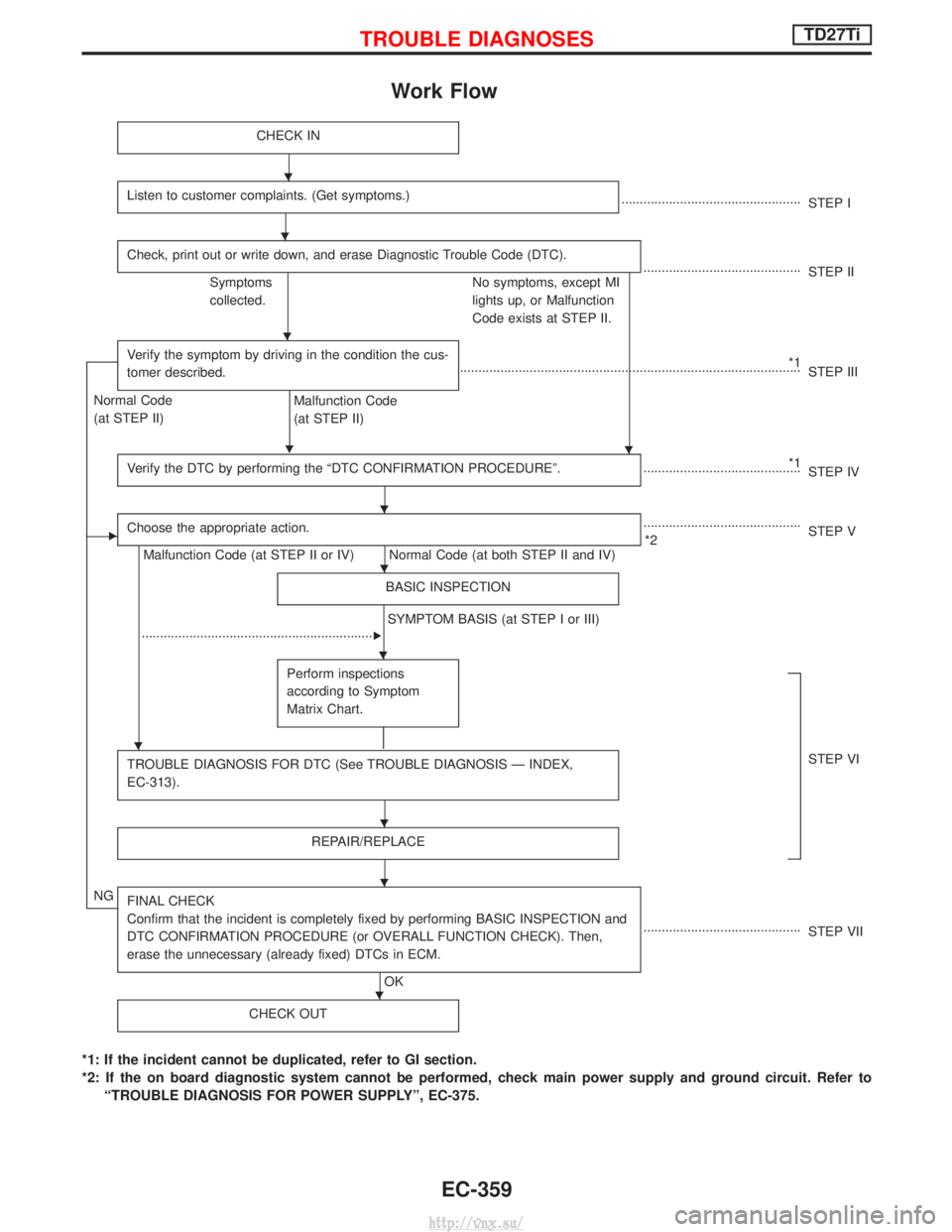
Work Flow
CHECK IN
Listen to customer complaints. (Get symptoms.).................................................STEP I
Check, print out or write down, and erase Diagnostic Trouble Code (DTC).
........................................... STEP II
Symptoms
collected. No symptoms, except MI
lights up, or Malfunction
Code exists at STEP II.
Verify the symptom by driving in the condition the cus-
tomer described.
H
*1
........................................................................\
..................... STEP III
Normal Code
(at STEP II)
Malfunction Code
(at STEP II)
Verify the DTC by performing the ªDTC CONFIRMATION PROCEDUREº.
*1
........................................... STEP IV
EChoose the appropriate action.
Malfunction Code (at STEP II or IV) Normal Code (at both STEP II and IV) ...........................................
*2 STEP V
BASIC INSPECTION
SYMPTOM BASIS (at STEP I or III)
................................................................
E
Perform inspections
according to Symptom
Matrix Chart.
TROUBLE DIAGNOSIS FOR DTC (See TROUBLE DIAGNOSIS Ð INDEX,
EC-313).STEP VI
REPAIR/REPLACE
NGFINAL CHECK
Confirm that the incident is completely fixed by performing BASIC INSPECTION and
DTC CONFIRMATION PROCEDURE (or OVERALL FUNCTION CHECK). Then,
erase the unnecessary (already fixed) DTCs in ECM.
OK ...........................................
STEP VII
CHECK OUT
*1: If the incident cannot be duplicated, refer to GI section.
*2: If the on board diagnostic system cannot be performed, check main power supply and ground circuit. Refer to ªTROUBLE DIAGNOSIS FOR POWER SUPPLYº, EC-375.
H
H
H
H
H
H
H
H
H
H
H
TROUBLE DIAGNOSESTD27Ti
EC-359
http://vnx.su/
Page 641 of 1833
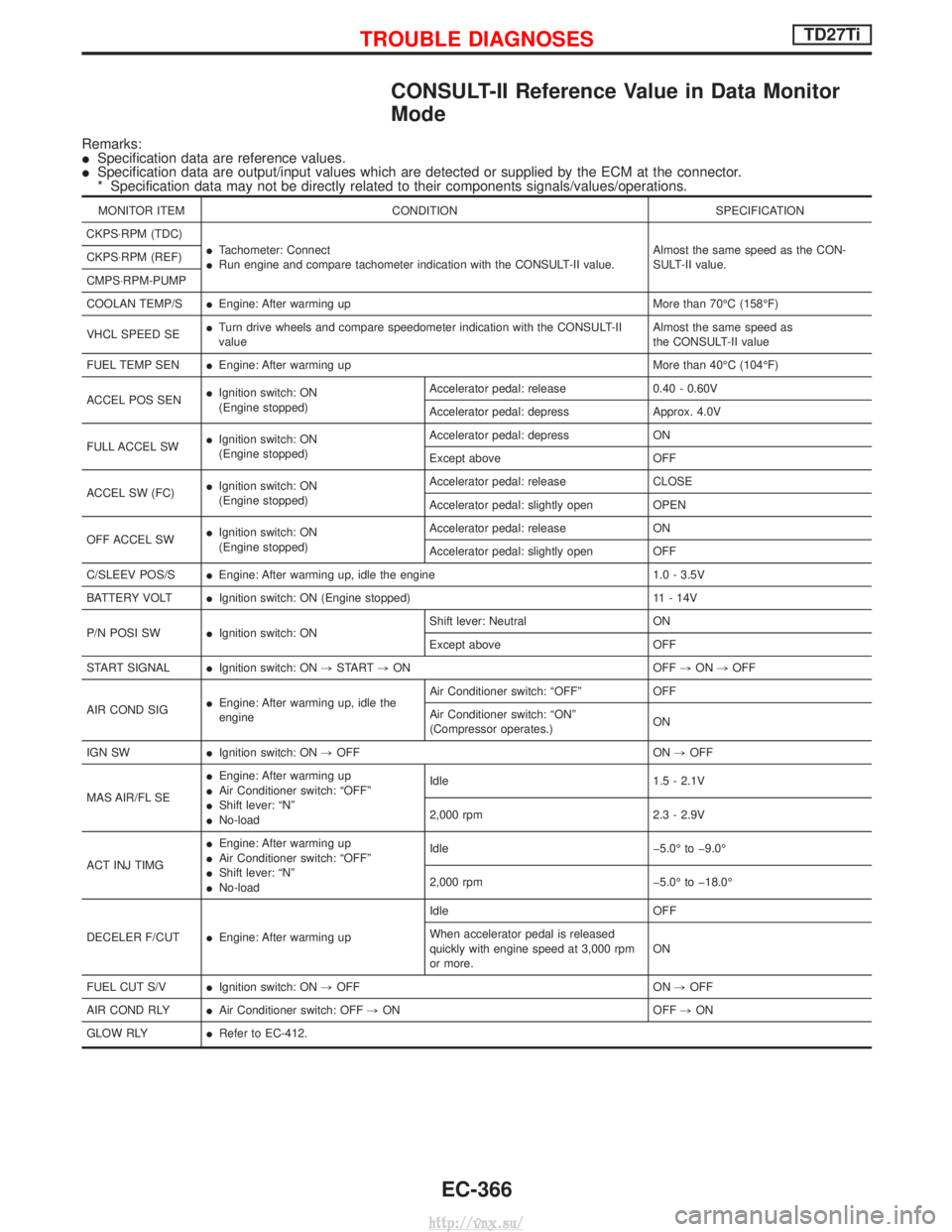
CONSULT-II Reference Value in Data Monitor
Mode
Remarks:
ISpecification data are reference values.
I Specification data are output/input values which are detected or supplied by the ECM at the connector.
* Specification data may not be directly related to their components signals/values/operations.
MONITOR ITEM CONDITION SPECIFICATION
CKPS×RPM (TDC) ITachometer: Connect
I Run engine and compare tachometer indication with the CONSULT-II value. Almost the same speed as the CON-
SULT-II value.
CKPS×RPM (REF)
CMPS×RPM-PUMP
COOLAN TEMP/S
IEngine: After warming up More than 70ÉC (158ÉF)
VHCL SPEED SE I
Turn drive wheels and compare speedometer indication with the CONSULT-II
value Almost the same speed as
the CONSULT-II value
FUEL TEMP SEN IEngine: After warming up More than 40ÉC (104ÉF)
ACCEL POS SEN I
Ignition switch: ON
(Engine stopped) Accelerator pedal: release 0.40 - 0.60V
Accelerator pedal: depress Approx. 4.0V
FULL ACCEL SW I
Ignition switch: ON
(Engine stopped) Accelerator pedal: depress ON
Except above OFF
ACCEL SW (FC) I
Ignition switch: ON
(Engine stopped) Accelerator pedal: release CLOSE
Accelerator pedal: slightly open OPEN
OFF ACCEL SW I
Ignition switch: ON
(Engine stopped) Accelerator pedal: release ON
Accelerator pedal: slightly open OFF
C/SLEEV POS/S IEngine: After warming up, idle the engine 1.0 - 3.5V
BATTERY VOLT IIgnition switch: ON (Engine stopped) 11 - 14V
P/N POSI SW IIgnition switch: ON Shift lever: Neutral ON
Except above OFF
START SIGNAL IIgnition switch: ON ,START ,ON OFF ,ON ,OFF
AIR COND SIG I
Engine: After warming up, idle the
engine Air Conditioner switch: ªOFFº OFF
Air Conditioner switch: ªONº
(Compressor operates.)
ON
IGN SW IIgnition switch: ON ,OFF ON ,OFF
MAS AIR/FL SE I
Engine: After warming up
I Air Conditioner switch: ªOFFº
I Shift lever: ªNº
I No-load Idle 1.5 - 2.1V
2,000 rpm 2.3 - 2.9V
ACT INJ TIMG I
Engine: After warming up
I Air Conditioner switch: ªOFFº
I Shift lever: ªNº
I No-load Idle þ5.0É to þ9.0É
2,000 rpm þ5.0É to þ18.0É
DECELER F/CUT IEngine: After warming up Idle OFF
When accelerator pedal is released
quickly with engine speed at 3,000 rpm
or more.
ON
FUEL CUT S/V IIgnition switch: ON ,OFF ON ,OFF
AIR COND RLY IAir Conditioner switch: OFF ,ON OFF ,ON
GLOW RLY IRefer to EC-412.
TROUBLE DIAGNOSESTD27Ti
EC-366
http://vnx.su/
Page 702 of 1833
Component Description
Malfunction Indicator (MI) is located on the instrument panel. When the ignition switch is turned ON without
engine running, MI will light up. This is a bulb check. When the engine is started, MI should go off. If MI remains
on, the on board diagnostic system has detected an engine system malfunction.
On Board Diagnosis Logic
DTC No.Trouble diagnosis name DTC detecting condition Possible cause
P0650
0907 Malfunction indicator (MI) control cir-
cuit I
An excessively high voltage is sent
to ECM through the MI circuit
under the condition that calls for MI
light up.
I An excessively low voltage is sent
to ECM through the MI circuit
under the condition that calls for MI
not to light up. I
Harness or connectors
(MI circuit is open or shorted.)
I MI
DTC Confirmation Procedure
NOTE:
If ªDTC Confirmation Procedureº has been previously
conducted, always turn ignition switch ªOFFº and wait at least
10 seconds before conducting the next test.
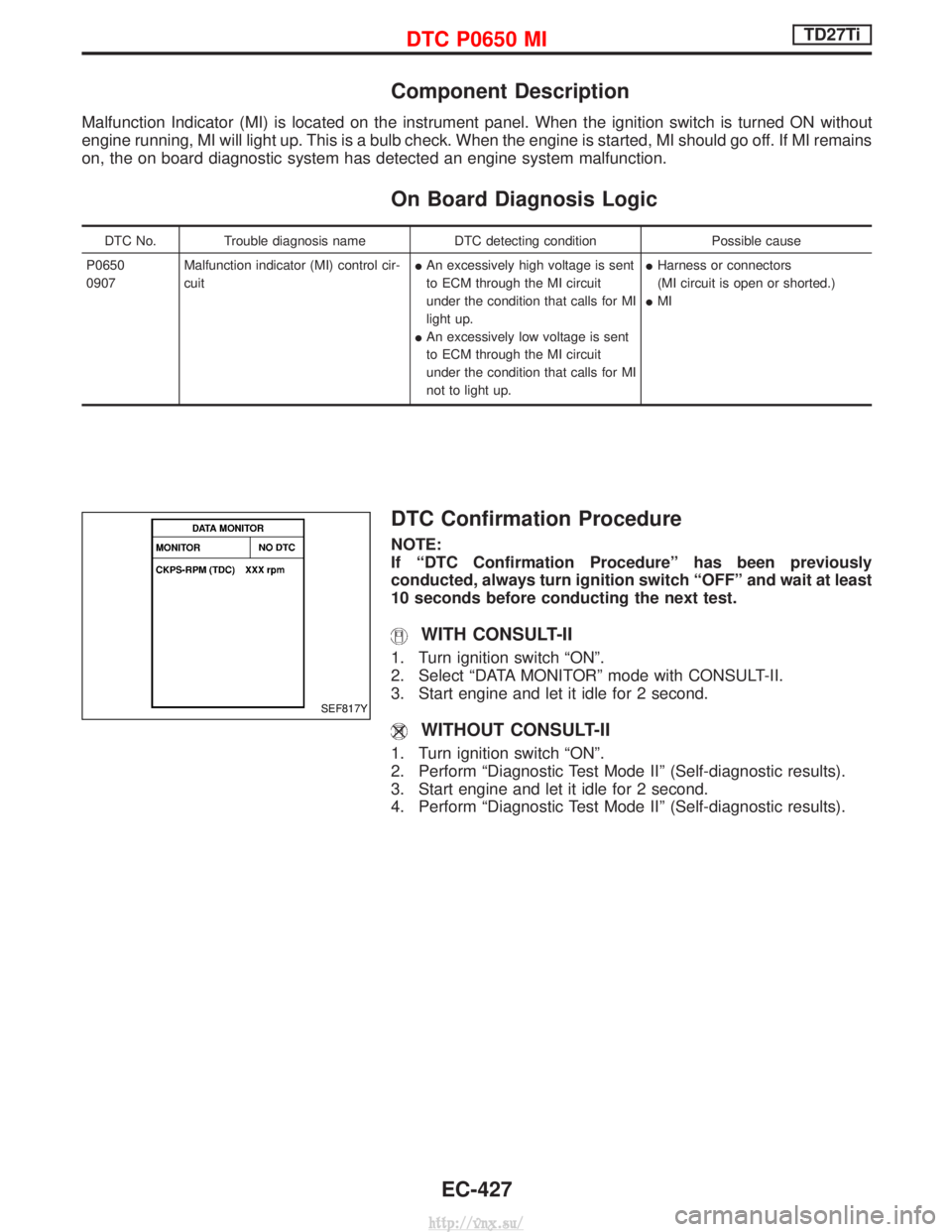
WITH CONSULT-II
1. Turn ignition switch ªONº.
2. Select ªDATA MONITORº mode with CONSULT-II.
3. Start engine and let it idle for 2 second.
WITHOUT CONSULT-II
1. Turn ignition switch ªONº.
2. Perform ªDiagnostic Test Mode IIº (Self-diagnostic results).
3. Start engine and let it idle for 2 second.
4. Perform ªDiagnostic Test Mode IIº (Self-diagnostic results).
SEF817Y
DTC P0650 MITD27Ti
EC-427
http://vnx.su/