ESP NISSAN TERRANO 2004 Service Workshop Manual
[x] Cancel search | Manufacturer: NISSAN, Model Year: 2004, Model line: TERRANO, Model: NISSAN TERRANO 2004Pages: 1833, PDF Size: 53.42 MB
Page 1324 of 1833
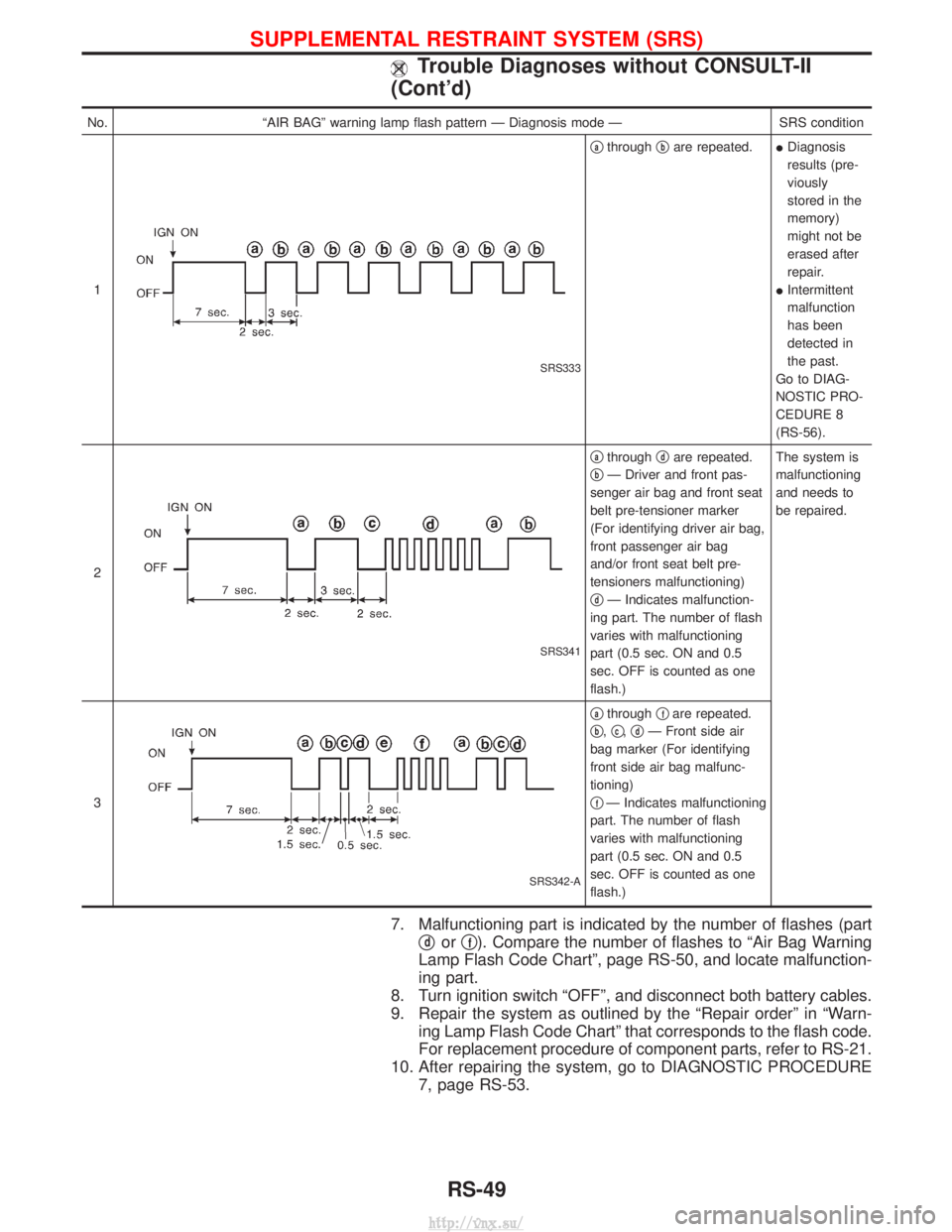
No.ªAIR BAGº warning lamp flash pattern Ð Diagnosis mode Ð SRS condition
1
SRS333
qathrough qbare repeated.
IDiagnosis
results (pre-
viously
stored in the
memory)
might not be
erased after
repair.
I Intermittent
malfunction
has been
detected in
the past.
Go to DIAG-
NOSTIC PRO-
CEDURE 8
(RS-56).
2
SRS341
qathrough qdare repeated.
q
bÐ Driver and front pas-
senger air bag and front seat
belt pre-tensioner marker
(For identifying driver air bag,
front passenger air bag
and/or front seat belt pre-
tensioners malfunctioning)
q
dÐ Indicates malfunction-
ing part. The number of flash
varies with malfunctioning
part (0.5 sec. ON and 0.5
sec. OFF is counted as one
flash.) The system is
malfunctioning
and needs to
be repaired.
3
SRS342-A
qathrough qfare repeated.
q
b, qc,qdÐ Front side air
bag marker (For identifying
front side air bag malfunc-
tioning)
q
fÐ Indicates malfunctioning
part. The number of flash
varies with malfunctioning
part (0.5 sec. ON and 0.5
sec. OFF is counted as one
flash.)
7. Malfunctioning part is indicated by the number of flashes (part q
dorqf). Compare the number of flashes to ªAir Bag Warning
Lamp Flash Code Chartº, page RS-50, and locate malfunction-
ing part.
8. Turn ignition switch ªOFFº, and disconnect both battery cables.
9. Repair the system as outlined by the ªRepair orderº in ªWarn- ing Lamp Flash Code Chartº that corresponds to the flash code.
For replacement procedure of component parts, refer to RS-21.
10. After repairing the system, go to DIAGNOSTIC PROCEDURE 7, page RS-53.
SUPPLEMENTAL RESTRAINT SYSTEM (SRS)
Trouble Diagnoses without CONSULT-II
(Cont'd)
RS-49
http://vnx.su/
Page 1340 of 1833
Description
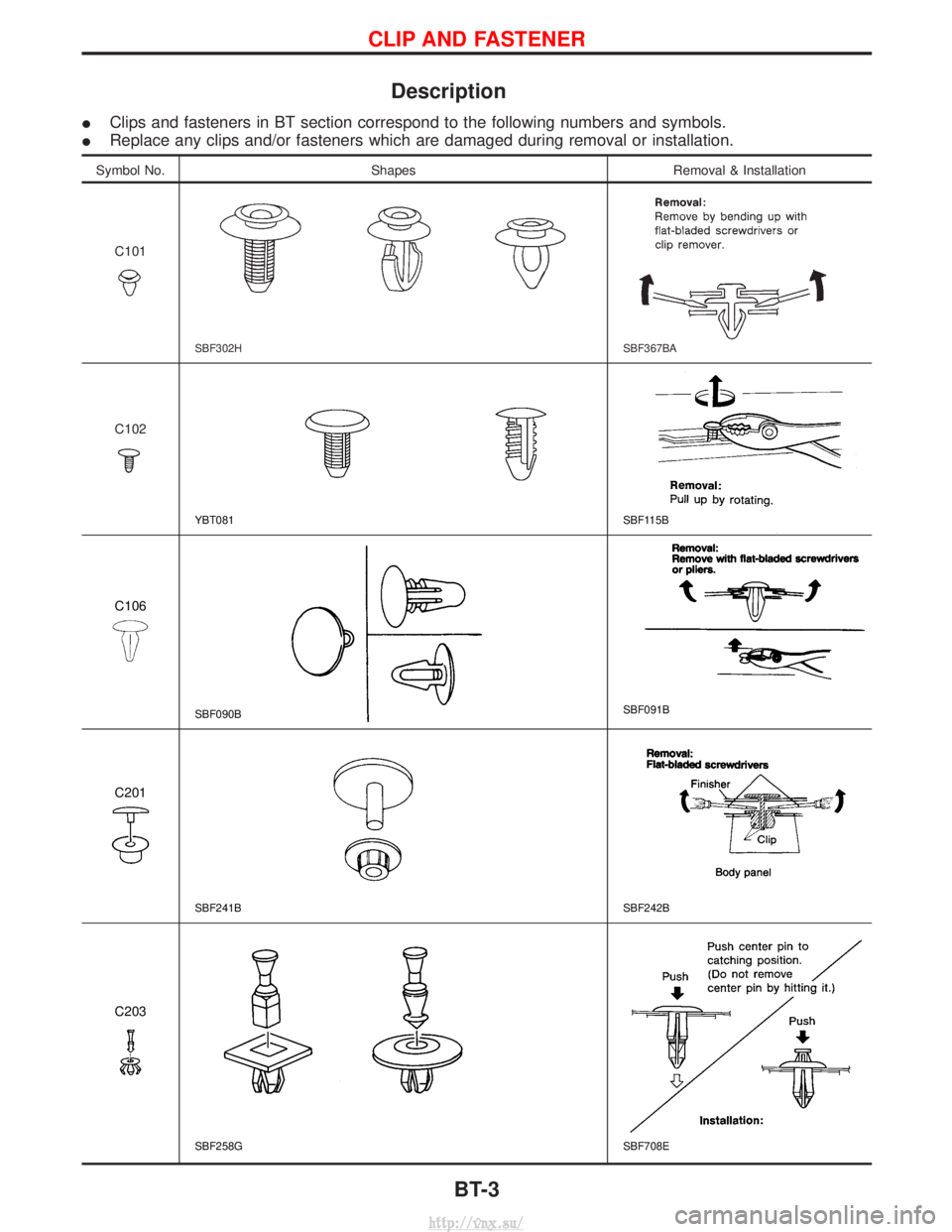
IClips and fasteners in BT section correspond to the following numbers and symbols.
I Replace any clips and/or fasteners which are damaged during removal or installation.
Symbol No. Shapes Removal & Installation
C101
SBF302HSBF367BA
C102
YBT081SBF115B
C106
SBF090BSBF091B
C201
SBF241BSBF242B
C203
SBF258GSBF708E
CLIP AND FASTENER
BT-3
http://vnx.su/
Page 1430 of 1833
TROUBLE DIAGNOSES FOR ABNORMAL PRESSURE
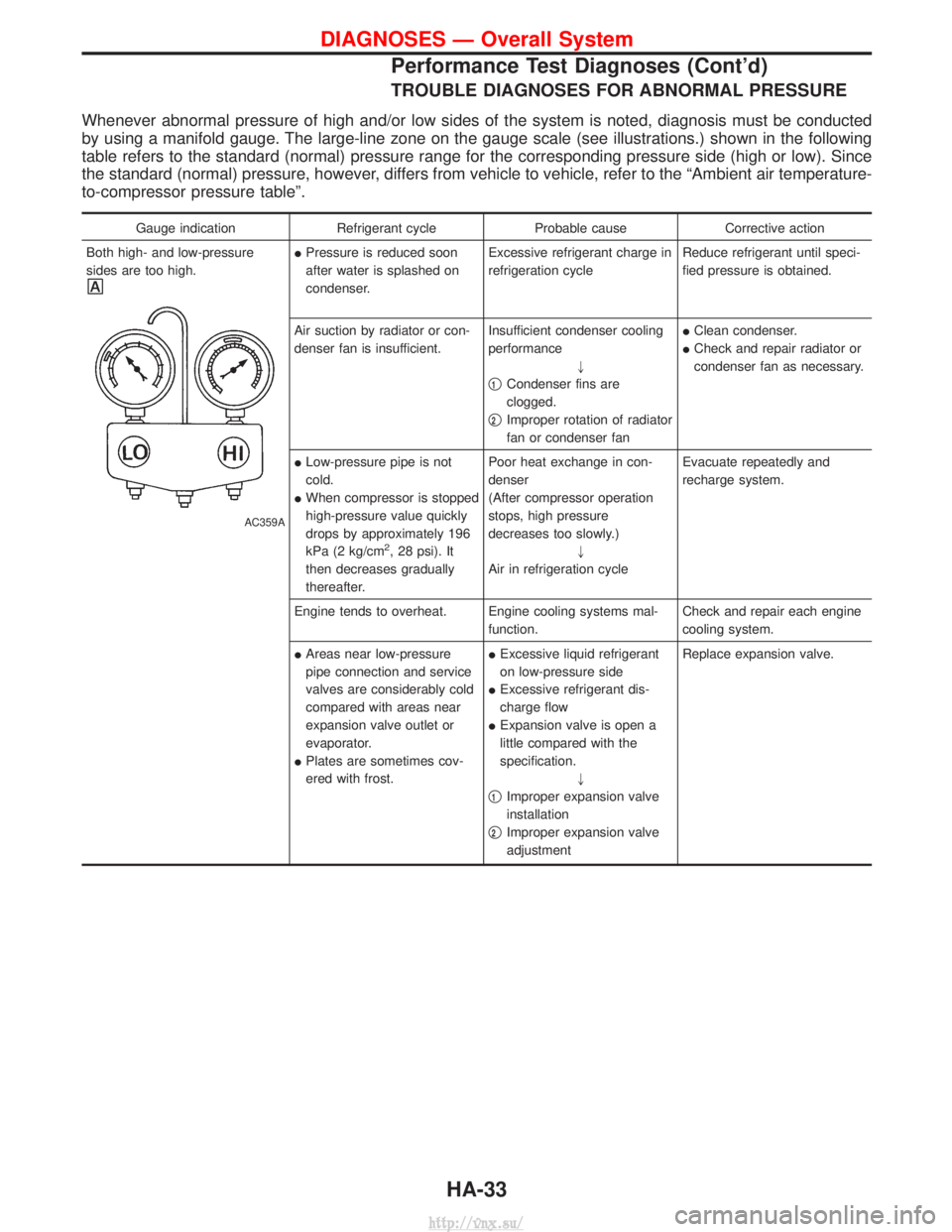
Whenever abnormal pressure of high and/or low sides of the system is noted, diagnosis must be conducted
by using a manifold gauge. The large-line zone on the gauge scale (see illustrations.) shown in the following
table refers to the standard (normal) pressure range for the corresponding pressure side (high or low). Since
the standard (normal) pressure, however, differs from vehicle to vehicle, refer to the ªAmbient air temperature-
to-compressor pressure tableº.
Gauge indicationRefrigerant cycleProbable causeCorrective action
Both high- and low-pressure
sides are too high.
AC359A
I Pressure is reduced soon
after water is splashed on
condenser. Excessive refrigerant charge in
refrigeration cycle
Reduce refrigerant until speci-
fied pressure is obtained.
Air suction by radiator or con-
denser fan is insufficient. Insufficient condenser cooling
performance
"
q
1Condenser fins are
clogged.
q
2Improper rotation of radiator
fan or condenser fan I
Clean condenser.
I Check and repair radiator or
condenser fan as necessary.
I Low-pressure pipe is not
cold.
I When compressor is stopped
high-pressure value quickly
drops by approximately 196
kPa (2 kg/cm
2, 28 psi). It
then decreases gradually
thereafter. Poor heat exchange in con-
denser
(After compressor operation
stops, high pressure
decreases too slowly.)
"
Air in refrigeration cycle Evacuate repeatedly and
recharge system.
Engine tends to overheat. Engine cooling systems mal- function.Check and repair each engine
cooling system.
I Areas near low-pressure
pipe connection and service
valves are considerably cold
compared with areas near
expansion valve outlet or
evaporator.
I Plates are sometimes cov-
ered with frost. I
Excessive liquid refrigerant
on low-pressure side
I Excessive refrigerant dis-
charge flow
I Expansion valve is open a
little compared with the
specification.
"
q
1Improper expansion valve
installation
q
2Improper expansion valve
adjustment Replace expansion valve.
DIAGNOSES Ð Overall System
Performance Test Diagnoses (Cont'd)
HA-33
http://vnx.su/
Page 1459 of 1833
DUAL-PRESSURE SWITCH
High-pressure side line pressurekPa (bar, kg/cm2, psi) Opera-
tion Conti-
nuity
Decreasing to 157 - 216 (1.6 - 2.2, 1.6 - 2.2, 23 - 31)
Increasing to 2,452 - 2,844 (24.5 - 28.4, 25 - 29, 356 - 412) Turn
OFF Does
not
exist
Increasing to 157 - 235 (1.6 - 2.4, 1.6 - 2.4, 23 - 34)
Decreasing to 1,863 - 2,256 (18.6 - 22.6, 19 - 23, 270 - 327) Turn
ON Exists
THERMO CONTROL AMP.
Evaporator outlet air temperature
ÉC (ÉF) Thermo amp.
operation Tester
Decreasing to 0.1 - 0.9 (32 - 34) Turn OFF Approx. 12V
Increasing to 2.5 - 3.5 (37 - 38) Turn ON Approx. 0V
A/C RELAY, COOLING FAN RELAY
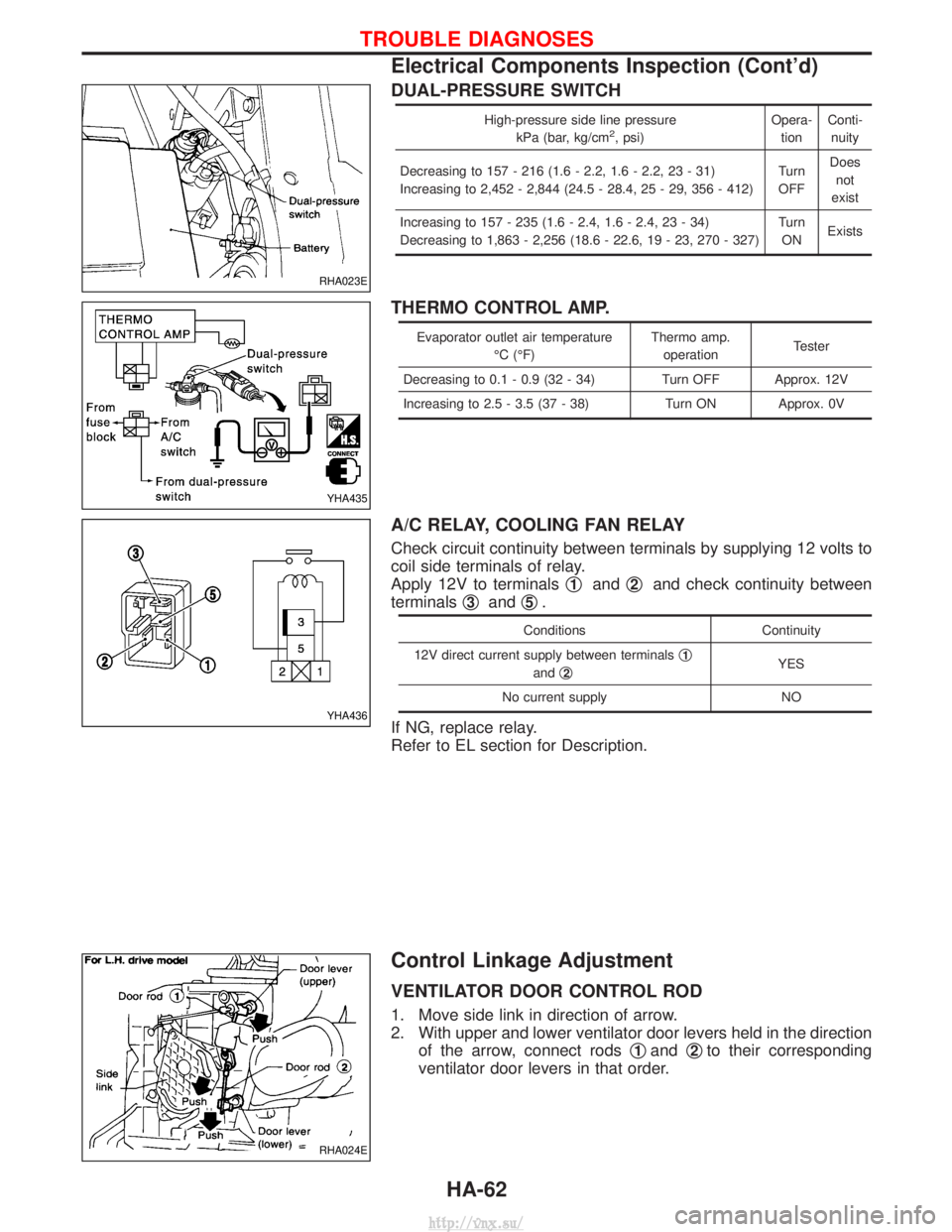
Check circuit continuity between terminals by supplying 12 volts to
coil side terminals of relay.
Apply 12V to terminals q
1andq2and check continuity between
terminals q
3andq5.
Conditions
Continuity
12V direct current supply between terminals q
1
andq2YES
No current supply NO
If NG, replace relay.
Refer to EL section for Description.
Control Linkage Adjustment
VENTILATOR DOOR CONTROL ROD
1. Move side link in direction of arrow.
2. With upper and lower ventilator door levers held in the direction of the arrow, connect rods q
1andq2to their corresponding
ventilator door levers in that order.
RHA023E
YHA435
YHA436
RHA024E
TROUBLE DIAGNOSES
Electrical Components Inspection (Cont'd)
HA-62
http://vnx.su/
Page 1512 of 1833
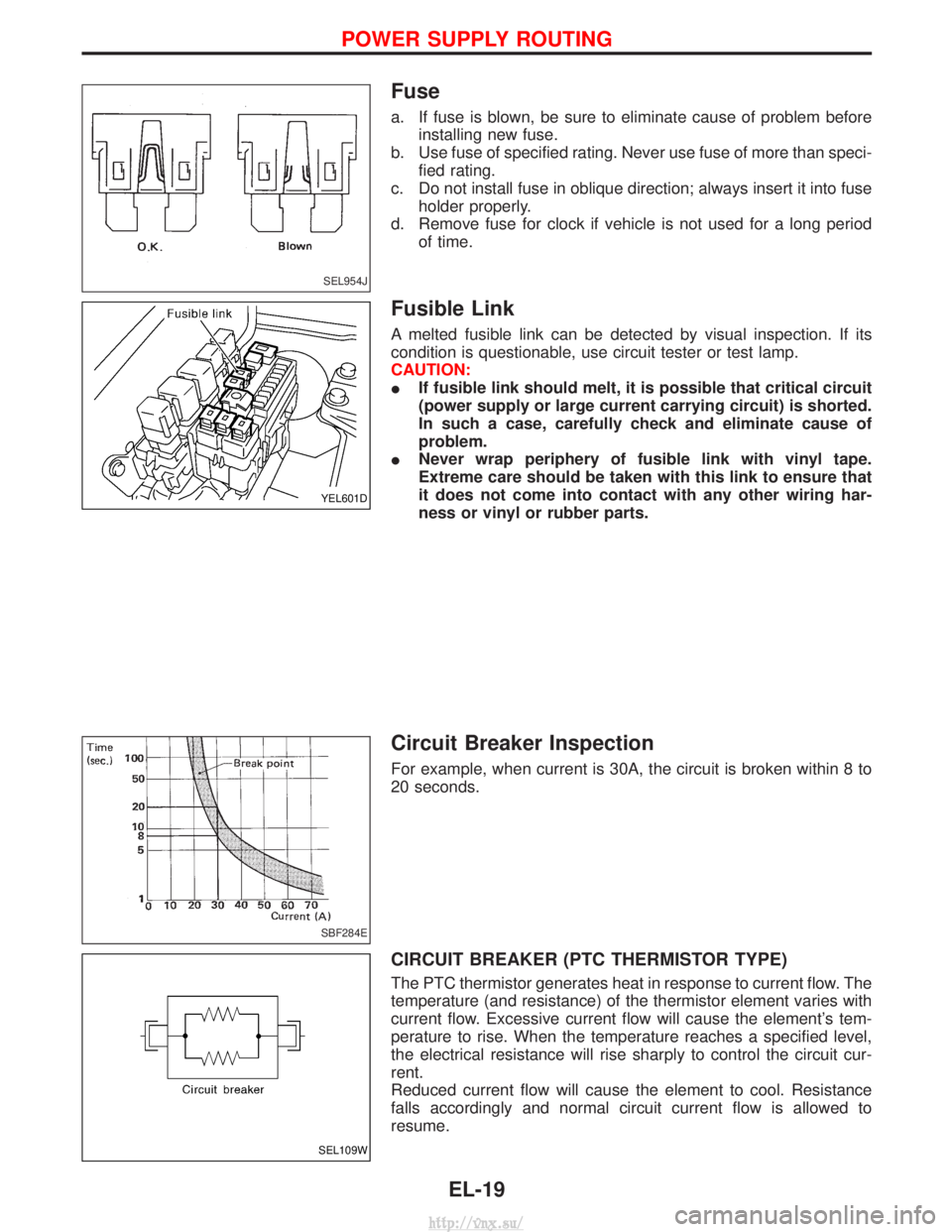
Fuse
a. If fuse is blown, be sure to eliminate cause of problem beforeinstalling new fuse.
b. Use fuse of specified rating. Never use fuse of more than speci- fied rating.
c. Do not install fuse in oblique direction; always insert it into fuse holder properly.
d. Remove fuse for clock if vehicle is not used for a long period of time.
Fusible Link
A melted fusible link can be detected by visual inspection. If its
condition is questionable, use circuit tester or test lamp.
CAUTION:
IIf fusible link should melt, it is possible that critical circuit
(power supply or large current carrying circuit) is shorted.
In such a case, carefully check and eliminate cause of
problem.
I Never wrap periphery of fusible link with vinyl tape.
Extreme care should be taken with this link to ensure that
it does not come into contact with any other wiring har-
ness or vinyl or rubber parts.
Circuit Breaker Inspection
For example, when current is 30A, the circuit is broken within 8 to
20 seconds.
CIRCUIT BREAKER (PTC THERMISTOR TYPE)
The PTC thermistor generates heat in response to current flow. The
temperature (and resistance) of the thermistor element varies with
current flow. Excessive current flow will cause the element's tem-
perature to rise. When the temperature reaches a specified level,
the electrical resistance will rise sharply to control the circuit cur-
rent.
Reduced current flow will cause the element to cool. Resistance
falls accordingly and normal circuit current flow is allowed to
resume.
SEL954J
YEL601D
SBF284E
SEL109W
POWER SUPPLY ROUTING
EL-19
http://vnx.su/
Page 1540 of 1833
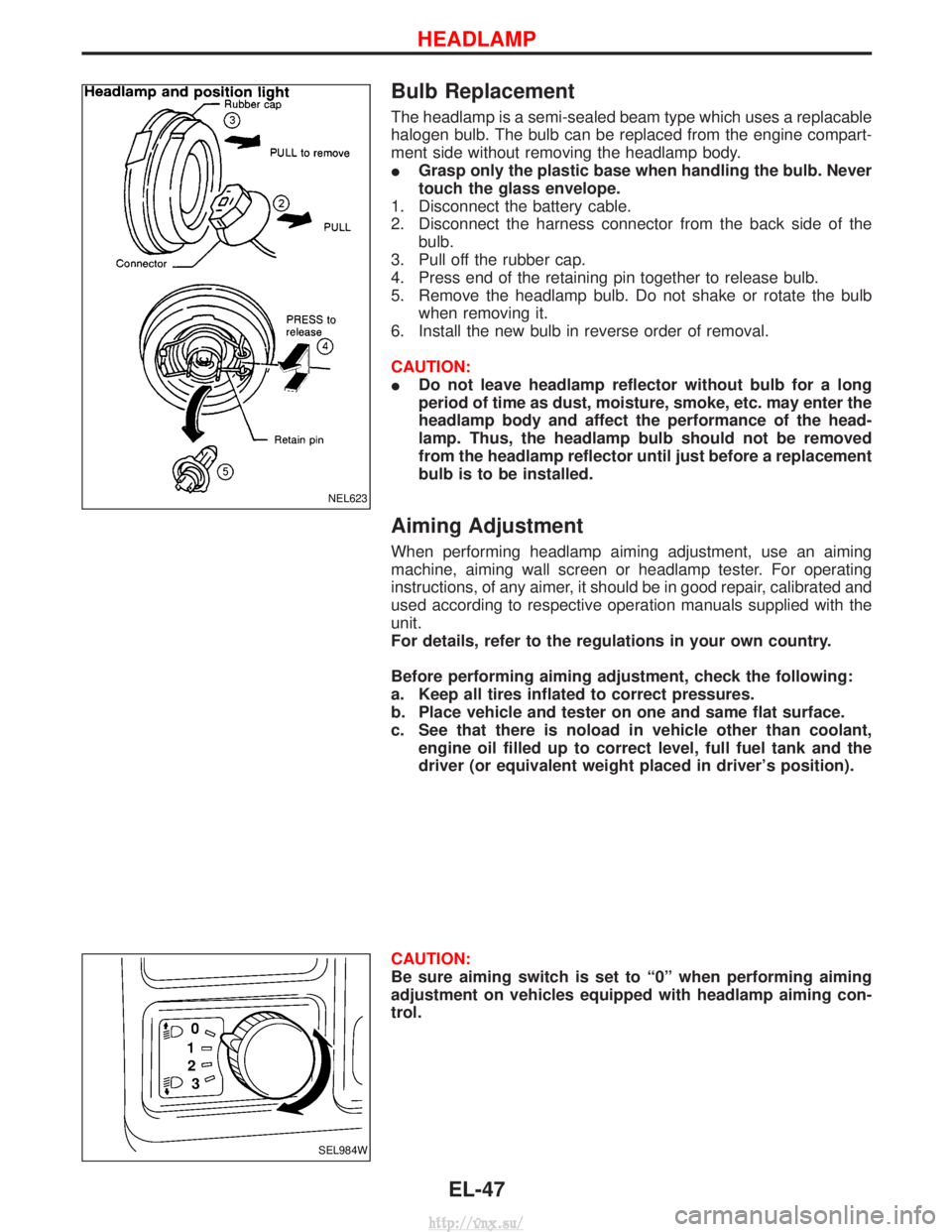
Bulb Replacement
The headlamp is a semi-sealed beam type which uses a replacable
halogen bulb. The bulb can be replaced from the engine compart-
ment side without removing the headlamp body.
IGrasp only the plastic base when handling the bulb. Never
touch the glass envelope.
1. Disconnect the battery cable.
2. Disconnect the harness connector from the back side of the bulb.
3. Pull off the rubber cap.
4. Press end of the retaining pin together to release bulb.
5. Remove the headlamp bulb. Do not shake or rotate the bulb when removing it.
6. Install the new bulb in reverse order of removal.
CAUTION:
I Do not leave headlamp reflector without bulb for a long
period of time as dust, moisture, smoke, etc. may enter the
headlamp body and affect the performance of the head-
lamp. Thus, the headlamp bulb should not be removed
from the headlamp reflector until just before a replacement
bulb is to be installed.
Aiming Adjustment
When performing headlamp aiming adjustment, use an aiming
machine, aiming wall screen or headlamp tester. For operating
instructions, of any aimer, it should be in good repair, calibrated and
used according to respective operation manuals supplied with the
unit.
For details, refer to the regulations in your own country.
Before performing aiming adjustment, check the following:
a. Keep all tires inflated to correct pressures.
b. Place vehicle and tester on one and same flat surface.
c. See that there is noload in vehicle other than coolant,
engine oil filled up to correct level, full fuel tank and the
driver (or equivalent weight placed in driver's position).
CAUTION:
Be sure aiming switch is set to ª0º when performing aiming
adjustment on vehicles equipped with headlamp aiming con-
trol.
NEL623
SEL984W
HEADLAMP
EL-47
http://vnx.su/
Page 1649 of 1833
![NISSAN TERRANO 2004 Service Workshop Manual System Description
Power is supplied at all times
Ifrom 40A fusible link (letter F, located in fuse and fusible link box)
I through circuit breaker [built-in fuse block (J/B)]
I to power window relay](/img/5/57394/w960_57394-1648.png "NISSAN TERRANO 2004 Service Workshop Manual System Description
Power is supplied at all times
Ifrom 40A fusible link (letter F, located in fuse and fusible link box)
I through circuit breaker [built-in fuse block (J/B)]
I to power window relay")
System Description
Power is supplied at all times
Ifrom 40A fusible link (letter F, located in fuse and fusible link box)
I through circuit breaker [built-in fuse block (J/B)]
I to power window relay [built-in fuse block (J/B)].
With ignition switch in ON or START position, power is supplied
I to power window relay
Ground is supplied to power window relay
I through body grounds F36, F47 (LHD models) or M33, M754 (RHD models).
The power window relay is energized and power is supplied
I through power window relay
I to power window main switch terminal 1,
I to power window sub-switch front passenger side terminal 5,
I to power window sub-switch rear LH and RH terminal 5 (models with rear power window).
MANUAL OPERATION
Front Door (Driver Side)
Ground is supplied
Ito power window main switch terminal 3
I through body grounds B10 and B18.
WINDOW UP
When the driver's window switch in the power window main switch is pressed in the up position, power is
supplied
I through power window main switch terminal 9
I to driver side power window motor terminal 2.
Ground is supplied
I through power window main switch terminal 1
I to driver side power window motor terminal 8.
Then, the motor raises the window until the switch is released.
WINDOW DOWN
When the driver's window switch in the power window main switch is pressed in the down position, power is
supplied
I through power window main switch terminal 8
I to driver side power window motor terminal 1.
Ground is supplied
I to driver side power window motor terminal 2
I through power window main switch terminal 9.
Then, the motor lowers the window until the switch is released.
Front Door (Passenger Side)
Ground is supplied
I to power window main switch terminal 3
I through body grounds B10 and B18.
NOTE:
Numbers in parentheses are terminal numbers, when power window switch is pressed in the UP and DOWN
positions respectively.
POWER WINDOW MAIN SWITCH OPERATION
Power is supplied
I through power window main switch (5, 6)
I to power window sub-switch front passenger side (3, 4).
The subsequent operation is the same as the front power window sub-switch operation.
FRONT POWER WINDOW SUB-SWITCH OPERATION
Power is supplied
I through front power window sub-switch (1, 2)
I to power window motor front passenger side (2, 1).
Ground is supplied
I to front passenger side power window motor (1, 2)
I through front power window sub-switch (2, 1)
I to front power window sub-switch (4, 3)
POWER WINDOW
EL-156
http://vnx.su/
Page 1665 of 1833
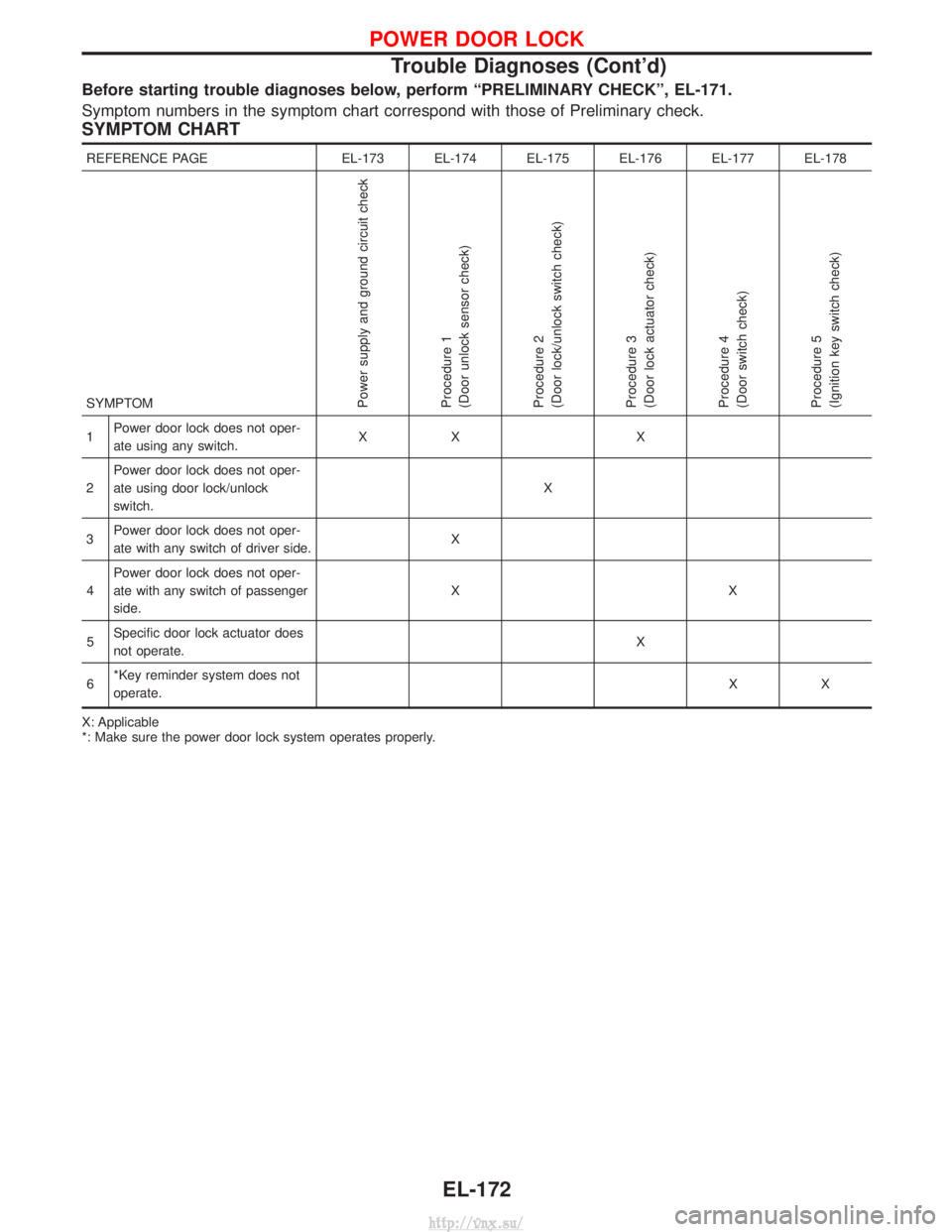
Before starting trouble diagnoses below, perform ªPRELIMINARY CHECKº, EL-171.
Symptom numbers in the symptom chart correspond with those of Preliminary check.
SYMPTOM CHART
REFERENCE PAGEEL-173 EL-174 EL-175 EL-176 EL-177 EL-178
SYMPTOM
Power supply and ground circuit check
Procedure 1
(Door unlock sensor check)
Procedure 2
(Door lock/unlock switch check)
Procedure 3
(Door lock actuator check)
Procedure 4
(Door switch check)
Procedure 5
(Ignition key switch check)
1 Power door lock does not oper-
ate using any switch. XX X
2 Power door lock does not oper-
ate using door lock/unlock
switch. X
3 Power door lock does not oper-
ate with any switch of driver side. X
4 Power door lock does not oper-
ate with any switch of passenger
side. XX
5 Specific door lock actuator does
not operate. X
6 *Key reminder system does not
operate. XX
X: Applicable
*: Make sure the power door lock system operates properly.
POWER DOOR LOCK
Trouble Diagnoses (Cont'd)
EL-172
http://vnx.su/
Page 1686 of 1833
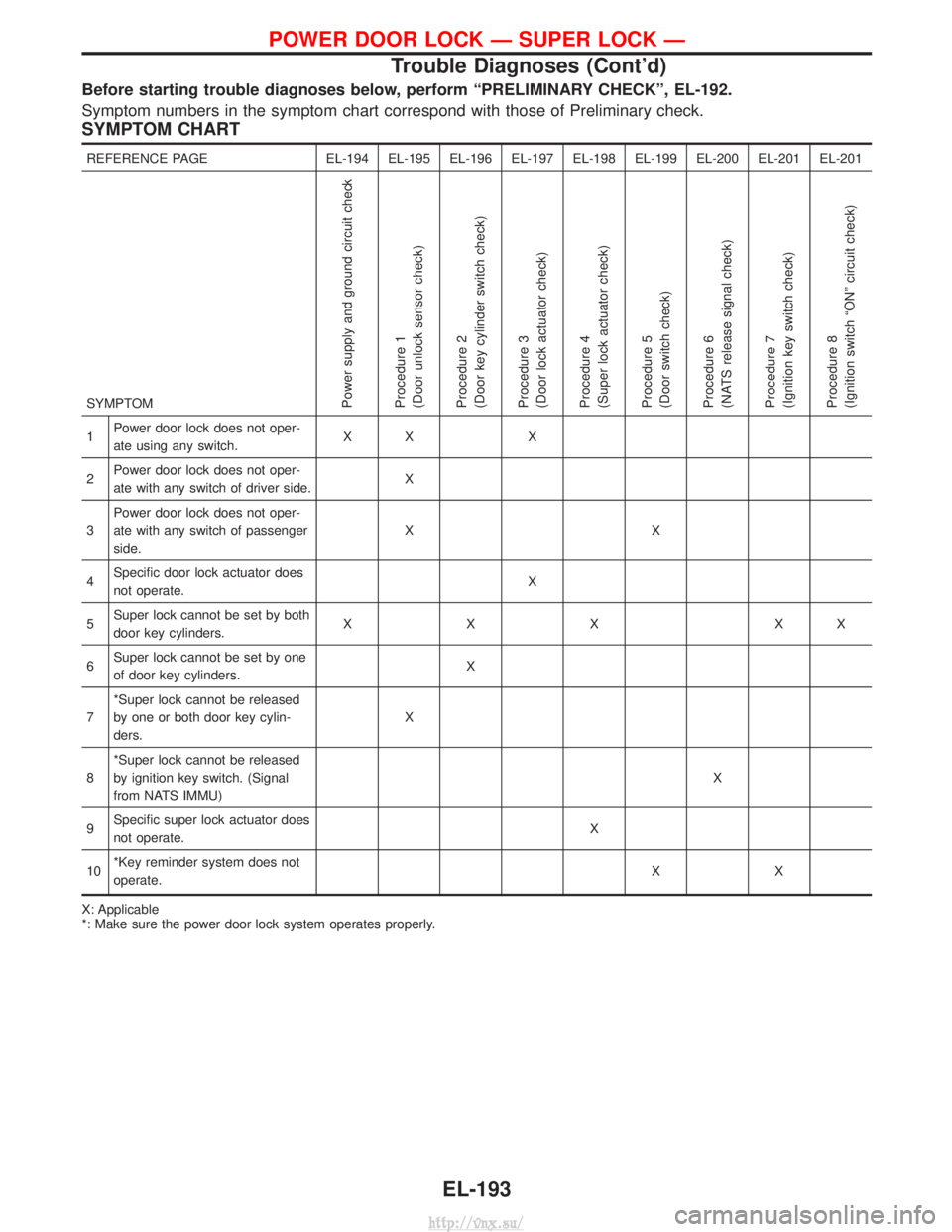
Before starting trouble diagnoses below, perform ªPRELIMINARY CHECKº, EL-192.
Symptom numbers in the symptom chart correspond with those of Preliminary check.
SYMPTOM CHART
REFERENCE PAGEEL-194 EL-195 EL-196 EL-197 EL-198 EL-199 EL-200 EL-201 EL-201
SYMPTOM
Power supply and ground circuit check
Procedure 1
(Door unlock sensor check)
Procedure 2
(Door key cylinder switch check)
Procedure 3
(Door lock actuator check)
Procedure 4
(Super lock actuator check)
Procedure 5
(Door switch check)
Procedure 6
(NATS release signal check)
Procedure 7
(Ignition key switch check)
Procedure 8
(Ignition switch ªONº circuit check)
1 Power door lock does not oper-
ate using any switch. XX X
2 Power door lock does not oper-
ate with any switch of driver side. X
3 Power door lock does not oper-
ate with any switch of passenger
side. XX
4 Specific door lock actuator does
not operate. X
5 Super lock cannot be set by both
door key cylinders. XXX XX
6 Super lock cannot be set by one
of door key cylinders. X
7 *Super lock cannot be released
by one or both door key cylin-
ders. X
8 *Super lock cannot be released
by ignition key switch. (Signal
from NATS IMMU) X
9 Specific super lock actuator does
not operate. X
10 *Key reminder system does not
operate. XX
X: Applicable
*: Make sure the power door lock system operates properly.
POWER DOOR LOCK Ð SUPER LOCK Ð
Trouble Diagnoses (Cont'd)
EL-193
http://vnx.su/
Page 1759 of 1833
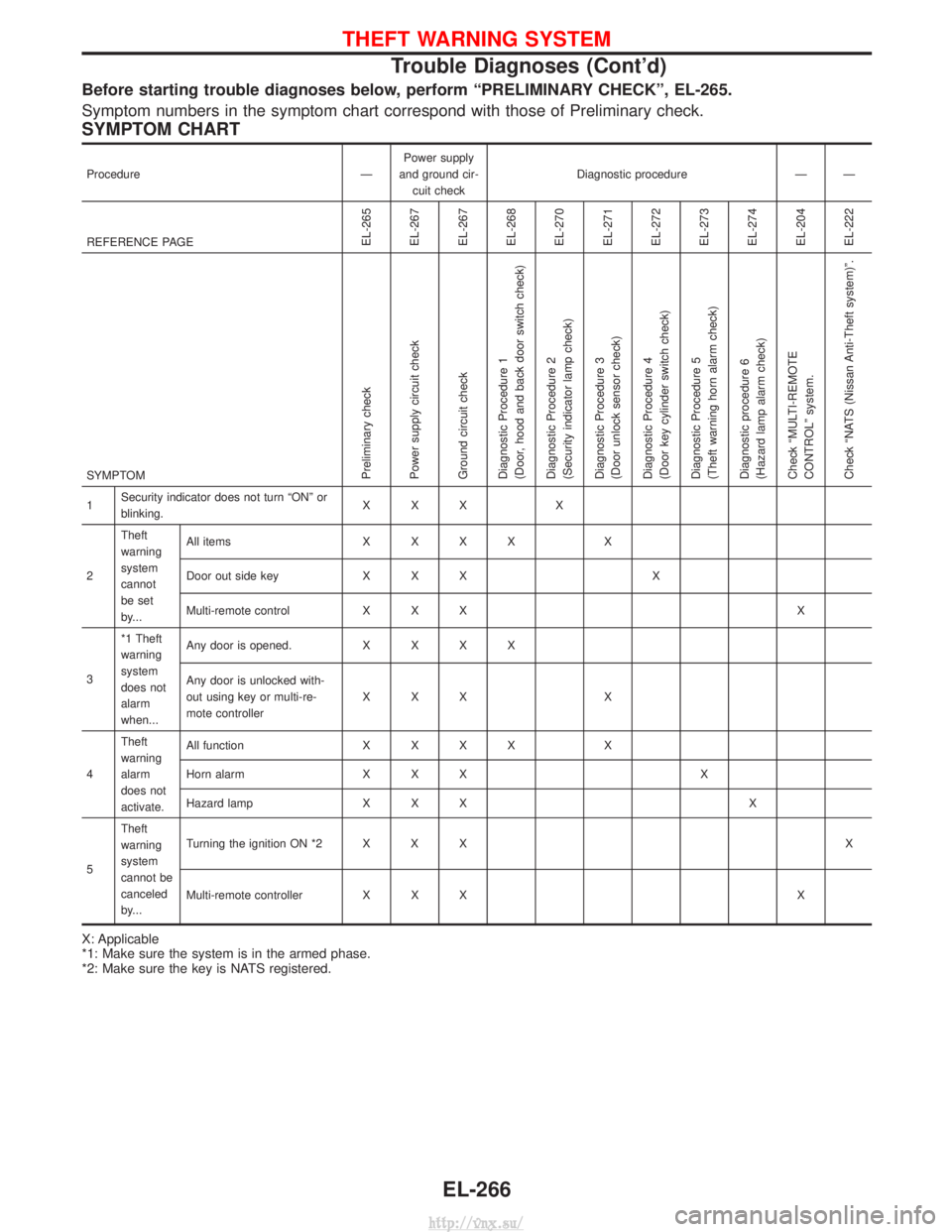
Before starting trouble diagnoses below, perform ªPRELIMINARY CHECKº, EL-265.
Symptom numbers in the symptom chart correspond with those of Preliminary check.
SYMPTOM CHART
ProcedureÐPower supply
and ground cir- cuit check Diagnostic procedure Ð Ð
REFERENCE PAGE
EL-265
EL-267
EL-267
EL-268
EL-270
EL-271
EL-272
EL-273
EL-274
EL-204
EL-222
SYMPTOMPreliminary check
Power supply circuit check
Ground circuit check
Diagnostic Procedure 1
(Door, hood and back door switch check)
Diagnostic Procedure 2
(Security indicator lamp check)
Diagnostic Procedure 3
(Door unlock sensor check)
Diagnostic Procedure 4
(Door key cylinder switch check)
Diagnostic Procedure 5
(Theft warning horn alarm check)
Diagnostic procedure 6
(Hazard lamp alarm check)
Check ªMULTI-REMOTE
CONTROLº system.
Check ªNATS (Nissan Anti-Theft system)º.
1 Security indicator does not turn ªONº or
blinking. XXX X
2 Theft
warning
system
cannot
be set
by... All items
XXXX X
Door out side key X X X X
Multi-remote control X X X X
3 *1 Theft
warning
system
does not
alarm
when... Any door is opened.
XXXX
Any door is unlocked with-
out using key or multi-re-
mote controller XXX
X
4 Theft
warning
alarm
does not
activate. All function
XXXX X
Horn alarm X X X X
Hazard lamp X X X X
5 Theft
warning
system
cannot be
canceled
by... Turning the ignition ON *2 X X X
X
Multi-remote controller X X X X
X: Applicable
*1: Make sure the system is in the armed phase.
*2: Make sure the key is NATS registered.
THEFT WARNING SYSTEM
Trouble Diagnoses (Cont'd)
EL-266
http://vnx.su/