ESP NISSAN TERRANO 2004 Service Service Manual
[x] Cancel search | Manufacturer: NISSAN, Model Year: 2004, Model line: TERRANO, Model: NISSAN TERRANO 2004Pages: 1833, PDF Size: 53.42 MB
Page 1067 of 1833
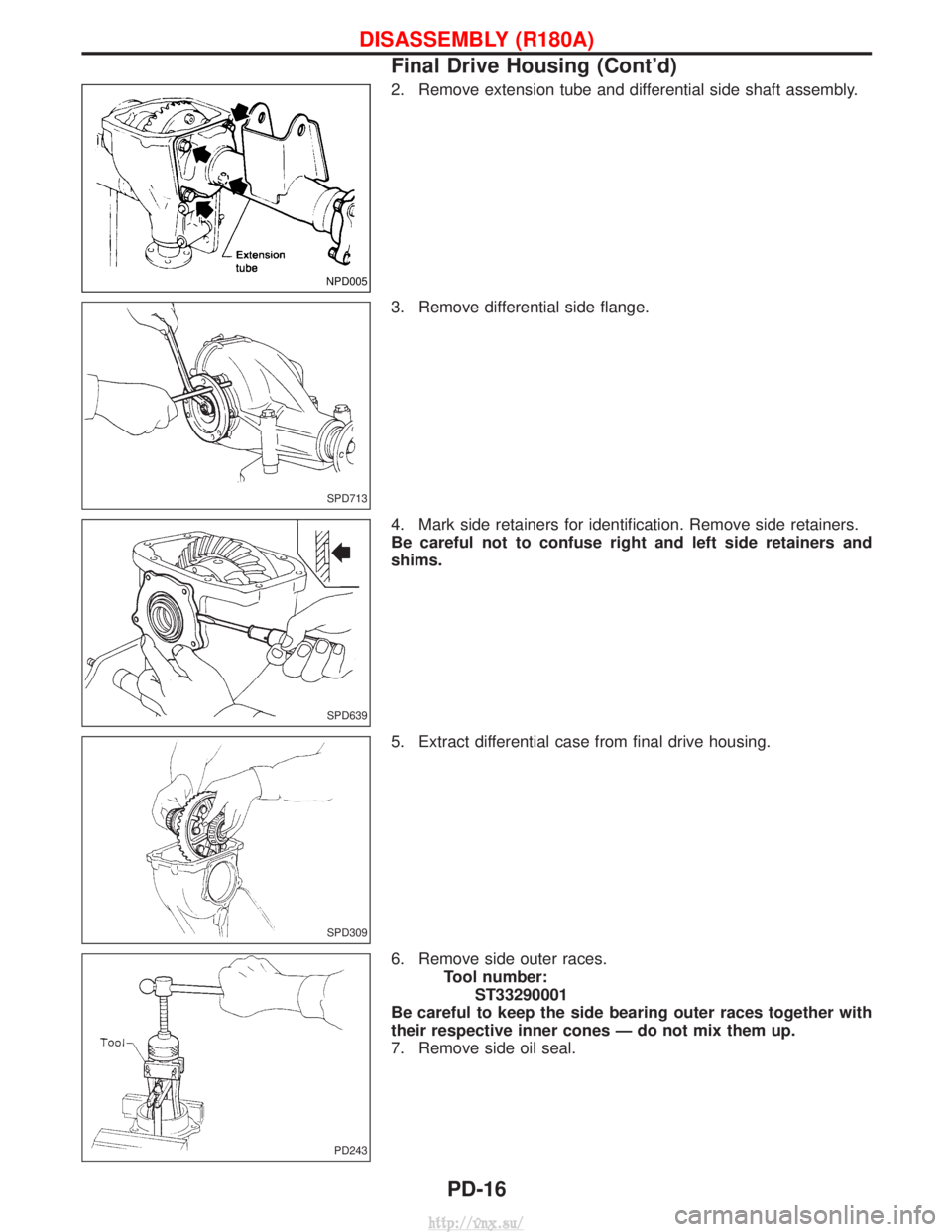
2. Remove extension tube and differential side shaft assembly.
3. Remove differential side flange.
4. Mark side retainers for identification. Remove side retainers.
Be careful not to confuse right and left side retainers and
shims.
5. Extract differential case from final drive housing.
6. Remove side outer races.Tool number:ST33290001
Be careful to keep the side bearing outer races together with
their respective inner cones Ð do not mix them up.
7. Remove side oil seal.
NPD005
SPD713
SPD639
SPD309
PD243
DISASSEMBLY (R180A)
Final Drive Housing (Cont'd)
PD-16
http://vnx.su/
Page 1090 of 1833
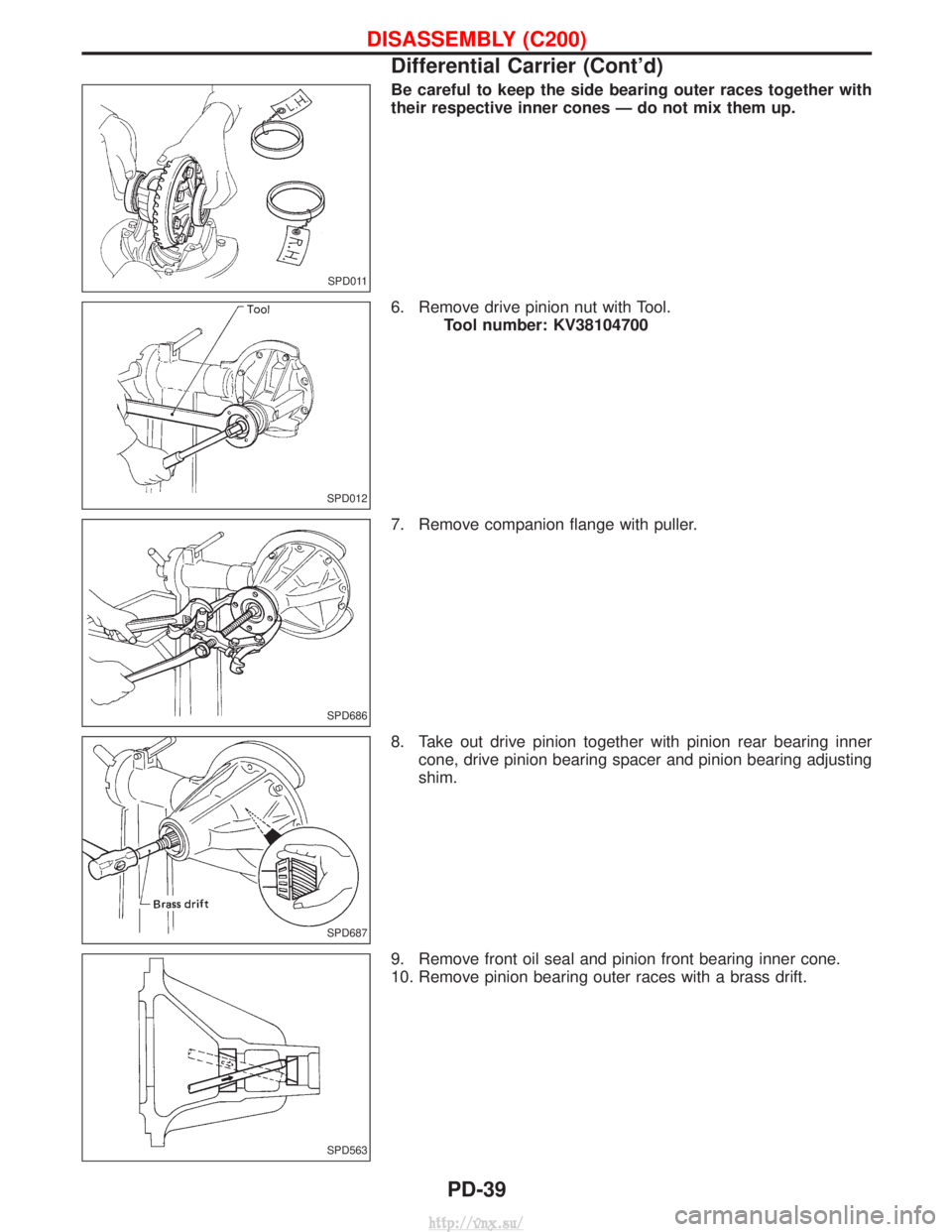
Be careful to keep the side bearing outer races together with
their respective inner cones Ð do not mix them up.
6. Remove drive pinion nut with Tool.Tool number: KV38104700
7. Remove companion flange with puller.
8. Take out drive pinion together with pinion rear bearing inner cone, drive pinion bearing spacer and pinion bearing adjusting
shim.
9. Remove front oil seal and pinion front bearing inner cone.
10. Remove pinion bearing outer races with a brass drift.
SPD011
SPD012
SPD686
SPD687
SPD563
DISASSEMBLY (C200)
Differential Carrier (Cont'd)
PD-39
http://vnx.su/
Page 1160 of 1833
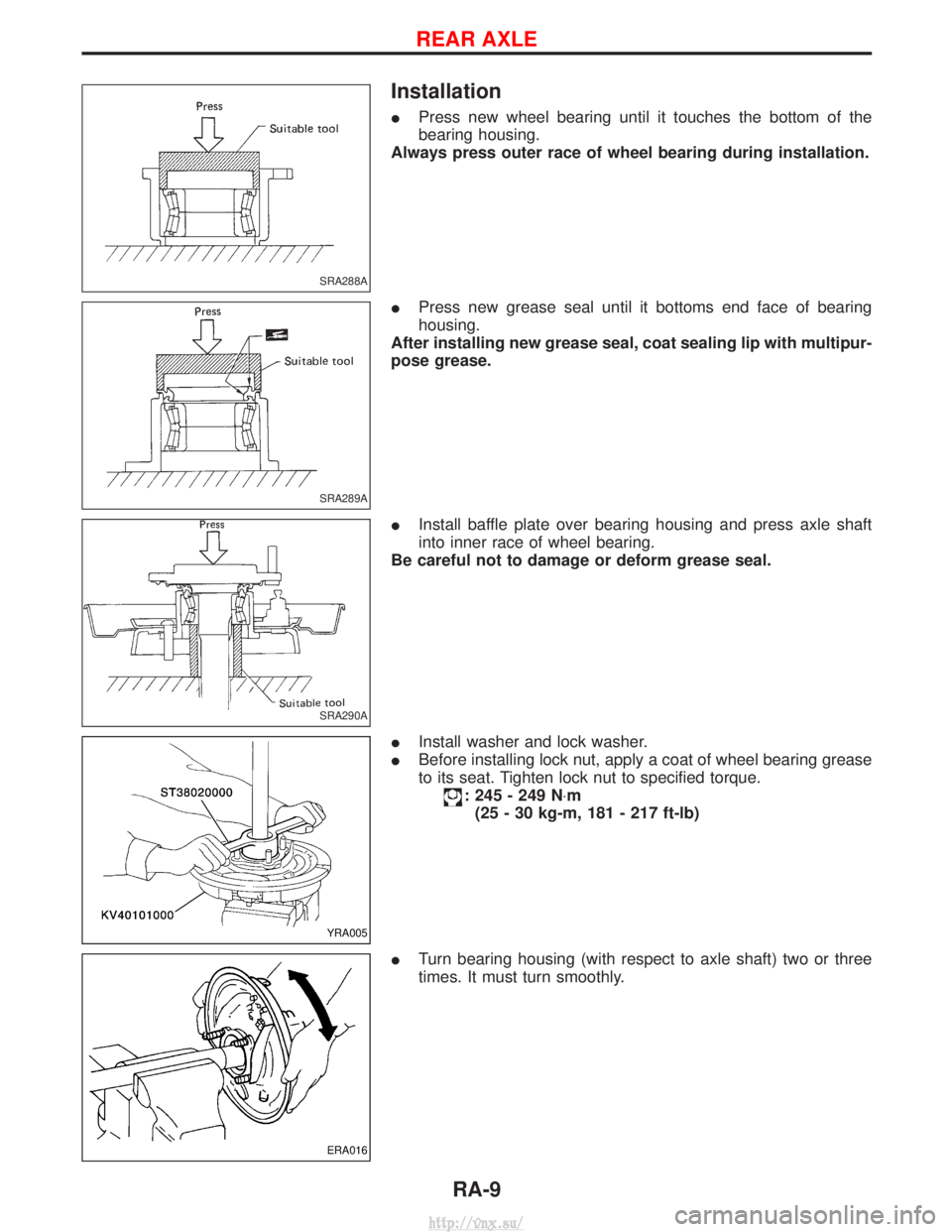
Installation
IPress new wheel bearing until it touches the bottom of the
bearing housing.
Always press outer race of wheel bearing during installation.
I Press new grease seal until it bottoms end face of bearing
housing.
After installing new grease seal, coat sealing lip with multipur-
pose grease.
I Install baffle plate over bearing housing and press axle shaft
into inner race of wheel bearing.
Be careful not to damage or deform grease seal.
I Install washer and lock washer.
I Before installing lock nut, apply a coat of wheel bearing grease
to its seat. Tighten lock nut to specified torque.
: 245 - 249 N ×m
(25 - 30 kg-m, 181 - 217 ft-lb)
I Turn bearing housing (with respect to axle shaft) two or three
times. It must turn smoothly.
SRA288A
SRA289A
SRA290A
YRA005
ERA016
REAR AXLE
RA-9
http://vnx.su/
Page 1213 of 1833
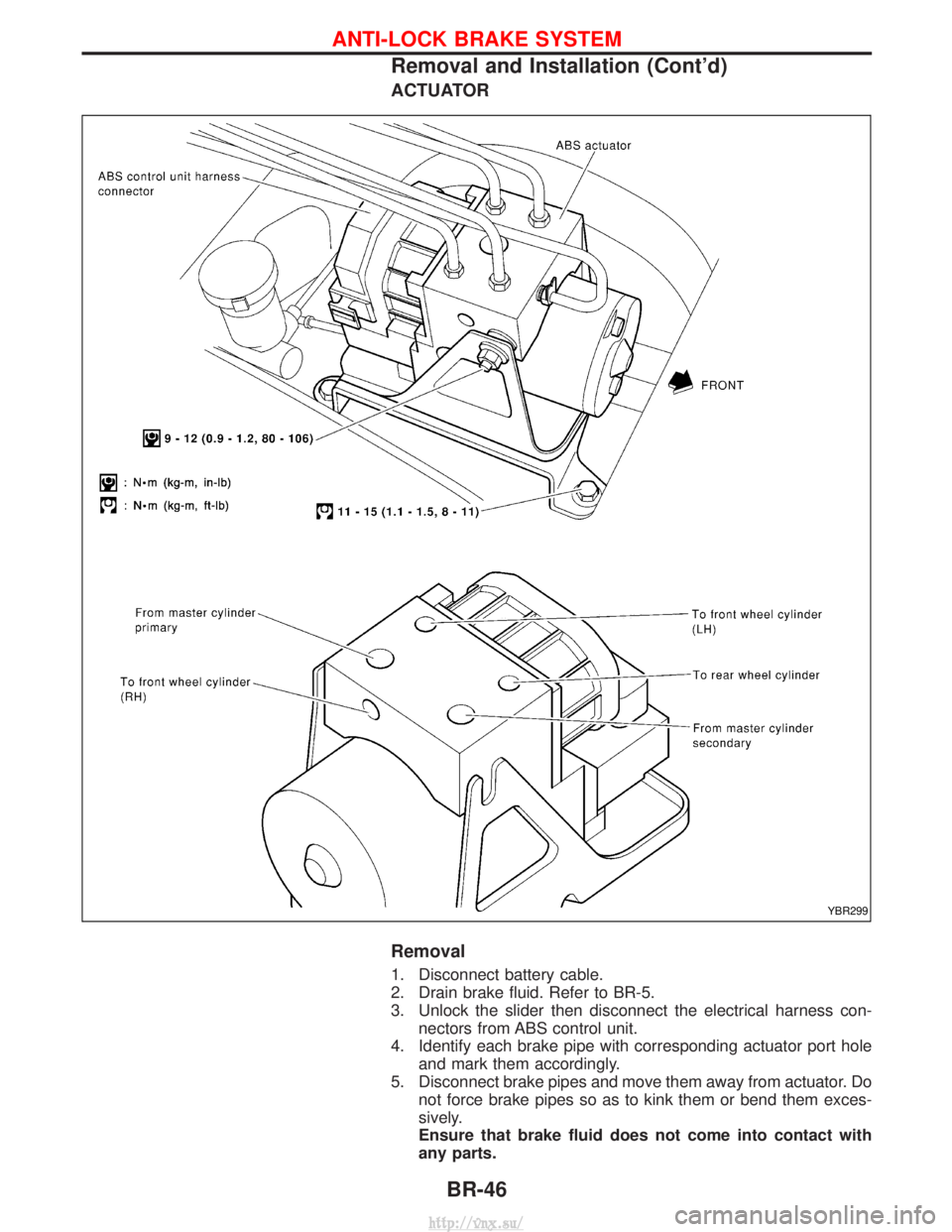
ACTUATOR
Removal
1. Disconnect battery cable.
2. Drain brake fluid. Refer to BR-5.
3. Unlock the slider then disconnect the electrical harness con-nectors from ABS control unit.
4. Identify each brake pipe with corresponding actuator port hole and mark them accordingly.
5. Disconnect brake pipes and move them away from actuator. Do not force brake pipes so as to kink them or bend them exces-
sively.
Ensure that brake fluid does not come into contact with
any parts.
YBR299
ANTI-LOCK BRAKE SYSTEM
Removal and Installation (Cont'd)
BR-46
http://vnx.su/
Page 1214 of 1833
6. Loosen/remove mounting nuts between actuator and bracket.
Installation
CAUTION:
After installation, pay attention to the following points:
IRefill brake fluid and bleed air. Refer to ªCHECK AND
ADJUSTMENTº, BR-5 and ªBleeding Brake Systemº,
ªBRAKE HYDRAULIC LINEº, BR-8, respectively.
1. Install actuator on bracket without tightening fixings.
2. Assemble brake tubes to actuator without tightening tube nuts. Ensure that correct tubes are connected to each port.
3. Fully tighten actuator and bracket fixings to specified torque.
4. Fully tighten flare nuts to specified torque, BR-9.
5. Secure ABS control unit harness connector and battery cable.
ANTI-LOCK BRAKE SYSTEM
Removal and Installation (Cont'd)
BR-47
http://vnx.su/
Page 1215 of 1833
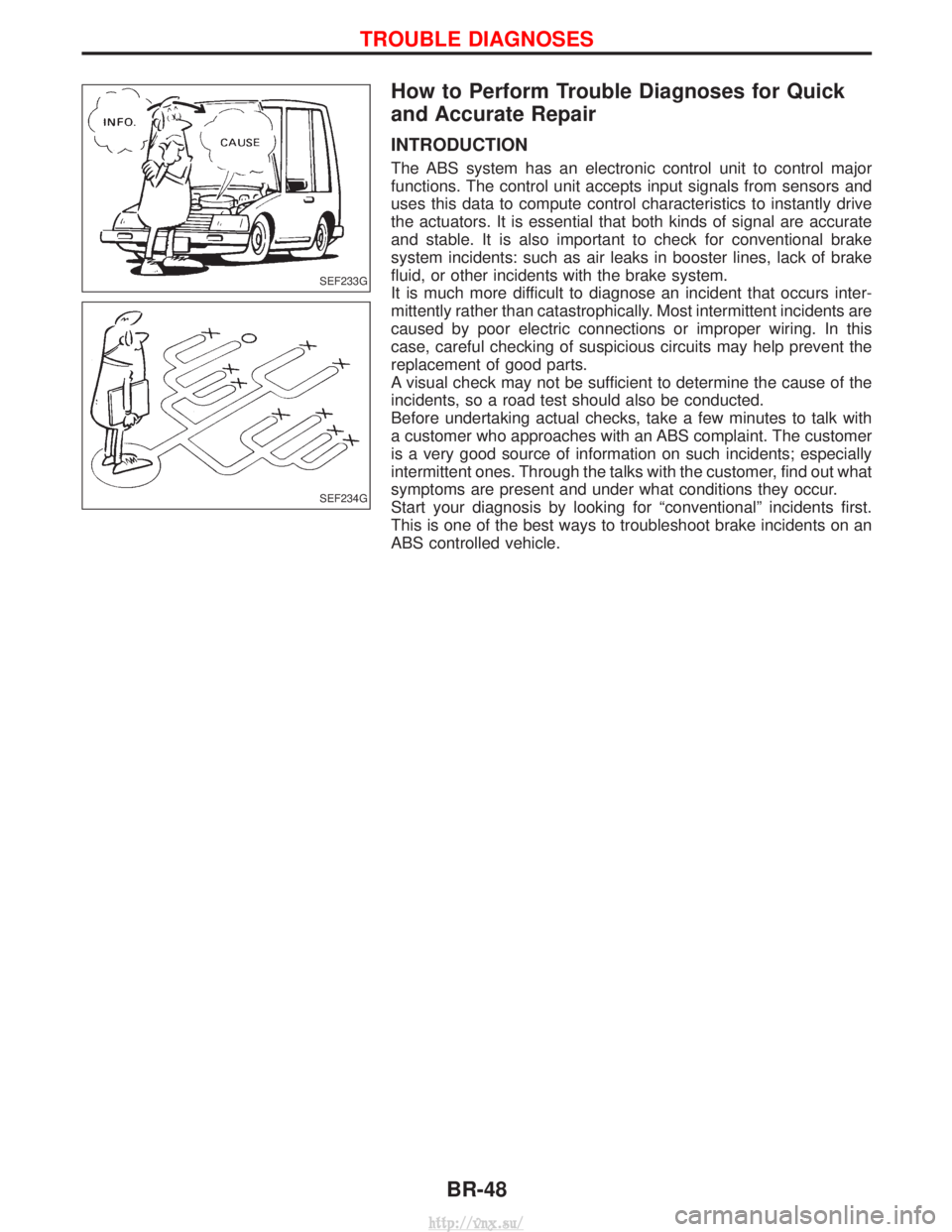
How to Perform Trouble Diagnoses for Quick
and Accurate Repair
INTRODUCTION
The ABS system has an electronic control unit to control major
functions. The control unit accepts input signals from sensors and
uses this data to compute control characteristics to instantly drive
the actuators. It is essential that both kinds of signal are accurate
and stable. It is also important to check for conventional brake
system incidents: such as air leaks in booster lines, lack of brake
fluid, or other incidents with the brake system.
It is much more difficult to diagnose an incident that occurs inter-
mittently rather than catastrophically. Most intermittent incidents are
caused by poor electric connections or improper wiring. In this
case, careful checking of suspicious circuits may help prevent the
replacement of good parts.
A visual check may not be sufficient to determine the cause of the
incidents, so a road test should also be conducted.
Before undertaking actual checks, take a few minutes to talk with
a customer who approaches with an ABS complaint. The customer
is a very good source of information on such incidents; especially
intermittent ones. Through the talks with the customer, find out what
symptoms are present and under what conditions they occur.
Start your diagnosis by looking for ªconventionalº incidents first.
This is one of the best ways to troubleshoot brake incidents on an
ABS controlled vehicle.
SEF233G
SEF234G
TROUBLE DIAGNOSES
BR-48
http://vnx.su/
Page 1272 of 1833
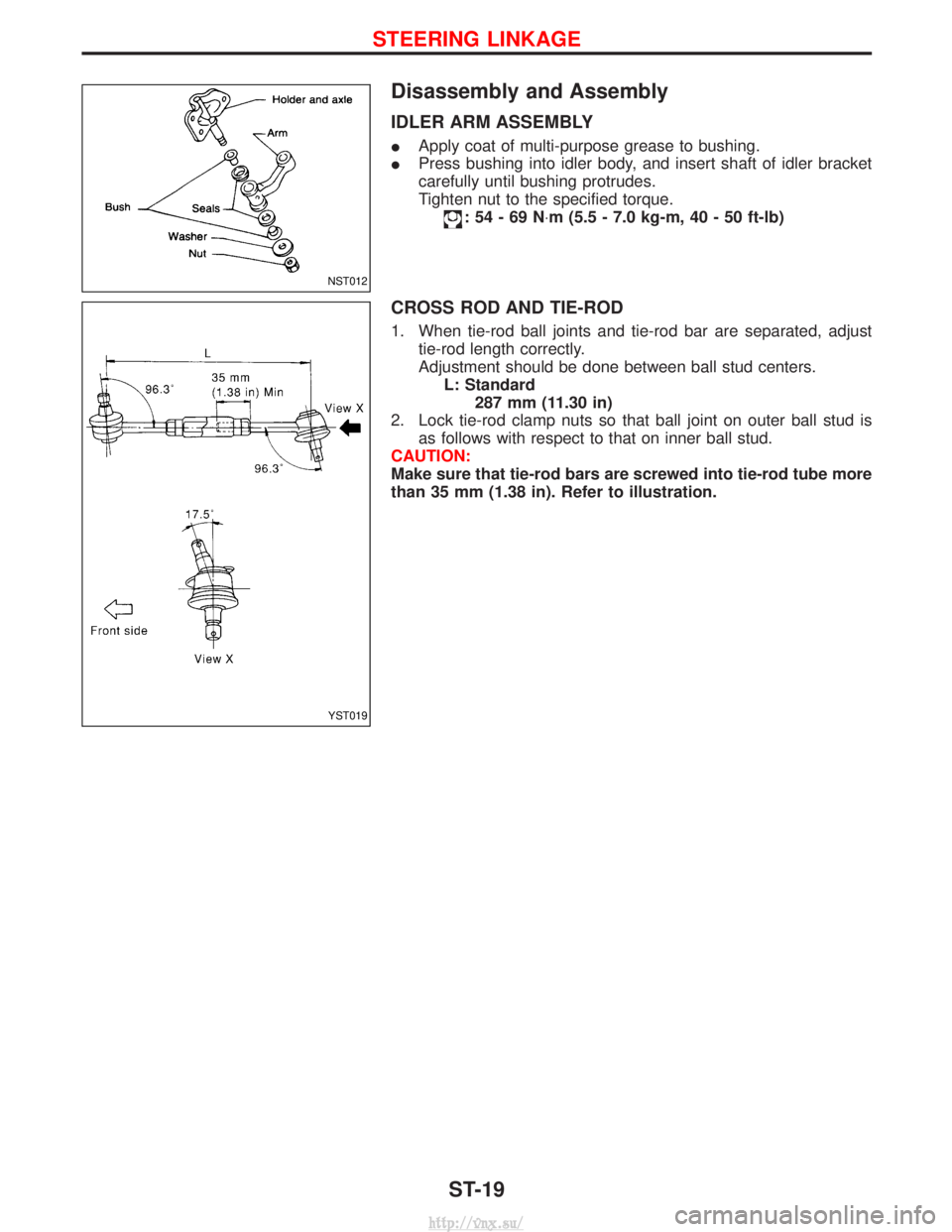
Disassembly and Assembly
IDLER ARM ASSEMBLY
IApply coat of multi-purpose grease to bushing.
I Press bushing into idler body, and insert shaft of idler bracket
carefully until bushing protrudes.
Tighten nut to the specified torque.
:54-69N ×m (5.5 - 7.0 kg-m, 40 - 50 ft-lb)
CROSS ROD AND TIE-ROD
1. When tie-rod ball joints and tie-rod bar are separated, adjust
tie-rod length correctly.
Adjustment should be done between ball stud centers.L: Standard 287 mm (11.30 in)
2. Lock tie-rod clamp nuts so that ball joint on outer ball stud is as follows with respect to that on inner ball stud.
CAUTION:
Make sure that tie-rod bars are screwed into tie-rod tube more
than 35 mm (1.38 in). Refer to illustration.
NST012
YST019
STEERING LINKAGE
ST-19
http://vnx.su/
Page 1302 of 1833
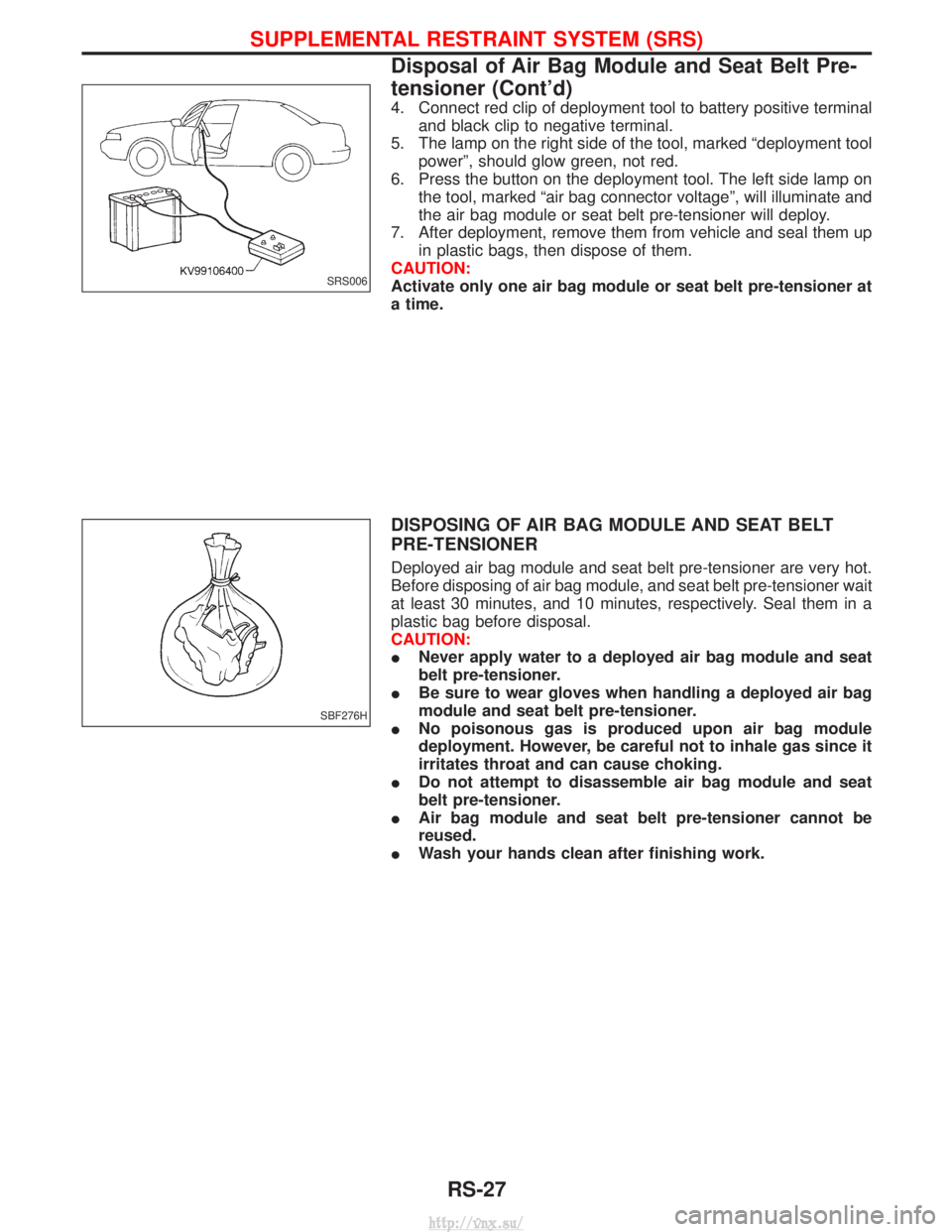
4. Connect red clip of deployment tool to battery positive terminaland black clip to negative terminal.
5. The lamp on the right side of the tool, marked ªdeployment tool powerº, should glow green, not red.
6. Press the button on the deployment tool. The left side lamp on the tool, marked ªair bag connector voltageº, will illuminate and
the air bag module or seat belt pre-tensioner will deploy.
7. After deployment, remove them from vehicle and seal them up in plastic bags, then dispose of them.
CAUTION:
Activate only one air bag module or seat belt pre-tensioner at
a time.
DISPOSING OF AIR BAG MODULE AND SEAT BELT
PRE-TENSIONER
Deployed air bag module and seat belt pre-tensioner are very hot.
Before disposing of air bag module, and seat belt pre-tensioner wait
at least 30 minutes, and 10 minutes, respectively. Seal them in a
plastic bag before disposal.
CAUTION:
I Never apply water to a deployed air bag module and seat
belt pre-tensioner.
I Be sure to wear gloves when handling a deployed air bag
module and seat belt pre-tensioner.
I No poisonous gas is produced upon air bag module
deployment. However, be careful not to inhale gas since it
irritates throat and can cause choking.
I Do not attempt to disassemble air bag module and seat
belt pre-tensioner.
I Air bag module and seat belt pre-tensioner cannot be
reused.
I Wash your hands clean after finishing work.
SRS006
SBF276H
SUPPLEMENTAL RESTRAINT SYSTEM (SRS)
Disposal of Air Bag Module and Seat Belt Pre-
tensioner (Cont'd)
RS-27
http://vnx.su/
Page 1315 of 1833
![NISSAN TERRANO 2004 Service Service Manual If no malfunction is detected on ªSELF-DIAG [CURRENT]º but mal-
function is indicated by the ªAIR BAGº warning lamp, go to DIAG-
NOSTIC PROCEDURE 4, page RS-44, to diagnose the following
situation](/img/5/57394/w960_57394-1314.png "NISSAN TERRANO 2004 Service Service Manual If no malfunction is detected on ªSELF-DIAG [CURRENT]º but mal-
function is indicated by the ªAIR BAGº warning lamp, go to DIAG-
NOSTIC PROCEDURE 4, page RS-44, to diagnose the following
situation")
If no malfunction is detected on ªSELF-DIAG [CURRENT]º but mal-
function is indicated by the ªAIR BAGº warning lamp, go to DIAG-
NOSTIC PROCEDURE 4, page RS-44, to diagnose the following
situations:
ISelf-diagnostic result ªSELF-DIAG [PAST]º (previously stored
in the memory) might not be erased after repair.
I The SRS system malfunctions intermittently.
8. Touch ªPRINTº.
9. Compare diagnostic codes to ªCONSULT-II Diagnostic Code Chartº, page RS-40.
10. Touch ªBACKº key of CONSULT-II until ªSELECT SYSTEMº appears in order to return to User mode from Diagnosis mode.
11. Turn ignition switch ªOFFº, then turn off and disconnect CONSULT-II, and disconnect both battery cables.
12. Repair the system as outlined by the ªRepair orderº in ªCON- SULT-II Diagnostic Code Chartº, that corresponds to the self-
diagnostic result. For replacement procedure of component
parts, refer to RS-13.
13. After repairing the system, go to DIAGNOSTIC PROCEDURE 3, page RS-42 for final checking.
CONSULT-II DIAGNOSTIC CODE CHART (ªSELF-DIAG
[CURRENT]º)
Diagnostic item Explanation Repair order
ªRecheck SRS at each replacement.º
NO DTC IS
DETECTED. When malfunction is
indicated by the ªAIR
BAGº warning lamp is
user mode.I
Self-diagnostic result ªSELF-DIAG
[PAST]º (previously stored in the
memory) might not be erased after
repair.
I Intermittent malfunction has been
detected in the past. I
Go to DIAGNOSTIC PROCEDURE 4
(RS-42) after charging battery.
I No malfunction is detected. IGo to DIAGNOSTIC PROCEDURE 3
(RS-42).
AIRBAG MODULE
[OPEN] I
Driver air bag module circuit is open. (including the spiral
cable) 1. Visually check the wiring harness
connection.
2. Replace the harness if it has visible damage.
3. Replace the spiral cable.
4. Replace driver air bag module. (Before disposal, it must be
deployed.)
5. Replace the diagnosis sensor unit.
6. Replace the related harness.
AIRBAG MODULE
[VB-SHORT]
I
Driver air bag module circuit is shorted to a power supply cir-
cuit. (including the spiral cable)
AIRBAG MODULE
[GND-SHORT] I
Driver air bag module circuit is shorted to ground. (including
the spiral cable)
AIRBAG MODULE
[SHORT] I
Driver air bag module circuit is shorted between wires.
SRS701
SUPPLEMENTAL RESTRAINT SYSTEM (SRS)
Trouble Diagnoses with CONSULT-II (Cont'd)
RS-40
http://vnx.su/
Page 1321 of 1833
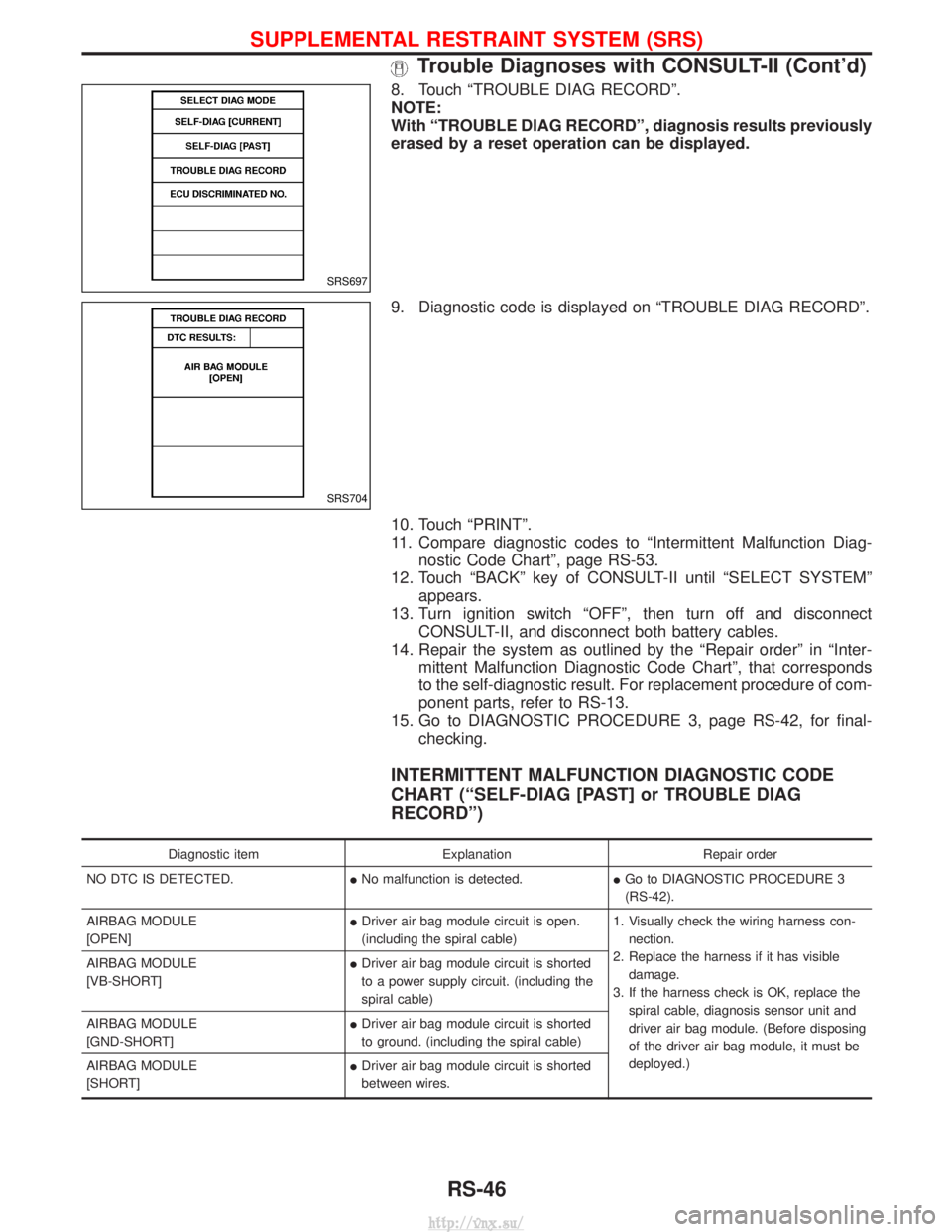
8. Touch ªTROUBLE DIAG RECORDº.
NOTE:
With ªTROUBLE DIAG RECORDº, diagnosis results previously
erased by a reset operation can be displayed.
9. Diagnostic code is displayed on ªTROUBLE DIAG RECORDº.
10. Touch ªPRINTº.
11. Compare diagnostic codes to ªIntermittent Malfunction Diag-nostic Code Chartº, page RS-53.
12. Touch ªBACKº key of CONSULT-II until ªSELECT SYSTEMº appears.
13. Turn ignition switch ªOFFº, then turn off and disconnect CONSULT-II, and disconnect both battery cables.
14. Repair the system as outlined by the ªRepair orderº in ªInter- mittent Malfunction Diagnostic Code Chartº, that corresponds
to the self-diagnostic result. For replacement procedure of com-
ponent parts, refer to RS-13.
15. Go to DIAGNOSTIC PROCEDURE 3, page RS-42, for final- checking.
INTERMITTENT MALFUNCTION DIAGNOSTIC CODE
CHART (ªSELF-DIAG [PAST] or TROUBLE DIAG
RECORDº)
Diagnostic item ExplanationRepair order
NO DTC IS DETECTED. INo malfunction is detected. IGo to DIAGNOSTIC PROCEDURE 3
(RS-42).
AIRBAG MODULE
[OPEN] I
Driver air bag module circuit is open.
(including the spiral cable) 1. Visually check the wiring harness con-
nection.
2. Replace the harness if it has visible damage.
3. If the harness check is OK, replace the spiral cable, diagnosis sensor unit and
driver air bag module. (Before disposing
of the driver air bag module, it must be
deployed.)
AIRBAG MODULE
[VB-SHORT]
I
Driver air bag module circuit is shorted
to a power supply circuit. (including the
spiral cable)
AIRBAG MODULE
[GND-SHORT] I
Driver air bag module circuit is shorted
to ground. (including the spiral cable)
AIRBAG MODULE
[SHORT] I
Driver air bag module circuit is shorted
between wires.
SRS697
SRS704
SUPPLEMENTAL RESTRAINT SYSTEM (SRS)
Trouble Diagnoses with CONSULT-II (Cont'd)
RS-46
http://vnx.su/