engine NISSAN TERRANO 2004 Service Manual PDF
[x] Cancel search | Manufacturer: NISSAN, Model Year: 2004, Model line: TERRANO, Model: NISSAN TERRANO 2004Pages: 1833, PDF Size: 53.42 MB
Page 94 of 1833
Parts Requiring Angular Tightening
IUse an angle wrench for the final tightening of the cylinder head
bolts.
I Do not use a torque value for final tightening.
I The torque value for these parts are for a preliminary step.
I Ensure thread and seat surfaces are clean and coated with
engine oil.
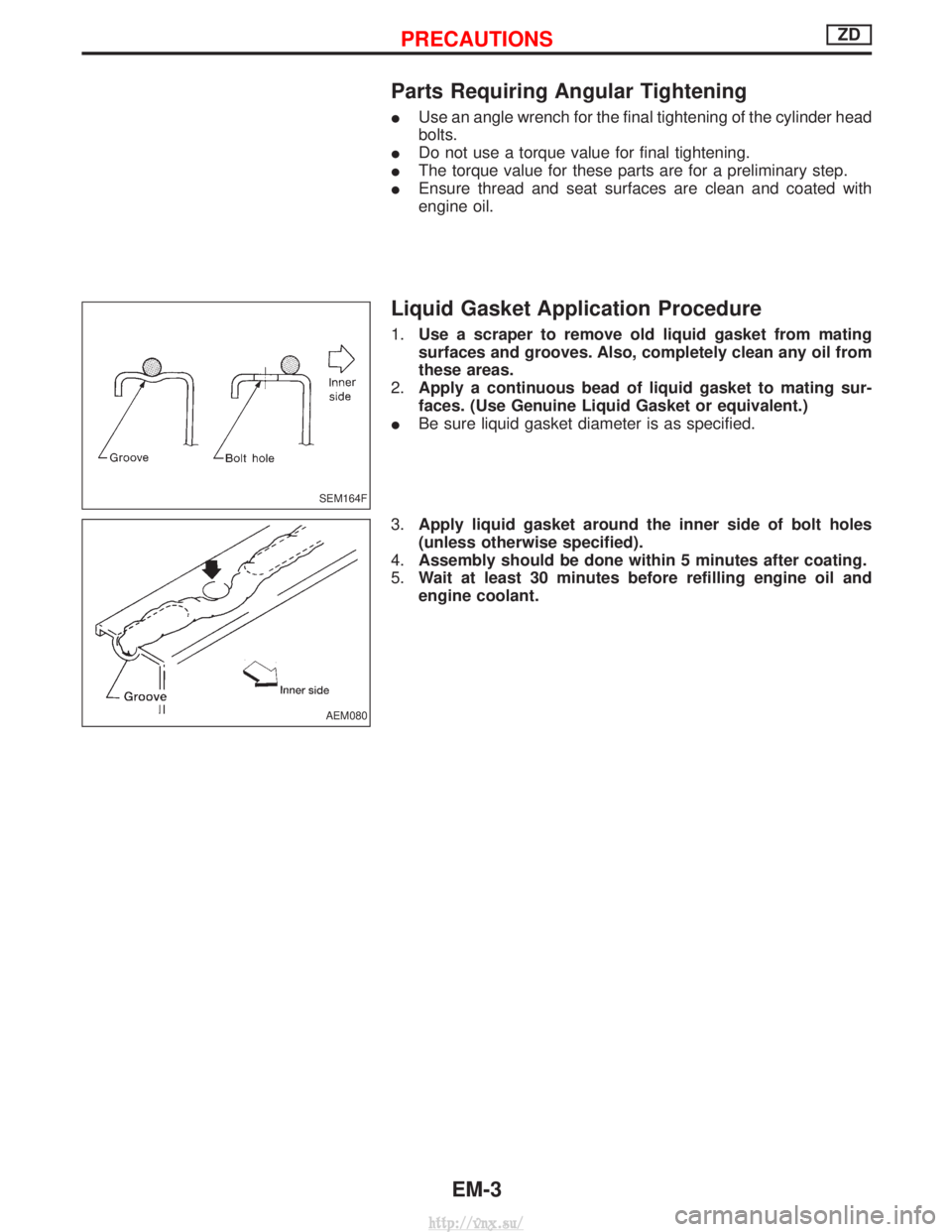
Liquid Gasket Application Procedure
1.Use a scraper to remove old liquid gasket from mating
surfaces and grooves. Also, completely clean any oil from
these areas.
2. Apply a continuous bead of liquid gasket to mating sur-
faces. (Use Genuine Liquid Gasket or equivalent.)
I Be sure liquid gasket diameter is as specified.
3. Apply liquid gasket around the inner side of bolt holes
(unless otherwise specified).
4. Assembly should be done within 5 minutes after coating.
5. Wait at least 30 minutes before refilling engine oil and
engine coolant.
SEM164F
AEM080
PRECAUTIONSZD
EM-3
http://vnx.su/
Page 95 of 1833
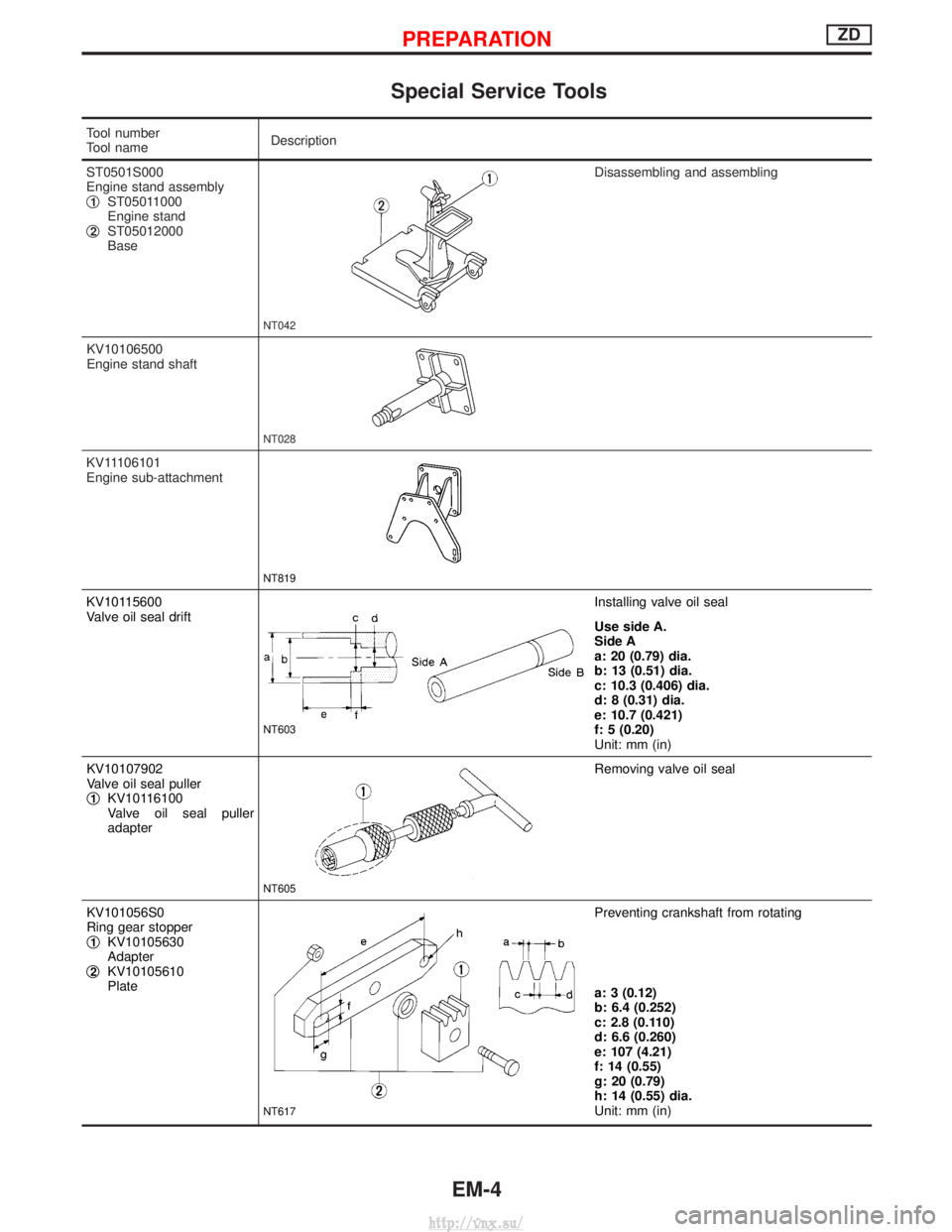
Special Service Tools
Tool number
Tool nameDescription
ST0501S000
Engine stand assembly
q
1ST05011000
Engine stand
q
2ST05012000
Base
NT042
Disassembling and assembling
KV10106500
Engine stand shaft
NT028
KV11106101
Engine sub-attachment
NT819
KV10115600
Valve oil seal drift
NT603
Installing valve oil seal
Use side A.
Side A
a: 20 (0.79) dia.
b: 13 (0.51) dia.
c: 10.3 (0.406) dia.
d: 8 (0.31) dia.
e: 10.7 (0.421)
f: 5 (0.20)
Unit: mm (in)
KV10107902
Valve oil seal puller
q
1KV10116100
Valve oil seal puller
adapter
NT605
Removing valve oil seal
KV101056S0
Ring gear stopper
q
1KV10105630
Adapter
q
2KV10105610
Plate
NT617
Preventing crankshaft from rotating
a: 3 (0.12)
b: 6.4 (0.252)
c: 2.8 (0.110)
d: 6.6 (0.260)
e: 107 (4.21)
f: 14 (0.55)
g: 20 (0.79)
h: 14 (0.55) dia.
Unit: mm (in)
PREPARATIONZD
EM-4
http://vnx.su/
Page 100 of 1833
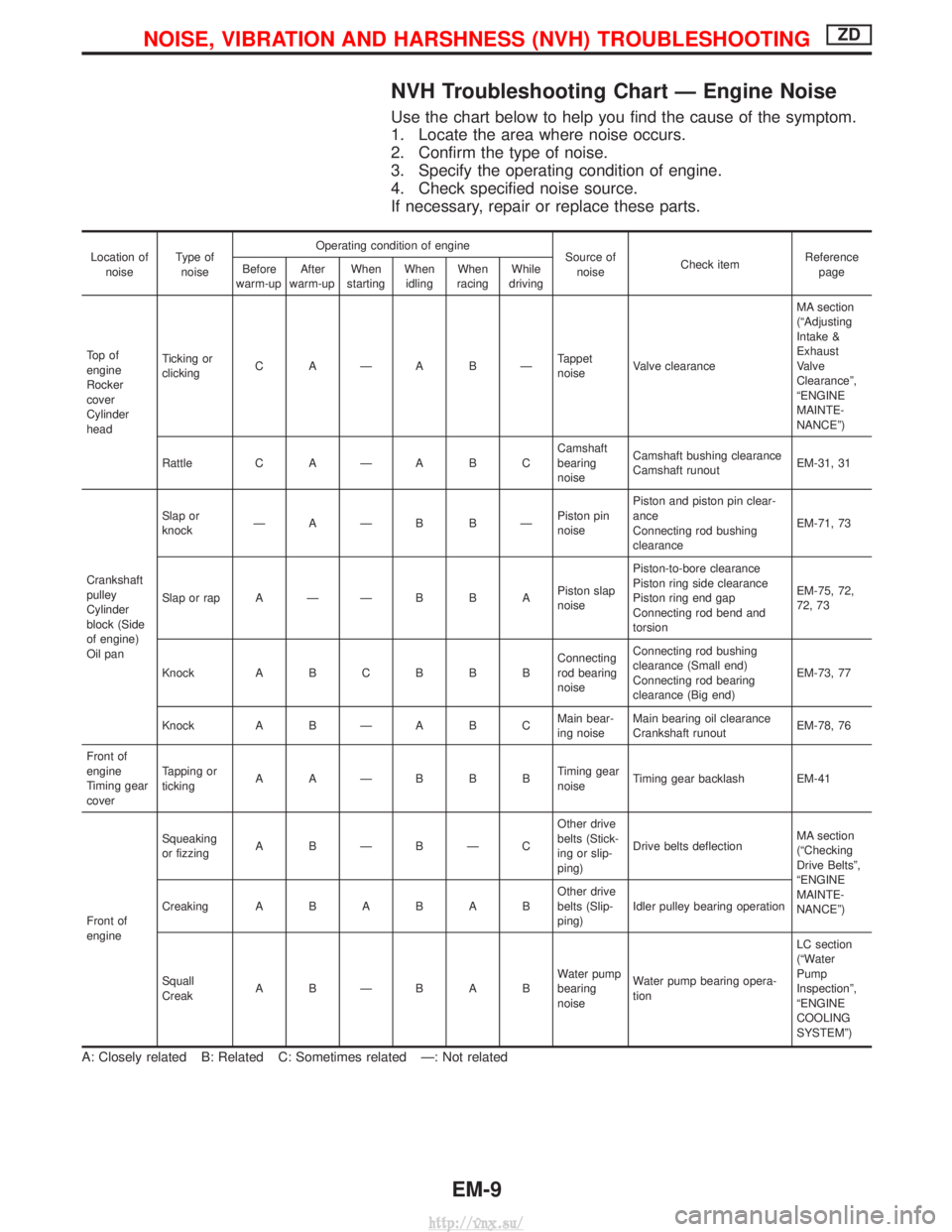
NVH Troubleshooting Chart Ð Engine Noise
Use the chart below to help you find the cause of the symptom.
1. Locate the area where noise occurs.
2. Confirm the type of noise.
3. Specify the operating condition of engine.
4. Check specified noise source.
If necessary, repair or replace these parts.
Location ofnoise Type of
noise Operating condition of engine
Source of
noise Check item Reference
page
Before
warm-up After
warm-up When
starting When
idling When
racing While
driving
To p o f
engine
Rocker
cover
Cylinder
head Ticking or
clicking
C AÐA BÐ Tappet
noiseValve clearance MA section
(ªAdjusting
Intake &
Exhaust
Valve
Clearanceº,
ªENGINE
MAINTE-
NANCEº)
Rattle C A Ð A B C Camshaft
bearing
noiseCamshaft bushing clearance
Camshaft runout
EM-31, 31
Crankshaft
pulley
Cylinder
block (Side
of engine)
Oil pan Slap or
knock
ÐAÐB BÐ Piston pin
noisePiston and piston pin clear-
ance
Connecting rod bushing
clearance
EM-71, 73
Slap or rap A Ð Ð B B A Piston slap
noisePiston-to-bore clearance
Piston ring side clearance
Piston ring end gap
Connecting rod bend and
torsion EM-75, 72,
72, 73
Knock A B C B B B Connecting
rod bearing
noiseConnecting rod bushing
clearance (Small end)
Connecting rod bearing
clearance (Big end)
EM-73, 77
Knock A B Ð A B C Main bear-
ing noiseMain bearing oil clearance
Crankshaft runout
EM-78, 76
Front of
engine
Timing gear
cover Tapping or
ticking
AAÐBBB Timing gear
noiseTiming gear backlash EM-41
Front of
engine Squeaking
or fizzing
A BÐBÐC Other drive
belts (Stick-
ing or slip-
ping)Drive belts deflection
MA section
(ªChecking
Drive Beltsº,
ªENGINE
MAINTE-
NANCEº)
Creaking
ABABAB Other drive
belts (Slip-
ping)Idler pulley bearing operation
Squall
Creak ABÐBAB Water pump
bearing
noiseWater pump bearing opera-
tion LC section
(ªWater
Pump
Inspectionº,
ªENGINE
COOLING
SYSTEMº)
A: Closely related B: Related C: Sometimes related Ð: Not related
NOISE, VIBRATION AND HARSHNESS (NVH) TROUBLESHOOTINGZD
EM-9
http://vnx.su/
Page 101 of 1833
1. Warm up engine.
2. Turn ignition switch OFF.
3. Using CONSULT-II, make sure no error codes are indicated forself-diagnosis items. Refer to EC section, ªFuel Pressure
Releaseº.
I Do not disconnect CONSULT-II until the end of this operation;
it will be used to check engine rpm and for error detection at
the end of this operation.
4. Disconnect the negative battery terminal.
5. Remove the following parts.
I Intercooler
I Throttle body
I Rocker cover
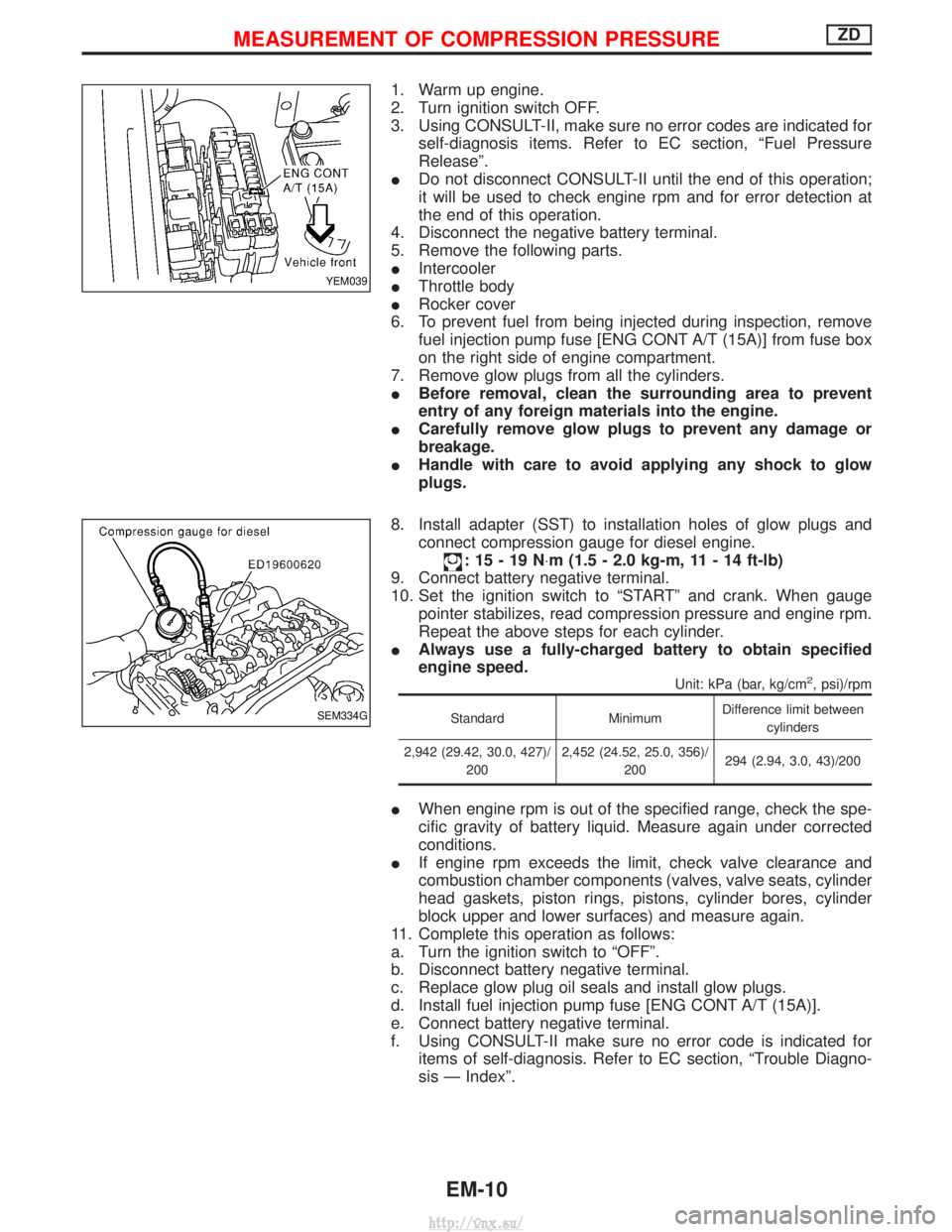
6. To prevent fuel from being injected during inspection, remove fuel injection pump fuse [ENG CONT A/T (15A)] from fuse box
on the right side of engine compartment.
7. Remove glow plugs from all the cylinders.
I Before removal, clean the surrounding area to prevent
entry of any foreign materials into the engine.
I Carefully remove glow plugs to prevent any damage or
breakage.
I Handle with care to avoid applying any shock to glow
plugs.
8. Install adapter (SST) to installation holes of glow plugs and connect compression gauge for diesel engine.
:15-19N ×m (1.5 - 2.0 kg-m, 11 - 14 ft-lb)
9. Connect battery negative terminal.
10. Set the ignition switch to ªSTARTº and crank. When gauge pointer stabilizes, read compression pressure and engine rpm.
Repeat the above steps for each cylinder.
I Always use a fully-charged battery to obtain specified
engine speed.
Unit: kPa (bar, kg/cm2, psi)/rpm
Standard MinimumDifference limit between
cylinders
2,942 (29.42, 30.0, 427)/ 200 2,452 (24.52, 25.0, 356)/
200 294 (2.94, 3.0, 43)/200
I
When engine rpm is out of the specified range, check the spe-
cific gravity of battery liquid. Measure again under corrected
conditions.
I If engine rpm exceeds the limit, check valve clearance and
combustion chamber components (valves, valve seats, cylinder
head gaskets, piston rings, pistons, cylinder bores, cylinder
block upper and lower surfaces) and measure again.
11. Complete this operation as follows:
a. Turn the ignition switch to ªOFFº.
b. Disconnect battery negative terminal.
c. Replace glow plug oil seals and install glow plugs.
d. Install fuel injection pump fuse [ENG CONT A/T (15A)].
e. Connect battery negative terminal.
f. Using CONSULT-II make sure no error code is indicated for items of self-diagnosis. Refer to EC section, ªTrouble Diagno-
sis Ð Indexº.
YEM039
SEM334G
MEASUREMENT OF COMPRESSION PRESSUREZD
EM-10
http://vnx.su/
Page 104 of 1833
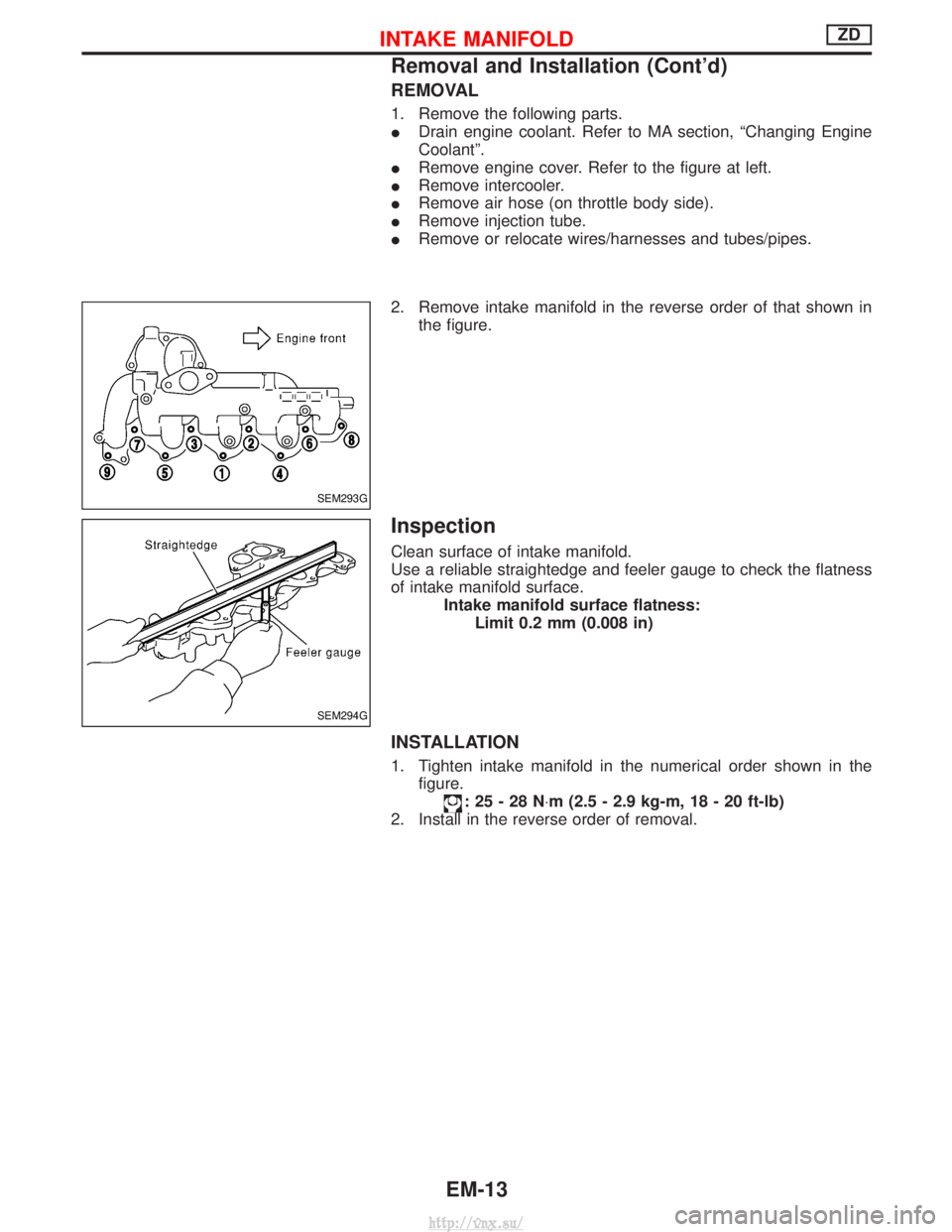
REMOVAL
1. Remove the following parts.
IDrain engine coolant. Refer to MA section, ªChanging Engine
Coolantº.
I Remove engine cover. Refer to the figure at left.
I Remove intercooler.
I Remove air hose (on throttle body side).
I Remove injection tube.
I Remove or relocate wires/harnesses and tubes/pipes.
2. Remove intake manifold in the reverse order of that shown in the figure.
Inspection
Clean surface of intake manifold.
Use a reliable straightedge and feeler gauge to check the flatness
of intake manifold surface. Intake manifold surface flatness:Limit 0.2 mm (0.008 in)
INSTALLATION
1. Tighten intake manifold in the numerical order shown in thefigure.
:25-28N ×m (2.5 - 2.9 kg-m, 18 - 20 ft-lb)
2. Install in the reverse order of removal.
SEM293G
SEM294G
INTAKE MANIFOLDZD
Removal and Installation (Cont'd)
EM-13
http://vnx.su/
Page 105 of 1833

Removal and Installation
REMOVAL
1. Remove the following parts.
IUndercover
I Under guard
I Engine coolant (drain)
Refer to MA section, ªChanging Engine Coolantº.
I Exhaust front tube
Refer to FE section, ªRemoval and Installationº, ªEXHAUST
SYSTEMº.
I Remove wires, harnesses, tubes and pipes.
YEM057
SEM296G
CATALYST AND TURBOCHARGERZD
EM-14
http://vnx.su/
Page 108 of 1833
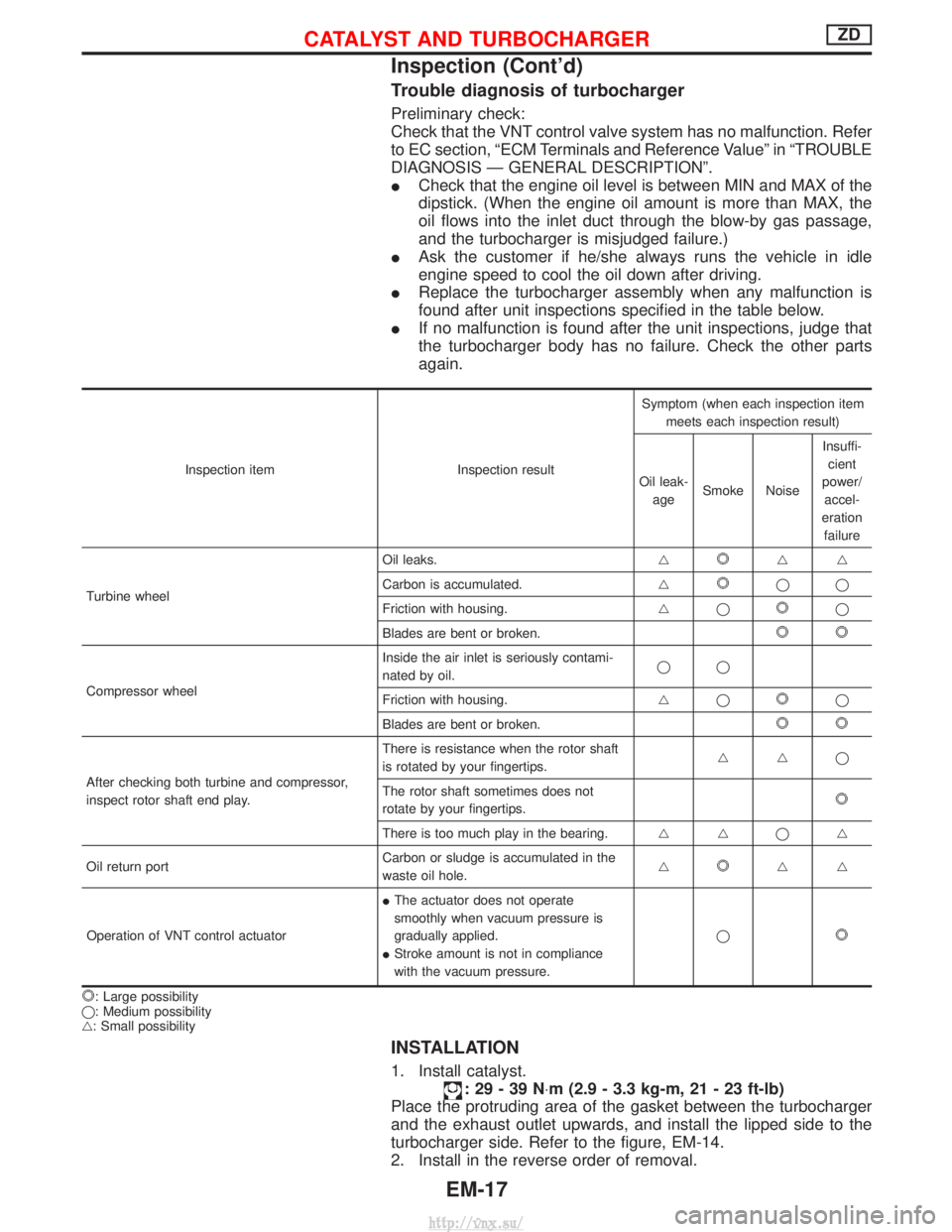
Trouble diagnosis of turbocharger
Preliminary check:
Check that the VNT control valve system has no malfunction. Refer
to EC section, ªECM Terminals and Reference Valueº in ªTROUBLE
DIAGNOSIS Ð GENERAL DESCRIPTIONº.
ICheck that the engine oil level is between MIN and MAX of the
dipstick. (When the engine oil amount is more than MAX, the
oil flows into the inlet duct through the blow-by gas passage,
and the turbocharger is misjudged failure.)
I Ask the customer if he/she always runs the vehicle in idle
engine speed to cool the oil down after driving.
I Replace the turbocharger assembly when any malfunction is
found after unit inspections specified in the table below.
I If no malfunction is found after the unit inspections, judge that
the turbocharger body has no failure. Check the other parts
again.
Inspection item Inspection resultSymptom (when each inspection item
meets each inspection result)
Oil leak- age Smoke Noise Insuffi-
cient
power/ accel-
eration failure
Turbine wheel Oil leaks.
g
gg
Carbon is accumulated. g
qq
Friction with housing. gq
q
Blades are bent or broken.
Compressor wheel Inside the air inlet is seriously contami-
nated by oil.
qq
Friction with housing. gqq
Blades are bent or broken.
After checking both turbine and compressor,
inspect rotor shaft end play. There is resistance when the rotor shaft
is rotated by your fingertips.
ggq
The rotor shaft sometimes does not
rotate by your fingertips.
There is too much play in the bearing. g gqg
Oil return port Carbon or sludge is accumulated in the
waste oil hole.g
gg
Operation of VNT control actuator I
The actuator does not operate
smoothly when vacuum pressure is
gradually applied.
I Stroke amount is not in compliance
with the vacuum pressure. q
: Large possibility
q: Medium possibility
g: Small possibility
INSTALLATION
1. Install catalyst.
:29-39N ×m (2.9 - 3.3 kg-m, 21 - 23 ft-lb)
Place the protruding area of the gasket between the turbocharger
and the exhaust outlet upwards, and install the lipped side to the
turbocharger side. Refer to the figure, EM-14.
2. Install in the reverse order of removal.
CATALYST AND TURBOCHARGERZD
Inspection (Cont'd)
EM-17
http://vnx.su/
Page 111 of 1833
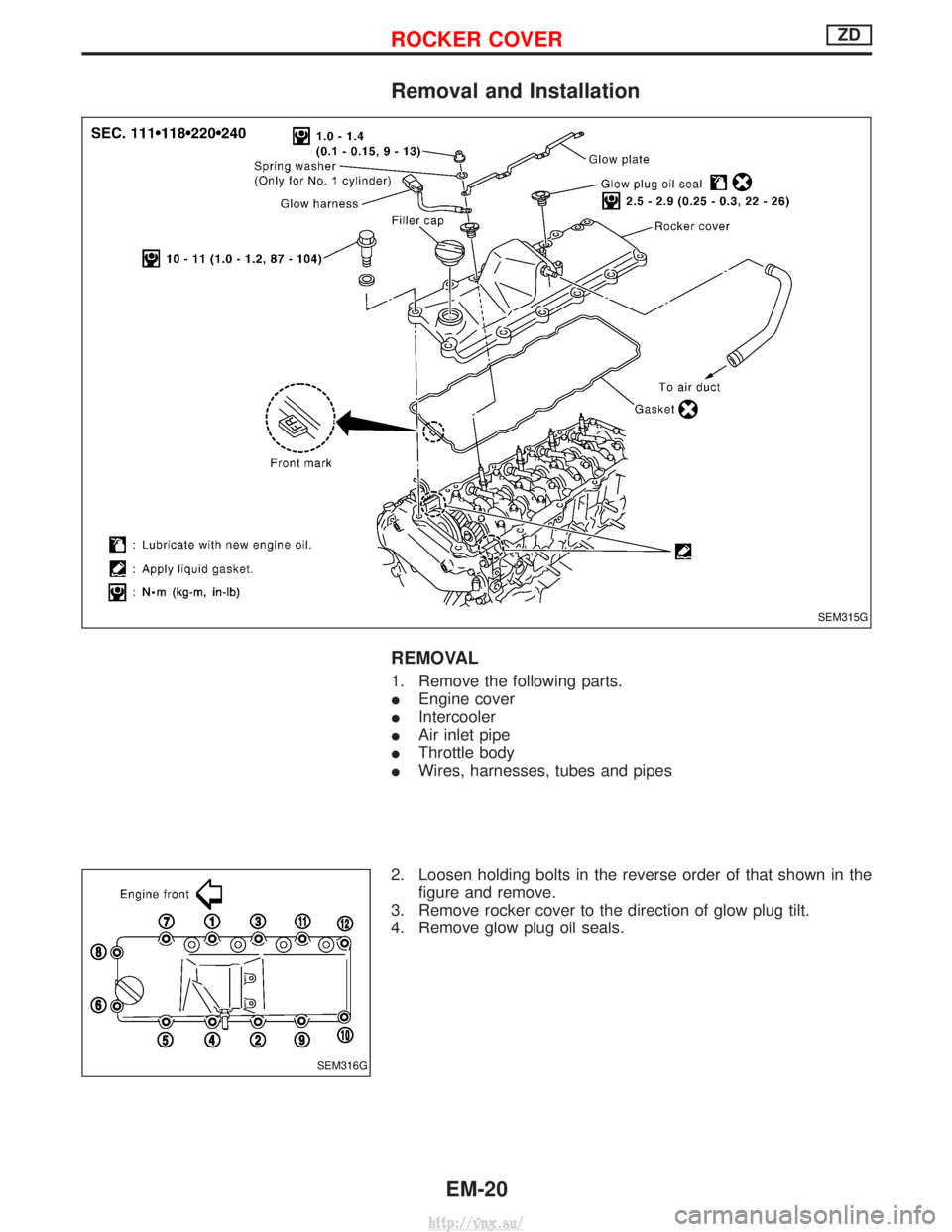
Removal and Installation
REMOVAL
1. Remove the following parts.
IEngine cover
I Intercooler
I Air inlet pipe
I Throttle body
I Wires, harnesses, tubes and pipes
2. Loosen holding bolts in the reverse order of that shown in the figure and remove.
3. Remove rocker cover to the direction of glow plug tilt.
4. Remove glow plug oil seals.
SEM315G
SEM316G
ROCKER COVERZD
EM-20
http://vnx.su/
Page 112 of 1833
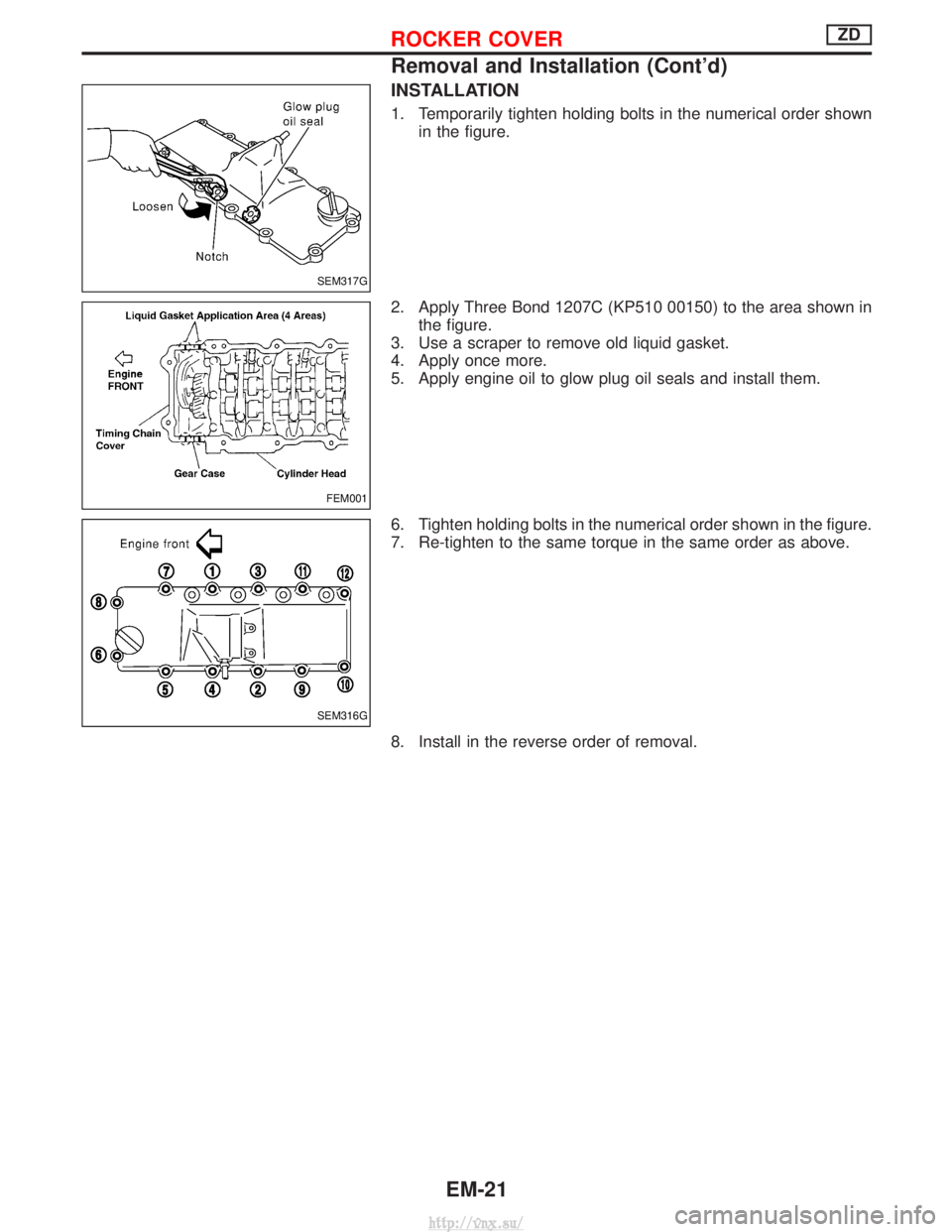
INSTALLATION
1. Temporarily tighten holding bolts in the numerical order shownin the figure.
2. Apply Three Bond 1207C (KP510 00150) to the area shown in the figure.
3. Use a scraper to remove old liquid gasket.
4. Apply once more.
5. Apply engine oil to glow plug oil seals and install them.
6. Tighten holding bolts in the numerical order shown in the figure.
7. Re-tighten to the same torque in the same order as above.
8. Install in the reverse order of removal.
SEM317G
FEM001
SEM316G
ROCKER COVERZD
Removal and Installation (Cont'd)
EM-21
http://vnx.su/
Page 113 of 1833
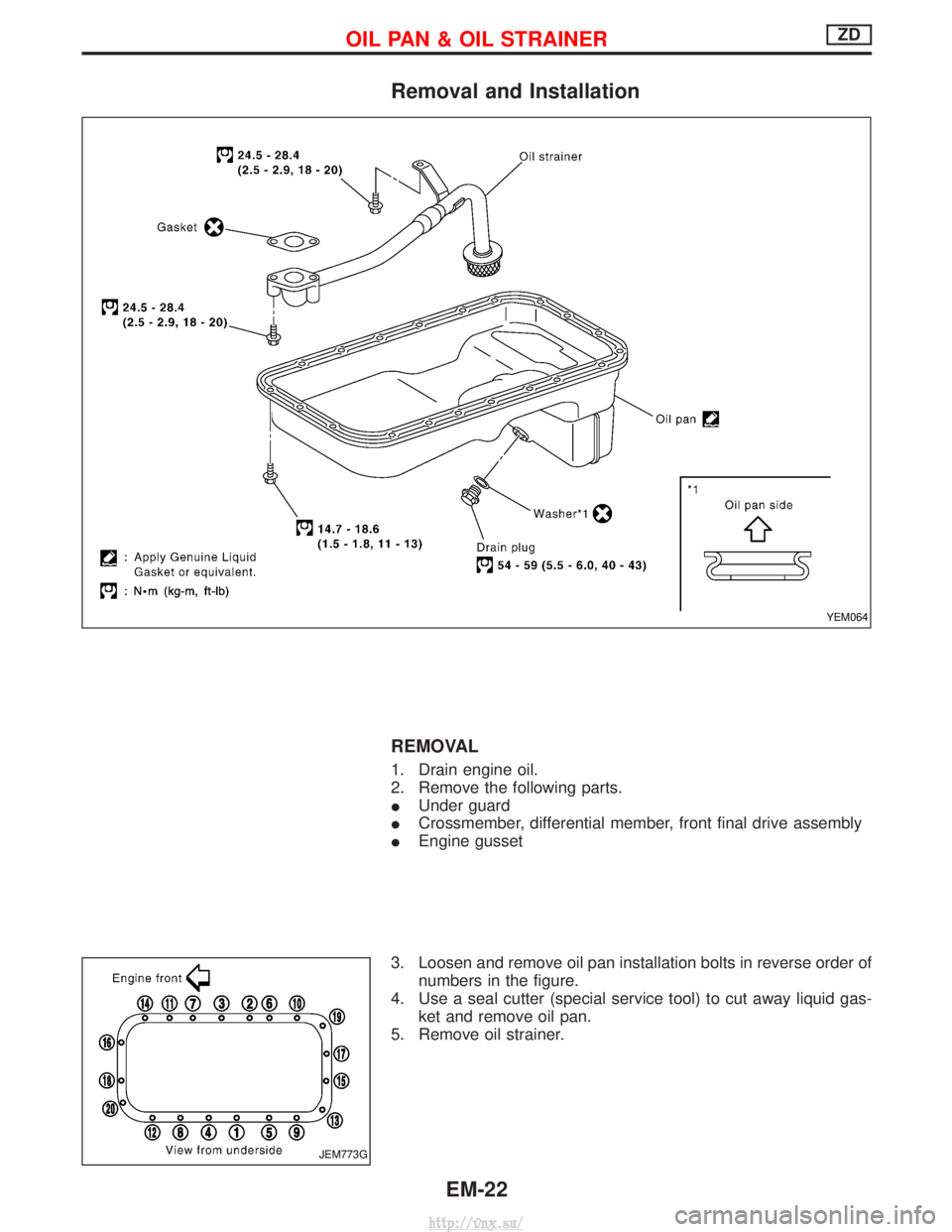
Removal and Installation
REMOVAL
1. Drain engine oil.
2. Remove the following parts.
IUnder guard
I Crossmember, differential member, front final drive assembly
I Engine gusset
3. Loosen and remove oil pan installation bolts in reverse order of numbers in the figure.
4. Use a seal cutter (special service tool) to cut away liquid gas- ket and remove oil pan.
5. Remove oil strainer.
YEM064
JEM773G
OIL PAN & OIL STRAINERZD
EM-22
http://vnx.su/