engine NISSAN TIIDA 2009 Service Repair Manual
[x] Cancel search | Manufacturer: NISSAN, Model Year: 2009, Model line: TIIDA, Model: NISSAN TIIDA 2009Pages: 4331, PDF Size: 58.04 MB
Page 1887 of 4331
![NISSAN TIIDA 2009 Service Repair Manual EVAPORATIVE EMISSION SYSTEM
EC-531
< SERVICE INFOMATION >
[MR TYPE 1] C
D E
F
G H
I
J
K L
M A EC
NP
O
Positive pressure is delivered to the EVAP system through the EVAP
service port. If fuel vapor lea](/img/5/57398/w960_57398-1886.png "NISSAN TIIDA 2009 Service Repair Manual EVAPORATIVE EMISSION SYSTEM
EC-531
< SERVICE INFOMATION >
[MR TYPE 1] C
D E
F
G H
I
J
K L
M A EC
NP
O
Positive pressure is delivered to the EVAP system through the EVAP
service port. If fuel vapor lea")
EVAPORATIVE EMISSION SYSTEM
EC-531
< SERVICE INFOMATION >
[MR TYPE 1] C
D E
F
G H
I
J
K L
M A EC
NP
O
Positive pressure is delivered to the EVAP system through the EVAP
service port. If fuel vapor leakage in the EVAP system occurs, use a
leak detector to locate the leak.
Removal and Installation INFOID:0000000004537030
EVAP CANISTER Tighten EVAP canister as shown in the figure.
EVAP CANISTER VENT CONTROL VALVE 1. Turn EVAP canister vent control valve counterclockwise.
• Lock (A)
• Unlock (B)
2. Remove the EVAP canister vent control valve.
Always replace O-ring with a new one.
How to Detect Fuel Vapor Leakage INFOID:0000000004537031
CAUTION:
• Never use compressed air or a high pressure pump.
• Do not exceed 4.12 kPa (0.042 kg/cm 2
, 0.6 psi) of pressure in EVAP system.
NOTE:
• Do not start engine.
• Improper installation of EVAP service port adapter to the EVAP service port may cause a leak.
WITH CONSULT-III
1. Attach the EVAP service port adapter securely to the EVAP service port.
2. Also attach the pressure pump and hose to the EVAP service port adapter. SEF462UC
PBIB1214E
PBIB3091E
Page 1889 of 4331
EC
NP
O
ON BOARD REFUELING VAPOR RECOVERY (ORVR)
System Description INFOID:0000000004537032
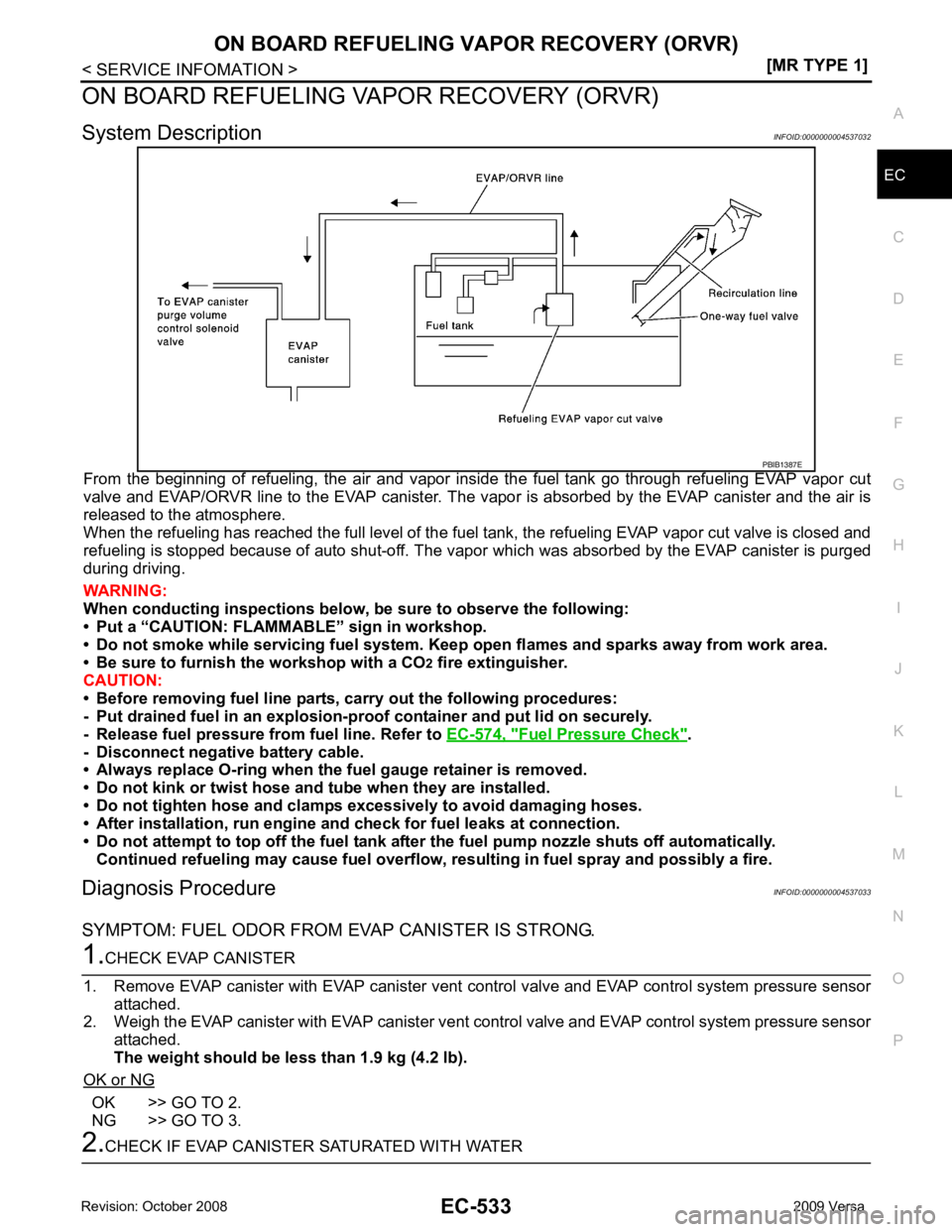
From the beginning of refueling, the air and vapor insi de the fuel tank go through refueling EVAP vapor cut
valve and EVAP/ORVR line to the EVAP canister. The v apor is absorbed by the EVAP canister and the air is
released to the atmosphere.
When the refueling has reached the full level of the fuel tank, the refueling EVAP vapor cut valve is closed and
refueling is stopped because of auto shut-off. The vapor which was absorbed by the EVAP canister is purged
during driving.
WARNING:
When conducting inspectio ns below, be sure to observe the following:
• Put a “CAUTION: FLAMMABL E” sign in workshop.
• Do not smoke while servicing fuel system. Keep open flames and sparks away from work area.
• Be sure to furnish the workshop with a CO 2
fire extinguisher.
CAUTION:
• Before removing fuel line parts, carry out the following procedures:
- Put drained fuel in an explosion-proof containe r and put lid on securely.
- Release fuel pressure from fuel line. Refer to EC-574, " Fuel Pressure Check " .
- Disconnect negative battery cable.
• Always replace O-ring when the fu el gauge retainer is removed.
• Do not kink or twist hose and tube when they are installed.
• Do not tighten hose and clamps excessively to avoid damaging hoses.
• After installation, run engine a nd check for fuel leaks at connection.
• Do not attempt to top off the fuel tank after the fuel pump nozzle shuts off automatically.
Continued refueling may cause fuel overflow, r esulting in fuel spray and possibly a fire.
Diagnosis Procedure INFOID:0000000004537033
SYMPTOM: FUEL ODOR FROM EVAP CANISTER IS STRONG. OK >> GO TO 2.
NG >> GO TO 3.
Page 1896 of 4331

U1000-U1010 " .
• Check that no DTC is displayed in “SELF DIAGNOSIS RESULT” mode of “BCM” before erasing the
detected DTC in “ENGINE” mode with CONSULT-III.
• When replacing ECM, refer to EC-571, " Procedure After Replacing ECM " .
Page 1897 of 4331
EC
NP
O
ON BOARD DIAGNOSTIC (OBD) SYSTEM
Introduction INFOID:0000000004537038
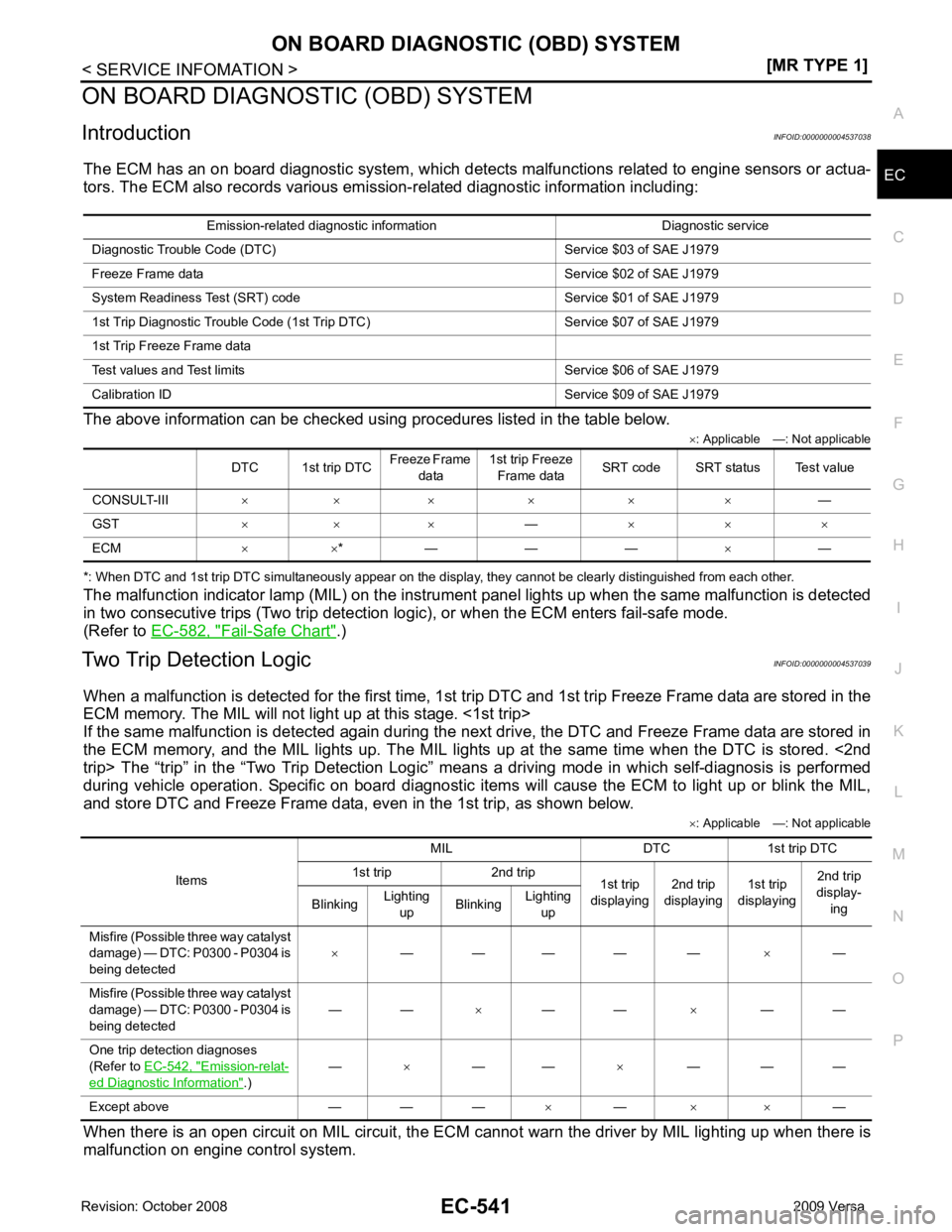
The ECM has an on board diagnostic system, which detects malfunctions related to engine sensors or actua-
tors. The ECM also records various emis sion-related diagnostic information including:
The above information can be checked using procedures listed in the table below. ×: Applicable —: Not applicable
*: When DTC and 1st trip DTC simultaneously appear on the display, they cannot be clearly distinguished from each other.
The malfunction indicator lamp (MIL) on the instrument panel lights up when the same malfunction is detected
in two consecutive trips (Two trip detection logic), or when the ECM enters fail-safe mode.
(Refer to EC-582, " Fail-Safe Chart " .)
Two Trip Detection Logic INFOID:0000000004537039
When a malfunction is detected for the first time, 1st tr ip DTC and 1st trip Freeze Frame data are stored in the
ECM memory. The MIL will not light up at this stage. <1st trip>
If the same malfunction is detected again during the next drive, the DTC and Freeze Frame data are stored in
the ECM memory, and the MIL lights up. The MIL lights up at the same time when the DTC is stored. <2nd
trip> The “trip” in the “Two Trip Detection Logic” m eans a driving mode in which self-diagnosis is performed
during vehicle operation. Specific on board diagnostic item s will cause the ECM to light up or blink the MIL,
and store DTC and Freeze Frame data, even in the 1st trip, as shown below.
×: Applicable —: Not applicable
When there is an open circuit on MIL circuit, the ECM c annot warn the driver by MIL lighting up when there is
malfunction on engine control system. Emission-related diagnostic information Diagnostic service
Diagnostic Tr ouble Code (DTC) Service $03 of SAE J1979
Freeze Frame data Service $02 of SAE J1979
System Readiness Test (SRT) code Service $01 of SAE J1979
1st Trip Diagnostic Trou ble Code (1st Trip DTC) Service $07 of SAE J1979
1st Trip Freeze Frame data
Test values and Test limi ts Service $06 of SAE J1979
Calibration ID Servic e $09 of SAE J1979
DTC 1st trip DTC Freeze Frame
data 1st trip Freeze
Frame data SRT code SRT status Test value
CONSULT-III × × × × × × —
GST × × × —× × ×
ECM × ×* — — — ×— Items
MIL DTC 1st trip DTC
1st trip 2nd trip 1st trip
displaying 2nd trip
displaying 1st trip
displaying 2nd trip
display-
ing
Blinking Lighting
up Blinking
Lighting
up
Misfire (Possible three way catalyst
damage) — DTC: P0300 - P0304 is
being detected ×
— — — — — ×—
Misfire (Possible three way catalyst
damage) — DTC: P0300 - P0304 is
being detected — —
×— — ×— —
One trip detection diagnoses
(Refer to EC-542, " Emission-relat-
ed Diagnostic Information " .)
—
×— — ×— — —
Except above — — — ×— × × —
Page 1900 of 4331
(A/T),
CVT-258 (CVT)
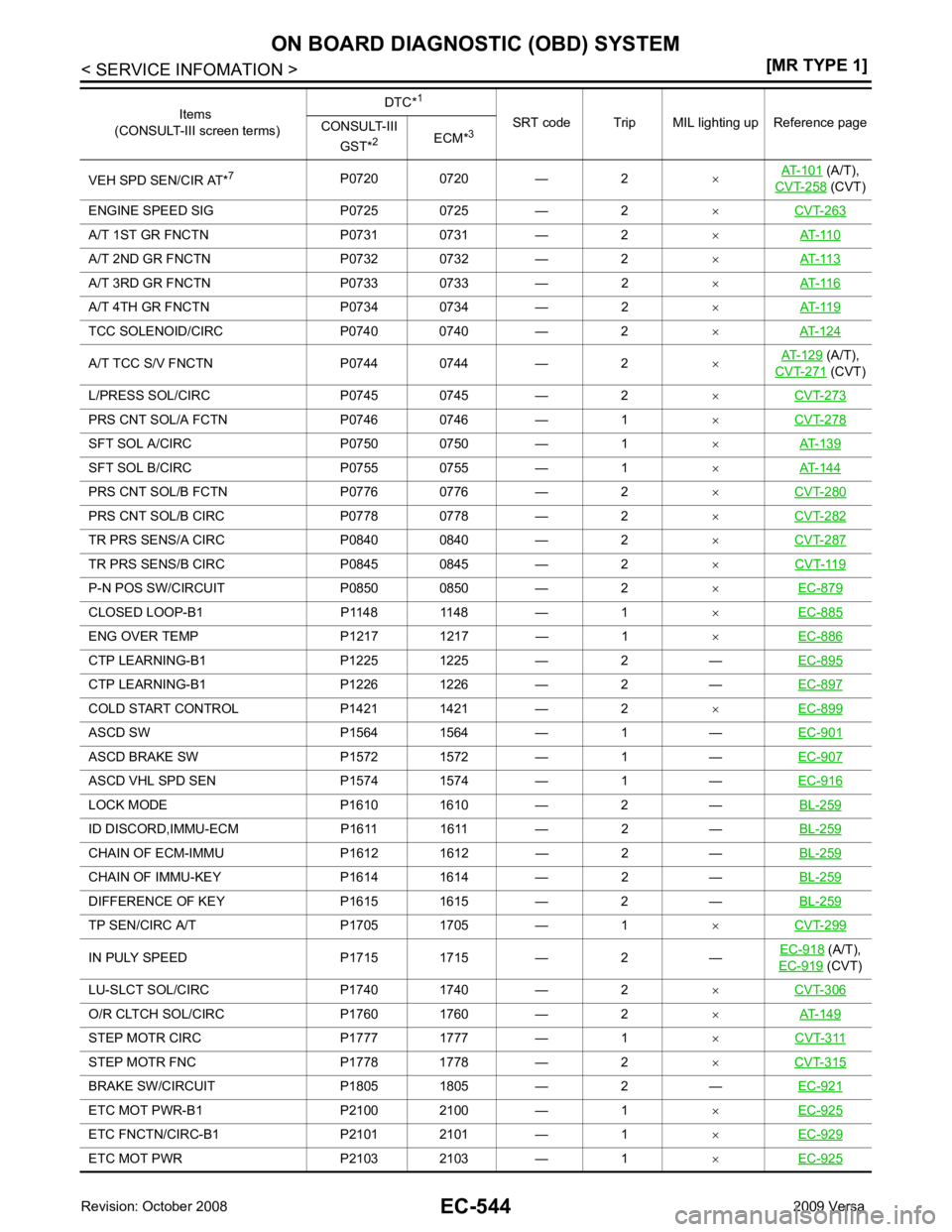
ENGINE SPEED SIG P0725 0725 — 2 ×CVT-263 A/T 1ST GR FNCTN P0731 0731 — 2
×AT-110 A/T 2ND GR FNCTN P0732 0732 — 2
×AT-113 A/T 3RD GR FNCTN P0733 0733 — 2
×AT-116 A/T 4TH GR FNCTN P0734 0734 — 2
×AT-119 TCC SOLENOID/CIRC P0740 0740 — 2
×AT-124 A/T TCC S/V FNCTN P0744 0744 — 2
×AT-129 (A/T),
CVT-271 (CVT)
L/PRESS SOL/CIRC P0745 0745 — 2 ×CVT-273 PRS CNT SOL/A FCTN P0746 0746 — 1
×CVT-278 SFT SOL A/CIRC P0750 0750 — 1
×AT-139 SFT SOL B/CIRC P0755 0755 — 1
×AT-144 PRS CNT SOL/B FCTN P0776 0776 — 2
×CVT-280 PRS CNT SOL/B CIRC P0778 0778 — 2
×CVT-282 TR PRS SENS/A CIRC P0840 0840 — 2
×CVT-287 TR PRS SENS/B CIRC P0845 0845 — 2
×CVT-119 P-N POS SW/CIRCUIT P0850 0850 — 2
×EC-879 CLOSED LOOP-B1 P1148 1148 — 1
×EC-885 ENG OVER TEMP P1217 1217 — 1
×EC-886 CTP LEARNING-B1 P1225 1225 — 2 —
EC-895CTP LEARNING-B1 P1226 1226 — 2 —
EC-897COLD START CONTROL P1421 1421 — 2
×EC-899 ASCD SW P1564 1564 — 1 —
EC-901ASCD BRAKE SW P1572 1572 — 1 —
EC-907ASCD VHL SPD SEN P1574 1574 — 1 —
EC-916LOCK MODE P1610 1610 — 2 —
BL-259ID DISCORD,IMMU-ECM P1611 1611 — 2 —
BL-259CHAIN OF ECM-IMMU P1612 1612 — 2 —
BL-259CHAIN OF IMMU-KEY P1614 1614 — 2 —
BL-259DIFFERENCE OF KEY P1615 1615 — 2 —
BL-259TP SEN/CIRC A/T P1705 1705 — 1
×CVT-299 IN PULY SPEED P1715 1715 — 2 —
EC-918 (A/T),
EC-919 (CVT)
LU-SLCT SOL/CIRC P1740 1740 — 2 ×CVT-306 O/R CLTCH SOL/CIRC P1760 1760 — 2
×AT-149 STEP MOTR CIRC P1777 1777 — 1
×CVT-311 STEP MOTR FNC P1778 1778 — 2
×CVT-315 BRAKE SW/CIRCUIT P1805 1805 — 2 —
EC-921ETC MOT PWR-B1 P2100 2100 — 1
×EC-925 ETC FNCTN/CIRC-B1 P2101 2101 — 1
×EC-929 ETC MOT PWR P2103 2103 — 1
×EC-925 Items
(CONSULT-III screen terms) DTC*
1
SRT code Trip MIL lighting up Reference page
CONSULT-III
GST* 2
ECM*3
Page 1902 of 4331

CONSULT-III Function (ENGINE) " .
Only one set of freeze frame data (either 1st trip freez e frame data or freeze frame data) can be stored in the
ECM. 1st trip freeze frame data is stored in the ECM me mory along with the 1st trip DTC. There is no priority
for 1st trip freeze frame data and it is updated each time a different 1st trip DTC is detected. However, once
freeze frame data (2nd trip detection/MIL on) is stored in the ECM memory, 1st trip freeze frame data is no
longer stored. Remember, only one set of freeze frame data can be stored in the ECM. The ECM has the fol-
lowing priorities to update the data.
For example, the EGR malfunction (P riority: 2) was detected and the freeze frame data was stored in the 2nd
trip. After that when the misfire (Priority: 1) is detected in another trip, the freeze frame data will be updated
from the EGR malfunction to the misfire. The 1st trip freeze frame data is updated each time a different mal-
function is detected. There is no priority for 1st trip freeze frame data. However, once freeze frame data is
stored in the ECM memory, 1st trip freeze data is no longer stored (because only one freeze frame data or 1st
trip freeze frame data can be stored in the ECM). If fr eeze frame data is stored in the ECM memory and freeze
frame data with the same priority occurs later, t he first (original) freeze frame data remains unchanged in the
ECM memory.
Both 1st trip freeze frame data and freeze frame dat a (along with the DTCs) are cleared when the ECM mem-
ory is erased. Procedures for clearing the ECM me mory are described in "EMISSION-RELATED DIAGNOS-
TIC INFORMATION ITEMS".
SYSTEM READINESS TEST (SRT) CODE
System Readiness Test (SRT) code is specified in Service $01 of SAE J1979.
As part of an enhanced emissions test for Inspection & Ma intenance (I/M), certain states require the status of
SRT be used to indicate whether the ECM has completed self-diagnosis of major emission systems and com-
ponents. Completion must be verified in order for the emissions inspection to proceed.
If a vehicle is rejected for a State emissions inspec tion due to one or more SRT items indicating “INCMP”, use
the information in this Service Manual to set the SRT to “CMPLT”.
In most cases the ECM will automatically complete its self-diagnosis cycle during normal usage, and the SRT
status will indicate “CMPLT” for each application system . Once set as “CMPLT”, the SRT status remains
“CMPLT” until the self-diagnosis memory is erased.
Occasionally, certain portions of the self-diagnostic test may not be completed as a result of the customer's
normal driving pattern; the SRT will indicate “INCMP” for these items.
NOTE:
The SRT will also indicate “INCMP” if the self-diagnosis memory is erased for any reason or if the ECM mem-
ory power supply is interrupted for several hours.
If, during the state emissions inspection, the SRT indica tes “CMPLT” for all test items, the inspector will con-
tinue with the emissions test. However, if the SRT indi cates “INCMP” for one or more of the SRT items the
vehicle is returned to the customer untested. Priority Items
1 Freeze frame data Misfire — DTC: P0300 - P0304
Fuel Injection System Function — DTC: P0171, P0172
2 Except the above items (Includes A/T or CVT related items)
3 1st trip freeze frame data
Page 1907 of 4331
![NISSAN TIIDA 2009 Service Repair Manual ON BOARD DIAGNOSTIC (OBD) SYSTEM
EC-551
< SERVICE INFOMATION >
[MR TYPE 1] C
D E
F
G H
I
J
K L
M A EC
NP
O
• Sea level
• Flat road
• Ambient air temperature: 20 - 30 °C (68 - 86 °F)
• Diagno](/img/5/57398/w960_57398-1906.png "NISSAN TIIDA 2009 Service Repair Manual ON BOARD DIAGNOSTIC (OBD) SYSTEM
EC-551
< SERVICE INFOMATION >
[MR TYPE 1] C
D E
F
G H
I
J
K L
M A EC
NP
O
• Sea level
• Flat road
• Ambient air temperature: 20 - 30 °C (68 - 86 °F)
• Diagno")
ON BOARD DIAGNOSTIC (OBD) SYSTEM
EC-551
< SERVICE INFOMATION >
[MR TYPE 1] C
D E
F
G H
I
J
K L
M A EC
NP
O
• Sea level
• Flat road
• Ambient air temperature: 20 - 30 °C (68 - 86 °F)
• Diagnosis is performed as quickly as possible under normal conditions.
Under different conditions [For example: ambient air temperature other than 20 - 30 °C (68 - 86 °F)], diagno-
sis may also be performed.
Pattern 1:
• The engine is started at the engine coolant temperature of −10 to 35 °C (14 to 95 °F)
(where the voltage between the ECM terminal 38 and ground is 3.0 - 4.3V).
• The engine must be operated at idle speed until the engine coolant temperature is greater than 70 °C
(158 °F) (where the voltage between the ECM te rminal 38 and ground is lower than 1.4V).
• The engine is started at the fuel tank temperature of warmer than 0 °C (32 °F) (where the voltage
between the ECM terminal 43 and ground is less than 4.1V).
Pattern 2:
• When steady-state driving is performed again even afte r it is interrupted, each diagnosis can be conducted.
In this case, the time required for diagnosis may be extended.
Pattern 3:
• Operate vehicle following the driving pattern shown in the figure.
• Release the accelerator pedal during decelerating vehicle speed
from 90 km/h (56 MPH) to 0 km/h (0 MPH).
Pattern 4:
• The accelerator pedal must be held very steady during steady-
state driving.
• If the accelerator pedal is moved, the test must be conducted all over again.
*1: Depress the accelerator pedal until vehicle speed is 90 km/h (56
MPH), then release the accelerator pedal and keep it released for
more than 10 seconds. Depress the accelerator pedal until vehicle
speed is 90 km/h (56 MPH) again.
*2: Checking the vehicle speed with GST is advised.
Suggested Transmission Gear Po sition for A/T and CVT Models
Set the selector lever in the D position (CVT), D position with the overdrive switch turned ON (A/T).
Suggested upshift speeds for M/T models
Shown below are suggested vehicle speeds for shifting into a higher gear. These suggestions relate to fuel
economy and vehicle performance. Actual upshift speeds will vary according to road conditions, the weather
and individual driving habits.
Suggested Maximum Speed in Each Gear
Downshift to a lower gear if the engine is not running smoothly, or if you need to accelerate.
Do not exceed the maximum suggested speed (shown below) in any gear. For level road driving, use the high-
est gear suggested for that speed. Always observe post ed speed limits and drive according to the road condi-
tions to ensure safe operation. Do not over-rev t he engine when shifting to a lower gear as it may cause
engine damage or loss of vehicle control. PBIB2244E
For normal accelera
tion in low alti-
tude areas
[less than 1,219 m (4,000 ft)]: For quick acceleration in low alti-
tude areas For high attitude areas
[over 1,219m (4,000 ft)]:
Gear change ACCEL shift point km/h (MPH) km/h (MPH) km/h (MPH)
1st to 2nd 13 (8) 24 (15) 24 (15)
2nd to 3rd 27 (17) 40 (25) 40 (25)
3rd to 4th 40 (25) 53 (33) 65 (40)
4th to 5th 58 (36) 71 (44) 73 (45)
5th to 6th 82 (51) 82 (51) 82 (51)
Page 1909 of 4331

EC
NP
O
HO2S
05H
Air fuel ratio (A/F) sensor 1
(Bank 2) P0151 83H 0BH
Minimum sensor output voltage for test
cycle
P0151 84H 0BH Maximum sensor output voltage for test
cycle
P0150 85H 0BH Minimum sensor output voltage for test
cycle
P0150 86H 0BH Maximum sensor output voltage for test
cycle
P0153 87H 04H Response rate: Response ratio (Lean to
Rich)
P0153 88H 04H Response rate: Response ratio (Rich to
Lean)
P2A03 89H 84H The amount of shift in air fuel ratio
P2A03 8AH 84H The amount of shift in air fuel ratio P0150 8BH 0BH Difference in sensor output voltage
P0153 8CH 83H Response gain at the limited frequency
06H Heated oxygen sensor 2
(Bank 2) P0158 07H 0CH
Minimum sensor output voltage for test
cycle
P0157 08H 0CH Maximum sensor output voltage for test
cycle
P0158 80H 0CH Sensor output voltage
P0159 81H 0CH Difference in sensor output voltage
07H Heated oxygen sensor 3
(Bank2) P0163 07H 0CH
Minimum sensor output voltage for test
cycle
P0164 08H 0CH Maximum sensor output voltage for test
cycle
P0166 80H 0CH Sensor output voltage
P0165 81H 0CH Difference in sensor output voltage
CATA-
LYST 21H
Three way catalyst function
(Bank1) P0420 80H 01H O2 storage index
P0420 82H 01H Switching time lag engine exhaust index
value
P2423 83H 0CH Difference in 3rd O2 sensor output volt-
age
P2423 84H 84H O2 storage index in HC trap catalyst
22H Three way catalyst function
(Bank2) P0430 80H 01H O2 storage index
P0430 82H 01H Switching time lag engine exhaust index
value
P2424 83H 0CH Difference in 3rd O2 sensor output volt-
age
P2424 84H 84H O2 storage index in HC trap catalyst
Item
OBD-
MID Self-diagnostic test item DTC Test value and Test
limit
(GST display) Description
TID Unit and
Scaling ID
Page 1912 of 4331

), skip step 1.
1. Erase DTC in TCM.
2. Select "ENGINE" with CONSULT-III.
3. Select "SELF-DIAG RESULTS". MISFIRE
A2H No.1 Cylinder Misfire
P0301 0BH 24H
EWMA (Exponential Weighted Moving
Average) misfire counts for last 10 driv-
ing cycles
P0301 0CH 24H Misfire counts for last/current driving cy-
cles
A3H No.2 Cylinder Misfire P0302 0BH 24H
EWMA (Exponential Weighted Moving
Average) misfire counts for last 10 driv-
ing cycles
P0302 0CH 24H Misfire counts for last/current driving cy-
cles
A4H No.3 Cylinder Misfire P0303 0BH 24H
EWMA (Exponential Weighted Moving
Average) misfire counts for last 10 driv-
ing cycles
P0303 0CH 24H Misfire counts for last/current driving cy-
cles
A5H No.4 Cylinder Misfire P0304 0BH 24H
EWMA (Exponential Weighted Moving
Average) misfire counts for last 10 driv-
ing cycles
P0304 0CH 24H Misfire counts for last/current driving cy-
cles
A6H No.5 Cylinder Misfire P0305 0BH 24H
EWMA (Exponential Weighted Moving
Average) misfire counts for last 10 driv-
ing cycles
P0305 0CH 24H Misfire counts for last/current driving cy-
cles
A7H No.6 Cylinder Misfire P0306 0BH 24H
EWMA (Exponential Weighted Moving
Average) misfire counts for last 10 driv-
ing cycles
P0306 0CH 24H Misfire counts for last/current driving cy-
cles
A8H No.7 Cylinder Misfire P0307 0BH 24H
EWMA (Exponential Weighted Moving
Average) misfire counts for last 10 driv-
ing cycles
P0307 0CH 24H Misfire counts for last/current driving cy-
cles
A9H No.8 Cylinder Misfire P0308 0BH 24H
EWMA (Exponential Weighted Moving
Average) misfire counts for last 10 driv-
ing cycles
P0308 0CH 24H Misfire counts for last/current driving cy-
cles
Item
OBD-
MID Self-diagnostic test item DTC Test value and Test
limit
(GST display) Description
TID Unit and
Scaling ID
Page 1913 of 4331
![NISSAN TIIDA 2009 Service Repair Manual ON BOARD DIAGNOSTIC (OBD) SYSTEM
EC-557
< SERVICE INFOMATION >
[MR TYPE 1] C
D E
F
G H
I
J
K L
M A EC
NP
O
4. Touch "ERASE". (The DTC in the ECM will be erased.)
With GST
NOTE:
If the ignition switch](/img/5/57398/w960_57398-1912.png "NISSAN TIIDA 2009 Service Repair Manual ON BOARD DIAGNOSTIC (OBD) SYSTEM
EC-557
< SERVICE INFOMATION >
[MR TYPE 1] C
D E
F
G H
I
J
K L
M A EC
NP
O
4. Touch \"ERASE\". (The DTC in the ECM will be erased.)
With GST
NOTE:
If the ignition switch")
ON BOARD DIAGNOSTIC (OBD) SYSTEM
EC-557
< SERVICE INFOMATION >
[MR TYPE 1] C
D E
F
G H
I
J
K L
M A EC
NP
O
4. Touch "ERASE". (The DTC in the ECM will be erased.)
With GST
NOTE:
If the ignition switch stays ON after repair work, be sure to turn ignition switch OFF once. Wait at least 10 sec-
onds and then turn it ON (engine stopped) again.
1. Select Service $04 with GST.
No Tools
NOTE:
If the ignition switch stays ON after repair work, be sure to turn ignition switch OFF once. Wait at least 10 sec-
onds and then turn it ON (engine stopped) again.
1. Erase DTC in ECM. Refer to How to Erase Diagnostic Test Mode II (Self-diagnostic Results).
• If the battery is disconnected, the emission-relate d diagnostic information will be lost within 24
hours.
• The following data are cleared when the ECM memory is erased.
- Diagnostic trouble codes
- 1st trip diagnostic trouble codes
- Freeze frame data
- 1st trip freeze frame data
- System readiness test (SRT) codes
- Test values
Malfunction Indicator Lamp (MIL) INFOID:0000000004537041
DESCRIPTION The MIL is located on the instrument panel.
1. The MIL will light up when the ignition switch is turned ON with- out the engine running. This is a bulb check.
If the MIL does not light up, refer to DI-20 or see
EC-1010 .
2. When the engine is start ed, the MIL should go off.
If the MIL remains on, the on board diagnostic system has
detected an engine system malfunction.
ON BOARD DIAGNOSTIC SYSTEM FUNCTION The on board diagnostic system has the following three functions. SEF217U