load capacity NISSAN TIIDA 2009 Service Repair Manual
[x] Cancel search | Manufacturer: NISSAN, Model Year: 2009, Model line: TIIDA, Model: NISSAN TIIDA 2009Pages: 4331, PDF Size: 58.04 MB
Page 2073 of 4331
![NISSAN TIIDA 2009 Service Repair Manual DTC P0137 HO2S2
EC-717
< SERVICE INFOMATION >
[MR TYPE 1] C
D E
F
G H
I
J
K L
M A EC
NP
O
DTC P0137 HO2S2
Component Description INFOID:0000000004537197
The heated oxygen sensor 2, after three w](/img/5/57398/w960_57398-2072.png "NISSAN TIIDA 2009 Service Repair Manual DTC P0137 HO2S2
EC-717
< SERVICE INFOMATION >
[MR TYPE 1] C
D E
F
G H
I
J
K L
M A EC
NP
O
DTC P0137 HO2S2
Component Description INFOID:0000000004537197
The heated oxygen sensor 2, after three w")
DTC P0137 HO2S2
EC-717
< SERVICE INFOMATION >
[MR TYPE 1] C
D E
F
G H
I
J
K L
M A EC
NP
O
DTC P0137 HO2S2
Component Description INFOID:0000000004537197
The heated oxygen sensor 2, after three way catalyst (manifold),
monitors the oxygen level in the exhaust gas.
Even if switching characteristics of the air fuel ratio (A/F) sensor 1
are shifted, the air/fuel ratio is c ontrolled to stoichiometric, by the sig-
nal from the heated oxygen sensor 2.
This sensor is made of ceramic zirconia. The zirconia generates volt-
age from approximately 1V in richer conditions to 0V in leaner condi-
tions.
Under normal conditions the heated oxygen sensor 2 is not used for
engine control operation.
CONSULT-III Reference Val ue in Data Monitor Mode INFOID:0000000004537198
Specification data are reference values.
On Board Diagnosis Logic INFOID:0000000004537199
The heated oxygen sensor 2 has a much longer switching time
between rich and lean than the air fuel ratio (A/F) sensor 1. The oxy-
gen storage capacity before the three way catalyst (manifold) causes
the longer switching time. To judge the malfunctions of heated oxy-
gen sensor 2, ECM monitors whether the maximum voltage of the
sensor is sufficiently high during the various driving condition such
as fuel-cut.
DTC Confirmation Procedure INFOID:0000000004537200
NOTE:
If DTC confirmation Procedure has been previously conduc ted, always turn ignition switch OFF and wait at
least 10 seconds before conducting the next test.
WITH CONSULT-III
TESTING CONDITION:
For the best results, perform DTC WORK SUPPORT at a temperature of 0 to 30°C (32 to 86 °F). SEF327R
MONITOR ITEM CONDITION SPECIFICATION
HO2S2 (B1) • Revving engine from idle to 3,000 rpm quickly after the following conditions are met.
- Engine: After warming up
- Keeping the engine speed between 3,500 and 4,000 rpm for 1 minute and at idle for 1 minute under no load 0 - 0.3V
←→ Approx. 0.6 - 1.0V
HO2S2 MNTR (B1) LEAN ←→ RICH SEF259VA
DTC No. Trouble diagnosis name DTC detecting condition Possible cause
P0137
0137 Heated oxygen sensor 2 cir-
cuit low voltage The maximum voltage from the sensor is not
reached to the specified voltage. • Harness or connectors
(Heated oxygen sensor 2 circuit open or
shorted.)
• Heated oxygen sensor 2
• Fuel pressure
• Fuel injector
• Intake air leaks
Page 2080 of 4331
![NISSAN TIIDA 2009 Service Repair Manual EC-724< SERVICE INFOMATION >
[MR TYPE 1]
DTC P0138 HO2S2
DTC P0138 HO2S2
Component Description INFOID:0000000004537206
The heated oxygen sensor 2, after three way catalyst (manifold),
monitor](/img/5/57398/w960_57398-2079.png "NISSAN TIIDA 2009 Service Repair Manual EC-724< SERVICE INFOMATION >
[MR TYPE 1]
DTC P0138 HO2S2
DTC P0138 HO2S2
Component Description INFOID:0000000004537206
The heated oxygen sensor 2, after three way catalyst (manifold),
monitor")
EC-724< SERVICE INFOMATION >
[MR TYPE 1]
DTC P0138 HO2S2
DTC P0138 HO2S2
Component Description INFOID:0000000004537206
The heated oxygen sensor 2, after three way catalyst (manifold),
monitors the oxygen level in the exhaust gas.
Even if switching characteristics of the air fuel ratio (A/F) sensor 1
are shifted, the air/fuel ratio is controlled to stoichiometric, by the sig-
nal from the heated oxygen sensor 2.
This sensor is made of ceramic zirconia. The zirconia generates volt-
age from approximately 1V in richer conditions to 0V in leaner condi-
tions.
Under normal conditions the heated ox ygen sensor 2 is not used for
engine control operation.
CONSULT-III Reference Value in Data Monitor Mode INFOID:0000000004537207
Specification data are reference values.
On Board Diagn osis Logic INFOID:0000000004537208
The heated oxygen sensor 2 has a much longer switching time between rich and lean than the air fuel ratio (A/
F) sensor 1. The oxygen storage capacity before the thr ee way catalyst (manifold) causes the longer switching
time.
MALFUNCTION A
To judge the malfunctions of rear heated oxygen sensor 2, ECM
monitors whether the voltage is unusually high during the various
driving condition such as fuel-cut.
MALFUNCTION B
To judge the malfunctions of heated oxygen sensor 2, ECM monitors
whether the minimum voltage of sensor is sufficiently low during the
various driving condition such as fuel-cut. SEF327R
MONITOR ITEM CONDITION SPECIFICATION
HO2S2 (B1) • Revving engine from idle to 3,000 rpm quickly after the following conditions are met.
- Engine: After warming up
- Keeping the engine speed between 3,500 and 4,000 rpm for 1 minute and at idle for 1 minute under no load 0 - 0.3V
←→ Approx. 0.6 - 1.0V
HO2S2 MNTR (B1) LEAN ←→ RICH PBIB2266E
PBIB2376E
Page 2089 of 4331
![NISSAN TIIDA 2009 Service Repair Manual DTC P0139 HO2S2
EC-733
< SERVICE INFOMATION >
[MR TYPE 1] C
D E
F
G H
I
J
K L
M A EC
NP
O
DTC P0139 HO2S2
Component Description INFOID:0000000004537215
The heated oxygen sensor 2, after three w](/img/5/57398/w960_57398-2088.png "NISSAN TIIDA 2009 Service Repair Manual DTC P0139 HO2S2
EC-733
< SERVICE INFOMATION >
[MR TYPE 1] C
D E
F
G H
I
J
K L
M A EC
NP
O
DTC P0139 HO2S2
Component Description INFOID:0000000004537215
The heated oxygen sensor 2, after three w")
DTC P0139 HO2S2
EC-733
< SERVICE INFOMATION >
[MR TYPE 1] C
D E
F
G H
I
J
K L
M A EC
NP
O
DTC P0139 HO2S2
Component Description INFOID:0000000004537215
The heated oxygen sensor 2, after three way catalyst (manifold),
monitors the oxygen level in the exhaust gas.
Even if switching characteristics of the air fuel ratio (A/F) sensor 1
are shifted, the air/fuel ratio is c ontrolled to stoichiometric, by the sig-
nal from the heated oxygen sensor 2.
This sensor is made of ceramic zirconia. The zirconia generates volt-
age from approximately 1V in richer conditions to 0V in leaner condi-
tions.
Under normal conditions the heated oxygen sensor 2 is not used for
engine control operation.
CONSULT-III Reference Val ue in Data Monitor Mode INFOID:0000000004537216
Specification data are reference values.
On Board Diagnosis Logic INFOID:0000000004537217
The heated oxygen sensor 2 has a much longer switching time
between rich and lean than the air fuel ratio (A/F) sensor 1. The oxy-
gen storage capacity before the three way catalyst (manifold) causes
the longer switching time. To judge the malfunctions of heated oxy-
gen sensor 2, ECM monitors whether the switching response of the
sensor's voltage is faster than specified during the various driving
condition such as fuel-cut.
DTC Confirmation Procedure INFOID:0000000004537218
NOTE:
If DTC Confirmation Procedure has been previously conduc ted, always turn ignition switch OFF and wait at
least 10 seconds before conducting the next test.
WITH CONSULT-III
TESTING CONDITION:
For better results, perform “DTC WORK SUPPORT” at a temperature of 0 to 30 °C (32 to 86 °F). SEF327R
MONITOR ITEM CONDITION SPECIFICATION
HO2S2 (B1) • Revving engine from idle to 3,000 rpm quickly after the following condi- tions are met.
- Engine: After warming up
- Keep the engine speed between 3,500 rpm and 4,000 rpm for 1 minute and idle for 1 minute under no load 0 - 0.3V
←→ Approx. 0.6 - 1.0V
HO2S2 MNTR (B1) LEAN ←→ RICH SEF302U
DTC No. Trouble diagnosis name DTC detecting condition Possible cause
P0139
0139 Heated oxygen sensor 2
circuit slow response It takes more time for the sensor to respond be-
tween rich and lean than the specified time. • Harness or connectors
(Heated oxygen sensor circuit is open or
shorted.)
• Heated oxygen sensor 2
• Fuel pressure
• Fuel injector
• Intake air leaks
Page 2143 of 4331
![NISSAN TIIDA 2009 Service Repair Manual DTC P0420 THREE WAY CATALYST FUNCTION
EC-787
< SERVICE INFOMATION >
[MR TYPE 1] C
D E
F
G H
I
J
K L
M A EC
NP
O
DTC P0420 THREE WAY CATALYST FUNCTION
On Board Diagnosis Logic INFOID:0000000004537280
T](/img/5/57398/w960_57398-2142.png "NISSAN TIIDA 2009 Service Repair Manual DTC P0420 THREE WAY CATALYST FUNCTION
EC-787
< SERVICE INFOMATION >
[MR TYPE 1] C
D E
F
G H
I
J
K L
M A EC
NP
O
DTC P0420 THREE WAY CATALYST FUNCTION
On Board Diagnosis Logic INFOID:0000000004537280
T")
DTC P0420 THREE WAY CATALYST FUNCTION
EC-787
< SERVICE INFOMATION >
[MR TYPE 1] C
D E
F
G H
I
J
K L
M A EC
NP
O
DTC P0420 THREE WAY CATALYST FUNCTION
On Board Diagnosis Logic INFOID:0000000004537280
The ECM monitors the switching frequency ratio of air fuel ratio (A/F)
sensor 1 and heated oxygen sensor 2.
A three way catalyst (manifold) with high oxygen storage capacity
will indicate a low switching frequency of heated oxygen sensor 2.
As oxygen storage capacity decr eases, the heated oxygen sensor 2
switching frequency will increase.
When the frequency ratio of air fuel ratio (A/F) sensor 1 and heated
oxygen sensor 2 approaches a specified limit value, the three way
catalyst (manifold) malfunction is diagnosed.
DTC Confirmation Procedure INFOID:0000000004537281
NOTE:
If DTC Confirmation Procedure has been previously conduc ted, always turn ignition switch OFF and wait at
least 10 seconds before conducting the next test.
WITH CONSULT-III
TESTING CONDITION:
Do not hold engine speed for more than the specified minutes below.
1. Turn ignition switch ON and select “DATA MONITOR” mode with CONSULT-III.
2. Start engine and warm it up to the normal operating temperature.
3. Turn ignition switch OFF and wait at least 10 seconds.
4. Start engine and keep the engine speed between 3,500 and 4,000 rpm for at least 1 minute under no load.
5. Let engine idle for 1 minute.
6. Make sure that “COOLAN TEMP/S” indicates more than 70 °C (158 °F).
If not, warm up engine and go to next step when “COOLAN TEMP/S” indication reaches to 70°C (158 °F).
7. Open engine hood.
8. Select “DTC & SRT CONFIRMATION” then “SRT WORK SUPPORT” mode with CONSULT-III.
9. Rev engine up to 2,000 to 3,000 rpm and hold it for 3 consecutive minutes then release the accelerator pedal completely.
If “INCMP” of “CATALYST” changed to “CMPLT”, go to step 12.
10. Wait 5 seconds at idle.
11. Rev engine up to 2,000 to 3,000 rpm and maintain it unt il “INCMP” of “CATALYST” changes to “CMPLT” (It
will take approximately 5 minutes).
If not “CMPLT”, stop engine and cool it down to less than 70 °C (158 °F) and then retest from step 1.
12. Check 1st trip DTC. If 1st trip DTC is detected, go to EC-788, " Diagnosis Procedure " .
Overall Function Check INFOID:0000000004537282
Use this procedure to check the overall function of the th ree way catalyst (manifold). During this check, a 1st
trip DTC might not be confirmed. SEF484YB
DTC No. Trouble diagnosis name DTC detecting condition Possible cause
P0420
0420 Catalyst system efficiency
below threshold • Three way catalyst (manifold) does not operate
properly.
• Three way catalyst (manifold) does not have enough oxygen storage capacity. • Three way catalyst (manifold)
• Exhaust tube
• Intake air leaks
• Fuel injector
• Fuel injector leaks
• Spark plug
• Improper ignition timing
Page 2591 of 4331
![NISSAN TIIDA 2009 Service Repair Manual DTC P0137 HO2S2
EC-1235
< SERVICE INFOMATION >
[MR TYPE 2] C
D E
F
G H
I
J
K L
M A EC
NP
O
DTC P0137 HO2S2
Component Description INFOID:0000000004500083
The heated oxygen sensor 2, after three](/img/5/57398/w960_57398-2590.png "NISSAN TIIDA 2009 Service Repair Manual DTC P0137 HO2S2
EC-1235
< SERVICE INFOMATION >
[MR TYPE 2] C
D E
F
G H
I
J
K L
M A EC
NP
O
DTC P0137 HO2S2
Component Description INFOID:0000000004500083
The heated oxygen sensor 2, after three")
DTC P0137 HO2S2
EC-1235
< SERVICE INFOMATION >
[MR TYPE 2] C
D E
F
G H
I
J
K L
M A EC
NP
O
DTC P0137 HO2S2
Component Description INFOID:0000000004500083
The heated oxygen sensor 2, after three way catalyst (manifold),
monitors the oxygen level in the exhaust gas.
Even if switching characteristics of the air fuel ratio (A/F) sensor 1
are shifted, the air/fuel ratio is c ontrolled to stoichiometric, by the sig-
nal from the heated oxygen sensor 2.
This sensor is made of ceramic zirconia. The zirconia generates volt-
age from approximately 1V in richer conditions to 0V in leaner condi-
tions.
Under normal conditions the heated oxygen sensor 2 is not used for
engine control operation.
CONSULT-III Reference Val ue in Data Monitor Mode INFOID:0000000004500084
Specification data are reference values.
On Board Diagnosis Logic INFOID:0000000004500085
The heated oxygen sensor 2 has a much longer switching time
between rich and lean than the air fuel ratio (A/F) sensor 1. The oxy-
gen storage capacity before the three way catalyst (manifold) causes
the longer switching time. To judge the malfunctions of heated oxy-
gen sensor 2, ECM monitors whether the maximum voltage of the
sensor is sufficiently high during the various driving condition such
as fuel-cut.
DTC Confirmation Procedure INFOID:0000000004500086
NOTE:
If DTC confirmation Procedure has been previously conduc ted, always turn ignition switch OFF and wait at
least 10 seconds before conducting the next test.
WITH CONSULT-III
TESTING CONDITION:
For the best results, perform DTC WORK SUPPORT at a temperature of 0 to 30°C (32 to 86 °F). SEF327R
MONITOR ITEM CONDITION SPECIFICATION
HO2S2 (B1) • Revving engine from idle to 3,000 rpm quickly after the following conditions are met.
- Engine: After warming up
- Keeping the engine speed between 3,500 and 4,000 rpm for 1 minute and at idle for 1 minute under no load 0 - 0.3V
←→ Approx. 0.6 - 1.0V
HO2S2 MNTR (B1) LEAN ←→ RICH SEF259VA
DTC No. Trouble diagnosis name DTC detecting condition Possible cause
P0137
0137 Heated oxygen sensor 2 cir-
cuit low voltage The maximum voltage from the sensor is not
reached to the specified voltage. • Harness or connectors
(Heated oxygen sensor 2 circuit open or
shorted.)
• Heated oxygen sensor 2
• Fuel pressure
• Fuel injector
• Intake air leaks
Page 2598 of 4331
![NISSAN TIIDA 2009 Service Repair Manual EC-1242< SERVICE INFOMATION >
[MR TYPE 2]
DTC P0138 HO2S2
DTC P0138 HO2S2
Component Description INFOID:0000000004501149
The heated oxygen sensor 2, after three way catalyst (manifold),
monito](/img/5/57398/w960_57398-2597.png "NISSAN TIIDA 2009 Service Repair Manual EC-1242< SERVICE INFOMATION >
[MR TYPE 2]
DTC P0138 HO2S2
DTC P0138 HO2S2
Component Description INFOID:0000000004501149
The heated oxygen sensor 2, after three way catalyst (manifold),
monito")
EC-1242< SERVICE INFOMATION >
[MR TYPE 2]
DTC P0138 HO2S2
DTC P0138 HO2S2
Component Description INFOID:0000000004501149
The heated oxygen sensor 2, after three way catalyst (manifold),
monitors the oxygen level in the exhaust gas.
Even if switching characteristics of the air fuel ratio (A/F) sensor 1
are shifted, the air/fuel ratio is controlled to stoichiometric, by the sig-
nal from the heated oxygen sensor 2.
This sensor is made of ceramic zirconia. The zirconia generates volt-
age from approximately 1V in richer conditions to 0V in leaner condi-
tions.
Under normal conditions the heated ox ygen sensor 2 is not used for
engine control operation.
CONSULT-III Reference Value in Data Monitor Mode INFOID:0000000004501150
Specification data are reference values.
On Board Diagn osis Logic INFOID:0000000004500094
The heated oxygen sensor 2 has a much longer switching time between rich and lean than the air fuel ratio (A/
F) sensor 1. The oxygen storage capacity before the thr ee way catalyst (manifold) causes the longer switching
time.
MALFUNCTION A
To judge the malfunctions of rear heated oxygen sensor 2, ECM
monitors whether the voltage is unusually high during the various
driving condition such as fuel-cut.
MALFUNCTION B
To judge the malfunctions of heated oxygen sensor 2, ECM monitors
whether the minimum voltage of sensor is sufficiently low during the
various driving condition such as fuel-cut. SEF327R
MONITOR ITEM CONDITION SPECIFICATION
HO2S2 (B1) • Revving engine from idle to 3,000 rpm quickly after the following conditions are met.
- Engine: After warming up
- Keeping the engine speed between 3,500 and 4,000 rpm for 1 minute and at idle for 1 minute under no load 0 - 0.3V
←→ Approx. 0.6 - 1.0V
HO2S2 MNTR (B1) LEAN ←→ RICH PBIB2266E
PBIB2376E
Page 2607 of 4331
![NISSAN TIIDA 2009 Service Repair Manual DTC P0139 HO2S2
EC-1251
< SERVICE INFOMATION >
[MR TYPE 2] C
D E
F
G H
I
J
K L
M A EC
NP
O
DTC P0139 HO2S2
Component Description INFOID:0000000004501151
The heated oxygen sensor 2, after three](/img/5/57398/w960_57398-2606.png "NISSAN TIIDA 2009 Service Repair Manual DTC P0139 HO2S2
EC-1251
< SERVICE INFOMATION >
[MR TYPE 2] C
D E
F
G H
I
J
K L
M A EC
NP
O
DTC P0139 HO2S2
Component Description INFOID:0000000004501151
The heated oxygen sensor 2, after three")
DTC P0139 HO2S2
EC-1251
< SERVICE INFOMATION >
[MR TYPE 2] C
D E
F
G H
I
J
K L
M A EC
NP
O
DTC P0139 HO2S2
Component Description INFOID:0000000004501151
The heated oxygen sensor 2, after three way catalyst (manifold),
monitors the oxygen level in the exhaust gas.
Even if switching characteristics of the air fuel ratio (A/F) sensor 1
are shifted, the air/fuel ratio is c ontrolled to stoichiometric, by the sig-
nal from the heated oxygen sensor 2.
This sensor is made of ceramic zirconia. The zirconia generates volt-
age from approximately 1V in richer conditions to 0V in leaner condi-
tions.
Under normal conditions the heated oxygen sensor 2 is not used for
engine control operation.
CONSULT-III Reference Val ue in Data Monitor Mode INFOID:0000000004501152
Specification data are reference values.
On Board Diagnosis Logic INFOID:0000000004500103
The heated oxygen sensor 2 has a much longer switching time
between rich and lean than the air fuel ratio (A/F) sensor 1. The oxy-
gen storage capacity before the three way catalyst (manifold) causes
the longer switching time. To judge the malfunctions of heated oxy-
gen sensor 2, ECM monitors whether the switching response of the
sensor's voltage is faster than specified during the various driving
condition such as fuel-cut.
DTC Confirmation Procedure INFOID:0000000004500104
NOTE:
If DTC Confirmation Procedure has been previously conduc ted, always turn ignition switch OFF and wait at
least 10 seconds before conducting the next test.
WITH CONSULT-III
TESTING CONDITION:
For better results, perform “DTC WORK SUPPORT” at a temperature of 0 to 30 °C (32 to 86 °F). SEF327R
MONITOR ITEM CONDITION SPECIFICATION
HO2S2 (B1) • Revving engine from idle to 3,000 rpm quickly after the following conditions are met.
- Engine: After warming up
- Keeping the engine speed between 3,500 and 4,000 rpm for 1 minute and at idle for 1 minute under no load 0 - 0.3V
←→ Approx. 0.6 - 1.0V
HO2S2 MNTR (B1) LEAN ←→ RICH SEF302U
DTC No. Trouble diagnosis name DTC detecting condition Possible cause
P0139
0139 Heated oxygen sensor 2
circuit slow response It takes more time for the sensor to respond be-
tween rich and lean than the specified time. • Harness or connectors
(Heated oxygen sensor circuit is open or
shorted.)
• Heated oxygen sensor 2
• Fuel pressure
• Fuel injector
• Intake air leaks
Page 2661 of 4331
![NISSAN TIIDA 2009 Service Repair Manual DTC P0420 THREE WAY CATALYST FUNCTION
EC-1305
< SERVICE INFOMATION >
[MR TYPE 2] C
D E
F
G H
I
J
K L
M A EC
NP
O
DTC P0420 THREE WAY CATALYST FUNCTION
On Board Diagnosis Logic INFOID:0000000004500166](/img/5/57398/w960_57398-2660.png "NISSAN TIIDA 2009 Service Repair Manual DTC P0420 THREE WAY CATALYST FUNCTION
EC-1305
< SERVICE INFOMATION >
[MR TYPE 2] C
D E
F
G H
I
J
K L
M A EC
NP
O
DTC P0420 THREE WAY CATALYST FUNCTION
On Board Diagnosis Logic INFOID:0000000004500166")
DTC P0420 THREE WAY CATALYST FUNCTION
EC-1305
< SERVICE INFOMATION >
[MR TYPE 2] C
D E
F
G H
I
J
K L
M A EC
NP
O
DTC P0420 THREE WAY CATALYST FUNCTION
On Board Diagnosis Logic INFOID:0000000004500166
The ECM monitors the switching frequency ratio of air fuel ratio (A/F)
sensor 1 and heated oxygen sensor 2.
A three way catalyst (manifold) with high oxygen storage capacity
will indicate a low switching frequency of heated oxygen sensor 2.
As oxygen storage capacity decr eases, the heated oxygen sensor 2
switching frequency will increase.
When the frequency ratio of air fuel ratio (A/F) sensor 1 and heated
oxygen sensor 2 approaches a specified limit value, the three way
catalyst (manifold) malfunction is diagnosed.
DTC Confirmation Procedure INFOID:0000000004500167
NOTE:
If DTC Confirmation Procedure has been previously conduc ted, always turn ignition switch OFF and wait at
least 10 seconds before conducting the next test.
WITH CONSULT-III
TESTING CONDITION:
Do not hold engine speed for more than the specified minutes below.
1. Turn ignition switch ON and select “DATA MONITOR” mode with CONSULT-III.
2. Start engine and warm it up to the normal operating temperature.
3. Turn ignition switch OFF and wait at least 10 seconds.
4. Start engine and keep the engine speed between 3,500 and 4,000 rpm for at least 1 minute under no load.
5. Let engine idle for 1 minute.
6. Make sure that “COOLAN TEMP/S” indicates more than 70 °C (158 °F).
If not, warm up engine and go to next step when “COOLAN TEMP/S” indication reaches to 70°C (158 °F).
7. Open engine hood.
8. Select “DTC & SRT CONFIRMATION” then “SRT WORK SUPPORT” mode with CONSULT-III.
9. Rev engine up to 2,000 to 3,000 rpm and hold it for 3 consecutive minutes then release the accelerator pedal completely.
If “INCMP” of “CATALYST” changed to “CMPLT”, go to step 12.
10. Wait 5 seconds at idle.
11. Rev engine up to 2,000 to 3,000 rpm and maintain it unt il “INCMP” of “CATALYST” changes to “CMPLT” (It
will take approximately 5 minutes).
If not “CMPLT”, stop engine and cool it down to less than 70 °C (158 °F) and then retest from step 1.
12. Check 1st trip DTC. If 1st trip DTC is detected, go to EC-1306, " Diagnosis Procedure " .
Overall Function Check INFOID:0000000004500168
Use this procedure to check the overall function of the th ree way catalyst (manifold). During this check, a 1st
trip DTC might not be confirmed. SEF484YB
DTC No. Trouble diagnosis name DTC detecting condition Possible cause
P0420
0420 Catalyst system efficiency
below threshold • Three way catalyst (manifold) does not operate
properly.
• Three way catalyst (manifold) does not have enough oxygen storage capacity. • Three way catalyst (manifold)
• Exhaust tube
• Intake air leaks
• Fuel injector
• Fuel injector leaks
• Spark plug
• Improper ignition timing
Page 3040 of 4331
EM
NP
O
DISASSEMBLY AND ASSEMBLY
ENGINE STAND SETTING
Setting INFOID:0000000004784310
NOTE:
Explained here is how to disassemble with engine stand supporting transmission surface. When using differ-
ent type of engine stand, note with difference in steps and etc.
1. Remove the engine and the transaxle assembly from the vehicle, and separate the transaxle from the
engine. Refer to EM-88, " Exploded View " .
2. Remove clutch cover and clutch disc (if equipped). Refer to CL-15, " Removal and Installation " .
3. Remove flywheel or driveplate. • Secure flywheel or driveplate with Tool, and remove bolts.
CAUTION:
• Never disassemble flywheel.
• Never place flywheel or driveplate with signal plate facing down.
• When handling signal plate, take car e not to damage or scratch it.
• Handle signal plate in a manner that prevents it from becoming magnetized.
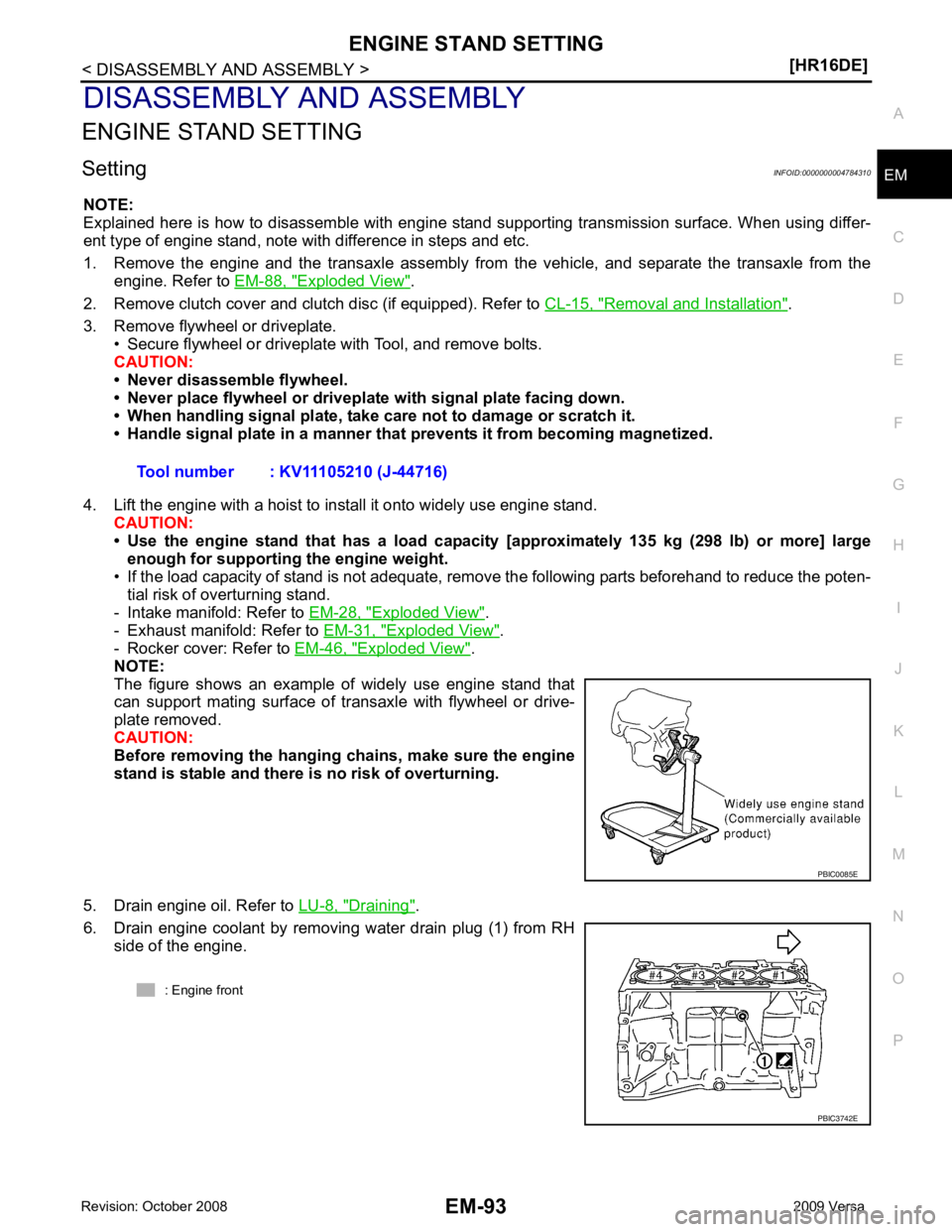
4. Lift the engine with a hoist to install it onto widely use engine stand. CAUTION:
• Use the engine stand that has a load capacity [approximately 135 kg (298 lb) or more] large
enough for supporting the engine weight.
• If the load capacity of stand is not adequate, remove the following parts beforehand to reduce the poten-
tial risk of overturning stand.
- Intake manifold: Refer to EM-28, " Exploded View " .
- Exhaust manifold: Refer to EM-31, " Exploded View " .
- Rocker cover: Refer to EM-46, " Exploded View " .
NOTE:
The figure shows an example of widely use engine stand that
can support mating surface of transaxle with flywheel or drive-
plate removed.
CAUTION:
Before removing the hanging chains, make sure the engine
stand is stable and there is no risk of overturning.
5. Drain engine oil. Refer to LU-8, " Draining " .
6. Drain engine coolant by removing water drain plug (1) from RH side of the engine. Tool number : KV11105210 (J-44716)
Page 3147 of 4331
.
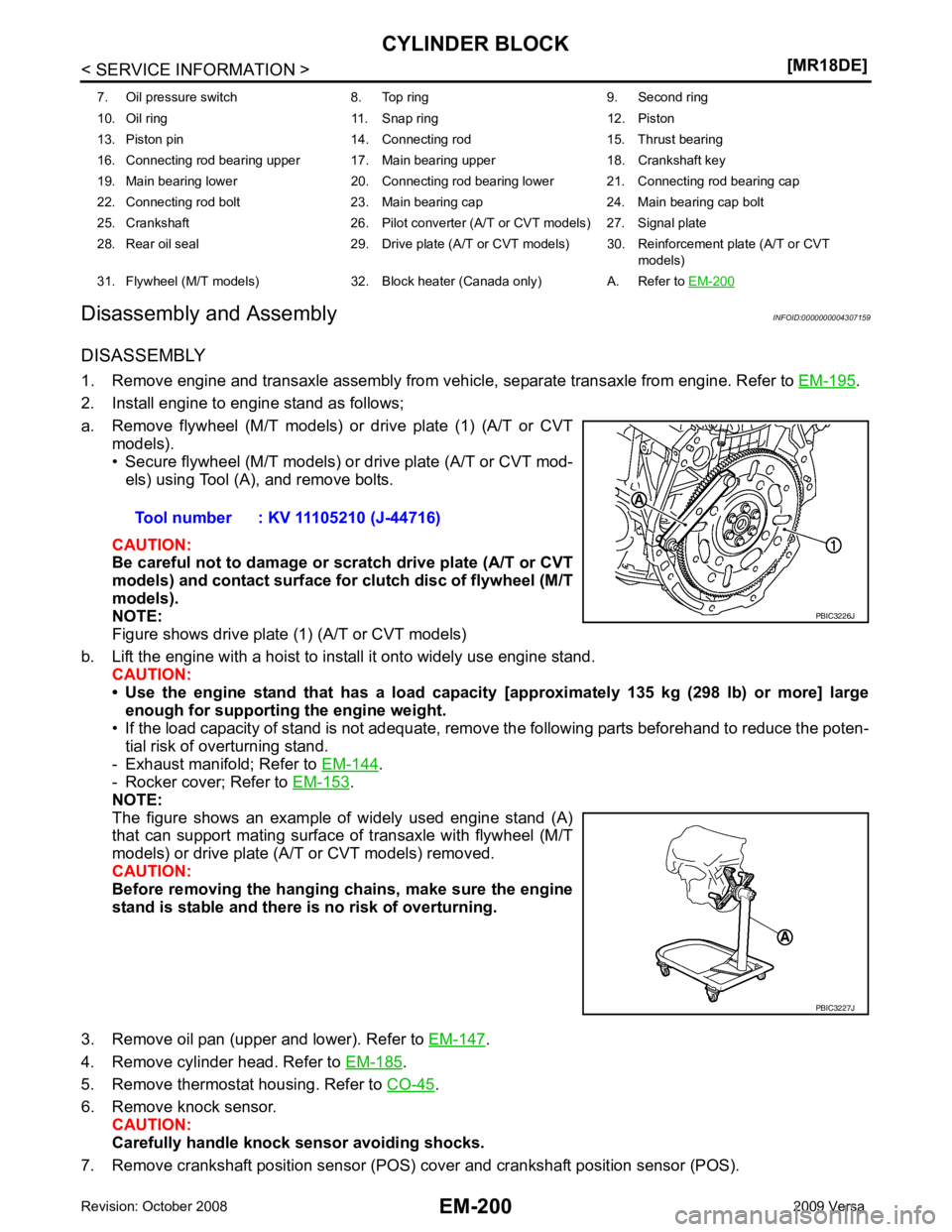
2. Install engine to engine stand as follows;
a. Remove flywheel (M/T models) or drive plate (1) (A/T or CVT models).
• Secure flywheel (M/T models) or drive plate (A/T or CVT mod-
els) using Tool (A), and remove bolts.
CAUTION:
Be careful not to damage or scratch drive plate (A/T or CVT
models) and contact surface for clutch disc of flywheel (M/T
models).
NOTE:
Figure shows drive plate (1) (A/T or CVT models)
b. Lift the engine with a hoist to install it onto widely use engine stand. CAUTION:
• Use the engine stand that has a load capacity [approximately 135 kg (298 lb) or more] large
enough for supporting the engine weight.
• If the load capacity of stand is not adequate, remo ve the following parts beforehand to reduce the poten-
tial risk of overturning stand.
- Exhaust manifold; Refer to EM-144 .
- Rocker cover; Refer to EM-153 .
NOTE:
The figure shows an example of widely used engine stand (A)
that can support mating surface of transaxle with flywheel (M/T
models) or drive plate (A/T or CVT models) removed.
CAUTION:
Before removing the hanging chains, make sure the engine
stand is stable and there is no risk of overturning.
3. Remove oil pan (upper and lower). Refer to EM-147 .
4. Remove cylinder head. Refer to EM-185 .
5. Remove thermostat housing. Refer to CO-45 .
6. Remove knock sensor. CAUTION:
Carefully handle knock sensor avoiding shocks.
7. Remove crankshaft position sensor (POS) cover and crankshaft position sensor (POS).
7. Oil pressure switch 8. Top ring 9. Second ring
10. Oil ring 11. Snap ring 12. Piston
13. Piston pin 14. Connecting rod 15. Thrust bearing
16. Connecting rod bearing upper 17. Main bearing upper 18. Crankshaft key
19. Main bearing lower 20. Connecting rod bearing lower 21. Connecting rod bearing cap
22. Connecting rod bolt 23. Main bearing cap 24. Main bearing cap bolt
25. Crankshaft 26. Pilot converter (A/T or CVT models) 27. Signal plate
28. Rear oil seal 29. Drive plate (A/T or CVT models) 30. Reinforcement plate (A/T or CVT models)
31. Flywheel (M/T models) 32. Block heater (Canada only) A. Refer to EM-200 PBIC3227J