automatic NISSAN TIIDA 2010 Service Owner's Guide
[x] Cancel search | Manufacturer: NISSAN, Model Year: 2010, Model line: TIIDA, Model: NISSAN TIIDA 2010Pages: 3745, PDF Size: 73.67 MB
Page 758 of 3745
NATS (NISSAN ANTI-THEFT SYSTEM)BL-249
< SERVICE INFORMATION >
C
DE
F
G H
J
K L
M A
B
BL
N
O P
-BCM
- Mechanical key
• NATS trouble diagnoses, system initialization and additional registration of other NATS mechanical key IDs
must be carried out using CONSULT-III hardware and CONSULT-III NATS software. When NATS initializa-
tion has been completed, the ID of the inserted mechanical key can be displayed.
Regarding the procedures of NATS initialization and mechanical key ID registration, refer to CONSULT-III
operation manual NATS.
SECURITY INDICATOR
• Forewarns that the vehicle is equipped with NATS.
• Security indicator will not blink while the ignition knob is in ON or START state. NOTE:
Because security indicator is highly efficient, the battery is barely affected.
Condition of Secu rity Indicator
• When operating the ignition switch with Intelligent Key, security indicator lamp will turn off at once if ignition
switch is pressed and blinks when ignition switch is released.
• When operating the ignition switch with mechanical key security indicator will turn off at once if mechanical key is inserted into key cylinder and blinks when mechanical key is removed.
(Once the mechanical key is inserted into key cylinder, BCM will only perform the key ID verification with
mechanical key)
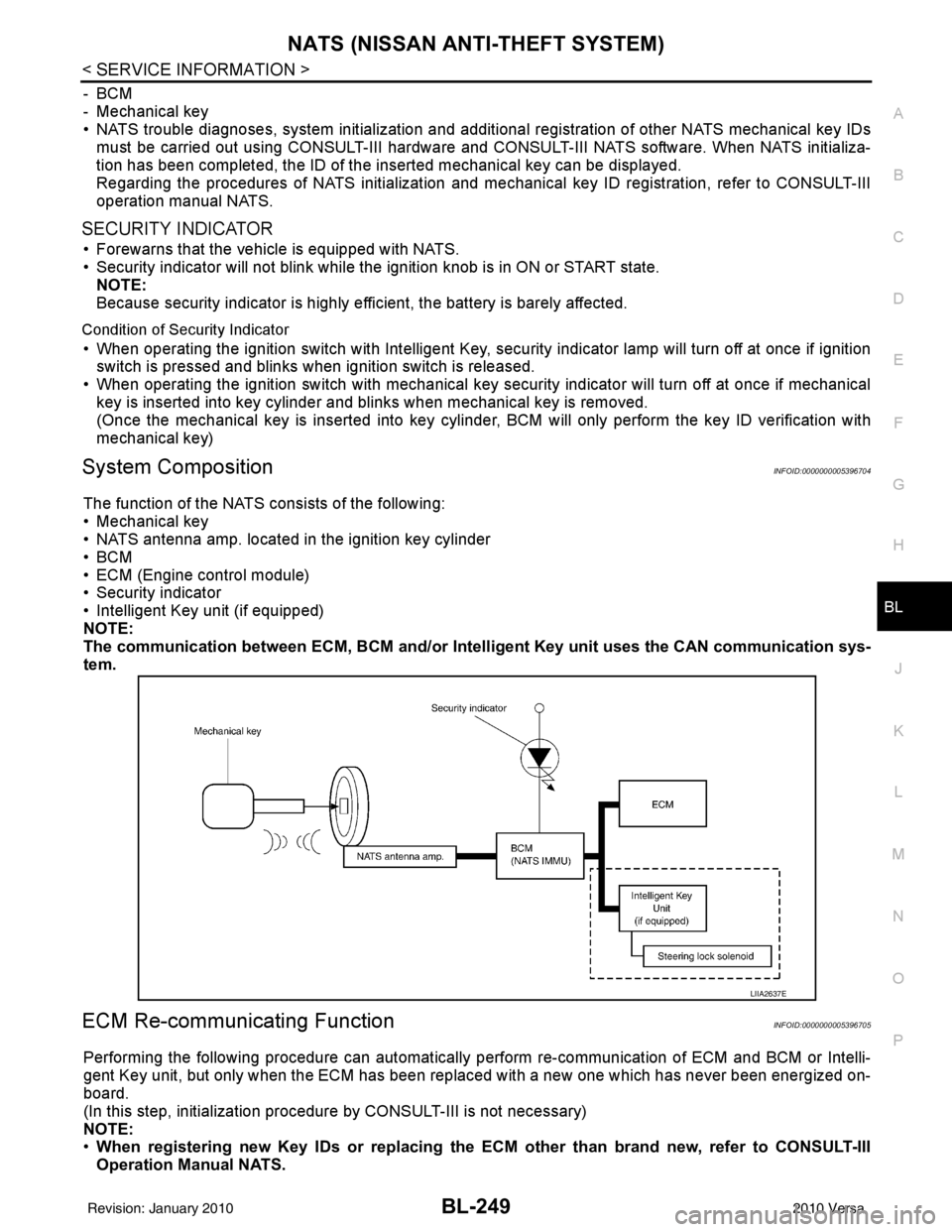
System CompositionINFOID:0000000005396704
The function of the NATS consists of the following:
• Mechanical key
• NATS antenna amp. located in the ignition key cylinder
•BCM
• ECM (Engine control module)
• Security indicator
• Intelligent Key unit (if equipped)
NOTE:
The communication between ECM, BCM and/or Intelligent K ey unit uses the CAN communication sys-
tem.
ECM Re-communicating FunctionINFOID:0000000005396705
Performing the following procedure can automatically perform re-communication of ECM and BCM or Intelli-
gent Key unit, but only when the ECM has been replaced with a new one which has never been energized on-
board.
(In this step, initialization procedur e by CONSULT-III is not necessary)
NOTE:
• When registering new Key IDs or replacing the ECM other than brand new, refer to CONSULT-III
Operation Manual NATS.
LIIA2637E
Revision: January 20102010 Versa
Page 975 of 3745
![NISSAN TIIDA 2010 Service Owners Guide ON-VEHICLE SERVICEBRC-85
< SERVICE INFORMATION > [VDC/TCS/ABS]
C
D
E
G H
I
J
K L
M A
B
BRC
N
O P
ON-VEHICLE SERVICE
Adjustment of Steering Angle Sensor Neutral PositionINFOID:0000000005612181
After re](/img/5/57397/w960_57397-974.png "NISSAN TIIDA 2010 Service Owners Guide ON-VEHICLE SERVICEBRC-85
< SERVICE INFORMATION > [VDC/TCS/ABS]
C
D
E
G H
I
J
K L
M A
B
BRC
N
O P
ON-VEHICLE SERVICE
Adjustment of Steering Angle Sensor Neutral PositionINFOID:0000000005612181
After re")
ON-VEHICLE SERVICEBRC-85
< SERVICE INFORMATION > [VDC/TCS/ABS]
C
D
E
G H
I
J
K L
M A
B
BRC
N
O P
ON-VEHICLE SERVICE
Adjustment of Steering Angle Sensor Neutral PositionINFOID:0000000005612181
After removing/installing or replacing ABS actuator and electric unit (control unit), steering angle sensor, steer-
ing and suspension components which affect wheel alignment or after adjusting wheel alignment, be sure to
adjust neutral position of steering angle sensor before running vehicle.
NOTE:
Adjustment of steering angle sensor neutral position requires CONSULT-III.
1. Stop vehicle with front wheels in straight-ahead position.
2. Connect CONSULT-III to data link connector on vehicle, and turn ignition switch ON (do not start engine).
3. Touch “ABS”, “WORK SUPPORT” and “ST ANGLE SENSOR ADJUSTMENT” on CONSULT-III screen in
this order.
4. Touch “START”. CAUTION:
Do not touch steering wheel whil e adjusting steering angle sensor.
5. After approximately 10 seconds, touch “END”. (After approximately 60 seconds, it ends automatically.)
6. Turn ignition switch OFF, then turn it ON again.
7. Run vehicle with front wheels in straight-ahead position, then stop.
8. Select “DATA MONITOR”, “SELECTION FROM MENU”, and “STR ANGLE SIG” on CONSULT-III screen.
Then check that “STR ANGLE SIG” is within 0 ±2.5 deg. If value is more than specification, repeat steps 1
to 5.
9. Erase memory of ABS actuator and electric unit (control unit) and ECM.
10. Turn ignition switch to OFF.
Revision: January 20102010 Versa
Page 1044 of 3745
![NISSAN TIIDA 2010 Service Owners Guide PRECAUTIONSCVT-11
< SERVICE INFORMATION > [RE0F08B]
D
E
F
G H
I
J
K L
M A
B
CVT
N
O P
• When connecting or disconnecting pin connectors into or
from TCM, take care not to damage pin terminals (bend](/img/5/57397/w960_57397-1043.png "NISSAN TIIDA 2010 Service Owners Guide PRECAUTIONSCVT-11
< SERVICE INFORMATION > [RE0F08B]
D
E
F
G H
I
J
K L
M A
B
CVT
N
O P
• When connecting or disconnecting pin connectors into or
from TCM, take care not to damage pin terminals (bend")
PRECAUTIONSCVT-11
< SERVICE INFORMATION > [RE0F08B]
D
E
F
G H
I
J
K L
M A
B
CVT
N
O P
• When connecting or disconnecting pin connectors into or
from TCM, take care not to damage pin terminals (bend or
break).
When connecting pin connectors make sure that there are not
any bends or breaks on TCM pin terminal.
• Before replacing TCM, perform TCM input/output signal
inspection and make sure whether TCM functions properly or
not. CVT-46, "
TCM Terminal and Reference Value".
• After performing each TROUBL E DIAGNOSIS, perform “DTC
Confirmation Procedure”.
If the repair is completed the DTC should not be displayed in
the “DTC Confirmation Procedure”.
• Always use the specified br and of CVT fluid. Refer to MA-14, "
Flu-
ids and Lubricants".
• Use lint-free paper, not cloth rags, during work.
• After replacing the CVT fluid, dispose of the waste oil using the methods prescribed by law, ordinance, etc.
Service Notice or PrecautionINFOID:0000000005397764
CVT FLUID COOLER SERVICE
If CVT fluid contains friction material (clutches, brakes , etc.), or if an CVT is replaced, inspect and clean the
CVT fluid cooler mounted in the radiator or replace the radiator. Flush cooler lines using cleaning solvent and
compressed air after repair. For CVT fluid cooler cleaning procedure, refer to CVT-15, "
CVT Fluid Cooler
Cleaning". For radiator replacement, refer to CO-40.
OBD-II SELF-DIAGNOSIS
• CVT self-diagnosis is performed by the TCM in combination with the ECM. The results can be read through
the blinking pattern of the malfunction indi cator lamp (MIL). Refer to the table on CVT-48, "
CONSULT-III
Function (TRANSMISSION)" for the indicator used to display each self-diagnostic result.
• The self-diagnostic results indicated by the MIL are automatically stored in both the ECM and TCM memo- ries.
Always perform the procedure on CVT-27, "
OBD-II Diagnostic Trouble Code (DTC)" to complete the
repair and avoid unnecessary blinking of the MIL.
For details of OBD-II, refer to EC-541, "
Introduction".
• Certain systems and components, especially those re lated to OBD, may use the new style slide-lock-
ing type harness connector. For description and how to disconnect, refer to PG-66
.
ATFTEMP COUNT Conversion Table INFOID:0000000005709762
SEF291H
MEF040DA
SEF217U
Revision: January 20102010 Versa
Page 1060 of 3745
![NISSAN TIIDA 2010 Service Owners Guide ON BOARD DIAGNOSTIC (OBD) SYSTEMCVT-27
< SERVICE INFORMATION > [RE0F08B]
D
E
F
G H
I
J
K L
M A
B
CVT
N
O P
ON BOARD DIAGNOSTIC (OBD) SYSTEM
IntroductionINFOID:0000000005397780
The CVT system has two s](/img/5/57397/w960_57397-1059.png "NISSAN TIIDA 2010 Service Owners Guide ON BOARD DIAGNOSTIC (OBD) SYSTEMCVT-27
< SERVICE INFORMATION > [RE0F08B]
D
E
F
G H
I
J
K L
M A
B
CVT
N
O P
ON BOARD DIAGNOSTIC (OBD) SYSTEM
IntroductionINFOID:0000000005397780
The CVT system has two s")
ON BOARD DIAGNOSTIC (OBD) SYSTEMCVT-27
< SERVICE INFORMATION > [RE0F08B]
D
E
F
G H
I
J
K L
M A
B
CVT
N
O P
ON BOARD DIAGNOSTIC (OBD) SYSTEM
IntroductionINFOID:0000000005397780
The CVT system has two self-diagnostic systems.
The first is the emission-related on board diagnostic syst em (OBD-II) performed by the TCM in combination
with the ECM. The malfunction is indicated by the MI L (malfunction indicator lamp) and is stored as a DTC in
the ECM memory, and the TCM memory.
The second is the TCM original self-diagnosis perform ed by the TCM. The malfunction is stored in the TCM
memory. The detected items are overlapped with OBD-II self-diagnostic items. For detail, refer to CVT-48,
"CONSULT-III Function (TRANSMISSION)".
OBD-II Function for CVT SystemINFOID:0000000005397781
The ECM provides emission-related on board diagnostic (OBD-II) functions for the CVT system. One function
is to receive a signal from the TCM used with OBD-relat ed parts of the CVT system. The signal is sent to the
ECM when a malfunction occurs in the corresponding OBD-re lated part. The other function is to indicate a
diagnostic result by means of the MIL (malfunction indica tor lamp) on the instrument panel. Sensors, switches
and solenoid valves are used as sensing elements.
The MIL automatically illuminates in One or Two Trip Detection Logic when a malfunction is sensed in relation
to CVT system parts.
One or Two Trip Detection Logic of OBD-IIINFOID:0000000005397782
ONE TRIP DETECTION LOGIC
If a malfunction is sensed during the first test drive, the MIL will illuminate and the malfunction will be stored in
the ECM memory as a DTC. The TCM is not provided with such a memory function.
TWO TRIP DETECTION LOGIC
When a malfunction is sensed during the first test drive, it is stored in the ECM memory as a 1st trip DTC
(diagnostic trouble code) or 1st trip freeze frame data. At this point, the MIL will not illuminate. — 1st trip
If the same malfunction as that experienced during the fi rst test drive is sensed during the second test drive,
the MIL will illuminate. — 2nd trip
The “trip” in the “One or Two Trip Detection Logic” m eans a driving mode in which self-diagnosis is performed
during vehicle operation.
OBD-II Diagnostic Trouble Code (DTC)INFOID:0000000005397783
HOW TO READ DTC AND 1ST TRIP DTC
DTC and 1st trip DTC can be read by the following methods.
( with CONSULT-III or GST) CONSULT-III or GST (Generic Scan Tool) Examples: P0705, P0720 etc.
These DTC are prescribed by SAE J2012.
(CONSULT-III also displays the malfunctioning component or system.)
• 1st trip DTC No. is the same as DTC No.
• Output of the diagnostic trouble code indicates that the indicated circuit has a malfunction. How-
ever, in case of the Mode II and GST, they do not indicate whether the malfunction is still occurring or
occurred in the past and returned to normal.
CONSULT-III can identify them as shown below, therefore, CONS ULT-III (if available) is recom-
mended.
DTC or 1st trip DTC of a malfunction is displayed in SELF-DIAGNOSTIC RESULTS mode for “ENGINE” with
CONSULT-III. Time data indicates how many times the vehicle was driven after the last detection of a DTC.
If the DTC is being detected curr ently, the time data will be “0”.
If a 1st trip DTC is stored in the ECM, the time data will be “1t”.
Freeze Frame Data and 1st Trip Freeze Frame Data
Revision: January 20102010 Versa
Page 1272 of 3745

EC-7
C
DE
F
G H
I
J
K L
M
EC A
N
O P
FUEL PRESSURE .......................................... ..496
Inspection ............................................................ ..496
EVAP LEAK CHECK ........................................498
Inspection ............................................................ ..498
ON-VEHICLE REPAIR ...............................500
EVAP CANISTER .............................................500
Exploded View .................................................... ..500
Removal and Installation .......................................500
Inspection ............................................................ ..501
SERVICE DATA AND SPECIFICATIONS
(SDS) ......... ................................. ................
502
SERVICE DATA AND SPECIFICATIONS
(SDS) .............................................................. ..
502
Idle Speed ........................................................... ..502
Ignition Timing .......................................................502
Calculated Load Value ..........................................502
Mass Air Flow Sensor ...........................................502
MR18DE
SERVICE INFORMATION .. .......................
503
INDEX FOR DTC ............................................ ..503
U0101-U1001 ...................................................... ..503
P0011-P0075 ........................................................503
P0101-P0128 ........................................................503
P0130-P0183 ........................................................504
P0222-P0420 ........................................................504
P0441-P0463 ........................................................505
P0500-P0643 ........................................................505
P0705-P0734 ........................................................506
P0740-P0840 ........................................................506
P0850-P1574 ........................................................507
P1610-P1615 ........................................................507
P1715-P1805 ........................................................507
P2100-P2A00 ........................................................508
PRECAUTIONS ................................................509
Precaution for Supplemental Restraint System
(SRS) "AIR BAG" and "SEAT BELT PRE-TEN-
SIONER" ............................................................. ..
509
Precaution Necessary for Steering Wheel Rota-
tion After Battery Disconnect ............................... ..
509
Precaution for Procedure without Cowl Top Cover ..510
On Board Diagnosis (OBD) System of Engine and
A/T, CVT ...............................................................
510
Precaution .............................................................510
PREPARATION ................................................514
Special Service Tool ........................................... ..514
Commercial Service Tool ......................................514
ENGINE CONTROL SYSTEM ..........................516
Schematic ........................................................... ..516
Multiport Fuel Injection (MFI) System ...................516
Electronic Ignition (EI) System ..............................519
Fuel Cut Control (at No Load and High Engine
Speed) ................................................................. ..
519
AIR CONDITIONING CUT CONTROL ............521
Input/Output Signal Chart ......................................521
System Description ................................................521
AUTOMATIC SPEED CONTROL DEVICE
(ASCD) ............................................................
522
System Description ................................................522
Component Description .........................................523
CAN COMMUNICATION .................................524
System Description ................................................524
EVAPORATIVE EMISSION SYSTEM .............525
Description .............................................................525
Component Inspection ...........................................527
Exploded View .......................................................529
Removal and Installation .......................................529
How to Detect Fuel Vapor Leakage .......................530
ON BOARD REFUELING VAPOR RECOV-
ERY (ORVR) ....................................................
532
System Description ................................................532
Diagnosis Procedure .............................................532
Component Inspection ...........................................535
POSITIVE CRANKCASE VENTILATION .......538
Description .............................................................538
Component Inspection ...........................................538
NVIS (NISSAN VEHICLE IMMOBILIZER SYS-
TEM-NATS) .....................................................
540
Description .............................................................540
ON BOARD DIAGNOSTIC (OBD) SYSTEM ..541
Introduction ............................................................541
Two Trip Detection Logic .......................................541
Emission-related Diagnostic Information ...............542
Malfunction Indicator Lamp (MIL) ..........................565
OBD System Operation Chart ...............................568
BASIC SERVICE PROCEDURE .....................574
Basic Inspection ....................................................574
Idle Speed and Ignition Timing Check ...................578
Procedure After Replacing ECM ...........................579
VIN Registration ....................................................580
Accelerator Pedal Released Position Learning .....580
Throttle Valve Closed Position Learning ...............580
Idle Air Volume Learning .......................................580
Fuel Pressure Check .............................................582
TROUBLE DIAGNOSIS ..................................585
Trouble Diagnosis Introduction ..............................585
DTC Inspection Priority Chart ................................590
Fail-Safe Chart ......................................................590
Symptom Matrix Chart ...........................................592
Engine Control Component Parts Location ...........596
Vacuum Hose Drawing ..........................................602
Circuit Diagram ......................................................603
Revision: January 20102010 Versa
Page 1303 of 3745
![NISSAN TIIDA 2010 Service Owners Guide EC-38
< FUNCTION DIAGNOSIS >[HR16DE]
MULTIPORT FUEL INJECTION SYSTEM
designed. Both manufacturing differences (i.e., mass ai
r flow sensor hot wire) and characteristic changes dur-
ing operation (i.e.](/img/5/57397/w960_57397-1302.png "NISSAN TIIDA 2010 Service Owners Guide EC-38
< FUNCTION DIAGNOSIS >[HR16DE]
MULTIPORT FUEL INJECTION SYSTEM
designed. Both manufacturing differences (i.e., mass ai
r flow sensor hot wire) and characteristic changes dur-
ing operation (i.e.")
EC-38
< FUNCTION DIAGNOSIS >[HR16DE]
MULTIPORT FUEL INJECTION SYSTEM
designed. Both manufacturing differences (i.e., mass ai
r flow sensor hot wire) and characteristic changes dur-
ing operation (i.e., fuel injector clogging) directly affect mixture ratio.
Accordingly, the difference between the basic and theoretical mixture ratios is monitored in this system. This is
then computed in terms of “injection pulse duration” to automatically compensate for the difference between
the two ratios.
“Fuel trim” refers to the feedback compensation value co mpared against the basic injection duration. Fuel trim
includes short-term fuel trim and long-term fuel trim.
“Short-term fuel trim” is the short-term fuel compensation used to maintain the mixture ratio at its theoretical
value. The signal from A/F sensor 1 indicates whether the mixture ratio is RICH or LEAN compared to the the-
oretical value. The signal then triggers a reduction in fuel volume if the mixture ratio is rich, and an increase in
fuel volume if it is lean.
“Long-term fuel trim” is overall fuel compensation carri ed out over time to compensate for continual deviation
of the short-term fuel trim from the central value. Continual deviation will occur due to individual engine differ-
ences, wear over time and changes in the usage environment.
FUEL INJECTION TIMING
Two types of systems are used.
• Sequential Multiport Fuel Injection System Fuel is injected into each cylinder during each engine cy cle according to the ignition order. This system is
used when the engine is running.
• Simultaneous Multiport Fuel Injection System Fuel is injected simultaneously into all four cylinder s twice each engine cycle. In other words, pulse signals
of the same width are simultaneously transmitted from the ECM.
The four injectors will then receive the signals two times for each engine cycle.
This system is used when the engine is being started and/ or if the fail-safe system (CPU) is operating.
FUEL SHUT-OFF
Fuel to each cylinder is cut off during deceleration, operation of the engine at excessively high speeds or oper-
ation of the vehicle at excessively high speeds.
SEF337W
Revision: January 20102010 Versa
Page 1352 of 3745
![NISSAN TIIDA 2010 Service Owners Guide ON BOARD DIAGNOSTIC (OBD) SYSTEMEC-87
< FUNCTION DIAGNOSIS > [HR16DE]
C
D
E
F
G H
I
J
K L
M A
EC
NP
O
In most cases the ECM will automatically complete its self-diagnosis cycle during normal usage, an](/img/5/57397/w960_57397-1351.png "NISSAN TIIDA 2010 Service Owners Guide ON BOARD DIAGNOSTIC (OBD) SYSTEMEC-87
< FUNCTION DIAGNOSIS > [HR16DE]
C
D
E
F
G H
I
J
K L
M A
EC
NP
O
In most cases the ECM will automatically complete its self-diagnosis cycle during normal usage, an")
ON BOARD DIAGNOSTIC (OBD) SYSTEMEC-87
< FUNCTION DIAGNOSIS > [HR16DE]
C
D
E
F
G H
I
J
K L
M A
EC
NP
O
In most cases the ECM will automatically complete its self-diagnosis cycle during normal usage, and the SRT
status will indicate “CMPLT” for each application system. Once set as “CMPLT”, the SRT status remains
“CMPLT” until the self-diagnosis memory is erased.
Occasionally, certain portions of the self-diagnostic test
may not be completed as a result of the customer's
normal driving pattern; the SRT will indicate “INCMP” for these items.
NOTE:
The SRT will also indicate “INCMP” if the self-diagnosis memory is erased for any reason or if the ECM mem-
ory power supply is interrupted for several hours.
If, during the state emissions inspection, the SRT indicates “CMPLT” for all test items, the inspector will con-
tinue with the emissions test. However, if the SRT i ndicates “INCMP” for one or more of the SRT items the
vehicle is returned to the customer untested.
NOTE:
If permanent DTC is stored or MIL illuminates during the state emissions inspection, the vehicle is also
returned to the customer untested even though the SRT indicates “CMPLT” for all test items. Therefore, it is
important to check SRT (“CMPLT ”), DTC (No DTCs) and permanent DT C (No permanent DTCs) before the
inspection.
SRT Item
The table below shows required self-diagnostic items to set the SRT to “CMPLT”.
*: If completion of several SRTs is required, perform driving patterns (DTC CONFIRMATION PROCEDURE), one by one based on the
priority for models with CONSULT-III.
SRT Set Timing
SRT is set as “CMPLT” after self-diagnosis has been performed one or more times. Completion of SRT is
done regardless of whether the result is OK or NG. T he set timing is different between OK and NG results and
is shown in the table below.
SRT item
(CONSULT-III indication) Performance
Priority* Required self-diagnostic items to set the SRT to “CMPLT” Corresponding
DTC No.
CATALYST 2 Three way catalyst function P0420
EVAP SYSTEM 2 EVAP control system purge flow monitoring P0441
1 EVAP control system P0442
2 EVAP control system P0456
HO2S 2 Air fuel ratio (A/F) sensor 1 P0133
Heated oxygen sensor 2 P0137
Heated oxygen sensor 2 P0138
Heated oxygen sensor 2 P0139
EGR/VVT SYSTEM 3 Intake value timing control function P0011
Self-diagnosis resultExample
Diagnosis Ignition cycle
← ON →OFF ← ON → OFF← ON →OFF ← ON →
All OK Case 1 P0400 OK (1) — (1) OK (2) — (2) P0402OK (1) — (1)— (1)OK (2)
P1402 OK (1) OK (2) — (2)— (2)
SRT of EGR “CMPLT” “CMPLT” “CMPLT” “CMPLT”
Case 2 P0400OK (1) — (1)— (1) — (1)
P0402 — (0)— (0)OK (1) — (1)
P1402 OK (1) OK (2) — (2)— (2)
SRT of EGR “INCMP” “INCMP” “CMPLT” “CMPLT”
Revision: January 20102010 Versa
Page 1367 of 3745
![NISSAN TIIDA 2010 Service Owners Guide EC-102
< FUNCTION DIAGNOSIS >[HR16DE]
ON BOARD DIAGNOSTIC (OBD) SYSTEM
*: The item is indicated, but not used.
NOTE:
Any monitored item that does not match the vehicle being diagnosed is deleted from](/img/5/57397/w960_57397-1366.png "NISSAN TIIDA 2010 Service Owners Guide EC-102
< FUNCTION DIAGNOSIS >[HR16DE]
ON BOARD DIAGNOSTIC (OBD) SYSTEM
*: The item is indicated, but not used.
NOTE:
Any monitored item that does not match the vehicle being diagnosed is deleted from")
EC-102
< FUNCTION DIAGNOSIS >[HR16DE]
ON BOARD DIAGNOSTIC (OBD) SYSTEM
*: The item is indicated, but not used.
NOTE:
Any monitored item that does not match the vehicle being diagnosed is deleted from the display automatically.PURG VOL C/V %
• Indicates the EVAP canister purge volume control so-
lenoid valve control value computed by the ECM ac-
cording to the input signals.
• The opening becomes larger as the value increases.
INT/V TIM(B1) °CA • Indicates [ °CA] of intake camshaft advance angle.
INT/V SOL(B1) %• The control value of the intake valve timing control so-
lenoid valve (determined by ECM according to the in-
put signals) is indicated.
• The advance angle becomes larger as the value in- creases.
AIR COND RLY ON/OFF • The air conditioner relay control condition (determined
by ECM according to the input signals) is indicated.
FUEL PUMP RLY ON/OFF • Indicates the fuel pump relay control condition deter-
mined by ECM according to the input signals.
VENT CONT/V ON/OFF • The control condition of the EVAP canister vent control
valve (determined by ECM according to the input sig-
nals) is indicated.
ON: Closed
OFF: Open
THRTL RELAY ON/OFF • Indicates the throttle contro
l motor relay control condi-
tion determined by the ECM according to the input sig-
nals.
COOLING FAN HI/LOW/
OFF• Indicates the condition of the cooling fan (determined
by ECM according to the input signals).
HI: High speed operation
LOW: Low speed operation
OFF: Stop
HO2S2 HTR (B1) ON/OFF • Indicates [ON/OFF] condition of heated oxygen sen-
sor 2 heater determined by ECM according to the in-
put signals.
I/P PULLY SPD rpm • Indicates the engine speed computed from the prima-
ry sped sensor signal.
VEHICLE SPEED km/h or
mph • The vehicle speed computed from the vehicle speed
signal sent from TCM is displayed.
IDL A/V LEARN YET/CM-
PLT • Display the condition of Idle Air Volume Learning
YET: Idle air volume learning has not been performed
yet.
CMPLT: Idle air volume learning has already been per-
formed successfully.
TRVL AFTER MIL km or
mile • Distance traveled while MIL is activated.
A/F S1 HTR(B1) % • Air fuel ratio (A/F) sensor 1 heater control value com-
puted by ECM according to the input signals.
• The current flow to the heater becomes larger as the value increases.
AC PRESS SEN V • The signal voltage from the refrigerant pressure sen-
sor is displayed.
A/F ADJ-B1 —• Indicates the correction of factor stored in ECM. The
factor is calculated from the difference between the
target air-fuel ratio stored in ECM and the air-fuel ratio
calculated from A/F sensor 1 signal.
HO2 S2 DIAG2 (B1)
*
[INCMP/CMPLT] —• Indicates DTC P0139 self-diagnosis (slow responce)
INCMP: Self-diagnosis is incomplete.
CMPLT: Self-diagnosis is complete.
Monitored item Unit
DescriptionRemarks
Revision: January 20102010 Versa
Page 1708 of 3745
![NISSAN TIIDA 2010 Service Owners Guide ON BOARD REFUELING VAPOR RECOVERY (ORVR)EC-443
< COMPONENT DIAGNOSIS > [HR16DE]
C
D
E
F
G H
I
J
K L
M A
EC
NP
O
ON BOARD REFUELING VAPOR RECOVERY (ORVR)
DescriptionINFOID:0000000005398624
From the beg](/img/5/57397/w960_57397-1707.png "NISSAN TIIDA 2010 Service Owners Guide ON BOARD REFUELING VAPOR RECOVERY (ORVR)EC-443
< COMPONENT DIAGNOSIS > [HR16DE]
C
D
E
F
G H
I
J
K L
M A
EC
NP
O
ON BOARD REFUELING VAPOR RECOVERY (ORVR)
DescriptionINFOID:0000000005398624
From the beg")
ON BOARD REFUELING VAPOR RECOVERY (ORVR)EC-443
< COMPONENT DIAGNOSIS > [HR16DE]
C
D
E
F
G H
I
J
K L
M A
EC
NP
O
ON BOARD REFUELING VAPOR RECOVERY (ORVR)
DescriptionINFOID:0000000005398624
From the beginning of refueling, the air and vapor insi
de the fuel tank go through refueling EVAP vapor cut
valve and EVAP/ORVR line to the EVAP canister. The v apor is absorbed by the EVAP canister and the air is
released to the atmosphere.
When the refueling has reached the full level of the fuel tank, the refueling EVAP vapor cut valve is closed and
refueling is stopped because of auto shut-off. The vapor which was absorbed by the EVAP canister is purged
during driving.
WARNING:
When conducting inspectio ns below, be sure to observe the following:
• Put a “CAUTION: FLAMMABL E” sign in workshop.
• Do not smoke while servicing fuel system. Keep open flames and sparks away from work area.
• Be sure to furnish the workshop with a CO
2 fire extinguisher.
CAUTION:
• Before removing fuel line parts, carry out the following procedures:
- Put drained fuel in an explosion-proof containe r and put lid on securely.
- Release fuel pressure from fuel line. Refer to FL-5, "
Checking Fuel Line".
- Disconnect battery ground cable.
• Always replace O-ring when the fu el gauge retainer is removed.
• Do not kink or twist hose and tube when they are installed.
• Do not tighten hose and clamps excessively to avoid damaging hoses.
• After installation, run engine and check for fuel leaks at connection.
• Do not attempt to top off the fuel tank after the fuel pump nozzle shuts off automatically.
Continued refueling may cause fuel overflow, resulting in fuel spray and possibly a fire.
Component Function CheckINFOID:0000000005398625
1.CHECK ORVR FUNCTION
Check whether the following symptoms are present.
• Fuel odor from EVAP canister is strong.
• Cannot refuel/Fuel odor from the fuel filler opening is strong while refueling.
Is any symptom present?
YES >> Go to EC-443, "Diagnosis Procedure".
NO >> INSPECTION END
Diagnosis ProcedureINFOID:0000000005398626
1.INSPECTION START
Check whether the following symptoms are present.
A: Fuel odor from EVAP canister is strong.
JMBIA1930GB
Revision: January 20102010 Versa
Page 1783 of 3745
![NISSAN TIIDA 2010 Service Owners Guide EC-518
< SERVICE INFORMATION >[MR18DE]
ENGINE CONTROL SYSTEM
The mixture ratio feedback system provides the best air/fuel mixture ratio for drivability and emission control.
The three way catalyst (ma](/img/5/57397/w960_57397-1782.png "NISSAN TIIDA 2010 Service Owners Guide EC-518
< SERVICE INFORMATION >[MR18DE]
ENGINE CONTROL SYSTEM
The mixture ratio feedback system provides the best air/fuel mixture ratio for drivability and emission control.
The three way catalyst (ma")
EC-518
< SERVICE INFORMATION >[MR18DE]
ENGINE CONTROL SYSTEM
The mixture ratio feedback system provides the best air/fuel mixture ratio for drivability and emission control.
The three way catalyst (manifold) can then better r
educe CO, HC and NOx emissions. This system uses air
fuel ratio (A/F) sensor 1 in the exhaust manifold to monitor whether the engine operation is rich or lean. The
ECM adjusts the injection pulse width according to t he sensor voltage signal. For more information about air
fuel ratio (A/F) sensor 1, refer to EC-704
. This maintains the mixture ratio within the range of stoichiometric
(ideal air/fuel mixture).
This stage is referred to as the closed loop control condition.
Heated oxygen sensor 2 is located downstream of the th ree way catalyst (manifold). Even if the switching
characteristics of air fuel ratio (A/F) sensor 1 shift, the air/fuel ratio is controlled to stoichiometric by the signal
from heated oxygen sensor 2.
Open Loop Control
The open loop system condition refers to when the ECM detects any of the following conditions. Feedback
control stops in order to maintain stabilized fuel combustion.
• Deceleration and acceleration
• High-load, high-speed operation
• Malfunction of air fuel ratio (A/F) sensor 1 or its circuit
• Insufficient activation of air fuel ratio (A /F) sensor 1 at low engine coolant temperature
• High engine coolant temperature
• During warm-up
• After shifting from N to D (A/T and CVT models)
• When starting the engine
MIXTURE RATIO SELF-LEARNING CONTROL
The mixture ratio feedback control system monitors the mixt ure ratio signal transmitted from air fuel ratio (A/F)
sensor 1. This feedback signal is then sent to the ECM. The ECM controls the basic mixture ratio as close to
the theoretical mixture ratio as possible. However, the bas ic mixture ratio is not necessarily controlled as orig-
inally designed. Both manufacturing differences (i.e., mass air flow sensor hot wire) and characteristic
changes during operation (i.e., fuel injector clogging) directly affect mixture ratio.
Accordingly, the difference between the basic and theoretical mixture ratios is monitored in this system. This is
then computed in terms of “injection pulse duration” to automatically compensate for the difference between
the two ratios.
“Fuel trim” refers to the feedback compensation value co mpared against the basic injection duration. Fuel trim
includes short term fuel trim and long term fuel trim.
“Short term fuel trim” is the short-term fuel compensati on used to maintain the mixture ratio at its theoretical
value. The signal from air fuel ratio (A/F) sensor 1 i ndicates whether the mixture ratio is RICH or LEAN com-
pared to the theoretical value. The signal then triggers a r eduction in fuel volume if the mixture ratio is rich, and
an increase in fuel volume if it is lean.
“Long term fuel trim” is overall fuel compensation carri ed out long-term to compensate for continual deviation
of the short term fuel trim from t he central value. Such deviation will occur due to individual engine differences,
wear over time and changes in the usage environment.
FUEL INJECTION TIMING
Two types of systems are used.
Sequential Multiport Fuel Injection System
Fuel is injected into each cylinder during each engine cycle according to the firing order. This system is used
when the engine is running.
Simultaneous Multiport Fuel Injection System
Fuel is injected simultaneously into all four cylinders twice each engine cycle. In other words, pulse signals of
the same width are simultaneously transmitted from the ECM.
The four fuel injectors will then receive the signals two times for each engine cycle.
SEF337W
Revision: January 20102010 Versa