Accelerator NISSAN TIIDA 2010 Service Workshop Manual
[x] Cancel search | Manufacturer: NISSAN, Model Year: 2010, Model line: TIIDA, Model: NISSAN TIIDA 2010Pages: 3745, PDF Size: 73.67 MB
Page 222 of 3745
TROUBLE DIAGNOSIS FOR SYMPTOMSAT-205
< SERVICE INFORMATION >
DE
F
G H
I
J
K L
M A
B
AT
N
O P
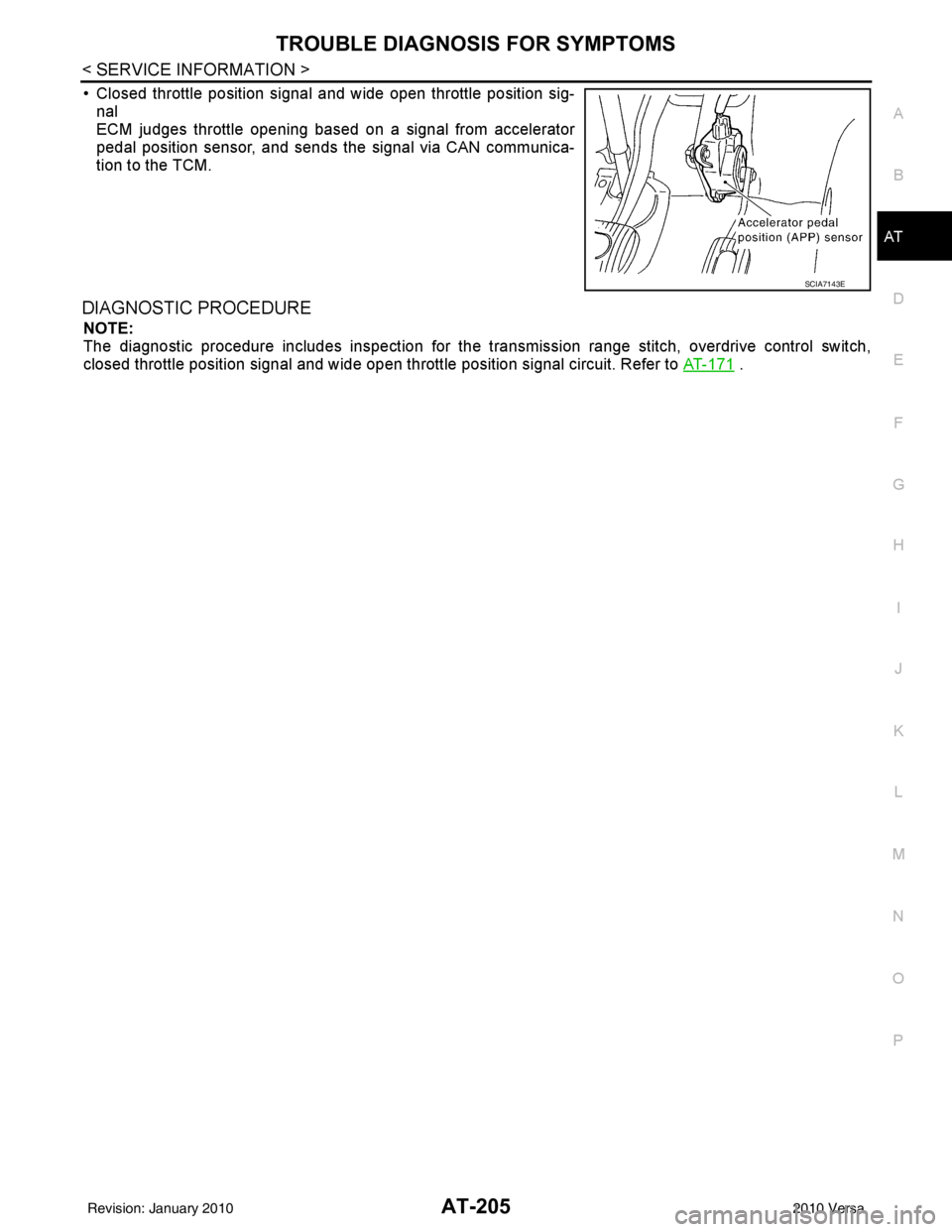
• Closed throttle position signal and wide open throttle position sig- nal
ECM judges throttle opening based on a signal from accelerator
pedal position sensor, and sends the signal via CAN communica-
tion to the TCM.
DIAGNOSTIC PROCEDURE
NOTE:
The diagnostic procedure includes inspection for the tr ansmission range stitch, overdrive control switch,
closed throttle position signal and wide open throttle position signal circuit. Refer to AT-171
.
SCIA7143E
Revision: January 20102010 Versa
Page 390 of 3745

SERVICE DATA AND SPECIFICATIONS (SDS)AT-373
< SERVICE INFORMATION >
DE
F
G H
I
J
K L
M A
B
AT
N
O P
SERVICE DATA AND SPECIFICATIONS (SDS)
General SpecificationINFOID:0000000005397455
*: Refer to MA-14.
Vehicle Speed at Which Gear Shifting OccursINFOID:0000000005397456
HR16DE engine models
MR18DE engine models
• At half throttle, the accelerator opening is 4/8 of the full opening.
Vehicle Speed at When Lock-up Occurs/ReleasesINFOID:0000000005397457
HR16DE engine models
MR18DE engine models
Engine HR16DEMR18DE
Automatic transaxle model RE4F03B
Automatic transaxle assembly Model code number 3CX3D, 3CX3E3CX0D
Transaxle gear ratio 1st
2.861
2nd 1.562
3rd 1.000
4th 0.697
Reverse 2.310
Final drive 4.072
Recommended fluid Genuine NISSAN Matic S ATF (Continental U.S. and Alaska) or
Canada NISSAN Automatic Transmission Fluid*
Fluid capacity [ (US qt, Imp qt)] 7.7 (8-1/8, 6-3/4)
7.9 (8-3/8, 7)
Throttle position Vehicle speed km/h (MPH)
D1 → D2D2 → D3D3 → D4D4 → D3D3 → D2D2 → D1
Full throttle 49 - 57
(31 - 35) 93 - 101
(58 - 62) 148 - 156
(92 - 96) 144 - 152
(90 - 94) 82 - 90
(51 - 55) 39 - 47
(25 - 29)
Half throttle 35 - 43
(22 - 26) 59 - 67
(37 - 41) 117 - 125
(73 - 77) 59 - 67
(37 - 41) 34 - 42
(22 - 26) 15 - 23
(10 - 14)
Throttle position Vehicle speed km/h (MPH)
D
1 → D2D2 → D3D3 → D4D4 → D3D3 → D2D2 → D1
Full throttle 51 - 59
(32 - 37) 97 - 105
(60 - 65) 154 - 162
(96 - 101) 150 - 158
(93 - 98) 87 - 95
(54 - 59) 40 - 48
(25 - 30)
Half throttle 34 - 42
(21 - 26) 62 - 70
(39 - 43) 124 - 132
(77 - 82) 69 - 77
(43 - 48) 36 - 44
(22 - 27) 19 - 27
(12 - 17)
Throttle position Selector lever position Vehicle speed km/h (MPH)
Lock-up ON Lock-up OFF
2.0/8 “D” position
73 - 81 (46 - 50) 49 - 57 (31 - 35)
“D” position (OD OFF) 86 - 94 (53 - 58) 82 - 90 (51 - 55)
Throttle position Selector lever position Vehicle speed km/h (MPH)
Lock-up ON Lock-up OFF
2.0/8 “D” position
86 - 94 (53 - 58) 59 - 67 (37 - 42)
“D” position (OD OFF) 86 - 94 (53 - 58) 83 - 91 (52 - 57)
Revision: January 20102010 Versa
Page 856 of 3745
BR-8
< SERVICE INFORMATION >
BRAKE PEDAL
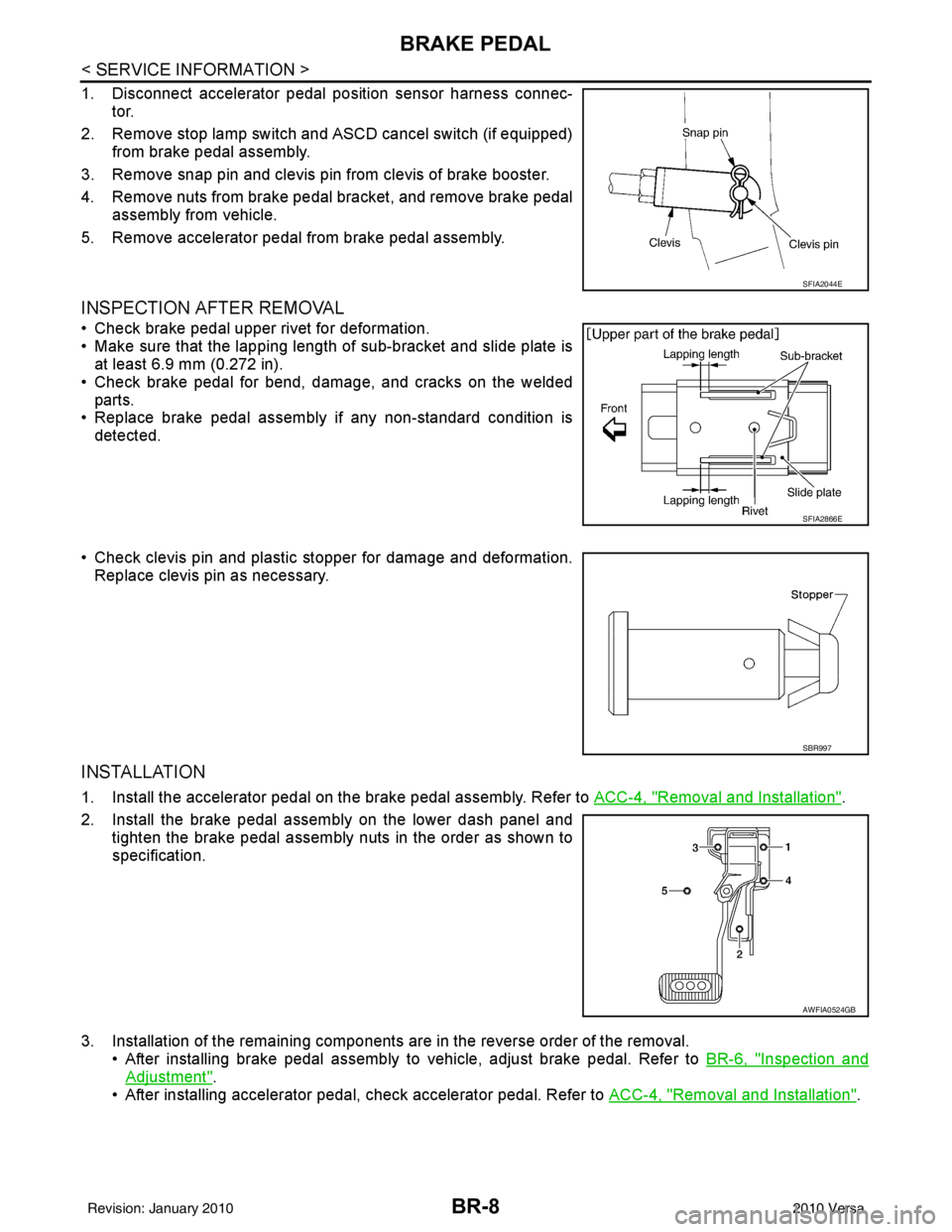
1. Disconnect accelerator pedal position sensor harness connec-tor.
2. Remove stop lamp switch and ASCD cancel switch (if equipped) from brake pedal assembly.
3. Remove snap pin and clevis pin from clevis of brake booster.
4. Remove nuts from brake pedal bracket, and remove brake pedal assembly from vehicle.
5. Remove accelerator pedal from brake pedal assembly.
INSPECTION AFTER REMOVAL
• Check brake pedal upper rivet for deformation.
• Make sure that the lapping length of sub-bracket and slide plate is at least 6.9 mm (0.272 in).
• Check brake pedal for bend, damage, and cracks on the welded parts.
• Replace brake pedal assembly if any non-standard condition is
detected.
• Check clevis pin and plastic stopper for damage and deformation. Replace clevis pin as necessary.
INSTALLATION
1. Install the accelerator pedal on the brake pedal assembly. Refer to ACC-4, "Removal and Installation".
2. Install the brake pedal assembly on the lower dash panel and tighten the brake pedal assembly nuts in the order as shown to
specification.
3. Installation of the remaining components are in the reverse order of the removal. • After installing brake pedal assembly to vehicle, adjust brake pedal. Refer to BR-6, "
Inspection and
Adjustment".
• After installing accelerator pedal, check accelerator pedal. Refer to ACC-4, "
Removal and Installation".
SFIA2044E
SFIA2866E
SBR997
AWFIA0524GB
Revision: January 20102010 Versa
Page 949 of 3745
![NISSAN TIIDA 2010 Service Workshop Manual TROUBLE DIAGNOSISBRC-59
< SERVICE INFORMATION > [VDC/TCS/ABS]
C
D
E
G H
I
J
K L
M A
B
BRC
N
O P
ACCEL POS SIG Open/close condition
of throttle valve (linked
with accelerator pedal)Accelerator pedal](/img/5/57397/w960_57397-948.png "NISSAN TIIDA 2010 Service Workshop Manual TROUBLE DIAGNOSISBRC-59
< SERVICE INFORMATION > [VDC/TCS/ABS]
C
D
E
G H
I
J
K L
M A
B
BRC
N
O P
ACCEL POS SIG Open/close condition
of throttle valve (linked
with accelerator pedal)Accelerator pedal")
TROUBLE DIAGNOSISBRC-59
< SERVICE INFORMATION > [VDC/TCS/ABS]
C
D
E
G H
I
J
K L
M A
B
BRC
N
O P
ACCEL POS SIG Open/close condition
of throttle valve (linked
with accelerator pedal)Accelerator pedal not de-
pressed (ignition switch is ON)
0%
BRC-79, "
CAN Commu-
nication System Inspec-
tion"Depress accelerator pedal (ig-
nition switch is ON) 0 to 100%
SIDE G-SENSOR Transverse G detected
by side G-sensorVehicle stopped
Approx. 0 m/s
2
BRC-70, "Yaw Rate/Side/
Decel G Sensor System
Inspection"
Vehicle turning rightnegative value (m/
s2)
Vehicle turning left positive value (m/
s
2)
STR ANGLE SIG Steering angle detect-
ed by steering angle
sensorStraight-ahead
Approx. 0°BRC-69, "
Steering Angle
Sensor System Inspec-
tion"Steering wheel turned –720 to 720 °
PRESS SENSOR Brake fluid pressure
detected by pressure
sensorWith ignition switch ON and
brake pedal released
Approx. 0 bar
BRC-77, "
Pressure Sen-
sor System Inspection"With ignition switch ON and
brake pedal depressed –40 to 300 bar
EBD SIGNAL EBD operation EBD is active
On
—
EBD is inactive Off
ABS SIGNAL ABS operationABS is active
On
—
ABS is inactive Off
TCS SIGNAL TCS operationTCS is active
On
—
TCS is inactive Off
VDC SIGNAL VDC operationVDC is active
On
—
VDC is inactive Off
EBD FAIL SIG EBD fail-safe signal In EBD fail safe mode On
—
EBD is normal Off
ABS FAIL SIG ABS fail-safe signal In ABS fail safe mode
On
—
ABS is normal Off
TCS FAIL SIG TCS fail-safe signal In TCS fail safe mode
On
—
TCS is normal Off
VDC FAIL SIG VDC fail-safe signal In VDC fail safe mode On
—
VDC is normal Off
CRANKING SIG Crank operation Crank is active
On
—
Crank is inactive Off
FLUID LEV SW Status of brake fluid
level switchWhen brake fluid level switch
ON
On
BRC-76, "
Brake Fluid
Level Switch System In-
spection"When brake fluid level switch
OFF Off
PARK BRAKE SW Status of parking brake
switchParking brake switch is active On
BRC-79, "
Component In-
spection"Parking brake switch is inactive Off
Monitor item Display content
Data monitor
Note: Error inspection
checklist
Condition Reference value in
normal operation
Revision: January 20102010 Versa
Page 1042 of 3745
![NISSAN TIIDA 2010 Service Workshop Manual PRECAUTIONSCVT-9
< SERVICE INFORMATION > [RE0F08B]
D
E
F
G H
I
J
K L
M A
B
CVT
N
O P
6. Turn ignition switch ON. CAUTION:
Never start engine.
7. Select “Self Diagnostic Results” in “TRANSMISSION](/img/5/57397/w960_57397-1041.png "NISSAN TIIDA 2010 Service Workshop Manual PRECAUTIONSCVT-9
< SERVICE INFORMATION > [RE0F08B]
D
E
F
G H
I
J
K L
M A
B
CVT
N
O P
6. Turn ignition switch ON. CAUTION:
Never start engine.
7. Select “Self Diagnostic Results” in “TRANSMISSION")
PRECAUTIONSCVT-9
< SERVICE INFORMATION > [RE0F08B]
D
E
F
G H
I
J
K L
M A
B
CVT
N
O P
6. Turn ignition switch ON. CAUTION:
Never start engine.
7. Select “Self Diagnostic Results” in “TRANSMISSION”.
8. Shift the selector lever to “R” position.
9. Depress slightly the accelerator pedal (Pedal angle: 2/8) while depressing the brake pedal.
10. Select “Erase” with step 9.
11. Release brake pedal and accelerator pedal.
12. Turn ignition switch OFF while keeping the selector lever in “R” position.
13. Wait approximately 10 seconds.
14. Turn ignition switch ON while keeping the selector lever in “R” position.
15. Select “Special function” in “TRANSMISSION”.
16. Check that the value on “CALIB DATA” in CONSULT-II I is the same as the data listed in the table below.
• Restart the procedure from step 3 if the values are not the same.
CALIB DATA
17. Shift the selector lever to “P” position.
18. Check that the shift position indicator in combinat ion meter turns ON. (It indicates approximately 1 or 2
seconds after shifting the selector lever to “P” position.)
• Check the following items if shift position indicator does not turn ON. Repair or replace accordingly as
necessary.
- The harness between TCM and ROM ASSY in transaxle assembly is open or shorted.
- Terminals disconnected, loose, or bent from connector housing.
- Power supply and ground of TCM. Refer to CVT-113, "
Description".
PATTERN C
1. Replace transaxle assembly first, and then replace TCM.
2. Perform the service of “PATTERN A”.
(Perform the service of “PATTERN B” if TCM is replaced first.)
Removal and Installation Procedure for CVT Unit ConnectorINFOID:0000000005397762
REMOVAL
Rotate bayonet ring counterclockwise, pull out CVT unit harness
connector upward and disconnect it.
INSTALLATION
Item name Display value
UNIT CLB ID 1 00
UNIT CLB ID 2 00
UNIT CLB ID 3 00
UNIT CLB ID 4 00
UNIT CLB ID 5 00
UNIT CLB ID 6 00
SCIA2096E
Revision: January 20102010 Versa
Page 1054 of 3745
![NISSAN TIIDA 2010 Service Workshop Manual CVT SYSTEMCVT-21
< SERVICE INFORMATION > [RE0F08B]
D
E
F
G H
I
J
K L
M A
B
CVT
N
O P
Hydraulic Control SystemINFOID:0000000005397772
TCM FunctionINFOID:0000000005397773
The function of the TCM is to:](/img/5/57397/w960_57397-1053.png "NISSAN TIIDA 2010 Service Workshop Manual CVT SYSTEMCVT-21
< SERVICE INFORMATION > [RE0F08B]
D
E
F
G H
I
J
K L
M A
B
CVT
N
O P
Hydraulic Control SystemINFOID:0000000005397772
TCM FunctionINFOID:0000000005397773
The function of the TCM is to:")
CVT SYSTEMCVT-21
< SERVICE INFORMATION > [RE0F08B]
D
E
F
G H
I
J
K L
M A
B
CVT
N
O P
Hydraulic Control SystemINFOID:0000000005397772
TCM FunctionINFOID:0000000005397773
The function of the TCM is to:
• Receive input signals sent from various switches and sensors.
• Determine required line pressure, shifting point, and lock-up operation.
• Send required output signals to the step motor and the respective solenoids.
CONTROL SYSTEM OUTLINE
The CVT senses vehicle operating conditions through various sensors. It always controls the optimum shift
position and reduces shifting and lock-up shocks.
AWDIA0768GB
SENSORS (or SIGNAL)
⇒TCM
⇒ACTUATORS
Transmission range switch
Accelerator pedal position signal
Closed throttle position signal
Engine speed signal
CVT fluid temperature sensor
Vehicle speed signal
Overdrive control signal
Stop lamp switch signal
Primary speed sensor
Secondary speed sensor
Secondary pressure sensor Shift control
Line pressure control
Primary pressure control
Secondary pressure control
Lock-up control
Engine brake control
Vehicle speed control
Fail-safe control
Self-diagnosis
CONSULT-III co
mmunication
line
Duet-EA control
CAN system
On board diagnosis Step motor
Torque converter clutch solenoid
valve
Lock-up select solenoid valve
Line pressure solenoid valve
Secondary pressure solenoid
valve
Shift position indicator
O/D OFF indicator lamp
Starter relay
Revision: January 20102010 Versa
Page 1055 of 3745
![NISSAN TIIDA 2010 Service Workshop Manual CVT-22
< SERVICE INFORMATION >[RE0F08B]
CVT SYSTEM
CONTROL SYSTEM DIAGRAM
CAN CommunicationINFOID:0000000005397774
SYSTEM DESCRIPTION
CAN (Controller Area Network) is a serial communication line for](/img/5/57397/w960_57397-1054.png "NISSAN TIIDA 2010 Service Workshop Manual CVT-22
< SERVICE INFORMATION >[RE0F08B]
CVT SYSTEM
CONTROL SYSTEM DIAGRAM
CAN CommunicationINFOID:0000000005397774
SYSTEM DESCRIPTION
CAN (Controller Area Network) is a serial communication line for")
CVT-22
< SERVICE INFORMATION >[RE0F08B]
CVT SYSTEM
CONTROL SYSTEM DIAGRAM
CAN CommunicationINFOID:0000000005397774
SYSTEM DESCRIPTION
CAN (Controller Area Network) is a serial communication line for real time application. It is an on-vehicle mul-
tiplex communication line with high data communication s
peed and excellent error detection ability. Many elec-
tronic control units are equipped onto a vehicle, and each control unit shares information and links with other
control units during operation (not independent). In CA N communication, control units are connected with 2
communication lines (CAN-H line, CAN-L line) allowing a high rate of information transmission with less wiring.
Each control unit transmits/receives data but selectively reads required data only. For details, refer to LAN-7,
"System Description".
Input/Output Signal of TCMINFOID:0000000005397775
AWDIA0769GB
Control itemFluid
pressure control Select con-
trol Shift control Lock-up
control CAN com-
munication control Fail-safe
function (*3)
Input T
ra n sm is sio n r ang e s wit c h XXXXXX
Accelerator pedal position signal
(*1)XXXXXX
Closed throttle position signal
(*1)X XXX
Engine speed signal
(*1)XX XXX
CVT fluid temperature sensor XX XX X
Stop lamp switch signal
(*1)X XXX
Overdrive control signal
(*1)XX
Primary speed sensor X XXXX
Secondary speed sensor XXXXXX
Secondary pressure sensor XX X
T C M pow er s upp ly v olt a ge s ig n al XXXXXX
Revision: January 20102010 Versa
Page 1057 of 3745
![NISSAN TIIDA 2010 Service Workshop Manual CVT-24
< SERVICE INFORMATION >[RE0F08B]
CVT SYSTEM
mand to the step motor, and control the flow-in/flow-out of line pressure from the primary pulley to determine
the position of the moving-pulley and](/img/5/57397/w960_57397-1056.png "NISSAN TIIDA 2010 Service Workshop Manual CVT-24
< SERVICE INFORMATION >[RE0F08B]
CVT SYSTEM
mand to the step motor, and control the flow-in/flow-out of line pressure from the primary pulley to determine
the position of the moving-pulley and")
CVT-24
< SERVICE INFORMATION >[RE0F08B]
CVT SYSTEM
mand to the step motor, and control the flow-in/flow-out of line pressure from the primary pulley to determine
the position of the moving-pulley and control the gear ratio.
NOTE:
The gear ratio is set for every position separately.
“D” POSITION
Shifting over all the ranges of gear ratios from the lowest to the high-
est.
OVERDRIVE-OFF MODE
Use this position for the improved engine braking.
“L” POSITION
By limiting the gear range to the lowest position, the strong driving
force and the engine brake can be secured.
DOWNHILL ENGINE BRAKE CONTROL
(AUTO ENGINE BRAKE CONTROL)
When downhill is detected with the accelerator pedal released, the engine brake will be strengthened up by
downshifting so as not to accelerate the vehicle more than necessary.
ACCELERATION CONTROL
According to vehicle speed and a change of accelerator pedal angle, driver's request for acceleration and driv-
ing scene are judged. This function assists improvem ent in acceleration feeling by making the engine speed
proportionate to the vehicle speed. And a shift map which can gain a larger driving force is available for com-
patibility of mileage with driveability.
AWDIA0770GB
SCIA1953E
SCIA1955E
Revision: January 20102010 Versa
Page 1069 of 3745
![NISSAN TIIDA 2010 Service Workshop Manual CVT-36
< SERVICE INFORMATION >[RE0F08B]
TROUBLE DIAGNOSIS
CVT Electrical Parts Location
INFOID:0000000005397788
1. O/D OFF indicator lamp 2. Shift position indicator3. Accelerator pedal position senso](/img/5/57397/w960_57397-1068.png "NISSAN TIIDA 2010 Service Workshop Manual CVT-36
< SERVICE INFORMATION >[RE0F08B]
TROUBLE DIAGNOSIS
CVT Electrical Parts Location
INFOID:0000000005397788
1. O/D OFF indicator lamp 2. Shift position indicator3. Accelerator pedal position senso")
CVT-36
< SERVICE INFORMATION >[RE0F08B]
TROUBLE DIAGNOSIS
CVT Electrical Parts Location
INFOID:0000000005397788
1. O/D OFF indicator lamp 2. Shift position indicator3. Accelerator pedal position sensor
4. CVT unit harness connector 5. Fuel door release 6. TCM
7. Overdrive control switch
BCIA0033E
Revision: January 20102010 Versa
Page 1072 of 3745
![NISSAN TIIDA 2010 Service Workshop Manual TROUBLE DIAGNOSISCVT-39
< SERVICE INFORMATION > [RE0F08B]
D
E
F
G H
I
J
K L
M A
B
CVT
N
O P
6. While holding down the foot brake, gradually press down the accelerator pedal.
7. Quickly read off the st](/img/5/57397/w960_57397-1071.png "NISSAN TIIDA 2010 Service Workshop Manual TROUBLE DIAGNOSISCVT-39
< SERVICE INFORMATION > [RE0F08B]
D
E
F
G H
I
J
K L
M A
B
CVT
N
O P
6. While holding down the foot brake, gradually press down the accelerator pedal.
7. Quickly read off the st")
TROUBLE DIAGNOSISCVT-39
< SERVICE INFORMATION > [RE0F08B]
D
E
F
G H
I
J
K L
M A
B
CVT
N
O P
6. While holding down the foot brake, gradually press down the accelerator pedal.
7. Quickly read off the stall speed, and then quickly remove your foot from the accelerator pedal.
CAUTION:
Do not hold down the accelerat or pedal for more than 5 sec-
onds during this test.
8. Move the selector lever to the “N” position.
9. Cool down the CVT fluid. CAUTION:
Run the engine at idle for at least 1 minute.
10. Repeat steps 6 through 9 with selector lever in “R” position.
Judgement Stall Test
O: Stall speed within standard value position.
H: Stall speed is higher than standard value.
L: Stall speed is lower than standard value.
LINE PRESSURE TEST
Line Pressure Test Port
Line Pressure Test Procedure
1. Inspect the amount of engine oil and replenish if necessary.
2. Drive the car for about 10 minutes to warm it up so that the CVT fluid reaches in the range of 50 to 80°C
(122 to 176 °F), then inspect the amount of CVT fluid and replenish if necessary.
NOTE: Stall speed:
CVT-176, "
Stall Speed"
SAT514G
SAT771B
Selector lever position
Expected problem location
“D” “R”
Stall rotation HO•F
orw ard c lu tc h
O H • Reverse brake
L L • Engine and torque converter one-way clutch
HH • Line pressure low
• Primary pulley
• Secondary pulley
•Steel belt
SCIA6184E
Revision: January 20102010 Versa