ECO mode NISSAN TITAN 2023 Manual Online
[x] Cancel search | Manufacturer: NISSAN, Model Year: 2023, Model line: TITAN, Model: NISSAN TITAN 2023Pages: 644, PDF Size: 7.8 MB
Page 571 of 644
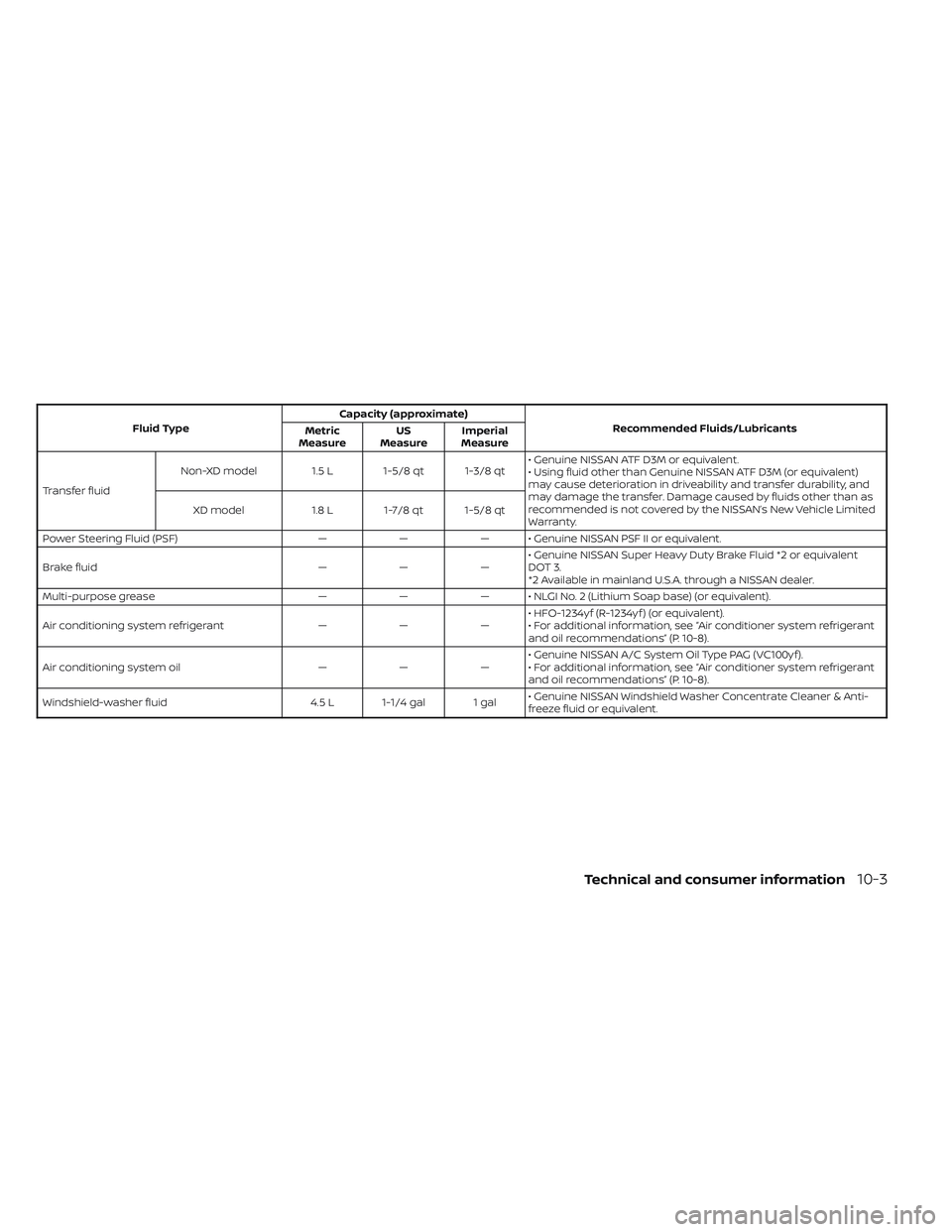
Fluid TypeCapacity (approximate)
Recommended Fluids/Lubricants
Metric
Measure US
Measure Imperial
Measure
Transfer fluid Non-XD model
1.5 L 1-5/8 qt 1-3/8 qt • Genuine NISSAN ATF D3M or equivalent.
• Using fluid other than Genuine NISSAN ATF D3M (or equivalent)
may cause deterioration in driveability and transfer durability, and
may damage the transfer. Damage caused by fluids other than as
recommended is not covered by the NISSAN’s New Vehicle Limited
Warranty.
XD model
1.8 L 1-7/8 qt 1-5/8 qt
Power Steering Fluid (PSF) ——— • Genuine NISSAN PSF II or equivalent.
Brake fluid ———• Genuine NISSAN Super Heavy Duty Brake Fluid *2 or equivalent
DOT 3.
*2 Available in mainland U.S.A. through a NISSAN dealer.
Multi-purpose grease ——— • NLGI No. 2 (Lithium Soap base) (or equivalent).
Air conditioning system refrigerant ———• HFO-1234yf (R-1234yf ) (or equivalent).
• For additional information, see “Air conditioner system refrigerant
and oil recommendations” (P. 10-8).
Air conditioning system oil ———• Genuine NISSAN A/C System Oil Type PAG (VC100yf ).
• For additional information, see “Air conditioner system refrigerant
and oil recommendations” (P. 10-8).
Windshield-washer fluid 4.5 L 1-1/4 gal 1 gal• Genuine NISSAN Windshield Washer Concentrate Cleaner & Anti-
freeze fluid or equivalent.
Technical and consumer information10-3
Page 598 of 644
CREW CAB MODELS
Crew Cab short wheel base models
should not be used to carry a slide-in
camper.
KING CAB® MODELS
This information is provided for you to
properly install a slide-in camper and is
based on the National Highway Traffic
Safety Administration regulations. It is rec-
ommended that, before installing the
camper, you carefully read the following in-
formation and ensure that the camper
meets the specifications.
This information may not apply to some
Canada model vehicles.
SPECIAL BODY VEHICLES
Some vehicles are equipped with commer-
cial or camper bodies. However, this Own-
er's Manual does not cover these options.
For additional information, refer to the
body manufacturer's instruction manual.
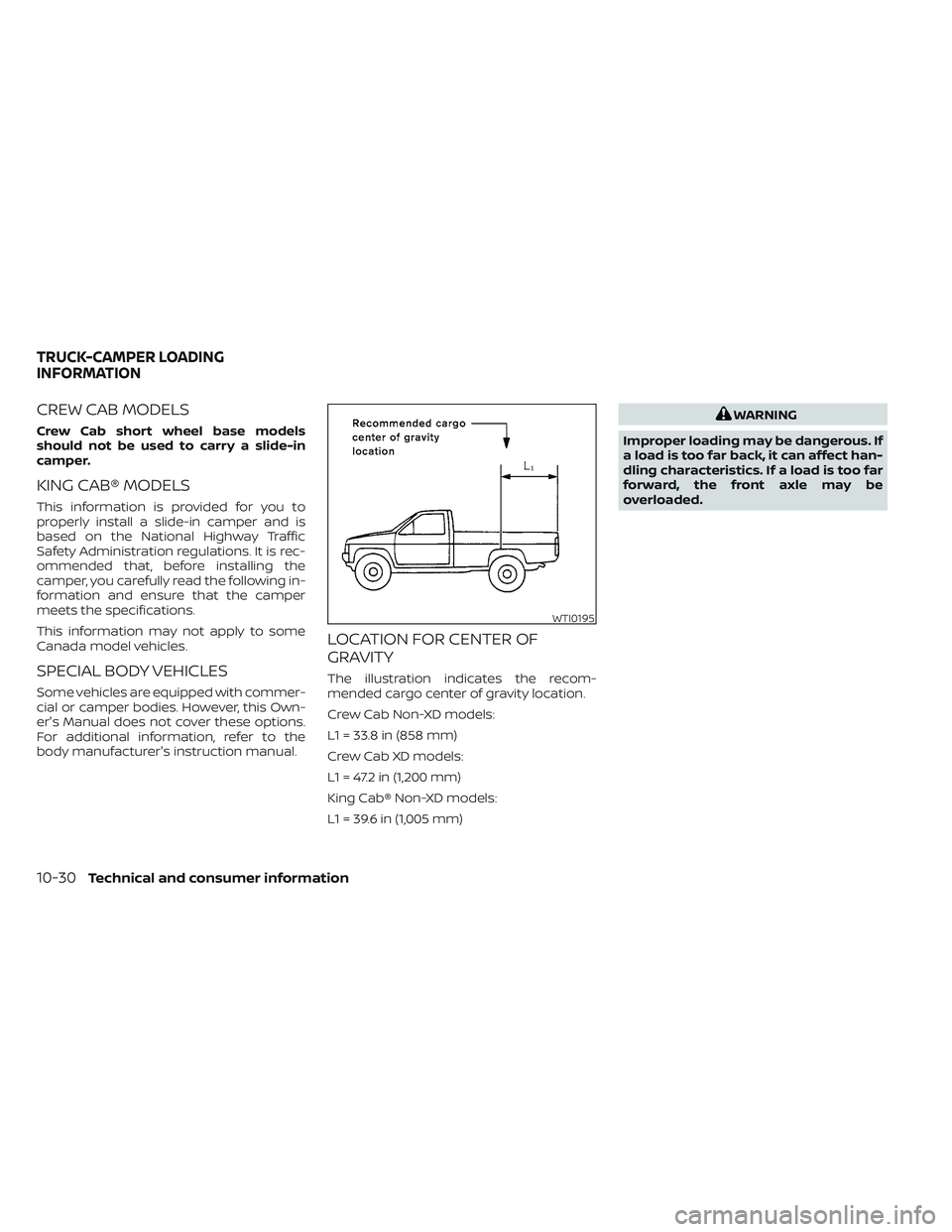
LOCATION FOR CENTER OF
GRAVITY
The illustration indicates the recom-
mended cargo center of gravity location.
Crew Cab Non-XD models:
L1 = 33.8 in (858 mm)
Crew Cab XD models:
L1 = 47.2 in (1,200 mm)
King Cab® Non-XD models:
L1 = 39.6 in (1,005 mm)
WARNING
Improper loading may be dangerous. If
a load is too far back, it can affect han-
dling characteristics. If a load is too far
forward, the front axle may be
overloaded.
WTI0195
TRUCK-CAMPER LOADING
INFORMATION
10-30Technical and consumer information
Page 601 of 644
Temperature conditions can also affect
towing. For example, towing a heavy trailer
in high outside temperatures on graded
roads can affect engine performance and
cause overheating. The engine protection
mode, which helps reduce the chance of
engine damage, could activate and auto-
matically decrease engine power. Vehicle
speed may decrease under high load. Plan
your trip carefully to account for trailer and
vehicle load, weather and road conditions.
WARNING
Overheating can result in reduced en-
gine power and vehicle speed. The re-
duced speed may be lower than other
traffic, which could increase the chance
of a collision. Be especially careful
when driving. If the vehicle cannot
maintain a safe driving speed, pull to
the side of the road in a safe area. Allow
the engine to cool and return to normal
operation. For additional information,
see “If your vehicle overheats” (P. 6-12).
CAUTION
Vehicle damage resulting from im-
proper towing procedures is not cov-
ered by NISSAN warranties.
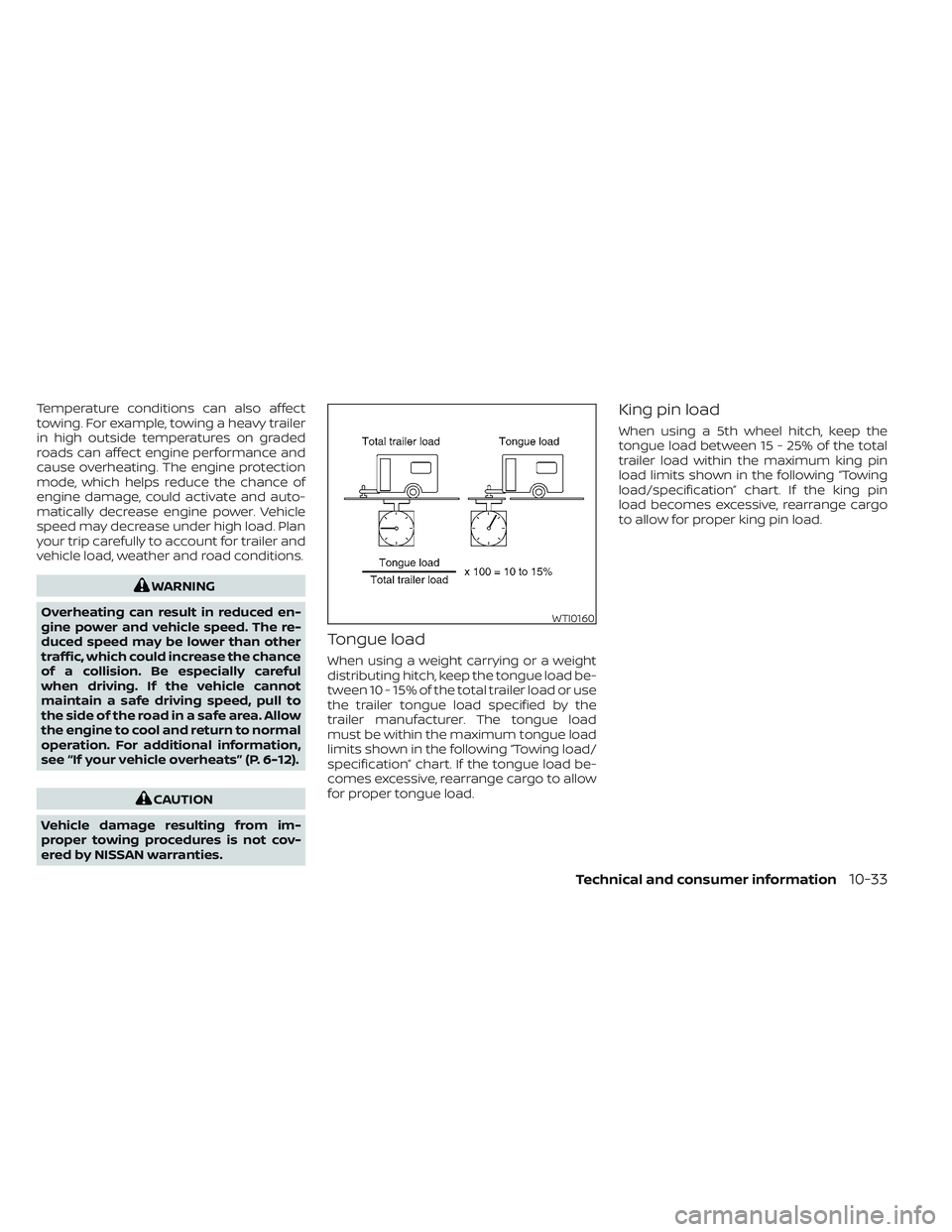
Tongue load
When using a weight carrying or a weight
distributing hitch, keep the tongue load be-
tween 10 - 15% of the total trailer load or use
the trailer tongue load specified by the
trailer manufacturer. The tongue load
must be within the maximum tongue load
limits shown in the following “Towing load/
specification” chart. If the tongue load be-
comes excessive, rearrange cargo to allow
for proper tongue load.
King pin load
When using a 5th wheel hitch, keep the
tongue load between 15 - 25% of the total
trailer load within the maximum king pin
load limits shown in the following “Towing
load/specification” chart. If the king pin
load becomes excessive, rearrange cargo
to allow for proper king pin load.
WTI0160
Technical and consumer information10-33
Page 605 of 644
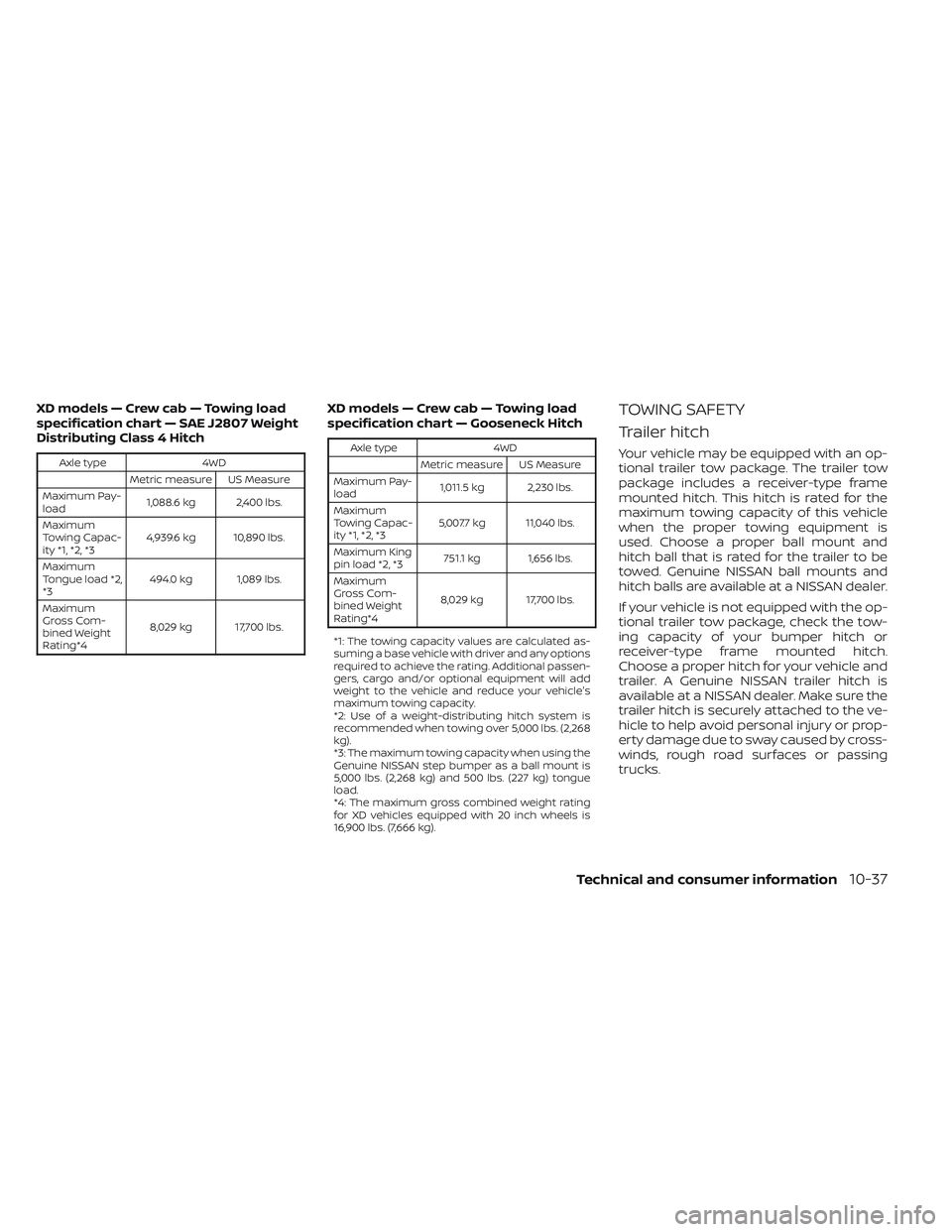
XD models — Crew cab — Towing load
specification chart — SAE J2807 Weight
Distributing Class 4 Hitch
Axle type4WD
Metric measure US Measure
Maximum Pay-
load 1,088.6 kg 2,400 lbs.
Maximum
Towing Capac-
ity *1, *2, *3 4,939.6 kg 10,890 lbs.
Maximum
Tongue load *2,
*3 494.0 kg 1,089 lbs.
Maximum
Gross Com-
bined Weight
Rating*4 8,029 kg 17,700 lbs.
XD models — Crew cab — Towing load
specification chart — Gooseneck Hitch
Axle type
4WD
Metric measure US Measure
Maximum Pay-
load 1,011.5 kg 2,230 lbs.
Maximum
Towing Capac-
ity *1, *2, *3 5,007.7 kg 11,040 lbs.
Maximum King
pin load *2, *3 751.1 kg 1,656 lbs.
Maximum
Gross Com-
bined Weight
Rating*4 8,029 kg 17,700 lbs.
*1: The towing capacity values are calculated as-
suming a base vehicle with driver and any options
required to achieve the rating. Additional passen-
gers, cargo and/or optional equipment will add
weight to the vehicle and reduce your vehicle's
maximum towing capacity.
*2: Use of a weight-distributing hitch system is
recommended when towing over 5,000 lbs. (2,268
kg).
*3: The maximum towing capacity when using the
Genuine NISSAN step bumper as a ball mount is
5,000 lbs. (2,268 kg) and 500 lbs. (227 kg) tongue
load.
*4: The maximum gross combined weight rating
for XD vehicles equipped with 20 inch wheels is
16,900 lbs. (7,666 kg).
TOWING SAFETY
Trailer hitch
Your vehicle may be equipped with an op-
tional trailer tow package. The trailer tow
package includes a receiver-type frame
mounted hitch. This hitch is rated for the
maximum towing capacity of this vehicle
when the proper towing equipment is
used. Choose a proper ball mount and
hitch ball that is rated for the trailer to be
towed. Genuine NISSAN ball mounts and
hitch balls are available at a NISSAN dealer.
If your vehicle is not equipped with the op-
tional trailer tow package, check the tow-
ing capacity of your bumper hitch or
receiver-type frame mounted hitch.
Choose a proper hitch for your vehicle and
trailer. A Genuine NISSAN trailer hitch is
available at a NISSAN dealer. Make sure the
trailer hitch is securely attached to the ve-
hicle to help avoid personal injury or prop-
erty damage due to sway caused by cross-
winds, rough road surfaces or passing
trucks.
Technical and consumer information10-37
Page 616 of 644
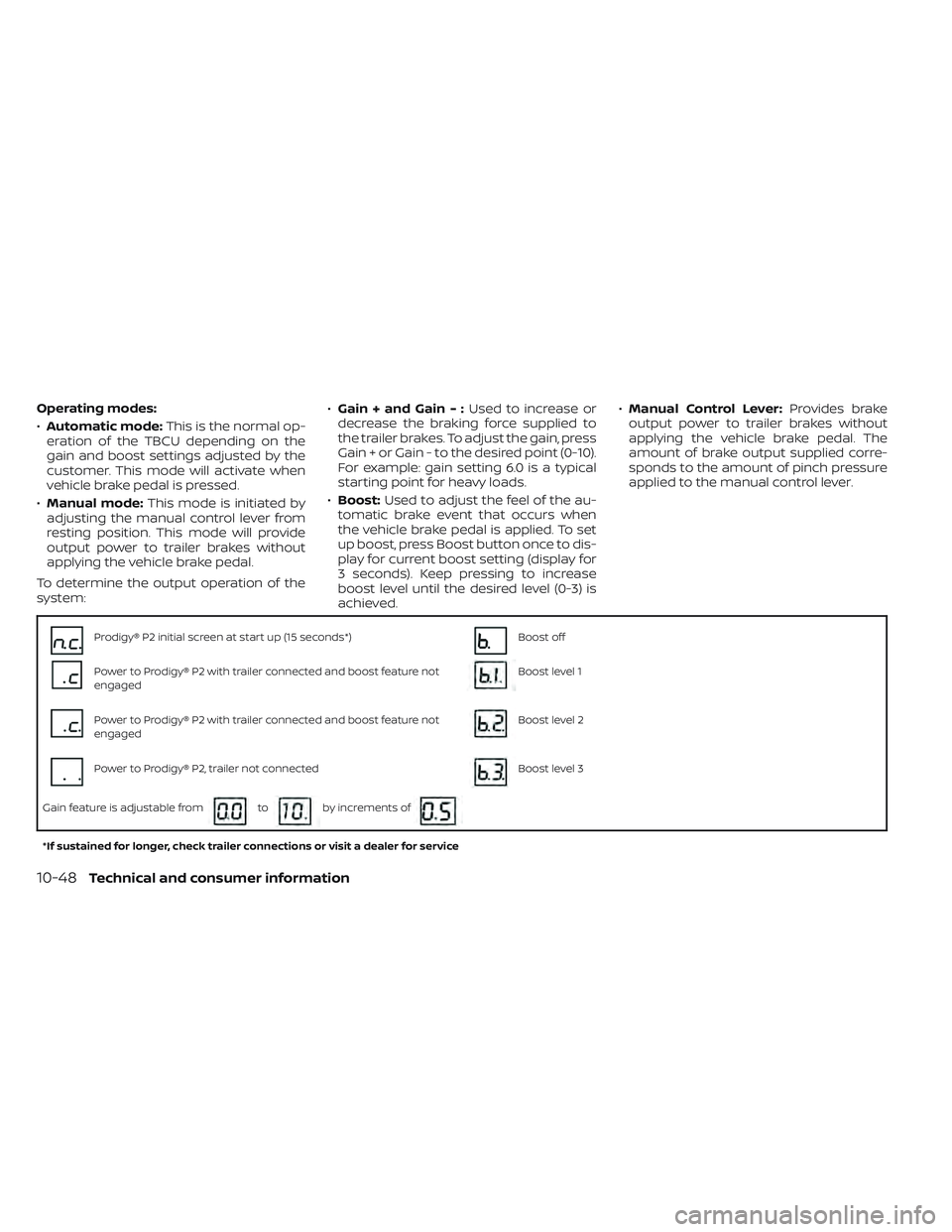
Operating modes:
•Automatic mode: This is the normal op-
eration of the TBCU depending on the
gain and boost settings adjusted by the
customer. This mode will activate when
vehicle brake pedal is pressed.
• Manual mode: This mode is initiated by
adjusting the manual control lever from
resting position. This mode will provide
output power to trailer brakes without
applying the vehicle brake pedal.
To determine the output operation of the
system: •
Gain + and Gain - : Used to increase or
decrease the braking force supplied to
the trailer brakes. To adjust the gain, press
Gain + or Gain - to the desired point (0-10).
For example: gain setting 6.0 is a typical
starting point for heavy loads.
• Boost: Used to adjust the feel of the au-
tomatic brake event that occurs when
the vehicle brake pedal is applied. To set
up boost, press Boost button once to dis-
play for current boost setting (display for
3 seconds). Keep pressing to increase
boost level until the desired level (0-3) is
achieved. •
Manual Control Lever: Provides brake
output power to trailer brakes without
applying the vehicle brake pedal. The
amount of brake output supplied corre-
sponds to the amount of pinch pressure
applied to the manual control lever.
Prodigy® P2 initial screen at start up (15 seconds*)Boost off
Power to Prodigy® P2 with trailer connected and boost feature not
engagedBoost level 1
Power to Prodigy® P2 with trailer connected and boost feature not
engagedBoost level 2
Power to Prodigy® P2, trailer not connectedBoost level 3
Gain feature is adjustable from
toby increments of
*If sustained for longer, check trailer connections or visit a dealer for service
10-48Technical and consumer information
Page 618 of 644
• Be certain your rearview mirrors conformto all federal, state or local regulations. If
not, install any mirrors required for towing
before driving the vehicle.
• Determine the overall height of the ve- hicle and trailer so the required clearance
is known.
Trailer towing tips
In order to gain skill and an understanding
of the vehicle's behavior, you should prac-
tice turning, stopping and backing up in an
area which is free from traffic. Steering sta-
bility and braking performance will be
somewhat different than under normal
driving conditions.
• Always secure items in the trailer to pre-vent load shif t while driving.
• Lock the trailer hitch coupler with a pin or lock to prevent the coupler from inadver-
tently becoming unlatched.
• Avoid abrupt starts, acceleration or stops.
• Avoid sharp turns or lane changes.
• Always drive your vehicle at a moderate speed. • When backing up, hold the bottom of the
steering wheel with one hand. Move your
hand in the direction in which you want
the trailer to go. Make small corrections
and back up slowly. If possible, have
someone guide you when you are back-
ing up.
Always block the wheels on both vehicle
and trailer when parking. Parking on a
slope is not recommended; however, if you
must do so:
CAUTION
If you move the shif t selector to the P
(Park) position before blocking the
wheels and applying the parking brake,
transmission damage could occur.
1. Apply and hold the brake pedal.
2. Have someone place blocks on the downhill side of the vehicle and trailer
wheels.
3. Af ter the wheel blocks are in place, slowly release the brake pedal until the
blocks absorb the vehicle load.
4. Apply the parking brake.
5. Shif t the transmission into P (Park). 6. Make sure the
indicator light (if so
equipped) indicates the transfer case is
in 4H, 4LO, or 2H and that the ATP light is
off. If the
indicator light is flashing,
or the ATP light is ON, make sure the
transmission is in P (Park) (A/T) and turn
the 4WD switch to 2WD or 4H. For addi-
tional information, see “Automatic
transmission park warning light” (P. 2-15)
and “Using 4-wheel drive (4WD)” (P. 5-105).
7. Turn off the engine.
To drive away:
1. Start the vehicle.
2. Apply and hold the brake pedal.
3. Shif t the transmission into gear.
4. Release the parking brake.
5. Drive slowly until the vehicle and trailer are clear from the blocks.
6. Apply and hold the brake pedal.
7. Have someone retrieve and store the blocks.
10-50Technical and consumer information
Page 620 of 644
• Use the Tow Mode or downshif t thetransmission to a lower gear for engine
braking when driving down steep or long
hills. This will help slow the vehicle without
applying the brakes.
• Avoid holding the brake pedal down too long or too frequently. This could cause
the brakes to overheat, resulting in re-
duced braking efficiency.
• Increase your following distance to allow for greater stopping distances while tow-
ing a trailer. Anticipate stops and brake
gradually.
• NISSAN recommends that the cruise control (if so equipped) not be used while
towing a trailer.
• While towing a trailer, do not use the fol- lowing systems (if so equipped):–– the Lane Departure Warning (LDW) system
–– the Blind Spot Warning (BSW) system
– – the Intelligent Cruise Control (ICC)
system
– – the Automatic Emergency Braking
(AEB) system
– – the Intelligent Forward Collision
Warning (I-FCW) system
– – the Rear Automatic Braking (RAB)
system –
– the Moving Object Detection (MOD)
system
– – the Cross Traffic Alert system
–– the Rear Sonar system
• Some states or provinces have specific regulations and speed limits for vehicles
that are towing trailers. Obey the local
speed limits.
• Check your hitch, trailer wiring harness connections, and trailer wheel lug nuts
af ter 50 miles (80 km) of travel and at
every break.
• When launching a boat, don't allow the water level to go over the exhaust tail
pipe or rear bumper.
• Make sure you disconnect the trailer lights before backing the trailer into the
water or the trailer lights may burn out.
When towing a trailer, final drive gear oil
should be replaced and transmission oil/
fluid should be changed more fre-
quently. For additional information, see
the “Do-it-yourself ” section of this
manual.Tow mode
Using tow mode is recommended when
pulling a heavy trailer or hauling a heavy
load. Press the TOW MODE switch to acti-
vate tow mode. The indicator light on the
TOW MODE switch illuminates when tow
mode is selected. Press the TOW MODE
switch again to turn tow mode off. Tow
mode is automatically canceled when the
ignition switch is turned off.
Tow mode includes the following features:
• Grade logic — Adjusts transmission shif ts when pulling a trailer or hauling a load up
a grade.
• Downhill Speed Control (DSC) — auto- matically downshif ts when driving down
a grade with a trailer or heavy load to help
control vehicle speed.
Driving the vehicle in the tow mode with no
trailer/load or light trailer/light load will not
cause any damage. However, fuel
economy may be reduced and the
transmission/engine driving characteris-
tics may feel unusual.
10-52Technical and consumer information
Page 626 of 644
These data can help provide a better un-
derstanding of the circumstances in which
crashes and injuries occur. NOTE: EDR data
are recorded by your vehicle only if a non-
trivial crash situation occurs; no data are
recorded by the EDR under normal driving
conditions and no personal data (e.g.,
name, gender, age, and crash location) are
recorded. However, other parties, such as
law enforcement, could combine the EDR
data with the type of personally identif ying
data routinely acquired during a crash
investigation.
To read data recorded by an EDR, special
equipment is required, and access to the
vehicle or the EDR is needed. In addition to
the vehicle manufacturer and NISSAN
dealer, other parties, such as law enforce-
ment, that have the special equipment, can
read the information if they have access to
the vehicle or the EDR.
EDR data will only be accessed with the
consent of the vehicle owner or lessee or
as otherwise required or permitted by law.Genuine NISSAN Service Manuals for this
model year and prior can be purchased. A
Genuine NISSAN Service Manual is the best
source of service and repair information for
your vehicle. This manual is the same one
used by the factory-trained technicians
working at NISSAN dealerships. Genuine
NISSAN Owner’s Manuals can also be
purchased.
For USA
For current pricing and availability of
Genuine
NISSAN Service Manuals,
contact:
www.nissan-techinfo.com
For current pricing and availability of
Genuine NISSAN Owner's Manuals,
contact:
1-800-247-5321 For Canada
To purchase a copy of a Genuine NISSAN
Service Manual or Owner’s Manual, for this
model year and prior, please contact your
nearest NISSAN dealer. For the phone num-
ber and location of a NISSAN dealer in your
area, call the NISSAN Information Center at
1-800-387-0122 and a bilingual NISSAN rep-
resentative will assist you.
OWNER'S MANUAL/SERVICE
MANUAL ORDER INFORMATION
10-58Technical and consumer information
Page 633 of 644
Headlight control switch.........2-45Hill descent control switch........2-59Instrument brightness control.....2-51Power door lock switch..........3-6Power inverter switch...........2-62Rear sonar system OFF switch.....2-63Tow mode switch.............2-63Turn signal switch.............2-52
T
Tachometer...................2-8Tailgate.................... .3-37Temperature gauge
Engine coolant temperature gauge. . .2-8Thef t (NISSAN Vehicle Immobilizer System),
engine start...............2-41, 5-16Three-way catalyst...............5-4Tie down hooks................3-41TireFlat tire................... .6-3Spare tire................6-4, 8-47Tire and Loading Information label. .10-17Tire chains.................8-43Tire pressure................8-34Tire rotation................8-44Tires of 4-wheel drive...........8-47Types of tires................8-42Uniform tire quality grading......10-54Wheel/tire size...............10-10Wheels and tires..........8-34, 10-10Tire pressure................. .8-34Low tire pressure warning light.....2-20
Tire Pressure Monitoring System
(TPMS)................... .5-5, 6-3Tow mode switch...............2-63Towing
2-wheel drive models...........6-15Flat towing................ .10-53Towing load/specification.......10-36Trailer towing...............10-32Towing a trailer................10-32Towing your vehicle..............6-13Traffic Sign Recognition (TSR)........5-23Trailer Brake Controller Unit (TBCU). . . .2-65Transceiver
HomeLink® Universal Transceiver. . .2-92,
2-93, 2-95, 2-96, 2-97, 2-100, 2-101
Transfer case shif ting procedures. . . .5-106Transmission Driving with automatic
transmission
................5-18Travel (See registering a vehicle in another
country)................... .10-15Trip odometer..................2-7Truck - camper loading...........10-30Truck box....................3-37Turn signal switch...............2-52
U
Under seat storage bin.....2-74,2-77,2-78Uniform tire quality grading........10-54USB/iPod® Charging Ports.........2-70Using 4-wheel drive.............5-105
V
Vanity mirror..................3-30Variable voltage control system......8-20Vehicle dimensions and weights.....10-11Vehicle Dynamic Control (VDC) OFF
switch..................... .2-59Vehicle Dynamic Control (VDC)
system.....................5-117Vehicle identification.............10-15Vehicle identification number (VIN). . . .10-15Vehicle identification number (VIN)
(Chassis number)..............10-15Vehicle identification number (VIN)
plate...................... .10-15Vehicle immobilizer system.....2-41, 5-16Vehicle information display.........2-24Vehicle loading information........10-20Vehicle recovery.............6-15,6-16Vehicle security system...........2-40Vehicle security system
(NISSAN Vehicle Immobilizer System),
engine start
...............2-41, 5-16Vents......................4-28Visors......................3-30Voltmeter....................2-10
W
Warning
Air bag warning light........1-83, 2-18Battery charge warning light......2-16Brake warning light............2-15
11-7