heater NISSAN X-TRAIL 2001 Service Repair Manual
[x] Cancel search | Manufacturer: NISSAN, Model Year: 2001, Model line: X-TRAIL, Model: NISSAN X-TRAIL 2001Pages: 3833, PDF Size: 39.49 MB
Page 3340 of 3833
ATC-64
TROUBLE DIAGNOSIS
COMPONENT DESCRIPTION
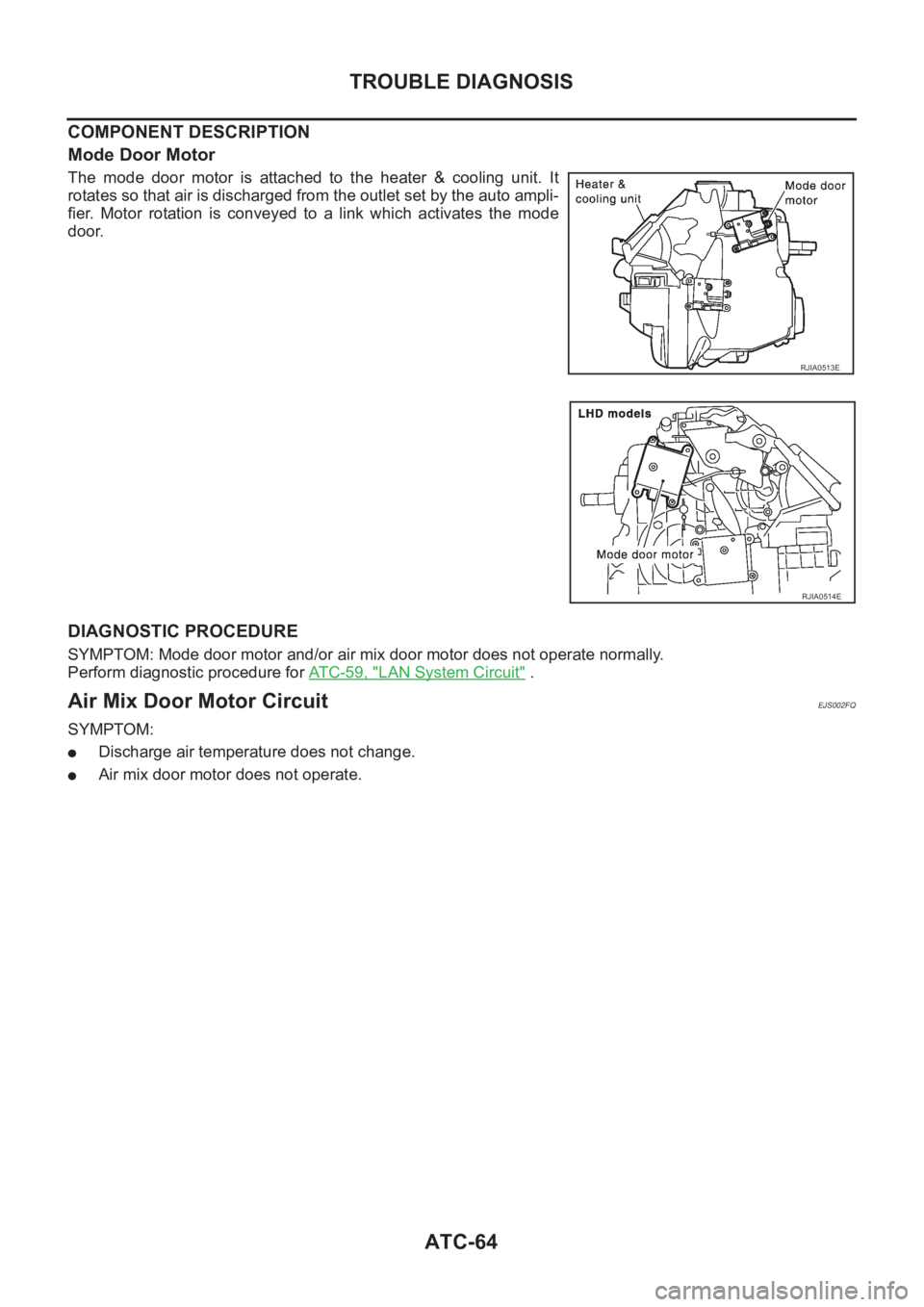
Mode Door Motor
The mode door motor is attached to the heater & cooling unit. It
rotates so that air is discharged from the outlet set by the auto ampli-
fier. Motor rotation is conveyed to a link which activates the mode
door.
DIAGNOSTIC PROCEDURE
SYMPTOM: Mode door motor and/or air mix door motor does not operate normally.
Perform diagnostic procedure for ATC-59, "
LAN System Circuit" .
Air Mix Door Motor CircuitEJS002FQ
SYMPTOM:
●Discharge air temperature does not change.
●Air mix door motor does not operate.
RJIA0513E
RJIA0514E
Page 3342 of 3833
ATC-66
TROUBLE DIAGNOSIS
SYSTEM DESCRIPTION
Component Parts
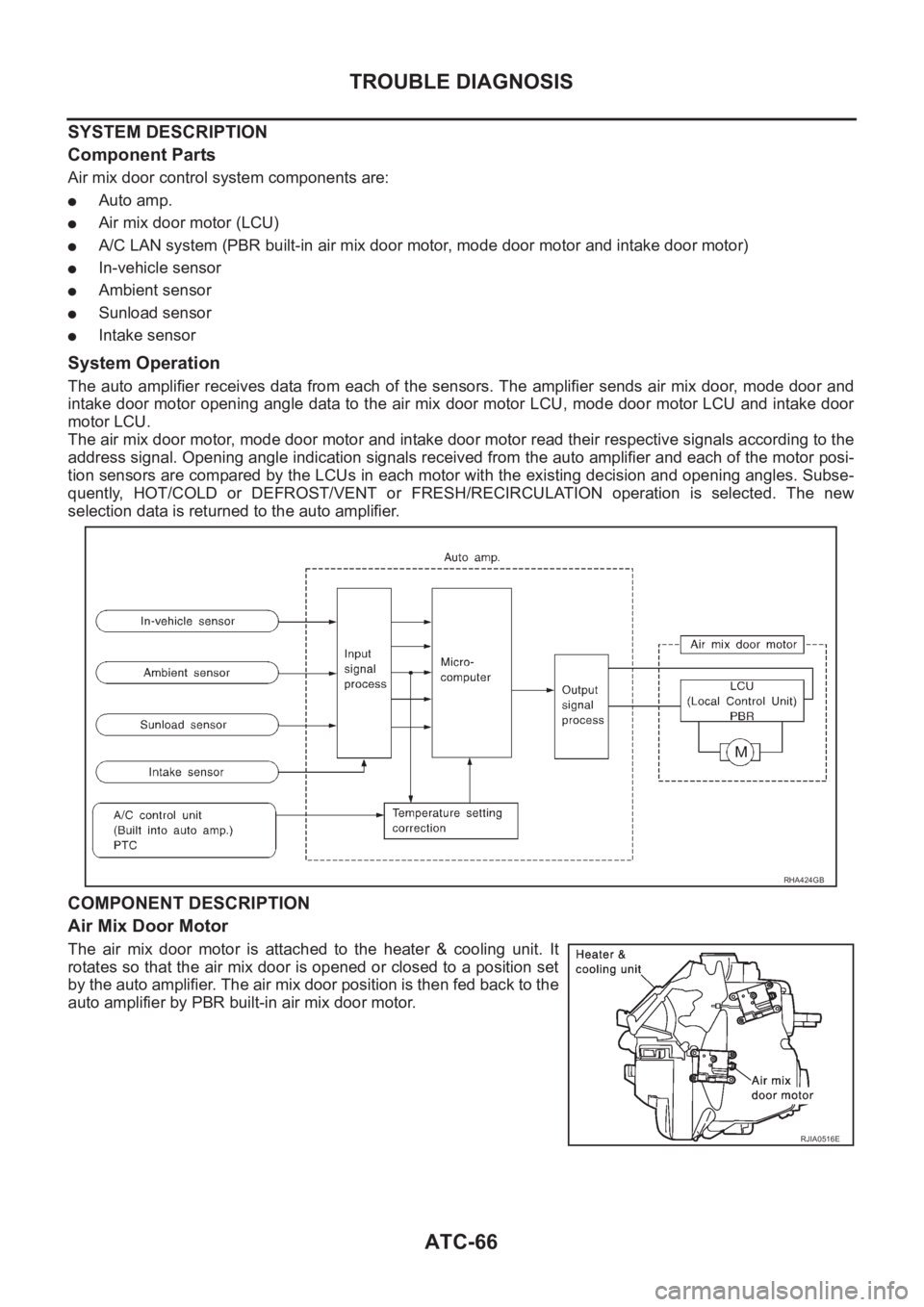
Air mix door control system components are:
●Auto amp.
●Air mix door motor (LCU)
●A/C LAN system (PBR built-in air mix door motor, mode door motor and intake door motor)
●In-vehicle sensor
●Ambient sensor
●Sunload sensor
●Intake sensor
System Operation
The auto amplifier receives data from each of the sensors. The amplifier sends air mix door, mode door and
intake door motor opening angle data to the air mix door motor LCU, mode door motor LCU and intake door
motor LCU.
The air mix door motor, mode door motor and intake door motor read their respective signals according to the
address signal. Opening angle indication signals received from the auto amplifier and each of the motor posi-
tion sensors are compared by the LCUs in each motor with the existing decision and opening angles. Subse-
quently, HOT/COLD or DEFROST/VENT or FRESH/RECIRCULATION operation is selected. The new
selection data is returned to the auto amplifier.
COMPONENT DESCRIPTION
Air Mix Door Motor
The air mix door motor is attached to the heater & cooling unit. It
rotates so that the air mix door is opened or closed to a position set
by the auto amplifier. The air mix door position is then fed back to the
auto amplifier by PBR built-in air mix door motor.
RHA424GB
RJIA0516E
Page 3378 of 3833
ATC-102
TROUBLE DIAGNOSIS
COMPONENT INSPECTION
Ambient Sensor
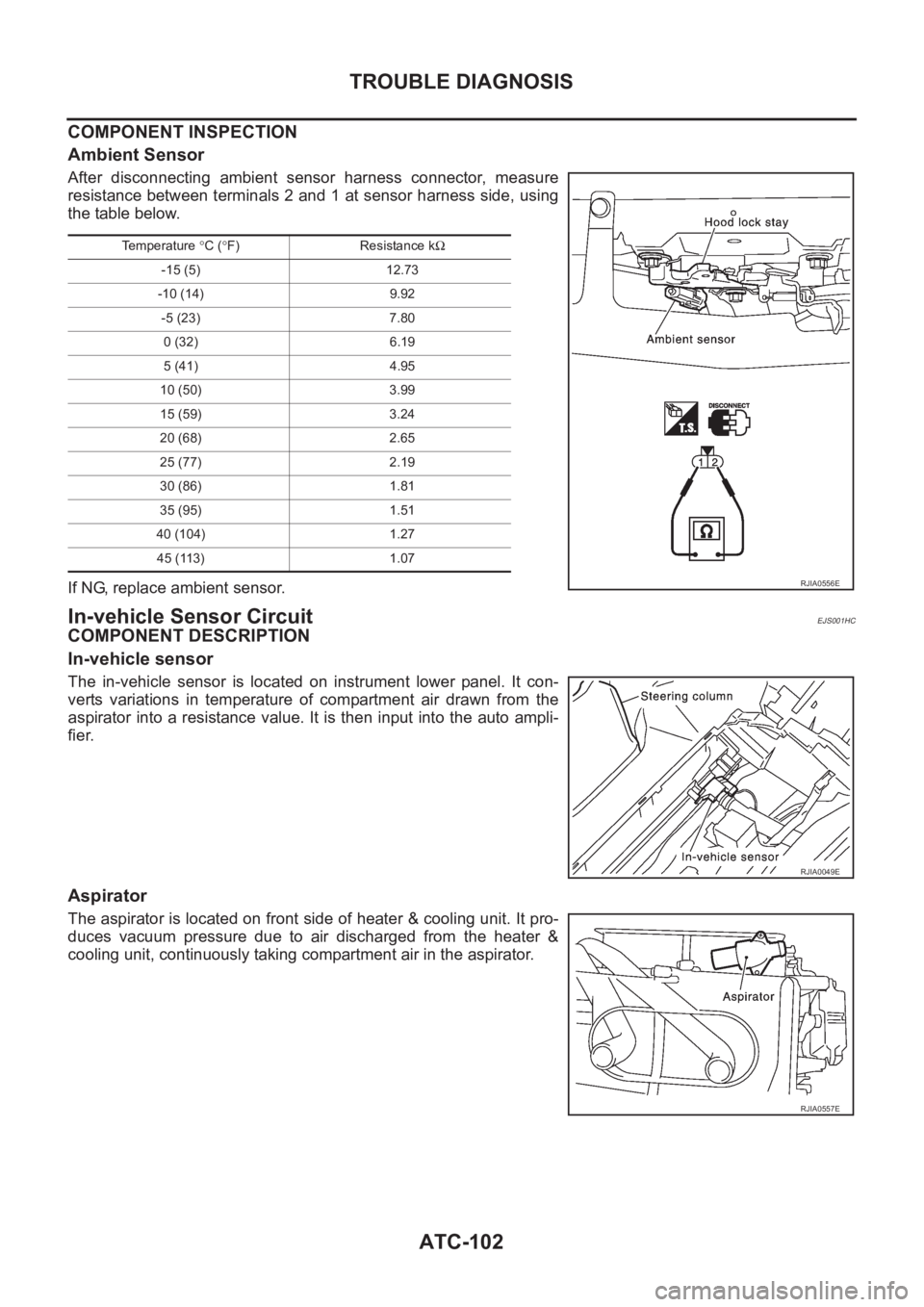
After disconnecting ambient sensor harness connector, measure
resistance between terminals 2 and 1 at sensor harness side, using
the table below.
If NG, replace ambient sensor.
In-vehicle Sensor CircuitEJS001HC
COMPONENT DESCRIPTION
In-vehicle sensor
The in-vehicle sensor is located on instrument lower panel. It con-
verts variations in temperature of compartment air drawn from the
aspirator into a resistance value. It is then input into the auto ampli-
fier.
Aspirator
The aspirator is located on front side of heater & cooling unit. It pro-
duces vacuum pressure due to air discharged from the heater &
cooling unit, continuously taking compartment air in the aspirator.
Temperature °C (°F) Resistance kΩ
-15 (5) 12.73
-10 (14) 9.92
-5 (23) 7.80
0 (32) 6.19
5 (41) 4.95
10 (50) 3.99
15 (59) 3.24
20 (68) 2.65
25 (77) 2.19
30 (86) 1.81
35 (95) 1.51
40 (104) 1.27
45 (113) 1.07
RJIA0556E
RJIA0049E
RJIA0557E
Page 3384 of 3833
ATC-108
TROUBLE DIAGNOSIS
Intake Sensor Circuit
EJS001HE
COMPONENT DESCRIPTION
Intake Sensor
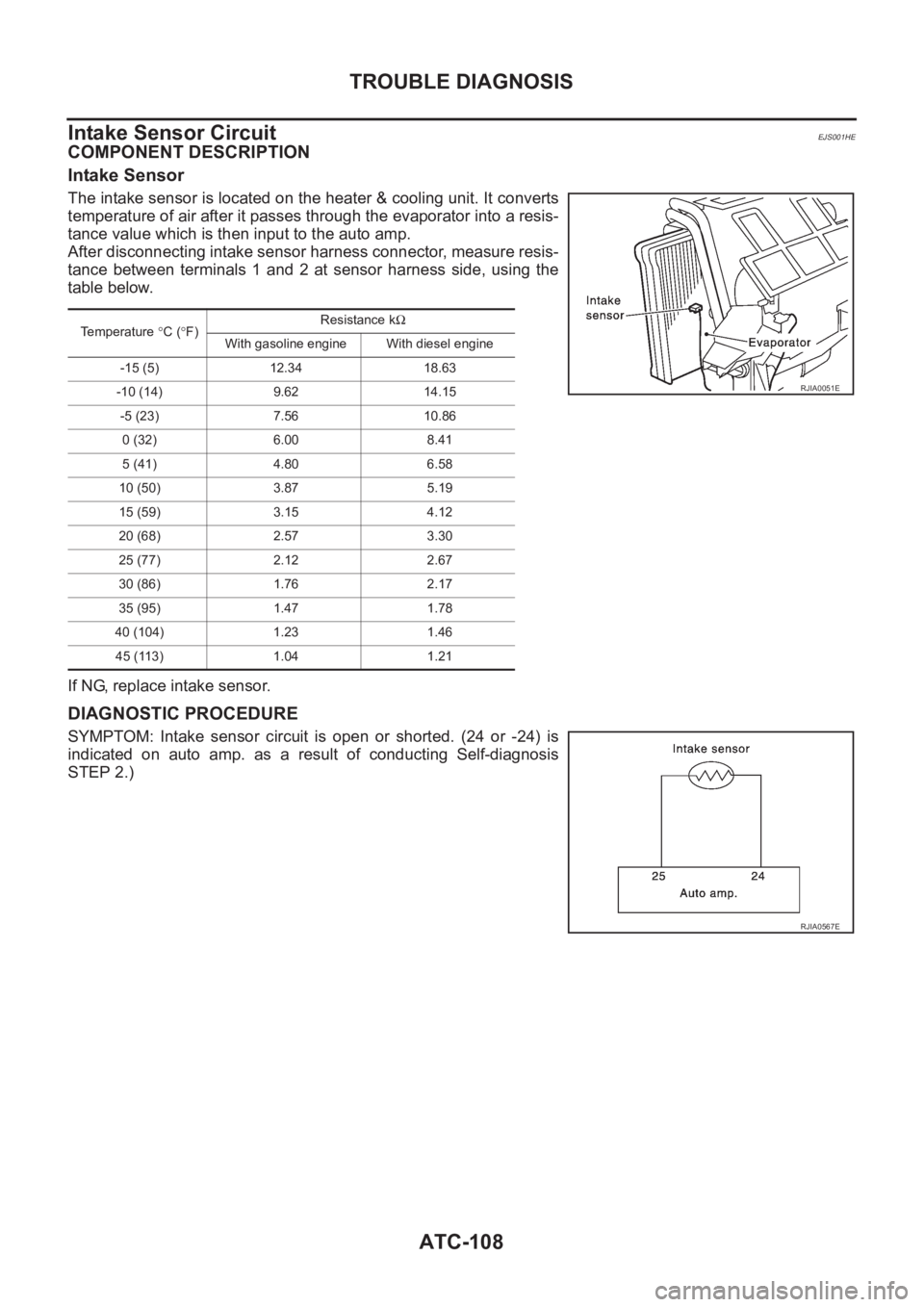
The intake sensor is located on the heater & cooling unit. It converts
temperature of air after it passes through the evaporator into a resis-
tance value which is then input to the auto amp.
After disconnecting intake sensor harness connector, measure resis-
tance between terminals 1 and 2 at sensor harness side, using the
table below.
If NG, replace intake sensor.
DIAGNOSTIC PROCEDURE
SYMPTOM: Intake sensor circuit is open or shorted. (24 or -24) is
indicated on auto amp. as a result of conducting Self-diagnosis
STEP 2.)
Temperature °C (°F)Resistance kΩ
With gasoline engine With diesel engine
-15 (5) 12.34 18.63
-10 (14) 9.62 14.15
-5 (23) 7.56 10.86
0 (32) 6.00 8.41
5 (41) 4.80 6.58
10 (50) 3.87 5.19
15 (59) 3.15 4.12
20 (68) 2.57 3.30
25 (77) 2.12 2.67
30 (86) 1.76 2.17
35 (95) 1.47 1.78
40 (104) 1.23 1.46
45 (113) 1.04 1.21
RJIA0051E
RJIA0567E
Page 3398 of 3833
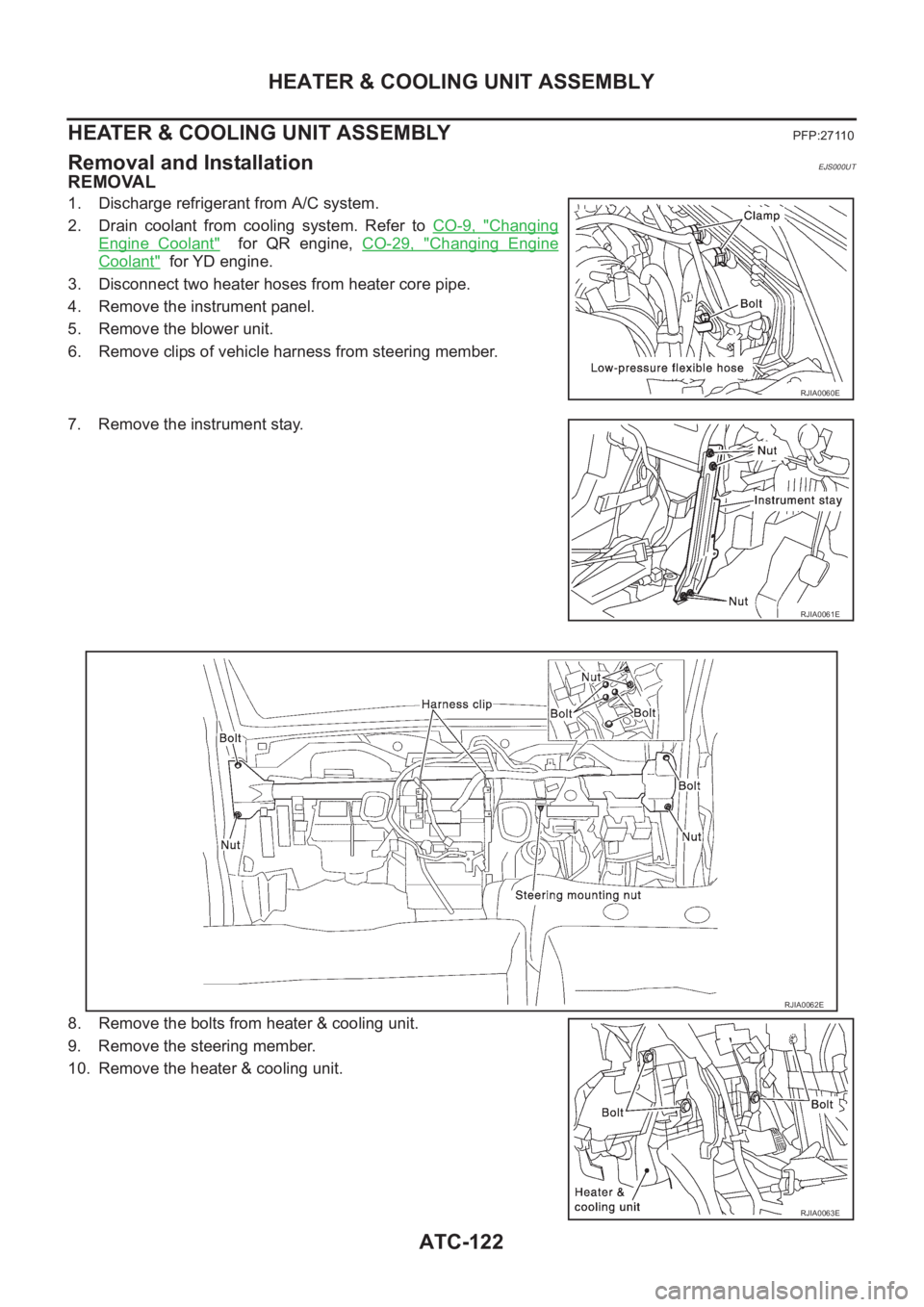
ATC-122
HEATER & COOLING UNIT ASSEMBLY
HEATER & COOLING UNIT ASSEMBLY
PFP:27110
Removal and InstallationEJS000UT
REMOVAL
1. Discharge refrigerant from A/C system.
2. Drain coolant from cooling system. Refer to CO-9, "
Changing
Engine Coolant" for QR engine, CO-29, "Changing Engine
Coolant" for YD engine.
3. Disconnect two heater hoses from heater core pipe.
4. Remove the instrument panel.
5. Remove the blower unit.
6. Remove clips of vehicle harness from steering member.
7. Remove the instrument stay.
8. Remove the bolts from heater & cooling unit.
9. Remove the steering member.
10. Remove the heater & cooling unit.
RJIA0060E
RJIA0061E
RJIA0062E
RJIA0063E
Page 3399 of 3833
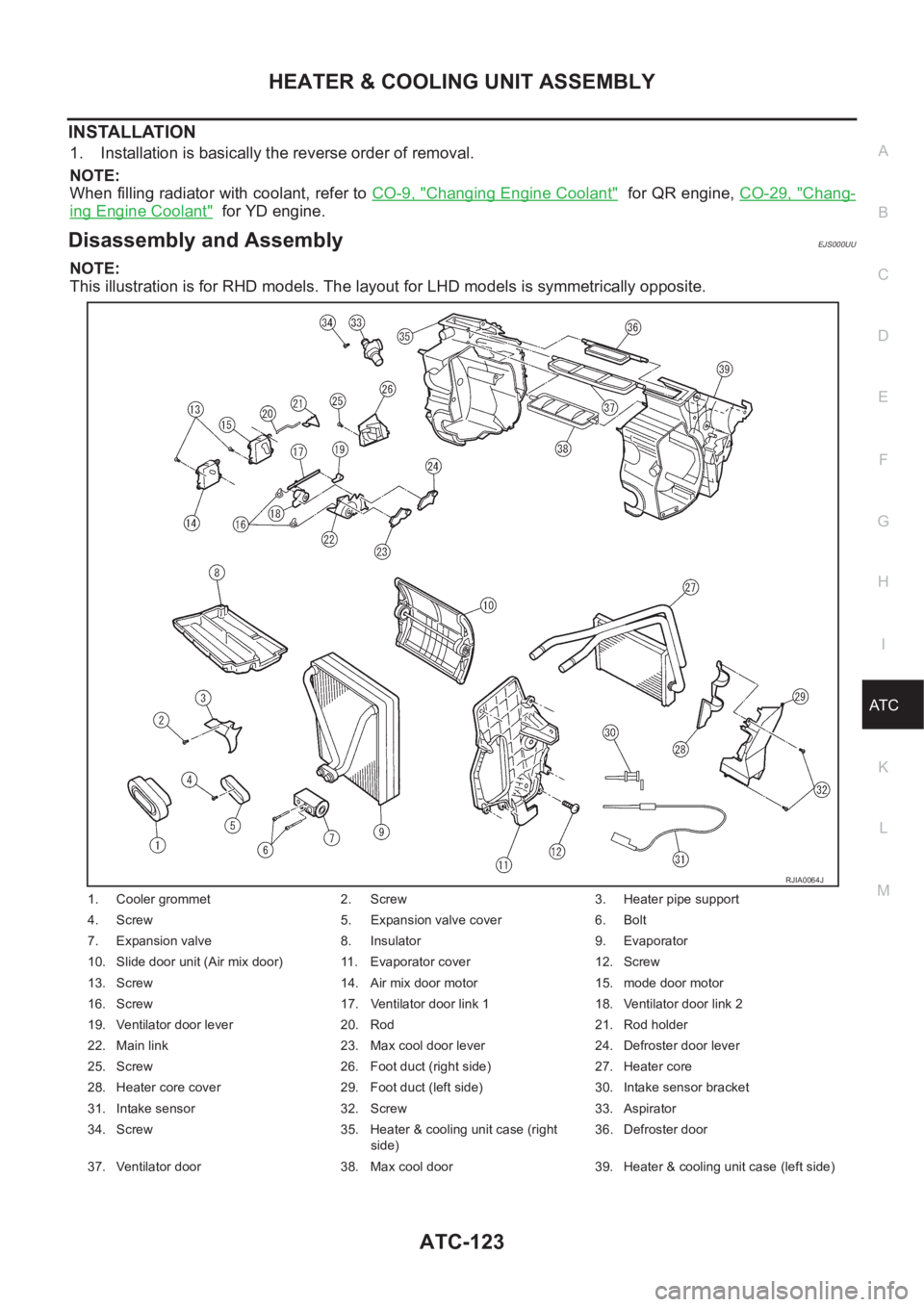
HEATER & COOLING UNIT ASSEMBLY
ATC-123
C
D
E
F
G
H
I
K
L
MA
B
AT C
INSTALLATION
1. Installation is basically the reverse order of removal.
NOTE:
When filling radiator with coolant, refer to CO-9, "
Changing Engine Coolant" for QR engine, CO-29, "Chang-
ing Engine Coolant" for YD engine.
Disassembly and AssemblyEJS000UU
NOTE:
This illustration is for RHD models. The layout for LHD models is symmetrically opposite.
1. Cooler grommet 2. Screw 3. Heater pipe support
4. Screw 5. Expansion valve cover 6. Bolt
7. Expansion valve 8. Insulator 9. Evaporator
10. Slide door unit (Air mix door) 11. Evaporator cover 12. Screw
13. Screw 14. Air mix door motor 15. mode door motor
16. Screw 17. Ventilator door link 1 18. Ventilator door link 2
19. Ventilator door lever 20. Rod 21. Rod holder
22. Main link 23. Max cool door lever 24. Defroster door lever
25. Screw 26. Foot duct (right side) 27. Heater core
28. Heater core cover 29. Foot duct (left side) 30. Intake sensor bracket
31. Intake sensor 32. Screw 33. Aspirator
34. Screw 35. Heater & cooling unit case (right
side)36. Defroster door
37. Ventilator door 38. Max cool door 39. Heater & cooling unit case (left side)
RJIA0064J
Page 3402 of 3833
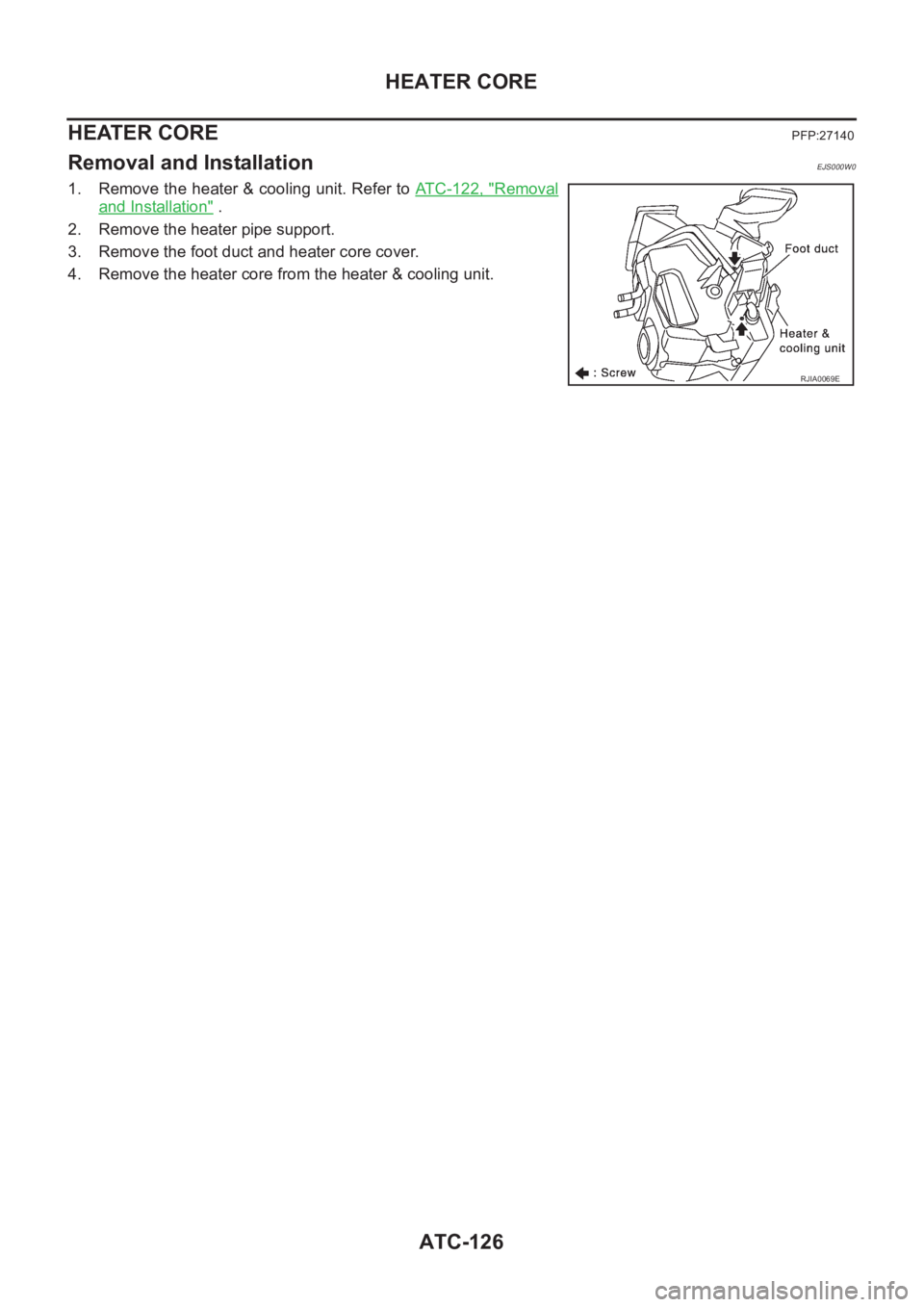
ATC-126
HEATER CORE
HEATER CORE
PFP:27140
Removal and InstallationEJS000W0
1. Remove the heater & cooling unit. Refer to ATC-122, "Removal
and Installation" .
2. Remove the heater pipe support.
3. Remove the foot duct and heater core cover.
4. Remove the heater core from the heater & cooling unit.
RJIA0069E
Page 3404 of 3833
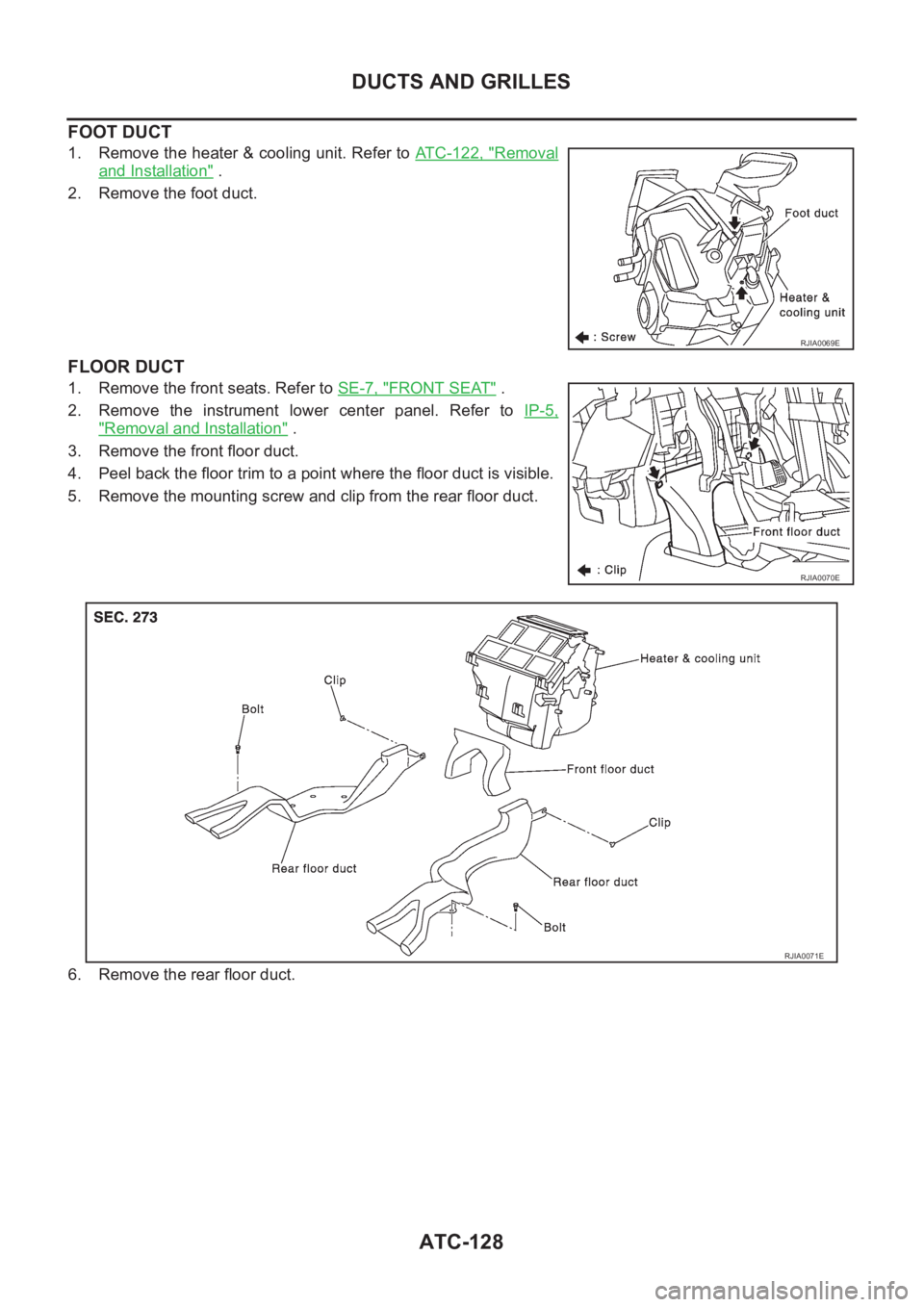
ATC-128
DUCTS AND GRILLES
FOOT DUCT
1. Remove the heater & cooling unit. Refer to ATC-122, "Removal
and Installation" .
2. Remove the foot duct.
FLOOR DUCT
1. Remove the front seats. Refer to SE-7, "FRONT SEAT" .
2. Remove the instrument lower center panel. Refer to IP-5,
"Removal and Installation" .
3. Remove the front floor duct.
4. Peel back the floor trim to a point where the floor duct is visible.
5. Remove the mounting screw and clip from the rear floor duct.
6. Remove the rear floor duct.
RJIA0069E
RJIA0070E
RJIA0071E
Page 3407 of 3833
REFRIGERANT LINES
ATC-131
C
D
E
F
G
H
I
K
L
MA
B
AT C
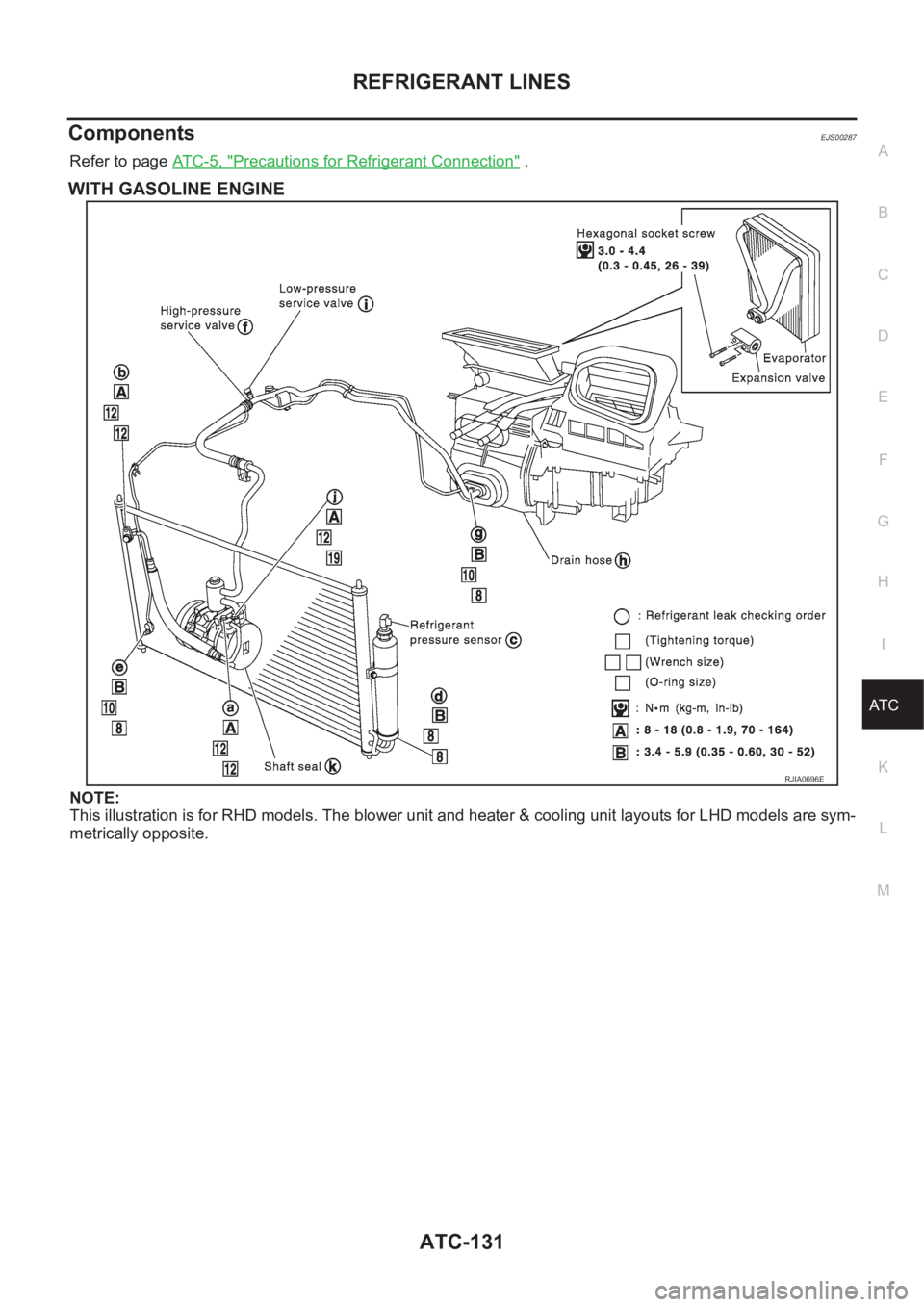
ComponentsEJS00287
Refer to page AT C - 5 , "Precautions for Refrigerant Connection" .
WITH GASOLINE ENGINE
NOTE:
This illustration is for RHD models. The blower unit and heater & cooling unit layouts for LHD models are sym-
metrically opposite.
RJIA0696E
Page 3408 of 3833
ATC-132
REFRIGERANT LINES
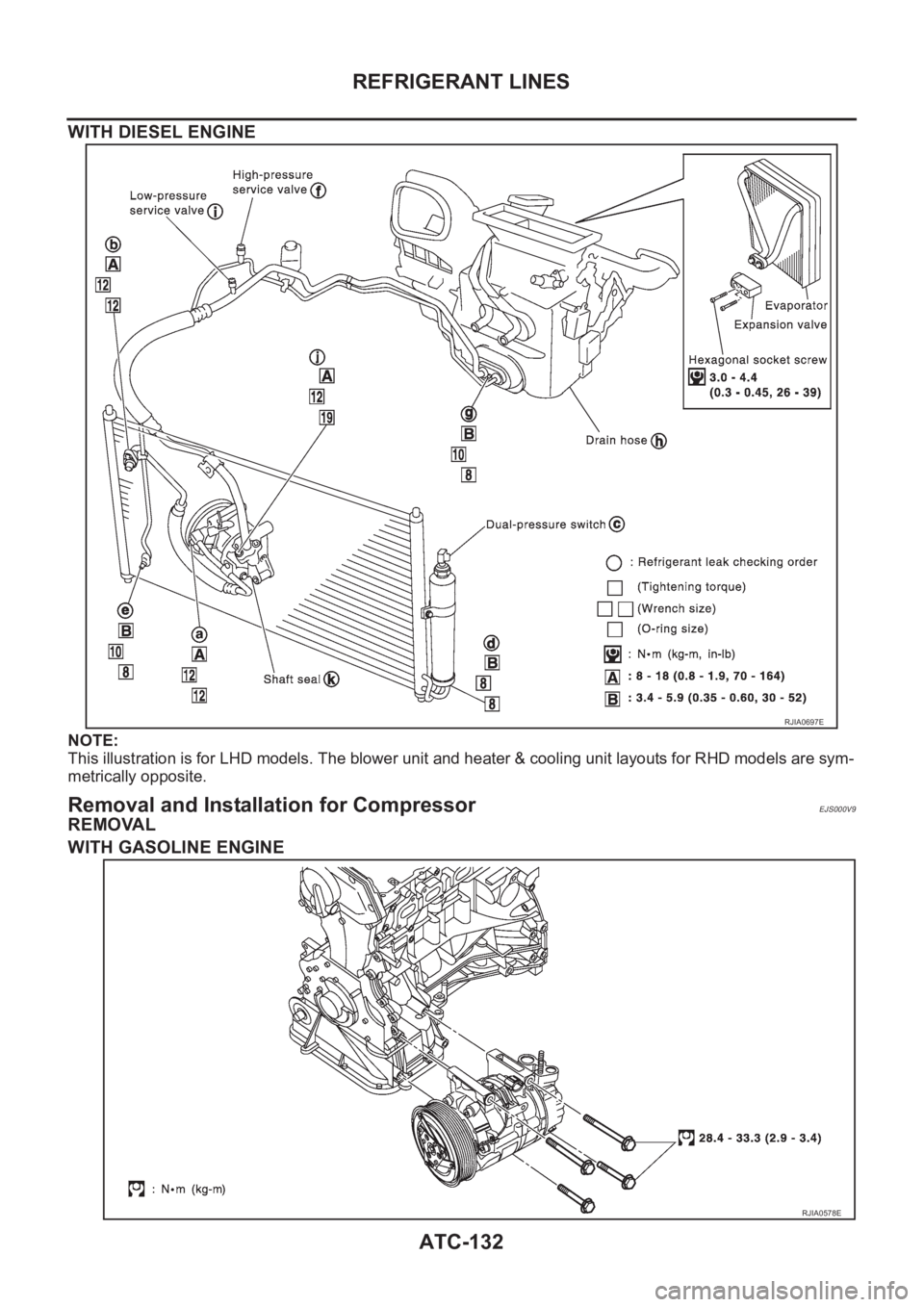
WITH DIESEL ENGINE
NOTE:
This illustration is for LHD models. The blower unit and heater & cooling unit layouts for RHD models are sym-
metrically opposite.
Removal and Installation for CompressorEJS000V9
REMOVAL
WITH GASOLINE ENGINE
RJIA0697E
RJIA0578E