remove seats NISSAN X-TRAIL 2001 Service Repair Manual
[x] Cancel search | Manufacturer: NISSAN, Model Year: 2001, Model line: X-TRAIL, Model: NISSAN X-TRAIL 2001Pages: 3833, PDF Size: 39.49 MB
Page 232 of 3833
![NISSAN X-TRAIL 2001 Service Repair Manual EM-182
[YD22DDTi]
CYLINDER HEAD
CYLINDER HEAD
PFP:11041
On-Vehicle ServiceEBS00LRV
CHECKING COMPRESSION PRESSURE
1. Warm up engine thoroughly. Then, stop it.
2. Using CONSULT-II, make sure no err](/img/5/57405/w960_57405-231.png "NISSAN X-TRAIL 2001 Service Repair Manual EM-182
[YD22DDTi]
CYLINDER HEAD
CYLINDER HEAD
PFP:11041
On-Vehicle ServiceEBS00LRV
CHECKING COMPRESSION PRESSURE
1. Warm up engine thoroughly. Then, stop it.
2. Using CONSULT-II, make sure no err")
EM-182
[YD22DDTi]
CYLINDER HEAD
CYLINDER HEAD
PFP:11041
On-Vehicle ServiceEBS00LRV
CHECKING COMPRESSION PRESSURE
1. Warm up engine thoroughly. Then, stop it.
2. Using CONSULT-II, make sure no error codes are indicated for self-diagnosis items. Refer to EC-1412,
"Basic Inspection" .
●Do not disconnect CONSULT-II until the end of this operation; it will be used to check engine rpm and
for error detection at the end of this operation.
3. Disconnect the negative battery terminal.
4. Remove charge air cooler. Refer to EM-122, "
Removal and Installation"
5. To prevent fuel from being injected during inspection, remove
fuel supply pump fuse [ENG CONT (20A)] from fuse box on the
left side of engine compartment.
●Among marks on fuse box, [ENG CONT 2 (20A)] is for fuel
supply pump fuse.
6. Remove glow plugs from all the cylinders. Refer to EM-138,
"Removal and Installation" .
CAUTION:
●Before removal, clean the surrounding area to prevent
entry of any foreign materials into the engine.
●Carefully remove glow plugs to prevent any damage or
breakage.
●Handle with care to avoid applying any shock to glow plugs.
7. Install adapter to installation holes of glow plugs and connect
compression gauge for diesel engine.
8. Connect battery negative terminal.
9. Set the ignition switch to “START” and crank. When gauge
pointer stabilizes, read compression pressure and engine rpm.
Repeat the above steps for each cylinder.
●Always use a fully-charged battery to obtain specified engine
speed.
Compression pressure
Unit: kPa (bar, kg/cm2 , psi)/rpm
●When engine rpm is out of the specified range, check the specific gravity of battery liquid. Measure
again under corrected conditions.
●If engine rpm exceeds the limit, check valve clearance and combustion chamber components (valves,
valve seats, cylinder head gaskets, piston rings, pistons, cylinder bores, cylinder block upper and lower
surfaces) and measure again.
●If compression pressure is low in some cylinders, apply engine oil from glow plug installation hole. Then
check pressure again.
–If compression pressure becomes normal after applying engine oil, piston ring may be worn or dam-
aged. Check piston ring for malfunction. If any, replace piston ring.
–If compression pressure is still low after applying engine oil, valve may be malfunctioning. Check valve
for malfunction. If contact malfunction is found, replace valve or valve seat.
●If compression pressure in adjacent two cylinders is low after applying engine oil, pressure may be
leaking from gasket. In this case, replace cylinder head gasket.
10. Complete this operation as follows:
PBIC0680E
: 18 - 21 N·m (1.8 - 2.2 kg-m, 13 - 15 ft-lb)
SEM112G
Standard Minimum Difference limit between cylinders
2,893 (28.9, 29.5, 419)/200 2,452 (24.52, 25.0, 356)/200 490 (4.90, 5.0, 71)/200
Page 238 of 3833
![NISSAN X-TRAIL 2001 Service Repair Manual EM-188
[YD22DDTi]
CYLINDER HEAD
5. Remove valve oil seals using valve oil seal puller.
6. Remove valve spring seats.
7. Before removing valve spring seats, perform valve seat contact
check. Re](/img/5/57405/w960_57405-237.png "NISSAN X-TRAIL 2001 Service Repair Manual EM-188
[YD22DDTi]
CYLINDER HEAD
5. Remove valve oil seals using valve oil seal puller.
6. Remove valve spring seats.
7. Before removing valve spring seats, perform valve seat contact
check. Re")
EM-188
[YD22DDTi]
CYLINDER HEAD
5. Remove valve oil seals using valve oil seal puller.
6. Remove valve spring seats.
7. Before removing valve spring seats, perform valve seat contact
check. Refer to EM-190, "
Valve Seat Contact" .
8. Before removing valve guides, perform valve guide clearance
check. Refer to EM-189, "
Valve Guide Clearance" .
ASSEMBLY
1. Install valve guides. Refer to EM-189, "Valve Guide Clearance" .
2. Install valve seats. Refer to EM-190, "
Valve Seat Replacement" .
3. Using valve oil seal drift, install valve oil seals referring to the
dimension shown in the figure.
4. Install valve spring seats.
5. Install valves.
●Install the valves with bigger outer diameter to intake valve
side.
●Note that valve layout here is different from that of conven-
tional engine.
6. Install valve spring.
7. Install valve spring retainers.
8. Using valve spring compressor, compress valve springs.
Then install valve collets using magnetic hand.
●After installing valve collets, tap the stem end using a plastic hammer, and check the installation status.
9. Install valve lifters and adjusting shims to the same positions as before.
INSPECTION AFTER DISASSEMBLY
Cylinder Head Distortion
Using straightedge and feeler gauge, check the bottom of the cylin-
der head for distortion.
JEM153G
JEM165G
Limit : 0.04 mm (0.0016 in)
SEM496G
Page 570 of 3833
![NISSAN X-TRAIL 2001 Service Repair Manual EC-220
[QR25(WITH EURO-OBD)]
DTC P0300 - P0304 MULTIPLE CYLINDER MISFIRE, NO. 1 - 4 CYLINDER MIS-
FIRE
5. CHECK IGNITION SPARK
1. Disconnect ignition coil assembly from rocker cover.
2. Connect a know](/img/5/57405/w960_57405-569.png "NISSAN X-TRAIL 2001 Service Repair Manual EC-220
[QR25(WITH EURO-OBD)]
DTC P0300 - P0304 MULTIPLE CYLINDER MISFIRE, NO. 1 - 4 CYLINDER MIS-
FIRE
5. CHECK IGNITION SPARK
1. Disconnect ignition coil assembly from rocker cover.
2. Connect a know")
EC-220
[QR25(WITH EURO-OBD)]
DTC P0300 - P0304 MULTIPLE CYLINDER MISFIRE, NO. 1 - 4 CYLINDER MIS-
FIRE
5. CHECK IGNITION SPARK
1. Disconnect ignition coil assembly from rocker cover.
2. Connect a known-good spark plug to the ignition coil assembly.
3. Place end of spark plug against a suitable ground and crank engine.
4. Check for spark.
OK or NG
OK >> GO TO 6.
NG >> Check ignition coil, power transistor and their circuits.
Refer to EC-379, "
IGNITION SIGNAL" .
6. CHECK SPARK PLUGS
Remove the spark plugs and check for fouling, etc.
OK or NG
OK >> GO TO 7.
NG >> Repair or replace spark plug(s) with standard type
one(s). For spark plug type, refer to MA-24, "
Checking
and Changing Spark Plugs" .
7. CHECK COMPRESSION PRESSURE
Check compression pressure. Refer to EM-59, "
CHECKING COMPRESSION PRESSURE" .
OK or NG
OK >> GO TO 8.
NG >> Check pistons, piston rings, valves, valve seats and cylinder head gaskets.
8. CHECK FUEL PRESSURE
1. Install all removed parts.
2. Release fuel pressure to zero. Refer to EC-42, "
FUEL PRESSURE RELEASE" .
3. Install fuel pressure gauge and check fuel pressure. Refer to EC-42, "
FUEL PRESSURE CHECK" .
OK or NG
OK >> GO TO 9.
NG >> Follow the Instruction of “FUEL PRESSURE CHECK”.
SEF575Q
SEF156I
Standard:
1,190 kPa (11.9 bar, 12.1 kg/cm2 , 172 psi)/250
rpm
Minimum:
990 kPa (9.9 bar, 10.1 kg/cm
2 , 144 psi)/250 rpm
Difference between each
cylinder:98 kPa (0.98 bar, 1.0 kg/cm
2 , 14 psi)/250 rpm
At idle: Approx. 350 kPa (3.5 bar, 3.57 kg/cm
2 , 51 psi)
Page 1299 of 3833
![NISSAN X-TRAIL 2001 Service Repair Manual DTC P0300 - P0304 MULTIPLE CYLINDER MISFIRE, NO. 1 - 4 CYLINDER MIS-
FIRE
EC-949
[QR20(WITH EURO-OBD)]
C
D
E
F
G
H
I
J
K
L
MA
EC
5.CHECK IGNITION SPARK
1. Disconnect ignition coil assembly from rocker](/img/5/57405/w960_57405-1298.png "NISSAN X-TRAIL 2001 Service Repair Manual DTC P0300 - P0304 MULTIPLE CYLINDER MISFIRE, NO. 1 - 4 CYLINDER MIS-
FIRE
EC-949
[QR20(WITH EURO-OBD)]
C
D
E
F
G
H
I
J
K
L
MA
EC
5.CHECK IGNITION SPARK
1. Disconnect ignition coil assembly from rocker")
DTC P0300 - P0304 MULTIPLE CYLINDER MISFIRE, NO. 1 - 4 CYLINDER MIS-
FIRE
EC-949
[QR20(WITH EURO-OBD)]
C
D
E
F
G
H
I
J
K
L
MA
EC
5.CHECK IGNITION SPARK
1. Disconnect ignition coil assembly from rocker cover.
2. Connect a known-good spark plug to the ignition coil assembly.
3. Place end of spark plug against a suitable ground and crank engine.
4. Check for spark.
OK or NG
OK >> GO TO 6.
NG >> Check ignition coil, power transistor and their circuits.
Refer to EC-1074, "
IGNITION SIGNAL" .
6.CHECK SPARK PLUGS
Remove the spark plugs and check for fouling, etc.
OK or NG
OK >> GO TO 7.
NG >> Repair or replace spark plug(s) with standard type
one(s). For spark plug type, refer to MA-24, "
Checking
and Changing Spark Plugs" .
7.CHECK COMPRESSION PRESSURE
Check compression pressure. Refer to EM-59, "
CHECKING COMPRESSION PRESSURE" .
OK or NG
OK >> GO TO 8.
NG >> Check pistons, piston rings, valves, valve seats and cylinder head gaskets.
8.CHECK FUEL PRESSURE
1. Install all removed parts.
2. Release fuel pressure to zero. Refer to EC-775, "
FUEL PRESSURE RELEASE" .
3. Install fuel pressure gauge and check fuel pressure. Refer to EC-775, "
FUEL PRESSURE CHECK" .
OK or NG
OK >> GO TO 9.
NG >> Follow the Instruction of “FUEL PRESSURE CHECK”.
SEF575Q
SEF156I
Standard:
1,190 kPa (11.9 bar, 12.1 kg/cm2 , 172 psi)/250
rpm
Minimum:
990 kPa (9.9 bar, 10.1 kg/cm
2 , 144 psi)/250 rpm
Difference between each
cylinder:98 kPa (0.98 bar, 1.0 kg/cm
2 , 14 psi)/250 rpm
At idle: Approx. 350 kPa (3.5 bar, 3.57 kg/cm
2 , 51 psi)
Page 2636 of 3833
TF-26
TRANSFER ASSEMBLY
Drive gear assembly
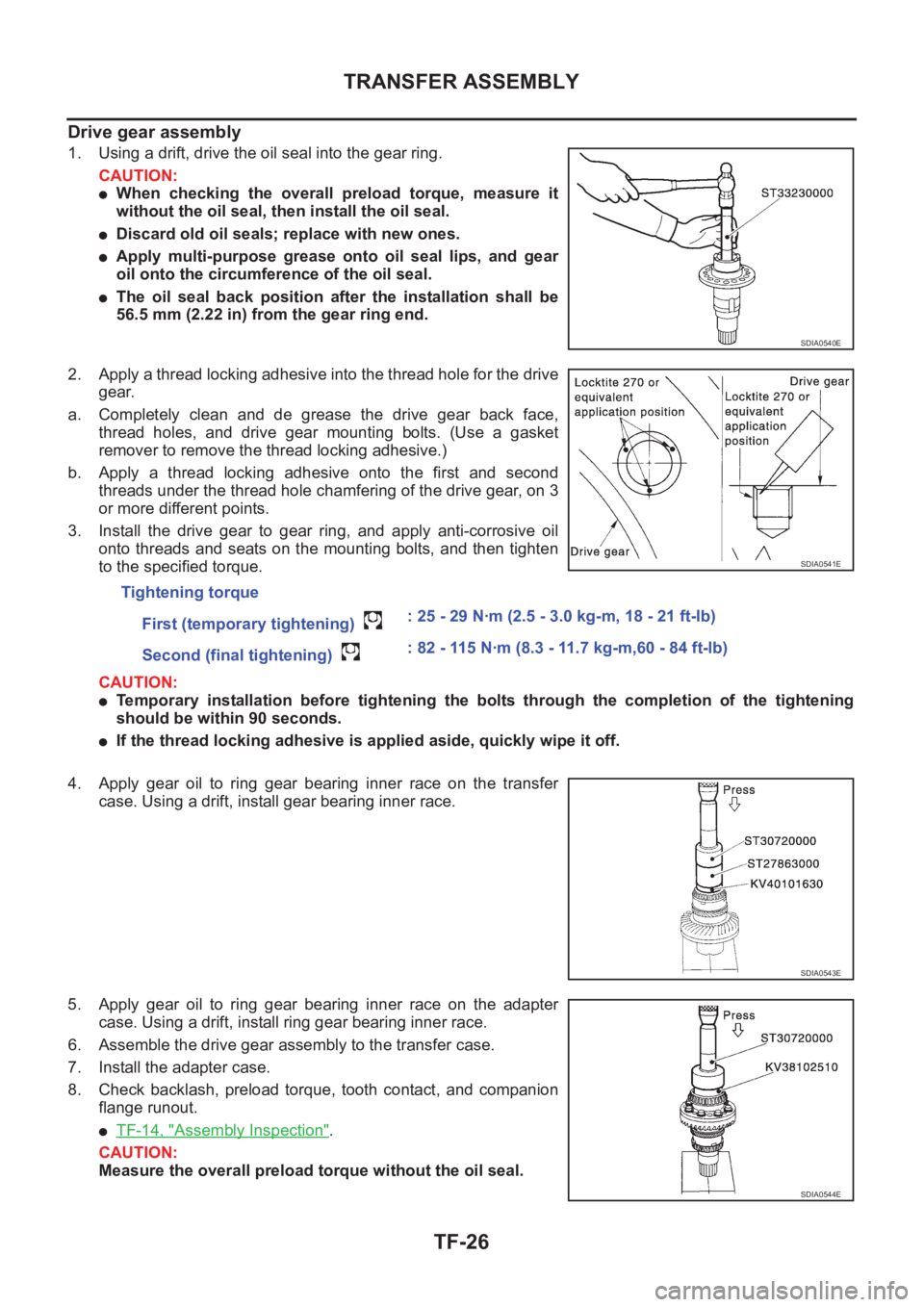
1. Using a drift, drive the oil seal into the gear ring.
CAUTION:
●When checking the overall preload torque, measure it
without the oil seal, then install the oil seal.
●Discard old oil seals; replace with new ones.
●Apply multi-purpose grease onto oil seal lips, and gear
oil onto the circumference of the oil seal.
●The oil seal back position after the installation shall be
56.5 mm (2.22 in) from the gear ring end.
2. Apply a thread locking adhesive into the thread hole for the drive
gear.
a. Completely clean and de grease the drive gear back face,
thread holes, and drive gear mounting bolts. (Use a gasket
remover to remove the thread locking adhesive.)
b. Apply a thread locking adhesive onto the first and second
threads under the thread hole chamfering of the drive gear, on 3
or more different points.
3. Install the drive gear to gear ring, and apply anti-corrosive oil
onto threads and seats on the mounting bolts, and then tighten
to the specified torque.
CAUTION:
●Temporary installation before tightening the bolts through the completion of the tightening
should be within 90 seconds.
●If the thread locking adhesive is applied aside, quickly wipe it off.
4. Apply gear oil to ring gear bearing inner race on the transfer
case. Using a drift, install gear bearing inner race.
5. Apply gear oil to ring gear bearing inner race on the adapter
case. Using a drift, install ring gear bearing inner race.
6. Assemble the drive gear assembly to the transfer case.
7. Install the adapter case.
8. Check backlash, preload torque, tooth contact, and companion
flange runout.
●TF-14, "Assembly Inspection".
CAUTION:
Measure the overall preload torque without the oil seal.
SDIA0540E
Tightening torque
First (temporary tightening) : 25 - 29 N·m (2.5 - 3.0 kg-m, 18 - 21 ft-lb)
Second (final tightening) : 82 - 115 N·m (8.3 - 11.7 kg-m,60 - 84 ft-lb)
SDIA0541E
SDIA0543E
SDIA0544E
Page 2714 of 3833
FSU-8
COIL SPRING AND SHOCK ABSORBER
COIL SPRING AND SHOCK ABSORBER
PFP:54302
Removal and InstallationEES00074
REMOVAL
1. Remove tires. Remove brake caliper and hung it aside.
CAUTION:
Avoid depressing brake pedal with brake caliper removed.
2. Remove electrical wires of ABS wheel speed sensor from strut.
3. Remove brake hose lock plate.
4. Remove mounting bolts and nuts securing steering knuckle to strut.
5. Remove mounting nuts on upper mounting plate and remove upper mounting plate and strut from vehicle.
INSTALLATION
●Refer to FSU-5, "Components" in “Front Suspension Assembly” for tightening torque. Tighten in the
reverse order of removal.
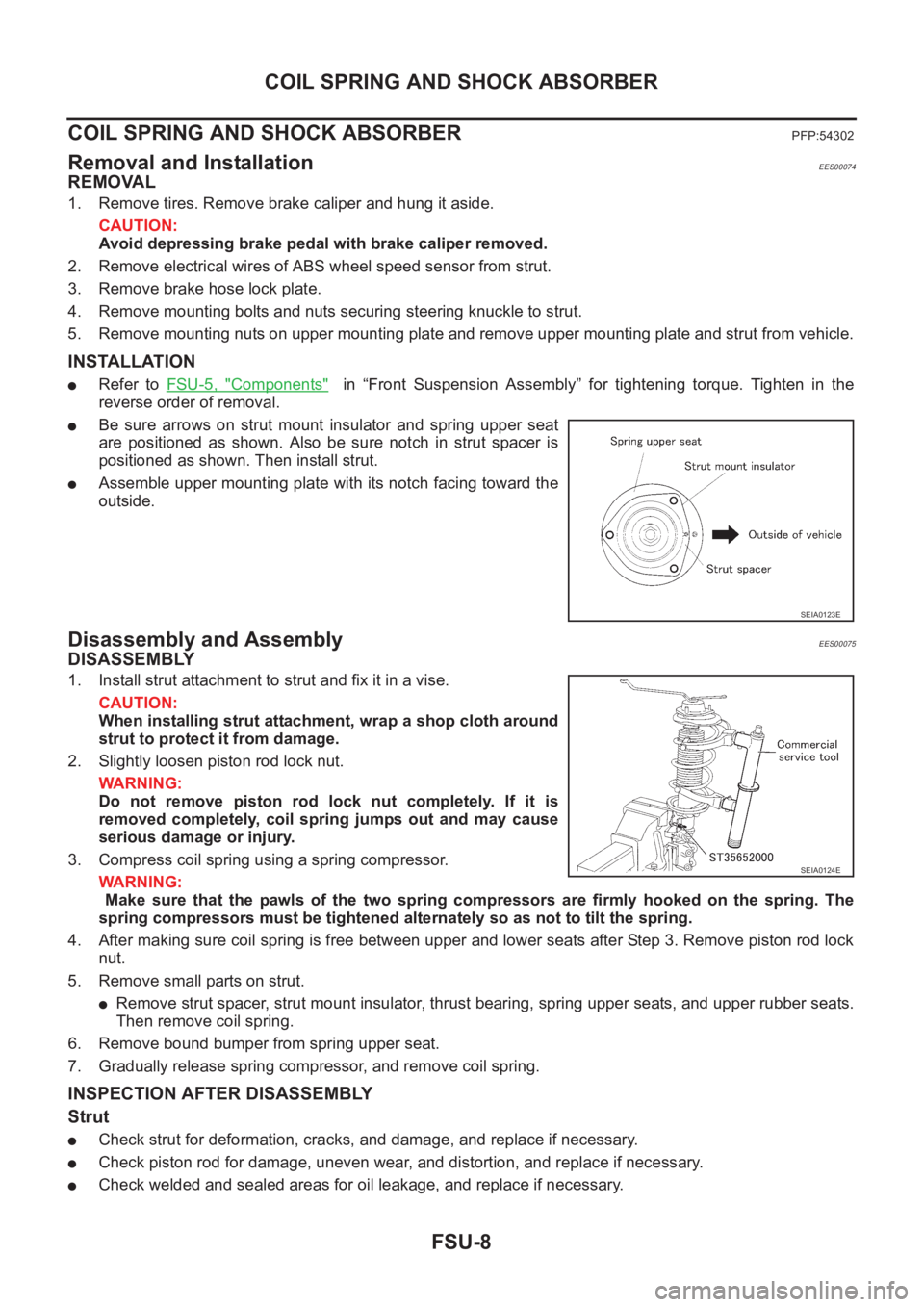
●Be sure arrows on strut mount insulator and spring upper seat
are positioned as shown. Also be sure notch in strut spacer is
positioned as shown. Then install strut.
●Assemble upper mounting plate with its notch facing toward the
outside.
Disassembly and AssemblyEES00075
DISASSEMBLY
1. Install strut attachment to strut and fix it in a vise.
CAUTION:
When installing strut attachment, wrap a shop cloth around
strut to protect it from damage.
2. Slightly loosen piston rod lock nut.
WARNING:
Do not remove piston rod lock nut completely. If it is
removed completely, coil spring jumps out and may cause
serious damage or injury.
3. Compress coil spring using a spring compressor.
WARNING:
Make sure that the pawls of the two spring compressors are firmly hooked on the spring. The
spring compressors must be tightened alternately so as not to tilt the spring.
4. After making sure coil spring is free between upper and lower seats after Step 3. Remove piston rod lock
nut.
5. Remove small parts on strut.
●Remove strut spacer, strut mount insulator, thrust bearing, spring upper seats, and upper rubber seats.
Then remove coil spring.
6. Remove bound bumper from spring upper seat.
7. Gradually release spring compressor, and remove coil spring.
INSPECTION AFTER DISASSEMBLY
Strut
●Check strut for deformation, cracks, and damage, and replace if necessary.
●Check piston rod for damage, uneven wear, and distortion, and replace if necessary.
●Check welded and sealed areas for oil leakage, and replace if necessary.
SEIA0123E
SEIA0124E
Page 2715 of 3833
COIL SPRING AND SHOCK ABSORBER
FSU-9
C
D
F
G
H
I
J
K
L
MA
B
FSU
Insulator and Rubber Parts
Check strut mount insulator for cracks and rubber parts for wear. Replace them if necessary.
Coil Spring
Check for cracks, wear, and damage, and replace if necessary.
ASSEMBLY
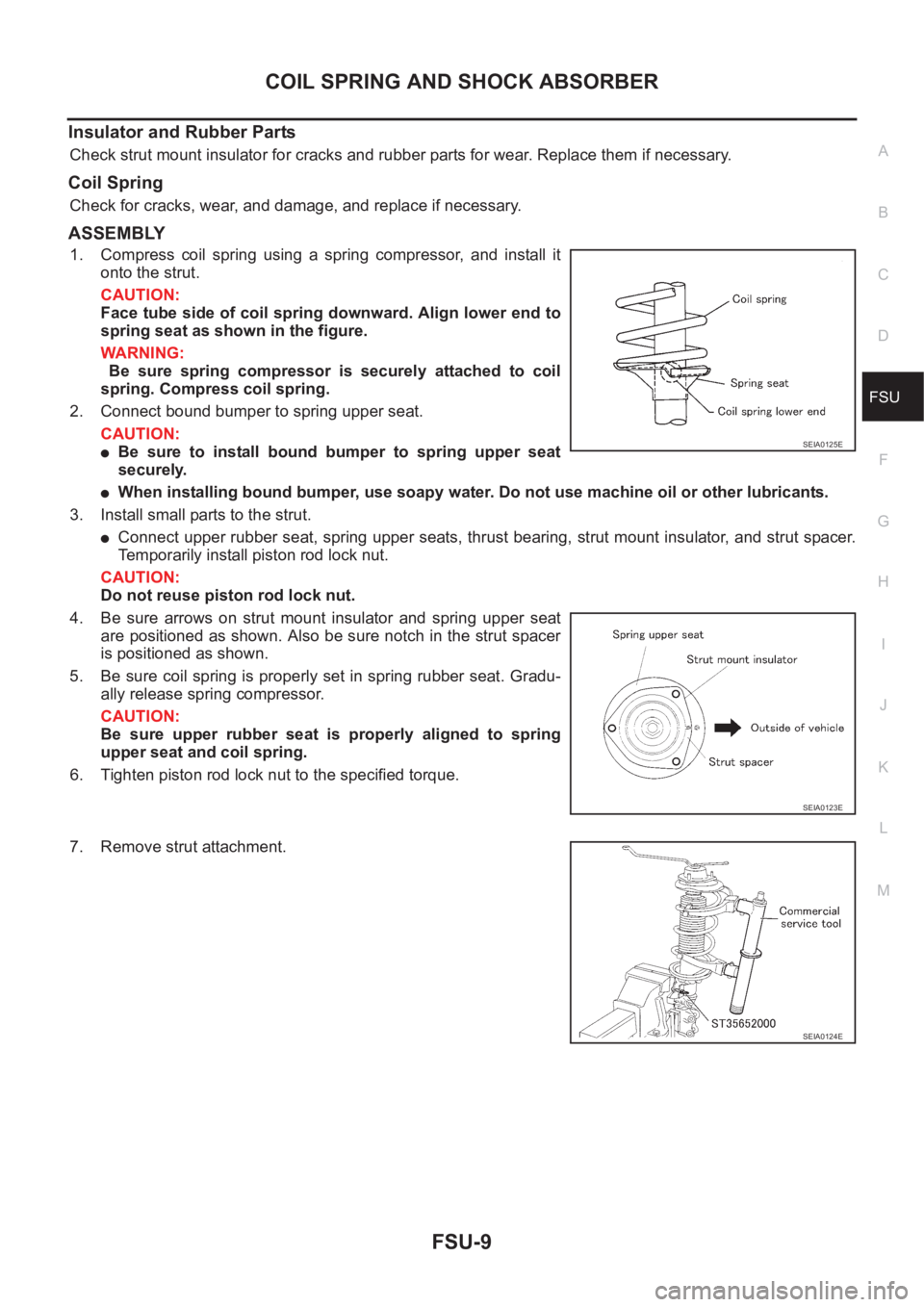
1. Compress coil spring using a spring compressor, and install it
onto the strut.
CAUTION:
Face tube side of coil spring downward. Align lower end to
spring seat as shown in the figure.
WARNING:
Be sure spring compressor is securely attached to coil
spring. Compress coil spring.
2. Connect bound bumper to spring upper seat.
CAUTION:
●Be sure to install bound bumper to spring upper seat
securely.
●When installing bound bumper, use soapy water. Do not use machine oil or other lubricants.
3. Install small parts to the strut.
●Connect upper rubber seat, spring upper seats, thrust bearing, strut mount insulator, and strut spacer.
Temporarily install piston rod lock nut.
CAUTION:
Do not reuse piston rod lock nut.
4. Be sure arrows on strut mount insulator and spring upper seat
are positioned as shown. Also be sure notch in the strut spacer
is positioned as shown.
5. Be sure coil spring is properly set in spring rubber seat. Gradu-
ally release spring compressor.
CAUTION:
Be sure upper rubber seat is properly aligned to spring
upper seat and coil spring.
6. Tighten piston rod lock nut to the specified torque.
7. Remove strut attachment.
SEIA0125E
SEIA0123E
SEIA0124E
Page 2728 of 3833
RSU-8
COIL SPRING AND STRUT
COIL SPRING AND STRUT
PFP:55302
Removal and InstallationEES0007H
REMOVAL
1. Remove tires.
2. Remove brake hose lock plate and remove brake hose from strut.
3. Remove mounting nuts and washers on upper portion of stabilizer connecting rod.
4. Remove strut-to-axle housing mounting bolts and nuts.
5. Remove luggage side lower finisher in luggage compartment. Remove mounting nuts on strut spacer.
Then remove strut from vehicle.
INSTALLATION
●Refer to RSU-5, "Components" for tightening torque. Install in the reverse order of removal.
Disassembly and AssemblyEES0007I
DISASSEMBLY
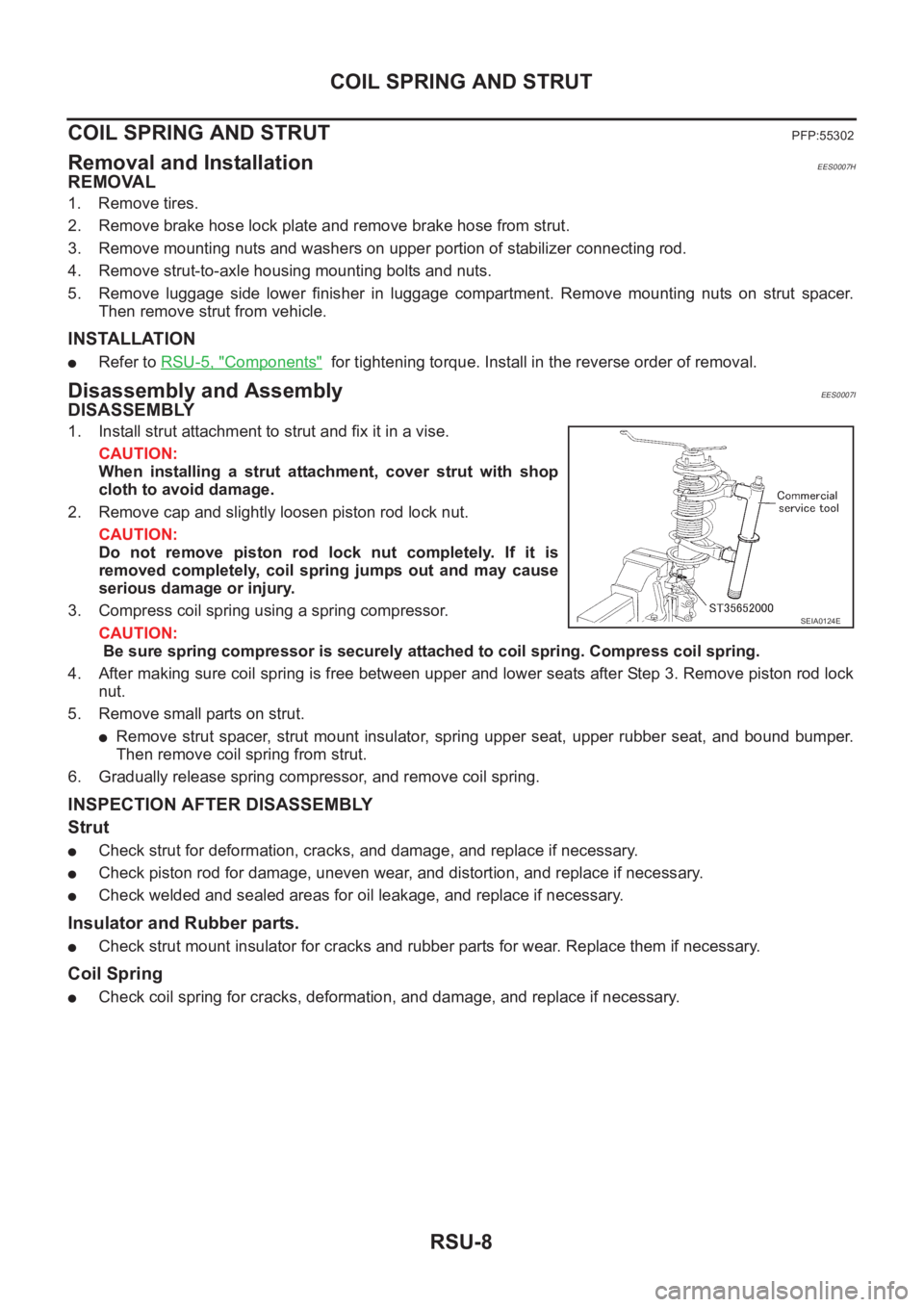
1. Install strut attachment to strut and fix it in a vise.
CAUTION:
When installing a strut attachment, cover strut with shop
cloth to avoid damage.
2. Remove cap and slightly loosen piston rod lock nut.
CAUTION:
Do not remove piston rod lock nut completely. If it is
removed completely, coil spring jumps out and may cause
serious damage or injury.
3. Compress coil spring using a spring compressor.
CAUTION:
Be sure spring compressor is securely attached to coil spring. Compress coil spring.
4. After making sure coil spring is free between upper and lower seats after Step 3. Remove piston rod lock
nut.
5. Remove small parts on strut.
●Remove strut spacer, strut mount insulator, spring upper seat, upper rubber seat, and bound bumper.
Then remove coil spring from strut.
6. Gradually release spring compressor, and remove coil spring.
INSPECTION AFTER DISASSEMBLY
Strut
●Check strut for deformation, cracks, and damage, and replace if necessary.
●Check piston rod for damage, uneven wear, and distortion, and replace if necessary.
●Check welded and sealed areas for oil leakage, and replace if necessary.
Insulator and Rubber parts.
●Check strut mount insulator for cracks and rubber parts for wear. Replace them if necessary.
Coil Spring
●Check coil spring for cracks, deformation, and damage, and replace if necessary.
SEIA0124E
Page 2729 of 3833
COIL SPRING AND STRUT
RSU-9
C
D
F
G
H
I
J
K
L
MA
B
RSU
ASSEMBLY
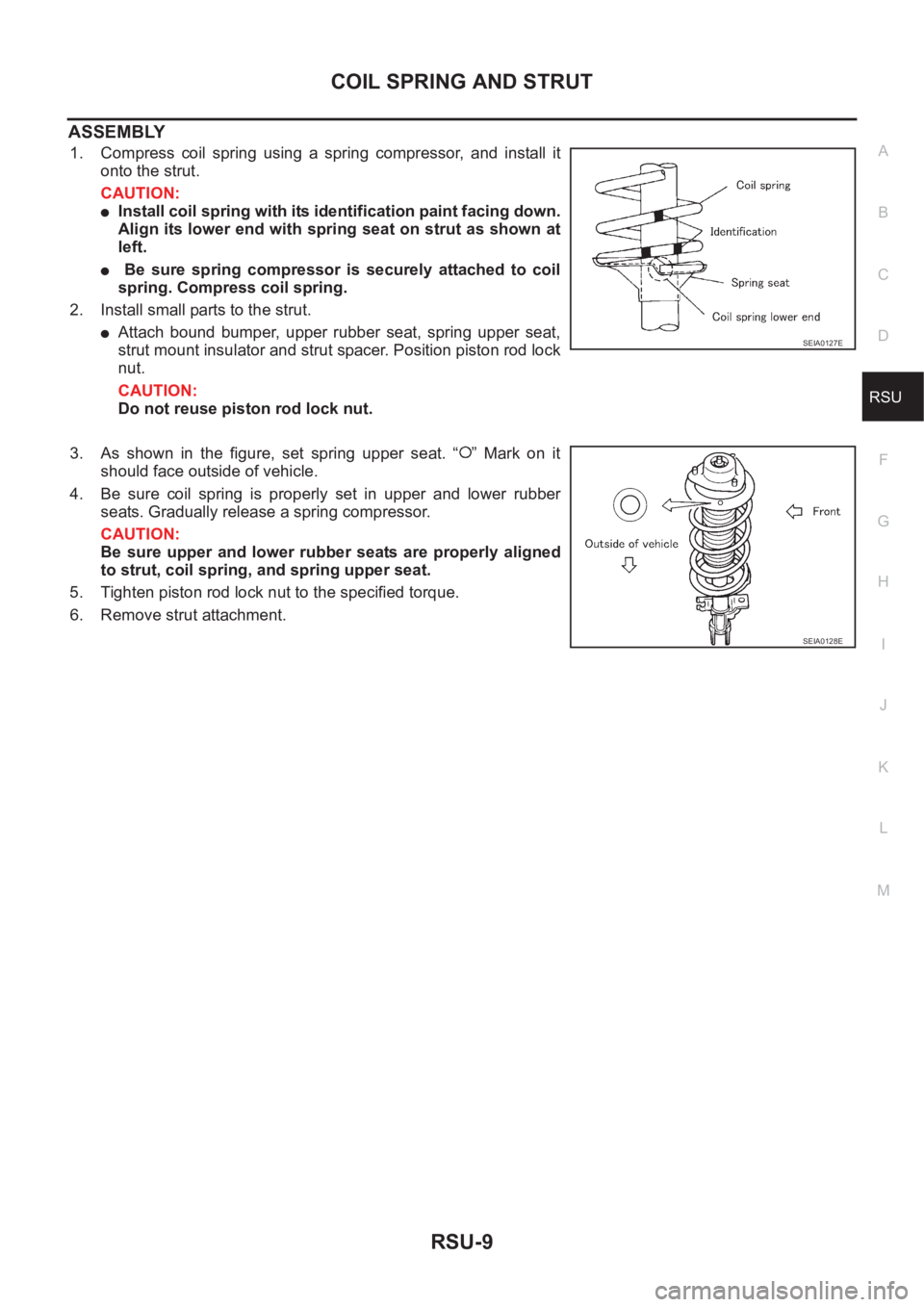
1. Compress coil spring using a spring compressor, and install it
onto the strut.
CAUTION:
●Install coil spring with its identification paint facing down.
Align its lower end with spring seat on strut as shown at
left.
● Be sure spring compressor is securely attached to coil
spring. Compress coil spring.
2. Install small parts to the strut.
●Attach bound bumper, upper rubber seat, spring upper seat,
strut mount insulator and strut spacer. Position piston rod lock
nut.
CAUTION:
Do not reuse piston rod lock nut.
3. As shown in the figure, set spring upper seat. “ ” Mark on it
should face outside of vehicle.
4. Be sure coil spring is properly set in upper and lower rubber
seats. Gradually release a spring compressor.
CAUTION:
Be sure upper and lower rubber seats are properly aligned
to strut, coil spring, and spring upper seat.
5. Tighten piston rod lock nut to the specified torque.
6. Remove strut attachment.SEIA0127E
SEIA0128E
Page 2763 of 3833
FRONT DISC BRAKE
BR-23
C
D
E
G
H
I
J
K
L
MA
B
BR
INSTALLATION
CAUTION:
●Refill with new brake fluid “DOT 3” or “DOT 4”.
●Never reuse drained brake fluid.
1. Install disc rotor.
2. Install caliper assembly. Tighten mounting bolts to the specified torque.
CAUTION:
Before installing caliper assembly, wipe oil and grease on steering knuckle washer seats and cali-
per assembly mounting surface.
3. Connect brake hose to caliper assembly and tighten union bolts to the specified torque.
CAUTION:
●Do not reuse the copper washer for union bolts.
●Securely assemble brake hose to protrusions on cylinder body.
4. Bleed air. Refer to BR-10, "
Bleeding Brake System" .
Caliper Disassembly and Assembly EFS000CK
DISASSEMBLY
WARNING:
Be careful not to pinch your fingers in the piston.
CAUTION:
Be careful not to damage the cylinder inner wall.
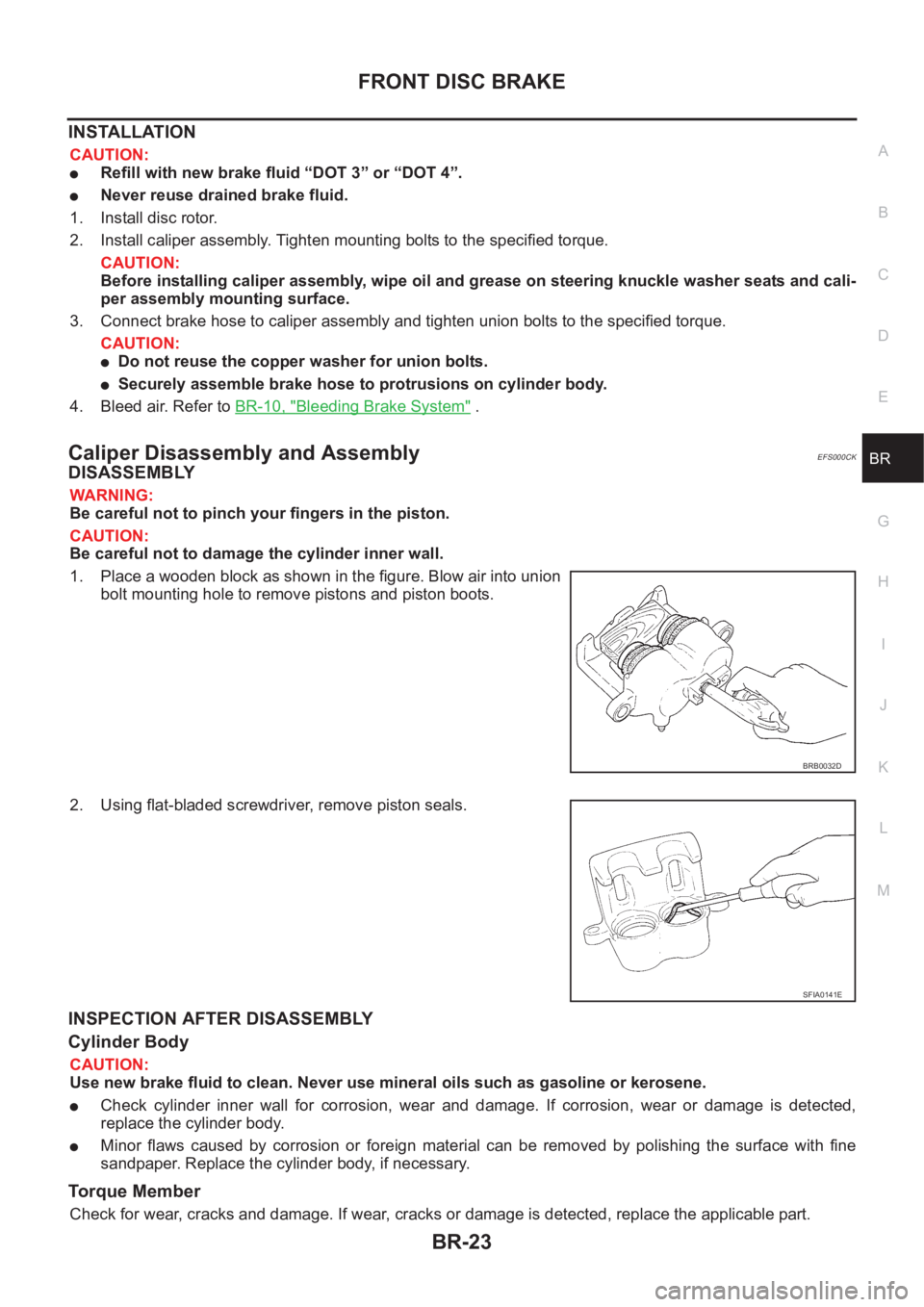
1. Place a wooden block as shown in the figure. Blow air into union
bolt mounting hole to remove pistons and piston boots.
2. Using flat-bladed screwdriver, remove piston seals.
INSPECTION AFTER DISASSEMBLY
Cylinder Body
CAUTION:
Use new brake fluid to clean. Never use mineral oils such as gasoline or kerosene.
●Check cylinder inner wall for corrosion, wear and damage. If corrosion, wear or damage is detected,
replace the cylinder body.
●Minor flaws caused by corrosion or foreign material can be removed by polishing the surface with fine
sandpaper. Replace the cylinder body, if necessary.
Torque Member
Check for wear, cracks and damage. If wear, cracks or damage is detected, replace the applicable part.
BRB0032D
SFIA0141E