towing Oldsmobile Achieva 1995 s Owner's Guide
[x] Cancel search | Manufacturer: OLDSMOBILE, Model Year: 1995, Model line: Achieva, Model: Oldsmobile Achieva 1995Pages: 340, PDF Size: 16.99 MB
Page 191 of 340
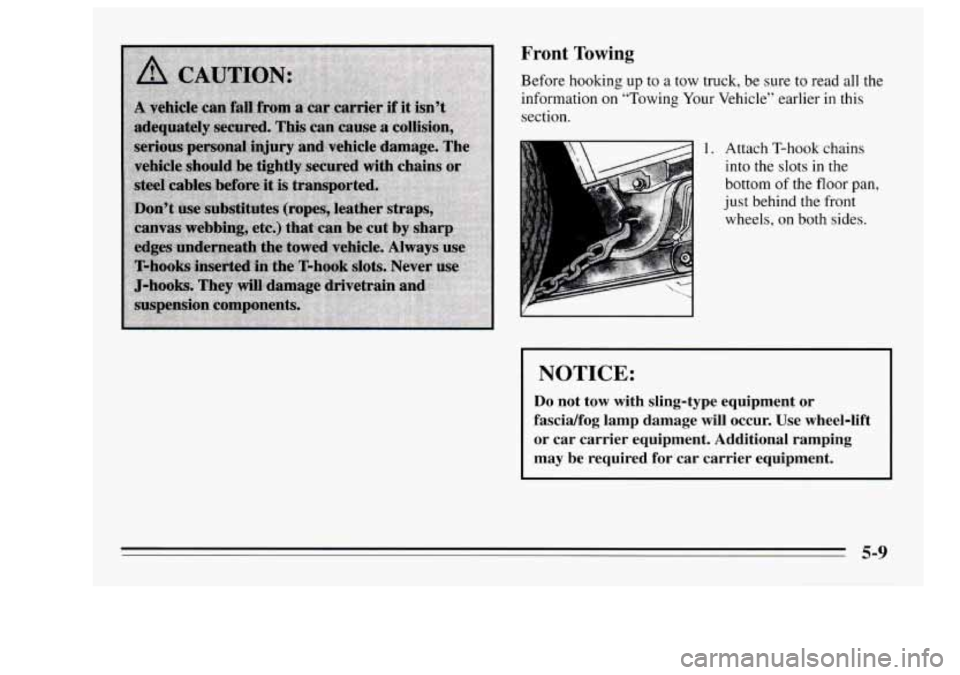
Front Towing
Before hooking up to a tow truck, be sure to read all the
information on “Towing Your Vehicle” earlier in this
section.
1. Attach T-hook chains
into the
slots in the
bottom
of the floor pan,
just behind the front
wheels, on both sides.
NOTICE:
Do not tow with sling-type equipment or
fascidfog lamp damage will occur. Use wheel-lift
or car carrier equipment. Additional ramping
may be required for car carrier equipment.
5-9
Page 192 of 340
NOTICE:
Towing a vehicle over rough surfaces could
damage
a vehicle. Damage can occur from vehicle
to ground or vehicle to wheel-lift equipment.
To
help avoid damage, install a towing dolly and
raise vehicle until adequate clearance
is obtained
between the ground and/or wheel-lift equipment.
Do not attach winch cables or J-hooks to
suspension components when using
car carrier
equipment. Always use T-hooks inserted in the
T-hook slots.
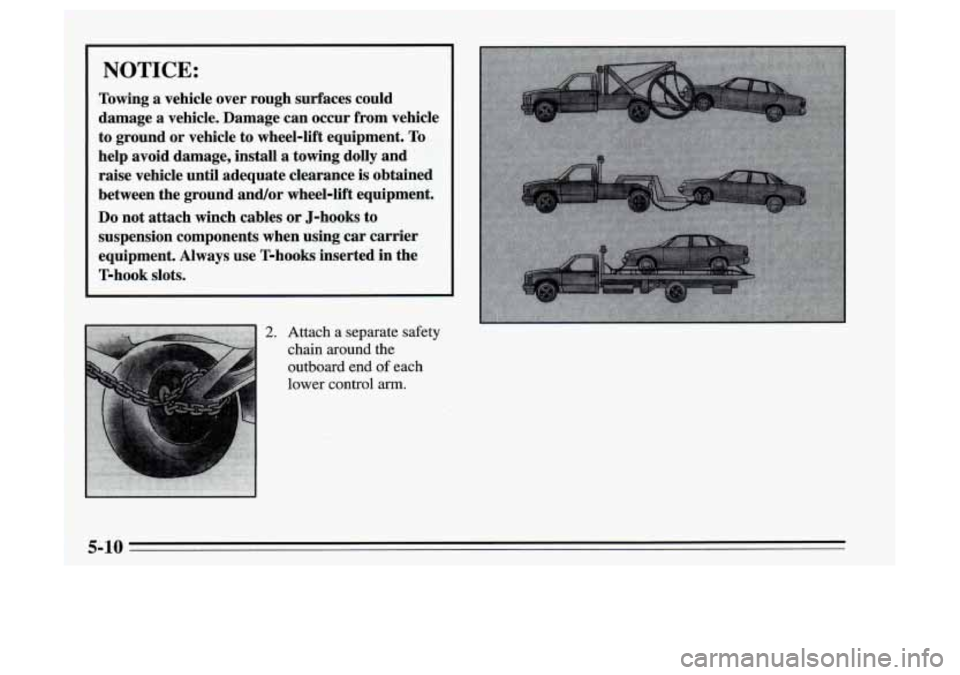
2. Attach a separate safety chain around the
outboard end
of each
lower control arm.
5-10
Page 193 of 340
Rear Towing
TOW LIMITS - 35 MPH (56 KPH), 50 MILES
(80 KM)
Before hooiung up to a tow truck, be sure to read all the
information on “Towing
Your Vehicle” earlier in this
section.
Also be sure to use the proper hook-up for your
particular vehicle.
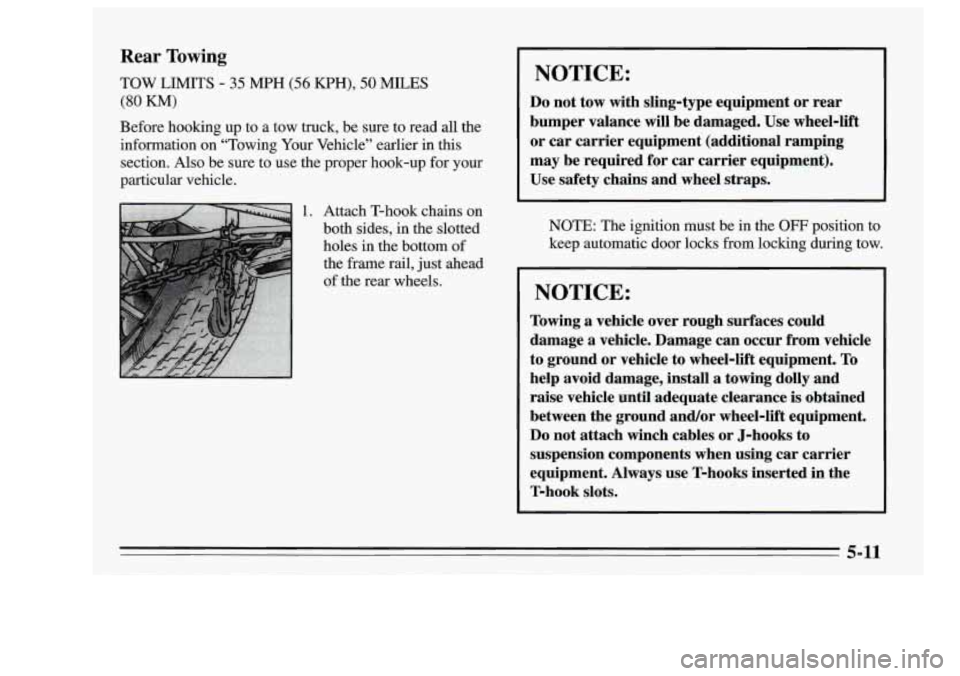
1. Attach T-hook chains on
both sides, in the slotted
holes in the bottom of
the fiame rail,
just ahead
of the rear wheels.
I NOTICE:
Do not tow with sling-type equipment or rear
bumper valance
will be damaged. Use wheel-lift
or car carrier equipment (additional ramping
may be required for car carrier equipment).
Use safety chains and wheel straps.
NOTE: The ignition must be in the OFF position to
keep automatic door locks from locking during
tow.
NOTICE:
Towing a vehicle over rough surfaces could
damage a vehicle. Damage can occur from vehicle
to ground or vehicle to wheel-lift equipment. To
help avoid damage, install a towing dolly and
raise vehicle until adequate clearance is obtained
between the ground and/or wheel-lift equipment.
Do not attach winch cables or J-hooks to
suspension components when using car carrier
equipment. Always use T-hooks inserted in the
T-hook slots.
5-11
Page 210 of 340
If You’re Stuck: In Sand, Mud, Ice or
Snow
What you don’t want to do when your vehicle is stuck is
to spin your wheels too fast. The method known
as
“rocking” can help you get out when you’re stuck, but
you must use caution.
NOTICE:
Spinning your wheels can destroy parts of your
vehicle as well
as the tires. If you spin the wheels
too fast while shifting your transaxle back and
forth, you can destroy your transaxle.
For information about using tire chains on your vehicle,
see “Tire Chains”
in the Index.
Rocking your vehicle to get it out
First, turn your steering wheel left and right. That will
clear the
area around your front wheels. Then shift back
and forth between REVERSE
(R) and a forward gear
(or
with a manual transaxle, between FIRST (1) or
SECOND (2) gear and REVERSE (R)), spinning the
wheels as little as possible. Release the accelerator pedal
while you shift, and press lightly on the accelerator
pedal when the transaxle is in gear. If that doesn’t get
you out after a few tries,
you may need to be towed out.
If
you do need to be towed out, see “Towing Your
Vehicle”
in the Index.
5-28
Page 272 of 340
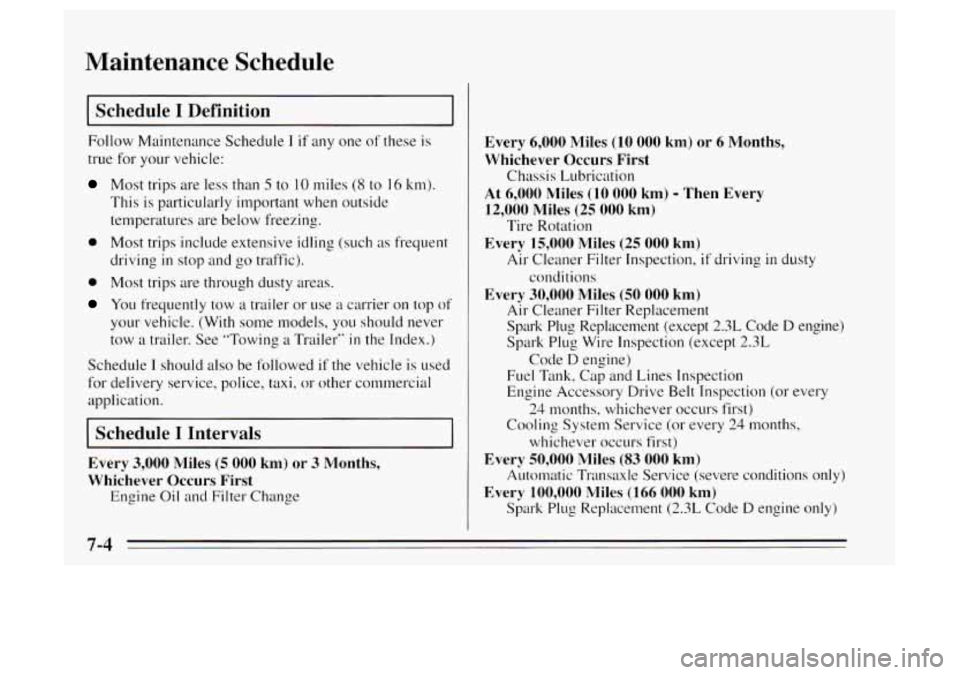
Maintenance Schedule
I Schedule I Definition I
Follow Maintenance Schedule I if any one of these is
true for your vehicle:
Most trips are less than 5 to 10 miles (8 to 16 km).
This is particularly important when outside
temperatures are below freezing.
0 Most trips include extensive idling (such as frequent
driving
in stop and go traffic).
0 Most trips are through dusty areas.
You frecp~ently tow a trailer or use a carrier on top of
your vehicle. (With some models, you should never
tow
a trailer. See “Towing a Trailer“ in the Index.)
Schedule
I should also be followed if the vehicle is used
for delivery service, police, taxi, or other commercial
application.
I Schedule I Intervals I
Every 3,000 Miles (5 000 km) or 3 Months,
Whichever Occurs First
Engine Oil and Filter Change
Every 6,000 Miles (10 000 km) or 6 Months,
Whichever Occurs First
Chassis Lubrication
At 6,000 Miles (10 000 km) - Then Every
12,000 Miles (25
000 km)
Every 15,000 Miles (25 000 km)
Tire Rotation
Air Cleaner Filter Inspection, if driving in dusty
conditions
Every 30,000 Miles (50 000 km)
Air Cleaner Filter Replacement
Spark Plug Replacement (except 2.3L Code
D engine)
Spark Plug Wire Inspection (except 2.3L
Fuel
Tmk, Cap and Lines Inspection
Engine Accessory Drive Belt Inspection (or every
Cooling System Service (or every 24 months,
Code
D engine)
24 months, whichever occurs first)
whichever occurs first)
Every 50,000 Miles (83 000 km)
Every 100,000 Miles (166 000 km)
Automatic Transaxle Service (severe conditions only)
Spark Plug Replacement (2.3L Code
D engine only)
7-4
Page 283 of 340
I Maintenance Schedule I I
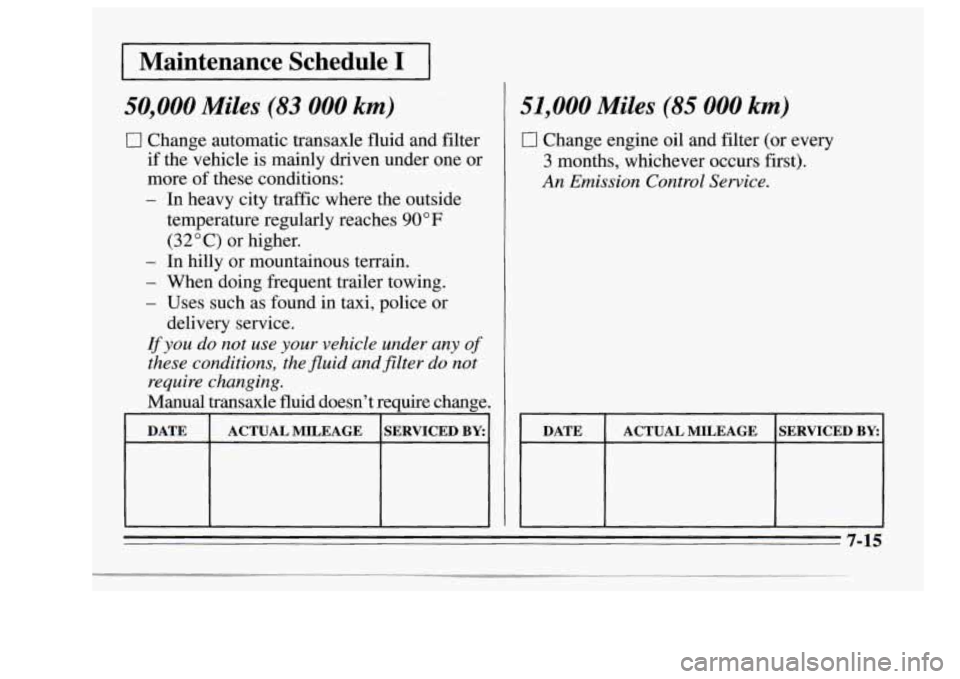
50,000 Miles (83 000 km)
0 Change automatic transaxle fluid and filter
if the vehicle is mainly driven under one or
more of these conditions:
- In heavy city traffic where the outside
temperature regularly reaches
90 OF
(32 O C) or higher.
- In hilly or mountainous terrain.
- When doing frequent trailer towing.
- Uses such as found in taxi, police or
delivery service. -
If you do not use your vehicle under any of
these conditions, the fluid and filter do not
require changing.
Manual transaxle fluid doesn’t require change.
-
-
ACTUAL MILEAGE
I
SERVICED BY: I
51,000 Miles (85 000 km)
17 Change engine oil and filter (or every
3 months, whichever occurs first).
An Emission Control Service.
I I I i
DATE SERVICED BY: ACTUAL MILEAGE
7-15
Page 293 of 340
![Oldsmobile Achieva 1995 s Owners Guide Maintenance Schedule I
100,000 Miles (1 66 000 km)
c] Replace spark plugs (2.3L Code D engine
only).
An. Emission Control Sewice.
0 Change automatic transaxle fluid and filter
if the vehi](/img/31/9564/w960_9564-292.png "Oldsmobile Achieva 1995 s Owners Guide Maintenance Schedule I
100,000 Miles (1 66 000 km)
c] Replace spark plugs (2.3L Code D engine
only).
An. Emission Control Sewice.
0 Change automatic transaxle fluid and filter
if the vehi")
Maintenance Schedule I
100,000 Miles (1 66 000 km)
c] Replace spark plugs (2.3L Code D engine
only).
An. Emission Control Sewice.
0 Change automatic transaxle fluid and filter
if the vehicle is mainly driven under one or
more of these conditions:
- In heavy city traffic where the outside
temperature regularly reaches
90°F
(32°C) or higher.
- In hilly or mountainous terrain.
- When doing frequent trailer towing.
- Uses such as found in taxi, police or
delivery service.
Ifyou do not use your vehicle under any of
these conditions, the fluid and filter do not
require changing.
Manual transaxle fluid doesn’t require
change.
DATE SERVICED BY ACTUAL MILEAGE
Page 298 of 340
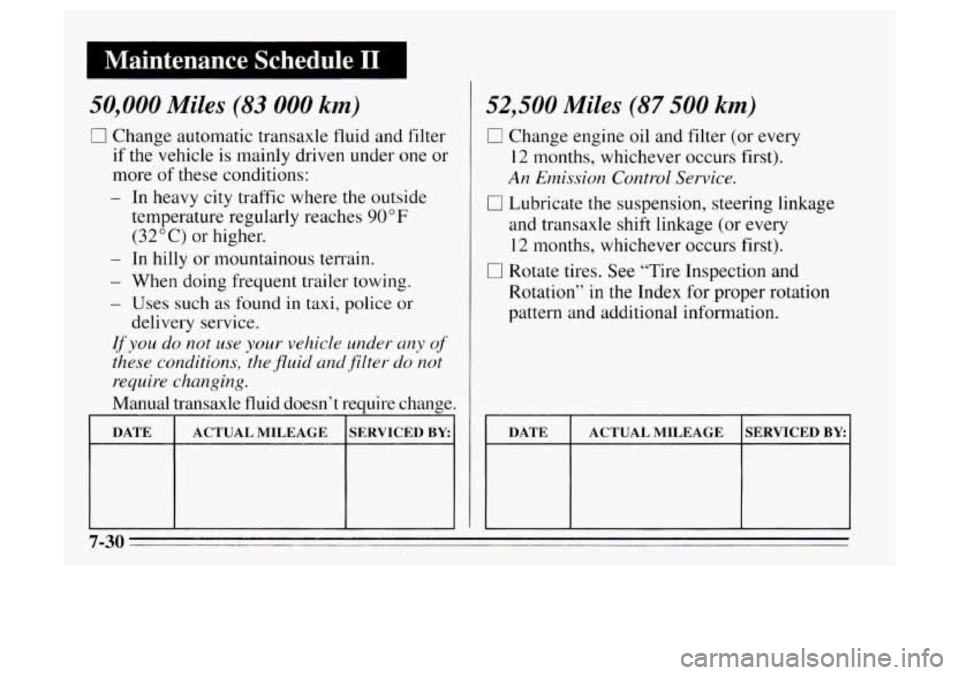
50,000 Miles (83 000 km)
0 Change automatic transaxle fluid and filter
if the vehicle is mainly driven under one or
more of these conditions:
- In heavy city traffic where the outside
temperature regularly reaches
90” F
(32°C) or higher.
- In hilly or mountainous terrain.
- When doing frequent trailer towing.
- Uses such as found in taxi, police or
If’ you do not use your vehicle Lmder my OJ”
t&se conditions, the fluid andjilter. ¬
require changing.
Manual transaxle fluid doesn’t reuuire chanrre.
delivery
service.
52,500 Miles (87 500 km)
0 Change engine oil and filter (or every
12 months, whichever occurs first).
An Emission Control Service.
0 Lubricate the suspension, steering linkage
and transaxle shift linkage (or every
12 months, whichever occurs first).
0 Kotate tires. See “Tire Inspection and
Rotation”
in the Index for proper rotation
pattern and additional information.
DATE
SERVICED BY ACTUAL MILEAGE
Page 303 of 340
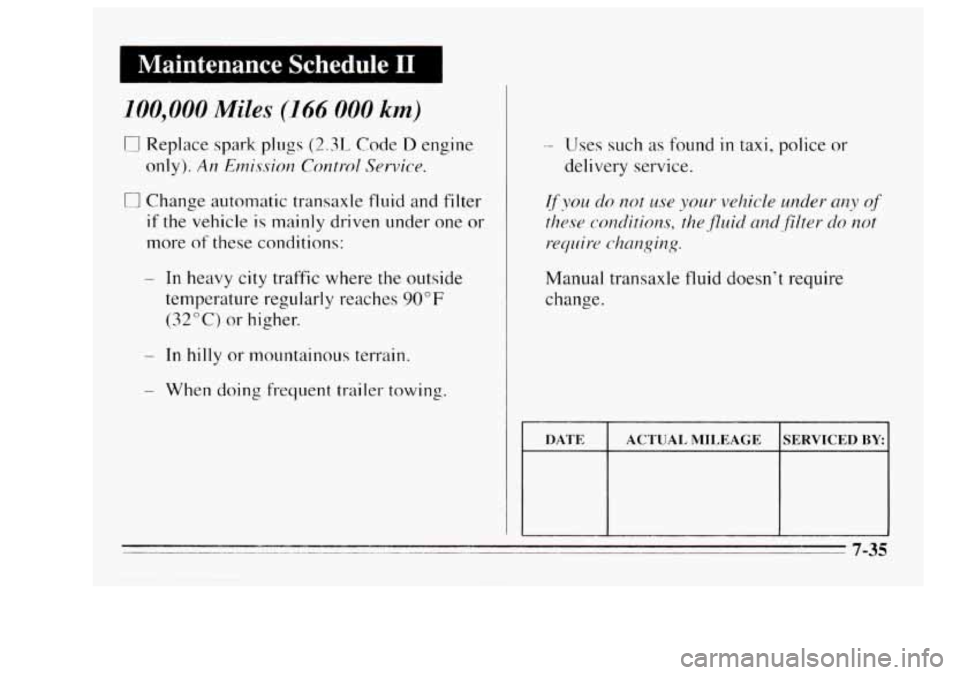
100,000 Miles (-1 66 000 km)
rl Change automatic transaxle fluid and filter
if the vehi-cle is mainly driven under one or
more of these conditions:
- In heavy city traffic where the outside
temperature regularly t-eaches
90°F
(32°C) or higher.
- In hilly or mountainous terrain.
-- When doing frequent trailer towing.
- Uses such as found in taxi, police or
deli very service.
If' you do not use your vehicle under any of
these conditions, the
Manual transaxle fluid doesn't require
change.
DA'I'E SERVICED IjY: ACTIJAI, MILEAGE
Page 320 of 340

Oldsmobile Roadside Assistance
Program Features and Benefits
The Oldsmobile Roadside Assistance program means
help is just a toll-free call away
-- 24 hours a day, 365
days a year.
Courteous and capable Customer Assistance Advisors
are on-call to provide you with prompt assistance.
24-Hour Oldsmobile Roadside Assistance
Telephone Number
1-800-442-OLDS (6537) is the one number to call for
assistance in the United States. Trained Customer
Assistance Advisors, on-call to render assistance
to
Achieva drivers, can dispatch roadside assistance and
towing service, locate the nearest Oldsmobile retail
facility, take your request for an Oldsmobile
computerized trip routing or simply answer any
questions the Achieva driver may have about the
coverage provided by your Oldsmobile Roadside
Assistance Program. The Oldsmobile Roadside
Assistance number
is fully staffed and operational
24 hours a day,
365 days a year.
Who Is Covered?
Oldsmobile Roadside Assistance (Oldsmobile Edge)
covers all
1995 Oldsmobile vehicles.*
Coverage is for the Oldsmobile vehicle,
regardless of
the driver, and is concurrent with the
Bumper-to-Bumper warranty period.
Oldsmobile reserves the right to limit services or
reimbursement to an owner or driver when
in
Oldsmobile’s judgement the claims become excessive in
frequency or type of occurrence.
4:Velzicles sold in Canada have a separate roadside
assistance
program, as described later in this section.
Canadian Roadside Assistance
Vehicles purchased in Canada have an extensive
roadside assistance program accessible from anywhere
in Canada or the U.S.A. Please refer to the separate
brochure provided by the retailer or call
1-800-268-6800 for emergency services.
8-6