maintenance schedule OLDSMOBILE BRAVADA 1997 User Guide
[x] Cancel search | Manufacturer: OLDSMOBILE, Model Year: 1997, Model line: BRAVADA, Model: OLDSMOBILE BRAVADA 1997Pages: 358, PDF Size: 18.02 MB
Page 244 of 358

When to Check Power Steering Fluid
It is not necessary to regularly check power steering
fluid unless you suspect there is a leak in the system or
you hear an unusual noise. A fluid loss in this system
could indicate a problem. Have the system inspected
and repaired.
How To Check Power Steering Fluid
When the engine compartment is cool, wipe the cap and
the top of the reservoir clean, then unscrew the cap and
wipe the dipstick with a clean rag. Replace the cap and
completely tighten it. Then remove the cap again and
look at the fluid level on the dipstick.
The level should be between the
ADD and FULL marks.
If necessary, add only enough fluid to bring the level up
to the proper range.
What to Use
Refer to the Maintenance Schedule to determine what
kind of fluid to use. See “Recommended Fluids and
Lubricants” in the Index. Always use the proper fluid.
Failure to use the proper fluid can cause leaks and
damage hoses and seals.
Windshield Washer Fluid
What to Use
When you need windshield washer fluid, be sure to read
the manufacturer’s instructions before use. If you will be
operating your vehicle in an area where the temperature
may fall below freezing, use a fluid that has sufficient
protection against freezing.
Adding Washer Fluid
Open the cap labeled WASHER FLUID ONLY with the
washer symbol on it. Add washer fluid until the tank is
full.
6-24
ProCarManuals.com
Page 246 of 358

So, it isn’t a good idea to “top off’ your brake fluid.
Adding brake fluid won’t correct a leak.
If you add fluid
when your linings are worn, then you’ll have too much
fluid when
you get new brake linings. You should add
(or remove) brake fluid,
as necessary, only when work is
done on the brake hydraulic system.
a
-
I CAUTION:
If you have too much brake fluid, it can spill on the
engine. The fluid will burn if the engine is
hot
enough. You or others could be burned, and your
vehicle
could be damaged. Add brake fluid only
when work
is done on the brake hydraulic system.
Refer to the Maintenance Schedule to determine when to
check your brake fluid. See “Periodic Maintenance
Inspections”
in the Index.
Checking Brake Fluid
You can check the brake fluid without taking off the cap.
Just look at the windows
on the brake fluid reservoir.
The fluid levels should be above
MIN. If they aren’t,
have your brake system checked to see
if there is a leak.
After work
is done on the brake hydraulic system, make
sure
the levels are above MIN and below the top of
each window.
6-26
ProCarManuals.com
Page 258 of 358
Tire Inspection and Rotation
Tires should be rotated every 6,000 to 8,000 miles
( 10 000 to 13 000 km). Any time you notice unusual
wear, rotate your tires
as soon as possible and check
wheel alignment. Also check for damaged tires or
wheels. See “When It’s Time for New Tires” and
“Wheel Replacement” later
in this section for
more information.
The purpose of regular rotation
is to achieve more
uniform wear for all tires on the vehicle. The first
rotation
is the most important. See “Scheduled
Maintenance Services”
in the Index for scheduled
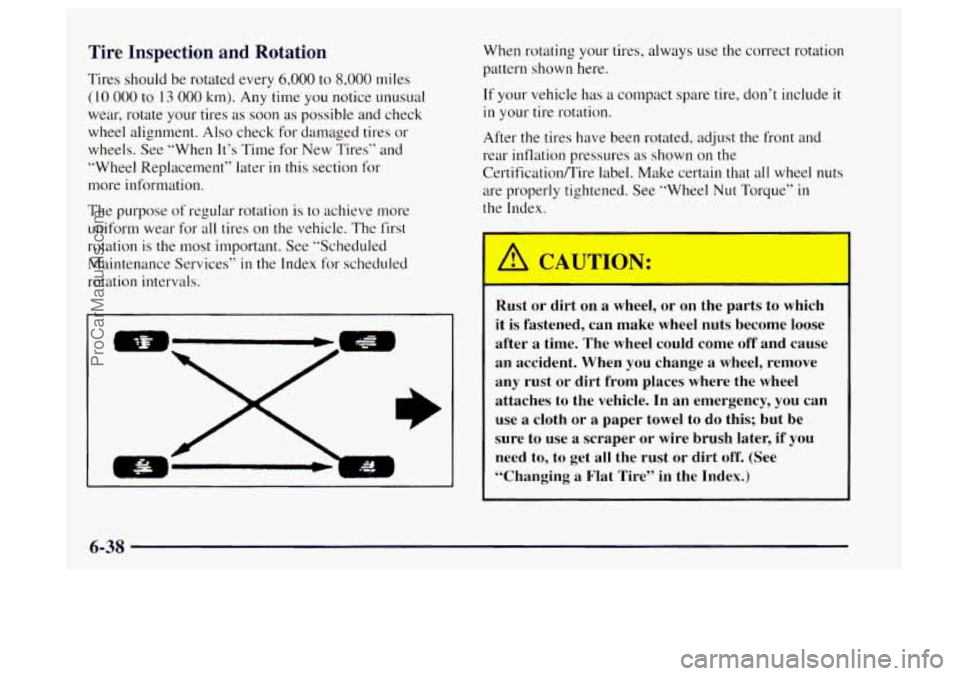
rotation intervals. When rotating your tires, always
use the correct rotation
pattern shown here.
If your vehicle has a compact spare
tire, don’t include it
in your tire rotation.
After the tires have been rotated, adjust the front and
rear inflation pressures
as shown on the
Certificationmire label. Make certain that all wheel nuts
are properly tightened. See
“Wheel Nut Toraue” in
the Index.
Rust or dirt on a wheel, or on the parts to which
it is fastened, can make wheel nuts become loose
after a time. The wheel could come off and cause
an accident. When you change a wheel, remove
any rust or dirt from places where the wheel
attaches to the vehicle. In an emergency, you can
use a cloth or a paper towel to do this; but be
sure to use a scraper or wire brush later,
if you
need to, to get all the rust or dirt off. (See
“Changing a Flat Tire” in the Index.)
6-38
ProCarManuals.com
Page 283 of 358
a Section 7 Maintenance Schedule
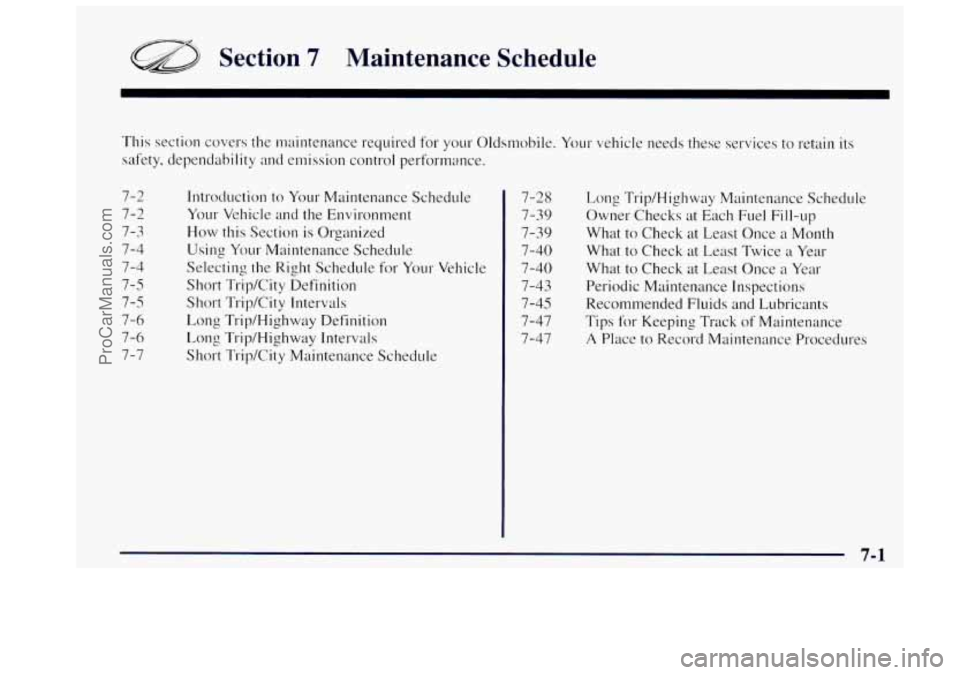
This section covers the maintenance required for your Oldsmobile. Your vehicle needs these services to retain its
safety, dependability and emission control performance.
7-2
7-2
7-3
7-4
7-4
7-5
7-5
7-6
7-6
7-7 Introduction to
Your Maintenance Schedule
Your Vehicle and the Environment
How this Section
is Organized
Using Your Maintenance Schedule
Selecting
the Right Schedule for Your Vehicle
Short Trip/City Definition
Short Trip/City Intervals
Long Trip/Highway Definition
Long Trip/Highway Intervals
Short Trip/City Maintenance Schedule 7-28
7-39
7-39
7-40
7 -40
7-43
7-4s
7-47
7-47 Long Trip/Highway Maintenance
Schedule
Owner Checks at Each Fuel Fill-up
What to Check at Least Once a Month
What to Check at Least Twice
a Year
What
to Check at Least Once a Year
Periodic Maintenance Inspections
Recommended Fluids and Lubricants
Tips
for Keeping Track of Maintenance
A Place to Record Maintenance Procedures
ProCarManuals.com
Page 285 of 358
How This Section is Organized
The remainder of this section is divided into five parts:
“Part
A: Scheduled Maintenance Services” shows
what to have done and how often. Some of these
services can be complex,
so unless you are technically
qualified and have the necessary equipment, you should
let your retailer’s service department
or another
qualified service center do these jobs.
Performing maintenance work on a vehicle can
be dangerous. In trying to do
some jobs, you can
be seriously injured.
Do your own maintenance
work only
if you have the required know-how
and the proper
tools and equipment for the job.
If you have any doubt, have a qualified
technician do the work.
If you are skilled enough to do some work on your
vehicle, you will probably want to get the service
information
GM publishes. See “Service and Owner
Publications”
in the Index. “Part
B: Owner Checks and Services”
tells you what
should be checked and when. It also explains what you
can easily do to help keep your vehicle
in good condition.
“Part C: Periodic Maintenance Inspections” explains
important inspections that your Oldsmobile retailer’s
service department or another qualified service center
should perform.
“Part
D: Recommended Fluids and Lubricants” lists
some products
GM recommends to help keep your
vehicle properly maintained. These products, or their
equivalents, should be used whether you do the work
yourself or have
it done.
“Part
E: Maintenance Record” provides a place for
you to record the maintenance performed
on your
vehicle. Whenever any maintenance is performed, be
sure to write
it down in this part. This will help you
determine when your next maintenance should be done.
In addition, it is a good idea to keep your maintenance
receipts. They may be needed to qualify your vehicle
for
warranty repairs.
7-3
ProCarManuals.com
Page 286 of 358
Part A: Scheduled Maintenance
Services
Using Your Maintenance Schedule
We at General Motors want to help you keep your
vehicle
in good working condition. But we don’t know
exactly- how you’ll drive it. You may drive very short
distances only a few times a week. Or you may drive
long distances all the time
in very hot, dusty weather.
You may use your vehicle
in making deliveries.
Or you may drive
it to work, to do errands or in many
other ways.
Because of all the different ways people use their
GM
vehicles. maintenance needs vary. You may even need
more frequent checks and replacements than you’ll find
in the schedules in this section. So please read this
section and note how
you drive. If you have any
questions
on how to keep your vehicle in good
condition, see your Oldsmobile retailer.
This part tells you the maintenance services you should
have done and
when you should schedule them. If you
go to your retailer for your service needs, you’ll know
that GM-trained and supported service people
will
perform the work using genuine GM parts. The proper fluids
and lubricants to use are listed
in
Part D. Make sure whoever services your vehicle uses
these.
All parts should be replaced and all necessary
repairs done before you or anyone else drives the
vehicle.
These schedules are
for vehicles that:
0 carry passengers and cargo within recommended
limits.
You will find these limits on your vehicle’s
Certification/Tire label. See “Loading Your Vehicle”
in the Index.
are driven on reasonable road surfaces within legal
driving limits.
0 use the recommended fuel. See “Fuel” in the Index.
Selecting the Right Schedule
First you’ll need to decide which of the two schedules is
right for your vehicle. Here’s how to decide which
schedule to follow:
ProCarManuals.com
Page 287 of 358
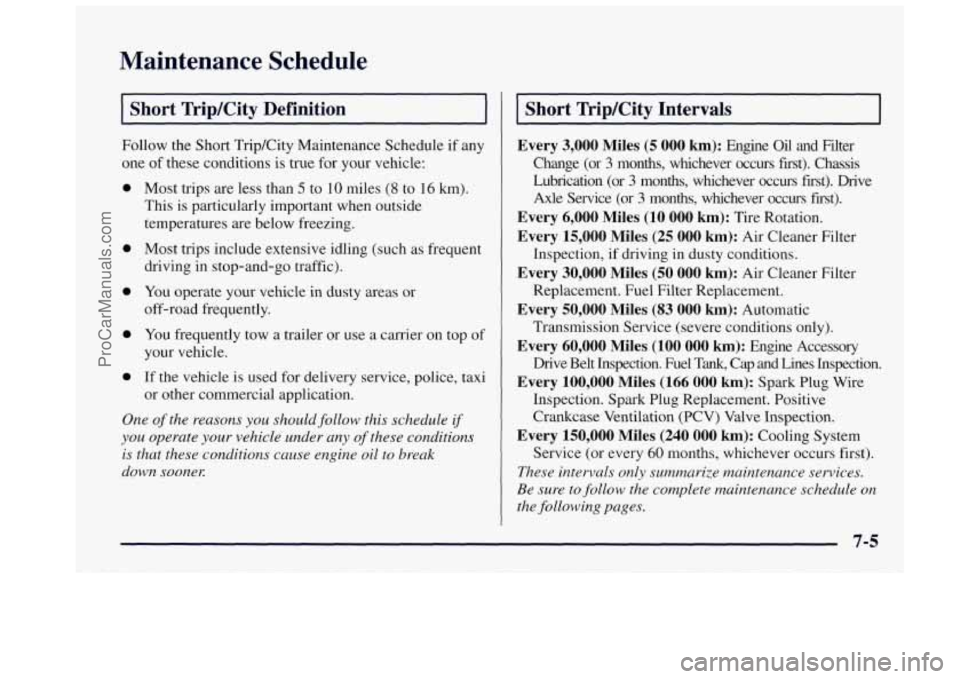
Maintenance Schedule
I Short TriplCity Definition I
Follow the Short Trip/City Maintenance Schedule if any
one of these conditions
is true for your vehicle:
0
0
0
0
0
Most trips are less than 5 to 10 miles (8 to 16 km).
This is particularly important when outside
temperatures are below freezing.
Most trips include extensive idling (such
as frequent
driving in stop-and-go traffic).
You operate your vehicle in dusty areas or
off-road frequently.
You frequently tow a trailer or use a carrier on top of
your vehicle.
If the vehicle is used for delivery service, police, taxi
or other commercial application.
One
of the reasons you should follow this schedule if
you operate your vehicle under any of these conditions
is that these conditions cause engine oil to break
down soonez
Short TripKity Intervals
Every 3,000 Miles (5 000 km): Engine Oil and Filter
Change (or
3 months, whichever occurs first). Chassis
Lubrication (or
3 months, whichever occurs first). Drive
Axle Service (or
3 months, whichever occurs first).
Every 6,000 Miles (10 000 km): Tire Rotation.
Every 15,000 Miles (25 000 km): Air Cleaner Filter
Inspection, if driving in dusty conditions.
Every 30,000 Miles (50 000 km): Air Cleaner Filter
Replacement. Fuel Filter Replacement.
Every 50,000 Miles (83 000 km): Automatic
Transmission Service (severe conditions only).
Every 60,000 Miles (100 000 km): Engine Accessory
Drive Belt Inspection. Fuel
Tank, Cap and Lines Inspection.
Every 100,000 Miles (166 000 km): Spark Plug Wire
Inspection. Spark Plug Replacement. Positive
Crankcase Ventilation (PCV) Valve Inspection.
Every 150,000 Miles (240 000 km): Cooling System
Service (or every
60 months, whichever occurs first).
These intervals only sunzmarize maintenance services.
Be sure
to follow the complete maintenance schedule on
the following pages.
RP / -3
ProCarManuals.com
Page 288 of 358

Maintenance Schedule
Long Tripmighway Definition - -
Follow this maintenance schedule only if none of the
conditions from the Short TripKity Maintenance
Schedule is true.
Do not use this schedule if the vehicle
is used for trailer towing, driven
in a dusty area or used
off paved roads. Use the Short Trip/City schedule for
these conditions.
Driving
CI vehicle with c~~fidly cuarlned engine under
Iliglzwny conditions
causes engine oil to br-ecrk
down slovver:
vong Trip/Highway Intervals
Every 7,500 Miles (12 500 km): Engine Oil and Filter
Change (or every
12 months, whichever occurs first).
Chassis Lubrication (or every
12 months, whichever
occurs first). Drive Axle Service. Tire Rotation.
Every 30,000 Miles (50 000 km): Fuel Filter
Replacement. Air Cleaner Filter Replacement.
Every 50,000 Miles (83 000 km): Automatic
Transmission Service (severe conditions only).
Every 60,000 Miles (100 000 km): Engine
Accessory Drive Belt Inspection. Fuel Tank,
Cap and Lines Inspection.
Every 100,000 Miles (166 000 km): Spark Plug Wire
Inspection. Spark Plug Replacement. Positive
Crankcase Ventilation (PCV) Valve Inspection.
Every 150,000 Miles (240 000 km): Cooling System
Service (or every
60 months, whichever occurs first).
These interwls odv s~.mmar-ize nminteneu?ce services.
Be ,wre to~follorv the c.ompletr rmintenclnce .schd~tle OR
the*fi)llmving pages.
7-6
ProCarManuals.com
Page 289 of 358
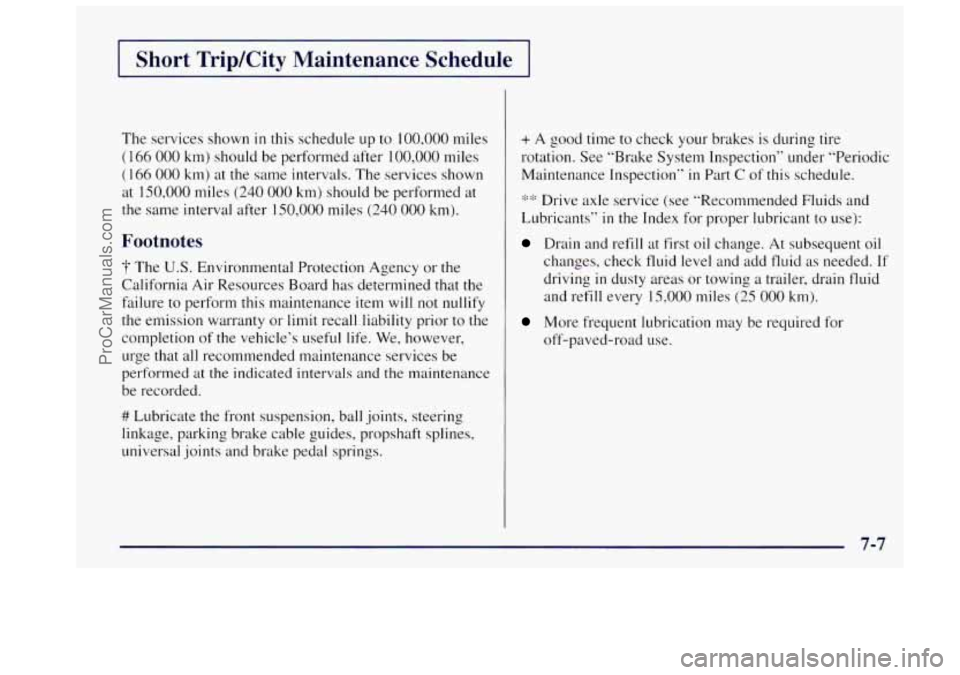
Short Trip/City Maintenance Schedule
The services shown in this schedule up to 100,000 miles
( 166 000 kmj should be performed after 100,000 miles
(166 000 kmj at the same intervals. The services shown
at
150,000 miles (240 000 km) should be performed at
the same interval after
150,000 miles (240 000 km).
Footnotes
7 The U.S. Environmental Protection Agency or the
California Air Resources Board has determined that the
failure to perform this maintenance item will
not nullify
the emission warranty or limit recall liability prior to the
completion of the vehicle’s useful life. We, however,
urge that all recommended maintenance services be
performed at the indicated intervals and the maintenance
be recorded.
## Lubricate the front suspension, ball joints, steering
linkage, parking brake cable guides, propshaft splines,
universal joints and brake pedal springs.
+ A good time to check your brakes is during tire
rotation. See “Brake System Inspection” under “Periodic
Maintenance Inspection’’ in Part
C of this schedule.
‘b‘k Drive axle service (see “Recommended Fluids and
Lubricants”
in the Index for proper lubricant to usej:
Drain and refill at first oil change. At subsequent oil
changes, check fluid level and add fluid
as needed. If
driving in dusty areas or towing a trailer, drain fluid
and refill every
15,000 miles (25 000 km).
More frequent lubrication may be required for
off-paved-road use.
7-7
ProCarManuals.com
Page 290 of 358

I Short Trip/City Maintenance Schedule I
3,000 Miles (5 000 km)
0 Change engine oil and filter (or every
3 months, whichever occurs first).
An Emission Control Service.
0 Lubricate chassis components (or every
3 months, whichever occurs first).
(See footnote
#.)
0 Check readfront axle fluid level and add
fluid as needed. Check constant velocity
joints and axle seals for lealung.
(See footnote
**.)
DATE ACTUAL MILEAGE SERVICED BY.
6,000 Miles (10 000 km)
Cl Change engine oil and filter (or every
3 months, whichever occurs first).
An Emission Control Service.
3 months, whichever occurs first).
(See footnote
#.)
0 Check readfkont axle fluid level and add fluid
as needed. Check constant velocity joints and axle seals for leaking. (See footnote
**.)
0 Rotate tires. See “Tire Inspection and
Rotation”
in the Index for proper rotation
pattern and additional information. (See footnote
+.)
0 Lubricate chassis components (or every
DATE ACTUAL MILEAGE SERVICED BY:
7-8
ProCarManuals.com