ECU Oldsmobile Bravada 2003 s User Guide
[x] Cancel search | Manufacturer: OLDSMOBILE, Model Year: 2003, Model line: Bravada, Model: Oldsmobile Bravada 2003Pages: 410, PDF Size: 20.1 MB
Page 46 of 410
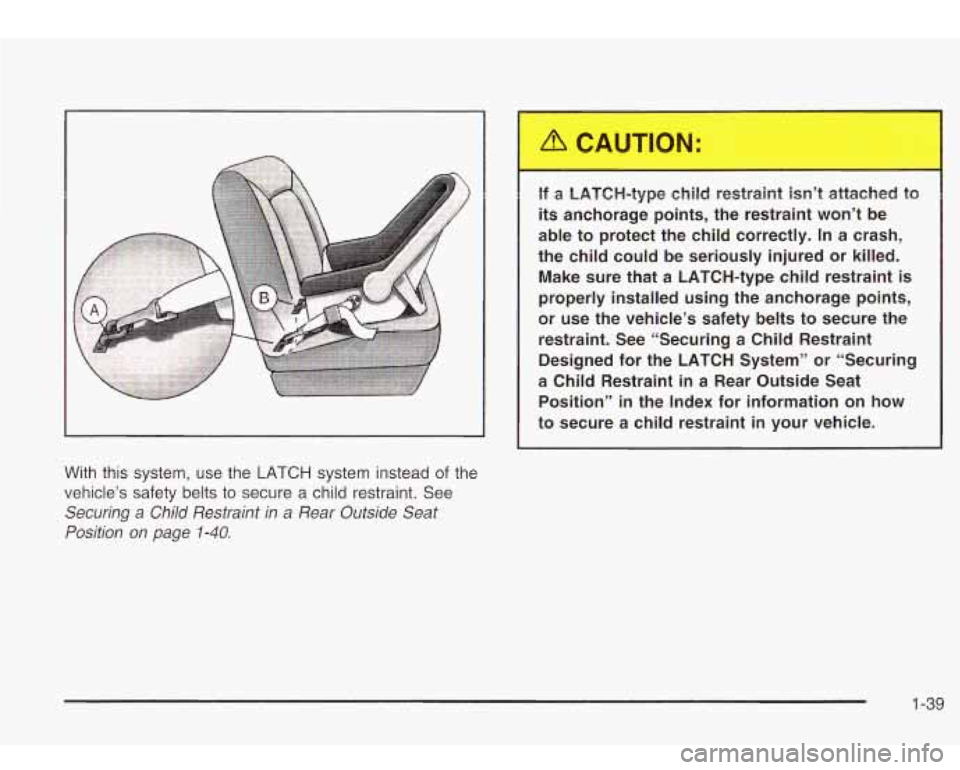
With this system, use the LATCH system instead of the
vehicle’s safety belts to secure a child restraint. See
Securing a Child Restraint in a Rear Outside Seat
Position on page
1-40.
If a LATCH-type child restraint isn’t attached to
its anchorage points, the restraint won’t be
able
to protect the child correctly. In a crash,
the child could be seriously injured or killed.
Make sure that
a LATCH-type child restraint is
properly installed using the anchorage points,
or use the vehicle’s safety belts to secure the restraint. See “Securing a Child Restraint
Designed for the LATCH System’’ or “Securing
a Child Restraint in a Rear Outside Seat
Position” in the Index for information on how
to secure a child restraint in your vehicle.
1-39
Page 47 of 410
Securing a Child Restraint Designed
for the LATCH System
1. Find the anchors for the seating position you want
to use, where the bottom of the seatback meets the
back
of the seat cushion.
2. Put the child restraint on the seat.
3. Attach the anchor points on the child restraint to the
anchors in the vehicle. The child restraint
instructions will show you how.
4. If the child restraint is forward-facing, attach the top
strap to the top strap anchor. See
Top Strap on
page
1-36. Tighten the top strap according to
the child restraint instructions.
directions to be sure it is secure.
5. Push and pull the child restraint in different
To remove the child restraint, simply unhook the top strap from the top tether anchor and then disconnect the
anchor points.
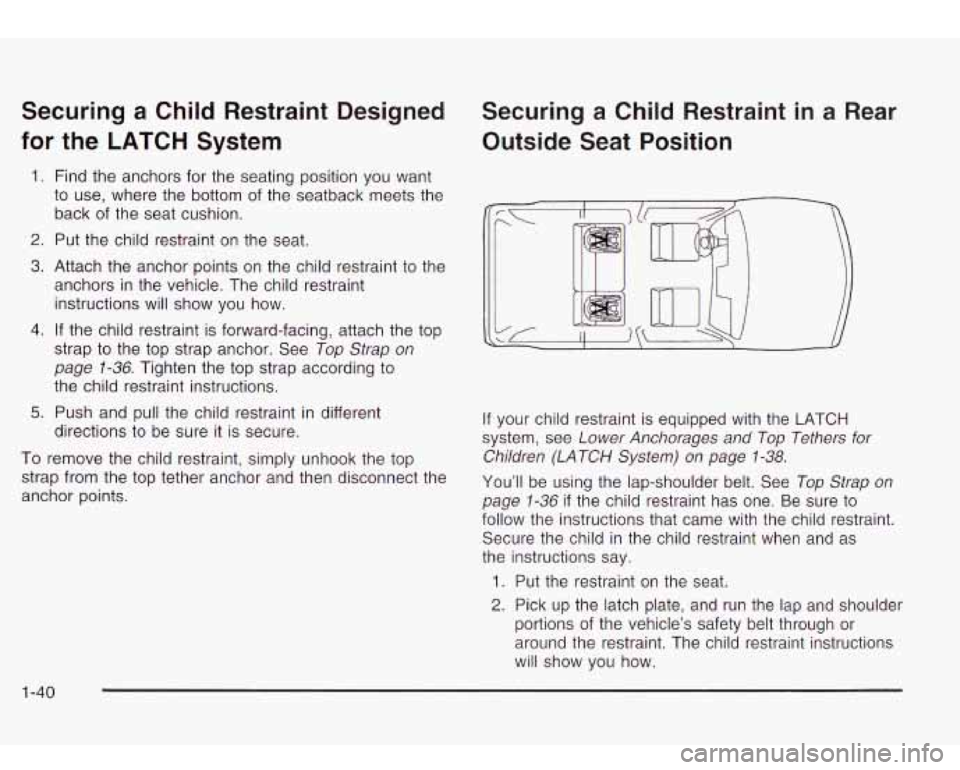
Securing a Child Restraint in a Rear
Outside Seat Position
If your child restraint is equipped with the LATCH
system, see
Lower Anchorages and Top Tethers for
Children (LATCH System)
on page 1-38.
You’ll be using the lap-shoulder belt. See Top Strap on
page
1-36 if the child restraint has one. Be sure to
follow the instructions that came with the child restraint.
Secure the child in the child restraint when and as
the instructions say.
1. Put the restraint on the seat.
2. Pick up the latch plate, and run the lap and shoulder
portions of the vehicle’s safety belt through or
around the restraint. The child restraint instructions
will show you how.
1-40
Page 49 of 410
1
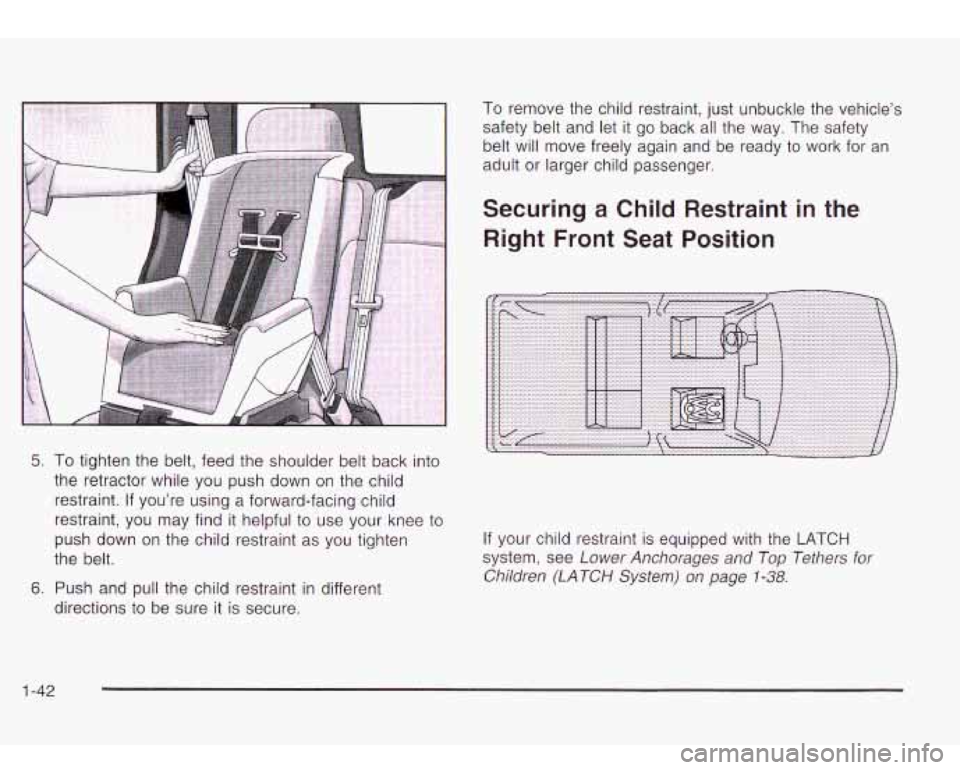
5. To tighten the belt, feed the shoulder belt back into
the retractor while you push down on the child
restraint.
If you’re using a forward-facing child
restraint, you may find it helpful
to use your knee to
push down on the child restraint as you tighten
the belt.
6. Push and pull the child restraint in different
directions
to be sure it is secure. To remove the child
restraint, just unbuckle the vehicle’s
safety belt and let it go back
all the way. The safety
belt will move freely again and be ready
to work for an
adult or larger child passenger.
Securing a Child Restraint in the
Right Front Seat Position
If your child restraint is equipped with the LATCH
system, see Lower Anchorages and Top Tethers for
Children (LATCH System) on page 1-38.
1 -42
Page 50 of 410
Your vehicle has a right front passenger air bag. Never
put a rear facing child restraint in this seat. Here's whl-
A child in a rear-facing child restraint can be
seriously injured or killed
if the right front
passenger's air bag inflates. This is because
the back of the rear-facing child restraint
would be very close to the inflating air bag.
Always secure a rear-facing child restraint in a
rear seat.
Although a rear seat is a safer place, you can secure a
forward-facing child restraint in the right front seat.
You'll be using the lap-shoulder belt. See
Top Strap on
page 7-36 if the child restraint has one. Be sure to
follow the instructions that came with the child restraint.
Secure the child in the child restraint when and as
the instructions say.
1. Because your vehicle has a right front passenger's
air bag, always move the seat as far back as it will
go before securing a forward-facing child restraint.
See
Power Seats on page 7-2.
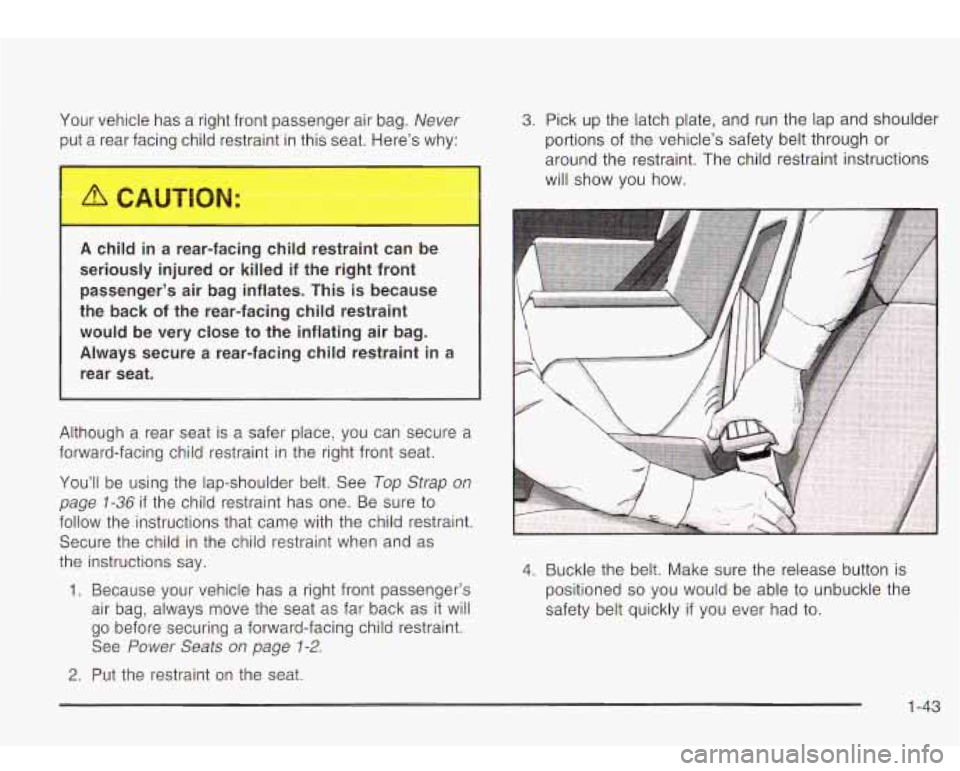
3. Pick up the latch plate, and run the lap and shoulder
portions of the vehicle's safety belt through
or
around the restraint. The child restraint instructions
will show you how.
4. Buckle the belt. Make sure the release button is
positioned
so you would be able to unbuckle the
safety belt quickly
if you ever had to.
2. Put the restraint on the seat.
1-43
Page 51 of 410
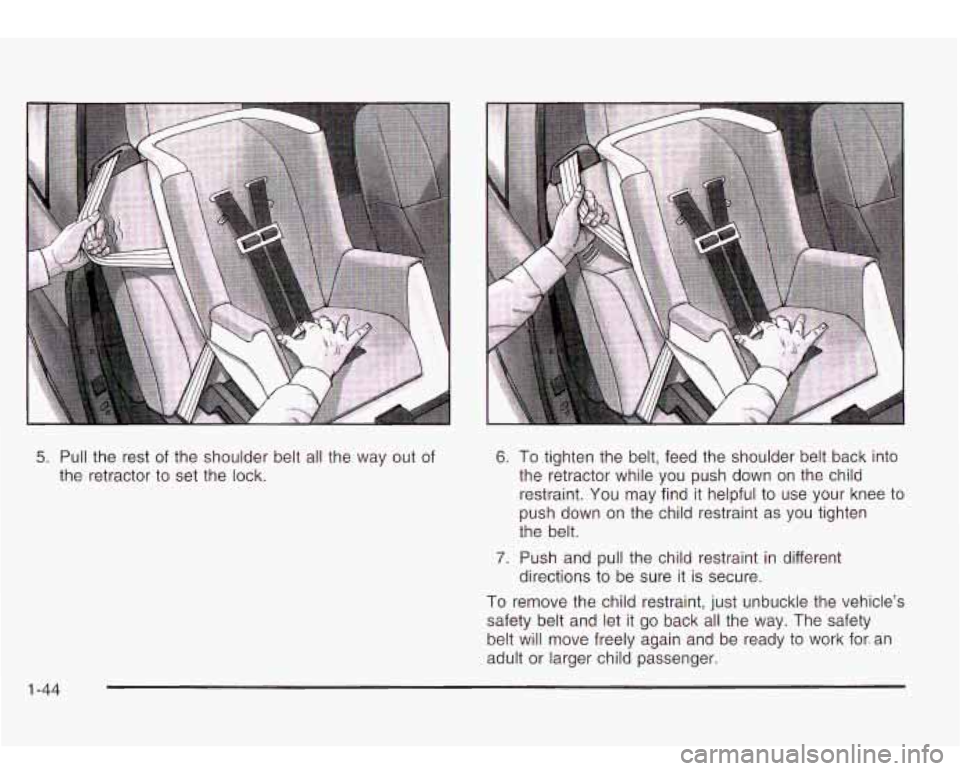
5. Pull the rest of the shoulder belt all the way out of
the retractor
to set the lock.
6. To tighten the belt, feed the shoulder belt back into
the retractor while you push down on the child
restraint. You may find it helpful
to use your knee to
push down on the child restraint as you tighten
the belt.
7. Push and pull the child restraint in different
directions
to be sure it is secure.
To remove the child restraint, just unbuckle the vehicle’s
safety belt and let it go back all the way. The safety
belt will move freely again and be ready
to work for. an
adult
or larger child passenger.
1 -44
Page 55 of 410
Both .. Jntal and -.-- irn,,ct air bags in..-te
with great force, faster than the blink of an
eye. If you’re too close to an inflating air bag,
as you would be if you were leaning forward, it
could seriously injure you. Safety belts help
keep you in position for air bag inflation before
and during
a crash. Always wear your safety
belt, even with frontal air bags. The driver
should sit as far back as possible while still
maintaining control of the vehicle. Front
~ occupants should not lean on or sleep against
the door.
Anyone who is up against, or very close to,
any air bag when it inflates can be seriously injured or killed. Air bags plus lap-shoulder
CAUTION: (Continued)
I
r __._ s o - -.le --st pro--:tic.. for adults, but
not for young children and infants. Neither the
vehicle’s safety belt system nor its air bag
system is designed for them. Young children
and infants need the protection that
a child
restraint system can provide. Always secure
children properly in your vehicle.
To read how,
see the part of this manual called “Older
Children” or “Infants and Young Children”.
There
is an air bag
readiness light on the
instrument panel cluster,
which shows the air
bag symbol.
The system checks the air bag electrical system for
malfunctions. The light tells you
if there is an electrical
problem. See
Air Bag Readiness Light on page 3-37
for more information.
1-48
Page 66 of 410
Section 2 Features and Controls
Keys ............................................................... 2-.
Remote Keyless Entry System
......................... 2-4
Remote Keyless Entry System Operation
........... 2-5
Doors and Locks ............................................. 2.8
Door Locks
.................................................... 2.8
Power Door Locks
.......................................... 2.9
Delayed Locking
............................................. 2.9
Programmable Automatic Door Locks
.............. 2.10
Rear Door Security Locks
.............................. 2-12
Lockout Protection
........................................ 2.12
Leaving Your Vehicle
.................................... 2.12
Liftgate/Liftglass
............................................ 2.13
Windows ........................................................ 2.14
Power Windows
............................................ 2.15
Sun Visors
................................................... 2.15
Theft-Deterrent Systems .................................. 2.16
Content Theft-Deterrent
................................. 2.16
Passlock@
................................................... 2.17
Starting and Operating Your Vehicle ................ 2.18
New Vehicle Break-In
.................................... 2.18
Ignition Positions
...................................... 2.18
Starting Your Engine
.............................. 2-19
~ ~~
Engine Coolant Heater .................................. 2.20
Automatic Transmission Operation
................... 2.22
All-Wheel Drive
............................................ 2.24
Parking Brake
.............................................. 2.25
Shifting Into Park (P)
..................................... 2-25
Shifting
Out of Park (P) ................................. 2-27
Parking Over Things That Burn
....................... 2-28
Engine Exhaust
............................................ 2-28
Running Your Engine While You Are Parked
.... 2-29
Mirrors ........................................................... 2-30
Automatic Dimming Rearview Mirror with Onstar@ and Compass
............................... 2-30
Outside Manual Mirrors
.................................. 2-32
Outside Power Mirror
.................................... 2-32
Outside Convex Mirror
................................... 2-33
Outside Heated Mirrors
.................................. 2-33
Outside Automatic Dimming Mirror with Curb
View Assist
.............................................. 2-33
Onstar@ System ............................................ 2-35
HomeLink@ Transmitter .................................. 2-37
Programming the HomeLink@ Transmitter
........ 2-37
2-1
Page 77 of 410
Rear Door Security Locks
Your vehicle may have this feature. You can lock the
rear doors
so they can't be opened from the inside
by passengers. To use one of these locks do the
following:
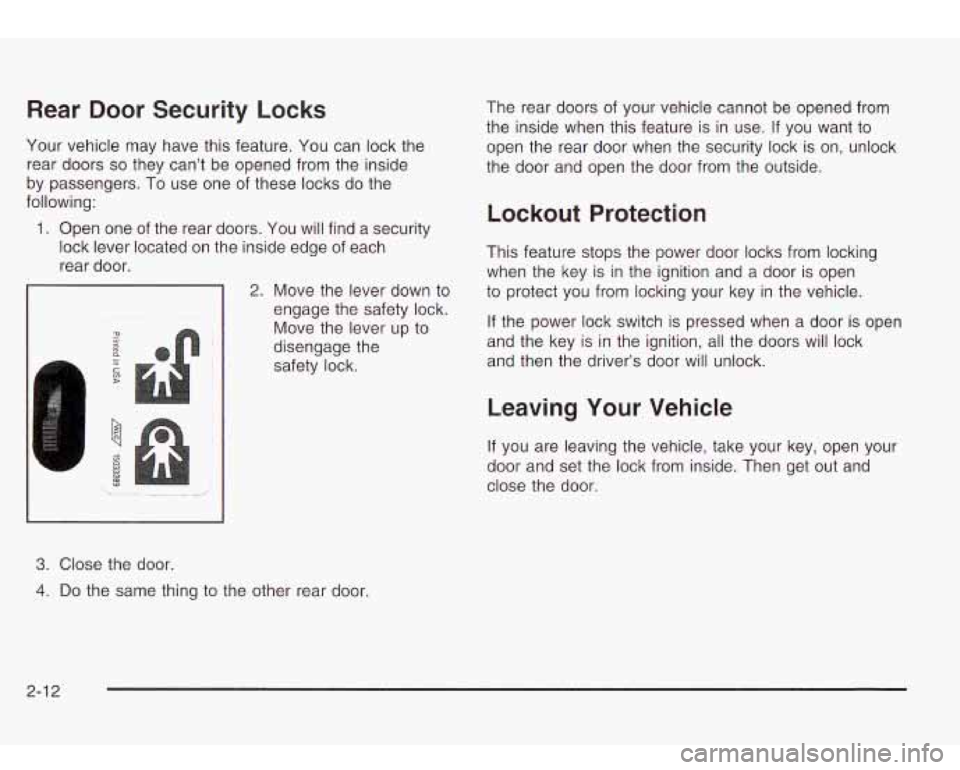
1. Open one
of the rear doors. You will find a security
lock lever located on the inside edge of each
rear door.
1-
3. Close the door.
2. Move the lever down to
engage the safety lock.
Move the lever up to
disengage the
safety lock. The
rear doors
of your vehicle cannot be opened from
the inside when this feature is in use.
If you want to
open the rear door when the security lock is on, unlock
the door and open the door from the outside.
Lockout Protection
This feature stops the power door locks from locking
when the key is in the ignition and a door is open
to protect you from locking your key in the vehicle.
If the power lock switch is pressed when a door is open
and the key is in the ignition, all the doors will lock
and then the driver's door will unlock.
Leaving Your Vehicle
If you are leaving the vehicle, take your key, open your
door and set the lock from inside. Then get out and
close the door.
4. Do the same thing to the other rear door.
2-1 2
Page 81 of 410
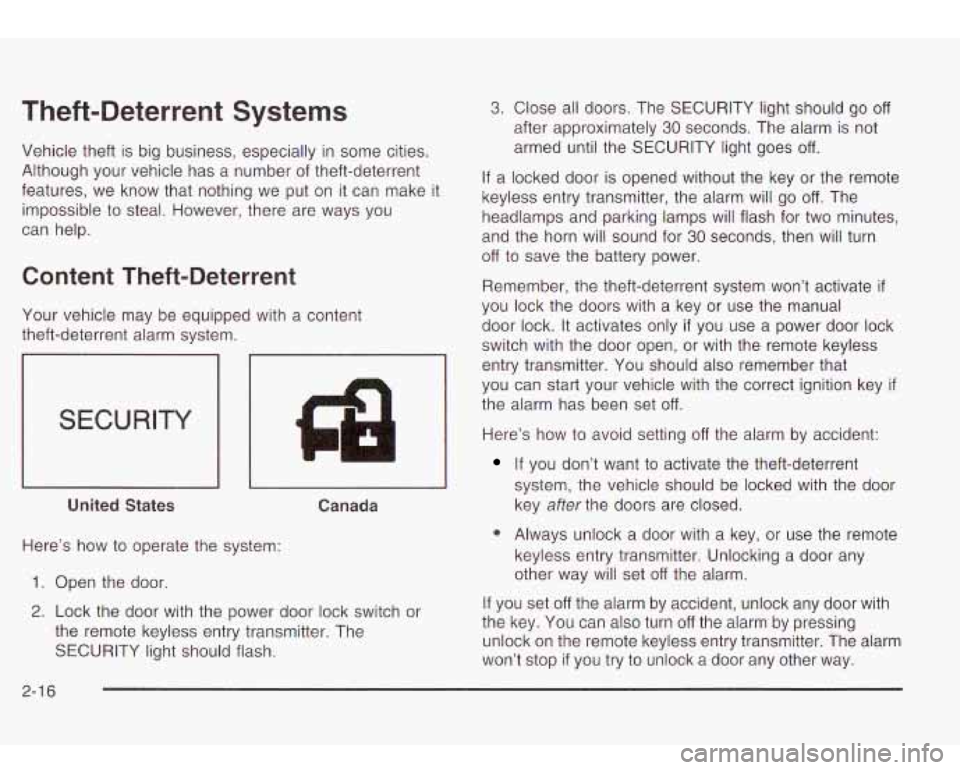
Theft-Deterrent Systems
Vehicle theft is big business, especially in some cities.
Although your vehicle has a number of theft-deterrent
features, we know that nothing we put on it can make it
impossible
to steal. However, there are ways you
can help.
Content Theft-Deterrent
Your vehicle may be equipped with a content
theft-deterrent alarm system.
SECURITY
4 I1
I I I I
United States Canada
Here’s how to operate the system:
1. Open the door.
2. Lock the door with the power door lock switch or
the remote keyless entry transmitter. The
SECURITY light should flash.
3. Close all doors. The SECURITY light should go off
after approximately 30 seconds. The alarm is not
armed until the SECURITY light goes
off.
If a locked door is opened without the key or the remote
keyless entry transmitter, the alarm will go
off. The
headlamps and parking lamps will flash for two minutes,
and the horn will sound for
30 seconds, then will turn
off to save the battery power.
Remember, the theft-deterrent system won’t activate
if
you lock the doors with a key or use the manual
door lock.
It activates only if you use a power door lock
switch with the door open, or with the remote keyless
entry transmitter. You should also remember that
you can start your vehicle with the correct ignition key
if
the alarm has been set off.
Here’s how to avoid setting off the alarm by accident:
If you don’t want to activate the theft-deterrent
system, the vehicle should be locked with the door
key
after the doors are closed.
0 Always unlock a door with a key, or use the remote
keyless entry transmitter. Unlocking a door any
other way will set
off the alarm.
If you set
off the alarm by accident, unlock any door with
the key. You can also turn
off the alarm by pressing
unlock on the remote keyless entry transmitter. The alarm
won’t stop
if you try to unlock a door any other way.
2-1 6
Page 82 of 410
Testing the Alarm
The alarm can be tested by following these steps:
1. From inside the vehicle, lower the driver’s window
and open the driver’s door.
Passlock@
2. Activate the system by locking the doors with the
power door lock switch while the door is open, or
with the remote keyless entry transmitter.
3. Get out of the vehicle, close the door and wait for
the SECURITY light to go out.
4. Then reach in through the window, unlock the door
with the manual door lock and open the door. This
should set
off the alarm.
When the alarm is set the power door unlock switch
is
not operational.
If the alarm does not sound when it should but the
headlamps flash, check
to see if the horn works. The
horn fuse may be blown. To replace the fuse, see
Fuses
and Circuit Breakers on page
5-86.
If the alarm does not sound or the headlamps do not
flash, the vehicle should be serviced by your dealer. Your
vehicle is equipped with the
Passlock@ theft-deterrent system.
Passiock@
is a passive theit-deterrent system.
Passlock@ enables fuel
if the ignition lock cylinder is
turned with a valid key. If a correct key is not used or the
ignition lock cylinder is tampered with, the fuel system
is disabled and the vehicle will not start.
During normal operation, the SECURITY light will turn
off
approximately five seconds after the key is turned
to RUN.
If the engine stalls and the SECURITY light flashes,
wait about
10 minutes until the light stops flashing before
trying
to restart the engine. Remember to release the
key from START as soon as the engine starts.
If the engine does not start after three tries, the vehicle
needs service.
If the engine is running and the SECURITY light comes
on, you will be able
to restart the engine if you turn
the engine
off. However, your Passlock@ system is not
working properly and must be serviced by your
dealer. Your vehicle is not protected by Passlock@ at
this time. You may also want to check the fuse.
See
Fuses and Circuit Breakers on page 5-86. See your
dealer for service.
In an emergency, call the GM Roadside Assistance
Center. See
Roadside Assistance Program on page 7-5.
2-1 7