brake light Oldsmobile Bravada 2003 s User Guide
[x] Cancel search | Manufacturer: OLDSMOBILE, Model Year: 2003, Model line: Bravada, Model: Oldsmobile Bravada 2003Pages: 410, PDF Size: 20.1 MB
Page 215 of 410
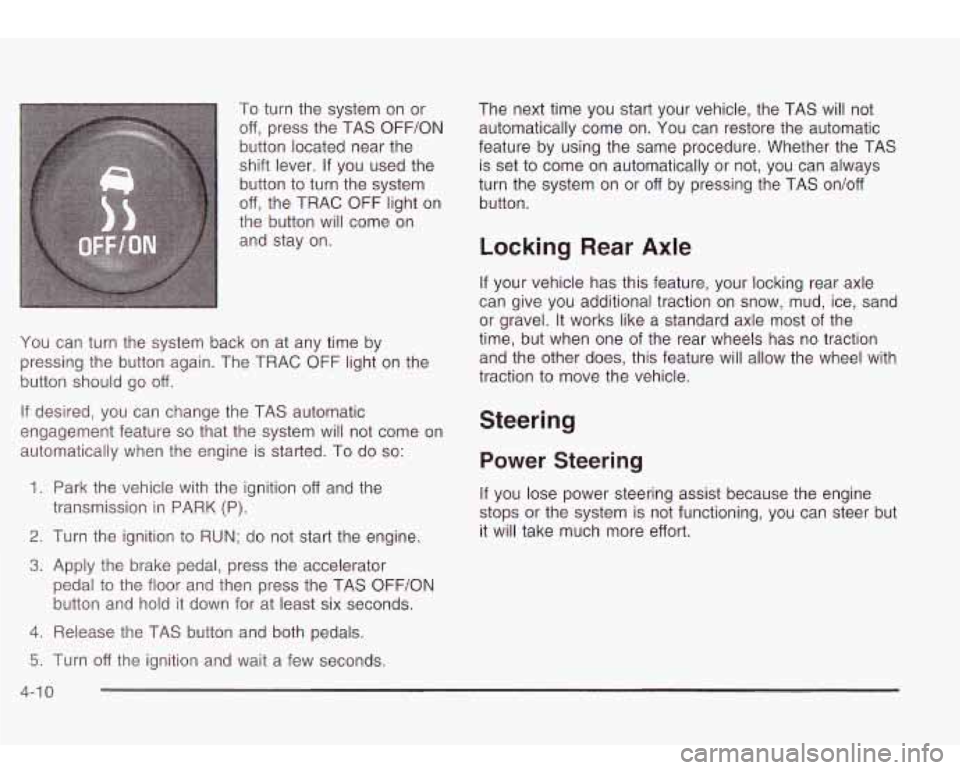
To turn the system on or
off, press the TAS OFF/ON
button located near the
shift lever.
If you used the
button to turn the system
off, the TRAC OFF light on
the button will come on
and stay on.
You can turn the system back on at any time by
pressing the button again. The TRAC OFF light on the
button should go off.
If desired, you can change the TAS automatic
engagement feature
so that the system will not come on
automatically when the engine is started. To do
so:
1.
Park the vehicle with the ignition off and the
2. Turn the ignition to RUN; do not start the engine.
3. Apply the brake pedal, press the accelerator
transmission in
PARK (P).
pedal
to the floor and then press the TAS OFF/ON
button and hold it down for at least six seconds.
4. Release the TAS button and both pedals. The next time you
start your vehicle, the TAS will not
automatically come on. You can restore the automatic
feature by using the same procedure. Whether the TAS
is set
to come on automatically or not, you can always
turn the system on or off by pressing the TAS on/off
button.
Locking Rear Axle
If your vehicle has this feature, your locking rear axle
can give you additional traction on snow, mud, ice, sand
or gravel. It works like a standard axle most of the
time, but when one
of the rear wheels has no traction
and the other does, this feature will allow the wheel with
traction to move the vehicle.
Steering
Power Steering
If you lose power steering assist because the engine
stops or the system is not functioning, you can steer but
it will take much more effort.
5. Turn off the ignition and wait a few seconds.
4-1 0
Page 227 of 410

Q: Suppose, after stalling, I try to back down the
hill and decide
I just can’t do it. What
should
I do?
A: Set the parking brake, put your transmission in
PARK (P) and turn
off the engine. Leave the
vehicle and go get some help. Exit on the uphill
side and stay clear of the path the vehicle would
take
if it rolled downhill.
Driving Downhill
When off-roading takes you downhill, you’ll want to
consider a number of things:
How steep is the downhill? Will I be able to maintain
vehicle control?
What’s the surface like? Smooth? Rough? Slippery?
Are there hidden surface obstacles? Ruts? Logs?
Hard-packed dirt? Gravel?
Boulders?
What’s at the bottom of the hill? Is there a there a
hidden creek bank or even a river bottom with
large rocks?
If you decide you can go down a hill safely, then
try to
keep your vehicle headed straight down, and use a
low gear. This way, engine drag can help your brakes
and they won’t have
to do all the work. Descend slowly,
keeping your vehicle under control at all times.
4-22
Heavy braki.., when going down a hill can
cause your brakes to overheat and fade. This
could cause
loss of control and a serious
accident. Apply the brakes lightly when
descending a hill and use a low gear to keep
vehicle speed under control.
Q: Are there some things I should not do when
driving down
a hill?
A: Yes! These are important because if you ignore
them you could
lose control and have a serious
accident.
When driving downhill, avoid turns that take you
across the incline
of the hill. A hill that’s not too
steep to drive down may be too steep to drive
across. You could roll over
if you don’t drive straight
down.
Never go downhill with the transmission in
NEUTRAL (N). This is called “free wheeling”. Your
brakes will have to do all the work and could
overheat and fade.
Page 234 of 410
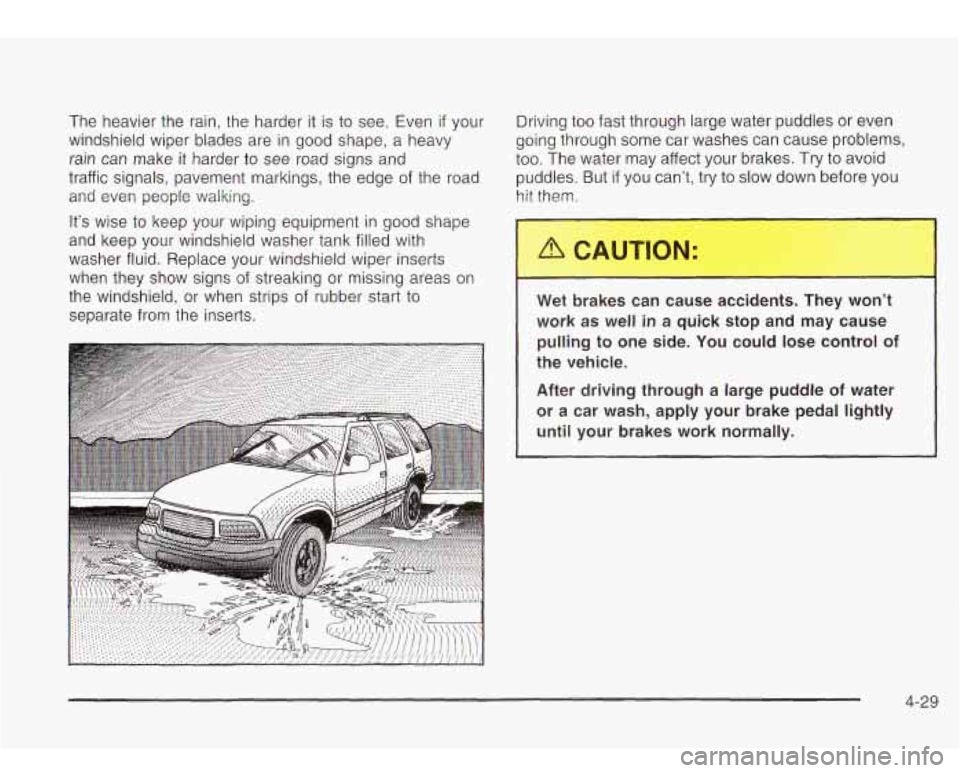
The heavier the rain, the harder it is to see. Even if your
windshield wiper blades are in good shape, a heavy
rain can make it harder to see road signs and
traffic signals, pavement markings, the edge of the road
and even people walking.
It’s wise to keep your wiping equipment
in good shape
and keep your windshield washer tank filled with
washer fluid. Replace your windshield wiper inserts
when they show signs of streaking or missing areas on
the windshield, or when strips of rubber start
to
separate from the inserts. Driving too fast through large
water puddles or even
going through some car washes can cause problems,
too. The water may affect your brakes. Try to avoid
puddles. But
if you can’t, try to slow down before you
hi tem.
I
I
Wet brakes can cause accidents. They won’t
work as well in a quick stop and may cause
pulling to one side. You could lose control
of
the vehicle.
After driving through a large puddle
of water
or a car wash, apply your brake pedal lightly
until your brakes work normally.
4-29
Page 258 of 410
Trailer Wiring Harness
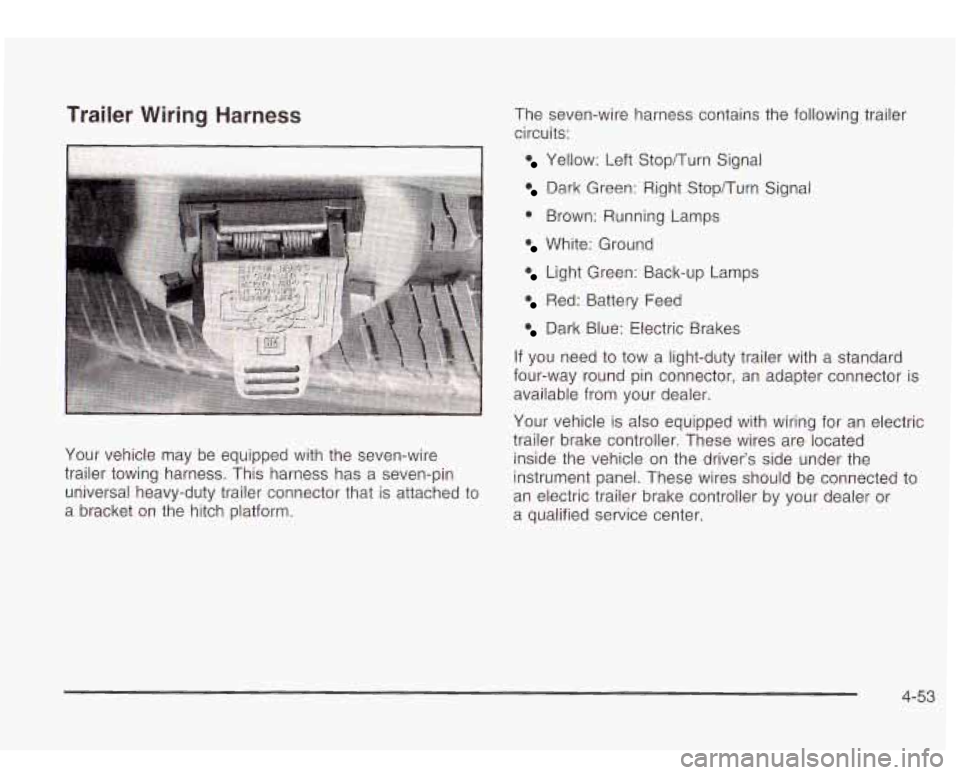
Your vehicle may be equipped with the seven-wire
trailer towing harness. This harness has a seven-pin
universal heavy-duty trailer connector that is attached to
a bracket on the hitch platform.
Yellow: Left Stop/Turn Signal
Dark Green: Right Stopnurn Signal
@ Brown: Running Lamps
White: Ground
Light Green: Back-up Lamps
Red: Battery Feed
Dark Blue: Electric Brakes
If you need to tow a light-duty trailer with a standard
four-way round pin connector, an adapter connector is
available from your dealer.
Your vehicle is also equipped with wiring for an electric
trailer brake controller. These wires are located inside the vehicle on the driver’s side under the
instrument panel. These wires should be connected to
an electric trailer brake controller by your dealer or
a qualified service center.
4-53
Page 296 of 410
Brake Pedal Travel
The brake wear warning sound means that
soon your brakes won’t work well. That could
lead to an accident. When you hear the brake
wear warning sound, have your vehicle
serviced.
Notice: Continuing to drive with worn-out brake
pads could result
in costly brake repair.
Some driving conditions or climates may cause a brake
squeal when the brakes are first applied or lightly
applied. This does not mean something is wrong with
your brakes.
Properly torqued wheel nuts are necessary
to help
prevent brake pulsation. When tires are rotated, inspect
brake pads for wear and evenly tighten wheel nuts in
the proper sequence
to GM torque specifications.
Brake linings should always be replaced as complete
axle sets.
See
Brake System Inspection on page 6-16.
See your dealer if the brake pedal does not return to
normal height, or
if there is a rapid increase in
pedal travel. This could be a sign of brake trouble.
Brake Adjustment
Every time you make a brake stop, your disc brakes
adjust for wear.
Replacing Brake System Parts
The braking system on a vehicle is complex. Its many
parts have
to be of top quality and work well together if
the vehicle is to have really good braking. Your
vehicle was designed and tested with top-quality GM
brake parts. When you replace parts
of your braking
system
- for example, when your brake linings
wear down and you need new ones put in
- be sure
you get new approved GM replacement parts.
If
you don’t, your brakes may no longer work properly. For
example,
if someone puts in brake linings that are
wrong for your vehicle, the balance between your front
and rear brakes can change
- for the worse. The
braking performance you’ve come
to expect can change
in many other ways
if someone puts in the wrong
replacement brake parts.
5-37
Page 298 of 410
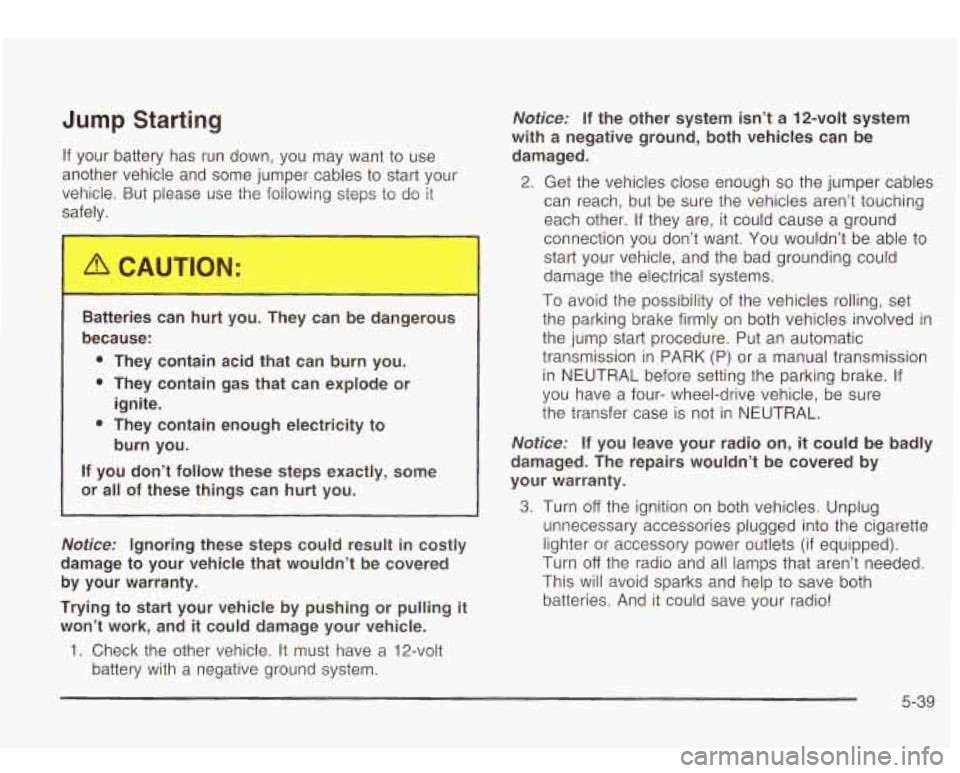
Jump Starting
If your battery has run down, you may want to use
another vehicle and some jumper cables to start your
vehicle. But please use the following steps
to do it
safely.
can be dangerous
* They contain acid that can burn you.
0 They contain gas that can explode or
* They contain enough electricity to
If you don’t follow these steps exactly, some
Notice: Ignoring these steps could result in costly
damage to your vehicle that wouldn’t be covered
by your warranty.
Trying to start your vehicle by pushing or pulling
it
won’t work, and it could damage your vehicle.
1. Check the other vehicle. It must have a 12-volt
battery with
a negative ground system.
Notice: If the other system isn’t a 12-volt system
with a negative ground, both vehicles can be damaged.
2. Get the vehicles close enough so the jumper cables
can reach, but be sure the vehicles aren’t touching
each other. If they are, it could cause a ground
connection you don’t want.
You wouldn’t be able to
start your vehicle, and the bad grounding could
damage the electrical systems.
To avoid the possibility of the vehicles rolling, set
the parking brake firmly on both vehicles involved in
the jump start procedure. Put an automatic
transmission in
PARK (P) or a manual transmission
in NEUTRAL before setting the parking brake. If
you have a four- wheel-drive vehicle, be sure
the transfer case is not in NEUTRAL.
Notice: If you leave your radio on, it could be badly
damaged. The repairs wouldn’t be covered by
your warranty.
3. Turn off the ignition on both vehicles. Unplug
unnecessary accessories plugged into the cigarette
lighter or accessory power outlets (if equipped).
Turn
off the radio and all lamps that aren’t needed.
This will avoid sparks and help
to save both
batteries. And it could save your radio!
5-39
Page 320 of 410
To use the air inflator attach the appropriate nozzle
adapter to the end of the hose
if required. Then attach
that end of the hose to the object you wish to inflate.
Attach the other end of the hose to the outlet.
Press and release the switch to turn the air inflator on.
The indicator light will remain on when the inflator is
running.
The system has an internal clock to prevent overheating.
The system will allow about five minutes of running
time, then the compressor will stop. The indicator light
will then begin to flash. When the indicator is off,
the inflator can be started again by pressing the switch.
If the compressor is still hot,
it may only run for a
short time before shutting off again.
Press and release the switch to turn the inflator off.
Place the inflator kit
tools in the pouch and store
it properly. Remove the inflator hose from the outlet
during loading and unloading. Load leveling will
not function with the inflator hose attached
to the inflator
outlet. See ”Electronically Controlled Air Suspension
System” in the Index.
To reinstall the cover, line up the tabs at the back of the
cover, put it in place and latch the tabs.
A continuous flashing indicator light may also indicate a
malfunction in the air suspension system. See
“Electronically Controlled Air Suspension System” in the
Index.
Inllarlllg something too m,.-h can make it
explode, and you or others could be injured.
Be sure to read the inflator instructions, and
inflate any object only to its recommended
If a Tire Goes Flat
It’s unusual for a tire to “blowout” while you’re driving,
especially
if you maintain your tires properly. If air goes
out of a tire, it’s much more likely to leak out slowly.
But
if you should ever have a “blowout”, here are a few
tips about what to expect and what to do:
If a front tire fails, the flat tire will create a drag that
pulls the vehicle toward that side. Take your foot off the
accelerator pedal and grip the steering wheel firmly.
Steer to maintain lane position, and then gently brake to
a stop well out of the traffic lane.
5-61
Page 348 of 410
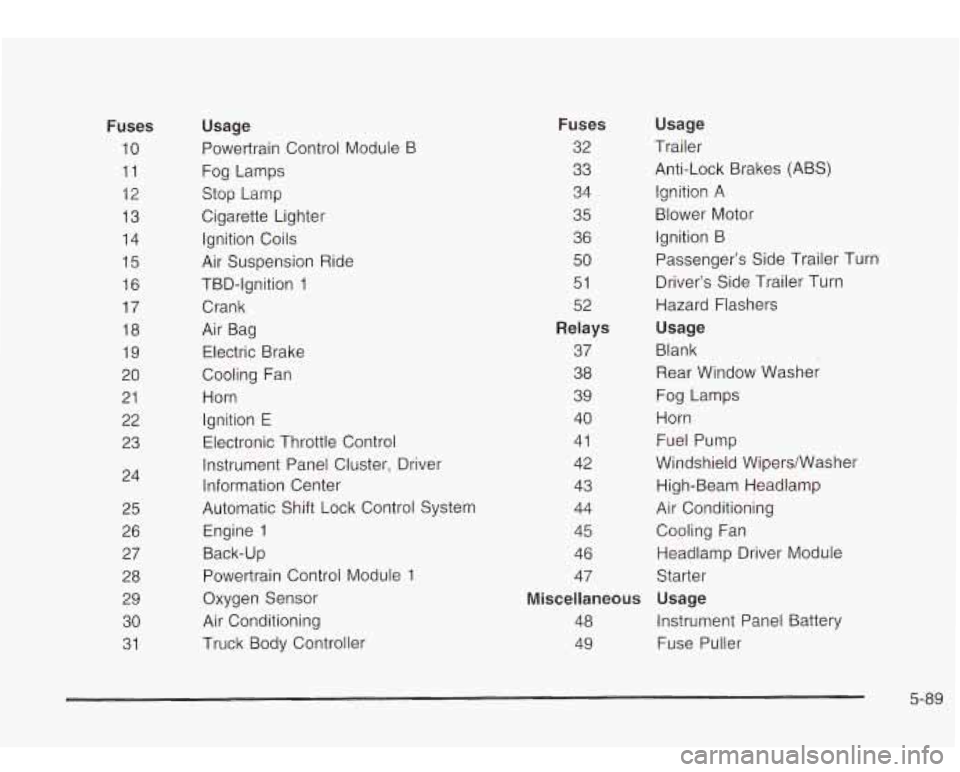
Fuses
10
11 12
13 14
15 16
17
18
19
20
21 22
23
24
25
26
27
28
29
30
31
Usage
Powertrain Control Module B
Fog Lamps
Stop Lamp
Cigarette Lighter
Ignition Coils
Air Suspension Ride
TBD-Ignition
1
Crank
Air Bag
Electric Brake
Cooling Fan
Horn Ignition
E
Electronic Throttle Control
Instrument Panel Cluster, Driver
Information Center
Automatic Shift Lock Control System
Engine 1
Back-up Powertrain Control Module 1
Oxygen Sensor
Air Conditioning
Truck Body Controller
Fuses
32
33
34
35
36
50
51
52
Relays
37
38
39
40
41
42
43
44
45
46 47
Usage
Trailer
Anti-Lock Brakes (ABS) Ignition A
Blower Motor Ignition B Passenger’s Side Trailer Turn
Driver’s Side Trailer Turn
Hazard Flashers
Usage
Blank Rear Window Washer
Fog Lamps
Horn Fuel Pump
Windshield WipersNasher
High-Beam Headlamp
Air Conditioning
Cooling Fan
Headlamp Driver Module
Starter
Miscellaneous Usage
48 Instrument Panel Battery
49 Fuse Puller
5-89
Page 358 of 410
Scheduled Maintenance
The services shown in this schedule up to 100,000 miles
(166 000 km) should be repeated after 100,000 miles
(166 000 km) at the same intervals for the life of
this vehicle. The services shown at
150,000 miles
(240 000 km) should be repeated at the same interval
after
150,000 miles (240 000 km) for the life of this
vehicle.
See
Part B: Owner Checks and Services on page 6- 10
and Part C: Periodic Maintenance Inspections on
page 6- 15.
Footnotes
t The US. Environmental Protection Agency or the
California Air Resources Board has determined that the
failure to perform this maintenance item will not nullify
the emission warranty or limit recall liability prior
to
the completion of the vehicle 's useful life. We, however,
urge that all recommended maintenance services be
performed at the indicated intervals and the
maintenance be recorded.
+ A good time to check your brakes is during tire
rotation. See Brake System Inspection
on page 6- 16.
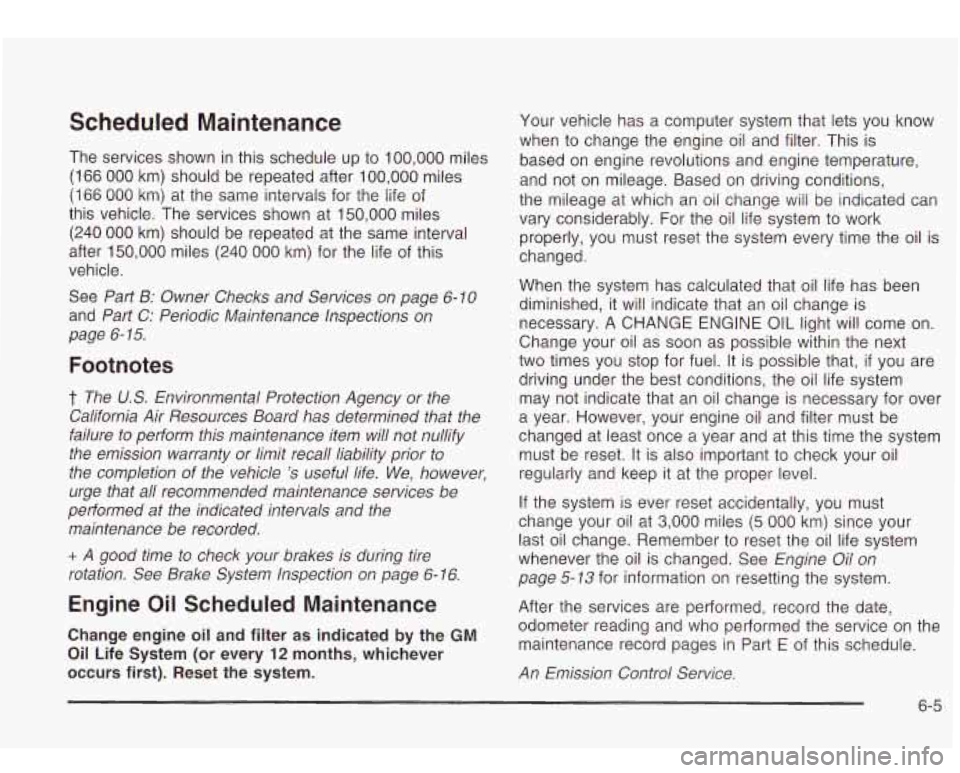
Engine Oil Scheduled Maintenance
Change engine oil and filter as indicated by the GM
Oil Life System (or every 12 months, whichever
occurs first). Reset the system.
Your vehicle has a computer system that lets you know
when
to change the engine oil and filter. This is
based on engine revolutions and engine temperature,
and not on mileage. Based on driving conditions,
the mileage
at which an oil change will be indicated can
vary considerably. For the
oil life system to work
properly, you must reset the system every time the oil is
changed.
When the system has calculated that oil life has been
diminished, it will indicate that an oil change is
necessary. A CHANGE ENGINE
OIL light will come on.
Change your oil as soon as possible within the next
two times you stop for fuel. It is possible that,
if you are
driving under the best conditions, the oil life system
may not indicate that an oil change is necessary for over
a year. However, your engine oil and filter must be
changed at least once a year and at this time the system
must be reset.
It is also important to check your oil
regularly and keep
it at the proper level.
If the system is ever reset accidentally, you must
change your oil at
3,000 miles (5 000 km) since your
last oil change. Remember
to reset the oil life system
whenever the oil is changed. See
Engine Oil on
page 5-13 for information on resetting the system.
After the services are performed, record the date, odometer reading and who performed the service on the
maintenance record pages in Part
E of this schedule.
An Emission Control Service.
6-5
Page 388 of 410
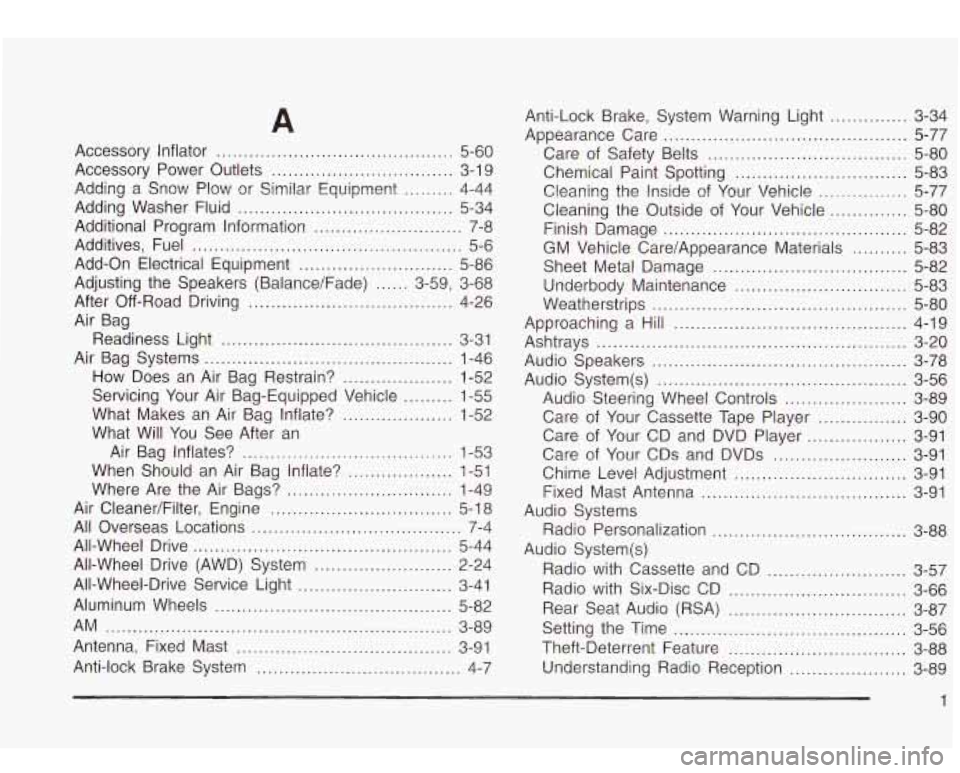
A
Accessory Inflator ........................................... 5-60
Accessory Power Outlets
................................. 3-19
Adding a Snow Plow or Similar Equipment
......... 4-44
Adding Washer Fluid
....................................... 5-34
Additional Program Information
........................... 7-8
Additives, Fuel
................................................. 5-6
Add-on Electrical Equipment
............................ 5-86
After Off-Road Driving
..................................... 4-26
Readiness Light
.......................................... 3-31
Air Bag Systems
............................................. 1-46
Adjusting the Speakers
(Balance/Fade)
...... 3-59, 3-68
Air Bag
How Does an Air Bag Restrain?
.................... 1-52
Servicing Your Air Bag-Equipped Vehicle
......... 1-55
What Makes an Air Bag Inflate?
.................... 1-52
What Will You See After an
Air Bag Inflates?
...................................... 1-53
When Should an Air Bag Inflate? ................... 1-51
Where Are the Air Bags?
.............................. 1-49
Air Cleaner/Filter, Engine
................................. 5-1 8
All Overseas Locations
...................................... 7-4
All-Wheel Drive
............................................... 5-44
All-Wheel Drive (AWD) System
......................... 2-24
All-Wheel-Drive Service Light
............................ 3-41
Aluminum Wheels
........................................... 5-82
AM ............................................................... 3-89
Antenna, Fixed Mast
....................................... 3-91
Anti-lock Brake System
..................................... 4-7
Anti-Lock Brake. System Warning Light .............. 3-34
Appearance Care
............................................ 5-77
Care
of Safety Belts .................................... 5-80
Chemical Paint Spotting
............................... 5-83
Gleaning the Inside of Your Vehicle
................ 5-77
Cleaning the Outside of Your Vehicle
.............. 5-80
Finish Damage
............................................ 5-82
GM Vehicle Care/Appearance Materials .......... 5-83
Sheet Metal Damage
................................... 5-82
Underbody Maintenance
............................... 5-83
Weatherstrips
.............................................. 5-80
Approaching a Hill
.......................................... 4-19
Ashtrays
........................................................ 3-20
Audio Speakers
.............................................. 3-78
Audio System(s)
............................................. 3-56
Audio Steering Wheel Controls
...................... 3-89
Care of Your Cassette Tape Player
................ 3-90
Care of Your CD and DVD Player
.................. 3-91
Care of Your CDs and DVDs
........................ 3-91
Chime Level Adjustment
............................... 3-91
Fixed Mast Antenna
..................................... 3-91
Radio Personalization
.......... .............. 3-88
Radio with Cassette and CD
......................... 3-57
Radio with Six-Disc CD
................................ 3-66
Audio Systems
Audio System(s)
Rear Seat Audio (RSA)
................................ 3-87
Setting the Time
.......................................... 3-56
Theft-Deterrent Feature
................................ 3-88
Understanding Radio Reception
..................... 3-89
1