service Oldsmobile Bravada 2003 s Owner's Guide
[x] Cancel search | Manufacturer: OLDSMOBILE, Model Year: 2003, Model line: Bravada, Model: Oldsmobile Bravada 2003Pages: 410, PDF Size: 20.1 MB
Page 239 of 410
Highway Hypnosis
Is there actually such a condition as “highway
hypnosis”? Or is it just plain falling asleep at the wheel?
Call
it highway hypnosis, lack of awareness, or
whatever.
There is something about an easy stretch of road with
the same scenery, along with the hum of the tires on the
road, the drone of the engine, and the rush of the
wind against the vehicle that can make you sleepy. Don’t
let it happen
to you! If it does, your vehicle can leave
the road in
less than a second, and you could crash and
be injured.
What can you
do about highway hypnosis? First, be
aware that it can happen.
Then here are some tips:
Make sure your vehicle is well ventilated, with a
Keep your eyes moving. Scan the road ahead and
comfortably
cool interior.
to the sides. Check your mirrors
and your
instruments frequently.
If you get sleepy, pull off the road into a rest,
service or parking area and take a nap, get some
exercise, or both. For safety, treat drowsiness
on the highway as an emergency.
Hill and Mountain Roads
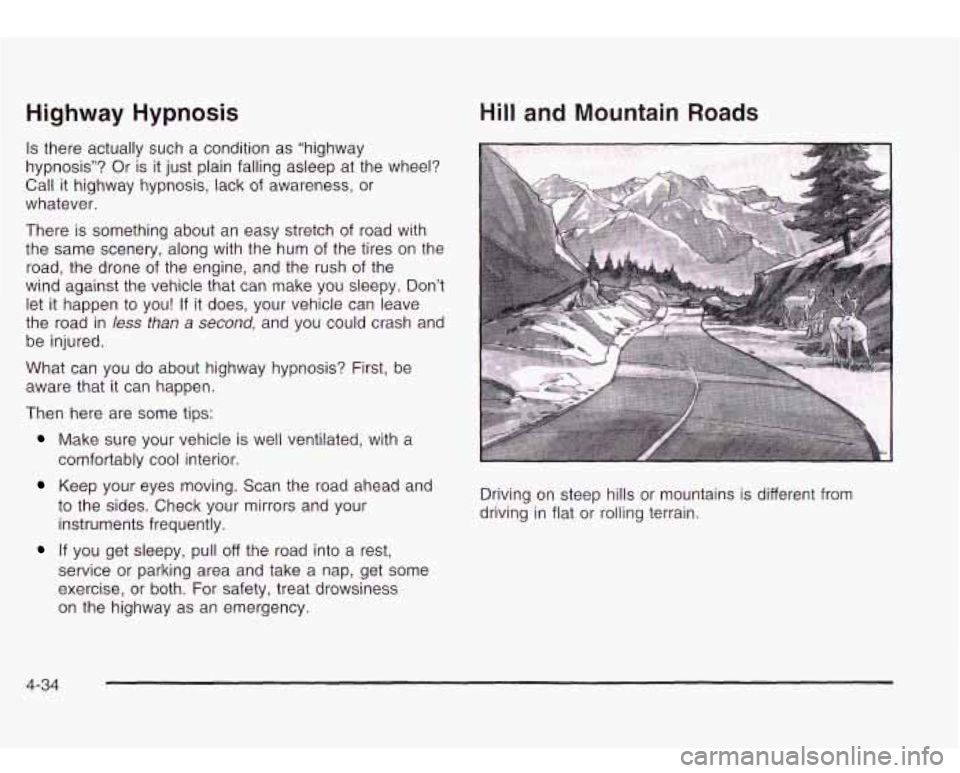
Driving on steep hills or mountains is different from
driving in flat or rolling terrain.
4-34
Page 246 of 410
Towing Loading Your Vehicle
Towing
Your Vehicle
Consult your dealer or a professional towing service if
you need to have your disabled vehicle towed. See
Roadside Assistance Program on page 7-5.
If you want to tow your vehicle behind another vehicle
for recreational purposes (such as behind a motorhome),
see “Recreational Vehicle Towing” following.
Recreational Vehicle Towing
Recreational vehicle towing means towing your vehicle
behind another vehicle
- such as behind a motorhome.
The two most common types of recreational vehicle
towing are known as “dinghy towing” (towing your vehicle
with all four wheels on the ground) and “dolly towing”
(towing your vehicle with two wheels on the ground and
two wheels up on a device known as a “dolly”).
Your vehicle was not designed to be towed with any
OJ
its wheels on the ground. If your vehicle must be
towed, see “Towing Your Vehicle” earlier in this section. The
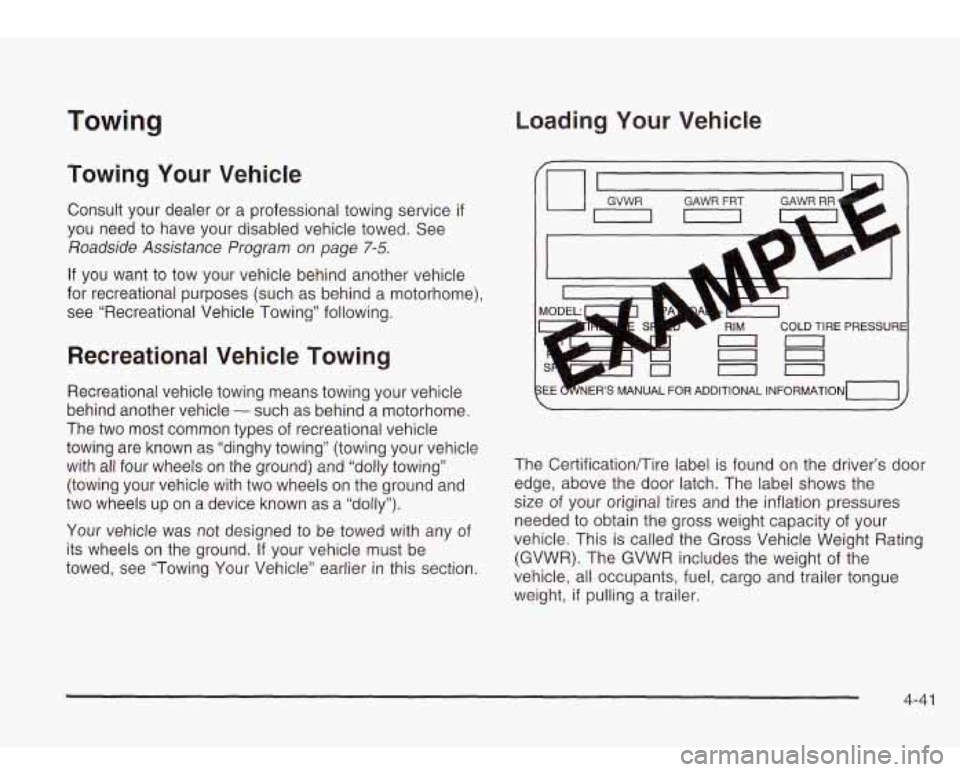
Certificationflire label is found on the driver’s door
edge, above the door latch. The label shows the
size of your original tires and the inflation pressures
needed to obtain the gross weight capacity of your
vehicle. This is called the Gross Vehicle Weight Rating (GVWR). The GVWR includes the weight of the
vehicle, all occupants, fuel, cargo and trailer tongue
weight,
if pulling a trailer.
Page 249 of 410

Overload Protection Indicator Light
The air suspension system is equipped with overload
protection. Overload protection is designed
to protect the
air suspension system, and
it is an indicator to the
driver that the vehicle
is overloaded. When the overload
protection mode is on,
it will not allow damage to the
air compressor. However, do not overload the vehicle.
See
Loading Your Vehicle on page 4-4 1.
If the suspension remains at a low height, the rear axle
load has exceeded GAWR (Gross Axle Weight
Rating). When the overload protection mode is activated,
the compressor operates for about
30 seconds to one
minute without raising the vehicle depending on the
amount of overload. This will continue each time
the ignition
is turned on until the rear axle load is
reduced below GAWR. The indicator light
on the inflator switch in the rear
passenger compartment also serves as an indicator for
internal system error.
If the indicator light is flashing
without the load leveling function or the inflator being
active, turn
off the ignition. The next day turn on
the ignition and check the indicator light. The vehicle
can be driven with the light flashing, but
if it is you
should have the vehicle serviced as soon as possible.
Adding a Snow Plow or Similar
Equipment
Your vehicle was neither designed nor intended for a
snow plow.
Notice: Adding a snow plow or similar equipment
to your vehicle can damage it, and the repairs
wouldn’t be covered by warranty.
Do not install a
snow plow or similar equipment on your vehicle.
4-44
Page 250 of 410
Towing a Trailer
If you don’t use the correct equipment and
drive properly, you can lose control when you
pull
a trailer. For example, if the trailer is too
heavy, the brakes may not work well
-- or even
at all. You and your passengers could be
seriously injured. Pull a trailer only if you have
followed all the steps in this section. Ask your
dealer for advice and information about towing
a trailer with your vehicle.
Notice: Pulling a trailer improperly can damage
your vehicle and result
in costly repairs not covered
by your warranty.
To pull a trailer correctly, follow
the advice in
this part, and see your dealer for
important information about towing a trailer with
your vehicle. Additional rear axle maintenance
is required for a vehicle used to tow a trailer. See
“Scheduled Maintenance Services’’
in the Index.
To identify the trailering capacity of your vehicle,
you should read the information in “Weight of the Trailer’’
that appears later in this section.
Trailering is different than just driving your vehicle by
itself. Trailering means changes in handling, durability
and fuel economy. Successful, safe trailering takes
correct equipment, and
it has to be used properly.
That’s the reason for this part. In
it are many time-testea,
important trailering
tips and safety rules. Many of
these are important for your safety and that of your
passengers.
So please read this section carefully before
you pull a trailer.
4-45
Page 257 of 410
Par1 . on Hills
You really should not park your vehicle, with a
trailer attached,
on a hill. If something goes
wrong, your
rig could start to move. People
can be injured, and both your vehicle and the
trailer can be damaged.
When You Are Ready to Leave After
Parking on a
Hill
1. Apply your regular brakes and hold the pedal down
while you:
But
if you ever have to park your rig on a hill, here’s
how to do it:
1. Apply your regular brakes, but don’t shift into
PARK (P) yet. When parking uphill, turn your wheels
away from the curb. When parking downhill, turn
your wheels into the curb.
2. Have someone place chocks under the trailer
wheels.
3. When the wheel chocks are in place, release the
4. Reapply the regular brakes. Then apply your
regular brakes until
the chocks absorb the load.
parking brake, and then shift into PARK
(P).
5. Release the regular brakes.
start your engine,
shift into a gear, and
release the parking brake.
2. Let up on the brake pedal.
3. Drive slowly until the trailer is clear of the chocks.
4. Stop and have someone pick up and store the
chocks.
Maintenance When Trailer Towing
Your vehicle will need service more often when you’re
pulling a trailer. See the Maintenance Schedule for more
on this. Things that are especially important in trailer
operation are automatic transmission fluid (don’t overfill),
engine oil, axle lubricant, belt, cooling system and
brake system. Each
of these is covered in this manual,
and the Index will help you find them quickly.
If
you’re trailering, it’s a good idea to review these sections
before you start your trip.
Check periodically
to see that all hitch nuts and bolts
are tight.
4-52
Page 258 of 410
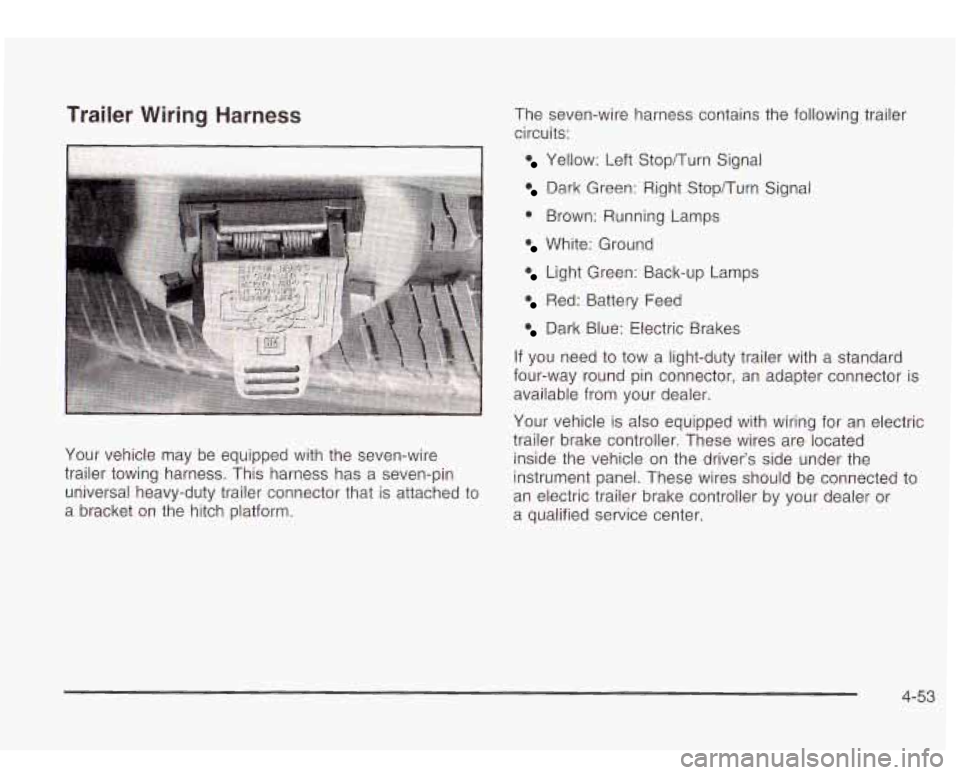
Trailer Wiring Harness
Your vehicle may be equipped with the seven-wire
trailer towing harness. This harness has a seven-pin
universal heavy-duty trailer connector that is attached to
a bracket on the hitch platform.
Yellow: Left Stop/Turn Signal
Dark Green: Right Stopnurn Signal
@ Brown: Running Lamps
White: Ground
Light Green: Back-up Lamps
Red: Battery Feed
Dark Blue: Electric Brakes
If you need to tow a light-duty trailer with a standard
four-way round pin connector, an adapter connector is
available from your dealer.
Your vehicle is also equipped with wiring for an electric
trailer brake controller. These wires are located inside the vehicle on the driver’s side under the
instrument panel. These wires should be connected to
an electric trailer brake controller by your dealer or
a qualified service center.
4-53
Page 260 of 410
Section 5 Service and Appearance Care
............................................................ Service 5.3
Doing Your Own Service Work
......................... 5-4
Adding Equipment to the Outside of Your
Vehicle 5.4
Fuel 5.5
......................................................
................................................................
Gasoline Octane ............................................ 5.5
Gasoline Specifications
.................................... 5.5
California Fuel
............................................... 5.6
Filling Your lank
............................................ 5-7
Filling a Portable Fuel Container
....................... 5-9
Checking Things Under the Hood .................... 5-10
Hood Release
.............................................. 5-10
Engine Compartment Overview
....................... 5-12
Engine
Oil ................................................... 5-13
Engine Air Cleaner/Filter
............................... 5-18
Automatic Transmission Fluid
......................... 5-20
Engine Coolant
............................................. 5-22
Radiator Pressure Cap
.................................. 5-24
Engine Overheating
....................................... 5-24
Cooling System
............................................ 5-26
Engine Fan Noise
.................................. 5-32
Power Steering Fluid
.................... ..... 5-33
....................................................... Additives 5.6
Fuels in Foreign Countries
............................... 5-6 Windshield
Washer Fluid
................................ 5-33
Brakes
........................................................ 5-34
Battery
........................................................ 5-38
Jump Starting
.......... ............................. 5-39
All-Wheel Drive ............. ......................... 5-44
Rear Axle ....................................................... 5-46
Bulb Replacement .......................................... 5.47
Taillamps and Turn Signal Lamps
................... 5.47
Replacement Bulbs
....................................... 5.48
Windshield Wiper Blade Replacement .............. 5.49
.............................................................. Tires 5.52
Inflation
.. lire Pressure ................................ 5.53
lire Inspection and Rotation
........................... 5.53
Buying New Tires
......................................... 5.56
Uniform Tire Quality Grading
.......................... 5.57
Wheel Replacement
...................................... 5.58
lire Chains
.................................................. 5.60
Accessory Inflator
......................................... 5.60
If a lire Goes Flat ........................................ 5.61
When It
Is Time
for New Tires ....................... 5-55
Wheel Alignment and lire Balance
.................. 5-58
Changing a Flat lire
..................................... 5-62
5-
1
Page 261 of 410
Section 5 Service and Appearance Care
Appearance Care ............................... ..... 5.77
Cleaning the Inside of Your Vehicle .... .... 5-77
Care of Safety Belts ...................................... 5-80
Weatherstrips
............................................... 5-80
Sheet Metal Damage
..................................... 5-82
Finish Damage ............................................. 5-82
Underbody Maintenance
................................ 5-83
Chemical Paint Spotting
................................. 5-83
GM Vehicle CarelAppearance Materials
........... 5-83
Vehicle Identification ...................................... 5-85
Vehicle Identification Number (VIN)
................. 5-85
Service Parts Identification Label
..................... 5-85
Cleaning
the Outside of Your Vehicle
.............. 5-80
Electrical System ......................................... 5-86
Headlamps
.................................................. 5.86
Windshield Wiper Fuses
................................ 5.86
Power Windows and Other Power Options
....... 5-86
Fuses and Circuit Breakers
............................ 5.86
Capacities and Specifications ......................... 5-93
Add-on
Electrical Equipment
........ ........... 5-86
Normal Maintenance Replacement Parts ~ ... 5-94
5-2
Page 262 of 410

Service
Your dealer knows your vehicle best and wants you to
be happy with it. We hope you’ll go to your dealer
for all your service needs. You’ll get genuine GM parts
and GM-trained and supported service people.
We hope you’ll want to keep your GM vehicle all GM.
Genuine GM parts have one
of these marks:
5-3
Page 263 of 410
Doing Your Own Service Work
-
1 If you want to do some of your own service work, you’ll
want
to use the proper service manual. It tells you
much more about how
to service your vehicle than this
manual can. To order the proper service manual,
see
Service Publications Ordering Information on
page
7-10.
Your vehicle has an air bag system. Before attempting
to do your own service work, see Servicing Your Air
Bag-Equipped Vehicle on page
1-55.
You should keep a record with all parts receipts and list
the mileage and the date of any service work you
perform. See
Part E: Maintenance ”lcord on page 6-19.
__ --Jre you have s __ nowle e,
experience, the proper replacement parts
and tools before you attempt any vehicle
maintenance task.
Be sure to use the proper nuts, bolts and
other fasteners. “English” and “metric”
fasteners can be easily confused.
If you
use the wrong fasteners, parts can later
break or fall
off. You could be hurt.
Adding Equipment to the Outside of
Your Vehicle
-1 Things you might add to the outside of your vehicle can
affect the airflow around
it. This may cause wind
noise and affect windshield washer performance. Check
with your dealer before adding equipment
to the
outside
of your vehicle.
1 A can be injured an, jour vehicle could be
damaged
if you try to do service work on a
vehicle without knowing enough about
it.
CAUTION: (Continued)
5-4