Lights Oldsmobile Cutlass Supreme 1994 s User Guide
[x] Cancel search | Manufacturer: OLDSMOBILE, Model Year: 1994, Model line: Cutlass Supreme, Model: Oldsmobile Cutlass Supreme 1994Pages: 276, PDF Size: 14.73 MB
Page 85 of 276
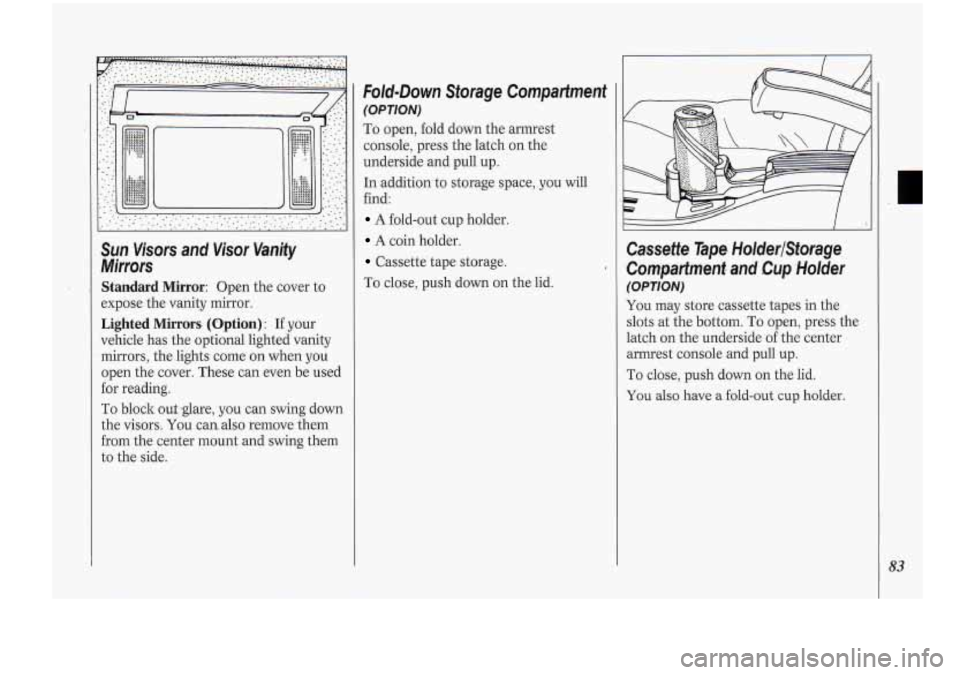
Sun Visors and Visor Va.nity
Mirrars
Standard Mirror: Open the cover to
expose the vanity mirror.
Lighted Mirrors- (Option) : If your
vehicle has the optional lighted vanity
mirrors, the .lights corne on when
you
open the cover. These can even be used
for reading.
To block out
YOU canalso remove them
from the center mount and swing them
to the- side.
Fold-Down Storage Compartment
(OPTION)
To open, fold down the armrest
console, press the latch on the
underside
and pull up.
In addition,to storage space, you will
find:
A-fold-out cup holder.
A coin holder.
Cassette tape storage.
To close, push down on the lid.
Cassette Tape HotderlStwage
.CompaHment and Cup Holder
(OPTION)
You may store cassette tapes in the
slots at the bottom.
To open, press the
latch on the underside
of the center
armrest console and
pull up.
To close, push down on the lid.
You also have a fold-out cup holder.
83
Page 92 of 276
90
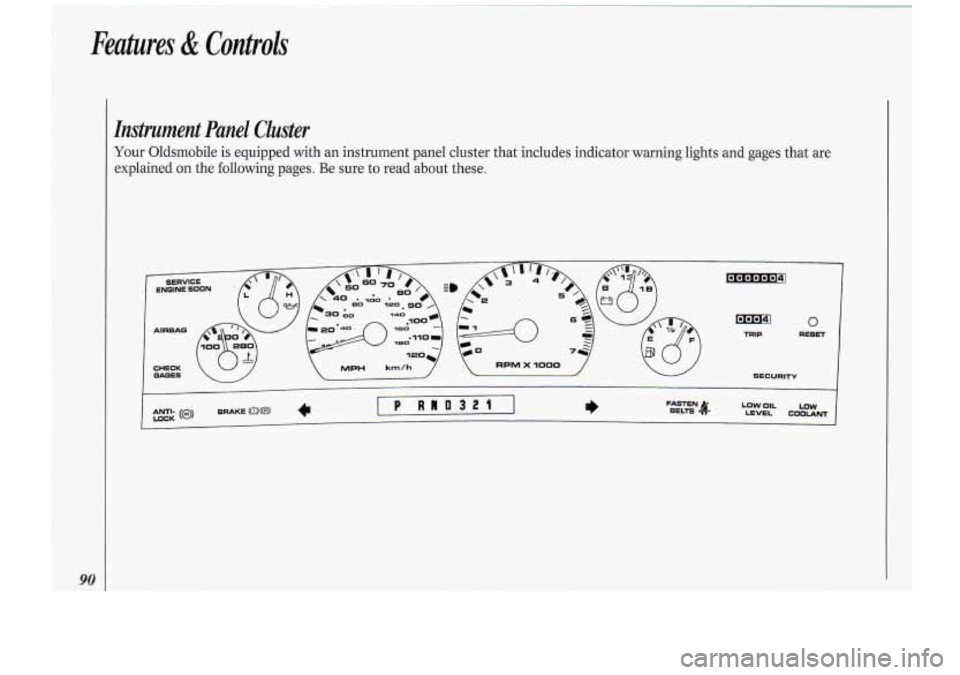
Instrument Panel Cluster
Your Oldsmobile is equipped with an instrument panel cluster that includes indicator warning lights and gages that are
explained on the following pages. Be sure to read about these.
Page 93 of 276
I. Warning Lights, Gages .and
l..icdors
This section describes the warning
lights and gages that may be on your
vehicle. The pictures will kelp you
locate them.
Warning lights and gages can signal that
something is wrong before it .becomes
serious enough to cause an expensive
repair or replacement. Paying attention
to your warning lights and- gages could
also save
you. or others,from injury.
Warning lights go on when there may
be or is
a problem with one of your
vehicle’s functions..
As you will see in
the details on the next few pages, some
warning lights come on briefly when
you turn the .ignition key just to let
you
know they’re worlting. If you are
familiar with this section, you should
not be alarmed when this happens.
Gages can indicate when there may be
or is a problem with one of your
vehicle’s functions. Often gages and
warning lights .work together to let you
know when there’s a problem with your
vehicle. When
one of the warning lights comes
on and stays on when you are driving,
or when one of the gages shows there
may be a problem, check -the section
that tells you what to
do about it. Please
follow the manual’s advice. Waiting to
do repairs can be costly
- and even
dangerous.
So please get to know. your
-warning lights and gages. They’re a big
help. MPH km/h 7
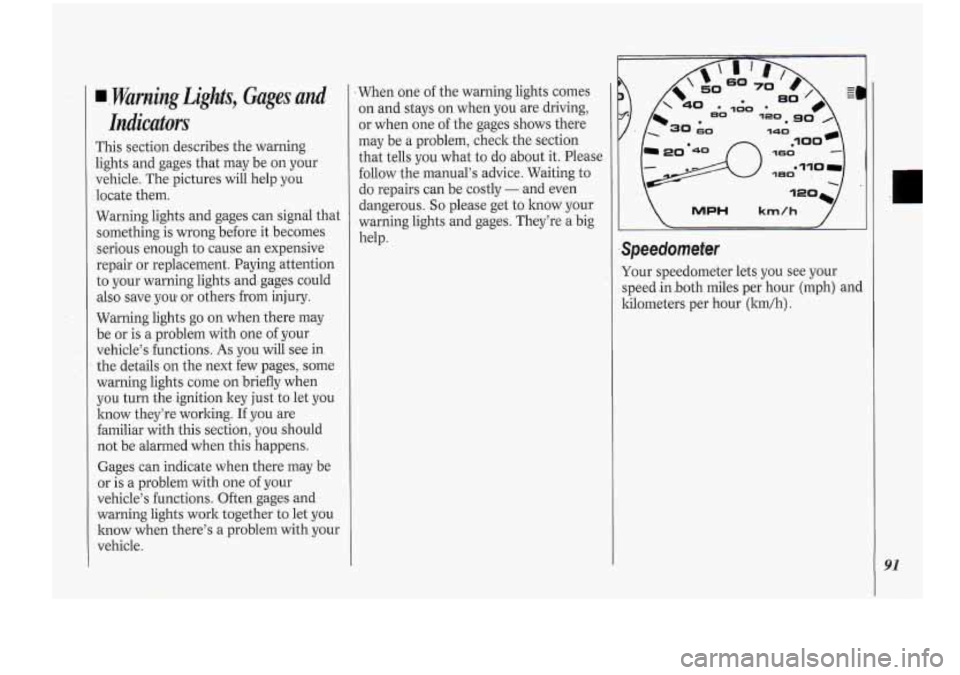
Your speedometer lets you see your
speed.in.both miles p,er hour (mph) and
kilometers per hour (lun/h)
.
91
Page 100 of 276
Features & Controls
98
NOTICE:
If you keep driving your vehicle
with this light on, after
a while the
emission controls won’t work as
well, your fuel economy won’t be as
good and your engine may not run
as smoothly. This could lead to
costly repairs not covered by your
warranty. CHECK
GAGES
1 ANTI-
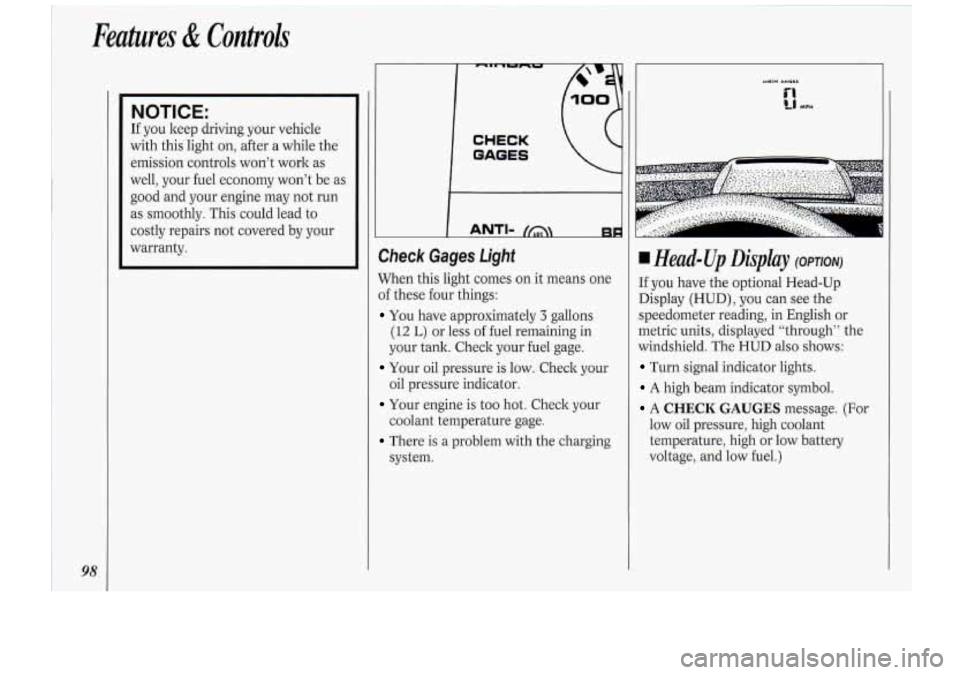
Check Gages Light
When this light comes on it means one
of these four things:
You have approximately 3 gallons
(12 L) or less of fuel remaining in
your tank. Check your fuel gage.
Your oil pressure is low. Check your
oil pressure indicator.
Your engine is too hot. Check your
coolant temperature gage.
There is a problem with the charging
system.
Head-Up Displcly (OP~ONJ
If you have the optional Head-Up
Display (HUD), you can see the
speedometer reading, in English or
metric units, displayed “through” the
windshield. The
HUD also shows:
Turn signal indicator lights.
A high beam indicator symbol.
A CHECK GAUGES message. (For
low oil pressure, high coolant
temperature, high or low battery
voltage, and low fuel.)
Page 101 of 276
I
CHECK GAUGES
I'
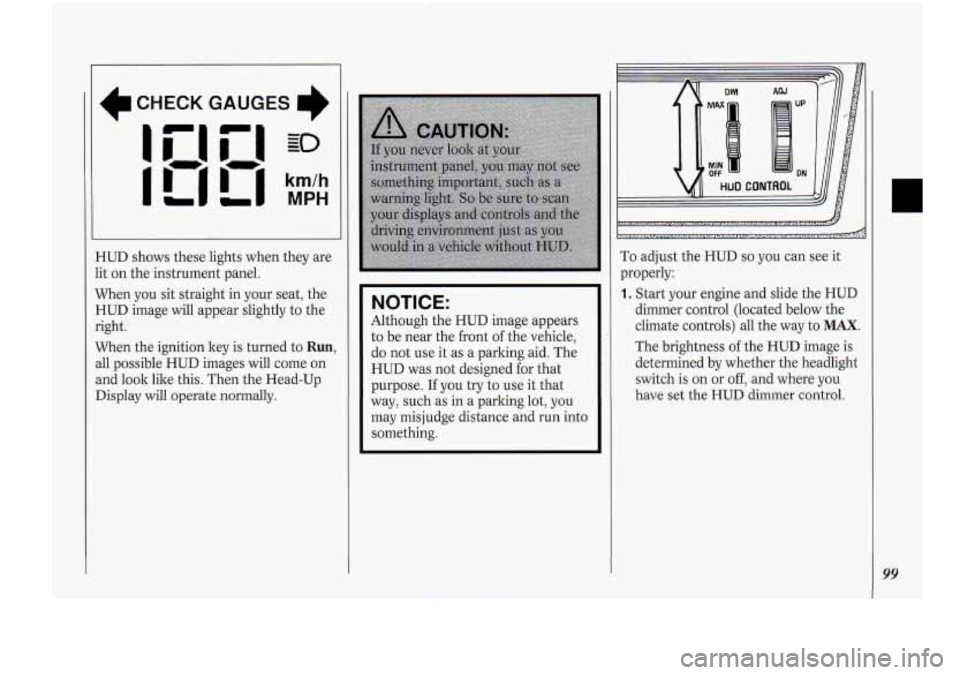
HUD shows these lights when they are
lit on the instrument panel.
When you sit straight in your seat, the
HUD image will appear slightly to the
right.
When the ignition key is turned to
Run,
all possible HUD images will come on
and look
lilce this. Then the Head-Up
Display will
operate normally.
NOITICE:
'Although the HUD image appears
to be near the front
of the vehicle,
do not use it as a parking aid. The
HUD was not designed for that
purpose.
If you try to use it that
way, such.as in a parking lot, you
may misjudge distance and
run into
something.
DIM AW
MAX UP
MIN OFF ON
HUD CONTROL
I
,:...>:.,.:.,;<.,.: ..,,,. r. .,,,..: ..n '..i..i.i .,.I
i...; .... "( ...-.. *zIL5b .,.. ~ ...,. ~ ....,......:.,,.. " ...._.._..... :.*....._.:.. ........., !I.... -&
To adjust the HUD so you can see it
properly:
1. Start your engine and slide the HUD
dimmer control (1ocate.d below the
climate controls) all the way to
MAX.
The brightness of the .HUD image is
determined by whether the headlight
switch is
on or off, and where you
have
set the HUD dimmer control.
99
Page 102 of 276

Features & Controls
100
~.*.,. :.. ~~.,,~..~.,.~. ;,~,!~~. ~~~~....,...... :.~:~........:.*,:~
.r..,..,~.~...:.1/2~~:1~.~.,~::,:.-..~~.':,lr'\..:.'..,,iC.~..;.~'...;:\
...::..:.: ...., 4; ...,., :*-&
2. Adjust the seat, if necessary, before
setting the height control.
Rotate the HUD image height control
all the way
up, raising the image as
far as possible. Then rotate the HUD
image height control downward
so
the image is as low as possible but in
full view.
3. Slide the dimmer control toward
OFF until the HUD image is no
brighter than necessary.
To turn the
HUD
off, slide the HUD dimmer
control to
OFF.
If the sun comes out, or it becomes
cloudy, or
if you turn on your
headlights. vou mav need to adiust the HUD's
brightness using the HUD
dimmer control. Polarizing sunglasses
could make the HUD image harder
to see.
Irr .
Pushing the ENG/MET rocker switch
on the center console will switch the
HUD speedometer from English
(conventional) to metric units, or back
again.
Some vehicles may not be equipped
with the
ENG/MET switch.
Page 136 of 276
Your Driving and the Road
134
steering, acceleration, or braking
(including engine bralting by shifting to
a lower gear). Any sudden changes
could cause the tires to slide. You may
not realize the surface is slippery until
your vehicle is skidding. Learn to
recognize warning clues
- such as
enough water, ice or packed snow on
the road to make a “mirrored surface”
- and slow down when you have any
doubt.
Remember: Any anti-lock braking system (ABS) helps avoid only the
braking skid.
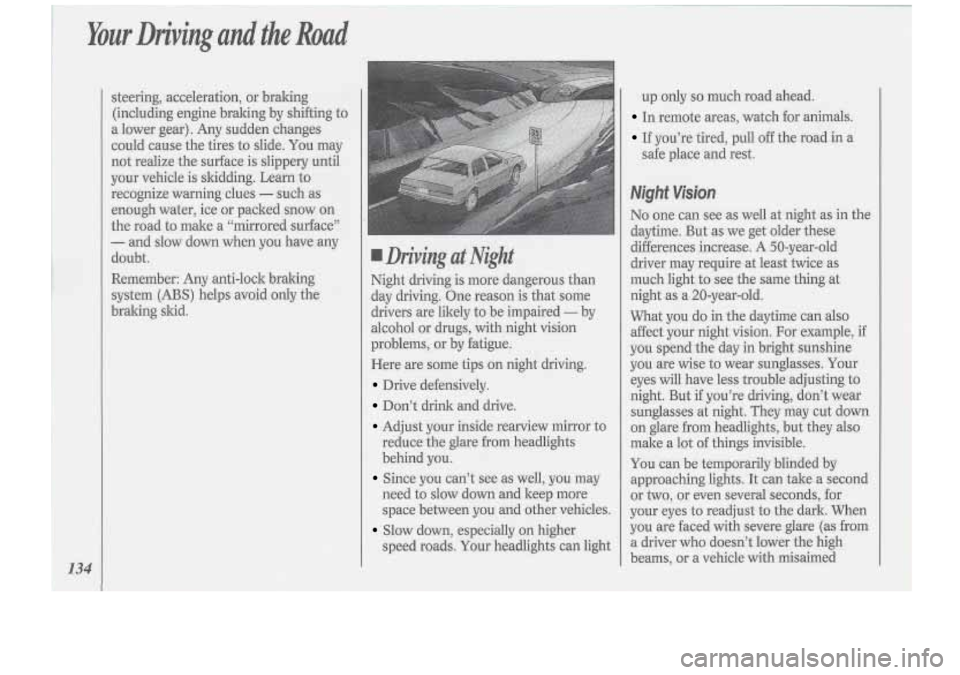
Driving at Night
Night driving is more dangerous than
day driving. One reason is that some
drivers are likely to be impaired
- by
alcohol or drugs, with night vision
problems, or by fatigue.
Here are some tips on night driving.
Drive defensively.
Don’t drink and drive.
Adjust your inside rearview mirror to
reduce the glare from headlights
behind you.
Since you can’t see as well, you may
need to slow down and keep more
space between you and other vehicles.
speed roads. Your headlights can light
Slow down, especially on higher up
only
so much road ahead.
In remote areas, watch for animals.
If you’re tired, pull off the road in a
safe place and rest.
Night Vision
No one can see as well at night as in the
daytime. But as we get older these
differences increase. A 50-year-old
driver may require at least twice as
much light to see the same thing at
night as
a 20-year-old.
What you do in the daytime can also
affect your night vision. For example,
if
you spend the day in bright sunshine
you are wise to wear sunglasses. Your
eyes will have less trouble adjusting to
night. But if you’re driving, don’t wear
sunglasses at night. They may cut down
on glare from headlights, but they also
make a lot of things invisible.
You can be temporarily blinded by
approaching lights. It can take a second
or two, or even several seconds, for
your eyes to readjust to the dark. When
you are faced with severe glare (as from
a driver who doesn’t lower the high
beams, or a vehicle with misaimed
i
Page 137 of 276
headlights), slow down a little. Avoid
staring directly into the approaching
lights.
Keep your windshield and all the glass
on your vehicle clean
- inside and out.
Glare at night is made much worse by
dirt on the glass. Even the inside of the
glass can build up a film caused by dust.
Dirty glass makes lights dazzle and
flash more than clean glass would,
making the pupils-
of your eyes contract
repeatedly.
Remember that your headlights light
up
far less of a roadway when you are in a
turn
or curve. Keep your eyes moving;
that way, it’s easier to pick
out dimly
lighted objects.
Just as your headlights
should be checked regularly for proper
aim,
so should your eyes be examined
regularly. Some drivers suffer from
night blindness -the inability to see
in
dim light - and aren’t even aware of it. It’s wise
to keep your wiping equipment
in good shape and keep your windshield
washer tank filled. Replace your
windshield wiper inserts when they
show signs
of streaking or missing areas
on the windshield, or when strips of
rubber start to separate from the
inserts.
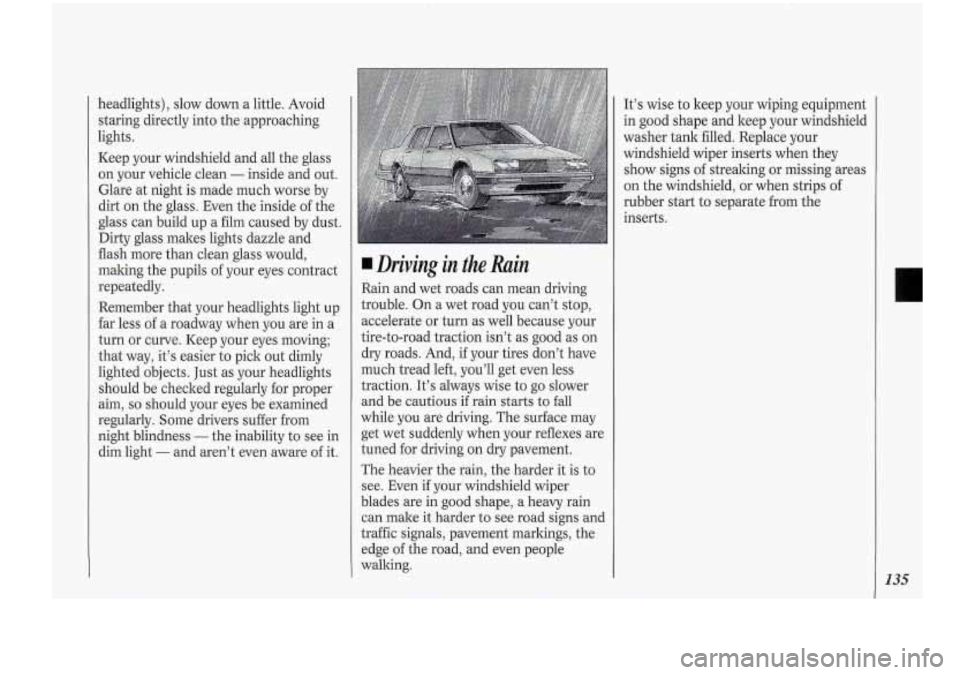
Driving in the Rain
Rain and wet roads can mean driving
trouble. On a wet road
you can’t stop,
accelerate or turn as well because your
tire-to-road traction isn’t as good as on
dry roads. And, if your tires don’t have
much tread left, you’ll get even less
traction. It’s always wise to go slower
and be cautious
if rain starts to fall
while you are driving. The surface may
get wet suddenly when your reflexes are
tuned for driving on dry pavement.
The heavier the rain, the harder it is to
see. Even if your windshield wiper
blades are in good shape, a heavy rain
can make it harder
to see road signs and
traffic signals, pavement markings, the
edge of the road, and even people
walking.
135
Page 138 of 276
I Your Driving and the Road
136
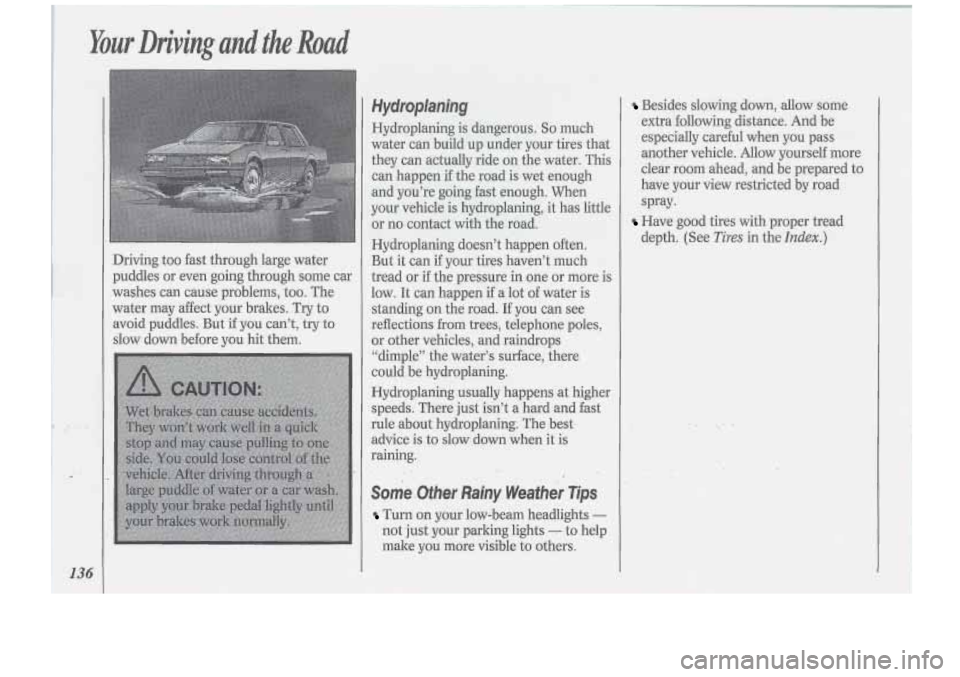
Driving too fast through large water
puddles or even going through some car
washes can cause problems, too. The
water may affect your brakes. Try to
avoid puddles.
But if you can’t, try to
slow down before you hit them.
Hydroplaning
Hydroplaning is dangerous. So much
water can build up under your tires that
they can actually ride
on the water. This
can happen if the road is wet enough
and you’re going fast enough. When
your vehicle is hydroplaning, it has little
or no contact with the road.
Hydroplaning doesn’t happen often.
But it can
if your tires haven’t much
tread or
if the pressure in one or more is
low. It can happen if a lot of water is
standing on the road. If you can see
reflections from trees, telephone poles,
or other vehicles, and raindrops
“dimple” the water’s surface, there
could be hydroplaning.
Hydroplaning usually happens at higher
speeds. There
just isn’t a hard and fast
rule about hydroplaning; The best
advice is to slow down when it is
raining.
Some .Other Rainy Weather Tips
Turn on your low-beam headlights -
not just your parlcing lights - to help
make you more visible to others.
Besides slowing down, allow some
extra following distance. And be
especially careful when you pass
another vehicle. Allow yourself more
clear room ahead, and be prepared to
have your view restricted by road
spray.
Have good tires with proper tread
depth. (See
Tires in the Index.)
Page 140 of 276
Your Driving and the Road
The exit sp leed is usu.alll J posted.
Reduce your speed according to your
speedometer, not to your sense
of
motion. After driving for any distance at
higher speeds, you may tend to think
you are going slower than you actually
are.
4 Before Leaving on a Long
Trip
Make sure you’re ready. Try to be well
rested.
If you must start when you’re
not
fr&- such as after a day’s work
- don’t plan to make too many miles
that first part of the journey. Wear
comfortable clothing and shoes
you can
easily drive in.
Is your vehicle ready for a long trip? If
you keep it serviced and maintained, it’s
ready
to go. If it needs service, have it
done before starting out. Of course,
you’ll find experienced and able service
experts in Oldsmobile dealerships all
across North America. They’ll be ready
and willing to help
if you need it.
Here are some things you can check
before a trip:
a
Windshield Washer Fluid: Is the
reservoir full? Are all windows clean
inside and outside?
Wiper Blades: Are they in good
Fuel, Engine Oil, Other Fluids: Have
Lights: Are they all working? Are the
shape?
you checked all levels?
lenses clean?
Tires: They are vitally impartant to a
safe, trouble-free trip.
Is the tread
good enough far long-distance
driving? Are the tires all inflated
to
the recommended pressure?
weather outlook along your route?
Should you delay your trip a short
time to avoid
a major storm system?
Maps: Do you have up-to-date maps?
Weather Forecasts: What’s the
I Highway Hypnosis
Is there actually such a condition as
“highway hypnosis”? Or is it just plain
falling asleep at the wheel? Call it
highway hypnosis, lack of~awareness, or
whatever.