brakes OLDSMOBILE SILHOUETTE 1993 Owner's Manual
[x] Cancel search | Manufacturer: OLDSMOBILE, Model Year: 1993, Model line: SILHOUETTE, Model: OLDSMOBILE SILHOUETTE 1993Pages: 323, PDF Size: 17.13 MB
Page 182 of 323
Your Driving and the Road
180
If You Do Decide to Pull a Trailer
(CON X)
Hitches
It’s important to have the correct hitch
equipment. Crosswinds, large trucks
going by, and rough roads are a few
reasons why you’ll need the right hitch.
Here are some rules to follow:
If you’ll be pulling a trailer that, when
loaded, will weigh more than 2,000
pounds (900 kg), be sure to use a
properly mounted, weight-distributing hitch and sway control of the proper
size. This equipment is very important
for proper vehicle loading and good
handling when you’re driving.
Will you have to make any holes in the
body of your vehicle when you install
a trailer hitch?
If you do, then be sure
to seal the holes later when you remove
the hitch. If
you don’t seal them, deadly
carbon monoxide (CO) from your
exhaust can get into your vehicle. (See
Index under Carbon Monoxide in
Exhaust.) Dirt and water can, too.
The bumpers on your vehicle are not
intended for hitches. Do not attach
rental hitches or other bumper-type
hitches to them. Use only a frame-
mounted hitch that does not attach to
the bumper.
Safety Chains
You should always attach chains
between your vehicle and your trailer. Cross the safety chains under the tongue
of the trailer
so that the tongue will not
drop to the road if it becomes separated
from
the hitch. Instructions about safety
chains may be provided by the hitch
manufacturer or by the trailer
manufacturer. Follow the manufacturer’s
recommendation for attaching safety
chains. Always leave just enough slack
so you can turn with your rig. And, never
allow safety chains to drag on the
ground.
Trailer Brakes
If your trailer weighs more than 1,OOO
pounds (450 kg) loaded, then it needs its
own brakes-and they must be adequate.
Be sure to read and follow the
instructions for the trailer brakes
so
you’ll be able to install, adjust and
maintain them properly.
Because you have anti-lock brakes, do
not try to
tap into your vehicle’s brake
system. If
you do, both brake systems
won’t work well, or at all.
ProCarManuals.com
Page 183 of 323
1 Driving with a Trailer
Towing a trailer requires a certain
amount of experience. Before setting out
for the open road, you’ll want to get
to
know your rig. Acquaint yourself with
the feel of handling and braking with the
added weight of the trailer. And always
keep in mind that the vehicle you are
driving is now a good deal longer and
not nearly
so responsive as your vehicle
is by itself.
Before you start, check the trailer hitch
and platform, safety chains, electrical
connector, lights, tires and mirror
adjustment.
If the trailer has electric
brakes,
start your vehicle and trailer
moving and then apply the trailer brake
controller by hand to be sure the brakes
are working. This lets you check your
electrical connection at the same time.
If you have a rear-most
window open and you pull a
mler with your‘vehicle, carbon
monoxide (CO) could come into
your vehicle. You can’t see or
smell CO. It can cause
unconsciousness or death (see the
Inh under Engine Exhausb). To I
maximize your safety when towing
a trailer:
@ Have your exhaust system
inspected for leaks, and Make
necessary yirs before starting
on your trip.
closed.
If exhaust does corne into your
vehicle through a window in the
fear or another opening, drive
with your front, main heating or
cmling system on and with the
fan on any speed. This WU bring
fresh, outside air into your
vehicle.
Do not use RECIRC
because it only recirculates the
air imide ywr vehick, See the
Index under Comfort &m&.
e KWP the =-most windows
During your trip, check occasionally to
be sure that the load is secure, and that
the lights and any trailer brakes are still
working.
Following Distance
Stay at least twice as far behind the
vehicle ahead as you would when
driving your vehicle without a trailer.
This can help you avoid situations that
require heavy braking and sudden turns.
Passing
You’ll need more passing distance up
ahead when you’re towing a trailer.
And, because you’re a good deal longer,
you’ll need to go much farther beyond
the passed vehicle before you can return
to your lane.
0
ProCarManuals.com
Page 184 of 323
Your Driving and the Road
Driving with a Trailer (CONT.)
Backing Up
Hold the bottom of the steering wheel
with one hand. Then, to move the trailer
to the left, just move that hand
to the
left. To move the trailer to the right,
move your hand to the right. Always
back up slowly and, if possible, have
someone guide you.
Making Turns
When you’re turning with a trailer,
make wider
turns than normal. Do this
so your trailer won’t strike soft
shoulders, curbs, road signs, trees, or
other objects. Avoid jerky or sudden
maneuvers. Signal well in advance.
Turn Signals When Towing a Trailer
When you tow a trailer, your vehicle has
to have a different
turn signal flasher
and extra wiring. The green arrows on
your instrument panel will flash
whenever you signal
a turn or lane
change. Properly hooked up, the trailer
lights will also flash, telling other
drivers you’re about to
turn, change
lanes or stop.
When towing a trailer, the green arrows
on your instrument panel will flash for
turns even if the bulbs on the trailer are
burned out. Thus, you may think drivers
behind you are seeing your signal when
they are not. It’s important to check
occasionally to be sure the trailer bulbs
are still working.
Driving On Grades
Reduce speed and shift to a lower gear
before you start down a long or steep
downgrade.
If you don’t shift down, you
might have to use your brakes
so much
that they would get hot and no longer
work well.
On a long uphill grade,
shift down and
reduce your speed to around
45 mph
(70 Wh) to reduce the possibility of
engine and transaxle overheating. If
your vehicle has a 3800 V6 engine, you
should also drive in
D instead of
Overdrive when towing a trailer on
fairly level roads. This will help your
engine and transaxle run cooler in
this
condition, too.
If you are towing a trailer that weighs
more
than 1,000 pounds (454 kg), and
you have an automatic transaxle with Overdrive, you may prefer to drive in
D
instead of Overdrive (or, as you need to,
a lower gear).
ProCarManuals.com
Page 185 of 323
Parking on Hills
You really should not park your vehicle,
with a trailer attached, on a hill. If
something goes wrong, your rig could
start to move. People can be injured,
and both your vehicle and the trailer can
be damaged.
But if you ever have to park your rig on
a hill, here’s how to do it:
1 . Apply your regular brakes, but don’t
shift into
P (Park) yet.
2. Have someone place chocks under
the trailer wheels.
3. When the wheel chocks are in place,
release the regular brakes until the
chocks absorb the load.
apply your parking brake, and then shift to
P (Park).
4. Reapply the regular brakes. Then
5. Release the regular brakes.
When You Are Ready to Leave After
Parking on a Hill
1. Apply your regular brakes and hold
the pedal down while you:
Start your engine;
Shift into a gear; and
Release the parking brake.
2. Let up on the brake pedal.
3. Drive slowly until the trailer is clear
4. Stop and have someone pick up and
of the chocks.
store the chocks.
Maintenance When Trailer
Towing
Your vehicle will need service more
often when you’re pulling a trailer. See
the Maintenance Schedule for more on
this. Things that are especially
important in trailer operation are
automatic transaxle fluid (don’t overfill)
engine oil, belts, cooling system, and
brake adjustment. Each
of these is
covered in this manual, and the
Index
will help you find them quickly. If
you’re trailering, it’s a good idea to
review these sections before you
start
your trip.
Check periodically
to see that all hitch
nuts and bolts are tight.
183
ProCarManuals.com
Page 217 of 323
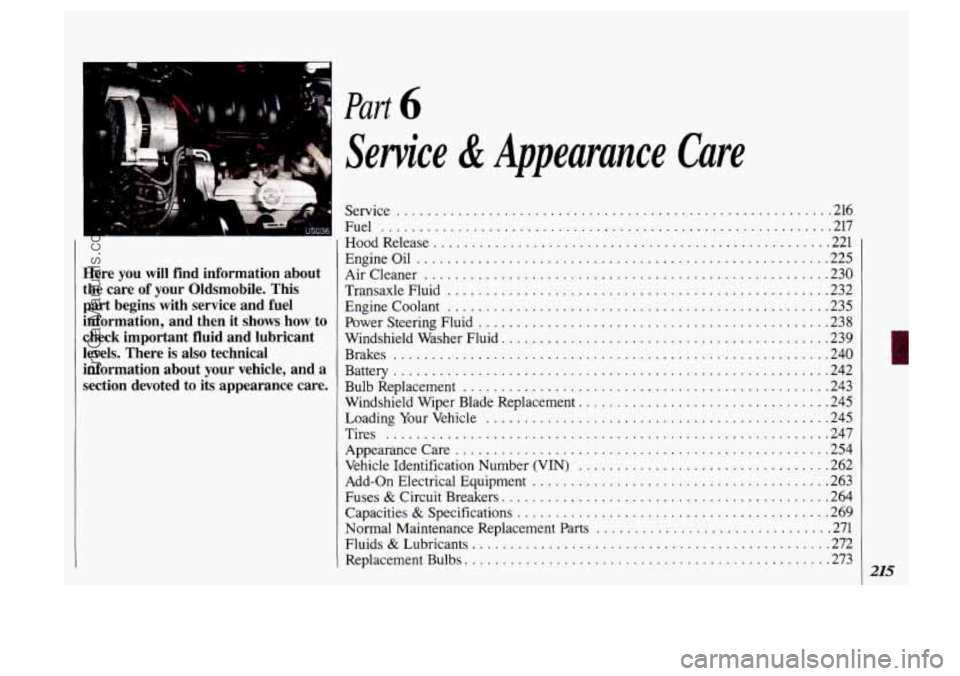
Here you will find information about
the care of your Oldsmobile
. This
part begins with service and fuel
information. and then it shows how to
check important fluid and lubricant levels
. There is also technical
information about your vehicle. and a section devoted to its appearance care
.
Part 6
Service di Appearance Care
Service ......................................................... 216
Fuel ........................................................... 217
HoodRelease
.................................................... 221
Engineoil
...................................................... 225
Aircleaner
..................................................... 230
TransaxleFluid
.................................................. 232
Enginecoolant
.................................................. 235
Power Steering Fluid
.............................................. 238
Windshield Washer Fluid
........................................... 239
Brakes
......................................................... 240
Battery
......................................................... 242
Bulb Replacement
................................................ 243
Windshield Wiper Blade Replacement
................................. 245
Loading Your Vehicle
............................................. 245
Tires
.......................................................... 247
Appearancecare ................................................. 254
Vehicle Identification Number (VIN)
................................. 262
Add-on Electrical Equipment
....................................... 263
Fuses
& Circuit Breakers ........................................... 264
Capacities
& Specifications ......................................... 269
Normal Maintenance Replacement Parts
............................... 271
Fluids
& Lubricants ............................................... 272
ReplacementBulbs
................................................ 273
215
ProCarManuals.com
Page 242 of 323
Service & Appearance Care
Windshield Washer Fluid (CONT.)
I 1 When using concentrated washer ” I
fluid, follow the manufacturer’s
instructions for adding water.
I 1 Don’t mix water with ready-to-
use washer fluid. Water can
cause the solution to freeze and
damage your washer fluid tank
and other parts of the washer
system. Also, water doesn’t clean
as well as washer fluid.
It
-1 Fill your washer fluid tank only
% full when it’s very cold. This
allows
for expansion, which
could damage the
tank if it is
completely full.
I 1 Don’t use radiator antifreeze in
your windshield washer.
It can
damage your washer system and
paint.
I
240
.. -. -. .. , .:.
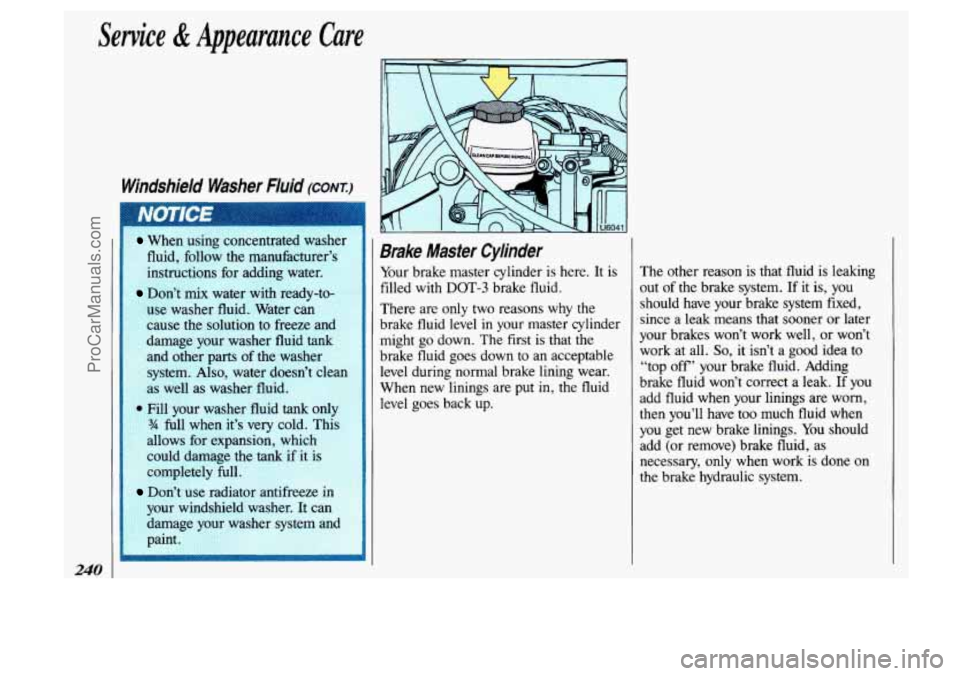
Brake Master Cylinder
Your brake master cylinder is here. It is
filled with
DOT-3 brake fluid.
There are
only two reasons why the
brake
fluid level in your master cylinder
might go down. The first is that the
brake fluid goes down to an acceptable level during normal brake lining wear.
When new linings are put in, the fluid
level goes back up. The other
reason is that fluid is leaking
out
of the brake system. If it is, you
should have your brake system
fixed,
since a leak means that sooner or later
your brakes won’t work well, or won’t
work at all.
So, it isn’t a good idea to
“top
off’ your brake fluid. Adding
brake fluid won’t correct a leak.
If you
add fluid when your linings are
worn,
then you’ll have too much fluid when
you get new brake linings. You should
add (or remove) brake fluid, as
necessary,
only when work is done on
the brake hydraulic system.
ProCarManuals.com
Page 244 of 323
Sewice & Appearaj
The braking system on a modern vehicle
is complex. Its many parts have to be of
top quality and work well together if the
vehicle is to have really good braking.
Vehicles we design and test have top-
quality GM brake parts
in them, as your
Oldsmobile does when it is new. When
you replace parts of your braking
system-for example, when your brake
linings wear down and you have to have
new ones put in-be sure you get new
genuine
GM replacement parts. If you
don’t, your brakes may no longer work
properly. For example, if someone puts
in brake linings that are wrong for your
vehicle, the balance between your front and rear brakes can change, for the
worse. The braking performance you’ve
come to expect can change in many
other ways if someone puts
in the wrong
replacement brake parts.
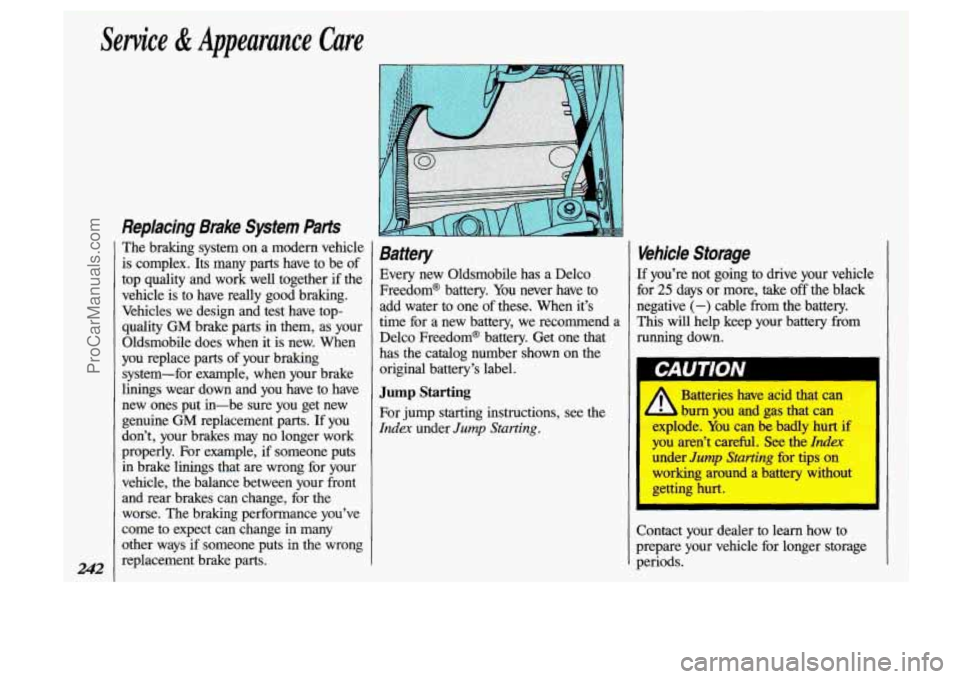
Battery
Every new Oldsmobile has a Delco
Freedom@ battery. You never have to
add water to one
of these. When it’s
time for a new battery, we recommend a
Delco Freedom@ battery. Get one that
has the catalog number shown on the
original battery’s label.
Jump Starting
For jump starting instructions, see the
Index under Jump Starting.
Vehide Storage
If you’re not going to drive your vehicle
for
25 days or more, take off the black
negative
(-) cable from the battery.
This will help keep your battery
from
running down.
II
- Batteries have acid that can
1 burn you and gas that can
plode. You can be badly hurt if
u aren’t careful. See the Index
der Jump Starting for tips on
Irking around a battery without
tting
hurt.
- -
”
Contact your dealer to learn how to
prepare your vehicle for longer storage
periods.
ProCarManuals.com
Page 291 of 323
CHECK
OR SERVICE WHAT TO DO
~
Parking Brake and
Automatic Transaxle
P (Park) Mechanism
Check
1 CAUTION
Underbody Flushing When
you are doing this check, your vehicle could begin
to wuve. IUU ur olrlers could be
A injured and property could be damaged. Make sure there is room in front of your vehicle
in
case it hepins tn rnll Re rea& tn Rnnlv the recrlllar hmke at nnm chnlllrl the vehirle hemin tn mnw-
Park on a fairly steep hill, with the vehicle facing downhill. Keeping your foot on the regular
brake, set the parking brake.
To check the parking brake: With the engine running and transaxle in N (Neutral), slowly
remove foot pressure from the regular brake pedal.
Do this until the vehicle is held by the
parking brake
only.
To check the P (Park) mechanism’s holding ability: Shift to P (Park). Then release all brakes.
L
At least every spring, use plain water to flush any corrosive materials from the underbody. Take
care
to clean thoroughly any areas where mud and other debris can collect.
289
ProCarManuals.com
Page 292 of 323
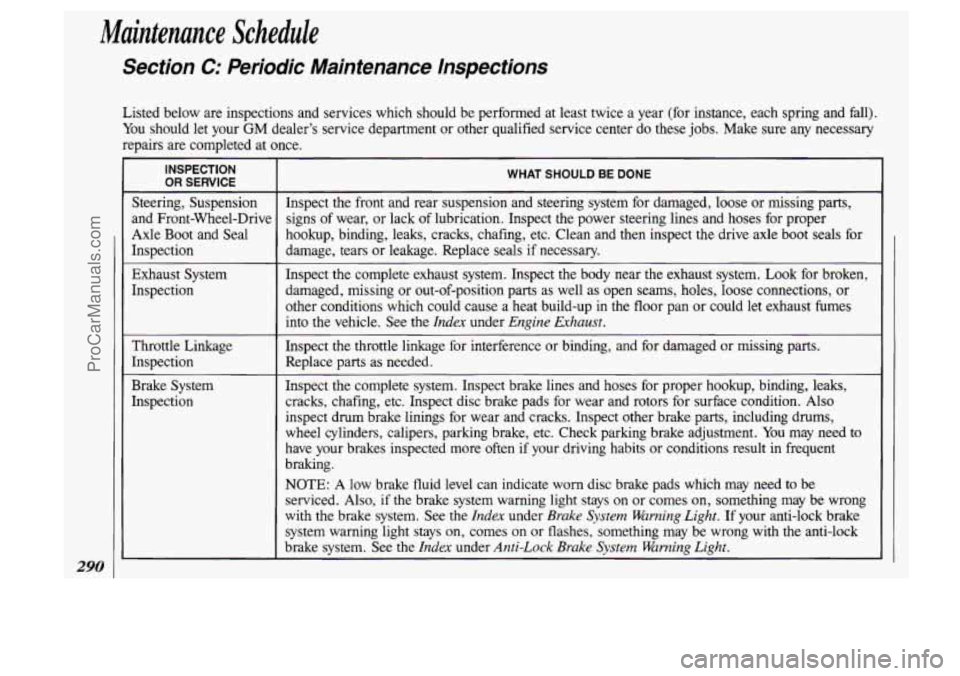
Maintenance Schedule
Section C: Periodic Maintenance lnspections
Listed below are inspections and services which should be performed at least twice a year (for instance, each spring and fall).
You should let your GM dealer’s service department or other qualified service center do these jobs. Make sure any necessary
repairs are completed at once.
290
INSPECTION
OR SERVICE
Steering, Suspension
and Front-Wheel-Drive
Axle Boot and Seal
Inspection
Exhaust System
Inspection
Throttle Linkage
Inspection
Brake System
Inspection
WHAT SHOULD BE DONE
Inspect the front and rear suspension and steering system for damaged, loose or missing parts,
signs of wear, or lack of lubrication. Inspect the power steering lines and hoses for proper
hookup, binding, leaks, cracks, chafing, etc. Clean and then in\
spect the drive axle boot seals for
damage, tears or leakage. Replace seals if necessary.
Inspect the complete exhaust system. Inspect the body near the exhaust system. Look for broken,
damaged, missing or out-of-position parts as well as open seams, holes, loose connections, or
other conditions which could cause a heat build-up in the floor pan or could let exhaust fumes
into the vehicle. See the
Index under Engine Exhaust.
Inspect the throttle linkage for interference or binding, and for damaged or missing parts.
Replace parts as needed.
Inspect the complete system. Inspect brake lines and hoses for \
proper hookup, binding, leaks,
cracks, chafing, etc. Inspect disc brake pads for wear and rotors for surface condition. Also
inspect drum brake linings for wear and cracks. Inspect other brake parts, including drums,
wheel cylinders, calipers, parking brake, etc. Check parking brake adjustment.
You may need to
have your brakes inspected more often
if your driving habits or conditions result in frequent
braking.
NOTE: A low brake fluid level can indicate worn disc brake pads which may need to be
serviced. Also, if the brake system warning light stays on or comes on, something may be wrong
with the brake system.
See the Index under Brake System Warning Light. If your anti-lock brake
system warning light stays on, comes on or flashes, something may be wrong with the anti-lock
brake system. See the
Index under Anti-Lock Brake System Warning Light.
ProCarManuals.com
Page 313 of 323
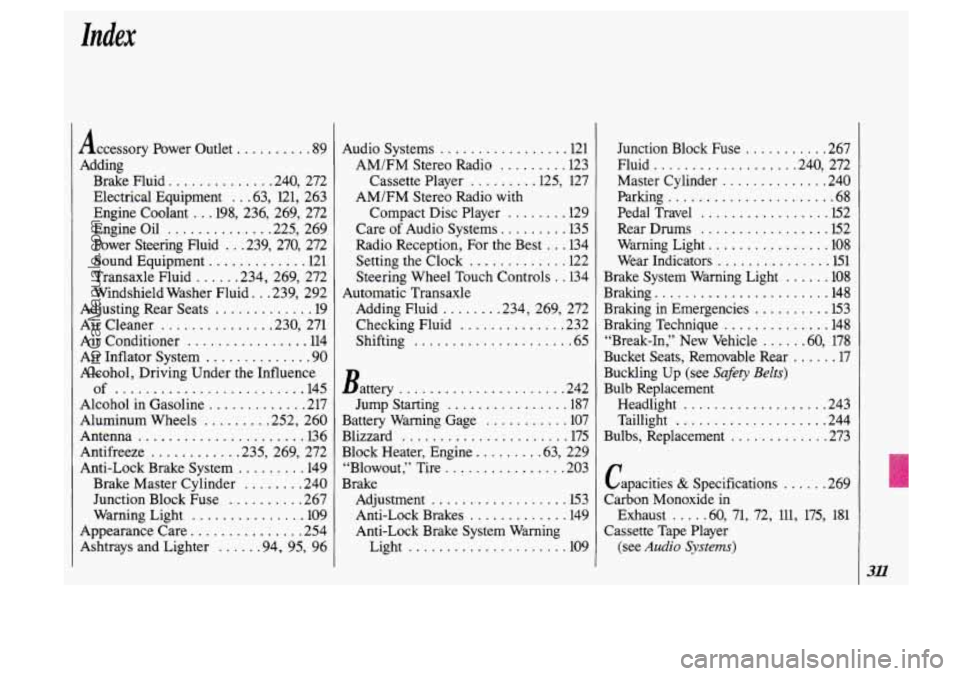
Index
Accessory Power Outlet .......... 89
Adding Brake Fluid
............. .240. 272
Engine Coolant
.. .198. 236. 269. 272
Engine Oil
............. .225. 269
Power Steering Fluid
.. .239. 270. 272
Sound Equipment
............. 121
Transaxle Fluid
..... .234. 269. 272
Adjusting Rear Seats
............. 19
Air Cleaner
.............. .230. 271
Air Conditioner
................ 114
Air Inflator System
.............. 90
Alcohol. Driving Under the Influence
of ......................... 145
Alcohol in Gasoline
............. 217
Aluminum Wheels
........ .252. 260
Antenna
...................... 136
Antifreeze
........... .235. 269. 272
Anti-Lock Brake System
......... 149
Brake Master Cylinder
........ 240
Junction Block Fuse
.......... 267
Warning Light
............... 109
Appearance Care ............... 254
Ashtrays and Lighter
..... .94. 95. 96
Electrical Equipment
.. .63.
121. 263
Windshield Washer Fluid
.. .239. 292 Audio Systems
................. 121
AM/FM Stereo Radio
......... 123
Cassette Player
........ .125. 127
AM/FM Stereo Radio with
Compact Disc Player
........ 129
Care of Audio Systems
......... 135
Radio Reception. For the Best
... 134
Setting the Clock
............. 122
Steering Wheel Touch Controls
. . 134
Adding Fluid
....... .234. 269. 272
Checking Fluid
.............. 232
Shifting
..................... 65
Automatic Transaxle
Battery
...................... 242
Jump Starting
................ 187
Battery Warning Gage
........... 107
Blizzard
...................... 175
Block Heater. Engine ........ .63. 229
“Blowout
,” Tire ................ 203
Brake Adjustment
.................. 153
Anti-Lock Brakes
............. 149
Anti-Lock Brake System Warning Light
..................... 109 Junction Block
Fuse
........... 267
Fluid
.................. .240. 272
Master Cylinder
.............. 240
Parking
..................... -68
Pedal Travel
................. 152
Rear Drums
................. 152
Warning Light
................ 108
Wear Indicators
............... 151
Brake System Warning Light
...... 108
Braking
....................... 148
Braking in Emergencies
.......... 153
Braking Technique .............. 148
“Break-In,” New Vehicle
..... .60, 178
Bucket Seats, Removable Rear
...... 17
Buckling Up (see Safety Belts)
Bulb Replacement
Headlight
................... 243
Taillight
.................... 244
Bulbs, Replacement
............. 273
Capacities
& Specifications ...... 269
Carbon Monoxide in
Cassette Tape Player Exhaust
.... .60, 71, 72,
111, 175, 181
(see
Audio Systems)
311
ProCarManuals.com