ignition OLDSMOBILE SILHOUETTE 1993 Owner's Guide
[x] Cancel search | Manufacturer: OLDSMOBILE, Model Year: 1993, Model line: SILHOUETTE, Model: OLDSMOBILE SILHOUETTE 1993Pages: 323, PDF Size: 17.13 MB
Page 134 of 323
Comfort Controls & Audio Systems
AM/FM Stereo with Compact
Disc Player
(CONT.)
When Finished with the Compact
Disc Player:
If you press POWER or turn off the
ignition, the disc will stay in the player
and
start again when you turn on the
ignition or power switch. The disc will
begin playing at the point where it had
been stopped.
ST/PL (Stop/Play): Press to stop the
disc player; the radio will play. Press
again to play the disc (the player will
start playing the disc where it was
stopped earlier).
EJCT (Eject): Press to eject the disc;
the radio will play.
CD Player Anti-Theft Fieature
Delco LOC II@ is a security feature for
the compact disc player. It can be used
or ignored. If ignored, the system plays
normally.
If it is used, your player won’t
be usable if it is ever stolen, because it
will go to
LOC mode any time battery
power is removed. Until an unLOC
code is entered, it will not
turn on.
The instructions below tell you how to
enter a secret code into the system.
If
your vehicle loses battery power for any
reason, you must unlock the system with
the secret code before the radio will turn
on.
To Set the Anti-Theft System:
1. Write down any six-digit number and
keep it in a safe place.
2. Turn the ignition to the Accessory or
Run position.
3. Press the POWER button to turn the
radio
off.
4. Press the PREV and FF buttons
together. Hold them down until
“- - -” shows on the display (at least
five seconds). You are ready to enter
your secret code.
NOTE:
If you allow more than 15
seconds to elapse between any steps, the
radio automatically reverts to time and
you must
start the procedure over at step 4.
ProCarManuals.com
Page 135 of 323
5. Press SET and 000 will appear on
the display.
6. Press and hold SEEK until the first
digit of your code appears.
7. Press and hold SCAN until the
second and third digits of your code
appear.
8. Press AM/FM and 000 will appear
again. Now you are ready to enter
the last three digits of your code.
9. Repeat steps 6 and 7 for the last
three digits of your code.
1 0. Press AM/FM and rEP will appear.
1 1. Repeat steps 6 through 10. This time
SEC will appear, indicating that the
radio is secure.
If “- - -” appears,
the steps were
not successful and
you must repeat the entire
procedure.
To Unlock the System After a Power
Loss:
When battery power is reapplied to a
secured radio, the radio won’t turn
on
and LOC will appear on the display.
Enter your secret code as follows; pause
no more than
15 seconds between steps.
1. Turn the ignition on. (Radio off.)
2. Press the SET button. The display
will show
000.
3. Enter the six digits of the code
following steps
6-9 above. The
display will show the numbers as
entered.
4. Press the AM/FM button and the
time appears, indicating that the
disabling sequence was successful.
If
the display indicates SEC, the
numbers did not match and the unit is
still secured.
Disabling the Anti-Theft System:
1. Press PREV and FF together for five
seconds with the ignition on and
radio power off. The display will
show SEC, indicating the unit is in
the secure mode. (If
“- - -” appears
on the display, the anti-theft system
has already been disabled.)
2. Press the SET button. The display
will show
000.
3. Enter the first three digits of the code
following steps
6 and 7 of the
preceding paragraphs. The display
will show the numbers as entered.
4. Press AM/FM. The radio will
display
000.
5. Repeat steps 6 and 7 to enter the second
three digits
of the code. The display
will show the numbers as entered.
6. Press
AM/FM. If bb- - -” then the
time appears, the disabling sequence
was successful (the numbers matched
the secret code) and the unit is in the
UNSECURED mode. If the display
shows
SEC, the disabling sequence
was unsuccessful (the numbers did
not match) and the
unit will remain
in the SECURED mode.
133
ProCarManuals.com
Page 152 of 323
Your
i
Anti-Lock Brakes (CONE)
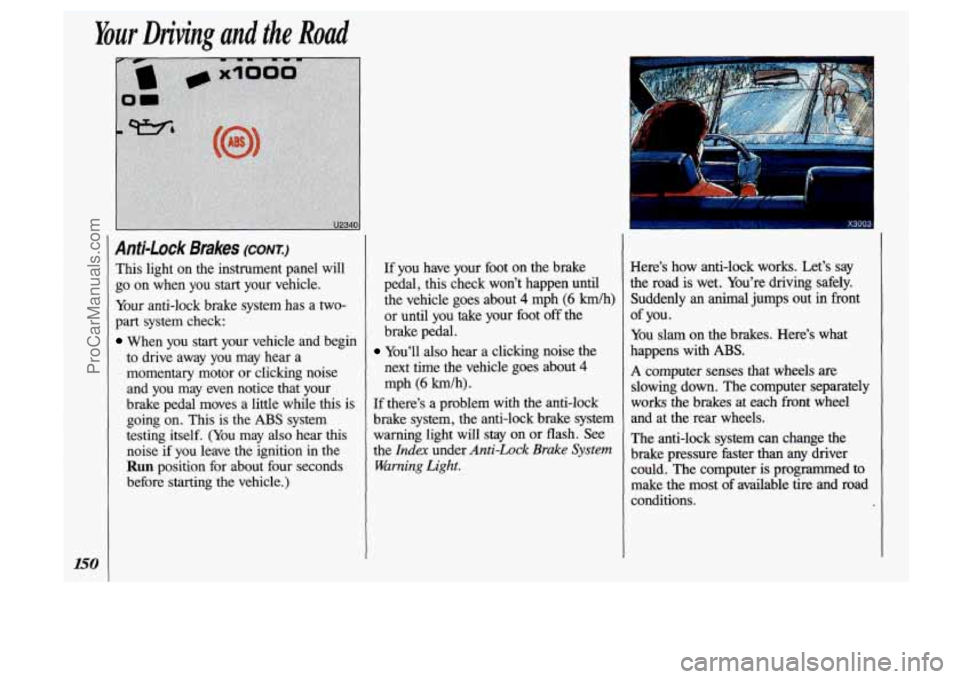
This light on the instrument panel will
go on when you start your vehicle.
Your anti-lock brake system has
a two-
part system check:
When you start your vehicle and begin
to drive away you may hear a
momentary motor or clicking noise
and you may even notice that your
brake pedal moves a little while this is
going on. This is the
ABS system
testing itself. (You may
also hear this
noise if you leave the ignition in the
Run position for about four seconds
before starting the vehicle.)
If you have your foot on the brake
pedal, this check won’t happen until
the vehicle goes about
4 mph (6 Wh)
or until you take your foot off the
brake pedal.
You’ll also hear a clicking noise the
next time the vehicle goes about
4
mph (6 Wh).
If there’s a problem with the anti-lock
brake system, the anti-lock brake system
warning light will stay on
or flash. See
the
Inda under Anti-Lock Brake System
Warning Light.
Here’s how anti-lock works. Let’s say
the road is wet. YOU’E driving safely.
Suddenly
an animal jumps out in front
You
slam on the brakes. Here’s what
happens with
ABS.
A computer senses that wheels are
slowing down. The computer separately
works the brakes at each front wheel
and at the rear wheels.
The anti-lock system can change the
brake pressure faster than any driver
could. The computer is programmed to
make the most of available tire and road
conditions.
of you.
ProCarManuals.com
Page 172 of 323
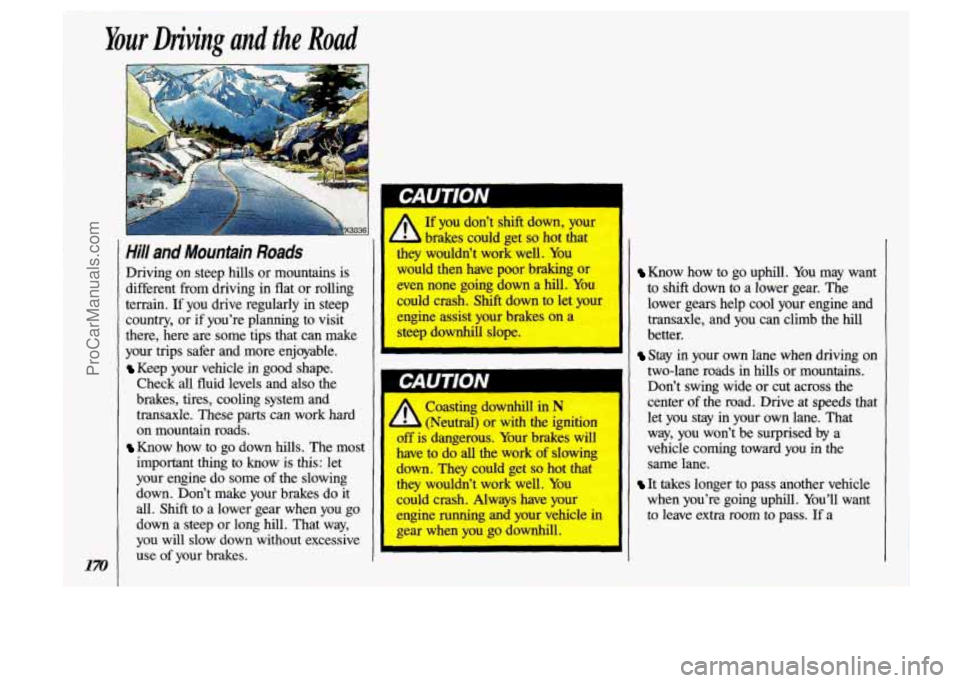
Hi// and Mountain Roads
Driving on steep hills or mountains is
different from driving in flat or rolling
terrain.
If you drive regularly in steep
country, or if you’re planning to visit
there, here are some tips that can make
your trips safer and more enjoyable.
Keep your vehicle in good shape.
Check all fluid levels and also the
brakes, tires, cooling system and
transaxle. These parts can work hard
on mountain roads.
Know how to go down hills. The most
important thing to
know is this: let
your engine do some of the slowing
down. Don’t make your brakes do it
all. Shift to a lower gear when you go
down a steep or long hill. That way,
you will slow down without excessive
use
of your brakes.
GAU I IUN
If you don’t shift down, your
brakes could get
so hot that I
they wouldn’t work well. You
1 would then have poor braking or
even none going down a hill. You
1 could crash. Shift down to let your
engine assist your brakes on a
steep downhill slope.
Coasting downhill in
N
C L (Neutral) or with the ignition
OII is dangerous. Your brakes will
have
to do all the work of slowing
down. They could get
so hot that
they wouldn’t work well. You
could crash. Always have your
engine running and your vehicle in
gear when you
go downhill.
I
Know how to go uphill. You may want
to shift down to a lower gear. The
lower gears help
cool your engine and
transaxle, and you can climb
the hill
better.
Stay in your own lane when driving on
two-lane roads in hills or mountains.
Don’t swing wide or cut across
the
center of the road. Drive at speeds that
let you stay
in your own lane. That
way, you won’t be surprised by
a
vehicle coming toward you in the
same lane.
It takes longer to pass another vehicle
when you’re going uphill. You’ll want
to leave extra room to pass. If a
ProCarManuals.com
Page 188 of 323
Problems on the Road
I
Hazard Warning Flashers
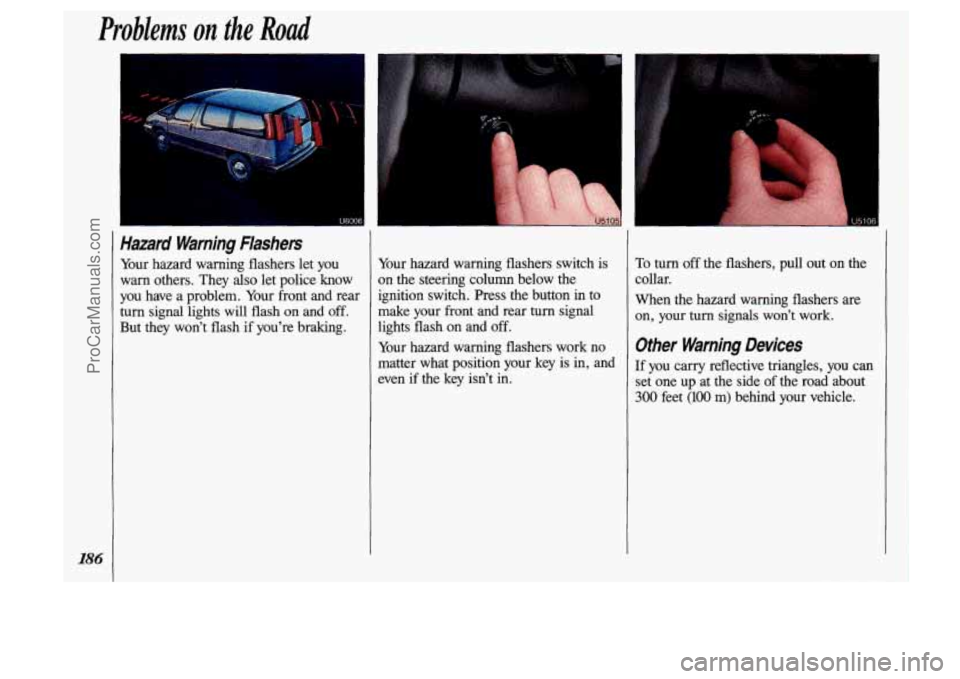
Your hazard warning flashers let you
warn others. They
also let police know
you have a problem. Your front and rear
turn signal lights will flash on and off.
But they won’t flash if you’re braking. Your
hazard warning flashers switch is
on the steering column below the
ignition switch. Press the button in to
make your front and rear turn signal
lights flash on and off.
Your hazard warning flashers work no
matter what position your key is in, and
even if the key isn’t in.
L
To turn off the flashers, pull out on the
collar.
When the hazard warning flashers are
on, your turn signals won’t work.
Other Warning Devices
If you carry reflective triangles, you can
set one up at the side of the road about
300 feet (100 m) behind your vehicle.
ProCarManuals.com
Page 190 of 323
Problems on the Road
i
I
I
I
I88
Jump Starting (CONT.)
2. Get the vehicles close enough so the
jumper cables can reach, but be sure
the vehicles aren’t touching each other.
If they are, it could cause a
ground connection you don’t want.
You wouldn’t be able to start your
Oldsmobile, and the bad grounding
could damage the electrical systems.
You could be injured
if the
L vehicles roll. Set the parking
brake
firmly on each vehicle. Put
an automatic transaxle in
P (Park)
or a manual transaxle
in N (Neutral).
3. Turn off the ignition on both
vehicles.
Turn off all lights that aren’t
needed, and radios.
This will avoid
sparks and help save both batteries.
And it could save your radio!
4. Open the hoods and locate the
batteries.
r An electric fan can start up
even when the engine is not
I
I uming and can injure you. Keep
hands, clothing and tools away
from any underhood electric fan.
Find the positive
(+) and negative
(-) terminals on each battery.
ProCarManuals.com
Page 194 of 323
Problems on the Road
192
Towing Your Oldsmobile (CONT.:)
When you call, tell the towing service:
That your vehicle cannot be towed
from the front with sling-type
equipment.
drive.
vehicle. lever.
damaged.
That your vehicle has front-wheel
The make, model, and year of your
Whether you can still move the shift
If there was an accident, what was
When the towing service arrives, let the
tow operator know that this manual
contains detailed towing instructions and
illustrations. The operator may want to
see them.
1 X6016
m,. ,
L ‘~‘n help avoid injury to you or
0 Never let passengers ride in a
vehicle that is
being towed.
* Never tow faster than safe or
0 Never tow with damaged parts
0 Never get under your vehicle
posted speeds.
not fully secured.
after it has been lifted by the tow
truck.
chains on each side when towing
a vehicle.
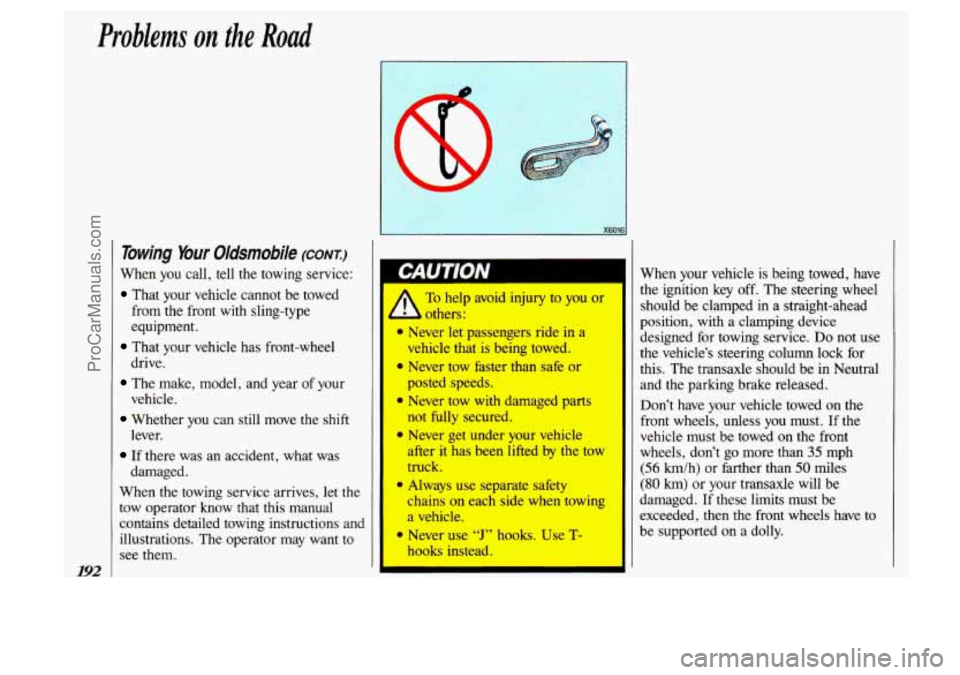
Never use “J” hooks. Use T-
hooks instead.
* Always use separate safety When your vehicle is being towed, have
the
ignition key
off. The steering wheel
should be clamped in a straight-ahead
position, with
a clamping device
designed for towing service. Do not use
the vehicle’s steering column lock for
this. The transaxle should be
in Neutral
and the parking brake released.
Don’t have your vehicle towed on
the
front wheels, unless you must. If the
vehicle must be towed on the front
wheels, don’t
go more than 35 mph
(56 km/h) or farther than 50 miles
(80 km) or your transaxle will be
damaged. If these limits must be
exceeded,
then the front wheels have to
be supported on a dolly.
ProCarManuals.com
Page 317 of 323

Identification Number. Vehicle .... 262
Idling Your Engine
........... .70. 72
If You’re Stuck: In Sand. Mud.
Ice or Snow .................. 213
Ignition
Key
......................... 46
Positions
..................... 60
Illuminated Entry System .......... 52
Indicator Lights (see
Warning Lights)
Infant Restraint (see Child Restraints)
Inflation. Tire ............ .212. 248
Inflator. Air
.................... 90
Inside Rearview Mirror .......... 92
Instrument Panel
............... 101
Instrument
Panel Cluster ......... 102
Instrument Panel Warning Lights
. . 104
Instrument Panel Intensity Control
. . 81
Interior Lights
.............. .81. 89
Override Switch
............... 89
.................... J ack. Tire 205
Jumn Starting
.................. 187
Keyless Entry. Remote
........... 49
Keys
.......................... 46
.
Lane Change Indicator ........... 74
Lap-Shoulder Belt
............... 26
Front
.................... 26. 30
Rear
........................ 30
Use by Children
........... .34. 40
Level Control. Electronic
.... .99. 245
Liftgate
................... .59. 110
Lighter
........................ 94
Lights Dome
....................... 89
Fog
......................... 81
Headlights
................... 79
Interior Lights Control .......... 81
“On” Reminder
............... 80
Reading .................. 85. 89
Rear Interior Lights ............ 89
Removing & Replacing
Bulbs
................ .243. 244
Replacement Bulbs
............ 273
Taillights
.................... 244
Turn Signal
................... 74
Underhood
.................. 225
Warning Lights
............... 104
Lights On Reminder
............. 80
Loading Your Vehicle ....... .99. 245
Interior
Lights Override Switch
... 89
Locks
Manual
.................. .47. 54
Power
....................... 48
Sliding
Door .................. 54
Long Distance Driving
........... 168
Low Battery
................... 187
Low Fuel Warning
.............. 105
Low Oil Pressure Warning
........ 106
Lubricants and Fluids
........... 272
Luggage Carrier
................. 97
Maintenance Record
........... 294
Maintenance Schedule
........... 275
Malfunction Indicator Lamp
....... 110
Manual Front Seat
............... 14
Manual Lap-Shoulder Safety Belt
... 26
Methanol in Gasoline
............ 217
Mileage Indicator (see
Odometer &
Mirrors
Speedometer)
Inside Manual Day/Night ........ 92
Outside Convex
............... 92
Power Remote Control
.......... 92
Visor Vanity
.................. 93
Mountain Driving
............... 170
..
ProCarManuals.com