light OLDSMOBILE SILHOUETTE 1997 Owners Manual
[x] Cancel search | Manufacturer: OLDSMOBILE, Model Year: 1997, Model line: SILHOUETTE, Model: OLDSMOBILE SILHOUETTE 1997Pages: 436, PDF Size: 21.87 MB
Page 327 of 436
Brake Wear
Your Oldsmobile has front disc brakes and rear
drum brakes.
Disc brake pads have built-in wear indicators that
make a high-pitched warning sound when the brake
pads are worn and new pads are needed. The sound may
come and go or be heard all
the time your vehicle is
moving (except when you are pushing on the brake
pedal firmly).
The brake wear warning sound means that soon
your brakes won’t work well. That could lead to
an accident. When you hear the brake wear
warning sound, have your vehicle serviced.
I NOTICE: 1
Continuing to drive with worn-out brake pads
could result in costly brake repair.
1
Some driving conditions or climates may cause a brake
squeal when
the brakes are first applied or lightly
applied. This does not mean something
is wrong with
your br.
c~ k es.
Properly torqued wheel nuts are necessary to help
prevent brake pulsation. When tires are rotated, inspect
brake pads for wear and
evenly torque wheel nuts in the
proper sequence to GM specifications.
Your rear drum brakes don’t have wear indicators,
but if
you ever hear
a rear brake rubbing noise, have the rear
brake linings inspected.
Also, the rear brake drums
should be removed and inspected each time the tires
are removed for rotation or changing. When you
have the front brakes replaced, have the rear brakes
inspected, too.
Brake linings should always be replaced
as complete
axle sets.
6-29
ProCarManuals.com
Page 341 of 436
Mixing tires could cause you to lose control while
driving.
If you mix tires of different sizes or types
(radial and bias-belted tires), the vehicle may not
handle properly, and you could have a crash.
Using tires of different sizes may also cause
damage to your vehicle. Be sure to use the same
size and type tires on all wheels.
It’s
all right to drive with your compact spare,
though. It was developed
for use on your vehicle.
Uniform Tire Quality Grading
The following information relates to the system
developed by the United States National Highway
Traffic Safety Administration, which grades tires by
treadwear, traction and temperature performance. (This
applies only to vehicles sold
in the United States.) The
grades are molded on the sidewalls of most passenger
car tires. The Uniform Tire Quality Grading system does not
apply to deep tread, winter-type snow tires,
space-saver or temporary use spare tires, tires with
nominal rim diameters
oC 10 to 12 inches (25 to 30 cm),
or to some limited-production tires.
While the tires available on General Motors passenger
cars and light trucks may vary with respect to these
grades,
they must also conform to Federal safety
requirements and additional General Motors Tire Performance Criteria (TPC) standards.
Treadwear
The treadwear grade is a comparative rating based
on
the wear rate of the tire when tested under controlled
conditions on
a specified government test course. For
example,
a tire graded 150 would wear one and a half
( 1 1/2) times as well on the government course as a tire
graded
100. The relative performance of tires depends
upon the actual conditions of their use, however, and
may depart significantly from the norm due to variations
in driving habits, service practices and differences in
road characteristics and climate.
6-43
ProCarManuals.com
Page 345 of 436
Cleaning the Inside of Your Oldsmobile
Use a vacuum cleaner often to get rid of dust and loose
dirt. Wipe
vinyl or leather with a clean, damp cloth.
Your Oldsmobile retailer has two cleaners,
a
solvent-type spot lifter and a foam-type powdered
cleaner. They will clean normal spots and stains
very
well. Do not use them on vinyl or leather.
Here are some cleaning tips:
1.
2.
3.
4.
5.
Always read the instructions on the cleaner label.
Clean up stains
as soon as you can -- before they set.
Use a clean cloth or sponge, and change to a clean area
often.
A soft brush may be used if stains are stubborn.
Use solvent-type cleaners
in a well-ventilated area
only.
If you use them, don’t saturate the stained area.
If a ring forms after spot cleaning, clean the entire
area immediately or
it will set.
Using Foam-Type Cleaner on Fabric
1. Vxuum and brush the area to remove any loose dirt.
2. Always clean a whole trim panel or section. Mask
surrounding trim along stitch or welt lines.
4. Use suds only and apply with a clean sponge. Don’t
saturate the material and don’t rub
it roughly.
5. As soon as you’ve cleaned the section, use a sponge
to remove the suds.
6. Rinse the section with a clean, wet sponge.
7. Wipe off what’s left with a slightly damp paper towel
or cloth.
8. Dry it immediately with a blow dryer.
9. Wipe with a clean cloth.
Using Solvent-Type Cleaner on Fabric
First, see if you have to use solvent-type cleaner at all.
Some spots and stains will clean off better with just
water and mild soap.
If you need to
use a solvent:
1. Gently scrape excess soil from the trim material with
a clean, dull
knife or scraper.
2. Use very little cleaner, light pressure and clean cloths
(preferably cheesecloth). Cleaning should start at the
outside of the stain, “feathering” toward
the center.
3. Keep changing to a clean section of the cloth.
3. Mix Multi-Purpose Powdered Cleaner following the 4. When you clean a stain from fabric, immediately dry the
directions on the container label. area with a
blow dryer to help prevent a cleaning ring.
6-47
ProCarManuals.com
Page 346 of 436
Special Cleaning Problems
Greasy or Oily Stains
Stains caused by grease, oil, butter, margarine, shoe
polish, coffee with cream, chewing gum, cosmetic
creams, vegetable oils, wax crayon, tar and asphalt can
be removed as follows:
1. Carefully scrape off excess stain.
2. Follow the solvent-type instructions described earlier.
Shoe polish,
wax crayon, tar and asphalt will stain if left
on
a vehicle’s seat fabric. They should be removed as
soon
as possible. Be careful, because the cleaner will
dissolve them and may cause them to spread.
Non-Greasy Stains
Stains caused by catsup, coffee (black), egg, fruit, fruit
juice, milk, soft drinks, wine, vomit, urine and blood can
be removed
as follows:
1. Carefully scrape off excess stain, then sponge the
soiled area with cool water.
2. If a stain remains, follow the foam-type instructions
described earlier.
3. If an odor lingers after cleaning vomit or urine,
treat
the area with a waterhaking soda solution:
1 teaspoon (5 ml) of baking soda to 1 cup (250 ml)
of lukewarm water.
4. If needed, clean lightly with solvent-type cleaner.
Combination Stains
Stains caused by candy, ice cream, mayonnaise, chili
sauce and unknown stains can be removed as follows:
1. Carefully scrape off excess stain.
2. Clean with cool water and allow to dry.
3. If a stain remains, clean it with solvent-type cleaner.
Cleaning Vinyl
Use warm water and a clean cloth.
0 Rub with a clean, damp cloth to remove dirt. You
may have to do
it more than once.
0 Things like tar, asphalt and shoe polish will stain if you
don’t get them off quickly. Use a clean cloth and a
vinyweather cleaner. See your retailer for this product.
6-48
ProCarManuals.com
Page 355 of 436
Fuses and Circuit Breakers
The wiring circuits in your vehicle are protected from
short circuits by a combination of fuses, circuit breakers
and fusible thermal links.
Look at the silver-colored band inside the fuse. If the
band
is broken or melted, replace the fuse. Be sure you
replace a bad fuse with a new one of the identical size
and rating.
If you ever have a problem on the road and don’t have a
spare fuse,
you can borrow one that has the same
amperage
or use one of the spare fuses in the underhood
fuse and relay center. Just pick some feature of your
vehicle that you can get along without
-- like the radio
or cigarette lighter -- and use its fuse, if it is the right
amperage. Replace it as soon as you can.
There are two fuse blocks in your vehicle: the
instrument panel fuse block and the underhood fuse and
relay center.
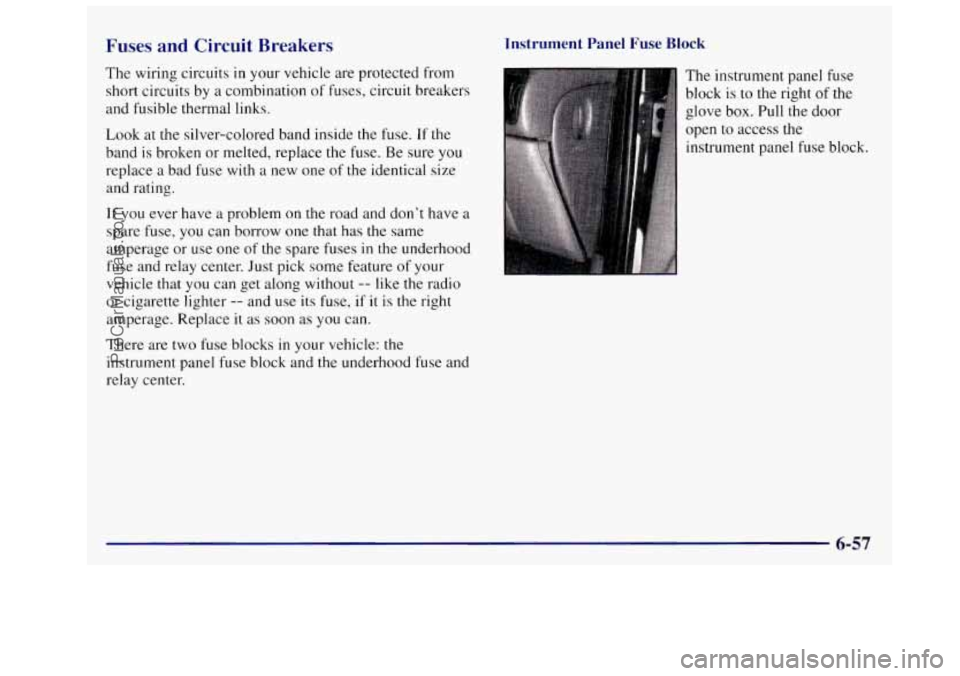
Instrument Panel Fuse Block
The instrument panel fuse
block
is to the right of the
glove box. Pull the door
open to access the
instrument panel fuse block.
ProCarManuals.com
Page 356 of 436
/ -.
FUSE USAGE CHART
BREAKERS
ELEC PRNDL RR DEFOG ELC
HEADlAMP
20
10 CRUISE 10 TlSlG 15 SIR 10 IGN 1 10 PSD
10 25
‘a 25
25 PWR OTR VENT RR HVAC FR$~~~~~~w’ SUNROOF HVAC/DRL
10
20 10
PIM WDQ/RR 2 10 M 20 FRT WPR WSHR SWC ACCY MALURADIO/DC RR WPR WSHR BCM PRGRM -- I PWGiAT, I HAZARD 15 STOP LAMP 15
L 20 PWR LOCK RR PWR SCKT ABS MOL BATT 20 10
FRT HVAC HI 20 2 K ABS SOL SWC BACK LIGHT
For More Information, See Owner’s Manual . Printed in 10250877 /
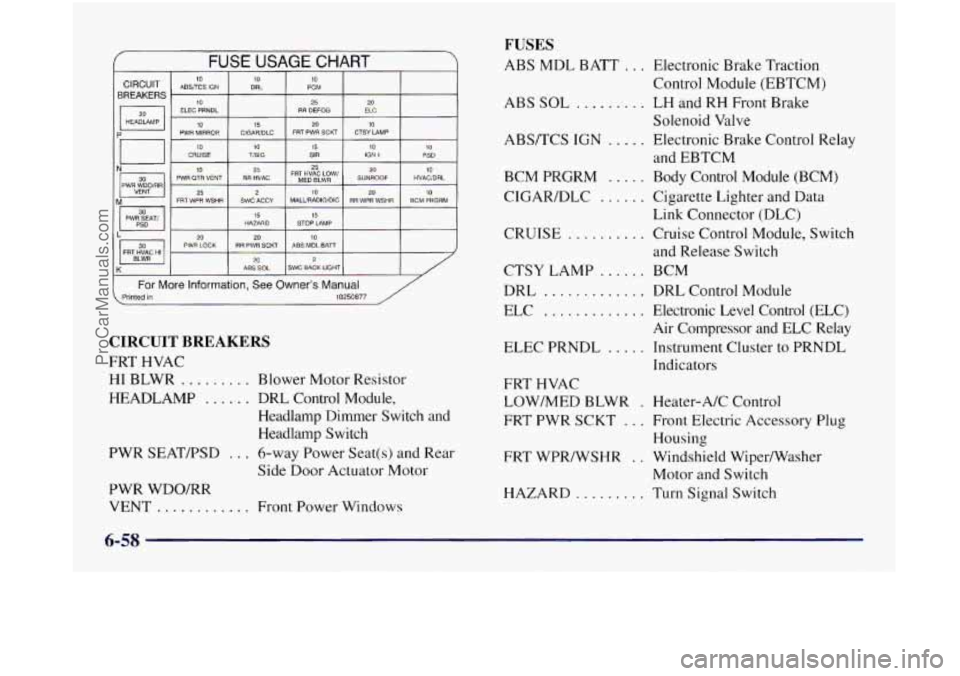
CIRCUIT BREAKERS
FRT HVAC
HI BLWR ......... Blower Motor Resistor
HEADLAMP
...... DRL Control Module,
Headlamp Dimmer Switch and
Headlamp Switch
PWR SEATFSD
... 6-way Power Seat(s) and Rear
Side Door Actuator Motor
PWR WDO/RR VENT
............ Front Power Windows
FUSES
ABS MDL BATT ... Electronic Brake Traction
ABS
SOL ......... LH and RH Front Brake
ABS/TCS
IGN ..... Electronic Brake Control Relay
BCM
PRGRM ..... Body Control Module (BCM)
CIGARDLC
...... Cigarette Lighter and Data
CRUISE
.......... Cruise Control Module, Switch
CTSY LAMP
...... BCM
DRL
............. DRL Control Module
ELC
............. Electronic Level Control (ELC)
Air Compressor and ELC Relay
ELEC PRNDL
..... Instrument Cluster to PRNDL
Indicators Control Module
(EBTCM)
Solenoid Valve
and EBTCM
Link Connector (DLC)
and Release Switch
FRT HVAC
LOW/MED BLWR
. Heater-A/C Control
FRT PWR SCKT
... Front Electric Accessory Plug
Housing
Motor and Switch
FRT
WPR/WSHR
. . Windshield Wiper/Washer
HAZARD
......... Turn Signal Switch
6-58
ProCarManuals.com
Page 357 of 436
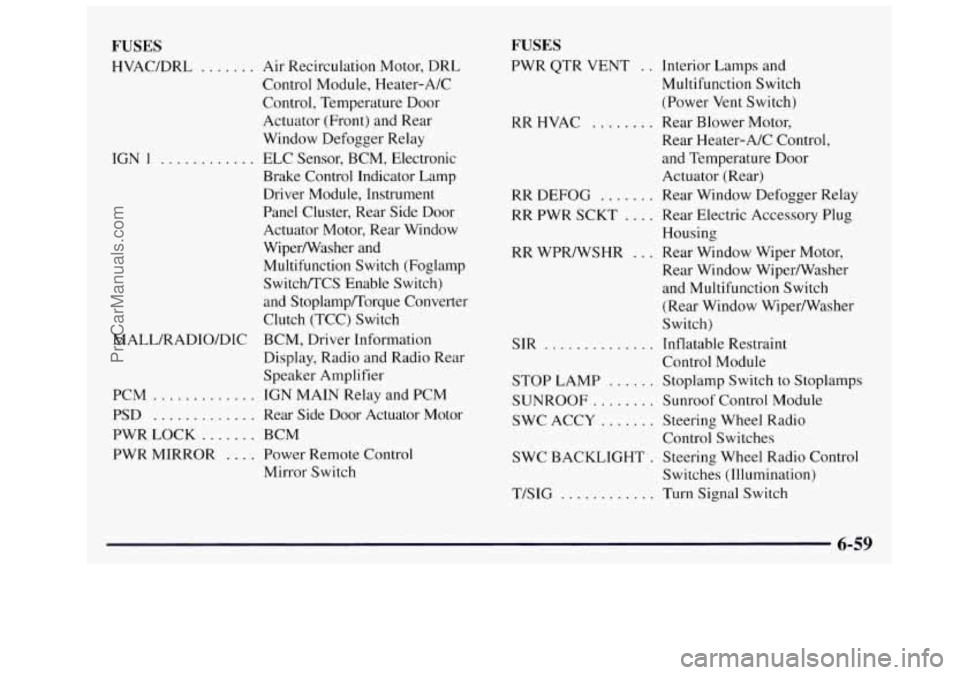
FUSES
HVAC/DRL ....... Air Recirculation Motor, DRL
IGN
1 ...........
MALL/RADIO/DIC Control Module, Heater-A/C
Control,
Temperature Door
Actuator (Front) and Rear
Window Defogger Relay
ELC Sensor, BCM, Electronic
Brake Control Indicator Lamp
Driver Module, Instrument
Panel Cluster, Rear Side Door
Actuator Motor, Rear Window
Wiperwasher and
Multifunction Switch (Foglamp
Switch/TCS Enable Switch)
and Stoplamp/Torque Converter
Clutch (TCC) Switch
BCM, Driver Information
Display, Radio and Radio Rear
Speaker Amplifier
PCM
............. IGN MAIN Relay and PCM
PSD
............. Rear Side Door Actuator Motor
PWR LOCK
....... BCM
PWR MIRROR
.... Power Remote Control
Mirror Switch
FUSES
PWR QTR VENT . . Interior Lamps and
Multifunction Switch
(Power
Vent Switch)
RR HVAC ........ Rear Blower Motor,
Rear Heater-A/C Control,
and Temperature Door
Actuator (Rear)
RR
DEFOG ....... Rear Window Defogger Relay
RR PWR SCKT .... Rear Electric Accessory Plug
Housing
Rear Window Wiper/Washer
and Multifunction Switch
(Rear Window Wiper/Washer
Switch)
Control Module
RR WPR/WSHR
... Rear Window Wiper Motor,
SIR
.............. Inflatable Restraint
STOP LAMP ...... Stoplamp Switch to Stoplamps
SUNROOF
........ Sunroof Control Module
SWC ACCY
....... Steering Wheel Radio
SWC BACKLIGHT
. Steering Wheel Radio Control
T/SIG ............ Turn Signal Switch
Control
Switches
Switches (Illumination)
6-59
ProCarManuals.com
Page 400 of 436
At Least Twice a Year At Least Once a Year
Restraint System Check
Make sure the safety belt reminder light and all your
belts, buckles, latch plates, retractors and anchorages are
working properly. If your vehicle has a built-in child
restraint, also periodically make sure the harness straps,
latch plates, buckle, clip, child head restraint and
anchorages are working properly. Look for any other
loose or damaged safety belt and built-in child restraint
system parts.
If you see anything that might keep a
safety belt or built-in child restraint system from doing
its job, have it repaired. Have any torn or frayed safety
belts
or harness straps replaced.
Also look for any opened or broken air bag covers, and
have them repaired or replaced. (The air bag system
does not need regular maintenance.)
Automatic Transaxle Check
Check the transaxle fluid level; add if needed. See
“Automatic Transaxle”
in the Index. A fluid loss
may indicate a problem. Check the system and repair
if needed.
Key Lock Cylinders Service
Lubricate the key lock cylinders with the lubricant
specified
in Part D.
Body Lubrication Service
Lubricate all body door hinges, including the liftgate.
Also lubricate all hinges and latches, including those for
the hood, power sliding door cable, rear compartment,
glove box door, console door, and any folding seat
hardware. Part
D tells you what to use. More frequent
lubrication may be required when exposed
to a corrosive
environment.
7-38
ProCarManuals.com
Page 419 of 436

L
Service Manual 1997 $90.00
Car
& Light Truck
Transmission Unit Repair 1997 $40.00
Owner's Manual In Portfolio
1997 $1 5.00
Owner's Manual Without Portfolio 1997 $1 0.00
9
9
7.
G
M
NOTE: Dealers and Companies please provide dealer or company name, and also the
name of the person to whose attention the shipment should be sent.
~~
s Mail completed order form to:
H
I
P
HELM, INCORPORATED P.O. Box 07130 Detroit, MI 48207 For purchases outside U.S.A. please write to the above address for quotation.
(CUSTOMER'S NAME) (ATTENTION)
T
(STREET ADDRESS-NO P.O. BOX NUMBERS)
(STATE) (ZIP CODE)
DAYTIME TELEPHONE NO.
0 AREA CODE
GM-OLD-ORD97 "(Prices are subject to change without notice and without incurring
obligation. Allow ample time for delivery.)
Check or Maney Order payable to Helm, Inc. (USA funds only - do hot send cash.)
[L1 Mastercard
Note to Canadian Customers: All listed prices are quoted in U.S. funds. Canadian residents
are to make checks payable in U.S. funds. To cover Canadian postage, add $11.50 plus the US. order processing.
ProCarManuals.com
Page 421 of 436
Section 9 Index
Accessory Power Outlet ......................... 2-84
Adding Equipment to the Outside
Of Your Vehicle ...... 6-3
AirBag
....................................... 1-43
How Does
it Restrain .......................... 1-47
Howitworks
................................ 1-45
Location
.................................... 1-45
Readiness Light
......................... 1.44, 2.94
Servicing
................................... 1-48
What Makes it Inflate
.......................... 1-46
What Will You See After it Inflates
............... 1-47
When Should it Inflate
......................... 1-46
Aircleaner
.................................... 6-15
Air Conditioning
................................ 3-3
Air Conditioning Refrigerants
..................... 6-62
AirInflator
.................................... 2-86
Alignment and Balance. Tire
...................... 6-44
Aluminum Wheels. Cleaning
...................... 6-52
Antenna. Integrated Windshield
.................... 3-30
Antifreeze ..................................... 6-20
Anti-Lock
........................................
Brake System Warning Light ................ 2.96. 4.7
Brakes
...................................... 4-7
Adjusting the Split Bench Seat
.................... 1 . 19
Appearance Care
............................... 6-46
Appearance Care Materials
....................... 6-54
Ashtray
....................................... 2-82
Audio Systems
.................................. 3-9
Automatic Door Locks
............................ 2-6
Automatic Overdrive
............................ 2-33
Automatic Transaxle Check
....................... 7-38
Automatic Transaxle Fluid
........................ 6-17
HowtoAdd
................................. 6-20
How to Check
............................... 6-18
When
to Check and Change ..................... 6-17
Automatic Transaxle Operation
.................... 2-31
Shifting
..................................... 2-31
Automatic Transaxle Park Mechanism Check
......... 7-40
Battery Saver
................................. 2-61
Battery
....................................... 6-30
Jump Starting
................................. 5-3
Warnings
................................ 5.3. 5.5
BBB Auto Line
................................. 8-7
Before Leaving on a Long Trip
.................... 4-22
Better Business Bureau Mediation
................... 8-7
9-1
ProCarManuals.com