light OLDSMOBILE SILHOUETTE 1997 Repair Manual
[x] Cancel search | Manufacturer: OLDSMOBILE, Model Year: 1997, Model line: SILHOUETTE, Model: OLDSMOBILE SILHOUETTE 1997Pages: 436, PDF Size: 21.87 MB
Page 206 of 436
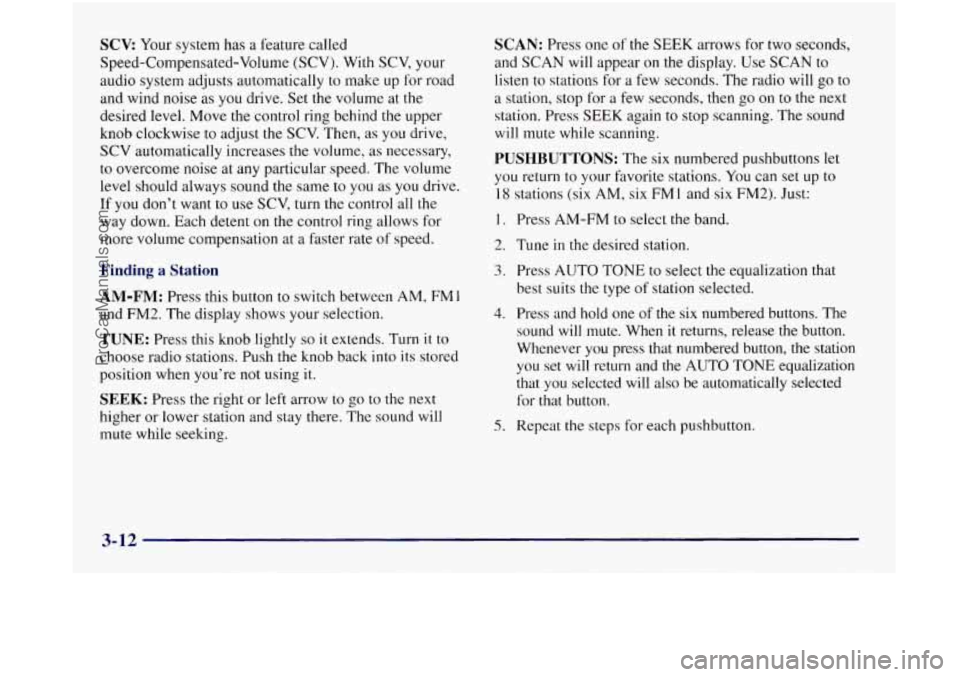
SCV: Your system has a feature called
Speed-Compensated-Volume (SCV). With SCV, your
audio system adjusts automatically to make up for road
and wind noise as you drive. Set the volume at the
desired level. Move the control ring behind the upper
knob clockwise to adjust the SCV. Then, as you drive,
SCV automatically increases the volume, as necessary,
to overcome noise at any particular speed. The volume
level should always sound the same to you as you drive.
If you don’t want to use SCV, turn the control all the
way down. Each detent on the control ring allows for
more volume compensation at a faster rate of speed.
Finding a Station
AM-FM: Press this button to switch between AM, FMl
and FM2. The display shows your selection.
TUNE: Press this knob lightly so it extends. Turn it to
choose radio stations. Push the knob back into its stored
position when you’re not using it.
SEEK: Press the right or left arrow to go to the next
higher or lower station and stay there. The sound will
mute while seeking.
SCAN: Press one of the SEEK arrows for two seconds,
and SCAN will appear on
the display. Use SCAN to
listen to stations for a few seconds. The radio will go
to
a station, stop for a few seconds, then go on to the next
station. Press
SEEK again to stop scanning. The sound
will mute while scanning.
PUSHBUTTONS: The six numbered pushbuttons let
you return to your favorite stations. You can set up to
18 stations (six AM, six FMl and six FM2). Just:
I. Press AM-FM to select the band.
2. Tune in the desired station.
3. Press AUTO TONE to select the equalization that
best suits the type of station selected.
4. Press and hold one of the six numbered buttons. The
sound will mute. When
it returns, release the button.
Whenever you press that numbered button, the station
you set will return and the AUTO TONE equalization
that you selected will also be automatically selected
for that button.
5. Repeat the steps for each pushbutton.
3-12
ProCarManuals.com
Page 207 of 436
If you manually tune or use SEEK or SCAN to find a
frequency stored
in a preset, the AUTO TONE
equalization stored for that frequency will be recalled.
Always check the display first to make sure you have
the correct band.
P SCAN: Press this button to listen to each of your
favorite stations stored on your pushbuttons for
a few
seconds. The radio will scan through each of the stations
stored on your pushbuttons, except those stations with
weak reception. The AUTO TONE setting stored for that
pushbutton will be automatically chosen. Press P SCAN
or one
of the pushbuttons again to stop scanning.
P SCAN will be displayed whenever the tuner is in the
P SCAN mode. The channel number (P1 -P6) will appear
momentarily just before the frequency is displayed.
Setting the Tone
BASS:
Press this knob lightly so it extends. Turn the
knob clockwise to increase bass and counterclockwise to
decrease bass. When you use this control, the radio’s
AUTO TONE setting will switch
to manual.
TREB: Press this knob lightly so it extends. Turn the
knob clockwise to increase treble and counterclockwise
to decrease treble. When you use this control, the radio’s
AUTO
TONE setting will switch to manual. If a station
is weak or noisy, you may want
to decrease the treble. Push these knobs back into their stored
positions when
you’re not using them.
AUTO TONE: This feature allows you to choose preset
bass and treble equalization settings designed for
classical, news, rock, pop, countrylwestern and
jazz
stations. C/W will appear on the display when you first
press AUTO
TONE. Each time you press it, another
setting will appear on the display. Press
it again after
JAZZ appears and
the AUTO TONE display will go
blank. Tone control will return to the BASS and TREB
knobs. Also, if you use the BASS and TREB knobs,
control will return to them and the AUTO TONE
display will go blank.
Adjusting the Speakers
BAL:
Press this knob lightly so it extends. Turn the
knob clockwise for right speakers and counterclockwise
for left speakers. The middle position balances the
sound between the speakers.
FADE: Press this knob lightly so it extends. Turn the
knob clockwise to adjust the sound to the front speakers
and counterclockwise for the rear speakers. The middle
position balances the sound between the speakers.
Push these knobs back into their stored positions when
you’re not using them.
3-13
ProCarManuals.com
Page 210 of 436
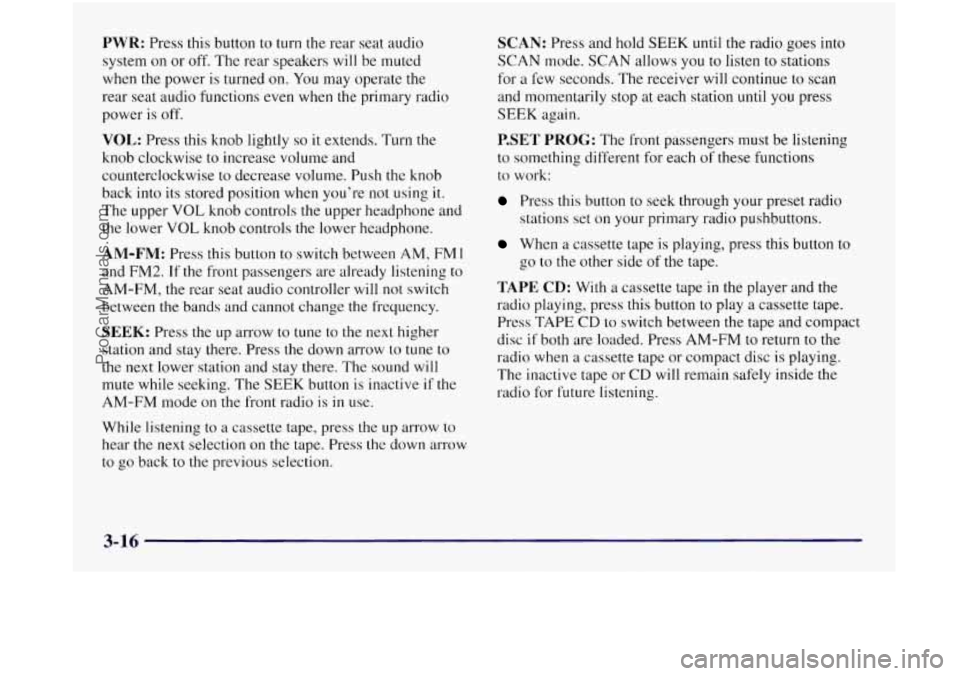
PWR: Press this button to turn the rear seat audio
system on or off. The rear speakers will be muted
when
the power is turned on. You may operate the
rear seat audio functions even when the primary radio
power
is off.
VOL: Press this knob lightly so it extends. Turn the
knob clockwise to increase volume and
counterclockwise to decrease volume. Push the knob
back into its stored position when you’re not using
it.
The upper VOL knob controls the upper headphone and
the lower
VOL knob controls the lower headphone.
AM-FM: Press this button to switch between AM, FM 1
and FM2. If the front passengers are already listening to
AM-FM, the rear seat audio controller will not switch
between
the bands and cannot change the frequency.
SEEK: Press the up arrow to tune to the next higher
station and stay there. Press the down arrow to tune
to
the next lower station and stay there. The sound will
mute while seeking. The SEEK button
is inactive if the
AM-FM mode on the front radio is
in use.
While listening
to a cassette tape, press the up arrow to
hear
the next selection on the tape. Press the down arrow
to go back to the previous selection.
SCAN: Press and hold SEEK until the radio goes into
SCAN mode. SCAN allows you
to listen to stations
for
a few seconds. The receiver will continue to scan
and momentarily stop at each station
until you press
SEEK again.
P.SET PROG: The front passengers must be listening
to something different for each
of these functions
to work:
Press this button to seek through your preset radio
stations set on your primary radio pushbuttons.
When a cassette tape is playing, press this button to
TAPE CD: With a cassette tape in the player and the
radio playing, press this button to play
a cassette tape.
Press TAPE
CD to switch between the tape and compact
disc
if both are loaded. Press AM-FM to return to the
radio when a cassette tape or compact disc is playing.
The inactive tape
or CD will remain safely inside the
radio for future listening.
go
to the other side
of the tape.
3-16
ProCarManuals.com
Page 213 of 436
AM-FM Stereo with Compact Disc Player
and Automatic Tone Control
(If Equipped)
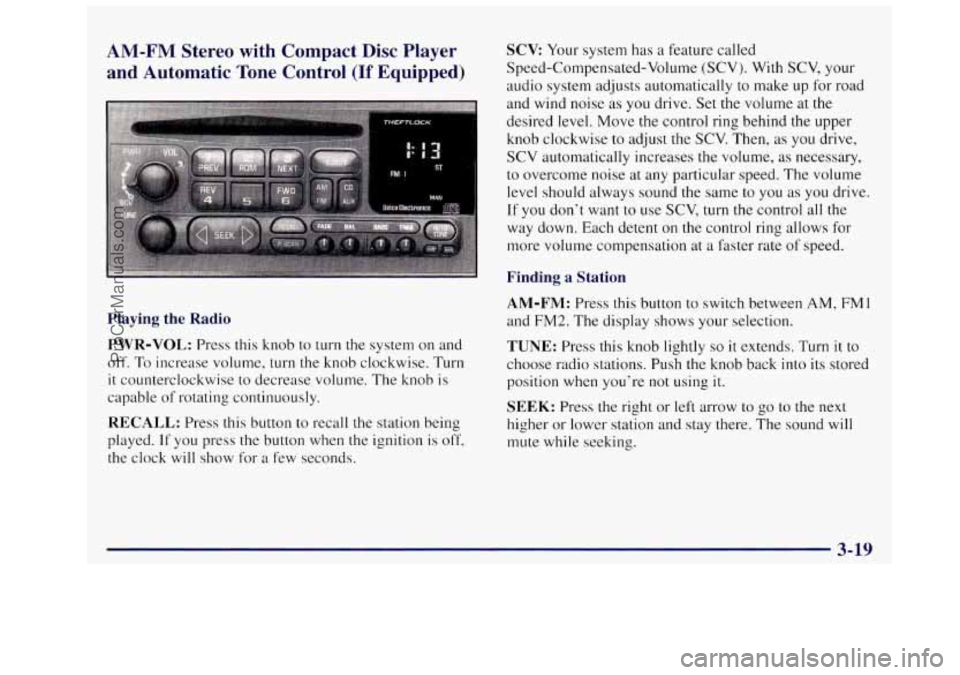
Playing the Radio
PWR-VOL:
Press this knob to turn the system on and
off.
To increase volume, turn the knob clockwise. Turn
it counterclockwise to decrease volume. The knob is
capable
of rotating continuously.
RECALL: Press this button to recall the station being
played.
If you press the button when the ignition is off,
the clock will show for a few seconds.
SCV Your system has a feature called
Speed-Compensated-Volume (SCV). With SCV, your
audio system adjusts automatically to make up for road
and wind noise as you drive. Set
the volume at the
desired level. Move the control ring behind the upper
knob clockwise to adjust the SCV. Then,
as you drive,
SCV automatically increases
the volume, as necessary,
to overcome noise at any particular speed. The volume
level should always sound
the same to you as you drive.
If you don’t want to use SCV, turn the control all the
way down. Each detent
on the control ring allows for
more volume compensation at a faster rate
of speed.
Finding a Station
AM-FM: Press this button to switch between AM, FMl
and FM2. The display shows your selection.
TUNE: Press this knob lightly so it extends. Turn it to
choose radio stations. Push the knob back into its stored
position
when you’re not using it.
SEEK: Press the right or left arrow to go to the next
higher or lower station and stay there. The sound
will
mute while seeking.
3-19
ProCarManuals.com
Page 214 of 436
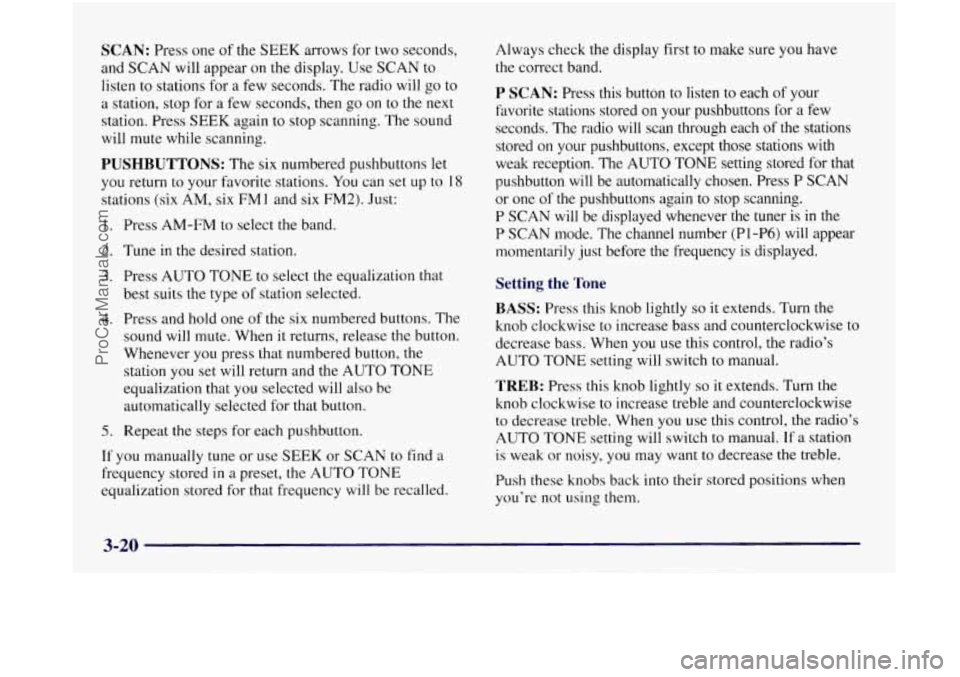
SCAN: Press one of the SEEK arrows for two seconds,
and SCAN will appear on the display. Use SCAN to
listen to stations for
a few seconds. The radio will go to
a station, stop for a few seconds, then go on to the next
station. Press
SEEK again to stop scanning. The sound
will
mute while scanning.
PUSHBUTTONS: The six numbered pushbuttons let
you return to your favorite stations. You can set up to
18
stations (six AM, six FMI and six FM2). Just:
1. Press AM-FM to select the band.
2. Tune in the desired station.
3. Press AUTO TONE to select the equalization that
best suits the type of station selected.
4. Press and hold one of the six numbered buttons. The
sound will mute. When it returns, release the button.
Whenever you press that numbered button, the
station you set will return and the AUTO TONE
equalization that you selected will also be
automatically selected for that button.
5. Repeat the steps for each pushbutton.
If you manually tune or use SEEK or SCAN to find
a
frequency stored in a preset, the AUTO TONE
equalization stored for that frequency
will be recalled. Always check the display first
to make sure you have
the correct band.
P SCAN: Press this button to listen to each of your
favorite stations stored on your pushbuttons for a few
seconds. The radio will scan through each of the stations
stored
on your pushbuttons, except those stations with
weak reception. The AUTO TONE setting stored for that
pushbutton
will be automatically chosen. Press P SCAN
or one of the pushbuttons again
to stop scanning.
P SCAN will be displayed whenever the tuner is
in the
P SCAN mode. The channel number (Pl-P6) will appear
momentarily just before the frequency is displayed.
Setting the Tone
BASS: Press this knob lightly so it extends. Turn the
knob clockwise to increase bass and counterclockwise to
decrease bass. When you use this control, the radio’s
AUTO TONE setting will switch to manual.
TREB: Press this knob lightly so it extends. Turn the
knob clockwise to increase treble and counterclockwise
to decrease treble. When
you use this control, the radio’s
AUTO TONE setting will switch to manual.
If a station
is weak or noisy, you
may want to decrease the treble.
Push these knobs back
into their stored positions when
you’re not using them.
3-20
ProCarManuals.com
Page 215 of 436
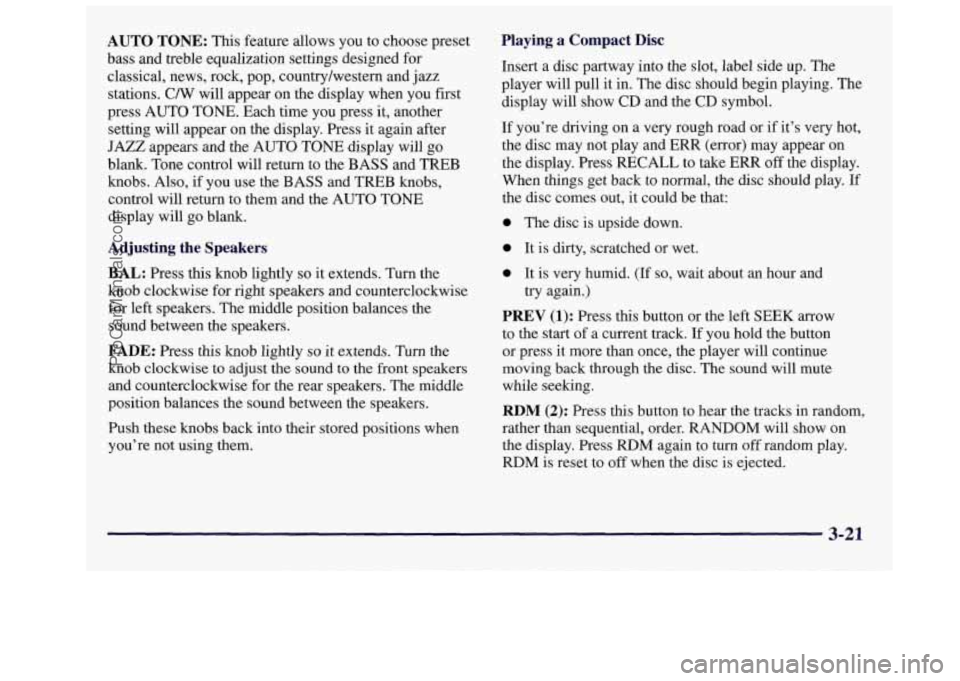
AUTO TONE: This feature allows you to choose preset
bass and treble equalization settings designed for classical, news, rock, pop, country/western and jazz
stations.
C/W will appear on the display when you first
press AUTO TONE. Each time you press it, another
setting will appear on the display. Press it again after
JAZZ appears and the AUTO TONE display will go
blank. Tone control will return to the BASS and TREB knobs. Also, if you use the BASS and TREB
knobs,
control will return to them and the AUTO TONE
display will go blank.
Adjusting the Speakers
BAL: Press this knob lightly so it extends. Turn the
knob clockwise for right speakers and counterclockwise
for left speakers. The middle position balances the
sound between the speakers.
FADE: Press hs knob lightly so it extends. Turn the
knob clockwise to adjust the sound to the front speakers
and counterclockwise for the rear speakers. The middle
position balances the sound between the speakers.
Push these knobs back into their stored positions when
you’re not using them.
Playing a Compact Disc
Insert a disc partway into the slot, label side up. The
player will pull it in.
The disc should begin playing. The
display will show
CD and the CD symbol.
If you’re driving on a very rough road or if it’s very hot,
the disc may not play and ERR (error) may appear on
the display. Press
RECALL to take ERR off the display.
When things get back to normal, the disc should play. If
the disc comes out, it could be that:
0 The disc is upside down.
0 It is dirty, scratched or wet.
0 It is very humid. (If so, wait about an hour and
PREV (1): Press this button or the left SEEK arrow
to the start of a current track. If you hold the button
or press it more than once, the player will continue
moving back through the disc. The sound will mute
while seeking. try
again.)
RDM (2): Press this button to hear the tracks in random,
rather than sequential, order. RANDOM will show on
the display. Press RDM again to turn off random play.
RDM is reset to off when the disc is ejected.
3-21
ProCarManuals.com
Page 217 of 436
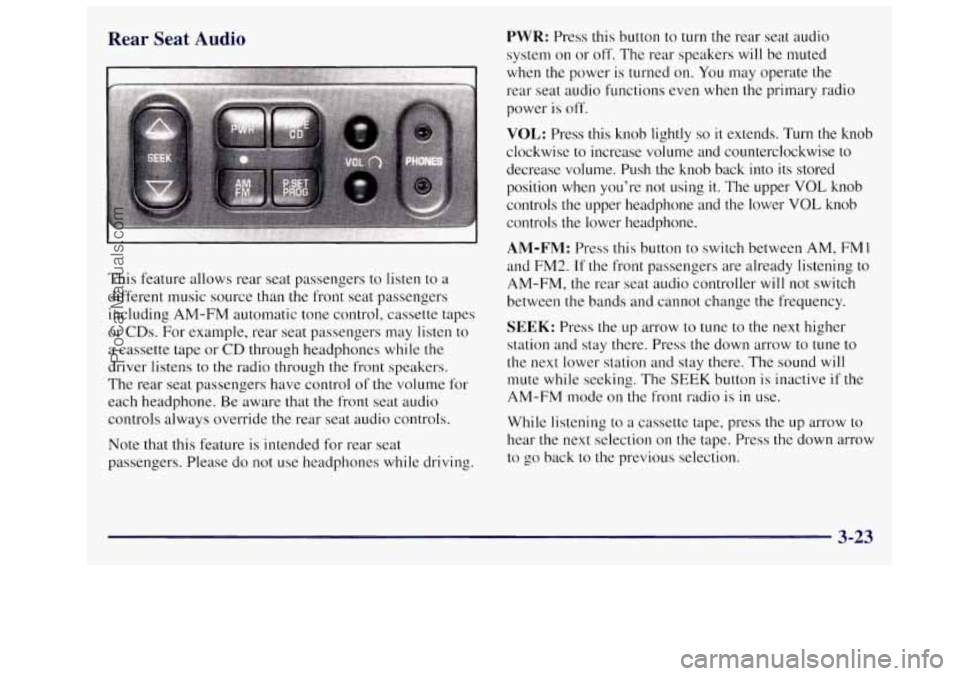
Rear Seat Audio
This feature allows rear seat passengers to listen to a
different music source than
the front seat passengers
including AM-FM automatic tone control, cassette tapes
or
CDs. For example, rear seat passengers may listen to
a cassette tape or
CD through headphones while the
driver listens to the radio through the front speakers.
The rear seat passengers have control of
the volume for
each headphone. Be aware that the front seat audio
controls always override
the rear seat audio controls.
note that this feature is intended for rear seat
passengers. Please do not use headphones while driving.
PWR: Press this button to turn the rear seat audio
system on or off. The rear speakers will be muted
when the power is turned
on. You may operate the
rear seat audio functions even when the primary radio
power is off.
VOL: Press this knob lightly so it extends. Turn the knob
clockwise to increase volume and counterclockwise to
decrease volume. Push the knob back into its stored
position
when you’re not using it. The upper VOL knob
controls
the upper headphone and the lower VOL knob
controls the lower headphone.
AM-FM: Press this button to switch between AM, FM I
and FM2. If the front passengers are already listening to
AM-FM, the rear seat audio controller will not switch
between the bands and cannot change the frequency.
SEEK: Press the up arrow to tune to the next higher
station and stay there. Press the down arrow to tune to
the next lower station and stay there. The sound
will
mute while seeking. The SEEK button is inactive if the
AM-FM mode on the front radio is in use.
While listening to a cassette tape, press the
up arrow to
hear the next selection on the tape. Press the down arrow
to go back to the previous selection.
3-23
ProCarManuals.com
Page 222 of 436
To help avoid hearing loss or damage:
Adjust the volume control to the lowest setting.
Increase volume slowly until you hear comfortably
and clearly.
NOTICE:
r
Before you add any sound equipment to your
vehicle
-- like a tape player, CB radio, mobile
telephone or two-way radio
-- be sure you can add
what you want.
If you can, it’s very important to
do it properly. Added sound equipment may
interfere with the operation of your vehicle’s
engine, Delco radio or other systems, and even
damage them. Your vehicle’s systems may
interfere with the operation of sound equipment
that has been added improperly.
So, before adding sound equipment, check with
your retailer and be sure to check Federal rules
covering mobile radio and telephone units.
Care of Your Cassette Tape Player
A tape player that is not cleaned regularly can cause
reduced sound quality, ruined cassettes or a damaged
mechanism. Cassette tapes should be stored in their
cases away from contaminants, direct sunlight and
extreme heat. If they aren’t, they may not operate
properly or may cause failure of the tape player.
Your tape player should be cleaned regularly after every
50 hours of use. Your radio may display CLN to indicate
that you have used your tape player for
50 hours without
resetting the tape clean timer. If this message appears
on the display, your cassette tape player needs to be
cleaned.
It will still play tapes, but you should clean it
as soon as possible to prevent damage to your tapes and
player. If you notice a reduction in sound quality, try a
known good cassette
to see if it is the tape or the tape
player at fault. If this other cassette has no improvement
in sound quality, clean the tape player.
3-28
ProCarManuals.com
Page 224 of 436
Care of Your Compact Discs
Handle discs carefully. Store them in their original cases
or other protective cases and away from direct sunlight
and dust. If the surface
of a disc is soiled, dampen a
clean, soft cloth in a mild, neutral detergent solution and
clean it, wiping from the center to the edge.
Be sure never to touch the signal surface
when handling
discs. Pick
up discs by grasping the outer edges or the
edge of the hole and the outer edge.
Integrated Windshield Antenna
The antenna in your vehicle is a very thin, metal layer
in the windshield.
If you look near the edges of the
windshield, you can see the outline of the antenna. The
connector
is at the top of the windshield, where the
headliner ends.
If you experience difficulty with remote transmitters,
such
as a garage door opener, try pointing the device
through the very top of the windshield.
3-30
ProCarManuals.com
Page 233 of 436
Avoid needless heavy braking. Some people drive
in spurts
-- heavy acceleration followed by heavy
braking
-- rather than keeping pace with traffic. This
is a mistake. Your brakes may not have time to cool
between hard stops. Your brakes will wear out much
faster if you do a lot
of heavy braking. If you keep pace
with the traffic and allow realistic following distances,
you will eliminate a lot of unnecessary braking. That
means better braking and longer brake life.
If your engine ever stops while you’re driving, brake
normally but don’t pump your brakes. If you do, the
pedal may get harder to push down.
If your engine
stops, you will still have some power brake assist. But
you will use it when you brake. Once the power assist is
used up,
it may take longer to stop and the brake pedal
will be harder
to push.
Anti-Lock Brakes (ABS)
Your vehicle has anti-lock brakes (ABS). ABS is an
advanced electronic braking system that will help
prevent a braking skid.
When you start your engine, or when you begin to drive
away, your anti-lock brake system
will check itself.
You may hear a momentary motor or clicking noise
while this test is going on, and you may even notice
that your brake pedal moves
a little. (You may also hear
a clicking noise
if you leave the ignition in the RUN
position for about four seconds before starting the
vehicle.) This is normal.
If there’s a problem with the
anti-lock brake system, this
warning light will stay on or
flash. See “Anti-Lock
Brake System Warning
Light” in the Index.
ProCarManuals.com