tire type OLDSMOBILE SILHOUETTE 1997 Owners Manual
[x] Cancel search | Manufacturer: OLDSMOBILE, Model Year: 1997, Model line: SILHOUETTE, Model: OLDSMOBILE SILHOUETTE 1997Pages: 436, PDF Size: 21.87 MB
Page 241 of 436
Loss of Control
Let’s review what driving experts say about what
happens when the
three control systems (brakes, steering
and acceleration) don’t have enough friction where the
tires meet the road to do what the driver has asked.
In any emergency, don’t give up. Keep trying to steer and
constantly seek
an escape route or area of less danger.
Skidding
In a skid, a driver can lose control of the vehicle.
Defensive drivers avoid most skids by taking reasonable
care suited
to existing conditions, and by not “overdriving”
those conditions. But skids
are always possible.
The three types of skids correspond to your
Oldsmobile’s
three control systems. In the bralung skid,
your wheels aren’t rolling. In the steering or cornering
skid, too much speed or steering in a curve causes tires
to slip and lose cornering force. And in the acceleration
slud, too much throttle causes the driving wheels to spin.
A cornering skid and an acceleration skid are best
handled by easing your foot off the accelerator pedal.
If your vehicle starts to slide, ease your foot off the
accelerator pedal and quickly steer the way you want the
vehicle to go.
If you start steering quickly enough, your
vehicle may straighten out. Always be ready for a
second skid
if it occurs.
Of course, traction is reduced when water, snow, ice,
gravel or other material is on
the road. For safety, you’ll
want to slow down and adjust your driving to these conditions. It is important to slow down on slippery
surfaces because stopping distance will be longer and
vehicle control more limited.
While driving on a surface with reduced traction, try
your best to avoid sudden steering, acceleration or
braking (including engine braking by shifting to a lower
gear). Any sudden changes could cause
the tires to slide.
You may not realize the surface is slippery until your
vehicle is sludding. Learn to recognize warning
clues
-- such as enough water, ice or packed snow on
the road to make a “mirrored surface”
-- and slow down
when you have any doubt.
Remember: Any anti-lock brake system (ABS) helps
avoid only the braking skid.
4-15
- --
ProCarManuals.com
Page 260 of 436
Total Weight on Your Vehicle’s Tires
Be sure your vehicle’s tires are inflated to the upper
limit for cold tires. You’ll find these numbers on the
Certification/Tire label at the rear edge of the driver’s
door or see “Tire Loading”
in the Index. Then be sure
you don’t go over
the GVW limit for your vehicle,
including the weight of the trailer tongue.
Hitches
It’s important to have the correct hitch equipment.
Crosswinds, large trucks going by and rough roads are
a
few reasons why you’ll need the right hitch. Here are
some rules to follow:
0 The bumpers on your vehicle are not intended
for hitches.
Do not attach rental hitches or other
bumper-type hitches to them. Use only
a
frame-mounted hitch that does not attach to
the bumper.
If you’ll be pulling a trailer that, when loaded, will
weigh more than
2,000 lbs. (900 kg), be sure to use a
properly mounted, weight-distributing hitch and
sway control of the proper size. This equipment is
very important for proper vehicle loading and good
handling
when you’re driving.
Will you have to make any holes in the body of your
vehicle when you install a trailer hitch?
If you do, then be sure to seal the holes later when
you remove the hitch. If you don’t seal them, deadly
carbon monoxide
(CO) from your exhaust can get
into your vehicle (see “Carbon Monoxide”
in the
Index). Dirt and water can, too.
Safety Chains
You should always attach chains between your vehicle
and your trailer. Cross the safety chains under the tongue
of the trailer so that the tongue will not drop to the road
if
it becomes separated from the hitch. Instructions
about safety chains may be provided by the hitch
manufacturer or by the trailer manufacturer. Follow the
manufacturer’s recommendation for attaching safety
chains and
do not attach them to the bumper. Always
leave just enough slack
so you can turn with your rig.
And, never allow safety chains to drag on the ground.
4-34
ProCarManuals.com
Page 265 of 436
Section 5 Problems on the Road
Here you’ll find what to do about some problems that can occur on the road.
5-2
5-3
5-3
5-8
5- 10
5-1 1
5-12
5- 12
5- 13 How
to Use Warning Flashers
Other Types of Warning Devices
Step-by-step Procedure for Jump Starting
Information
You Should Know Before Towing
Towing Your Vehicle From the Front
Towing Your Vehicle From the Rear
Overheated Engine Protection
Operating Mode
If
Your Engine is Overheating
If Steam
is Coming From Your Engine
5- 15
5-16
5 -22
5-22
5-3
1
5-32
5-33
5-34
Cooling System
How to Add Coolant
What to
do if a Tire Goes Flat
How to Change a Flat Tire
Where to Store the Flat Tire and
Tools
Information on the Compact Spare Tire
If You’re Stuck in Sand, Mud, Snow or on Ice
How
to Rock Your Vehicle to Get Unstuck
5-1
ProCarManuals.com
Page 272 of 436
Towing Your Vehicle
Try to have a GM dealer or a professional towing
service tow your vehicle. They can provide the right
equipment and know how
to tow it without damage.
See “Roadside Assistance”
in the Index.
If your vehicle has been changed or modified since it
was factory-new by adding aftermarket items like
fog
lamps, aero skirting, or special tires and wheels, these
things can be damaged during towing.
Before
you do anything, turn on the hazard
warning flashers.
When you call, tell the towing service:
0 That your vehicle has front-wheel drive.
0 That your vehicle cannot be towed from the front or
rear with sling-type equipment.
0 The make, model and year of your vehicle.
0 Whether you can still move the shift lever.
If there was an accident, what was damaged. To
help avoid injury to you or others:
Never let passengers ride in a vehicle that is
Never tow faster than safe or posted speeds.
Never tow with damaged parts not
Never get under your vehicle after it has
Always use separate safety chains on each
Never use J-hooks. Use T-hooks instead.
being towed.
fully secured.
been lifted by the tow truck.
side when towing
a vehicle.
5-8
ProCarManuals.com
Page 299 of 436
Section 6 Service and Appearance Care
Here you will find information about the care of your Oldsmobile. This section begins with service information, and
then it shows how to check important fluid and lubricant levels. There is also technical information about your
vehicle, and a part devoted
to its appearance care.
6-2
6- 3
6-4
6-5
6-7
6-10 6-15
6-16 6-17
6-20 6- 24
6-25
6-26
6-30 6-30
6-3
1
6-38 Doing
Your Own Service Work
What Kind
of Fuel to Use
Using Fuel in Foreign Countries
Where to Put the Fuel and Filling the Tank
Checking Things Under the Hood
Checking Your Engine
Oil
Air Cleaner
Pollen Filter
Automatic Transaxle Fluid
Engine Coolant
Power Steering Fluid
Where to Fill
the Windshielc 9 Washer Fluic
Important Brake Information
Information on Your Vehicle’s Battery
Tips on Vehicle Storage
Bulb Replacement Procedures
Windshield Wiper Blade Replacement 6-40
6-42
6-44
6-47 6-49
6-50
6-52
6-53 6-54
6-55 6-56
6-57
6-62
6-62
6-62 6-63
6-63 How and
When to Check Tire Inflation
When
it is Time to Buy New Tires
Wheel Alignment
Cleaning the Inside of Your Vehicle
Care of the Safety Belts
Cleaning
the Outside of Your Vehicle
How to Clean Aluminum Wheels
Underbody Maintenance
Recommended Appearance Care Materials
Your Vehicle Identification Number
(VIN)
The Electrical System
Fuses and Circuit Breakers
Replacement Bulb Types for Your Vehicle
Capacities and Specifications
Air Conditioning Specifications
Vehicle Dimensions
Normal Replacement Parts
6-1
ProCarManuals.com
Page 338 of 436
Inflation -- Tire Pressure
the driver’s door, shows the correct inflation pressures
me
Certificatioflire label, which is on the rear edge
of
for your tires when they’re cold. “Cold” means your
vehicle has been sitting for at least three hours or driven
no more than 1 mile (1.6 lun).
NOTICE:
Don’t let anyone tell you that underinflation or
overinflation is all right.
It’s not. If your tires
don’t have enough air (underinflation), you can
get the following:
Too much flexing
Too much heat
0 Tire overloading
0 Bad wear
0 Bad handling
0 Bad fuel economy.
NOTICE: (Continued NOTICE:
(Continued)
If your tires have too much air (overinflation),
you can get the following:
0 Unusual wear
Bad handling
Rough ride
0 Needless damage from road hazards.
When to Check
Check your tires once a month or more.
Don’t forget your compact spare tire. It should be at
60 psi (420 kPa).
How to Check
Use a good quality pocket-type gage to check tire
pressure.
You can’t tell if your tires are properly inflated
simply
by looking at them. Radial tires may look
properly inflated even when they’re underinflated.
Be sure to put the valve caps back
on the valve stems.
They help prevent leaks by keeping out
dirt and moisture.
6-40
ProCarManuals.com
Page 340 of 436
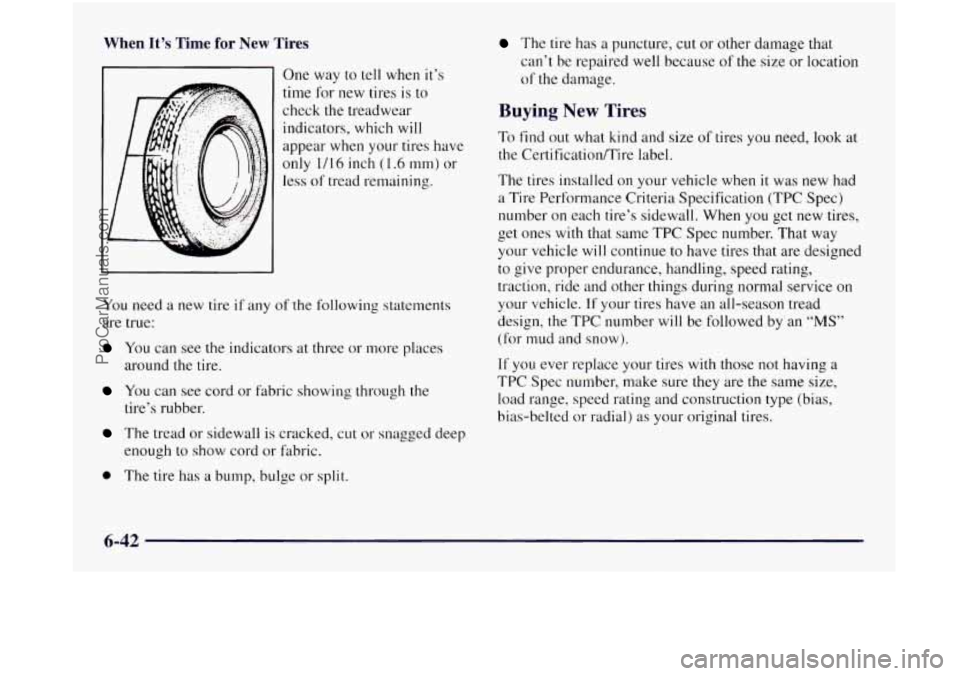
When It’s Time for New Tires
One way to tell when it’s
time for new tires is to
check the treadwear indicators, which will
appear when your tires have
only 1/16 inch (1.6 mm) or
less of tread remaining.
You need a new tire
if any of the following statements
are true:
You can see the indicators at three or more places
around the tire.
You can see cord or fabric showing through the
tire’s rubber.
The tread or sidewall is cracked, cut or snagged deep
enough to show cord or hbric.
0 The tire has a bump, bulge or split.
The tire has a puncture, cut or other damage that
can’t be repaired well because of
the size or location
of the damage.
Buying New Tires
To find out what kind and size of tires you need, look at
the CertificatiodTire label.
The tires installed on your vehicle when
it was new had
a Tire Performance Criteria Specification (TPC Spec)
number on each tire’s sidewall. When you get new tires,
your vehicle will continue to have tires
that are designed
to give proper endurance, handling, speed rating,
traction, ride and other things during normal service on
your vehicle.
If your tires have an all-season tread
design, the TPC number will be followed
by an “MS”
(for mud and snow).
0 oet ones with that same TPC Spec number. That way
If you ever replace your tires with those not having a
TPC Spec number, make sure they are the same size,
load range, speed rating and construction type (bias,
bias-belted or radial)
as your original tires.
6-42
ProCarManuals.com
Page 341 of 436
Mixing tires could cause you to lose control while
driving.
If you mix tires of different sizes or types
(radial and bias-belted tires), the vehicle may not
handle properly, and you could have a crash.
Using tires of different sizes may also cause
damage to your vehicle. Be sure to use the same
size and type tires on all wheels.
It’s
all right to drive with your compact spare,
though. It was developed
for use on your vehicle.
Uniform Tire Quality Grading
The following information relates to the system
developed by the United States National Highway
Traffic Safety Administration, which grades tires by
treadwear, traction and temperature performance. (This
applies only to vehicles sold
in the United States.) The
grades are molded on the sidewalls of most passenger
car tires. The Uniform Tire Quality Grading system does not
apply to deep tread, winter-type snow tires,
space-saver or temporary use spare tires, tires with
nominal rim diameters
oC 10 to 12 inches (25 to 30 cm),
or to some limited-production tires.
While the tires available on General Motors passenger
cars and light trucks may vary with respect to these
grades,
they must also conform to Federal safety
requirements and additional General Motors Tire Performance Criteria (TPC) standards.
Treadwear
The treadwear grade is a comparative rating based
on
the wear rate of the tire when tested under controlled
conditions on
a specified government test course. For
example,
a tire graded 150 would wear one and a half
( 1 1/2) times as well on the government course as a tire
graded
100. The relative performance of tires depends
upon the actual conditions of their use, however, and
may depart significantly from the norm due to variations
in driving habits, service practices and differences in
road characteristics and climate.
6-43
ProCarManuals.com
Page 344 of 436
Tire Chains
I
I NOTICE:
Use tire chains only where legal and only when
you must.
Use only SAE Class “S” type chains
that are the proper size for your tires. Install
them on the front tires and tighten them as tightly as possible with the ends securely
fastened. Drive slowly and follow the chain
manufacturer’s instructions.
If you can hear the
chains contacting your vehicle, stop and retighten
them. If the contact continues, slow down until it
stops. Driving too fast or spinning the wheels
with chains
on will damage your vehicle.
Appearance Care
Remember, cleaning products can be hazardous. Some
are toxic. Others can burst into flame if you strike a
match or get them on a hot part of the vehicle. Some are
dangerous if you breathe their fumes
in a closed space.
When you
use anything from a container to clean your
Oldsmobile, be sure to follow the manufacturer’s warnings
and instructions. And always open your doors
or windows when you’re cleaning the inside.
Never use these to clean your vehicle:
Gasoline
Benzene
Naphtha
0 Carbon Tetrachloride
0 Acetone
0 Paint Thinner
Turpentine
0 Lacquer Thinner
Nail Polish Remover
They can all be hazardous
-- some more than
others
-- and they can all damage your vehicle, too.
Don’t use any of these unless this manual
says you can.
In many uses, these will damage your vehicle:
Alcohol
0 Laundry Soap
0 Bleach
0 Reducing Agents
6-46
ProCarManuals.com
Page 345 of 436
Cleaning the Inside of Your Oldsmobile
Use a vacuum cleaner often to get rid of dust and loose
dirt. Wipe
vinyl or leather with a clean, damp cloth.
Your Oldsmobile retailer has two cleaners,
a
solvent-type spot lifter and a foam-type powdered
cleaner. They will clean normal spots and stains
very
well. Do not use them on vinyl or leather.
Here are some cleaning tips:
1.
2.
3.
4.
5.
Always read the instructions on the cleaner label.
Clean up stains
as soon as you can -- before they set.
Use a clean cloth or sponge, and change to a clean area
often.
A soft brush may be used if stains are stubborn.
Use solvent-type cleaners
in a well-ventilated area
only.
If you use them, don’t saturate the stained area.
If a ring forms after spot cleaning, clean the entire
area immediately or
it will set.
Using Foam-Type Cleaner on Fabric
1. Vxuum and brush the area to remove any loose dirt.
2. Always clean a whole trim panel or section. Mask
surrounding trim along stitch or welt lines.
4. Use suds only and apply with a clean sponge. Don’t
saturate the material and don’t rub
it roughly.
5. As soon as you’ve cleaned the section, use a sponge
to remove the suds.
6. Rinse the section with a clean, wet sponge.
7. Wipe off what’s left with a slightly damp paper towel
or cloth.
8. Dry it immediately with a blow dryer.
9. Wipe with a clean cloth.
Using Solvent-Type Cleaner on Fabric
First, see if you have to use solvent-type cleaner at all.
Some spots and stains will clean off better with just
water and mild soap.
If you need to
use a solvent:
1. Gently scrape excess soil from the trim material with
a clean, dull
knife or scraper.
2. Use very little cleaner, light pressure and clean cloths
(preferably cheesecloth). Cleaning should start at the
outside of the stain, “feathering” toward
the center.
3. Keep changing to a clean section of the cloth.
3. Mix Multi-Purpose Powdered Cleaner following the 4. When you clean a stain from fabric, immediately dry the
directions on the container label. area with a
blow dryer to help prevent a cleaning ring.
6-47
ProCarManuals.com